
Arquivo da tag: Parapsicologia

The new science of death: ‘There’s something happening in the brain that makes no sense’ (Guardian)

blurred figure in a tunnel moving towards a light

Photograph: Gaia Moments/Alamy

Original article

The long read

New research into the dying brain suggests the line between life and death may be less distinct than previously thought

by Alex Blasdel

Tue 2 Apr 2024 05.00 BSTShare

Patient One was 24 years old and pregnant with her third child when she was taken off life support. It was 2014. A couple of years earlier, she had been diagnosed with a disorder that caused an irregular heartbeat, and during her two previous pregnancies she had suffered seizures and faintings. Four weeks into her third pregnancy, she collapsed on the floor of her home. Her mother, who was with her, called 911. By the time an ambulance arrived, Patient One had been unconscious for more than 10 minutes. Paramedics found that her heart had stopped.

After being driven to a hospital where she couldn’t be treated, Patient One was taken to the emergency department at the University of Michigan. There, medical staff had to shock her chest three times with a defibrillator before they could restart her heart. She was placed on an external ventilator and pacemaker, and transferred to the neurointensive care unit, where doctors monitored her brain activity. She was unresponsive to external stimuli, and had a massive swelling in her brain. After she lay in a deep coma for three days, her family decided it was best to take her off life support. It was at that point – after her oxygen was turned off and nurses pulled the breathing tube from her throat – that Patient One became one of the most intriguing scientific subjects in recent history.

For several years, Jimo Borjigin, a professor of neurology at the University of Michigan, had been troubled by the question of what happens to us when we die. She had read about the near-death experiences of certain cardiac-arrest survivors who had undergone extraordinary psychic journeys before being resuscitated. Sometimes, these people reported travelling outside of their bodies towards overwhelming sources of light where they were greeted by dead relatives. Others spoke of coming to a new understanding of their lives, or encountering beings of profound goodness. Borjigin didn’t believe the content of those stories was true – she didn’t think the souls of dying people actually travelled to an afterworld – but she suspected something very real was happening in those patients’ brains. In her own laboratory, she had discovered that rats undergo a dramatic storm of many neurotransmitters, including serotonin and dopamine, after their hearts stop and their brains lose oxygen. She wondered if humans’ near-death experiences might spring from a similar phenomenon, and if it was occurring even in people who couldn’t be revived.

Dying seemed like such an important area of research – we all do it, after all – that Borjigin assumed other scientists had already developed a thorough understanding of what happens to the brain in the process of death. But when she looked at the scientific literature, she found little enlightenment. “To die is such an essential part of life,” she told me recently. “But we knew almost nothing about the dying brain.” So she decided to go back and figure out what had happened inside the brains of people who died at the University of Michigan neurointensive care unit. Among them was Patient One.

At the time Borjigin began her research into Patient One, the scientific understanding of death had reached an impasse. Since the 1960s, advances in resuscitation had helped to revive thousands of people who might otherwise have died. About 10% or 20% of those people brought with them stories of near-death experiences in which they felt their souls or selves departing from their bodies. A handful of those patients even claimed to witness, from above, doctors’ attempts to resuscitate them. According to several international surveys and studies, one in 10 people claims to have had a near-death experience involving cardiac arrest, or a similar experience in circumstances where they may have come close to death. That’s roughly 800 million souls worldwide who may have dipped a toe in the afterlife.

As remarkable as these near-death experiences sounded, they were consistent enough that some scientists began to believe there was truth to them: maybe people really did have minds or souls that existed separately from their living bodies. In the 1970s, a small network of cardiologists, psychiatrists, medical sociologists and social psychologists in North America and Europe began investigating whether near-death experiences proved that dying is not the end of being, and that consciousness can exist independently of the brain. The field of near-death studies was born.

Over the next 30 years, researchers collected thousands of case reports of people who had had near-death experiences. Meanwhile, new technologies and techniques were helping doctors revive more and more people who, in earlier periods of history, would have almost certainly been permanently deceased. “We are now at the point where we have both the tools and the means to scientifically answer the age-old question: What happens when we die?” wrote Sam Parnia, an accomplished resuscitation specialist and one of the world’s leading experts on near-death experiences, in 2006. Parnia himself was devising an international study to test whether patients could have conscious awareness even after they were found clinically dead.

But by 2015, experiments such as Parnia’s had yielded ambiguous results, and the field of near-death studies was not much closer to understanding death than it had been when it was founded four decades earlier. That’s when Borjigin, together with several colleagues, took the first close look at the record of electrical activity in the brain of Patient One after she was taken off life support. What they discovered – in results reported for the first time last year – was almost entirely unexpected, and has the potential to rewrite our understanding of death.

“I believe what we found is only the tip of a vast iceberg,” Borjigin told me. “What’s still beneath the surface is a full account of how dying actually takes place. Because there’s something happening in there, in the brain, that makes no sense.”


For all that science has learned about the workings of life, death remains among the most intractable of mysteries. “At times I have been tempted to believe that the creator has eternally intended this department of nature to remain baffling, to prompt our curiosities and hopes and suspicions all in equal measure,” the philosopher William James wrote in 1909.

The first time that the question Borjigin began asking in 2015 was posed – about what happens to the brain during death – was a quarter of a millennium earlier. Around 1740, a French military physician reviewed the case of a famous apothecary who, after a “malign fever” and several blood-lettings, fell unconscious and thought he had travelled to the Kingdom of the BlessedThe physician speculated that the apothecary’s experience had been caused by a surge of blood to the brain. But between that early report and the mid-20th century, scientific interest in near-death experiences remained sporadic.

In 1892, the Swiss climber and geologist Albert Heim collected the first systematic accounts of near-death experiences from 30 fellow climbers who had suffered near-fatal falls. In many cases, the climbers underwent a sudden review of their entire past, heard beautiful music, and “fell in a superbly blue heaven containing roseate cloudlets”, Heim wrote. “Then consciousness was painlessly extinguished, usually at the moment of impact.” There were a few more attempts to do research in the early 20th century, but little progress was made in understanding near-death experiences scientifically. Then, in 1975, an American medical student named Raymond Moody published a book called Life After Life.

Sunbeams behind clouds in vivid sunset sky reflecting in ocean water
 Photograph: Getty Images/Blend Images

In his book, Moody distilled the reports of 150 people who had had intense, life-altering experiences in the moments surrounding a cardiac arrest. Although the reports varied, he found that they often shared one or more common features or themes. The narrative arc of the most detailed of those reports – departing the body and travelling through a long tunnel, having an out-of-body experience, encountering spirits and a being of light, one’s whole life flashing before one’s eyes, and returning to the body from some outer limit – became so canonical that the art critic Robert Hughes could refer to it years later as “the familiar kitsch of near-death experience”. Moody’s book became an international bestseller.

In 1976, the New York Times reported on the burgeoning scientific interest in “life after death” and the “emerging field of thanatology”. The following year, Moody and several fellow thanatologists founded an organisation that became the International Association for Near-Death Studies. In 1981, they printed the inaugural issue of Vital Signs, a magazine for the general reader that was largely devoted to stories of near-death experiences. The following year they began producing the field’s first peer-reviewed journal, which became the Journal of Near-Death Studies. The field was growing, and taking on the trappings of scientific respectability. Reviewing its rise in 1988, the British Journal of Psychiatry captured the field’s animating spirit: “A grand hope has been expressed that, through NDE research, new insights can be gained into the ageless mystery of human mortality and its ultimate significance, and that, for the first time, empirical perspectives on the nature of death may be achieved.”

But near-death studies was already splitting into several schools of belief, whose tensions continue to this day. One influential camp was made up of spiritualists, some of them evangelical Christians, who were convinced that near-death experiences were genuine sojourns in the land of the dead and divine. As researchers, the spiritualists’ aim was to collect as many reports of near-death experience as possible, and to proselytise society about the reality of life after death. Moody was their most important spokesman; he eventually claimed to have had multiple past lives and built a “psychomanteum” in rural Alabama where people could attempt to summon the spirits of the dead by gazing into a dimly lit mirror.

The second, and largest, faction of near-death researchers were the parapsychologists, those interested in phenomena that seemed to undermine the scientific orthodoxy that the mind could not exist independently of the brain. These researchers, who were by and large trained scientists following well established research methods, tended to believe that near-death experiences offered evidence that consciousness could persist after the death of the individual. Many of them were physicians and psychiatrists who had been deeply affected after hearing the near-death stories of patients they had treated in the ICU. Their aim was to find ways to test their theories of consciousness empirically, and to turn near-death studies into a legitimate scientific endeavour.

Finally, there emerged the smallest contingent of near-death researchers, who could be labelled the physicalists. These were scientists, many of whom studied the brain, who were committed to a strictly biological account of near-death experiences. Like dreams, the physicalists argued, near-death experiences might reveal psychological truths, but they did so through hallucinatory fictions that emerged from the workings of the body and the brain. (Indeed, many of the states reported by near-death experiencers can apparently be achieved by taking a hero’s dose of ketamine.) Their basic premise was: no functioning brain means no consciousness, and certainly no life after death. Their task, which Borjigin took up in 2015, was to discover what was happening during near-death experiences on a fundamentally physical level.

Slowly, the spiritualists left the field of research for the loftier domains of Christian talk radio, and the parapsychologists and physicalists started bringing near-death studies closer to the scientific mainstream. Between 1975, when Moody published Life After Life, and 1984, only 17 articles in the PubMed database of scientific publications mentioned near-death experiences. In the following decade, there were 62. In the most recent 10-year span, there were 221. Those articles have appeared everywhere from the Canadian Urological Association Journal to the esteemed pages of The Lancet.

Today, there is a widespread sense throughout the community of near-death researchers that we are on the verge of great discoveries. Charlotte Martial, a neuroscientist at the University of Liège in Belgium who has done some of the best physicalist work on near-death experiences, hopes we will soon develop a new understanding of the relationship between the internal experience of consciousness and its outward manifestations, for example in coma patients. “We really are in a crucial moment where we have to disentangle consciousness from responsiveness, and maybe question every state that we consider unconscious,” she told me. Parnia, the resuscitation specialist, who studies the physical processes of dying but is also sympathetic to a parapsychological theory of consciousness, has a radically different take on what we are poised to find out. “I think in 50 or 100 years time we will have discovered the entity that is consciousness,” he told me. “It will be taken for granted that it wasn’t produced by the brain, and it doesn’t die when you die.”


If the field of near-death studies is at the threshold of new discoveries about consciousness and death, it is in large part because of a revolution in our ability to resuscitate people who have suffered cardiac arrest. Lance Becker has been a leader in resuscitation science for more than 30 years. As a young doctor attempting to revive people through CPR in the mid-1980s, senior physicians would often step in to declare patients dead. “At a certain point, they would just say, ‘OK, that’s enough. Let’s stop. This is unsuccessful. Time of death: 1.37pm,’” he recalled recently. “And that would be the last thing. And one of the things running through my head as a young doctor was, ‘Well, what really happened at 1.37?’”

In a medical setting, “clinical death” is said to occur at the moment the heart stops pumping blood, and the pulse stops. This is widely known as cardiac arrest. (It is different from a heart attack, in which there is a blockage in a heart that’s still pumping.) Loss of oxygen to the brain and other organs generally follows within seconds or minutes, although the complete cessation of activity in the heart and brain – which is often called “flatlining” or, in the case of the latter, “brain death” – may not occur for many minutes or even hours.

For almost all people at all times in history, cardiac arrest was basically the end of the line. That began to change in 1960, when the combination of mouth-to-mouth ventilation, chest compressions and external defibrillation known as cardiopulmonary resuscitation, or CPR, was formalised. Shortly thereafter, a massive campaign was launched to educate clinicians and the public on CPR’s basic techniques, and soon people were being revived in previously unthinkable, if still modest, numbers.

As more and more people were resuscitated, scientists learned that, even in its acute final stages, death is not a point, but a process. After cardiac arrest, blood and oxygen stop circulating through the body, cells begin to break down, and normal electrical activity in the brain gets disrupted. But the organs don’t fail irreversibly right away, and the brain doesn’t necessarily cease functioning altogether. There is often still the possibility of a return to life. In some cases, cell death can be stopped or significantly slowed, the heart can be restarted, and brain function can be restored. In other words, the process of death can be reversed.

It is no longer unheard of for people to be revived even six hours after being declared clinically dead. In 2011, Japanese doctors reported the case of a young woman who was found in a forest one morning after an overdose stopped her heart the previous night; using advanced technology to circulate blood and oxygen through her body, the doctors were able to revive her more than six hours later, and she was able to walk out of the hospital after three weeks of care. In 2019, a British woman named Audrey Schoeman who was caught in a snowstorm spent six hours in cardiac arrest before doctors brought her back to life with no evident brain damage.

“I don’t think there’s ever been a more exciting time for the field,” Becker told me. “We’re discovering new drugs, we’re discovering new devices, and we’re discovering new things about the brain.”


The brain – that’s the tricky part. In January 2021, as the Covid-19 pandemic was surging toward what would become its deadliest week on record, Netflix released a documentary series called Surviving Death. In the first episode, some of near-death studies’ most prominent parapsychologists presented the core of their arguments for why they believe near-death experiences show that consciousness exists independently of the brain. “When the heart stops, within 20 seconds or so, you get flatlining, which means no brain activity,” Bruce Greyson, an emeritus professor of psychiatry at the University of Virginia and one of the founding members of the International Association for Near-Death Studies, says in the documentary. “And yet,” he goes on to claim, “people have near-death experiences when they’ve been (quote) ‘flatlined’ for longer than that.”

That is a key tenet of the parapsychologists’ arguments: if there is consciousness without brain activity, then consciousness must dwell somewhere beyond the brain. Some of the parapsychologists speculate that it is a “non-local” force that pervades the universe, like electromagnetism. This force is received by the brain, but is not generated by it, the way a television receives a broadcast.

In order for this argument to hold, something else has to be true: near-death experiences have to happen during death, after the brain shuts down. To prove this, parapsychologists point to a number of rare but astounding cases known as “veridical” near-death experiences, in which patients seem to report details from the operating room that they might have known only if they had conscious awareness during the time that they were clinically dead. Dozens of such reports exist. One of the most famous is about a woman who apparently travelled so far outside her body that she was able to spot a shoe on a window ledge in another part of the hospital where she went into cardiac arrest; the shoe was later reportedly found by a nurse.
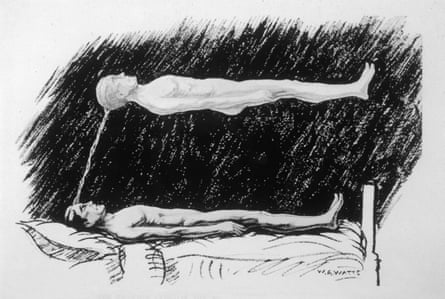
an antique illustration of an ‘out of body experience’
 Photograph: Chronicle/Alamy

At the very least, Parnia and his colleagues have written, such phenomena are “inexplicable through current neuroscientific models”. Unfortunately for the parapsychologists, however, none of the reports of post-death awareness holds up to strict scientific scrutiny. “There are many claims of this kind, but in my long decades of research into out-of-body and near-death experiences I never met any convincing evidence that this is true,” Sue Blackmore, a well-known researcher into parapsychology who had her own near-death experience as a young woman in 1970, has written.

The case of the shoe, Blackmore pointed out, relied solely on the report of the nurse who claimed to have found it. That’s far from the standard of proof the scientific community would require to accept a result as radical as that consciousness can travel beyond the body and exist after death. In other cases, there’s not enough evidence to prove that the experiences reported by cardiac arrest survivors happened when their brains were shut down, as opposed to in the period before or after they supposedly “flatlined”. “So far, there is no sufficiently rigorous, convincing empirical evidence that people can observe their surroundings during a near-death experience,” Charlotte Martial, the University of Liège neuroscientist, told me.

The parapsychologists tend to push back by arguing that even if each of the cases of veridical near-death experiences leaves room for scientific doubt, surely the accumulation of dozens of these reports must count for something. But that argument can be turned on its head: if there are so many genuine instances of consciousness surviving death, then why should it have so far proven impossible to catch one empirically?


Perhaps the story to be written about near-death experiences is not that they prove consciousness is radically different from what we thought it was. Instead, it is that the process of dying is far stranger than scientists ever suspected. The spiritualists and parapsychologists are right to insist that something deeply weird is happening to people when they die, but they are wrong to assume it is happening in the next life rather than this one. At least, that is the implication of what Jimo Borjigin found when she investigated the case of Patient One.

In the moments after Patient One was taken off oxygen, there was a surge of activity in her dying brain. Areas that had been nearly silent while she was on life support suddenly thrummed with high-frequency electrical signals called gamma waves. In particular, the parts of the brain that scientists consider a “hot zone” for consciousness became dramatically alive. In one section, the signals remained detectable for more than six minutes. In another, they were 11 to 12 times higher than they had been before Patient One’s ventilator was removed.

“As she died, Patient One’s brain was functioning in a kind of hyperdrive,” Borjigin told me. For about two minutes after her oxygen was cut off, there was an intense synchronisation of her brain waves, a state associated with many cognitive functions, including heightened attention and memory. The synchronisation dampened for about 18 seconds, then intensified again for more than four minutes. It faded for a minute, then came back for a third time.

In those same periods of dying, different parts of Patient One’s brain were suddenly in close communication with each other. The most intense connections started immediately after her oxygen stopped, and lasted for nearly four minutes. There was another burst of connectivity more than five minutes and 20 seconds after she was taken off life support. In particular, areas of her brain associated with processing conscious experience – areas that are active when we move through the waking world, and when we have vivid dreams – were communicating with those involved in memory formation. So were parts of the brain associated with empathy. Even as she slipped irrevocably deeper into death, something that looked astonishingly like life was taking place over several minutes in Patient One’s brain.

The shadows of anonymous people are seen on a wall
 Photograph: Richard Baker/Corbis/Getty Images

Those glimmers and flashes of something like life contradict the expectations of almost everyone working in the field of resuscitation science and near-death studies. The predominant belief – expressed by Greyson, the psychiatrist and co-founder of the International Association of Near Death Studies, in the Netflix series Surviving Death – was that as soon as oxygen stops going to the brain, neurological activity falls precipitously. Although a few earlier instances of brain waves had been reported in dying human brains, nothing as detailed and complex as what occurred in Patient One had ever been detected.

Given the levels of activity and connectivity in particular regions of her dying brain, Borjigin believes it’s likely that Patient One had a profound near-death experience with many of its major features: out-of-body sensations, visions of light, feelings of joy or serenity, and moral re-evaluations of one’s life. Of course, Patient One did not recover, so no one can prove that the extraordinary happenings in her dying brain had experiential counterparts. Greyson and one of the other grandees of near-death studies, a Dutch cardiologist named Pim van Lommel, have asserted that Patient One’s brain activity can shed no light on near-death experiences because her heart hadn’t fully flatlined, but that is a self-defeating argument: there is no rigorous empirical evidence that near-death experiences occur in people whose hearts have completely stopped.

At the very least, Patient One’s brain activity – and the activity in the dying brain of another patient Borjigin studied, a 77-year-old woman known as Patient Three – seems to close the door on the argument that the brain always and nearly immediately ceases to function in a coherent manner in the moments after clinical death. “The brain, contrary to everybody’s belief, is actually super active during cardiac arrest,” Borjigin said. Death may be far more alive than we ever thought possible.


Borjigin believes that understanding the dying brain is one of the “holy grails” of neuroscience. “The brain is so resilient, the heart is so resilient, that it takes years of abuse to kill them,” she pointed out. “Why then, without oxygen, can a perfectly healthy person die within 30 minutes, irreversibly?” Although most people would take that result for granted, Borjigin thinks that, on a physical level, it actually makes little sense.

Borjigin hopes that understanding the neurophysiology of death can help us to reverse it. She already has brain activity data from dozens of deceased patients that she is waiting to analyse. But because of the paranormal stigma associated with near-death studies, she says, few research agencies want to grant her funding. “Consciousness is almost a dirty word amongst funders,” she added. “Hardcore scientists think research into it should belong to maybe theology, philosophy, but not in hardcore science. Other people ask, ‘What’s the use? The patients are gonna die anyway, so why study that process? There’s nothing you can do about it.’”

Evidence is already emerging that even total brain death may someday be reversible. In 2019, scientists at Yale University harvested the brains of pigs that had been decapitated in a commercial slaughterhouse four hours earlier. Then they perfused the brains for six hours with a special cocktail of drugs and synthetic blood. Astoundingly, some of the cells in the brains began to show metabolic activity again, and some of the synapses even began firing. The pigs’ brain scans didn’t show the widespread electrical activity that we typically associate with sentience or consciousness. But the fact that there was any activity at all suggests the frontiers of life may one day extend much, much farther into the realms of death than most scientists currently imagine.

Other serious avenues of research into near-death experience are ongoing. Martial and her colleagues at the University of Liège are working on many issues relating to near-death experiences. One is whether people with a history of trauma, or with more creative minds, tend to have such experiences at higher rates than the general population. Another is on the evolutionary biology of near-death experiences. Why, evolutionarily speaking, should we have such experiences at all? Martial and her colleagues speculate that it may be a form of the phenomenon known as thanatosis, in which creatures throughout the animal kingdom feign death to escape mortal dangers. Other researchers have proposed that the surge of electrical activity in the moments after cardiac arrest is just the final seizure of a dying brain, or have hypothesised that it’s a last-ditch attempt by the brain to restart itself, like jump-starting the engine on a car.

Meanwhile, in parts of the culture where enthusiasm is reserved not for scientific discovery in this world, but for absolution or benediction in the next, the spiritualists, along with sundry other kooks and grifters, are busily peddling their tales of the afterlife. Forget the proverbial tunnel of light: in America in particular, a pipeline of money has been discovered from death’s door, through Christian media, to the New York Times bestseller list and thence to the fawning, gullible armchairs of the nation’s daytime talk shows. First stop, paradise; next stop, Dr Oz.

But there is something that binds many of these people – the physicalists, the parapsychologists, the spiritualists – together. It is the hope that by transcending the current limits of science and of our bodies, we will achieve not a deeper understanding of death, but a longer and more profound experience of life. That, perhaps, is the real attraction of the near-death experience: it shows us what is possible not in the next world, but in this one.

 Follow the Long Read on X at @gdnlongread, listen to our podcasts here and sign up to the long read weekly email here.

How to think about weird things (AEON)

From discs in the sky to faces in toast, learn to weigh evidence sceptically without becoming a closed-minded naysayer

by Stephen Law

Stephen Law is a philosopher and author. He is director of philosophy at the Department of Continuing Education at the University of Oxford, and editor of Think, the Royal Institute of Philosophy journal. He researches primarily in the fields of philosophy of religion, philosophy of mind, Ludwig Wittgenstein, and essentialism. His books for a popular audience include The Philosophy Gym (2003), The Complete Philosophy Files (2000) and Believing Bullshit (2011). He lives in Oxford.

Edited by Nigel Warburton

10 NOVEMBER 2021

Many people believe in extraordinary hidden beings, including demons, angels, spirits and gods. Plenty also believe in supernatural powers, including psychic abilities, faith healing and communication with the dead. Conspiracy theories are also popular, including that the Holocaust never happened and that the terrorist attacks on the United States of 11 September 2001 were an inside job. And, of course, many trust in alternative medicines such as homeopathy, the effectiveness of which seems to run contrary to our scientific understanding of how the world actually works.

Such beliefs are widely considered to be at the ‘weird’ end of the spectrum. But, of course, just because a belief involves something weird doesn’t mean it’s not true. As science keeps reminding us, reality often is weird. Quantum mechanics and black holes are very weird indeed. So, while ghosts might be weird, that’s no reason to dismiss belief in them out of hand.

I focus here on a particular kind of ‘weird’ belief: not only are these beliefs that concern the enticingly odd, they’re also beliefs that the general public finds particularly difficult to assess.

Almost everyone agrees that, when it comes to black holes, scientists are the relevant experts, and scientific investigation is the right way to go about establishing whether or not they exist. However, when it comes to ghosts, psychic powers or conspiracy theories, we often hold wildly divergent views not only about how reasonable such beliefs are, but also about what might count as strong evidence for or against them, and who the relevant authorities are.

Take homeopathy, for example. Is it reasonable to focus only on what scientists have to say? Shouldn’t we give at least as much weight to the testimony of the many people who claim to have benefitted from homeopathic treatment? While most scientists are sceptical about psychic abilities, what of the thousands of reports from people who claim to have received insights from psychics who could only have known what they did if they really do have some sort of psychic gift? To what extent can we even trust the supposed scientific ‘experts’? Might not the scientific community itself be part of a conspiracy to hide the truth about Area 51 in Nevada, Earth’s flatness or the 9/11 terrorist attacks being an inside job?

Most of us really struggle when it comes to assessing such ‘weird’ beliefs – myself included. Of course, we have our hunches about what’s most likely to be true. But when it comes to pinning down precisely why such beliefs are or aren’t reasonable, even the most intelligent and well educated of us can quickly find ourselves out of our depth. For example, while most would pooh-pooh belief in fairies, Arthur Conan Doyle, the creator of the quintessentially rational detective Sherlock Holmes, actually believed in them and wrote a book presenting what he thought was compelling evidence for their existence.

When it comes to weird beliefs, it’s important we avoid being closed-minded naysayers with our fingers in our ears, but it’s also crucial that we avoid being credulous fools. We want, as far as possible, to be reasonable.

I’m a philosopher who has spent a great deal of time thinking about the reasonableness of such ‘weird’ beliefs. Here I present five key pieces of advice that I hope will help you figure out for yourself what is and isn’t reasonable.

Let’s begin with an illustration of the kind of case that can so spectacularly divide opinion. In 1976, six workers reported a UFO over the site of a nuclear plant being constructed near the town of Apex, North Carolina. A security guard then reported a ‘strange object’. The police officer Ross Denson drove over to investigate and saw what he described as something ‘half the size of the Moon’ hanging over the plant. The police also took a call from local air traffic control about an unidentified blip on their radar.

The next night, the UFO appeared again. The deputy sheriff described ‘a large lighted object’. An auxiliary officer reported five lighted objects that appeared to be burning and about 20 times the size of a passing plane. The county magistrate described a rectangular football-field-sized object that looked like it was on fire.

Finally, the press got interested. Reporters from the Star newspaper drove over to investigate. They too saw the UFO. But when they tried to drive nearer, they discovered that, weirdly, no matter how fast they drove, they couldn’t get any closer.

This report, drawn from Philip J Klass’s book UFOs: The Public Deceived (1983), is impressive: it involves multiple eyewitnesses, including police officers, journalists and even a magistrate. Their testimony is even backed up by hard evidence – that radar blip.

Surely, many would say, given all this evidence, it’s reasonable to believe there was at least something extraordinary floating over the site. Anyone who failed to believe at least that much would be excessively sceptical – one of those perpetual naysayers whose kneejerk reaction, no matter how strong the evidence, is always to pooh-pooh.

What’s most likely to be true: that there really was something extraordinary hanging over the power plant, or that the various eyewitnesses had somehow been deceived? Before we answer, here’s my first piece of advice.NEED TO KNOWTHINK IT THROUGHKEY POINTSWHY IT MATTERSLINKS & BOOKS

Think it through

1. Expect unexplained false sightings and huge coincidences

Our UFO story isn’t over yet. When the Star’s two-man investigative team couldn’t get any closer to the mysterious object, they eventually pulled over. The photographer took out his long lens to take a look: ‘Yep … that’s the planet Venus all right.’ It was later confirmed beyond any reasonable doubt that what all the witnesses had seen was just a planet. But what about that radar blip? It was a coincidence, perhaps caused by a flock of birds or unusual weather.

What moral should we draw from this case? Not, of course, that because this UFO report turned out to have a mundane explanation, all such reports can be similarly dismissed. But notice that, had the reporters not discovered the truth, this story would likely have gone down in the annals of ufology as one of the great unexplained cases. The moral I draw is that UFO cases that have multiple eyewitnesses and even independent hard evidence (the radar blip) may well crop up occasionally anyway, even if there are no alien craft in our skies.

We tend significantly to underestimate how prone to illusion and deception we are when it comes to the wacky and weird. In particular, we have a strong tendency to overdetect agency – to think we are witnessing a person, an alien or some other sort of creature or being – where in truth there’s none.

Psychologists have developed theories to account for this tendency to overdetect agency, including that we have evolved what’s called a hyperactive agency detecting device. Had our ancestors missed an agent – a sabre-toothed tiger or a rival, say – that might well have reduced their chances of surviving and reproducing. Believing an agent is present when it’s not, on the other hand, is likely to be far less costly. Consequently, we’ve evolved to err on the side of overdetection – often seeing agency where there is none. For example, when we observe a movement or pattern we can’t understand, such as the retrograde motion of a planet in the night sky, we’re likely to think the movement is explained by some hidden agent working behind the scenes (that Mars is actually a god, say).

One example of our tendency to overdetect agency is pareidolia: our tendency to find patterns – and, in particular, faces – in random noise. Stare at passing clouds or into the embers of a fire, and it’s easy to interpret the randomly generated shapes we see as faces, often spooky ones, staring back.

And, of course, nature is occasionally going to throw up the face-like patterns just by chance. One famous illustration was produced in 1976 by the Mars probe Viking Orbiter 1. As the probe passed over the Cydonia region, it photographed what appeared to be an enormous, reptilian-looking face 800 feet high and nearly 2 miles long. Some believe this ‘face on Mars’ was a relic of an ancient Martian civilisation, a bit like the Great Sphinx of Giza in Egypt. A book called The Monuments of Mars: A City on the Edge of Forever (1987) even speculated about this lost civilisation. However, later photos revealed the ‘face’ to be just a hill that looks face-like when lit a certain way. Take enough photos of Mars, and some will reveal face-like features just by chance.

The fact is, we should expect huge coincidences. Millions of pieces of bread are toasted each morning. One or two will exhibit face-like patterns just by chance, even without divine intervention. One such piece of toast that was said to show the face of the Virgin Mary (how do we know what she looked like?) was sold for $28,000. We think about so many people each day that eventually we’ll think about someone, the phone will ring, and it will be them. That’s to be expected, even if we’re not psychic. Yet many put down such coincidences to supernatural powers.

2. Understand what strong evidence actually is

When is a claim strongly confirmed by a piece of evidence? The following principle appears correct (it captures part of what confirmation theorists call the Bayes factor; for more on Bayesian approaches to assessing evidence, see the link at the end):

Evidence confirms a claim to the extent that the evidence is more likely if the claim is true than if it’s false.

Here’s a simple illustration. Suppose I’m in the basement and can’t see outside. Jane walks in with a wet coat and umbrella and tells me it’s raining. That’s pretty strong evidence it’s raining. Why? Well, it is of course possible that Jane is playing a prank on me with her wet coat and brolly. But it’s far more likely she would appear with a wet coat and umbrella and tell me it’s raining if that’s true than if it’s false. In fact, given just this new evidence, it may well be reasonable for me to believe it’s raining.

Here’s another example. Sometimes whales and dolphins are found with atavistic limbs – leg-like structures – where legs would be found on land mammals. These discoveries strongly confirm the theory that whales and dolphins evolved from earlier limbed, land-dwelling species. Why? Because, while atavistic limbs aren’t probable given the truth of that theory, they’re still far more probable than they would be if whales and dolphins weren’t the descendants of such limbed creatures.

The Mars face, on the other hand, provides an example of weak or non-existent evidence. Yes, if there was an ancient Martian civilisation, then we might discover what appeared to be a huge face built on the surface of the planet. However, given pareidolia and the likelihood of face-like features being thrown up by chance, it’s about as likely that we would find such face-like features anyway, even if there were no alien civilisation. That’s why such features fail to provide strong evidence for such a civilisation.

So now consider our report of the UFO hanging over the nuclear power construction site. Are several such cases involving multiple witnesses and backed up by some hard evidence (eg, a radar blip) good evidence that there are alien craft in our skies? No. We should expect such hard-to-explain reports anyway, whether or not we’re visited by aliens. In which case, such reports are not strong evidence of alien visitors.

Being sceptical about such reports of alien craft, ghosts or fairies is not knee-jerk, fingers-in-our-ears naysaying. It’s just recognising that, though we might not be able to explain the reports, they’re likely to crop up occasionally anyway, whether or not alien visitors, ghosts or fairies actually exist. Consequently, they fail to provide strong evidence for such beings.

3. Extraordinary claims require extraordinary evidence

It was the scientist Carl Sagan who in 1980 said: ‘Extraordinary claims require extraordinary evidence.’ By an ‘extraordinary’ claim, Sagan appears to have meant an extraordinarily improbable claim, such as that Alice can fly by flapping her arms, or that she can move objects with her mind. On Sagan’s view, such claims require extraordinarily strong evidence before we should accept them – much stronger than the evidence required to support a far less improbable claim.

Suppose for example that Fred claims Alice visited him last night, sat on his sofa and drank a cup of tea. Ordinarily, we would just take Fred’s word for that. But suppose Fred adds that, during her visit, Alice flew around the room by flapping her arms. Of course, we’re not going to just take Fred’s word for that. It’s an extraordinary claim requiring extraordinary evidence.

If we’re starting from a very low base, probability-wise, then much more heavy lifting needs to be done by the evidence to raise the probability of the claim to a point where it might be reasonable to believe it. Clearly, Fred’s testimony about Alice flying around the room is not nearly strong enough.

Similarly, given the low prior probability of the claims that someone communicated with a dead relative, or has fairies living in their local wood, or has miraculously raised someone from the dead, or can move physical objects with their mind, we should similarly set the evidential bar much higher than we would for more mundane claims.

4. Beware accumulated anecdotes

Once we’ve formed an opinion, it can be tempting to notice only evidence that supports it and to ignore the rest. Psychologists call this tendency confirmation bias.

For example, suppose Simon claims a psychic ability to know the future. He can provide 100 examples of his predictions coming true, including one or two dramatic examples. In fact, Simon once predicted that a certain celebrity would die within 12 months, and they did!

Do these 100 examples provide us with strong evidence that Simon really does have some sort of psychic ability? Not if Simon actually made many thousands of predictions and most didn’t come true. Still, if we count only Simon’s ‘hits’ and ignore his ‘misses’, it’s easy to create the impression that he has some sort of ‘gift’.

Confirmation bias can also create the false impression that a therapy is effective. A long list of anecdotes about patients whose condition improved after a faith healing session can seem impressive. People may say: ‘Look at all this evidence! Clearly this therapy has some benefits!’ But the truth is that such accumulated anecdotes are usually largely worthless as evidence.

It’s also worth remembering that such stories are in any case often dubious. For example, they can be generated by the power of suggestion: tell people that a treatment will improve their condition, and many will report that it has, even if the treatment actually offers no genuine medical benefit.

Impressive anecdotes can also be generated by means of a little creative interpretation. Many believe that the 16th-century seer Nostradamus predicted many important historical events, from the Great Fire of London to the assassination of John F Kennedy. However, because Nostradamus’s prophecies are so vague, nobody was able to use his writings to predict any of these events before they occurred. Rather, his texts were later creatively interpreted to fit what subsequently happened. But that sort of ‘fit’ can be achieved whether Nostradamus had extraordinary abilities or not. In which case, as we saw under point 2 above, the ‘fit’ is not strong evidence of such abilities.

5. Beware ‘But it fits!’

Often, when we’re presented with strong evidence that our belief is false, we can easily change our mind. Show me I’m mistaken in believing that the Matterhorn is near Chamonix, and I’ll just drop that belief.

However, abandoning a belief isn’t always so easy. That’s particularly the case for beliefs in which we have invested a great deal emotionally, socially and/or financially. When it comes to religious and political beliefs, for example, or beliefs about the character of our close relatives, we can find it extraordinarily difficult to change our minds. Psychologists refer to the discomfort we feel in such situations – when our beliefs or attitudes are in conflict – as cognitive dissonance.

Perhaps the most obvious strategy we can employ when a belief in which we have invested a great deal is threatened is to start explaining away the evidence.

Here’s an example. Dave believes dogs are spies from the planet Venus – that dogs are Venusian imposters on Earth sending secret reports back to Venus in preparation for their imminent invasion of our planet. Dave’s friends present him with a great deal of evidence that he’s mistaken. But, given a little ingenuity, Dave finds he can always explain away that evidence:

‘Dave, dogs can’t even speak – how can they communicate with Venus?’

‘They can speak, they just hide their linguistic ability from us.’

‘But Dave, dogs don’t have transmitters by which they could relay their messages to Venus – we’ve searched their baskets: nothing there!’

‘Their transmitters are hidden in their brain!’

‘But we’ve X-rayed this dog’s brain – no transmitter!’

‘The transmitters are made from organic material indistinguishable from ordinary brain stuff.’

‘But we can’t detect any signals coming from dogs’ heads.’

‘This is advanced alien technology – beyond our ability to detect it!’

‘Look Dave, Venus can’t support dog life – it’s incredibly hot and swathed in clouds of acid.’

‘The dogs live in deep underground bunkers to protect them. Why do you think they want to leave Venus?!’

You can see how this conversation might continue ad infinitum. No matter how much evidence is presented to Dave, it’s always possible for him to cook up another explanation. And so he can continue to insist his belief is logically consistent with the evidence.

But, of course, despite the possibility of his endlessly explaining away any and all counterevidence, Dave’s belief is absurd. It’s certainly not confirmed by the available evidence about dogs. In fact, it’s powerfully disconfirmed.

The moral is: showing that your theory can be made to ‘fit’ – be consistent with – the evidence is not the same thing as showing your theory is confirmed by the evidence. However, those who hold weird beliefs often muddle consistency and confirmation.

Take young-Earth creationists, for example. They believe in the literal truth of the Biblical account of creation: that the entire Universe is under 10,000 years old, with all species being created as described in the Book of Genesis.

Polls indicate that a third or more of US citizens believe that the Universe is less than 10,000 years old. Of course, there’s a mountain of evidence against the belief. However, its proponents are adept at explaining away that evidence.

Take the fossil record embedded in sedimentary layers revealing that today’s species evolved from earlier species over many millions of years. Many young-Earth creationists explain away this record as a result of the Biblical flood, which they suppose drowned and then buried living things in huge mud deposits. The particular ordering of the fossils is supposedly accounted for by different ecological zones being submerged one after the other, starting with simple marine life. Take a look at the Answers in Genesis website developed by the Bible literalist Ken Ham, and you’ll discover how a great deal of other evidence for evolution and a billions-of-years-old Universe is similarly explained away. Ham believes that, by explaining away the evidence against young-Earth creationism in this way, he can show that his theory ‘fits’ – and so is scientifically confirmed by – that evidence:

Increasing numbers of scientists are realising that when you take the Bible as your basis and build your models of science and history upon it, all the evidence from the living animals and plants, the fossils, and the cultures fits. This confirms that the Bible really is the Word of God and can be trusted totally.
[my italics]

According to Ham, young-Earth creationists and evolutionists do the same thing: they look for ways to make the evidence fit the theory to which they have already committed themselves:

Evolutionists have their own framework … into which they try to fit the data.
[my italics]

But, of course, scientists haven’t just found ways of showing how the theory of evolution can be made consistent with the evidence. As we saw above, that theory really is strongly confirmed by the evidence.

Any theory, no matter how absurd, can, with sufficient ingenuity be made to ‘fit’ the evidence: even Dave’s theory that dogs are Venusian spies. That’s not to say it’s reasonable or well confirmed.

Of course, it’s not always unreasonable to explain away evidence. Given overwhelming evidence that water boils at 100 degrees Celsius at 1 atmosphere, a single experiment that appeared to contradict that claim might reasonably be explained away as a result of some unidentified experimental error. But as we increasingly come to rely on explaining away evidence in order to try to convince ourselves of the reasonableness of our belief, we begin to drift into delusion.

Key points – How to think about weird things

  1. Expect unexplained false sightings and huge coincidences. Reports of mysterious and extraordinary hidden agents – such as angels, demons, spirits and gods – are to be expected, whether or not such beings exist. Huge coincidences – such as a piece of toast looking very face-like – are also more or less inevitable.
  2. Understand what strong evidence is. If the alleged evidence for a belief is scarcely more likely if the belief is true than if it’s false, then it’s not strong evidence.
  3. Extraordinary claims require extraordinary evidence. If a claim is extraordinarily improbable – eg, the claim that Alice flew round the room by flapping her arms – much stronger evidence is required for reasonable belief than is required for belief in a more mundane claim, such as that Alice drank a cup of tea.
  4. Beware accumulated anecdotes. A large number of reports of, say, people recovering after taking an alternative medicine or visiting a faith healer is not strong evidence that such treatments actually work.
  5. Beware ‘But it fits!’ Any theory, no matter how ludicrous (even the theory that dogs are spies from Venus), can, with sufficient ingenuity, always be made logically consistent with the evidence. That’s not to say it’s confirmed by the evidence.

Why it matters

Sometimes, belief in weird things is pretty harmless. What does it matter if Mary believes there are fairies at the bottom of her garden, or Joe thinks his dead aunty visits him occasionally? What does it matter if Sally is a closed-minded naysayer when it comes to belief in psychic powers? However, many of these beliefs have serious consequences.

Clearly, people can be exploited. Grieving parents contact spiritualists who offer to put them in contact with their dead children. Peddlers of alternative medicine and faith healing charge exorbitant fees for their ‘cures’ for terminal illnesses. If some alternative medicines really work, casually dismissing them out of hand and refusing to properly consider the evidence could also cost lives.

Lives have certainly been lost. Many have died who might have been saved because they believed they should reject conventional medicine and opted for ineffective alternatives.

Huge amounts of money are often also at stake when it comes to weird beliefs. Psychic reading and astrology are huge businesses with turnovers of billions of dollars per year. Often, it’s the most desperate who will turn to such businesses for advice. Are they, in reality, throwing their money away?

Many ‘weird’ beliefs also have huge social and political implications. The former US president Ronald Reagan and his wife Nancy were reported to have consulted an astrologer before making any major political decision. Conspiracy theories such as QAnon and the Sandy Hook hoax shape our current political landscape and feed extremist political thinking. Mainstream religions are often committed to miracles and gods.

In short, when it comes to belief in weird things, the stakes can be very high indeed. It matters that we don’t delude ourselves into thinking we’re being reasonable when we’re not.

The Atlantic article ‘The Cognitive Biases Tricking Your Brain’ (2018) by Ben Yagoda provides a great introduction to thinking that can lead us astray, including confirmation bias.

The UK-based magazine The Skeptic provides some high-quality free articles on belief in weird things. Well worth a subscription.

The Skeptical Inquirer magazine in the US is also excellent, and provides some free content.

The RationalWiki portal provides many excellent articles on pseudoscience.

The British mathematician Norman Fenton, professor of risk information management at Queen Mary University of London, provides a brief online introduction to Bayesian approaches to assessing evidence.

My book Believing Bullshit: How Not to Get Sucked into an Intellectual Black Hole (2011) identifies eight tricks of the trade that can turn flaky ideas into psychological flytraps – and how to avoid them.

The textbook How to Think About Weird Things: Critical Thinking for a New Age (2019, 8th ed) by the philosophers Theodore Schick and Lewis Vaughn, offers step-by-step advice on sorting through reasons, evaluating evidence and judging the veracity of a claim.

The book Critical Thinking (2017) by Tom Chatfield offers a toolkit for what he calls ‘being reasonable in an unreasonable world’.

What if Dean Radin is right? (The Sceptic’s Dictionary)

by Robert Todd Carroll

Dean Radin, author of The Conscious Universe: The Scientific Truth of Psychic Phenomena (HarperSanFrancisco 1997), says that “psi researchers have resolved a century of skeptical doubts through thousands of replicated laboratory studies” (289) regarding the reality of psychic phenomena such as ESP(extrasensory perception) and PK (psychokinesis). Of course, Radin also considers meta-analysis as the most widely accepted method of measuring replication in science (51). Few scientists would agree with either of these claims. In any case, most American adults—about 75%, according to a 2005 Gallup poll—believe in at least one paranormal phenomenon. Forty-one percent believe in ESP. Fifty-five percent believe in the power of the mind to heal the body. One doesn’t need to be psychic to know that the majority of believers in psi have come to their beliefs through experience or anecdotes, rather than through studying the scientific evidence Radin puts forth in his book.

Radin doesn’t claim that the scientific evidence is going to make more believers. He realizes that the kind of evidence psi researchers have put forth hasn’t persuaded most scientists that there is anything of value in parapsychology. He thinks  there is “a general uneasiness about parapsychology” and that because of the “insular nature of scientific disciplines, the vast majority of psi experiments are unknown to most scientists.” He also dismisses critics as skeptics who’ve conducted “superficial reviews.” Anyone familiar with the entire body of research, he says, would recognize he is correct and would see that there are “fantastic theoretical implications” (129) to psi research. Nevertheless, in 2005 the Nobel Committee once again  passed over the psi scientists when handing out awards to those who have made significant contributions to our scientific knowledge.

The evidence Radin presents, however, is little more than a hodgepodge of occult statistics. Unable to find a single person who can correctly guess a three-letter word or move a pencil an inch without trickery, the psi researchers have resorted to doing complex statistical analyses of data. In well-designed studies they assume that whenever they have data that, by some statistical formula, is not likely due to chance, they attribute the outcome to psi. A well-designed study is one that carefully controls for such things as cheating, sensory leakage (unintentional transfer of information by non-psychic means), inadequate randomization, and other factors that might lead to an artifact (something that looks like it’s due to psi when it’s actually due to something else).

The result of this enormous data that Radin cites is that there is statistical evidence (for what it’s worth) that indicates (however tentatively) that some very weak psi effects are present (so weak that not a single individual who participates in a successful study has any inkling of possessing psychic power). Nevertheless, Radin thinks it is appropriate to speculate about the enormous implications of psi for biology, psychology, sociology, philosophy, religion, medicine, technology, warfare, police work, business, and politics. Never mind that nobody has any idea as to how psi might work. That is a minor detail to someone who can write with a straight face (apparently) that:

lots of independent, simple glimpses of the future may one day innocently crash the future. It’s not clear what it means to “crash the future,” but it doesn’t sound good. (297)

No, it certainly doesn’t sound good. But, as somebody once said, “the future will be better tomorrow.”

According to Radin, we may look forward to a future with “psychic garage-door openers” and the ability to “push atoms around” with our minds (292). Radin is not the least bit put off by the criticism that all the other sciences have led us away from superstition andmagical thinking, while parapsychology tries to lead us into those pre-scientific modes. Radin notes that “the concept that mind is primary over matter is deeply rooted in Eastern philosophy and ancient beliefs about magic.” However, instead of saying that it is now time to move forward, he rebuffs “Western science” for rejecting such beliefs as “mere superstition.” Magical thinking, he says, “lies close beneath the veneer of the sophisticated modern mind” (293). He even claims that “the fundamental issues [of consciousness] remain as mysterious today as they did five thousand years ago.” We may not have arrived at a final theory of the mind, but a lot of the mystery has evaporated with the progress made in the neurosciences over the past century. None of our advancing knowledge of the mind, however, has been due to contributions from parapsychologists. (Cf. Blackmore 2001).

Radin doesn’t grasp the fact that the concept of mind can be an illusion without being a “meaningless illusion” (294). He seems to have read David Chalmers, but I suggest he and his followers read Daniel Dennett. I’d begin with Sweet Dreams (2005)Consciousness is not “a complete mystery,” as Radin claims (294). The best that Radin can come up with as evidence that psi research has something to offer consciousness studies is the claim that “information can be obtained in ways that bypass the ordinary sensory system altogether” (295). Let’s ignore the fact that this claim begs the question. What neuroscience has uncovered is just how interesting and complex this “ordinary sensory system” turns out to be.

Radin would have us believe that magical thinking is essential to our psychological well being (293). If he’s right, we’ll one day be able to solve all social problems by “mass-mind healings.” And religious claims will get new meaning as people come to understand the psychic forces behind miracles and talking to the dead. According to Radin, when a medium today talks to a spirit “perhaps he is in contact with someone who is alive in the past.From the ‘departed’ person’s perspective, she may find herself communicating with someone from the future, although it is not clear that she would know that” (295). Yes, I don’t think that would be clear, either.

In medicine, Radin expects distant mental healing (which he argues has been scientifically established) to expand to something that “might be called techno-shamanism” (296). He describes this new development as “an exotic, yet rigorously schooled combination of ancient magical principles and future technologies” (296). He expects psi to join magnetic resonance imaging and blood tests as common stock in the world of medicine. “This would translate into huge savings and improved quality of life for millions of people” (192) as “untold billions of dollars in medical costs could be saved” (193). 

Then, of course, there will be the very useful developments that include the ability to telepathically “call a friend in a distant spacecraft, or someone in a deeply submerged submarine” (296). On the other hand, the use of psychic power by the military and by police investigators will depend, Radin says, on “the mood of the times.” If what is popular on television is an indicator of the mood of the times, I predict that there will be full employment for psychic detectives and remote viewers in the future.

Radin looks forward to the day when psi technology “might allow thought control of prosthetics for paraplegics” and “mind-melding techniques to provide people with vast, computer-enhanced memories, lightning-fast mathematical capabilities, and supersensitive perceptions” (197). He even suggests we employ remote viewer Joe McMoneagle  to reveal future technological devices he “has sensed in his remote-viewing sessions” (100).

Radin considers a few other benefits that will come from our increased ability to use psi powers: “to guide archeological digs and treasure-hunting expeditions, enhance gambling profits, and provide insight into historical events” (202). However, he does not consider some of the obvious problems and benefits that would occur should psychic ability become common. Imagine the difficulties for the junior high teacher in a room full of adolescents trained in PK. Teachers and parents would be spending most of their psychic energy controlling the hormones of their charges. The female garment and beauty industries would be destroyed as many attractive females would be driven to try to make themselves look ugly to avoid having their clothes being constantly removed by psychic perverts and pranksters. 

Ben Radford has noted the potential for “gross and unethical violations of privacy,” as people would be peeping into each other’s minds. On the other hand, infidelity and all forms of deception might die out, since nobody could deceive anyone about anything if we were all psychic. Magic would become pointless and “professions that involve deception would be worthless” (Radford 2000). There wouldn’t be any need for undercover work or spies. Every child molester would be identified immediately. No double agent could ever get away with it. There wouldn’t be any more lotteries, since everybody could predict the winning numbers. We wouldn’t need trials of accused persons and the polygraph would be a thing of the past.

Hurricanes, tsunamis, earthquakes, floods, and other signs of intelligent design will become things of the past as billions of humans unite to focus their thoughts on predicting and controlling the forces of nature. We won’t need to build elaborate systems to turn away errant asteroids or comets heading for our planet: billons of us will unite to will the objects on their merry way toward some other oblivion. It is unlikely that human nature will change as we become more psychically able, so warfare will continue but will be significantly changed. Weapons won’t be needed because we’ll be able to rearrange our enemies’ atoms and turn them into mush from the comfort of our living rooms. (Who knows? It might only take a few folks with super psi powers to find Osama bin Laden and turn him into a puddle of irradiated meat.) Disease and old age will become things of the past as we learn to use our thoughts to kill cancer cells and control our DNA.

Space travel will become trivial and heavy lifting will be eliminated as we will be able to teleport anything to anywhere at anytime through global consciousness. We’ll be able to transport all the benefits of earthly consciousness to every planet in the universe. There are many other likely effects of global psychic ability that Radin has overlooked but this is understandable given his heavy workload as Senior Scientist at IONS (The Institute of Noetic Sciences) and as a blogger.

Radin notes only one problem should psi ability become common: we’ll all be dipping into the future and we might “crash the future,” whatever that means. The bright side of crashing the future will be the realization of “true freedom” as we will no longer be doomed to our predestined fate. We will all have the power “to create the future as we wish, rather than blindly follow a predetermined course through our ignorance” (297). That should make even the most cynical Islamic fundamentalist or doomsday Christian take heed. This psi stuff could be dangerous to one’s delusions even as it tickles one’s funny bone and stimulates one’s imagination to aspire to the power of gods and demons.

******      ******      ******

update: Radin has a follow-up book out called Entangled Minds: Extrasensory Experiences in a Quantum Reality. Like The Conscious Universe, this one lays out the scientific evidence for psi as seen from the eyes of a true believer. As noted above, in The Conscious Universe, Radin uses statistics and meta-analysisto prove that psychic phenomena really do exist even if those who have the experiences in the labs are unaware of them. Statistical data show that the world has gone psychic, according to the latest generation of parapsychologists. You may be unconscious of it, but your mind is affecting random number generators all over the world as you read this. The old psychic stuff—thinking about aunt Hildie moments before she calls to tell you to bugger off—is now demonstrated to be true by statistical methods that were validated in 1937 by Burton Camp and meta-validated by Radin 60 years later when he asserted that meta-analysis was the replication parapsychologists had been looking for. The only difference is that now when you think of aunt Hildie it might be moments before she calls her car mechanic and that, too, may be linked to activity in your mind that you are unaware of.

Radin’s second book sees entanglement as a key to understanding extrasensory phenomena. Entanglement is a concept from quantum physics that refers to connections between subatomic particles that persist regardless of being separated by various distances. He notes that some physicists have speculated that the entire universe might be entangled and that the Eastern mystics of old might have been on to something cosmic. His speculations are rather wild but his assertions are rather modest. For example: “I believe that entanglement suggests a scenario that may ultimately lead to a vastly improved understanding of psi” (p. 14) and “I propose that the fabric of reality is comprised [sic] of ‘entangled threads’ that are consistent with the core of psi experience” (p. 19). Skeptics might suggest that studying self-deception and wishful thinking would lead to a vastly improved understanding of psi research and that being consistent with a model is a minimal, necessary condition for taking any model seriously, but hardly sufficient to warrant much faith.

Readers of The Conscious Universe will be pleased to know that Radin has outdone himself on the meta-analysis front. In his second book, he provides a meta-meta-analysis of over 1,000 studies on dream psi, ganzfeld psi, staring, distant intention, dice PK, and RNG PK. He concludes that the odds against chance of getting these results are 10104 against 1 (p. 276). As Radin says, “there can be little doubt that something interesting is going on” (p. 275). Yes, but I’m afraid it may be going on only in some entangled minds.

On the bright side, Radin continues to ignore Gary Schwartz and self-proclaimed psychics like Jon Edward, Sylvia BrowneUri Geller, and Ted Owens. He still has a fondness for remote viewers like Joe McMoneagle, however, who seems impressive if you don’t understand subjective validation, are willing to ignore the vast majority of his visions, and aren’t bothered by vagueness in the criteria as to what counts as a “hit” in remote viewing. Even a broken clock is right twice a day.

Radin predicts that some day “psi research will be taught in universities with the same aplomb as today’s elementary economics and biology” (p. 295). Perhaps psi research will be taught in the same classroom as intelligent design, though this seems unlikely as parapsychology attempts to reduce all supernatural and paranormal phenomena to physics. Maybe they could both be taught in the same curriculum: things that explain everything but illuminate nothing.

note: If the reader wants to see a more complete review of Radin’s work, please read my reviews of his books. Links are given below.

further reading

book reviews by Robert T. Carroll

The Conscious Universe: The Scientific Truth of Psychic Phenomena
by Dean Radin (HarperOne 1997)

Entangled Minds: Extrasensory Experiences in a Quantum Reality
by Dean Radin (Paraview Pocket Books 2006)

The End of Materialism: How Evidence of the Paranormal is Bringing Science and Spirit Together by Charles T. Tart, Ph.D. (New Harbinger 2009)

Spook: Science Tackles the Afterlife 
by Mary Roach (W. W. Norton 2005).

The Afterlife Experiments: Breakthrough Scientific Evidence of Life After Death
by Gary Schwartz (Atria 2003)

Ghost Hunters – William James and the Hunt for Scientific Proof of Life After Death
by Deborah Blum (Penguin Press 2006).

books and articles

Blackmore, Susan. (2001) “What Can the Paranormal Teach Us About Consciousness?” Skeptical Inquirer, March/April.

Blackmore, Susan (2003). Consciousness: An Introduction. Oxford University Press.

Good, I. J. (1997). Review of The Conscious UniverseNatureOctober 23, with links to responses by Radin, Brian Josephson, and Nick Herbert.

Larsen, Claus. (2002). An evening with Dean Radin.

Pedersen, Morten Monrad. (2003). Book Review of Dean Radin’s The Conscious Universe

Radin, Dean. (1997). The Conscious Universe – The Scientific Truth of Psychic Phenomena. HarperCollins.

Radin, Dean. (2006). Entangled Minds: Extrasensory Experiences in a Quantum Reality. Paraview Pocket Books.

Radford, Benjamin. (2000). “Worlds in Collision – Applying Reality to the Paranormal,” Skeptical Inquirer, November/December.

Last updated 01-Aug-2015