Arquivo da tag: Opinião pública

Confronting the ‘Paradox of Progress’ (Yale Forum on Climate Change & The Media)

A First-Hand Perspective
Google’s Science Communication Fellows

Paul Higgins August 2, 2011

The ‘paradox of progress’ illustrated by climate change prompts a first-hand participant in a recent Google fellowship program to ponder how best to combine scientific and technological advances with improved public understanding for the benefit of society overall.

Scientific and technological advances are creating a challenging paradox for society, a paradox of progress.

Advances in the sciences and technical fields provide our society with tremendous capacity to overcome the numerous challenges we face. But those challenges in many cases are driven by the rapidly expanding scale of human activities, which are made possible in the first place by advances in science and technology.

Circumventing this paradox of progress — reaping the benefits that science and technology bring us, while avoiding the unintended negative consequences — will depend on using those advances more effectively throughout all of society.

Climate change illustrates the paradox of progress extremely well. The social and technological advances that powered the Industrial Revolution vastly improve our quality of life and well-being, but also drive our global disruption of the climate system. All the while, scientific and technological advances help us understand the causes, consequences, and potential risk management solutions to climate change.

It’s a serious concern that these massive advances in scientific knowledge have had little impact on public understanding of climate science, its implications, or society’s risk management efforts.

Given the importance of circumventing the paradox of progress, for climate change and more broadly, I was pleased to learn that Google was initiating a Science Communication Fellowship Program and thrilled to be named a member of the inaugural class of 21 fellows. Still, the question, to me, is this: Can the combination of the technological capabilities of one of the world’s leading IT companies and the expertise of the scientific community transform scientific communication for climate change and, more broadly, for all socially-relevant scientific disciplines?

The fellowship program centered on a workshop held in June at Google’s headquarters in Mountain View, California. There were, in my view, three specific goals of the workshop and the fellowship:

– to promote collaboration among the fellows;

– to develop transformative project ideas that could harness new media and information technology (IT) for more effective communication of the science of climate change; and

– to help develop communication approaches that would be broadly and generally transferable to other scientific disciplines.

The workshop included perspectives from outside experts, presentations from Googlers (the internal moniker for Google staff) on new media and advances in IT, and brainstorming activities designed to generate new ideas.

The Googlers’ presentations were impressive, perhaps even a little daunting. They brought home, in a way I hadn’t realized before (despite my heavy reliance on new technology), how rapidly the IT world is advancing and how much potential IT has to transform society. At times, seeing what these Googlers could do with information technology left me questioning what was left for me to contribute. Fortunately, the brainstorming provided an answer.

I had gone to Google with two ideas for climate science communication and I had two more ideas while there. That seemed fairly standard among the fellows so by the end we were awash in new, interesting, and potentially transformative ideas for communicating climate science.

Of course, with so many ideas and a need to winnow them to a tractable number of actual project proposals, everyone was bound to see some of their favorite ideas end up forlorn and abandoned on the bottom of a white board. I had two ideas that I was sorry to see stall during the vetting but that I intend to pursue separately nonetheless. (At this stage it is appropriate and consistent with the workshop protocol, in my view, to discuss only those ideas that were both my own and that are not moving forward formally within the fellowship program).

The first is a multi-media show featuring leading climate experts. Each show will follow a one-on-one interview format and will showcase the expert’s knowledge and understanding. The discussion will explore what the expert does, why their work is important, what the current state of knowledge is (what is known and understood and with what level of confidence), what key questions remain unresolved or contentious, and the broader implications of their work to society.

The show would meet three critical needs: 1) it would help educate the public about climate change; 2) it would provide a new venue for rapid responses to important events (e.g., ground-breaking research findings and public controversies and misunderstandings), and 3) it would help develop the communication skills of climate experts.

The second idea involves development of an interactive game that would give users a chance to assess and manage climate change risks for themselves. Subjective preferences have major implications, good and bad, for policy choices, and this tool could help reveal and encourage reflection over those opinions. Are you risk averse? If so, how do you balance your risk aversion between policy choices that are too aggressive (e.g., that risk excessive increases in energy and transportation prices) or too weak (i.e., that risk disruption of key life-support services)? How do your answers change as you learn more about the nature of the risk management problem (i.e., with additional information from the physical, natural, and social sciences)?

Breakthroughs in Science and Public Understanding

Over the next few weeks, the 21 fellows will refine project ideas and submit proposals to Google for possible seed funding. Whether these ideas can ultimately transform science communication will take time to determine. Regardless, the process of generating new ideas during the workshop was profoundly successful. That’s a good first step because resolving the paradox of progress will depend on achieving breakthroughs not only in science but also in how society uses the knowledge and understanding that results.

With more effective use of scientific knowledge and understanding, we can make choices with the greatest chance to benefit society overall. So far the massive advances in scientific understanding of climate change appear to have little impact on public understanding of climate science, its implications, or society’s risk management efforts. But perhaps Google’s Science Communication Fellowship Program over time can do for civic engagement of science what Google has done for information technology.

Championing Ideas … Your Own and Those of Others

The combination of talks and brainstorming made for an invigorating three days but also a grueling workshop experience. By the end of each day, many participants were clearly spent and more than a little confused about best paths forward. That is what happens when people’s horizons are expanding and they are confronting new challenges.

Fortunately, by the following morning, I had integrated what I’d learned the day before and found what I thought would be a good path forward.

For me, the most critical breakthrough was to recognize and accommodate two complementary approaches: 1) to champion the idea(s) that I thought most promising, regardless of whether others at the workshop liked my vision or not; and 2) to help, however possible, champions of other ideas successfully implement their visions.

This two-pronged approach for me captures the nature of scientific pursuit at its best. Science relies on personal autonomy, individual incentives, and unique contributions, but also depends on collaboration and cooperation to help make everyone’s work more effective. The first component reflects the importance of individual insight and ability, the second the importance of staying focused on broader, shared goals: the pursuit of knowledge and understanding in the case of scientific research, increased public understanding in the case of science communication.

Author
Paul Higgins is the Associate Director of the American Meteorological Society’s Policy Program in Washington, D.C.

Climate Change Sparks Battles in Classroom (Science)

Science 5 August 2011: Vol. 333 no. 6043 pp. 688-689 DOI: 10.1126/science.333.6043.688

SCIENCE EDUCATION
Sara Reardon

The U.S. political debate over climate change is seeping into K-12 science classrooms, and teachers are feeling the heat.

Growth potential. Students gather acorns for a middle school science project. CREDIT: JEFF CASALE/AP IMAGES

This Spring, when the science department of Los Alamitos High School in southern California proposed an advanced class in environmental science, members of the elected school board for the small district in Orange County thought the course was a great idea. Then they read the syllabus and saw a mention of climate change.

The topic, the board decided, is a “controversial issue.” Its next step was a new policy requiring teachers to explain to the school board how they are handling such topics in class in a “balanced” fashion. And the new environmental science course, which starts this fall, will be the first affected.

Local teachers immediately deplored the board’s actions. “It’s very difficult when we, as science teachers, are just trying to present scientific facts,” says Kathryn Currie, head of the high school’s science department. And science educators around the country say such attacks are becoming all too familiar. They see climate science now joining evolution as an inviting target for those who accuse “liberal” teachers of forcing their “beliefs” upon a captive audience of impressionable children.

“Evolution is still the big one, but climate change is catching up,” says Roberta Johnson, executive director of the National Earth Science Teachers Association (NESTA) in Boulder, Colorado. An informal survey this spring of 800 NESTA members (see word cloud) found that climate change was second only to evolution in triggering protests from parents and school administrators. One teacher reported being told by school administrators not to teach climate change after a parent threatened to come to class and make a scene. Online message boards for science teachers tell similar tales.

Hot topic. Teachers can bone up on climate science in workshops and classes. CREDIT: SOURCE: ROBERTA KILLEEN JOHNSON, NATIONAL EARTH SCIENCE TEACHERS ASSOCIATION

Unlike those biology teachers who have borne the brunt of the century-long assault on evolution, however, today’s earth science teachers won’t have the protection of the First Amendment’s language about religion if climate change deniers decide to take their cause to court. But the teachers feel their arguments are equally compelling: Science courses should reflect the best scientific knowledge of the day, and offering opposing views amounts to teaching poor science.

Most science teachers don’t relish having to engage this latest threat to their profession. “They want to teach the science,” says Susan Buhr, education director at the Cooperative Institute for Research in Environmental Sciences (CIRES) in Boulder. “They’re struggling to be on top of the science in the first place.”

CIRES and NESTA offer workshops and online resources for educators seeking more information on climate change. But teachers also say that they resent devoting any of their precious classroom time to a discussion of an alleged “controversy.” And they believe that politics has no place in a science classroom.

Even so, some are being dragged against their will into a conflict they fear could turn ugly. “There seems to be a lynch-mob hate against any teacher trying to teach climate change,” says Andrew Milbauer, an environmental sciences teacher at Conserve School, a private boarding school in Land O’Lakes, Wisconsin.

Milbauer felt that wrath after receiving an invitation to participate in a public debate about climate change. The event, put on last year by Tea Party activists, proposed to pit high school teachers against professors and climate change deniers David Legates and Willie Soon in front of students from 200 high schools. Organizers said the format was designed “to expand knowledge of the global warming debate to the youth of our state.” When Milbauer and his colleagues declined to participate, organizer Kim Simac complained to the local papers about their “suspicious” behavior. Milbauer corresponded for a time on the organization’s blog until Simac wrote that Milbauer, “in his role as science teacher, is passing on to our youth this monstrous hoax as being the gospel truth.”

Milbauer regards the episode as an unfortunate but telling example of misguided science and uses it in class discussions. “I explain this is the trap the [other side] is building,” he says.

Some teachers would disagree, however. In comments in the NESTA survey, a handful of teachers called climate change “just a theory like evolution” or said they firmly believed that opposing views should be presented with equal weight.

Sowing confusion

Given the ongoing and noisy national debate over climate change, it’s not surprising that those disagreements are seeping into K-12 schools, too. Science educators are scrambling to figure out how to deliver top-quality instruction without being sucked into the maelstrom. The issue is acute in Louisiana, which enacted a law in 2008 that lists climate change along with evolution as “controversial” subjects that teachers and students alike can challenge in the classroom without fear of reprisal.

A hotter climate? The phrase “climate change” came up often when NESTA asked its teacher members what classroom concepts trigger outside concerns. SOURCE: ROBERTA KILLEEN JOHNSON, NATIONAL EARTH SCIENCE TEACHERS ASSOCIATION

When a state law suggests that established scientific theories are controversial, says Ian Binns, a science education researcher at Louisiana State University in Baton Rouge, “it tells our students and teachers that there are problems that there aren’t.” That ambiguity, he and others fear, can distort a student’s understanding of the nature of scientific inquiry. “Science is not about providing balance to every viewpoint that’s out there,” says Joshua Rosenau of the National Center for Science Education, a nonprofit organization in Oakland, California, that has begun to monitor controversies regarding climate change in addition to battles over evolution. To Rosenau, staging debates over science in schools or on the floors of Congress “is madness.”

In Los Alamitos, the course will follow the curriculum laid out by the nonprofit College Board for its Advanced Placement (AP) course in environmental science, which presents the scientific evidence for climate change. This curriculum, which prepares students to take an end-of-year test for college credit, is what irritated Jeffrey Barke, a Los Alamitos school board member and physician who led the push to revise the district’s policies after learning about the course. Barke has spoken publicly about his concern that “liberal faculty” members would use the course to present global warming as “dogma.”

Science department head Currie criticizes the board’s new policy and feels that it may confuse students when they answer multiple-choice questions relating to climate change on the final AP exam. “When a kid comes across that on the AP test, what are they supposed to bubble?” she asks. “The fact, or [Barke’s] belief that it’s not a fact?” The school board, however, has said that the new policy is simply a way to prevent political bias from entering the classroom.

Currie and her colleagues are spending the summer working up a lesson plan for the new course, but she isn’t sure what will satisfy the board. “I’m going to fight for scientific facts being presented in the classroom,” she says. “I want to keep politics out.”

Arming for battle

The extent to which politics is affecting geoscience courses around the country is hard to measure, Rosenau says: “Just like with evolution, it’s difficult to know what a given teacher in a given classroom is teaching.”

To improve the quality of that instruction, both CIRES and NESTA are trying to put up-to-date, data-rich climate science materials into the hands of teachers and students to supplement textbooks. They’re not the only ones; even government agencies such as the National Oceanic and Atmospheric Administration, spurred by language in the 2007 America COMPETES Act about their role in improving science education, have beefed up their teacher training programs.

But it’s not enough to say that “you just need to teach people more,” Rosenau says. Teachers also have to learn how to defend themselves against parents or administrators wearing “ideological blinders,” he says. CIRES has analyzed the strategies that teachers used in the creationism debates and repurposed them for discussions about climate change. That includes citing state science standards—30 states include climate science in their description of what should be taught—and enlisting the support of administrators before tackling the subject in class.

Those who have taught geoscience or environmental science may feel more confident than colleagues who teach general physical science in managing a classroom discussion. Parents and students trying to poke holes in what they are being taught often “can’t articulate what the opposing view even is,” says Karen Lionberger, director of curriculum and content development for AP Environmental Science in Duluth, Georgia.

Of course, some attacks on climate change come from well-heeled sources. In 2009, the Heartland Institute, which has received significant funding from Exxon-Mobil, expanded its audience beyond teachers and students with a pamphlet, called The Skeptic’s Handbook, mailed to the presidents of the country’s 14,000 public school boards.

Heartland Institute senior fellow James Taylor, who sent out the pamphlet, says the underlying message is that educators need “to understand that there is quite a bit that remains to be learned” about climate change. Taylor also applauds the actions of the Los Alamitos school board, saying that “if the science is unsettled on any topic, of course you should present all points of view.”

The AP course itself doesn’t take a position on the issue, Lionberger says. The handful of multiple-choice questions on the final exam relating to climate change are not “slanted in any way,” she says, and none explicitly asks whether climate change is occurring. But because AP courses can be taken for college credit, she says, “we’re going to follow what colleges and universities are doing” by teaching students about the factors that contribute to climate change and its effects on the planet. Although researchers are always adding to that pool of knowledge, she says “for now, we will fall on the side of consensus science.”

Stuff white people like: denying climate change (Grist)

CLIMATE SKEPTICS

BY DAVID ROBERTS
2 AUG 2011 4:11 PM

There’s a study running soon in the journalGlobal Environmental Change called “Cool dudes: The denial of climate change among conservative white males in the United States.” It analyzes poll and survey data from the last 10 years and finds that … are you sitting down? … conservative white men are far more likely to deny the threat of climate change than other people.

OK, that’s no surprise to anyone who’s been awake over the last decade. But the paper goes beyond that to put forward some theories aboutwhy conservative white men (CWM) are so loathe to accept climate change. The explanation is some mix of the following, all of which overlap in various ways:

    • First there’s the “white male effect” — generally speaking, white males are less concerned with a variety of risks. This probably has to do with the fact that they are less exposed to risk than other demographics, what with running things and all.
    • Then, as Chris Mooney notes, there’s the “social dominance orientation” of conservatives, who see social life as following the law of the jungle. One’s choice is to dominate or be dominated; that is the natural order of things. Such folk are leery of climate change solutions premised on fairness or egalitarianism.
  • Then there are the well-understood “system-justifying tendencies” of conservatives. The authors explain that conservatives …

    … strongly display tendencies to justify and defend the current social and economic system. Conservatives dislike change and uncertainty and attempt to simplify complexity. Further, conservative white males have disproportionately occupied positions of power within our economic system. Given the expansive challenge that climate change poses to the industrial capitalist economic system, it should not be surprising that conservative white males’ strong system-justifying attitudes would be triggered to deny climate change.

  • Finally, there’s “identity-protective cognition,” a notion borrowed from Dan Kahan at Yale. (See this PDF.) Here’s how Kahan and colleagues sum it up:

    We propose that variance in risk perceptions — across persons generally, and across race and gender in particular — reflects a form of motivated cognition through which people seek to deflect threats to identities they hold, and roles they occupy, by virtue of contested cultural norms.

    “Motivated cognition” refers to reasoning done in service of justifying an already held belief or goal. It helps explain why the CWM who know the most about climate science are the most likely to reject it; they learn about it in order to reject it. See Chris Mooney’s great piece on that. Point being: when facts (or the implications of those facts) threaten people’s social identities, they tend to dismiss the facts rather than the identity.

To all these reasons, I’d add “epistemic closure,” the extraordinary way that the modern right has constructed a self-contained, hermetically sealed media environment in which conservatives can be protected from ever encountering a contrary view. It’s an accelerant to all the tendencies described above.

Anyway, as you can see, the rejection of climate science among CWM is basically overdetermined. Climate change threatens their values, their privileges, and their worldview. They are reacting as one would expect them to react.

TV 10 weather forecasts worse than a crap shoot (City Pulse)

Media Muckraker
November 12, 2002

The surprise 3.1-inch snowfall last Monday, Dec. 2, resulted in more than 100 Lansing area accidents. Little did I know, as I chugged my car on U.S. 127 that morning, that over 20 of those accidents were taking place at the I-96 exchange just up around the bend. Fortunately, before I arrived at the ice-slick, my instincts got the better of me and I averted a possible accident by turning off I-127 early.

No thanks to the weathermen of WILX-10 (who share double duty as the forecasters for the Lansing State Journal). They had forecast snow, but had never said how much, hinting at just an inch or so.

Then it happened again. On Tuesday, Rockcole, Provenzano and Drummond predicted a low temperature “near 10.” In fact the mercury fell to 18 degrees below zero, the day’s lowest temperature since 1869!

How could the weathermen be so wrong? I decided to do a little weather muckraking.

In Britain, earlier this year, Ben Magoo wondered about the accuracy of the BBC’s weather reporting after the sunny vacation day they predicted for him turned out soggy. “Is the super computer in the [BBC] office accurately modeling the world’s climate, or is it resting its brain and picking out sun and rain symbols at random? We will find the answer!” Magoo developed a computer program to automatically analyze their weather data at 10 sites, including York, the Tower of London and Cambridge. Here’s what he found at Cambridge:

Cambridge, England | Days Monitored: 126
Days Ahead
1
2
3
4
Accuracy
55%
50%
43%
35%

Incredibly, the chance of the next day’s forecast being right was just 55 percent. Note that Magoo ignored the same-day predictions, making “the assumption that predicting today’s weather is dead simple, so the BBC couldn’t possibly get this wrong.” Really now?

Turning to Lansing, I analyzed 14 days of WILX-LSJ forecasts between Nov. 24 and Dec. 7. I determined a forecast to be in error if at least one of the following occurred: 1) the predicted temperature was incorrect by 5 degrees or more (for either the high or low); 2) precipitation did not occur as predicted (e.g… they predicted snow, but there was none, or the converse), or 3) the precipitation prediction was off by 100% or more (e.g.,. they predicted 1 inch of snow, but it snowed 3 inches, a 200 percent difference).

Lansing, MI | Days Monitored: 14
Days Ahead
Same Day
1
2
3
4
Accuracy
50%
38%
50%
55%
20%

Remarkably, my analysis demonstrated that the WILX-LSJ forecasters were unable to predict the day’s weather – for the same day – a full seven of 14 days (50 percent)! The British chap had evidently presumed way too much. Distant predictions tended to be about 50/50, with fifth day a poor 20 percent.

You’d figure that predicting the weather a few hours hence would be a breeze. But they missed 3.1 inches of snow on Dec. 2 and were off by 28 degrees on Dec. 3. On Nov 29, the LSJ predicted that day’s weather would have a high in “the upper 30s,” which was significantly lower than the actual high of 46. And on Dec. 4, the LSJ predicted a low temp in the “low teens,” which was a far cry (for the freezing news carriers delivering the newspaper to your doorstep) from the actual low of 4 degrees below zero.

All tolled, of 60 days forecast, the accuracy rate was just 43 percent. Don’t believe it? Check it out for yourself, the evidence is in the library (the other TV weathermen do not have evidence so accessible). Lansing’s numbers are remarkably close to the Cambridge study, suggesting that this level of miscalculation might be consistent over the entire year.

One moral is to not rely on the forecasts to plan time off work.

At the very least, weathermen should humbly state the truth; there is a 50/50 chance that our forecasts will be wrong in at least one important area.Incompetence? Arrogance? It goes much deeper than that.

In Oscar Wilde’s “The Importance of Being Earnest,” Jack comments on the weather thus, “Charming day it has been, Miss Fairfax.” To which Gwendolen Fairfax replies, “Pray don’t talk to me about the weather, Mr. Worthing. Whenever people talk to me about the weather, I always feel quite certain that they mean something else. And that makes me so nervous.”

It’s true. Weather forecasts are less about the weather than about cementing social relations – telling you who has authority. While weather seems so bloody innocuous, in fact, culturally speaking, the weather forecast is a covert agent of social control.

It doesn’t matter to the mainstream media bosses that weathermen are wrong most of the time (if they even know it). What’s important is that weathermen exude an aura of certainty (precision numbers) while expressing an undercurrent of fear (of the possible storm). Just like the IRS, the traffic cop or your boss, no matter how wrong, he’s the person in charge – with certainty. There’s no way out. That’s one hidden message.

The good news is that they’re wrong!

Here’s what needs to be done. Lose the “Stormtracker” and hire a muckraker. Don’t circumvent serious issues like the amount of PCBs in the morning’s snowfall, or the amount of soot in a Lansing fog. And tell the viewers/readers where the historic danger spots are (like I-127& I-96) before the next snowstorm.

Here’s my forecast. Under the current corporate structure, they’ll never do it.

Alex Peter Zenger is the pen name for the Media Muckraker. It is inspired by the work of John Peter Zenger, one of the founding fighters for press freedom in the United States.

Let’s Take Back the Sky! (City Pulse)

by Brian McKenna
November 7, 2001

Saturday, Nov. 3, just hours before the planned confrontation with the enemy, our intelligence assessed its radar, consulted U.S. satellite imagery and identified the front. It would be a good day for bombing, “sunny with a high of 58 degrees.”

The U.S. war on Afghanistan?

No, Stormtracker 6’s weather prediction efforts for the Spartan/Wolverine football game, Michigan’s civil war.

Historically, weather forecasting came of age with the D-Day assault on Normandy Beach in 1944. A half-century later weather-work still retains its militant glow.

Consider the language. Channel 10’s “Sky Team” and “Stormtracker 6” punctuate their TV reports with alerts, watches, warnings, outbreaks, damage, hazards and threats. Like the Joint Chiefs, they monitor the scene with satellites, radar, chase vans, web cams and computerized maps. On occasion, they’ll interrupt our TV viewing with dire warnings of impending disaster, using the shrill three-note cry of the Emergency Broadcast System, originally intended for nuclear alerts. Channel 6’s WLNS will even e-mail you the warnings upon request.

The shift in terminology from the innocuous “weather report” to the ominous “Stormtracker 6” serves notice of a perennial threat.

There are rarely serious storm-related casualties in Lansing, yet Channels 6 and 10 have three full-time weathercasters apiece (yet not a single full-time environmental reporter).

What’s going on? According to several media critics, the latent function of the weather forecast is to reassure you that our boys (the “Sky Team”) are patrolling the heavens and carefully tracking any potential invaders. It’s 11 o’clock prayers, a psychological tonic. All is right with the world as you lay your head upon the pillow.

It’s no mistake that TV weather borrows the metaphorical ammunition of football and war. For, at its heart, U.S. culture is awash in fear and aggression. Has been for decades. And the “cultural cops,” be they Marines, Spartans or middle-aged weathermen with video map-clickers, are on guard, making us safe from “The Other.” Be they terrorists, a football rival or a storm.

Weather has become “the discourse of reactionary time,” says Alex Cockburn, social critic. Weather is supposed to be about our ability to “undergo or endure the action of the elements” in the open air. But weather reporters usually restrict analysis of those elements to the “natural” ones like H2O, lightning and tornadoes. Missing is coverage of human-made elements or compounds like sulfur dioxide, nitrogen dioxide, mercury and hundreds of toxic chemicals spewing from General Motors car assembly plants, the Lansing Board of Water and Light’s coal fired utility or our car exhausts. These airborne elements – totaling hundreds of thousands of tons per year — account for untold levels of Lansing-area disease from cancer, hypertension and asthma.

There is some positive political movement around the edges of weather reporting. The cultural pressure on weathermen to report allergy alerts, ozone action days and high ultraviolet radiation days has highlighted the fact that, like it or not, weathermen are influential educators about nature and the environment.

Ironically, some local weathermen yearn to be seen as environmentalists. Channel 6 meteorologists highlight their relationship with the Ebersole Environmental Center, where once a month they escort a class of Lansing’s public school students for a nature study. Their Web site even has several links to interesting “Science and Astronomy” sites. Sadly, these fact-filled portals into the ecological and astronomical worlds are marginal to the TV show, where a de-politicized rhetoric of temperatures, clouds and the obvious abound.

Let’s imagine that TV weatherfolk really covered “the elements” in all their ecological diversity. Let’s fantasize about weathermen who enlighten, not just put us to sleep. Here are two items that I would have reported on last week:

October 2001 was the fourth wettest on record. It rained 5.69 inches. That equates to 123.5 million gallons of raw sewage that overflowed into the Grand River last month, a record amount for October.

On Thursday, Nov. 1, an environmental group named PEER (Public Employees for Environmental Responsibility) released the third report that was suppressed by the Ingham County Health Department (the others are on water and food). It found an asthma epidemic among African American youth and particularly high asthma rates in the 48915 area code. (See the report at: http://www.peer.org/michigan/Ingham_air.pdf)

I’d include stories or guest spots by naturewatch folk in every broadcast. Wouldn’t it be nice to know that the red salamander had just come out of hibernation that day? Or that the full moon was rising on the “Give Peace a Chance” concert next Saturday night?

http://www.lansingcitypulse.com/lansing/archives/011107/health/index.html

Climate Chaos (Against the Grain)

Tues 6.28.11| Climate Chaos

Christian Parenti speaking at a KPFA benefit on July 14th, on Tropic of Chaos: Climate Change and the New Geography of Violence, Nation Books, 2011

Listen to this Program here.

Download program audio (mp3, 49.82 Mbytes)

Residents of the Global North may be justly wringing their hands about flooding, droughts, and freak weather, but the most worrying effects of climate change are expected to hit the countries of the Global South, especially those in the broad regions on either side of the equator. Christian Parenti has reported from that vast area and discusses the shape that climate-related social dislocation is already taking, as well as the militarized plans of the rich countries to keep poor climate refugees out.

© Against the Grain, a program of KPFA Radio, 94.1fm Berkeley CA and online at KPFA.org.

I am, therefore I’m right (Christian Science Monitor)

By Jim Sollisch / July 29, 2011

If you’ve ever been on a jury, you might have noticed that a funny thing happens the minute you get behind closed doors. Everybody starts talking about themselves. They say what they would have done if they had been the plaintiff or the defendant. They bring up anecdote after anecdote. It can take hours to get back to the points of law that the judge has instructed you to consider.

Being on a jury (I recently served on my fourth) reminds me why I can’t stomach talk radio. We Americans seem to have lost the ability to talk about anything but our own experiences. We can’t seem to generalize without stereotyping or to consider evidence that goes against our own experience.

I heard a doctor on a radio show the other day talking about a study that found that exercise reduces the incidence of Alzheimer’s. And caller after caller couldn’t wait to make essentially the opposite point: “Well, my grandmother never exercised and she lived to 95, sharp as a tack.” We are in an age summed up by the aphorism: “I experience, therefore I’m right.”

This isn’t a new phenomenon, except by degree. Historically, the hallmarks of an uneducated person were the lack of ability to think critically, to use deductive reasoning, to distinguish the personal from the universal. Now that seems an apt description of many Americans. The culture of “I” is everywhere you look, from the iPod/iPhone/iPad to the fact that memoir is the fastest growing literary genre.

How’d we get here? The same way we seem to get everywhere today: the Internet. The Internet has allowed us to segregate ourselves based on our interests. All cat lovers over here. All people who believe President Obama wasn’t born in the United States over there. For many of us, what we believe has become the most important organizing element in our lives. Once we all had common media experiences: Walter Cronkite, Ed Sullivan, a large daily newspaper. Now each of us can create a personal media network – call it the iNetwork – fed by the RSS feeds of our choosing.

But the Internet doesn’t just cordon us off in our own little pods. It also makes us dumber, as Nicholas Carr points out in his excellent book, “The Shallows: What the Internet is Doing to our Brains.” He argues that the way we consume media changes our brains, not just our behaviors. The Internet rewards shallow thinking: One search leads to thousands of results that skim over the surface of a subject.

Of course, we could dive deeply into any one of the listings, but we don’t. Studies show that people skim on line, they don’t read. The experience has been designed to reward speed and variety, not depth. And there is tangible evidence, based on studies of brain scans, that the medium is changing our physical brains, strengthening the synapses and areas used for referential thinking while weakening the areas used for critical thinking.

And when we diminish our ability to think critically, we, in essence, become less educated. Less capable of reflection and meaningful conversation. Our experience, reinforced by a web of other gut instincts and experiences that match our own, becomes evidence. Case in point: the polarization of our politics. Exhibit A: the debt ceiling impasse.

Ironically, the same medium that helped mobilize people in the Arab world this spring is helping create a more rigid, dysfunctional democracy here: one that’s increasingly polarized, where each side is isolated and capable only of sound bites that skim the surface, a culture where deep reasoning and critical thinking aren’t rewarded.

The challenge for most of us isn’t to go backwards: We can’t disconnect from the Internet. Nor would we want to. But we can work harder to make “search” the metaphor it once was: to discover, not just to skim. The Internet lets us find facts in an instant. But it doesn’t stop us from finding insight, if we’re willing to really search.

Jim Sollisch is creative director at Marcus Thomas Advertising.

She’s Alive… Beautiful… Finite… Hurting… Worth Dying for.

This is a non-commercial attempt to highlight the fact that world leaders, irresponsible corporates and mindless ‘consumers’ are combining to destroy life on earth. It is dedicated to all who died fighting for the planet and those whose lives are on the line today. The cut was put together by Vivek Chauhan, a young film maker, together with naturalists working with the Sanctuary Asia network (www.sanctuaryasia.com).

Why Global Warming Slowed in the 2000’s: Another Possible Explanation (Climate Central)

Published: July 21st, 2011
By Michael D. Lemonick

The world is getting progressively warmer, and the vast majority of evidence points to greenhouse gases spewed into the atmosphere by humans — carbon dioxide (CO2), especially — as the main culprit. But while the buildup of greenhouse gases has been steadily increasing, the warming goes in fits and starts. From one year to the next it might get a little warmer or a lot warmer, or even cooler.

That’s because greenhouse gases aren’t the whole story. Natural variations in sunlight and ocean currents; concentrations of particles in the air, manmade and otherwise; and even plain old weather variations can speed the warming up or slow it down, even as the underlying temperature trend continues upward. And while none of those factors is likely to change that trend over the long haul, scientists really want to understand how they affect projections of where our climate is heading.

The latest attempt to do so just appeared in Science Express, the online counterpart of the journal Science, where a team of climate scientists is reporting on their investigations of airborne particles, or aerosols, in the stratosphere. It’s well known, says co-author John Daniel, of the National Oceanic and Atmospheric Administration’s Earth System Research Laboratory in Boulder, Colo., that these particles have a cooling effect, since they reflect sunlight that would otherwise warm the planet.

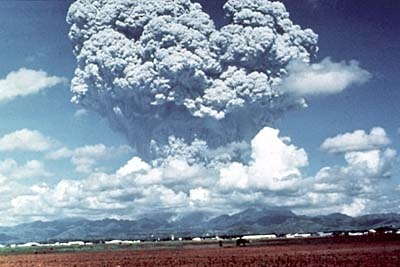
Mt. Pinatubo’s erruption in the Philippines, in 1991. Credit: USGS.

It’s also well known that major volcanic eruptions, like Mt. Pinatubo’s in the Philippines in 1991, can pump lots of aerosols into the stratosphere — and indeed, Pinatubo alone temporarily cooled the planet for about two years. The explosion of Mt. Tambora in 1815 had even more catastrophic effects, which you can imagine given that 1816 came to be known as “the year without a summer.” But what lots of people thought, says Daniel, “is that since there haven’t been any eruptions on that scale recently, aerosols have become relatively unimportant for climate.”

That, says the study, is not true: even without major eruptions, aerosols in the stratosphere increased by about 7 percent per year from 2000 to 2010. Plug that figure into climate models, and they predict a reduction in the warming you’d otherwise expect from the rise in greenhouse gases by up to 20 percent.

In the real world, as it happens, the rise in temperature slowed during that same decade. “That,” says Daniel, “was the motivation for doing this research. It could have just been natural climate variability, but we wondered if it could be something else.” Some climate scientists attribute the slowdown to heat being temporarily stored in the deep oceans, but stratospheric aerosols could clearly be part of the answer as well.

Whether these aerosols are natural or manmade, however, is something the scientists didn’t address. Just last week, a paper in Proceedings of the National Academy of Sciences (PNAS) suggested the cause was a construction boom of coal-fired power plants in China over the same decade. The new study doesn’t necessarily contradict that. “Human emissions could play a role,” says Daniel, although the PNAS study was talking about aerosols in the lower atmosphere, not the stratosphere. “But even in the absences of colossal volcanic eruptions,” he says, “smaller eruptions could still add up.”

The other difference between the two studies is that the one from last week looked at the relatively slow temperature rise over the most recent decade and tried to tease out what might have changed since the previous decades, when the warming was faster. The new one took actual observations of aerosols and tried to predict what the temperature rise should be. That sort of approach tends to produce more credible results, since an incorrect prediction would stick out like a sore thumb.

Where the two studies emphatically agree is that if the level of aerosols goes down — due to a lull in eruptions, or a reduction in coal-plant pollution, or both — the pace of warming would likely pick up. That would mean that current projections for up to a 4.5°C increase in global average surface temperatures by the end of the century might turn out to be an underestimate. And if aerosol levels increase, the temperature in 2100 could be lower than everyone expects.

80 Percent of World Climate Data Are Not Computerized and Readily Available (Science Daily)

Science News

ScienceDaily (July 20, 2011) — In order to gain a better knowledge of climate variations, such as those caused by global warming, and be able to tackle them, we need to understand what happened in the recent past. This is the conclusion of a research study led by the Rovira i Virgili University (URV), which shows that the scientific community today is only able to access and analyse 20% of the recorded climate information held. The remaining data are not accessible in digital format.

Some climate data in Europe go back to the 17th Century, but “not even 20% of the information recorded in the past is available to the scientific community,” Manola Brunet, lead author of the study and a researcher at the URV’s Centre for Climate Change, said.

This situation is even worse in continents such as Africa and South America, where weather observations did not begin until the middle of the 19th Century. These are the results of a study published in Climate Research, which highlights the need to urgently recover all the information recorded in perishable formats.

“Failure to decipher the messages in the climate records of the past will result in socioeconomic problems, because we will be unable to deal with the current and future impacts of climate change and a hotter world,” says Brunet.

Spain, along with the USA, Canada, Holland and Norway, is one of a small number of countries which allows partial access to its historic climate data. The rest of the world does not make these data available to the scientific community or the general public, despite recommendations to this effect by the World Meteorological Organization (WMO).

In order to overcome the political and legal hurdles posed by this currently poor access, “governments should adopt a resolution within the United Nations on opening up their historical climate data,” the researcher suggests.

Predicting heat waves

Weather services in all countries are faced with the overwhelming job of converting all their paper-based historical climate information, which is stored in archives, libraries and research centres, into digital format. The wide range of forms in which the information is held makes access harder, as do the purposes for which the meteorological service itself was actually created.

“The main objective is to provide a weather service to public, who want to know what the weather will be like the next day,” explains Brunet. This has led to climate science (which studies the range of atmospheric conditions characterising a region rather than focusing on weather forecasting) becoming the great ‘victim’, receiving fewer funds with which to digitise, develop and standardise data.

However, climate services do play a significant role in some European countries, the United States and Canada. It was these services that were able to explain last summer’s heat wave in Eastern Europe and put it into context, as well as the high temperatures recorded on the Old Continent in 2003.

“If we had access to all the historical data recorded, we would be able to evaluate the frequency with which these phenomena are likely to occur in the future with a higher degree of certainty,” the expert explains.

This kind of information is of scientific, social and economic interest, with insurance companies setting their premiums according to expected climate changes, for example. City councils and governments also “want to understand climate conditions and how these will change in future in order to improve land zoning and prevent urban development from taking place in areas likely to be affected by flooding,” concludes Brunet.

Science and truth have been cast aside by our desire for controversy (Guardian)

Last week’s report into media science coverage highlighted an over-reliance on pointless dispute

Robin McKie
The Observer, Sunday 24 July 2011

Thomas Huxley, the British biologist who so vociferously, and effectively, defended Darwin’s theory of natural selection in the 19th century, had a basic view of science. “It is simply common sense at its best – rigidly accurate in observation and merciless to fallacy in logic.”

It is as neat a description as you can get and well worth remembering when considering how science is treated by the UK media and by the BBC in particular. Last week, a study, written by geneticist Steve Jones, warned that far too often the corporation had failed to appreciate the nature of science and to make a distinction “between well-established fact and opinion”. In doing so, the corporation had given free publicity to marginal belief, he said.

Jones was referring to climate change deniers, anti-MMR activists, GM crop opponents and other fringe groups who have benefited from wide coverage despite the paucity of evidence that supports their beliefs. By contrast, scientists, as purveyors of common sense, have found themselves sidelined because producers wanted to create controversy and so skewed discussions to hide researchers’ near unanimity of views in these fields. In this way, the British public has been misled into thinking there is a basic division among scientists over global warming or MMR.

It is a problem that can be blamed on the media that believe, with some justification, that adversarial dispute is the best way to cover democracy in action. It serves us well with politics and legal affairs, but falls down badly when it comes to science because its basic processes, which rely heavily on internal criticism and disproof, are so widely misunderstood.

Yet there is nothing complicated about the business, says Robert May, the former UK government science adviser. “In the early stages of research, ideas are like hillocks on a landscape. So you design experiments to discriminate among them. Most hillocks shrink and disappear until, in the end, you are left with a single towering pinnacle of virtual certitude.”

The case of manmade climate change is a good example, adds May. “A hundred years ago, scientists realised carbon dioxide emissions could affect climate. Twenty years ago, we thought they were now having an impact. Today, after taking more and more measurements, we can see there is no other explanation for the behaviour of the climate. Humans are changing it. Of course, deniers disagree, but that’s because they hold fixed positions that have nothing to do with science.”

It is the scientist, not the denier, who is the real sceptic, adds Paul Nurse, president of the Royal Society. “When you carry out research, you cannot afford to cherry-pick data or ignore inconvenient facts. You have to be brutal. You also have to be sceptical about your own ideas and attack them. If you don’t, others will.”

When an idea reaches the stage where it’s almost ready to become a paper, it has therefore been subjected to savage scrutiny by its own authors and by their colleagues – and that is before writing has started. Afterwards, the paper goes to peer review where there is a further round of critical appraisal by a separate group of researchers. What emerges is a piece of work that has already been robustly tested – a point that is again lost in the media.

Over the centuries, this process has been honed to near perfection. By proposing and then attacking ideas and by making observations to test them, humanity has built up a remarkable understanding of the universe. The accuracy of Einstein’s theories of relativity, Crick and Watson’s double helix structure of DNA and plate tectonics were all revealed this way, though no scientist would admit these discoveries are the last word, as the palaeontologist Stephen Jay Gould once pointed out: “In science, ‘fact’ can only mean ‘confirmed to such a degree that it would be perverse to withhold provisional assent’,” he admitted.

Certainly, things can go wrong, as Huxley acknowledged. Science may be organised common sense but all too often a beautiful theory created this way has been skewered by “a single ugly fact”, as he put it. Think of Fred Hoyle’s elegant concept of a steady state universe that is gently expanding and eternal. The idea was at one time considered to be philosophically superior to its rival, the big bang theory that proposed the cosmos erupted into existence billions of years ago. The latter idea explained the expansion of the universe by recourse to a vast explosion. The former accounted for this expansion in more delicate, intriguing terms.

The steady state theory continued to hold its own until, in 1964, radio-astronomers Arno Penzias and Robert Woodrow Wilson noted interference on their radio telescope at the Bell Labs in New Jersey and tried to eliminate it. The pair went as far as shovelling out the pigeon droppings in the telescope and had the guilty pigeons shot (each blamed the other for giving the order). Yet the noise persisted. Only later did the two scientists realise what they were observing. The static hiss they were picking up was caused by a microwave radiation echo that had been set off when the universe erupted into existence after its big bang birth.

That very ugly fact certainly ruined Hoyle’s beautiful theory and, no doubt, his breakfast when he read about it in his newspaper. But then the pursuit of truth has always been a tricky and cruel business. “It is true that some things come along like that to throw scientists into a tizz but it doesn’t happen very often,” adds Jones. “The trouble is, the BBC thinks it happens every day.”

And this takes us to the nub of the issue: how should science be reported and recorded? How can you take a topic such as climate change, about which there is virtual unanimity of views among scientists, and keep it in the public’s eye. The dangers of rising greenhouse gas emissions have dramatic implications after all. But simply reporting every tiny shrinkage in polar ice sheets or rise in sea levels will only alienate readers or viewers, a point acknowledged by May. “Newspapers, radio and TV have a duty to engage and there is no point in doing a lot of excellent reporting on a scientific issue if it is boring or trivial. The alternative is to trivialise or distort, thus subordinating substance in the name of attraction. It is a paradox for which I can see no answer.”

Jones agrees. “What we don’t want to do is go back to the days when fawning reporters asked great figures to declaim on scientific issues – or political ones, for that matter. On the other hand, we cannot continue to distort views in the name balance,” It is a tricky business, but as former Times editor Charlie Wilson once told a member of staff upset at a task’s complexity: “Of course, it’s hard. If it was easy we would get an orang-utan to do it.”

Jones, in highlighting a specific problem for the BBC, has opened up a far wider, far more important issue – the need to find ways to understand how science works and to appreciate its insights and complexities. It certainly won’t be easy.

Can a Candid Climate Modeler Convince Contrarians? (Scientific American)

Intrepid British climate scientist sets out to win over global warming doubters

By Jeremy Lovell and ClimateWire | July 19, 2011

CONVINCING CONTRARIANS: Scientists attempt to win over climate change doubters. Image: Courtesy of NOAA

LONDON — David Stainforth is a brave man. His mission is to try to remove some of the confusion over the climate debate by explaining why uncertainty has to be a part of the computerized climate models that scientists use to forecast the expected impacts of climate change, including more violent storms as well as more flooding and droughts.

Stainforth, a climate modeler and senior research fellow at the London School of Economics, hopes that by coming clean on the degree of difficulty in making such predictions, he and his fellow climate scientists will find it easier to make — and win — the argument that prompt action now is not only necessary but the far cheaper alternative to inaction.

“Governments and people want certainty about what will happen with climate change, so scientists tend to turn to climate modeling. But the models are wrong in so many ways because there are so many uncertainties and unknowns built into them,” Stainforth told ClimateWire here at the Royal Academy’s recent annual Summer Science Exhibition.

“The reason is that they are just that, models, not reality. The bottom line is that they give a quite useful message from science to the adaptation community. But it is all relative and hedged about with qualifications. They give likelihoods not certainties, ranges of probabilities, not absolutes. That is where the discussion then must start, not end,” he added.

It is a bold step to take at a time when the climate skeptics appear to be making the most of the continuing public confusion and denial over the issues shown in repeated polls in the United States and United Kingdom. Skeptics have taken advantage of the revelations of scientific infighting with the leaked emails from the United Kingdom’s University of East Anglia in late 2009. They have also pointed to evidence of some sloppy science by the Intergovernmental Panel on Climate Change to assert that the feared results of climate change may be more fiction than science.

Take that, add the diplomatic bickering and backsliding in international climate change talks, then fold in the news of the continuing global economic crisis and reports that renewable energy will drive up energy costs. You will get a sense that what Stainforth is attempting is a very hard sell.

The ‘trouble’ with climate models

“You can explain in five or 10 minutes why we need to do something about climate change — and do it without using climate models. But it is far harder to persuade people of the degree and speed of what needs to be done without the models, and that is where the trouble starts,” said Stainforth.

“Governments and the media demand certainty. They don’t want uncertainties and probabilities. For example, all our models predict wetter winters and warmer summers, but they are far less certain about wetter or drier summers, and that has major implications for the siting and size of flood defenses,” he explained, referring to dams and levees.

“Climate scientists have moved a long way beyond discussing whether climate change is a threat to our societies and economies. That is settled. But that is not to say they do not still disagree about a lot of things like the design of the models and the degree of change,” he added.

He remains hopeful that the non-scientific public will understand the strong consensus among climate scientists that makes the remaining bickering look small. “There is uncertainty, but there is also probability. By showing and discussing the degree of each in public and with the public, we hope to involve them and therefore get out of the loop and move forward.”

Stainforth’s mission is backed by an array of groups including the United Kingdom’s Natural Environment Research Council, the Economic and Social Research Council and the Centre for Climate Change Economics and Policy as well as the London School of Economics. There is also the Grantham Research Institute on Climate Change and the Environment — headed by Lord Nicholas Stern, whose report on the economics of climate change in 2006 electrified governments worldwide on the issue.

Trying some interactive games

Using literature and interactive games at the Confidence in Climate website, the project sets out to show how probabilities work and why different models may come up with quite widely differing predictions. It then applies this to a composite of theories and observations on the climate conundrum.

“When you make a decision about the future — whether it is based on theory or observation — it is a sort of gamble. You can never know what is going to happen. When we make decisions about how to tackle climate change it is no different,” the website says.

“Because of the uncertainty we can’t be sure exactly what degree of challenge we will face. None the less, some things are clear — uncertainty doesn’t mean ignorance. … We also know that bigger increases in atmospheric greenhouse gas levels are likely to lead to much bigger impacts; the impact of a 4 degree warming is likely to be more than twice the impact of a 2 degree warming,” it adds.

As for Stainforth, he thinks the debate urgently needs to be widened considerably from the rather restricted inner core of scientists, modelers, meteorologists and statisticians who have monopolized it to date.

“We need ecologists, farmers, doctors, anthropologists, sociologists, engineers, psychologists, hydrologists, social scientists. The climate change problem involves everyone and should therefore include everyone,” he said.

“We have to grasp the nettle here and communicate openly the uncertainty, to explain what is uncertain, where, why and to what degree. We don’t want it split into ‘believers’ and ‘unbelievers’; we want people to understand.”

Reprinted from Climatewire with permission from Environment & Energy Publishing, LLC. http://www.eenews.net, 202-628-6500

On Experts and Global Warming (N.Y. Times)

July 12, 2011, 4:01 PM
By GARY GUTTING

Experts have always posed a problem for democracies. Plato scorned democracy, rating it the worst form of government short of tyranny, largely because it gave power to the ignorant many rather than to knowledgeable experts (philosophers, as he saw it). But, if, as we insist, the people must ultimately decide, the question remains: How can we, nonexperts, take account of expert opinion when it is relevant to decisions about public policy?

Once we accept the expert authority of climate science, we have no basis for supporting the minority position.

To answer this question, we need to reflect on the logic of appeals to the authority of experts. First of all, such appeals require a decision about who the experts on a given topic are. Until there is agreement about this, expert opinion can have no persuasive role in our discussions. Another requirement is that there be a consensus among the experts about points relevant to our discussion. Precisely because we are not experts, we are in no position to adjudicate disputes among those who are. Finally, given a consensus on a claim among recognized experts, we nonexperts have no basis for rejecting the truth of the claim.

These requirements may seem trivially obvious, but they have serious consequences. Consider, for example, current discussions about climate change, specifically about whether there is long-term global warming caused primarily by human activities (anthropogenic global warming or A.G.W.). All creditable parties to this debate recognize a group of experts designated as “climate scientists,” whom they cite in either support or opposition to their claims about global warming. In contrast to enterprises such as astrology or homeopathy, there is no serious objection to the very project of climate science. The only questions are about the conclusions this project supports about global warming.

There is, moreover, no denying that there is a strong consensus among climate scientists on the existence of A.G.W. — in their view, human activities are warming the planet. There are climate scientists who doubt or deny this claim, but even they show a clear sense of opposing a view that is dominant in their discipline. Nonexpert opponents of A.G.W. usually base their case on various criticisms that a small minority of climate scientists have raised against the consensus view. But nonexperts are in no position to argue against the consensus of scientific experts. As long as they accept the expert authority of the discipline of climate science, they have no basis for supporting the minority position. Critics within the community of climate scientists may have a cogent case against A.G.W., but, given the overall consensus of that community, we nonexperts have no basis for concluding that this is so. It does no good to say that we find the consensus conclusions poorly supported. Since we are not experts on the subject, our judgment has no standing.

It follows that a nonexpert who wants to reject A.G.W. can do so only by arguing that climate science lacks the scientific status needed be taken seriously in our debates about public policy. There may well be areas of inquiry (e.g., various sub-disciplines of the social sciences) open to this sort of critique. But there does not seem to be a promising case against the scientific authority of climate science. As noted, opponents of the consensus on global warming themselves argue from results of the discipline, and there is no reason to think that they would have had any problem accepting a consensus of climate scientists against global warming, had this emerged.

Some nonexpert opponents of global warming have made much of a number of e-mails written and circulated among a handful of climate scientists that they see as evidence of bias toward global warming. But unless this group is willing to argue from this small (and questionable) sample to the general unreliability of climate science as a discipline, they have no alternative but to accept the consensus view of climate scientists that these e-mails do not undermine the core result of global warming.

I am not arguing the absolute authority of scientific conclusions in democratic debates. It is not a matter of replacing Plato’s philosopher-kings with scientist-kings in our polis. We the people still need to decide (perhaps through our elected representatives) which groups we accept as having cognitive authority in our policy deliberations. Nor am I denying that there may be a logical gap between established scientific results and specific policy decisions. The fact that there is significant global warming due to human activity does not of itself imply any particular response to this fact. There remain pressing questions, for example, about the likely long-term effects of various plans for limiting CO2 emissions, the more immediate economic effects of such plans, and, especially, the proper balance between actual present sacrifices and probable long-term gains. Here we still require the input of experts, but we must also make fundamental value judgments, a task that, pace Plato, we cannot turn over to experts.

The essential point, however, is that once we have accepted the authority of a particular scientific discipline, we cannot consistently reject its conclusions. To adapt Schopenhauer’s famous remark about causality, science is not a taxi-cab that we can get in and out of whenever we like. Once we board the train of climate science, there is no alternative to taking it wherever it may go.

New York Times Publishes a Searing Drought Story, But Completely Misses the Climate Change Angle (Climate Central)

Published: July 12th, 2011, Last Updated: July 13th, 2011
By Andrew Freedman

In Monday’s New York Times, Kim Severson and Kirk Johnson wrote an eloquent story on the intense drought that is maintaining a tight grip on a broad swath of America’s southern tier, from Arizona to Florida. Reporting from Georgia, Severson and Johnson detailed the plight of farmers struggling to make ends meet as the parched soil makes it nearly impossible for them to grow crops and feed livestock.

Monday’s story from the New York Times on drought.

The piece is a great example of how emotionally moving storytelling from a local perspective can convey the consequences of broad issues and trends, in this case, a major drought that has enveloped 14 states. In that sense, it served Times readers extraordinarily well.

However, when it came to providing readers with a thorough understanding of the drought’s causes and aggravating factors, Severson and Johnson left out any mention of the elephant in the room — global climate change, and pinned the entire drought on one factor, La Niña. For this, it was overly simplistic, and even just downright inaccurate.

Here’s how the story framed the drought’s causes:

From a meteorological standpoint, the answer is fairly simple. “A strong La Niña shut off the southern pipeline of moisture,” said David Miskus, who monitors drought for the National Oceanic and Atmospheric Administration.

The La Niña “lone gunman” theory is problematic from a scientific standpoint. Just last week, Marty Hoerling, the federal government’s top researcher tasked with examining how climate change may be influencing extreme weather and climate events, told reporters that “we cannot reconcile it [the drought] with just the La Niña impact alone, at least not at this time.”

Instead, the causal factors are more nuanced than that, and they do include global warming, since it is changing the background conditions in which such extreme events occur.

During a press conference last week from a drought management meeting in the parched city of Austin, Texas, Hoerling made clear that climate change is already increasing average temperatures across the drought region, and is expected to lead to more frequent and intense droughts in the Southwest. Other research indicates the trend towards a drier Southwest is already taking place. “There are recent regional tendencies toward more severe droughts in the southwestern United States, parts of Canada and Alaska, and Mexico,” stated a 2008 report from the U.S. Global Change Research Program.

As is the case with any extreme weather or climate event now, one cannot truly separate climate change from the mix, considering that droughts, floods, and other extreme events now occur in an environment that has been profoundly altered by human emissions of greenhouse gases, such as carbon dioxide. This doesn’t mean that climate change is causing all of these extreme events, but it does mean that climate change may be increasing the likelihood that some types of events will occur, and may be changing the characteristics of some extreme events, such as by making heat waves more intense.

The fact that the Times story detailed both the drought and the record heat accompanying it, yet left out any mention of climate change, was a particularly puzzling error of omission. Hoerling, for one, pointed to the extreme heat seen during this drought as a possible sign of things to come, as climate change helps produce dangerous combinations of heat and drought.

“We haven’t necessarily dealt with drought and heat at the same time in such a persistent way, and that’s a new condition,” Hoerling said, noting that higher temperatures only hasten the drying of soils.

Many ponds in Texas, such as this one in Rusk County, were nearly dry by late June 2011. Credit: agrilifetoday/flickr.

Texas had its warmest June on record, for example, and on June 26th, Amarillo, Texas recorded its warmest temperature on record for any month, at 111°F. According to the Weather Channel, parts of Oklahoma and Texas have already exceeded their yearly average number of days at or above 100 degrees, including Oklahoma City, Dallas, and Austin. The heat is related to the drought, because when soil moisture is so low, more of the sun’s energy goes towards heating the air directly.

It’s unfortunate that the Times story, which was a searing portrayal of how a drought can impact communities that are already down on their luck due to economic troubles, did not include at least some discussion on climate change. As I’ve shown here, and climate blogger Joe Romm has also pointed out, there was sufficient evidence to justify raising the climate change topic in that story, and many others like it. After all, if the media doesn’t make an effort to evaluate the evidence on the links between extreme weather and climate change, then how can we expect the public to understand how global warming may affect their lives?

At Climate Central, our scientists are working to better understand whether and how climate change is increasing the likelihood of certain extreme weather events, such as heat waves, while at the same time, our journalists are covering the Southern drought and wildfire situation with the goal of making sure our readers understand what scientific studies show about global warming and extreme events.

This is not an easy task, but it need not be such a lonely one.

Update, July 13: The Times published an editorial on the drought today, which also blames the drought squarely on La Niña-related weather patterns, and makes no mention of climate change impacts or projections.

* * *

EDITORIAL (New York Times)
Suffering in the Parched South
Published: July 12, 2011

Right now, the official drought map of the United States looks as if it has been set on fire and scorched at the bottom edge. Scorched is how much of the Southeast and Southwest feel, in the midst of a drought that is the most extreme since the 1950s and possibly since the Dust Bowl of the 1930s. The government has classified much of this drought as D4, which means exceptional. The outlook through late September shows possible improvement in some places, but in most of Texas, Oklahoma, southern Arkansas, and northern Louisiana and Mississippi the drought is expected to worsen.

Dry conditions began last year and have only intensified as temperatures rose above 100 in many areas. Rain gauges have been empty for months, causing a region-wide search for new underground sources of water as streams and lakes dry up. The drought is produced by a pattern of cooling in the Pacific called La Niña. A cooler ocean means less moisture in the atmosphere, which shuts down the storms shuttling east across the region.

Droughts are measured in dollars as well as degrees. The prospects for cattle and wheat, corn and cotton crops across the South are dire. There is no way yet to estimate the ultimate cost of this drought because there is no realistic estimate of when it will end. Farmers have been using crop insurance payments, and federal relief is available in disaster areas, including much of Texas. But the only real relief will be the end of the dry, hot winds and the beginning of long, settled rains.

* * *

Drought Spreads Pain From Florida to Arizona

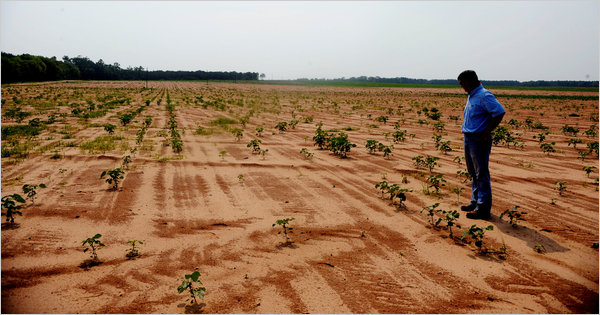
Grant Blankenship for The New York Times. Buster Haddock, an agricultural scientist at the University of Georgia, in a field where cotton never had the chance to grow.

By KIM SEVERSON and KIRK JOHNSON
Published: July 11, 2011

COLQUITT, Ga. — The heat and the drought are so bad in this southwest corner of Georgia that hogs can barely eat. Corn, a lucrative crop with a notorious thirst, is burning up in fields. Cotton plants are too weak to punch through soil so dry it might as well be pavement.

Waiting for Rain

Dangerously Dry – Nearly a fifth of the contiguous United States has been faced with the worst drought in recent years.

The Dry Season

OKLAHOMA A simple, if plaintive, message from the residents of Hough, in the panhandle, late last month. Shawn Yorks/The Guymon Daily Herald, via Associated Press

Farmers with the money and equipment to irrigate are running wells dry in the unseasonably early and particularly brutal national drought that some say could rival the Dust Bowl days.

“It’s horrible so far,” said Mike Newberry, a Georgia farmer who is trying grow cotton, corn and peanuts on a thousand acres. “There is no description for what we’ve been through since we started planting corn in March.”

The pain has spread across 14 states, from Florida, where severe water restrictions are in place, to Arizona, where ranchers could be forced to sell off entire herds of cattle because they simply cannot feed them.

In Texas, where the drought is the worst, virtually no part of the state has been untouched. City dwellers and ranchers have been tormented by excessive heat and high winds. In the Southwest, wildfires are chewing through millions of acres.

Last month, the United States Department of Agriculture designated all 254 counties in Texas natural disaster areas, qualifying them for varying levels of federal relief. More than 30 percent of the state’s wheat fields might be lost, adding pressure to a crop in short supply globally.

Even if weather patterns shift and relief-giving rain comes, losses will surely head past $3 billion in Texas alone, state agricultural officials said.

Most troubling is that the drought, which could go down as one of the nation’s worst, has come on extra hot and extra early. It has its roots in 2010 and continued through the winter. The five months from this February to June, for example, were so dry that they shattered a Texas record set in 1917, said Don Conlee, the acting state climatologist.

Oklahoma has had only 28 percent of its normal summer rainfall, and the heat has blasted past 90 degrees for a month.

“We’ve had a two- or three-week start on what is likely to be a disastrous summer,” said Kevin Kloesel, director of the Oklahoma Climatological Survey.

The question, of course, becomes why. In a spring and summer in which weather news has been dominated by epic floods and tornadoes, it is hard to imagine that more than a quarter of the country is facing an equally daunting but very different kind of natural disaster.

From a meteorological standpoint, the answer is fairly simple. “A strong La Niña shut off the southern pipeline of moisture,” said David Miskus, who monitors drought for the National Oceanic and Atmospheric Administration.

The weather pattern called La Niña is an abnormal cooling of Pacific waters. It usually follows El Niño, which is an abnormal warming of those same waters.

Although a new forecast from the National Weather Service’s Climate Prediction Center suggests that this dangerous weather pattern could revive in the fall, many in the parched regions find themselves in the unlikely position of hoping for a season of heavy tropical storms in the Southeast and drenching monsoons in the Southwest.

Climatologists say the great drought of 2011 is starting to look a lot like the one that hit the nation in the early to mid-1950s. That, too, dried a broad part of the southern tier of states into leather and remains a record breaker.

But this time, things are different in the drought belt. With states and towns short on cash and unemployment still high, the stress on the land and the people who rely on it for a living is being amplified by political and economic forces, state and local officials say. As a result, this drought is likely to have the cultural impact of the great 1930s drought, which hammered an already weakened nation.

“In the ’30s, you had the Depression and everything that happened with that, and drought on top,” said Donald A. Wilhite, director of the school of natural resources at the University of Nebraska in Lincoln and former director of the National Drought Mitigation Center. “The combination of those two things was devastating.”

Although today’s economy is not as bad, many Americans ground down by prolonged economic insecurity have little wiggle room to handle the effects of a prolonged drought. Government agencies are in the same boat.

“Because we overspent, the Legislature overspent, we’ve been cut back and then the drought comes along and we don’t have the resources and federal government doesn’t, and so we just tighten our belt and go on,” said Donald Butler, the director of the Arizona Department of Agriculture.

The drought is having some odd effects, economically and otherwise.

“One of the biggest impacts of the drought is going to be the shrinking of the cattle herd in the United States,” said Bruce A. Babcock, an agricultural economist at Iowa State University in Ames. And that will have a paradoxical but profound impact on the price of a steak.

Ranchers whose grass was killed by drought cannot afford to sustain cattle with hay or other feed, which is also climbing in price. Their response will most likely be to send animals to slaughter early. That glut of beef would lower prices temporarily.

But America’s cattle supply will ultimately be lower at a time when the global supply is already low, potentially resulting in much higher prices in the future.

There are other problems. Fishing tournaments have been canceled in Florida and Mississippi, just two of the states where low water levels have kept recreational users from lakes and rivers. In Texas, some cities are experiencing blackouts because airborne deposits of salt and chemicals are building up on power lines, triggering surges that shut down the system. In times of normal weather, rain usually washes away the environmental buildup. Instead, power company crews in cities like Houston are being dispatched to spray electrical lines.

In this corner of Georgia, where temperatures have been over 100 and rainfall has been off by more than half, fish and wildlife officials are worried over the health of the shinyrayed pocketbook and the oval pigtoe mussels, both freshwater species on the endangered species list.

The mussels live in Spring Creek, which is dangerously low and borders Terry Pickle’s 2,000-acre farm here. He pulls his irrigation from wells that tie into the water system of which Spring Creek is a part.

Whether nature or agriculture is to blame remains a debate in a state that for 20 years has been embroiled in a water war with Alabama and Florida. Meanwhile, Colquitt has allowed the state to drill a special well to pump water back into the creek to save the mussels from extinction.

Most farmers here are much more worried about the crops than the mussels. With cotton and corn prices high, they had high hopes for the season. But many have had to replant fields several times to get even one crop to survive. Others, like Mr. Pickle, have relied on irrigation so expensive that it threatens to eat into any profits.

The water is free, but the system used to get it from the ground runs on diesel fuel. His bill for May and June was an unheard of $88,442.

Thousands of small stories like that will all contribute to the ultimate financial impact of the drought, which will not be known until it is over. And no one knows when that will be.

The United States Department of Agriculture’s Farm Service Agency has already provided over $75 million in assistance to ranchers nationwide, with most of it going to Florida, New Mexico and Texas. An additional $62 million in crop insurance indemnities have already been provided to help other producers.

Economists say that adding up the effects of drought is far more complicated than, say, those of a hurricane or tornado, which destroy structures that have set values. With drought, a shattered wheat or corn crop is a loss to one farmer, and it has a specific price tag. But all those individual losses punch a hole in the food supply and drive prices up. That is good news for a farmer who manages to get a crop in. The final net costs down the line are thus dispersed, and mostly passed along.

That means grocery shoppers will feel the effects of the drought at the dinner table, where the cost of staples like meat and bread will most likely rise, said Michael J. Roberts, an associate professor of agricultural and resource economics at North Carolina State University in Raleigh, N.C. “The biggest losers are consumers,” he said.

Kim Severson reported from Colquitt, Ga., and Kirk Johnson from Denver. Dan Frosch contributed reporting from Denver.

Our Extreme Future: Predicting and Coping with the Effects of a Changing Climate (Scientific American)

Adapting to extreme weather calls for a combination of restoring wetland and building drains and sewers that can handle the water. But leaders and the public are slow to catch on. Final part of a three-part series

By John Carey | Thursday, June 30, 2011 | 97

Image: Fikret Onal/Flickr

Editor’s note: This article is the last of a three-part series by John Carey. Part 1, “Storm Warning: Extreme Weather Is a Product of Climate Change,” was posted on June 28. Part 2, “Global Warming and the Science of Extreme Weather,” was posted on June 29.

Extreme weather events have become both more common and more intense. And increasingly, scientists have been able to pin at least part of the blame on humankind’s alteration of the climate. What’s more, the growing success of this nascent science of climate attribution (finding the telltale fingerprints of climate change in extreme events) means that researchers have more confidence in their climate models—which predict that the future will be even more extreme.

Are we prepared for this future? Not yet. Indeed, the trend is in the other direction, especially in Washington, D.C., where a number of members of Congress even argue that climate change itself is a hoax.

Scientists hope that rigorously identifying climate change’s contribution to individual extreme events can indeed wake people up to the threat. As the research advances, it should be possible to say that two extra inches (five centimeters) of rain poured down in a Midwestern storm because of greenhouse gases, or that a California heat wave was 10 times more likely to occur thanks to humans’ impacts on climate. So researchers have set up rapid response teams to assess climate change’s contribution to extreme events while the events are still fresh in people’s minds. In addition, the Intergovernmental Panel on Climate Change (IPCC) is preparing a special report on extreme events and disasters, due out by the end of 2011. “It is important for us emphasize that climate change and its impacts are not off in the future, but are here and now,” explained Rajendra Pachauri, chair of the IPCC, during a briefing at United Nations climate talks in Cancún last December.

The message is beginning to sink in. The Russian government, for instance, used to doubt the existence of climate change, or argue that it might be beneficial for Russia. But now, government officials have realized that global warming will not bring a gradual and benign increase in temperatures. Instead, they’re likely to see more crippling heat waves. As Russian President Dmitry Medvedev told the Security Council of the Russian Federation last summer: “Everyone is talking about climate change now. Unfortunately, what is happening now in our central regions is evidence of this global climate change, because we have never in our history faced such weather conditions.”

Doubts persist despite evidence

Among the U.S. public, the feeling is different. Opinion pollsand anecdotal reports show that most Americans do not perceive a threat from climate change. And a sizable number of Americans, including many newly elected members of Congress, do not even believe that climate change exists. Extreme weather? Just part of nature, they say. After all, disastrous floods and droughts go back to the days of Noah and Moses. Why should today’s disasters be any different? Was the July 23, 2010, storm that spawned Les Scott’s record hailstone evidence of a changing climate, for instance? “Not really,” Scott says. “It was just another thunderstorm. We get awful bad blizzards that are a lot worse.”

And yes, 22 of Maryland’s 23 counties were declared natural disaster areas after record-setting heat and drought in 2010. “It was the worst corn crop I ever had,” says fourth-generation farmer Earl “Buddy” Hance. But was it a harbinger of a more worrisome future? Probably not, says Hance, the state’s secretary of agriculture. “As farmers we are skeptical, and we need to see a little more. And if it does turn out to be climate change, farmers would adapt.” By then, adaptation could be really difficult, frets Minnesota organic farmer Jack Hedin, whose efforts to raise the alarm are “falling on deaf ears,” he laments.

Many scientists share Hedin’s worry. “The real honest message is that while there is debate about how much extreme weather climate change is inducing now, there is very little debate about its effect in the future,” says Michael Wehner, staff scientist at Lawrence Berkeley National Laboratory and member of the lead author teams of the interagency U.S. Climate Change Science Program’s Synthesis and Assessment reports on climate extremes. For instance, climate models predict that by 2050 Russia will have warmed up so much that every summer will be as warm as the disastrous heat wave it just experienced, says Richard Seager of Columbia University’s Lamont–Doherty Earth Observatory. In other words, many of today’s extremes will become tomorrow’s everyday reality. “Climate change will throw some significant hardballs at us,” says Martin Hoerling, a research meteorologist at the National Oceanic and Atmospheric Administration’s Earth System Research Laboratory in Boulder, Colo. “There will be a lot of surprises that we are not adapted to.”

A dusty future

One of the clearest pictures of this future is emerging for the U.S. Southwest and a similar meteorological zone that stretches across Italy, Greece and Turkey. Work by Tim Barnett of the Scripps Institution of Oceanography, Seager and others predicts that these regions will get hotter and drier—and, perhaps more important, shows that the change has already begun. “The signal of a human influence on climate pops up in 1985, then marches on getting strong and stronger,” Barnett says. By the middle of the 21st century, the models predict, the climate will be as dry as the seven-year long Dust Bowl drought of the 1930s or the damaging 1950s drought centered in California and Mexico, Seager says: “In the future the drought won’t last just seven years. It will be the new norm.”

That spells trouble. In the Southwest the main worry is water—water that makes cities like Los Angeles and Las Vegas possible and that irrigates the enormously productive farms of California’s Central Valley. Supplies are already tight. During the current 11-year dry spell, the demand for water from the vast Colorado River system, which provides water to 30 million people and irrigates four million acres (1.6 million hectares) of cropland, has exceeded the supply. The result: water levels in the giant Lake Mead reservoir dropped to a record low in October (before climbing one foot, or 30 centimeters, after torrential winter rains in California reduced the demand for Colorado River water). Climate change will just make the problem worse. “The challenge will be great,” says Terry Fulp, deputy regional director of the U.S. Department of the Interior’s Bureau of Reclamation’s Lower Colorado Region. “I rank climate change as probably my largest concern. When I’m out on my boat on Lake Mead, it’s on my mind all the time.”

The Southwest is just a snapshot of the challenges ahead. Imagine the potential peril to regions around the world, scientists say. “Our civilization is based on a stable base climate—it doesn’t take very much change to raise hell,” Scripps’s Barnett says. And given the lag in the planet’s response to the greenhouse gases already in the atmosphere, many of these changes are coming whether we like them or not. “It’s sort of like that Kung Fu guy who said, ‘I’m going to kick your head off now, and there’s not a damn thing you can do about it,'” Barnett says.

Grassroots action

Although efforts to fight climate change are now stalled in Washington, many regions do see the threat and are taking action both to adapt to the future changes and to try to limit the amount of global warming itself. The Bureau of Reclamation’s Lower Colorado Region office, for instance, has developed a plan to make “manageable” cuts in the amounts of water that the river system supplies, which Fulp hopes will be enough to get the region through the next 15 years. In Canada, after experiencing eight extreme storms (of more than one-in-25-year intensity) between 1986 and 2006, Toronto has spent hundreds of millions of dollars to upgrade its sewer and storm water system for handling deluges. “Improved storm drains are the cornerstone of our climate adaptation policy,” explains Michael D’Andrea, Toronto’s director of water infrastructure management.

In Iowa, even without admitting that climate change is real, farmers are acting as if it is, spending millions of dollars to alter their practices. They are adding tile drainage to their fields to cope with increased floods, buying bigger machinery to move more quickly because their planting window has become shorter, planting a month earlier than they did 50 years ago, and sowing twice as many corn plants per acre to exploit the additional moisture, says Gene Takle, professor of meteorology at Iowa State University in Ames. “Iowa’s floods are in your face—and in your basement—evidence that the climate has changed, and the farmers are adapting,” he says.

Local officials have seen the connection, too. After the huge floods of 2008, the Iowa town of Cedar Falls passed an ordinance requiring that anyone who lives in the 500-year flood plain must have flood insurance—up from the previous 200-year flood requirement. State Sen. Robert Hogg wants to make the policy statewide. He also is pushing to restore wetlands that can help soak up floodwaters before they devastate cities. “Wetland restoration costs money, but it’s cheaper than rebuilding Cedar Rapids,” he says. “I like to say that dealing with climate change is not going to require the greatest sacrifices, but it is going to require the greatest foresight Americans have ever had.”

Right now, that foresight is more myopia, many scientists worry. So when and how will people finally understand that far more is needed? It may require more flooded basements, more searing heat waves, more water shortages or crop failures, more devastating hurricanes or other examples of the increases in extreme weather that climate change will bring. “I don’t want to root for bad things to happen, but that’s what it will take,” says one government scientist who asked not to be identified. Or as Nashville resident Rich Hays says about his own experience with the May 2010 deluge: “The flood was definitely a wake-up call. The question is: How many wake-up calls do we need?”

Reporting for this story was funded by the Pew Center on Global Climate Change.

Global Warming and the Science of Extreme Weather (Scientific American)

How rising temperatures change weather and produce fiercer, more frequent storms. Second of a three-part series

By John Carey | Wednesday, June 29, 2011 | 46

HURRICANE KATRINA battered New Orleans in 2005. Image: NOAA

Editor’s note: This article is the second of a three-part series by John Carey. Part 1, posted on June 28, is “Storm Warning: Extreme Weather Is a Product of Climate Change”.

Extreme floods, prolonged droughts, searing heat waves, massive rainstorms and the like don’t just seem like they’ve become the new normal in the last few years—they have become more common, according to data collected by reinsurance company Munich Re (see Part 1 of this series). But has this increase resulted from human-caused climate change or just from natural climatic variations? After all, recorded floods and droughts go back to the earliest days of mankind, before coal, oil and natural gas made the modern industrial world possible.

Until recently scientists had only been able to say that more extreme weather is “consistent” with climate change caused by greenhouse gases that humans are emitting into the atmosphere. Now, however, they can begin to say that the odds of having extreme weather have increased because of human-caused atmospheric changes—and that many individual events would not have happened in the same way without global warming. The reason: The signal of climate change is finally emerging from the “noise”—the huge amount of natural variability in weather.

Scientists compare the normal variation in weather with rolls of the dice. Adding greenhouse gases to the atmosphere loads the dice, increasing odds of such extreme weather events. It’s not just that the weather dice are altered, however. As Steve Sherwood, co-director of the Climate Change Research Center at the University of New South Wales in Australia, puts it, “it is more like painting an extra spot on each face of one of the dice, so that it goes from 2 to 7 instead of 1 to 6. This increases the odds of rolling 11 or 12, but also makes it possible to roll 13.”

Why? Basic physics is at work: The planet has already warmed roughly 1 degree Celsius since preindustrial times, thanks to CO2and other greenhouse gases emitted into the atmosphere. And for every 1-degree C (1.8 degrees Fahrenheit) rise in temperature, the amount of moisture that the atmosphere can contain rises by 7 percent, explains Peter Stott, head of climate monitoring and attribution at the U.K. Met Office’s Hadley Center for Climate Change. “That’s quite dramatic,” he says. In some places, the increase has been much larger. Data gathered by Gene Takle, professor of meteorology at Iowa State University in Ames, show a 13 percent rise in summer moisture over the past 50 years in the state capital, Des Moines.

The physics of too much rain

The increased moisture in the atmosphere inevitably means more rain. That’s obvious. But not just any kind of rain, the climate models predict. Because of the large-scale energy balance of the planet, “the upshot is that overall rainfall increases only 2 to 3 percent per degree of warming, whereas extreme rainfall increases 6 to 7 percent,” Stott says. The reason again comes from physics. Rain happens when the atmosphere cools enough for water vapor to condense into liquid. “However, because of the increasing amount of greenhouse gases in the troposphere, the radiative cooling is less efficient, as less radiation can escape to space,” Stott explains. “Therefore the global precipitation increases less, at about 2 to 3 percent per degree of warming.” But because of the extra moisture, when precipitation does occur (in both rain and snow), it’s more likely to be in bigger events.

Iowa is one of many places that fits the pattern. Takle documented a three- to seven-fold increase in high rainfall events in the state, including the 500-year Mississippi River flood in 1993, the 2008 Cedar Rapids flood as well as the 500-year event in 2010 in Ames, which inundated the Hilton Coliseum basketball court in eight feet (2.5 meters) of water . “We can’t say with confidence that the 2010 Ames flood was caused by climate change, but we can say that the dice are loaded to bring more of these events,” Takle says.

And more events seem to be in the news every month, from unprecedented floods in Riyadh, Saudi Arabia, to massive snowstorms that crippled the U.S. Northeast in early 2011, to the November 2010 to January 2011 torrents in Australia that flooded an area the size of Germany and France . This “disaster of biblical proportions,” as local Australian officials called it, even caused global economic shock waves: The flooding of the country’s enormously productive coal mines sent world coal prices soaring.

More stormy weather

More moisture and energy in the atmosphere, along with warmer ocean temperatures also mean more intense hurricanes, many scientists say. In fact, 2010 was the first year in decades in which two simultaneous category 4 hurricanes, Igor and Julia, formed in the Atlantic Ocean. In addition, the changed conditions bring an increased likelihood of more powerful thunderstorms with violent updrafts, like a July 23, 2010, tempest in Vivian, S.D., that produced hailstones that punched softball-size holes through roofs—and created a behemoth ball of ice measured at a U.S. record 8 inches (20 centimeters) in diameter even after it had partially melted. “I’ve never seen a storm like that before—and hope I’ll never go through anything like it,” says Les Scott, the Vivian farmer and rancher who found the hailstone .

Warming the planet alters large-scale circulation patterns as well. Scientists know that the sun heats moist air at the equator, causing the air to rise. As it rises, the air cools and sheds most of its moisture as tropical rain. Once six to 10 miles (9.5 to 16 kilometers) aloft, the now dry air travels toward the poles, descending when it reaches the subtropics, normally at the latitude of the Baja California peninsula. This circulation pattern, known as a Hadley cell, contributes to desertification, trade winds and the jet stream.

On a warmer planet, however, the dry air will travel farther north and south from the equator before it descends, climate models predict, making areas like the U.S. Southwest and the Mediterranean even drier. Such an expanded Hadley cell would also divert storms farther north. Are the models right? Richard Seager of Columbia University’s Lamont–Doherty Earth Observatory has been looking for a climate change–induced drying trend in the Southwest, “and there seems to be some tentative evidence that it is beginning to happen,” he says. “It gives us confidence in the models.” In fact, other studies show that the Hadley cells have not only expanded, they’ve expanded more than the models predicted.

Such a change in atmospheric circulation could explain both the current 11-year drought in the Southwest and Minnesota’s status as the number one U.S. state for tornadoes last year. On October 26, 2010, the Minneapolis area even experienced record low pressure in what Paul Douglas, founder and CEO of WeatherNation in Minnesota, dubbed a “landicane”—a hurricanelike storm that swept across the country. “I thought the windows of my home would blow in,” Douglas recalls. “I’ve chased tornados and flown into hurricanes but never experienced anything like this before.” Yet it makes sense in the context of climate change, he adds. “Every day, every week, another piece of the puzzle falls into place,” he says. “More extreme weather seems to have become the rule, not just in the U.S. but in Europe and Asia.”

The rise of climate attribution

Is humankind really responsible? That’s where the burgeoning field of climate attribution, pioneered by Hadley’s Peter Stott and other scientists, comes in. The idea is to look for trends in the temperature or precipitation data that provide evidence of overall changes in climate. When those trends exist, it then becomes possible to calculate how much climate change has contributed to extreme events. Or in more technical terms, the probability of a particular temperature or rainfall amount is shaped roughly like a bell curve. A change in climate shifts the whole curve. That, in turn, increases the likelihood of experiencing the more extreme weather at the tail end of the bell curve. Whereas day-to-day weather remains enormously variable, the underlying human-caused shift in climate increases the power and number of the events at the extreme. The National Oceanic and Atmospheric Administration’s (NOAA) Deke Arndt puts it more colorfully: “Weather throws the punches, but climate trains the boxer,” he says. By charting the overall shift, then, it’s possible to calculate the increased chances of extreme events due to global warming.

This idea was already in the air in 2003 when Stott traveled though the worst heat wave in recorded European history on a wedding anniversary trip to Italy and Switzerland. One of the striking consequences he noticed was that the Swiss mountains were missing their usual melodious tinkling of cowbells. “There was no water in the mountains, and the farmers had to take all their cows down in the valley,” he says. He decided to see if he could pin part of the blame on climate change after he returned to his office in Exeter, England. “I didn’t expect to get a positive result,” he says

But he did. In fact, the signal of a warming climate was quite clear in Europe, even using data up to only 2000. In a landmark paper in Nature Stott and colleagues concluded that the chances of a heat wave like the 2003 event have more than doubled because of climate change. (Scientific American is part of Nature Publishing Group.) Data collected since then show that the odds are at least four times higher compared with pre-industrial days. “We are very aware of the risks of misattribution,” Stott says. “We don’t want to point to specific events and say that they are part of climate change when they really are due to natural variability. But for some events, like the 2003 heat wave, we have the robust evidence to back it up.”

Case in point: Hurricane Katrina

Another event with a clear global warming component, says Kevin Trenberth, head of climate analysis at the National Center for Atmospheric Research (NCAR) in Boulder, Colo., was Hurricane Katrina. Trenberth calculated that the combination of overall planetary warming, elevated moisture in the atmosphere, and higher sea-surface temperatures meant that “4 to 6 percent of the precipitation—an extra inch [2.5 centimeters] of rain—in Katrina was due to global warming,” he says. “That may not sound like much, but it could be the straw that breaks the camel’s back or causes a levee to fail.” It was also a very conservative estimate. “The extra heat produced as moisture condenses can invigorate a storm, and at a certain point, the storm just takes off,” he says. “That would certainly apply to Nashville.” So climate change’s contribution to Katrina could have been twice as high as his calculations show, he says. Add in higher winds to the extra energy, and it is easy to see how storms can become more damaging.

This science of attribution is not without controversies. Another case in point: the 2010 Russian heat wave, which wiped out one quarter of the nation’s wheat crop and darkened the skies of Moscow with smoke from fires. The actual meteorological cause is not in doubt. “There was a blocking of the atmospheric circulation,” explains Martin Hoerling, a research meteorologist at the NOAA’s Earth System Research Laboratory, also in Boulder. “The jet stream shifted north, bringing a longer period of high pressure and stagnant weather conditions.” But what caused the blocking? Hoerling looked for an underlying long-term temperature trend in western Russia that might have increased the odds of a heat wave, as Stott had done for the 2003 European event. He found nothing. “The best explanation is a rogue black swan—something that came out of the blue,” he says.

Wrong, retorts NCAR’s Trenberth. He sees a clear expansion of the hot, dry Mediterranean climate into western Russia that is consistent with climate change predictions—and that also intensified the Pakistan monsoon. “I completely repudiate Marty—and it doesn’t help to have him saying you can’t attribute the heat wave to climate change,” he says. “What we can say is that, as with Katrina, this would not have happened the same way without global warming.”

Yet even this dispute is smaller than it first appears. What is not in doubt is that the Russian heat wave is a portent—a glimpse of the future predicted by climate models. Even Hoerling sees it as a preview of coming natural disasters. By 2080, such events are expected to happen, on average, once every five years, he says: “It’s a good wake-up call. This type of phenomenon will become radically more common.”

Storm Warnings: Extreme Weather Is a Product of Climate Change (Scientific American)

More violent and frequent storms, once merely a prediction of climate models, are now a matter of observation. Part 1 of a three-part series

By John Carey | Tuesday, June 28, 2011 | 130

DROWNING: The Souris River overflowed levees in Minot, N.D., as seen here on June 23. Image: Patrick Moes/U.S. Army Corps of Engineers

In North Dakota the waters kept rising. Swollen by more than a month of record rains in Saskatchewan, the Souris River topped its all time record high, set back in 1881. The floodwaters poured into Minot, North Dakota’s fourth-largest city, and spread across thousands of acres of farms and forests. More than 12,000 people were forced to evacuate. Many lost their homes to the floodwaters.

Yet the disaster unfolding in North Dakota might be bringing even bigger headlines if such extreme events hadn’t suddenly seemed more common. In this year alone massive blizzards have struck the U.S. Northeast, tornadoes have ripped through the nation, mighty rivers like the Mississippi and Missouri have flowed over their banks, and floodwaters have covered huge swaths of Australia as well as displaced more than five million people in China and devastated Colombia. And this year’s natural disasters follow on the heels of a staggering litany of extreme weather in 2010, from record floods in Nashville, Tenn., and Pakistan, to Russia’s crippling heat wave.

These patterns have caught the attention of scientists at the National Climatic Data Center in Asheville, N.C., part of the National Oceanic and Atmospheric Administration (NOAA). They’ve been following the recent deluges’ stunning radar pictures and growing rainfall totals with concern and intense interest. Normally, floods of the magnitude now being seen in North Dakota and elsewhere around the world are expected to happen only once in 100 years. But one of the predictions of climate change models is that extreme weather—floods, heat waves, droughts, even blizzards—will become far more common. “Big rain events and higher overnight lows are two things we would expect with [a] warming world,” says Deke Arndt, chief of the center’s Climate Monitoring Branch. Arndt’s group had already documented a stunning rise in overnight low temperatures across the U.S. So are the floods and spate of other recent extreme events also examples of predictions turned into cold, hard reality?

Increasingly, the answer is yes. Scientists used to say, cautiously, that extreme weather events were “consistent” with the predictions of climate change. No more. “Now we can make the statement that particular events would not have happened the same way without global warming,” says Kevin Trenberth, head of climate analysis at the National Center for Atmospheric Research (NCAR) in Boulder, Colo.

That’s a profound change—the difference between predicting something and actually seeing it happen. The reason is simple: The signal of climate change is emerging from the “noise”—the huge amount of natural variability in weather.

Extreme signals

There are two key lines of evidence. First, it’s not just that we’ve become more aware of disasters like North Dakota or last year’s Nashville flood, which caused $13 billion in damage, or the massive 2010 summer monsoon in Pakistan that killed 1,500 people and left 20 million more homeless. The data show that the number of such events is rising. Munich Re, one of the world’s largest reinsurance companies, has compiled the world’s most comprehensive database of natural disasters, reaching all the way back to the eruption of Mount Vesuvius in A.D. 79. Researchers at the company, which obviously has a keen financial interest in trends that increase insurance risks, add 700 to 1,000 natural catastrophes to the database each year, explains Mark Bove, senior research meteorologist in Munich Re’s catastrophe risk management office in Princeton, N.J. The data indicate a small increase in geologic events like earthquakes since 1980 because of better reporting. But the increase in the number of climate disasters is far larger. “Our figures indicate a trend towards an increase in extreme weather events that can only be fully explained by climate change,” says Peter Höppe, head of Munich Re’s Geo Risks Research/Corporate Climate Center: “It’s as if the weather machine had changed up a gear.

The second line of evidence comes from a nascent branch of science called climate attribution. The idea is to examine individual events like a detective investigating a crime, searching for telltale fingerprints of climate change. Those fingerprints are showing up—in the autumn floods of 2000 in England and Wales that were the worst on record, in the 2003 European heat wave that caused 14,000 deaths in France, in Hurricane Katrina—and, yes, probably even in Nashville. This doesn’t mean that the storms or hot spells wouldn’t have happened at all without climate change, but as scientists like Trenberth say, they wouldn’t have been as severe if humankind hadn’t already altered the planet’s climate.This new science is still controversial. There’s an active debate among researchers about whether the Russian heat wave bears the characteristic signature of climate change or whether it was just natural variability, for instance. Some scientists worry that trying to attribute individual events to climate change is counterproductive in the larger political debate, because it’s so easy to dismiss the claim by saying that the planet has always experienced extreme weather. And some researchers who privately are convinced of the link are reluctant to say so publicly, because global warming has become such a target of many in Congress.

But the evidence is growing for a link between the emissions of modern civilization and extreme weather events. And that has the potential to profoundly alter the perception of the threats posed by climate change. No longer is global warming an abstract concept, affecting faraway species, distant lands or generations far in the future. Instead, climate change becomes personal. Its hand can be seen in the corn crop of a Maryland farmer ruined when soaring temperatures shut down pollination or the $13 billion in damage in Nashville, with the Grand Ole Opry flooded and sodden homes reeking of rot. “All of a sudden we’re not talking about polar bears or the Maldives any more,” says Nashville-based author and environmental journalist Amanda Little. “Climate change translates into mold on my baby’s crib. We’re talking about homes and schools and churches and all the places that got hit.”

Drenched in Nashville

Indeed, the record floods in Nashville in May 2010 shows how quickly extreme weather can turn ordinary life into a nightmare. The weekend began innocuously. The forecast was a 50 percent chance of rain. Musician Eric Normand and his wife Kelly were grateful that the weather event they feared, a tornado, wasn’t anticipated. Eric’s Saturday concert in a town south of Nashville should go off without a hitch, he figured.

He was wrong. On Saturday, it rained—and rained. “It was a different kind of rain than any I had experienced in my whole life,” says Nashville resident Rich Hays. Imagine the torrent from an intense summer thunderstorm, the sort of deluge that prompts you to duck under an underpass for a few minutes until the rain stops and it’s safe to go on, Little says. It was like that, she recalls—except that on this weekend in May 2010 it didn’t stop. Riding in the bus with his fellow musicians, Normand “looked through a window at a rain-soaked canopy of green and gray,” he wrote later. Scores of cars were underwater on the roads they had just traveled. A short 14-hour bus gig turned out to be “one of the most stressful and terrifying we had ever experienced,” Normand says.

And still it rained—more than 13 inches (33 centimeters) that weekend. The water rose in Little’s basement—one foot, two feet, three feet (one meter) deep. “You get this panicky feeling that things are out of control,” she says. Over at Hays’s home, fissures appeared in the basement floor, and streams of water turned into a “full-on river,” Hays recalls. Then in the middle of night, “I heard this massive crack, almost like an explosion,” he says. The force of the water had fractured the house’s concrete foundation. He and his wife spent the rest of the night in fear that the house might collapse.

Sunday morning, Normand went out in the deluge to ask his neighbor if he knew when the power might go back on—it was then he realized that his normal world had vanished. A small creek at the bottom of the hill was now a lake one-half mile (0.8 kilometer) wide, submerging homes almost up to their second stories. “My first reaction was disbelief,” Normand says. He and his family were trapped, without power and surrounded by flooded roads. “We were just freaked out,” he recalls.

And all across the flooded city the scenes were surreal, almost hallucinatory, Little says. “There were absurdities heaped upon absurdities. Churches lifted off foundations and floating down streets. Cars floating in a herd down highways.” In her own basement her family’s belongings bobbed like debris in a pond.

By time the deluge ended, more than 13 inches (33 centimeters) of rain had fallen, as recorded at Nashville’s airport. The toll: 31 people dead, more than $3 billion in damage—and an end to the cherished perception that Nashville was safe from major weather disasters. “A community that had never been vulnerable to this incredible force of nature was literally taken by storm,” Little says.

But can the Nashville deluge, the North Dakota floods and the many other extreme weather events around the world be connected with the greenhouse gases that humans have spewed into the atmosphere? Increasingly the answer seems to be yes. Whereas it will never be possible to say that any particular event was caused by climate change, new science is teasing out both the contributions that it makes to individual events—and the increase in the odds of extreme weather occurring as a result of climate change.

Reviewing the Nisbet ‘Climate Shift’ Report and Controversial Claims of Media Progress (Yale Forum on Climate Change & The Media)

by John Wihbey | July 11, 2011

Matt Nisbet’s ‘Climate Shift’ research report raised headline-grabbing points on fundraising successes by those advocating action on climate change. But it’s what lies behind those headlines — and relating specifically to media coverage — that also warrants further review and analysis.

Few pieces of recent academic research on climate change have stirred up as much controversy as American University professor Matthew Nisbet’s April 2011 report “Climate Shift: Clear Vision for the Next Decade of Public Debate.”

The report’s biggest headline-grabbing finding — that the environmental lobby is now holding its own in the money race with industry groups opposing carbon regulations — doubtless will generate further analysis, and one can imagine more such annual scorecards assessing this power struggle. And the questions “Climate Shift” raises about the relative political wisdom — or lack of same — in pushing the failed cap-and-trade bill in Congress may well be debated by historians for years to come.

Perhaps the most underappreciated facet of the scholarship that Nisbet put forth, however, involves his analysis of media coverage in the years 2009-2010, contained in his provocatively titled chapter 3, “The Death of a Norm: Evaluating False Balance in News Coverage.”

According to Nisbet’s story-by-story analysis that covers the vertiginous period involving Copenhagen, the so-called “climategate” hacked e-mails, and federal cap-and-trade, the mainstream media — represented in his analysis by The New York Times, CNN.com, The Wall Street Journal, Politico, and The Washington Post — basically moved past the oft-criticized journalistic mode of “he said, she said,” or “false balance.” In its place, those media generally reflected the “consensus science” as backed by organizations such as the U.N.’s IPCC and the National Academy of Sciences and most of its international counterparts. (The opinion pages of the Journal are bracketed as an exception, and Nisbet’s analysis shows that its editorials do indeed continue to cast doubt on climate science.)

Nisbet’s assertion is a profound one, with significant implications. His stated goal with “Climate Shift” is to help reorient the priorities of groups trying to combat global change through the promotion of science and smart messaging to the public. (See companion posting based on author’s extensive e-mail interview with Nisbet.)
“[I]f trend-setting national media have overwhelmingly portrayed the consensus views on the fundamentals of climate science (as the report’s findings indicate),” Nisbet wrote in a recent e-mail interview with The Yale Forum, “then we should be turning to other types of media organizations in our engagement efforts and focusing on other dimensions of coverage, including … subsidizing the ability of local and regional media to cover climate change and energy insecurity as these challenges relate to their region and communities.” These are ideas Nisbet has raised also in previous reports.

Lines of Criticism

Bloggers at Media Matters do criticize how Nisbet interprets his data around the “climategate” period — one of the few on-the-numbers critiques. Nisbet responds that changes in coverage since then are either not “statistically significant” or “not meaningful.”

Other than that, few have questioned the particulars of Nisbet’s labor-intensive analysis of how those five outlets performed. Their selection — and the exclusion of others — though, is the subject of debate.

Nisbet says he chose those specific news outlets because they set the news agenda and have high-volume traffic, as reflected in Nielsen-tabulated figures. CNN.com, the Post and the Times ranked numbers 4, 5 and 9, respectively, in terms of web traffic in 2009. But given that news aggregators such as Yahoo, AOL, and Google ranked 1, 3, and 6, respectively, one might think that Nisbet’s universe of analysis did not capture the true flow of public news information.

The combined traffic of the aggregators is nearly twice that of the news sites Nisbet focused on. Admittedly, though, these aggregators would be a moving target — and an empirical analysis of the quality of news linked to would be difficult — but that’s where some huge portion of the public gets its news and information, and therefore its impressions and opinions.

(One other quibble, about the selection of Politico: Nisbet calls it “the paper ‘the White House wakes up to,’ as memorably headlined in a profile at The New York Times.” In fact, the article he cites is really just a profile of Politico reporter Mike Allen and his important day calendar “Playbook” blog. Though Politico is powerful and prolific, what constitutes “the paper of record for members of Congress,” as Nisbet puts it, may be an issue of reasonable disagreement among media watchers.)

Climate communications expert and University of Colorado-Boulder professor Max Boykoff was one of the formal reviewers for the “Climate Shift” report. He told The Yale Forum in an e-mail interview, “Overall, I found [Nisbet’s] work in Chapter 3 to be good. As he assembled it I spoke with Matt multiple times. (Chapter 3 was the part of the report I most focused on). We discussed how to replicate the methods and approaches that I undertook in my work on empirically testing the accuracy of coverage about human contributions to climate change (aka, the ‘balance as bias’ thesis). His methods and findings (re: WSJ op-ed divergence etc.) appeared valid and reliable.”

Still, Boykoff stated a potentially striking limitation of this type of analysis in his reviewer comments submitted back to Nisbet: Such analysis “still isn’t equipped to gauge how one particular carefully/prominently/well- or ill-timed article or commentary could have a much greater influence on public perceptions and views than consistently inaccurate treatment. In other words, the sometimes haphazard nature of media consumption — from skimming articles to just hearing/watching portions of a segment — isn’t accounted for through this approach. At the end of the day, these studies … struggle to account for ‘selective listening’ or ‘selective reading’ that we actually engage in during our daily lives.”

Boykoff also said he told Nisbet that his (Nisbet’s) research had not provided sufficient support for the “Climate Shift” report’s contention that “even in a world of blogs and fragmented audiences, the coverage appearing at these outlets strongly shapes the news decisions made at the broadcast and cable networks and informs the decisions of policymakers.”

The Fox News Question

Other notable criticisms of Nisbet’s approach in Chapter 3 of his report have focused on his exclusion of television sources, particularly Fox News. Prolific blogger and energy/climate expert Joseph Romm, who leveled ferocious criticism of Nisbet on his “Climate Progress” blog, makes much of this point. This dispute is a tricky one, resting on a difficult-to-resolve social science debate about how “persuade-able” the Fox News audience is, and just how best to measure the impacts of its huge ratings and online readership as part of American political consciousness.

In his comments to The Yale Forum, Nisbet replied, “As I discuss in the report, the audience for Fox News and political talk radio tend to be strongly self-selecting with consumption of these media tending to reinforce the views of those already doubtful or dismissive of climate change (approximately 25 percent of Americans).” Moreover, he says it “is not clear how these unsurprising findings would help us to move forward since any level of engagement with Fox News producers or talk radio hosts is unlikely to lead to changes in their coverage patterns. We can complain about and criticize these outlets, but much of the criticism and anger, I would argue, often ends up distracting us from initiatives where we can make a difference with journalists, editors, and with different publics.”

This latter point, of course, highlights an important facet of Nisbet’s project, namely that it has a particular goal, an “agenda” even, that puts an emphasis on both utility, or making a “difference,” and on truth as criteria for inquiry. (It’s possible this is where he opens the door for controversy, as it leaves him open to criticisms that he is downplaying conservative media and thereby painting an unduly positive picture of the U.S. media as a whole on climate issues.)

Columbia Journalism Review science editor Curtis Brainard told The Yale Forum recently that he thinks the spirit of Nisbet’s report is basically right in Chapter 3, at least as it relates to “news reporters and news articles.” For Nisbet and Brainard both, broad accusations that public ignorance is the media’s “fault” are no longer well-founded.

“There is this conventional wisdom floating around out there that journalists are inept, rarely able to get their facts straight or explain or deliver an accurate account of events,” Brainard wrote in an e-mail. “They’re not. But it’s much easier for activists and other policy or program stakeholders to blame the media when things don’t go their way than to analyze the much more complicated interplay of multiple factors.”

(As an aside, Brainard notes that he wrote about precisely this dynamic in his recent article, “Tornadoes and Climate Change,” which pushes back against such charges leveled by environmental writer and activist Bill McKibben. Brainard says McKibben is too quick to condemn the media as a whole for not making connections between various extreme weather events.)

We’re past those earlier days, Brainard told The Yale Forum, when the basic questions about climate science are portrayed in most mainstream news media as being unsettled: “The coverage has become so much more sophisticated since then, delving into the specific consequences of climate change, from sea level rise, to changing precipitation and drought patterns, to consequences for flora and fauna. Many reporters struggle to accurately explain the highly uncertain and nuanced science underlying these phenomena, but the flaws in the coverage are quite different from the false balance that was on exhibit before, say, 2006. First of all, there is nowhere near as much scientific consensus about these finer points of climate science as there is about the fundamentals (i.e., the Earth is warming, and humans are most likely to blame), so today’s stories are really apples compared with yesterday’s oranges.”

Work Ahead for Media, Scholars

If Nisbet’s report has an underlying flaw, perhaps, it may be in its packaging, particularly in its “Move On”-style message and ambition to deliver a definitive verdict. Its real virtue is that it has just very effectively — whether or not one buys it all — started a different kind of conversation. And given that just five outlets were analyzed in the report, there is certainly much more conversation to be had.

As mentioned, Nisbet has said he is already carrying out new research and further study on local and regional media. (See his latest thoughts on this issue as they relate to Chicago.) It’s a cause on which all academics and media professionals and critics might agree, as the business model for such outlets continues to erode. Local information ecosystems are changing, shifting, and in many cases decaying. But many observers point out how essential they remain.

“It would also be good to look at the practically countless number of local TV network affiliates across the country since, collectively, they are where most Americans still get their news,” Brainard also noted.

“Local newspapers, as Pew has documented, remain at the center of the local media ecosystem, with the overwhelming number of regional/local issues covered by local TV news and at local blogs originating from local newspaper coverage,” Nisbet said. “In this sense, on climate change and energy, we should think about local and regional newspapers as being part of the central communication infrastructure that regions and communities need to learn, connect, plan and make collective choices on the issue.”

Perhaps, through further studies by Nisbet and others, this important work on local and regional media — their shortcomings and needs — can shed additional light.

John Wihbey is a regular contributor to the Yale Forum. He is a journalist and researcher, and he can be reached at jpwihb@yahoo.com.

The Impact of Candidates’ Statements About Climate Change On Electoral Success (Science Daily)

ScienceDaily (July 5, 2011) — Candidates gain votes by taking a “green” position on climate change — endorsing the existence of warming, human causation, and the need for taking action to address it, according to a new study of U.S. adults.

Among citizens who are Democrats and Independents, a hypothetical U.S. Senate candidate gained votes by making a green statement on climate change and lost votes by making a not-green statement, compared to making no statement on climate. Among citizens who are Republicans, the candidate’s vote share was unaffected by taking a green position or a not-green position, compared to being silent on climate.

These results suggest that by taking a green position on climate, candidates of either party can gain the votes of Democrats and Independents while not alienating Republicans.

These results are based on experiments embedded in telephone surveys of a representative national sample of American adults conducted in November 2010 and in telephone surveys of representative samples of adult residents of three states (Florida, Maine, and Massachusetts) in July 2010.

The report by Jon A. Krosnick, Bo MacInnis, and Ana Villar is entitled, “The Impact of Candidates’ Statements about Climate Change on Electoral Success in 2010: Experimental Evidences.”

Some Catholics seek to counter Galileo (Chicago Tribune)

Splinter group says the Earth, not the sun, is, indeed, at the center of the universe

By Manya A. Brachear, Tribune reporter
July 4, 2011

Some people believe the world literally revolves around them. It’s a belief born not of selfishness but faith.

A small group of conservative Roman Catholics is pointing to a dozen biblical verses and the Church’s original teaching as proof that the Earth is the center of the universe, the view that prompted Galileo Galilei’s clash with the Church four centuries ago.

The relatively obscure movement has gained a following among a few Chicago-area Catholics who find comfort in knowing there are still staunch defenders of original Church doctrine.

“This subject is, as far as I can see, an embarrassment to the modern church because the world more or less looks upon geocentrism or someone who believes it in the same boat as the flat Earth,” said James Phillips, of Cicero.

Phillips attends Our Lady Immaculate Catholic Church in Oak Park, a parish run by the Society of St. Pius X, a group that rejects most of the modernizing reforms the Vatican II council made from 1962 to 1965.

But by challenging modern science, the proponents of a geocentric universe are challenging the very church they seek to serve and protect.

“I have no idea who these people are. Are they sincere, or is this a clever bit of theater?” said Brother Guy Consolmagno, the curator of meteorites and spokesman for the Vatican Observatory.

Indeed, those promoting geocentrism argue that heliocentrism, or the centuries-old consensus among scientists that the Earth revolves around the sun, is nothing more than a conspiracy theory to squelch the church’s influence.

“Heliocentrism becomes ‘dangerous’ if it is being propped up as the true system when, in fact, it is a false system,” said Robert Sungenis, leader of a budding movement to get scientists to reconsider. “False information leads to false ideas, and false ideas lead to illicit and immoral actions — thus the state of the world today. … Prior to Galileo, the church was in full command of the world; and governments and academia were subservient to her.”

Sungenis is no lone Don Quixote, as illustrated by the hundreds of curiosity seekers, skeptics and supporters at a conference last fall titled “Galileo Was Wrong. The Church Was Right” just off the University of Notre Dame campus in South Bend, Ind.

Astrophysicists at Notre Dame didn’t appreciate the group hitching its wagon to the prestige of America’s flagship Catholic university and resurrecting a concept that’s extinct for a reason.

“It’s an idea whose time has come and gone,” astrophysics professor Peter Garnavich said. “There are some people who want to move the world back to the 1950s when it seemed like a better time. These are people who want to move the world back to the 1250s. I don’t really understand it at all.”

Garnavich said the theory of geocentrism violates what he believes should be a strict separation of church and science. One answers why, the other answers how, and never the twain should meet, he said.

But supporters of the theory contend that there is scientific evidence to support geocentrism, just as there is evidence to support the six-day story of creation in Genesis.

There is proof in Scripture that the Earth is the center of the universe, Sungenis said. Among many verses, he cites Joshua 10:12-14 as definitive proof: “And the sun stood still, and the moon stayed, while the nation took vengeance on its foe. … The sun halted in the middle of the sky; not for a whole day did it resume its swift course.”

But Ken Ham, founder of the Creation Museum in Petersburg, Ky., said the Bible is silent on geocentrism.

“There’s a big difference between looking at the origin of the planets, the solar system and the universe and looking at presently how they move and how they are interrelated,” Ham said. “The Bible is neither geocentric or heliocentric. It does not give any specific information about the structure of the solar system.”

Just as Ham challenges the foundation of natural history museums, Sungenis challenges planetariums, most notably the Vatican Observatory.

Consolmagno said the very premise of going after Galileo illustrates the theory’s lack of scientific credibility.

“Of course, we understand the universe in a far more nuanced way than Galileo did 400 years ago,” he said. “And I would hope that the next 400 years would see just as much development.”

But Sungenis said the renewed interest in geocentrism is due, in part, to the efforts of Christians entering the scientific domain previously dominated by secularists. These Christian scientists, he said, showed modern science is without scientific foundation or even good evidence.

The issue has even sparked a debate between Art and Pat Jones, of Lyons. Pat Jones, a conservative Catholic who often attends Mass at Phillips’ parish, said heliocentrism is part of a conspiracy.

“Because of our fallen nature in Christian terms, we take the line of least resistance — go with the flow,” said Pat Jones. “But the means of grace have to be intact.”

Her husband, Art, a self-described skeptical Protestant, says he is still a “doubting Thomas” but wouldn’t put it past the orthodox science community to cook up a conspiracy. He accompanied his wife to the South Bend conference to learn more and “keep peace in the family.”

Meanwhile, the theory has brought others like Phillips closer to God.

“I dropped my practice of faith,” Phillips said. “When I came back, it was a big wake-up call for me. … The world has its own dogmas.”

mbrachear@tribune.com

Reveling in the Pain of Others: Moral Degeneracy and Violence in the “Kill Team” Photos (Truthout)

By Henry A. Giroux, Truthout | News Analysis
Monday, 20 June 2011

Cpl. Jeremy Morlock poses with the body of an unarmed Afghan boy named Gul Mudin in the village of La Mohammad Kalay. (Photo: US Army)

The inability to identify with others was unquestionably the most important psychological condition for the fact that something like Auschwitz could have occurred in the midst of more or less civilized and innocent people…. The coldness of the societal monad, the isolated competitor, was the precondition, as indifference to the fate of others…. Regressive tendencies, that is, people with repressed sadistic traits, are produced everywhere today by the global evolution of society…. Everywhere where it is mutilated, consciousness is reflected back upon the body and the sphere of the corporeal in an unfree form that tends toward violence. -Theodor Adorno

War, violence and death have become the organizing principle of governance and culture in the United States as we move into the second decade of the 21st century. Lacking a language for the social good, the very concept of the social as a space in which justice, equality, social protections and a responsibility to the other mediate everyday life is being refigured through a spectacle of violence and cruelty. Under such circumstances, ethical considerations and social costs are removed from market-driven policies and values just as images of human suffering are increasingly abstracted from not only their social and political contexts, but also the conditions that make such suffering possible. Moreover, as public issues collapse into privatized considerations, matters of agency, responsibility and ethics are now framed within the discourse of extreme individualism. Unexpected violence, aggression and the “‘masculine’ virtues of toughness, strength, decisiveness and determination … are accentuated,” along with the claims of vengeance, militarization and violence.(1) The collapse of the social and the formative culture that make human bonds possible is now outmatched by the rise of a Darwinian ethic of greed and self-interest in which violence, aggressiveness and sadism have become the primary metric for living and dying. As the social contract is replaced by social collapse, a culture of depravity has emerged in American society. The spectacle of violence permeates every aspect of the machinery of cultural production and screen culture – extending from television news and reality TV to the latest Hollywood fare. Of course, this is not new. What is new is that more and more people desire spectacles of high-intensity violence and images of death, mutilation and suffering and their desires should no longer be attributed to an individual aberration, but instead suggest an increasingly widespread social pathology.

Death and violence have become the mediating link between US domestic policy – the state’s treatment of its own citizens – and foreign policy, between the tedium of ever expanding workdays and the thrill of sadistic release. Disposable bodies now waste away in American prisons, schools and shelters just as they litter the battlefields of Iraq and Afghanistan. America has become a permanent warfare state, with a deep investment in a cultural politics and the corollary cultural apparatuses that legitimate and sanctify its machinery of death. The American public’s fascination with violence and death is evident in the recent popular obsession with high-octane action films, along with the ever-expanding volume of vampire and zombie films, TV shows and books. We also see death-dealing and violent acts accrue popularity with Hollywood films such as the 2010 academy-award winning “The Hurt Locker,” in which the American bomb disposal expert, William James (Jeremy Renner), repeatedly puts himself at risk in the face of defusing various bomb threats – thus to highlight the filmmaker’s concern with a growing “addiction” to war. As Mark Featherstone points out, there is more represented here than the reckless behavior of immature and hyper-masculine soldiers. He writes, “James takes unnecessary risks and lives for the limit experience…. [H]e feels most alive when he is closest to death … When James … throws the bomb suit away and stands before the bomb with no protection, he puts himself at the mercy of the bomb, the embodiment of the death drive.”(2)

“The Hurt Locker” is only one of a number of serious films that address, if not mirror, a psychological state in which the production of a virulent masculinity now augurs both a pathological relationship with the body, pain and violence and a disdain for compassion, human rights and social justice. The death drive in American society has become one of its fundamental characteristics and, undoubtedly, its most disabling pathology. More than a trace of this mode of aggression and moral indifference now dominates contemporary American life. Marked by a virulent notion of hardness and aggressive masculinity, a culture of depravity has become commonplace in a society in which pain, humiliation and abuse are condensed into digestible spectacles of violence endlessly circulated through extreme sports, reality TV, video games, YouTube postings and proliferating forms of the new and old media. But the ideology of hardness and the economy of pleasure it justifies are also present in the material relations of power that have intensified since the Reagan presidency, when a shift in government policies first took place and set the stage for the emergence of an unchecked regime of torture and state violence under the Bush-Cheney regime. Conservative and liberal politicians alike now spend millions waging wars around the globe, funding the largest military state in the world, providing huge tax benefits to the ultra-rich and major corporations, and all the while draining public coffers, increasing the scale of human poverty and misery and eliminating all viable public spheres – whether they be the social state, public schools, public transportation, or any other aspect of a formative culture that addresses the needs of the common good.

Mainstream politicians now call for cutbacks in public funding in order to address the pressing problems of the very deficit they not only created, but gladly embrace, since it provides an excuse either to drastically reduce funding for vital entitlements such as Medicare and early childhood education or to privatize public education, transportation, and other public services, while putting more money into the hands of the rich and powerful. The real deficit here is one of truth and morality. The politics of austerity has now become a discourse for eviscerating the social state and forcing upon cities, families and individuals previously unimaginable levels of precarity, suffering and insecurity. As Rania Khalek points out, conservatives want to “exploit the budget crisis in order to starve government…. The truth is that the economic crisis, sparked by decades of deregulation and greedy financial forms, caused high levels of unemployment that dramatically reduced state and local tax revenues. Add to that years of tax cuts for the wealthy and decades of corporate tax-dodging and you’ve got yourself a budget crisis.”(3) The discourse of “deficit porn” now justifies the shift in public policy and state funding further away from providing social protections and safeguarding civil liberties toward the establishment of legislative programs intent on promoting shared fears and increasing disciplinary modes of governance that rely on the criminalization of social problems.(4)

The broader cultural turn toward the death drive and the strange economy of desire it produces is also evident in the emergence of a culture of depravity in which the American public appears more and more amenable to deriving pleasure from images that portray gratuitous violence and calamity. As mentioned above, exaggerated violence now rules screen culture. The public pedagogy of entertainment includes extreme images of violence, human suffering and torture splashed across giant movie screens, some in 3D, offering viewers every imaginable portrayal of violent acts, each more shocking and brutal than the last. The growing taste for sadism can be seen in the recent fascination on the part of the media with Peter Moskos’ book “In Defense of Flogging,” in which the author seriously proposes that prisoners be given a choice between a standard sentence and a number of lashes administered in public.(5) In the name of reform, Moskos argues, without any irony, that public flogging is more honest and a sure-fire way of reducing the prison population. Not only is this book being given massive air time in the mainstream media, but its advocacy of corporal punishment and flogging is treated as if it is a legitimate proposal for reform. Mind-crushing punishment is presented as the only choice left for prisoners outside of serving their sentences. Moreover, this medieval type of punishment inflicts pain on the body as part of a public spectacle. Moskos seems to miss how the legacy of slavery informs his proposal, given that flogging was one of the preferred punishments handed out to slaves and that 70 percent of all current prisoners in the United States are people of color. Surely, the next step will be a reality TV franchise in which millions tune in to watch public floggings. This is not merely barbarism parading as reform – it is also a blatant indicator of the degree to which sadism and the infatuation with violence have become normalized in a society that seems to take delight in dehumanizing itself.

As the social is devalued along with rationality, ethics and any vestige of democracy, spectacles of violence and brutality now merge into forms of collective pleasure that constitute what I believe is an important and new symbiosis among visual pleasure, violence and suffering. As I have suggested, taking pleasure in violence can no longer be reduced to a matter of individual pathology, but registers a larger economy of pleasure across the broader culture and social landscape. The consumption of images of human pain as a matter of personal pleasure and taste has given way to representations of human suffering, humiliation and death that circulate across the culture as part of the collective indulgence in gross spectacles that persist in being called entertainment, news and knowledge sharing. What is more, privatized pleasures and violence translate increasingly into forms of structural violence that are mobilized by the death drive and use the spectacles of violence to generate a source of gratification and intense socially experienced pleasure. Amplified sadism and voyeurism are now characteristic of a contemporary society that has narrowed the range of social expression and values to the receipt of instant gratification and the pursuit of pleasure as one of its sole imperatives. As images of degradation and human suffering become more palatable and pleasurable, the body no longer becomes the privileged space of agency, but “the location of violence, crime and social pathology.”(6) Americans now find themselves in the midst of a brutal authoritarianism in which freedom is reduced to the narrow realm of individual needs, narcissistic pleasures and the removal of all forms of social responsibility, particularly those imposed by the government. Sovereignty and governance, under the guise of “personal choice,” are instead produced and defined by the market and the power of large corporations and financial institutions. As decadence and despair are normalized in the wider culture, people are increasingly exploited for their pleasure quotient, while any viable notion of the social is subordinated to the violence of a deregulated market economy and its ongoing production of a culture of cruelty.(7) For all intents and purposes, politics as a matter of public governance is dead in the United States.

How else to explain the insistent demand by many conservative and liberal pundits and the American public at large that the government release the grisly images of Osama bin Laden’s corpse, even though the fact of his assassination was never in doubt? How might we understand the growing support among the American populace for state-sanctioned torture and the rising indifference to images which reveal its horrible injustices? Just as torture is sanctioned by the state and becomes normalized for many Americans, the spectacle of violence spreads through the culture with ever-greater intensity. Whatever bleeds – now gratuitously and luxuriously – brings in box office profits and dominates media headlines, despite being often presented without any viable context for making sense of the imagery, or any critical commentary that might undercut or rupture the pleasure viewers are invited to derive from such images. Representations of violence and human tragedy now merge seamlessly with neoliberalism’s culture of depravity in which risk and mayhem reinforce shared fears rather than shared responsibilities and a Hobbesian war of all against all becomes the organizing principle for structuring a vast array of institutions and social relations.

As corporate capitalism translates into corporate fascism, prominent politicians such as Sarah Palin, radio hosts such as Rush Limbaugh and media monopoly moguls such as those who deliver Fox News repeatedly deploy the vocabulary of violence to attack the social state, labor unions, immigrants, young people, teachers and public-service employees. At the same time, the depravity of aesthetics gains popular currency in organs of the dominant media that reproduce an endless stream of denigrating images and narratives of people constrained by the forces of poverty, racism and disability. Their pain and suffering now become a source of delight for late-night comics, radio talk show hosts and TV programs that provide ample narratives and images of poor families, individuals and communities who become fodder for the “poverty porn” industry.(8) Programs such as the reality TV series “Jersey Shore,” the syndicated tabloid TV talk show series “The Jerry Springer Show” (and its endless imitators) and “The Biggest Loser” all exemplify what Gerry Mooney and Lynn Hancock claim is a massive “assault on people experiencing poverty [seizing] on any example of ‘dysfunctionality’ in poor working class communities … [exhibiting] expressions of middle-class fears and distrust, [while] also [displaying] a fascination with poverty and the supposedly deviant lifestyles of those affected – where viewers of moral outrage are encouraged to find the worst and weakest moments of people’s lives also funny and entertaining.”(9)Disconnected from any moral criteria, the search for ever more intense levels of sensation and excitation become the pedagogical and performative force par excellence in shaping the world of entertainment. Within this context, the pleasure of humiliation and violence is maximized and cruelty is elevated to a structuring principle of society.

What has led to this immunity and insensitivity to cruelty and prurient images of violence? Part of this process is due to the fact that the American public is bombarded by an unprecedented “huge volume of exposure to … images of human suffering.”(10)As Zygmunt Bauman argues, there are social costs that come with this immersion of the culture in staged violence. One consequence is that “the sheer numbers and monotony of images may have a ‘wearing off’ impact [and] to stave off the ‘viewing fatigue,’ they must be increasingly gory, shocking and otherwise ‘inventive’ to arouse any sentiments at all or indeed draw attention. The level of ‘familiar’ violence, below which the cruelty of cruel acts escapes attention, is constantly rising.”(11) Hyper-violence and spectacular representations of cruelty disrupt and block our ability to respond politically and ethically to the violence as it’s actually happening on the ground. In this instance, unfamiliar violence such as extreme images of torture and death becomes banally familiar, while familiar violence that occurs daily is barely recognized, becoming, if not boring, then relegated to the realm of the unnoticeable and unnoticed. An increasing volume of violence is pumped into the culture as yesterday’s spine-chilling and nerve-wrenching violence loses its shock value. As the need for more intense images of violence accumulates, the moral indifference and desensitization to violence grow, while matters of cruelty and suffering are offered up as fodder for sports, entertainment, news media, and other outlets for seeking pleasure.

Under the regime of neoliberal policies, relations and values, profit-making becomes the only legitimate mode of exchange; private interests replace public concerns; and unbridled individualism infects a society in which the vocabulary of fear, competition, war and punishment governs existing relationships. Within an economy of pleasure and commodification, freedom is subsumed by a calculated deficit that reduces agency to a regressive infantilism and degraded forms of gratification. What Leo Lowenthal called “the atomization of the individual” bespeaks a figure now terrorized by other human beings and reduced to living “in a state of stupor, in a moral coma.”(12) This type of depoliticized inward thinking – with its repudiation of the obligations of shared sociality, disengagement from moral responsibility and outright disdain for those who are disadvantaged by virtue of being poor, young or elderly – does more than fuel the harsh, militarized and ultra-masculine logic of the news and entertainment sector. This “atomization of the individual” also elevates death over life, selfishness over compassion and economics over politics. The spectrum of disdain and vulnerability has been extended at the current historical moment to contempt for life itself. Life reduced to “bare life” and the vulnerability it produces elicits imperviousness at best and a new kind of pleasure at worst. Precarity, uncertainty and misfortune no longer evoke compassion but disdain, while simultaneously opening up a space in which vulnerability offers a pretext for forms of pleasure that reinforce a culture of cruelty.(13) But even more so, it produces a kind of dysfunctional silence in American society in the face of widespread hardship and suffering – virtually wiping out society’s collective memories of moral decency and mutuality.

The merging of violence and pleasure has been on full display throughout American history, though images of such depravities have often been hidden. Exceptions can be found in the history of racism and the startling and disturbing images of the public lynching of African-Americans, the brutal murder of Emmett Till and the mass killings at My Lai depicted in photographs of American soldiers relaxing and smiling after the carnage. More recently, a number of photographs have once again surfaced which display grotesque acts of violence and murder by a select group of American soldiers stationed in Afghanistan. The images released by Rolling Stone magazine in the United States focused on the murderous actions of 12 US soldiers, who decided to kill Afghan civilians allegedly for sport. They used the moniker “The Kill Team” to refer to themselves, aptly registering both the group’s motivation and its monstrous actions. In the five months during which these soldiers went on a murderous rampage in Kandahar Province, writes one reporter, “they engaged in routine substance abuse and brutality toward Afghan locals that led to four premeditated murders of innocent civilians, the ritual mutilation of corpses (some of the soldiers reportedly severed fingers from their victims to keep as trophies) and the snapping of celebratory photographs alongside the deceased as if they were bagged deer.”(14) The soldiers’ actions exhibited their immersion in a death-driven culture that differs only in degree from the one I have been documenting throughout this article. Their actions were neither isolated nor individualized, but reflect their evident belief that killing for sport in such a culture could take place with impunity. Proudly bearing the title “Kill Team” registers “the pure depravity of the alleged crimes.”(15) In one particularly disturbing photo celebrating a kill, one of the soldiers, Jeremy Morlock, is shown posing with the body of Gul Mudin, a 15-year-old Afghan boy. With a grin on his face and a thumbs-up sign, Morlock is kneeling on the ground next to Mudin’s bloody and half-naked corpse, grabbing a handful of hair to lift up his bloodied face.

The platoon’s squad leader, Staff Sgt. Calvin Gibbs, was so pleased with the kill that he desecrated the young boy’s dead body by severing one of his fingers. Mark Boal quotes one soldier’s account of the incident: “‘It was like another day at the office for him’…. Gibbs started ‘messing around with the kid, moving his arms and mouth and acting like the kid was talking.'” Boal adds, “Then, using a pair of razor-sharp medic’s shears, [Gibbs] reportedly sliced off the dead boy’s pinky finger and gave it to [the soldier], as a trophy for killing his first Afghan.”(16)Gibbs’ instinct for barbarism appears utterly ruthless and lacking in any sense of ethical consideration or self-reflection – to say nothing of the political and social costs incurred by the US-led mission. The staff sergeant was so intent on killing Afghan civilians that he actually boasted about it, telling one soldier, “Come down to the line and we’ll find someone to kill.”(17)Revealing the depth of his inhumanity, Gibbs reportedly told his soldiers that all Afghans were savages, and talked to his squad about how they might be inventive in killing civilians. In one almost unbelievable scenario, the soldiers considered throwing “candy out of a Stryker vehicle as they drove through a village and shoot[ing] the children who came running to pick up the sweets. According to one soldier, they also talked about a second scenario in which they ‘would throw candy out in front and in the rear of the Stryker; the Stryker would then run the children over.'”(18)

Unlike the Abu Ghraib prison photos that were designed to humiliate detainees, the “Kill Team” photos suggest a deeper depravity, an intense pleasure in acts of violence that are preplanned and carried out with no impending threat, culminating in the sadistic collection of body parts of the slain victims as trophies. The “Kill Team” was after more than humiliation and the objectification of the other; it harbored a deep desire to feel intense excitement through pathological acts of murder and then captured the savagery in photos that served as mementos, so they could revisit and experience once again the delight that comes with descending into the sordid pornographic hell that connects violence, pleasure and death. The smiles on the faces of the young soldiers as they posed among their trophy killings are not the snapshots of privatized violence, but images of sadism that are symptoms of a social pathology in which shared pleasure in violence is now commonplace. As my colleague David L. Clark points out, the smiles on the faces of these soldiers suggest something perverse and alarming. He writes, “This isn’t Hannibal Lecter, after all, but G.I. Joe [and these photos appear as] symptomatic evidence of a certain public enjoyment of violence for the sake of violence, i.e., not the smile of shared pleasures between intimates (one form of the everyday), but a smile that marks a broader acceptance and affirmation of cruelty, killing for sport. Those smiles register a knowing pleasure in that violence and say that it is okay to kill and okay to take pleasure in that killing.”(19)

The “Kill Team” photographs are important because they signify a new register of what can be called a failed sociality. In this instance, the social does not disappear as much as it is overwritten by a sociality of shared violence – a sociality marked not by the injurious violence of the lone sociopath, but instead by a growing army of sociopaths. The “Kill Team” photographs offer a glimpse into a larger set of social conditions in a winner-take-all society in which it becomes difficult to imagine pleasure in any other terms except through the spectacle of violence buttressed by a market-driven culture and dominated by a survivalist ethic. What is it about these photos that reveals the smear of the pornographic, a titillation grounded in maximizing the pleasure of violence? What are the political, economic and social forces bearing down on American society that so easily undercut its potential to raise critical questions about war, violence, morality and human suffering? What forms of responsibility and what pedagogical strategies does one invoke in the face of a society that feeds off spectacles of violence and cruelty? What forms of witnessing and education might be called into play in which the feelings of pleasure mobilized by images of human suffering can be used as “a catalyst for critical inquiry and deep thought?”(20)Rather than being reduced to a mechanism for the cathartic release of pleasure, a society saturated in the claims of violence, war, aggression and poisonous modes of masculinity must serve as an indictment, a source of memory and evidence of the need to imagine otherwise.

In contrast to the “Kill Team” photos, we have seen images from Libya, Syria and Iran where the murder of young students and other protesters by state militia thugs have been captured on video and circulated the world over. Such images become a pedagogical tool, a critical mode of public pedagogy capable of forms of witnessing that allow people to imagine the unimaginable. What is emancipatory about these images, as Georges Didi-Huberman points out in a different context, is that they work to refuse what he calls the “disimagination machine”; that is, these are images that are “images in spite of all” – bearing witness to a different and critical sense of remembering, agency, ethics and collective resistance.(21) These images have ignited massive collective protests against repressive governments. Such images did not feed the basest of collective desires and pleasurable fantasies detached from any real consequences. To the contrary, such images of abuse and suffering have inflamed a society in which a formative culture exists that enables people to connect emotional investments and desires to a politics in which unthinkable acts of violence are confronted as part of a larger “commitment to political accountability, community and the importance of positive affect for both belonging and change.”(22)

America has lost the formative culture that would allow us to contest, challenge and transform the prevailing culture of unbridled individualism, consumerism, militarism and desire for instant pleasure. Both major political parties now impose harsh penalties on the poor, young people, the elderly, immigrants, and other groups considered disposable. We are on the brink of an authoritarianism in which war and violence not only cause unbearable hardship and suffering for the vast majority of the American people, but also produce a larger social pathology in which the actions of the “Kill Team” soldiers who sought out pleasure in the most vile and grotesque acts of violence are symptomatic of something that is becoming normalized and commonplace in American society. This is a violence being waged against democracy and the public good, one that feeds on mobilization of desires and collective pleasures in the face of the suffering of others.

Footnotes:

1. Richard J. Bernstein, The Abuse of Evil (London: Polity, 2005), p. 49.

2. Mark Featherstone, “The Hurt Locker: What is the Death Drive?” Sociology and Criminology at Keele University – Blogspot (February 25, 2010). Online here.

3. Rania Khalek, “Death by Budget Cut: Why Conservatives and Some Dems Have Blood on their Hands,” AlterNet (June 13, 2011). Online here.

4. See, for instance, Loic Wacquant, “Punishing the Poor: The Neoliberal Government of Social Insecurity,” (Durham: Duke University Press, 2009).

5. Peter Moskos, “In Defense of Flogging,” (New York: Basic Books, 2011).

6. Paul Gilroy, “‘After the Love Has Gone’: Bio-Politics and Ethepoetics in the Black Public Sphere,” Public Culture 7:1 (1994), p. 58.

7. I take up in great detail the notion of a culture of cruelty in Henry A. Giroux, “Zombie Politics and Culture in the Age of Casino Capitalism,” (New York: Peter Lang, 2011).

8. I have taken the term “poverty porn” from Gerry Mooney and Lynn Hancock, “Poverty Porn and the Broken Society,” Variant 39/40 (Winter 2010). Online here.

9. Ibid.

10. Zygmunt Bauman, “Life in Fragments,” (Malden: Blackwell, 1995), p. 149.

11. Zygmunt Bauman, “Life in Fragments,” (Malden: Blackwell, 1995), pp. 149-150.

12. Leo Lowenthal, “Atomization of Man,” False Prophets: Studies in Authoritarianism (New Brunswick, NJ: Transaction Books, 1987), p. 182.

13. Judith Butler touches on this issue in Judith Butler, “Precarious Life: The Powers of Mourning and Violence,” (London: Verso Press, 2004).

14. Jim Frederick, “Anatomy of a War Crime: Behind the Enabling of the ‘Kill Team,'” Time (March 29, 2011). Online here.

15. Ibid.

16. Mark Boal, “The Kill Team,” Rolling Stone, (March 27, 2011). Online here.

17. Ibid.

18. Ibid.

19. David L. Clark, personal correspondence, May 15, 2011.

20. Mieke Bal, “The Pain Of Images,” in “Beautiful Suffering,” ed. Mark Reinhardt, Holly Edwards and Erina Duganne (Chicago: University of Chicago Press, 2007), p. 111.

21. Georges Didi-Huberman, “Images in Spite of All: Four Photographs from Auschwitz,” trans. Shane B. Lillis (Chicago: University of Chicago Press, 2008), pp. 1-2.

22. Clare Hemmings, “Invoking Affect: Cultural Theory and the Ontological Turn,” Cultural Studies 19:5 (September 2005), pp. 557-558.

Henry A. Giroux currently holds the Global TV Network Chair Professorship at McMaster University in the English and Cultural Studies Department. His most recent books include: Youth in a Suspect Society (Palgrave, 2009); Politics After Hope: Obama and the Crisis of Youth, Race, and Democracy (Paradigm, 2010); Hearts of Darkness: Torturing Children in the War on Terror (Paradigm, 2010); The Mouse that Roared: Disney and the End of Innocence (co-authored with Grace Pollock, Rowman and Littlefield, 2010); Zombie Politics and Culture in the Age of Casino Capitalism (Peter Lang, 2011); Henry Giroux on Critical Pedagogy (Continuum, 2011). His newest books: Education and the Crisis of Public Values (Peter Lang) and Twilight of the Social: Resurgent Publics in the Age of Disposability (Paradigm Publishers) will be published in 2012. Giroux is also a member of Truthout’s Board of Directors. His website is www.henryagiroux.com.

Climate of Denial: Can science and the truth withstand the merchants of poison? (Rolling Stone)

By AL GORE
JUNE 22, 2011 7:45 AM ET

Illustration by Matt Mahurin

The first time I remember hearing the question “is it real?” was when I went as a young boy to see a traveling show put on by “professional wrestlers” one summer evening in the gym of the Forks River Elementary School in Elmwood, Tennessee.

The evidence that it was real was palpable: “They’re really hurting each other! That’s real blood! Look a’there! They can’t fake that!” On the other hand, there was clearly a script (or in today’s language, a “narrative”), with good guys to cheer and bad guys to boo.

But the most unusual and in some ways most interesting character in these dramas was the referee: Whenever the bad guy committed a gross and obvious violation of the “rules” — such as they were — like using a metal folding chair to smack the good guy in the head, the referee always seemed to be preoccupied with one of the cornermen, or looking the other way. Yet whenever the good guy — after absorbing more abuse and unfairness than any reasonable person could tolerate — committed the slightest infraction, the referee was all over him. The answer to the question “Is it real?” seemed connected to the question of whether the referee was somehow confused about his role: Was he too an entertainer?

Scorched Earth: How Climate Change Is Spreading Drought Throughout the Globe

That is pretty much the role now being played by most of the news media in refereeing the current wrestling match over whether global warming is “real,” and whether it has any connection to the constant dumping of 90 million tons of heat-trapping emissions into the Earth’s thin shell of atmosphere every 24 hours.

Admittedly, the contest over global warming is a challenge for the referee because it’s a tag-team match, a real free-for-all. In one corner of the ring are Science and Reason. In the other corner: Poisonous Polluters and Right-wing Ideologues.

The referee — in this analogy, the news media — seems confused about whether he is in the news business or the entertainment business. Is he responsible for ensuring a fair match? Or is he part of the show, selling tickets and building the audience? The referee certainly seems distracted: by Donald Trump, Charlie Sheen, the latest reality show — the list of serial obsessions is too long to enumerate here.

But whatever the cause, the referee appears not to notice that the Polluters and Ideologues are trampling all over the “rules” of democratic discourse. They are financing pseudoscientists whose job is to manufacture doubt about what is true and what is false; buying elected officials wholesale with bribes that the politicians themselves have made “legal” and can now be made in secret; spending hundreds of millions of dollars each year on misleading advertisements in the mass media; hiring four anti-climate lobbyists for every member of the U.S. Senate and House of Representatives. (Question: Would Michael Jordan have been a star if he was covered by four defensive players every step he took on the basketball court?)

This script, of course, is not entirely new: A half-century ago, when Science and Reason established the linkage between cigarettes and lung diseases, the tobacco industry hired actors, dressed them up as doctors, and paid them to look into television cameras and tell people that the linkage revealed in the Surgeon General’s Report was not real at all. The show went on for decades, with more Americans killed each year by cigarettes than all of the U.S. soldiers killed in all of World War II.

This time, the scientific consensus is even stronger. It has been endorsed by every National Academy of science of every major country on the planet, every major professional scientific society related to the study of global warming and 98 percent of climate scientists throughout the world. In the latest and most authoritative study by 3,000 of the very best scientific experts in the world, the evidence was judged “unequivocal.”

But wait! The good guys transgressed the rules of decorum, as evidenced in their private e-mails that were stolen and put on the Internet. The referee is all over it: Penalty! Go to your corner! And in their 3,000-page report, the scientists made some mistakes! Another penalty!

And if more of the audience is left confused about whether the climate crisis is real? Well, the show must go on. After all, it’s entertainment. There are tickets to be sold, eyeballs to glue to the screen.

Part of the script for this show was leaked to The New York Times as early as 1991. In an internal document, a consortium of the largest global-warming polluters spelled out their principal strategy: “Reposition global warming as theory, rather than fact.” Ever since, they have been sowing doubt even more effectively than the tobacco companies before them.

To sell their false narrative, the Polluters and Ideologues have found it essential to undermine the public’s respect for Science and Reason by attacking the integrity of the climate scientists. That is why the scientists are regularly accused of falsifying evidence and exaggerating its implications in a greedy effort to win more research grants, or secretly pursuing a hidden political agenda to expand the power of government. Such slanderous insults are deeply ironic: extremist ideologues — many financed or employed by carbon polluters — accusing scientists of being greedy extremist ideologues.

After World War II, a philosopher studying the impact of organized propaganda on the quality of democratic debate wrote, “The conversion of all questions of truth into questions of power has attacked the very heart of the distinction between true and false.”


Is the climate crisis real? Yes, of course it is. Pause for a moment to consider these events of just the past 12 months:

• Heat. According to NASA, 2010 was tied with 2005 as the hottest year measured since instruments were first used systematically in the 1880s. Nineteen countries set all-time high temperature records. One city in Pakistan, Mohenjo-Daro, reached 128.3 degrees Fahrenheit, the hottest temperature ever measured in an Asian city. Nine of the 10 hottest years in history have occurred in the last 13 years. The past decade was the hottest ever measured, even though half of that decade represented a “solar minimum” — the low ebb in the natural cycle of solar energy emanating from the sun.

• Floods. Megafloods displaced 20 million people in Pakistan, further destabilizing a nuclear-armed country; inundated an area of Australia larger than Germany and France combined; flooded 28 of the 32 districts that make up Colombia, where it has rained almost continuously for the past year; caused a “thousand-year” flood in my home city of Nashville; and led to all-time record flood levels in the Mississippi River Valley. Many places around the world are now experiencing larger and more frequent extreme downpours and snowstorms; last year’s “Snowmaggedon” in the northeastern United States is part of the same pattern, notwithstanding the guffaws of deniers.

• Drought. Historic drought and fires in Russia killed an estimated 56,000 people and caused wheat and other food crops in Russia, Ukraine and Kazakhstan to be removed from the global market, contributing to a record spike in food prices. “Practically everything is burning,” Russian president Dmitry Medvedev declared. “What’s happening with the planet’s climate right now needs to be a wake-up call to all of us.” The drought level in much of Texas has been raised from “extreme” to “exceptional,” the highest category. This spring the majority of the counties in Texas were on fire, and Gov. Rick Perry requested a major disaster declaration for all but two of the state’s 254 counties. Arizona is now fighting the largest fire in its history. Since 1970, the fire season throughout the American West has increased by 78 days. Extreme droughts in central China and northern France are currently drying up reservoirs and killing crops.

• Melting Ice. An enormous mass of ice, four times larger than the island of Manhattan, broke off from northern Greenland last year and slipped into the sea. The acceleration of ice loss in both Greenland and Antarctica has caused another upward revision of global sea-level rise and the numbers of refugees expected from low-lying coastal areas. The Arctic ice cap, which reached a record low volume last year, has lost as much as 40 percent of its area during summer in just 30 years.

These extreme events are happening in real time. It is not uncommon for the nightly newscast to resemble a nature hike through the Book of Revelation. Yet most of the news media completely ignore how such events are connected to the climate crisis, or dismiss the connection as controversial; after all, there are scientists on one side of the debate and deniers on the other. A Fox News executive, in an internal e-mail to the network’s reporters and editors that later became public, questioned the “veracity of climate change data” and ordered the journalists to “refrain from asserting that the planet has warmed (or cooled) in any given period without IMMEDIATELY pointing out that such theories are based upon data that critics have called into question.”

But in the “real” world, the record droughts, fires, floods and mudslides continue to increase in severity and frequency. Leading climate scientists like Jim Hansen and Kevin Trenberth now say that events like these would almost certainly not be occurring without the influence of man-made global warming. And that’s a shift in the way they frame these impacts. Scientists used to caution that we were increasing the probability of such extreme events by “loading the dice” — pumping more carbon into the atmosphere. Now the scientists go much further, warning that we are “painting more dots on the dice.”  We are not only more likely to roll 12s; we are now rolling 13s and 14s. In other words, the biggest storms are not only becoming more frequent, they are getting bigger, stronger and more destructive.

“The only plausible explanation for the rise in weather-related catastrophes is climate change,” Munich Re, one of the two largest reinsurance companies in the world, recently stated. “The view that weather extremes are more frequent and intense due to global warming coincides with the current state of scientific knowledge.”

Many of the extreme and destructive events are the result of the rapid increase in the amount of heat energy from the sun that is trapped in the atmosphere, which is radically disrupting the planet’s water cycle. More heat energy evaporates more water into the air, and the warmer air holds a lot more moisture. This has huge consequences that we now see all around the world.

When a storm unleashes a downpour of rain or snow, the precipitation does not originate just in the part of the sky directly above where it falls. Storms reach out — sometimes as far as 2,000 miles — to suck in water vapor from large areas of the sky, including the skies above oceans, where water vapor has increased by four percent in just the last 30 years. (Scientists often compare this phenomenon to what happens in a bathtub when you open the drain; the water rushing out comes from the whole tub, not just from the part of the tub directly above the drain. And when the tub is filled with more water, more goes down the drain. In the same way, when the warmer sky is filled with a lot more water vapor, there are bigger downpours when a storm cell opens the “drain.”)

In many areas, these bigger downpours also mean longer periods between storms — at the same time that the extra heat in the air is also drying out the soil. That is part of the reason so many areas have been experiencing both record floods and deeper, longer-lasting droughts.

Moreover, the scientists have been warning us for quite some time — in increasingly urgent tones — that things will get much, much worse if we continue the reckless dumping of more and more heat-trapping pollution into the atmosphere. Drought is projected to spread across significant, highly populated areas of the globe throughout this century. Look at what the scientists say is in store for the Mediterranean nations. Should we care about the loss of Spain, France, Italy, the Balkans, Turkey, Tunisia? Look at what they say is in store for Mexico. Should we notice? Should we care?

Maybe it’s just easier, psychologically, to swallow the lie that these scientists who devote their lives to their work are actually greedy deceivers and left-wing extremists — and that we should instead put our faith in the pseudoscientists financed by large carbon polluters whose business plans depend on their continued use of the atmospheric commons as a place to dump their gaseous, heat-trapping waste without limit or constraint, free of charge.


The truth is this: What we are doing is functionally insane. If we do not change this pattern, we will condemn our children and all future generations to struggle with ecological curses for several millennia to come. Twenty percent of the global-warming pollution we spew into the sky each day will still be there 20,000 years from now!

We do have another choice. Renewable energy sources are coming into their own. Both solar and wind will soon produce power at costs that are competitive with fossil fuels; indications are that twice as many solar installations were erected worldwide last year as compared to 2009. The reductions in cost and the improvements in efficiency of photovoltaic cells over the past decade appear to be following an exponential curve that resembles a less dramatic but still startling version of what happened with computer chips over the past 50 years.

Enhanced geothermal energy is potentially a nearly limitless source of competitive electricity. Increased energy efficiency is already saving businesses money and reducing emissions significantly. New generations of biomass energy — ones that do not rely on food crops, unlike the mistaken strategy of making ethanol from corn — are extremely promising. Sustainable forestry and agriculture both make economic as well as environmental sense. And all of these options would spread even more rapidly if we stopped subsidizing Big Oil and Coal and put a price on carbon that reflected the true cost of fossil energy — either through the much-maligned cap-and-trade approach, or through a revenue-neutral tax swap.

All over the world, the grassroots movement in favor of changing public policies to confront the climate crisis and build a more prosperous, sustainable future is growing rapidly. But most governments remain paralyzed, unable to take action — even after years of volatile gasoline prices, repeated wars in the Persian Gulf, one energy-related disaster after another, and a seemingly endless stream of unprecedented and lethal weather disasters.

Continuing on our current course would be suicidal for global civilization. But the key question is: How do we drive home that fact in a democratic society when questions of truth have been converted into questions of power? When the distinction between what is true and what is false is being attacked relentlessly, and when the referee in the contest between truth and falsehood has become an entertainer selling tickets to a phony wrestling match?

The “wrestling ring” in this metaphor is the conversation of democracy. It used to be called the “public square.” In ancient Athens, it was the Agora. In the Roman Republic, it was the Forum. In the Egypt of the recent Arab Spring, “Tahrir Square” was both real and metaphorical — encompassing Facebook, Twitter, Al-Jazeera and texting.

In the America of the late-18th century, the conversation that led to our own “Spring” took place in printed words: pamphlets, newsprint, books, the “Republic of Letters.” It represented the fullest flower of the Enlightenment, during which the oligarchic power of the monarchies, the feudal lords and the Medieval Church was overthrown and replaced with a new sovereign: the Rule of Reason.

The public square that gave birth to the new consciousness of the Enlightenment emerged in the dozen generations following the invention of the printing press — “the Gutenberg Galaxy,” the scholar Marshall McLuhan called it — a space in which the conversation of democracy was almost equally accessible to every literate person. Individuals could both find the knowledge that had previously been restricted to elites and contribute their own ideas.

Ideas that found resonance with others rose in prominence much the way Google searches do today, finding an ever larger audience and becoming a source of political power for individuals with neither wealth nor force of arms. Thomas Paine, to take one example, emigrated from England to Philadelphia with no wealth, no family connections and no power other than that which came from his ability to think and write clearly — yet his Common Sense became the Harry Potter of Revolutionary America. The “public interest” mattered, was actively discussed and pursued.

But the “public square” that gave birth to America has been transformed beyond all recognition. The conversation that matters most to the shaping of the “public mind” now takes place on television. Newspapers and magazines are in decline. The Internet, still in its early days, will one day support business models that make true journalism profitable — but up until now, the only successful news websites aggregate content from struggling print publications. Web versions of the newspapers themselves are, with few exceptions, not yet making money. They bring to mind the classic image of Wile E. Coyote running furiously in midair just beyond the edge of the cliff, before plummeting to the desert floor far beneath him.


The average American, meanwhile, is watching television an astonishing five hours a day. In the average household, at least one television set is turned on more than eight hours a day. Moreover, approximately 75 percent of those using the Internet frequently watch television at the same time that they are online.

Unlike access to the “public square” of early America, access to television requires large amounts of money. Thomas Paine could walk out of his front door in Philadelphia and find a dozen competing, low-cost print shops within blocks of his home. Today, if he traveled to the nearest TV station, or to the headquarters of nearby Comcast — the dominant television provider in America — and tried to deliver his new ideas to the American people, he would be laughed off the premises. The public square that used to be a commons has been refeudalized, and the gatekeepers charge large rents for the privilege of communicating to the American people over the only medium that really affects their thinking. “Citizens” are now referred to more commonly as “consumers” or “the audience.”

That is why up to 80 percent of the campaign budgets for candidates in both major political parties is devoted to the purchase of 30-second TV ads. Since the rates charged for these commercials increase each year, the candidates are forced to raise more and more money in each two-year campaign cycle.

Of course, the only reliable sources from which such large sums can be raised continuously are business lobbies. Organized labor, a shadow of its former self, struggles to compete, and individuals are limited by law to making small contributions. During the 2008 campaign, there was a bubble of hope that Internet-based fundraising might even the scales, but in the end, Democrats as well as Republicans relied far more on traditional sources of large contributions. Moreover, the recent deregulation of unlimited — and secret — donations by wealthy corporations has made the imbalance even worse.

In the new ecology of political discourse, special-interest contributors of the large sums of money now required for the privilege of addressing voters on a wholesale basis are not squeamish about asking for the quo they expect in return for their quid. Politicians who don’t acquiesce don’t get the money they need to be elected and re-elected. And the impact is doubled when special interests make clear — usually bluntly — that the money they are withholding will go instead to opponents who are more than happy to pledge the desired quo. Politicians have been racing to the bottom for some time, and are presently tunneling to new depths. It is now commonplace for congressmen and senators first elected decades ago — as I was — to comment in private that the whole process has become unbelievably crass, degrading and horribly destructive to the core values of American democracy.

Largely as a result, the concerns of the wealthiest individuals and corporations routinely trump the concerns of average Americans and small businesses. There are a ridiculously large number of examples: eliminating the inheritance tax paid by the wealthiest one percent of families is considered a much higher priority than addressing the suffering of the millions of long-term unemployed; Wall Street’s interest in legalizing gambling in trillions of dollars of “derivatives” was considered way more important than protecting the integrity of the financial system and the interests of middle-income home buyers. It’s a long list.

Almost every group organized to promote and protect the “public interest” has been backpedaling and on the defensive. By sharp contrast, when a coalition of powerful special interests sets out to manipulate U.S. policy, their impact can be startling — and the damage to the true national interest can be devastating.

In 2002, for example, the feverish desire to invade Iraq required convincing the American people that Saddam Hussein was somehow responsible for attacking the United States on September 11th, 2001, and that he was preparing to attack us again, perhaps with nuclear weapons. When the evidence — the “facts” — stood in the way of that effort to shape the public mind, they were ridiculed, maligned and ignored. Behind the scenes, the intelligence was manipulated and the public was intentionally deceived. Allies were pressured to adopt the same approach with their publics. A recent inquiry in the U.K. confirmed this yet again. “We knew at the time that the purpose of the dossier was precisely to make a case for war, rather than setting out the available intelligence,” Maj. Gen. Michael Laurie testified. “To make the best out of sparse and inconclusive intelligence, the wording was developed with care.” Why? As British intelligence put it, the overthrow of Saddam was “a prize because it could give new security to oil supplies.”

That goal — the real goal — could have been debated on its own terms. But as Bush administration officials have acknowledged, a truly candid presentation would not have resulted in sufficient public support for the launching of a new war. They knew that because they had studied it and polled it. So they manipulated the debate, downplayed the real motive for the invasion, and made a different case to the public — one based on falsehoods.

And the “referee” — the news media — looked the other way. Some, like Fox News, were hyperactive cheerleaders. Others were intimidated into going along by the vitriol heaped on any who asked inconvenient questions. (They know it; many now acknowledge it, sheepishly and apologetically.)


Senators themselves fell, with a few honorable exceptions, into the same two camps. A few weeks before the United States invaded Iraq, the late Robert Byrd — God rest his soul — thundered on the Senate floor about the pitiful quality of the debate over the choice between war and peace: “Yet, this Chamber is, for the most part, silent — ominously, dreadfully silent. There is no debate, no discussion, no attempt to lay out for the nation the pros and cons of this particular war. There is nothing.”

The chamber was silent, in part, because many senators were somewhere else — attending cocktail parties and receptions, largely with special-interest donors, raising money to buy TV ads for their next campaigns. Nowadays, in fact, the scheduling of many special-interest fundraisers mirrors the schedule of votes pending in the House and Senate.

By the time we invaded Iraq, polls showed, nearly three-quarters of the American people were convinced that the person responsible for the planes flying into the World Trade Center Towers was indeed Saddam Hussein. The rest is history — though, as Faulkner wrote, “The past is never dead. It’s not even past.” Because of that distortion of the truth in the past, we are still in Iraq; and because the bulk of our troops and intelligence assets were abruptly diverted from Afghanistan to Iraq, we are also still in Afghanistan.

In the same way, because the banks had their way with Congress when it came to gambling on unregulated derivatives and recklessly endangering credit markets with subprime mortgages, we still have almost double-digit unemployment, historic deficits, Greece and possibly other European countries teetering on the edge of default, and the threat of a double-dip recession. Even the potential default of the United States of America is now being treated by many politicians and too many in the media as yet another phony wrestling match, a political game. Are the potential economic consequences of a U.S. default “real”? Of course they are! Have we gone completely nuts?

We haven’t gone nuts — but the “conversation of democracy” has become so deeply dysfunctional that our ability to make intelligent collective decisions has been seriously impaired. Throughout American history, we relied on the vibrancy of our public square — and the quality of our democratic discourse — to make better decisions than most nations in the history of the world. But we are now routinely making really bad decisions that completely ignore the best available evidence of what is true and what is false. When the distinction between truth and falsehood is systematically attacked without shame or consequence — when a great nation makes crucially important decisions on the basis of completely false information that is no longer adequately filtered through the fact-checking function of a healthy and honest public discussion — the public interest is severely damaged.

That is exactly what is happening with U.S. decisions regarding the climate crisis. The best available evidence demonstrates beyond any reasonable doubt that the reckless spewing of global-warming pollution in obscene quantities into the atmospheric commons is having exactly the consequences long predicted by scientists who have analyzed the known facts according to the laws of physics.

The emergence of the climate crisis seems sudden only because of a relatively recent discontinuity in the relationship between human civilization and the planet’s ecological system. In the past century, we have quadrupled global population while relying on the burning of carbon-based fuels — coal, oil and gas — for 85 percent of the world’s energy. We are also cutting and burning forests that would otherwise help remove some of the added CO2 from the atmosphere, and have converted agriculture to an industrial model that also runs on carbon-based fuels and strip-mines carbon-rich soils.

The cumulative result is a radically new reality — and since human nature makes us vulnerable to confusing the unprecedented with the improbable, it naturally seems difficult to accept. Moreover, since this new reality is painful to contemplate, and requires big changes in policy and behavior that are at the outer limit of our ability, it is all too easy to fall into the psychological state of denial. As with financial issues like subprime mortgages and credit default swaps, the climate crisis can seem too complex to worry about, especially when the shills for the polluters constantly claim it’s all a hoax anyway. And since the early impacts of climatic disruption are distributed globally, they masquerade as an abstraction that is safe to ignore.

These vulnerabilities, rooted in our human nature, are being manipulated by the tag-team of Polluters and Ideologues who are trying to deceive us. And the referee — the news media — is once again distracted. As with the invasion of Iraq, some are hyperactive cheerleaders for the deception, while others are intimidated into complicity, timidity and silence by the astonishing vitriol heaped upon those who dare to present the best evidence in a professional manner. Just as TV networks who beat the drums of war prior to the Iraq invasion were rewarded with higher ratings, networks now seem reluctant to present the truth about the link between carbon pollution and global warming out of fear that conservative viewers will change the channel — and fear that they will receive a torrent of flame e-mails from deniers.

Many politicians, unfortunately, also fall into the same two categories: those who cheerlead for the deniers and those who cower before them. The latter group now includes several candidates for the Republican presidential nomination who have felt it necessary to abandon their previous support for action on the climate crisis; at least one has been apologizing profusely to the deniers and begging for their forgiveness.

“Intimidation” and “timidity” are connected by more than a shared word root. The first is designed to produce the second. As Yeats wrote almost a century ago, “The best lack all conviction, while the worst are full of passionate intensity.”

Barack Obama’s approach to the climate crisis represents a special case that requires careful analysis. His election was accompanied by intense hope that many things in need of change would change. Some things have, but others have not. Climate policy, unfortunately, is in the second category. Why?

First of all, anyone who honestly examines the incredible challenges confronting President Obama when he took office has to feel enormous empathy for him: the Great Recession, with the high unemployment and the enormous public and private indebtedness it produced; two seemingly interminable wars; an intractable political opposition whose true leaders — entertainers masquerading as pundits — openly declared that their objective was to ensure that the new president failed; a badly broken Senate that is almost completely paralyzed by the threat of filibuster and is controlled lock, stock and barrel by the oil and coal industries; a contingent of nominal supporters in Congress who are indentured servants of the same special interests that control most of the Republican Party; and a ferocious, well-financed and dishonest campaign poised to vilify anyone who dares offer leadership for the reduction of global-warming pollution.

In spite of these obstacles, President Obama included significant climate-friendly initiatives in the economic stimulus package he presented to Congress during his first month in office. With the skillful leadership of House Speaker Nancy Pelosi and committee chairmen Henry Waxman and Ed Markey, he helped secure passage of a cap-and-trade measure in the House a few months later. He implemented historic improvements in fuel-efficiency standards for automobiles, and instructed the Environmental Protection Agency to move forward on the regulation of global-warming pollution under the Clean Air Act. He appointed many excellent men and women to key positions, and they, in turn, have made hundreds of changes in environmental and energy policy that have helped move the country forward slightly on the climate issue. During his first six months, he clearly articulated the link between environmental security, economic security and national security — making the case that a national commitment to renewable energy could simultaneously reduce unemployment, dependence on foreign oil and vulnerability to the disruption of oil markets dominated by the Persian Gulf reserves. And more recently, as the issue of long-term debt has forced discussion of new revenue, he proposed the elimination of unnecessary and expensive subsidies for oil and gas.


But in spite of these and other achievements, President Obama has thus far failed to use the bully pulpit to make the case for bold action on climate change. After successfully passing his green stimulus package, he did nothing to defend it when Congress decimated its funding. After the House passed cap and trade, he did little to make passage in the Senate a priority. Senate advocates — including one Republican — felt abandoned when the president made concessions to oil and coal companies without asking for anything in return. He has also called for a massive expansion of oil drilling in the United States, apparently in an effort to defuse criticism from those who argue speciously that “drill, baby, drill” is the answer to our growing dependence on foreign oil.

The failure to pass legislation to limit global-warming pollution ensured that the much-anticipated Copenhagen summit on a global treaty in 2009 would also end in failure. The president showed courage in attending the summit and securing a rhetorical agreement to prevent a complete collapse of the international process, but that’s all it was — a rhetorical agreement. During the final years of the Bush-Cheney administration, the rest of the world was waiting for a new president who would aggressively tackle the climate crisis — and when it became clear that there would be no real change from the Bush era, the agenda at Copenhagen changed from “How do we complete this historic breakthrough?” to “How can we paper over this embarrassing disappointment?”

Some concluded from the failure in Copenhagen that it was time to give up on the entire U.N.-sponsored process for seeking an international agreement to reduce both global-warming pollution and deforestation. Ultimately, however, the only way to address the climate crisis will be with a global agreement that in one way or another puts a price on carbon. And whatever approach is eventually chosen, the U.S. simply must provide leadership by changing our own policy.

Yet without presidential leadership that focuses intensely on making the public aware of the reality we face, nothing will change. The real power of any president, as Richard Neustadt wrote, is “the power to persuade.” Yet President Obama has never presented to the American people the magnitude of the climate crisis. He has simply not made the case for action. He has not defended the science against the ongoing, withering and dishonest attacks. Nor has he provided a presidential venue for the scientific community — including our own National Academy — to bring the reality of the science before the public.

Here is the core of it: we are destroying the climate balance that is essential to the survival of our civilization. This is not a distant or abstract threat; it is happening now. The United States is the only nation that can rally a global effort to save our future. And the president is the only person who can rally the United States.

Many political advisers assume that a president has to deal with the world of politics as he finds it, and that it is unwise to risk political capital on an effort to actually lead the country toward a new understanding of the real threats and real opportunities we face. Concentrate on the politics of re-election, they say. Don’t take chances.

All that might be completely understandable and make perfect sense in a world where the climate crisis wasn’t “real.” Those of us who support and admire President Obama understand how difficult the politics of this issue are in the context of the massive opposition to doing anything at all — or even to recognizing that there is a crisis. And assuming that the Republicans come to their senses and avoid nominating a clown, his re-election is likely to involve a hard-fought battle with high stakes for the country. All of his supporters understand that it would be self-defeating to weaken Obama and heighten the risk of another step backward. Even writing an article like this one carries risks; opponents of the president will excerpt the criticism and strip it of context.

But in this case, the President has reality on his side. The scientific consensus is far stronger today than at any time in the past. Here is the truth: The Earth is round; Saddam Hussein did not attack us on 9/11; Elvis is dead; Obama was born in the United States; and the climate crisis is real. It is time to act.

Those who profit from the unconstrained pollution that is the primary cause of climate change are determined to block our perception of this reality. They have help from many sides: from the private sector, which is now free to make unlimited and secret campaign contributions; from politicians who have conflated their tenures in office with the pursuit of the people’s best interests; and — tragically — from the press itself, which treats deception and falsehood on the same plane as scientific fact, and calls it objective reporting of alternative opinions.

All things are not equally true. It is time to face reality. We ignored reality in the marketplace and nearly destroyed the world economic system. We are likewise ignoring reality in the environment, and the consequences could be several orders of magnitude worse. Determining what is real can be a challenge in our culture, but in order to make wise choices in the presence of such grave risks, we must use common sense and the rule of reason in coming to an agreement on what is true.


So how can we make it happen? How can we as individuals make a difference? In five basic ways:

First, become a committed advocate for solving the crisis. You can start with something simple: Speak up whenever the subject of climate arises. When a friend or acquaintance expresses doubt that the crisis is real, or that it’s some sort of hoax, don’t let the opportunity pass to put down your personal marker. The civil rights revolution may have been driven by activists who put their lives on the line, but it was partly won by average Americans who began to challenge racist comments in everyday conversations.

Second, deepen your commitment by making consumer choices that reduce energy use and reduce your impact on the environment. The demand by individuals for change in the marketplace has already led many businesses to take truly significant steps to reduce their global-warming pollution. Some of the corporate changes are more symbolic than real — “green-washing,” as it’s called — but a surprising amount of real progress is taking place. Walmart, to pick one example, is moving aggressively to cut its carbon footprint by 20 million metric tons, in part by pressuring its suppliers to cut down on wasteful packaging and use lower-carbon transportation alternatives. Reward those companies that are providing leadership.

Third, join an organization committed to action on this issue. The Alliance for Climate Protection (climateprotect.org), which I chair, has grassroots action plans for the summer and fall that spell out lots of ways to fight effectively for the policy changes we need. We can also enable you to host a slide show in your community on solutions to the climate crisis — presented by one of the 4,000 volunteers we have trained. Invite your friends and neighbors to come and then enlist them to join the cause.

Fourth, contact your local newspapers and television stations when they put out claptrap on climate — and let them know you’re fed up with their stubborn and cowardly resistance to reporting the facts of this issue. One of the main reasons they are so wimpy and irresponsible about global warming is that they’re frightened of the reaction they get from the deniers when they report the science objectively. So let them know that deniers are not the only ones in town with game. Stay on them! Don’t let up! It’s true that some media outlets are getting instructions from their owners on this issue, and that others are influenced by big advertisers, but many of them are surprisingly responsive to a genuine outpouring of opinion from their viewers and readers. It is way past time for the ref to do his job.

Finally, and above all, don’t give up on the political system. Even though it is rigged by special interests, it is not so far gone that candidates and elected officials don’t have to pay attention to persistent, engaged and committed individuals. President Franklin Roosevelt once told civil rights leaders who were pressing him for change that he agreed with them about the need for greater equality for black Americans. Then, as the story goes, he added with a wry smile, “Now go out and make me do it.”

To make our elected leaders take action to solve the climate crisis, we must forcefully communicate the following message: “I care a lot about global warming; I am paying very careful attention to the way you vote and what you say about it; if you are on the wrong side, I am not only going to vote against you, I will work hard to defeat you — regardless of party. If you are on the right side, I will work hard to elect you.”

Why do you think President Obama and Congress changed their game on “don’t ask, don’t tell?” It happened because enough Americans delivered exactly that tough message to candidates who wanted their votes. When enough people care passionately enough to drive that message home on the climate crisis, politicians will look at their hole cards, and enough of them will change their game to make all the difference we need.

This is not naive; trust me on this. It may take more individual voters to beat the Polluters and Ideologues now than it once did — when special-interest money was less dominant. But when enough people speak this way to candidates, and convince them that they are dead serious about it, change will happen — both in Congress and in the White House. As the great abolitionist leader Frederick Douglass once observed, “Power concedes nothing without a demand. It never did, and it never will.”

What is now at risk in the climate debate is nothing less than our ability to communicate with one another according to a protocol that binds all participants to seek reason and evaluate facts honestly. The ability to perceive reality is a prerequisite for self-governance. Wishful thinking and denial lead to dead ends. When it works, the democratic process helps clear the way toward reality, by exposing false argumentation to the best available evidence. That is why the Constitution affords such unique protection to freedom of the press and of speech.

The climate crisis, in reality, is a struggle for the soul of America. It is about whether or not we are still capable — given the ill health of our democracy and the current dominance of wealth over reason — of perceiving important and complex realities clearly enough to promote and protect the sustainable well-being of the many. What hangs in the balance is the future of civilization as we know it.

This story is from Rolling Stone issue 1134/1135, available on newsstands and through Rolling Stone All Access on June 24, 2011.