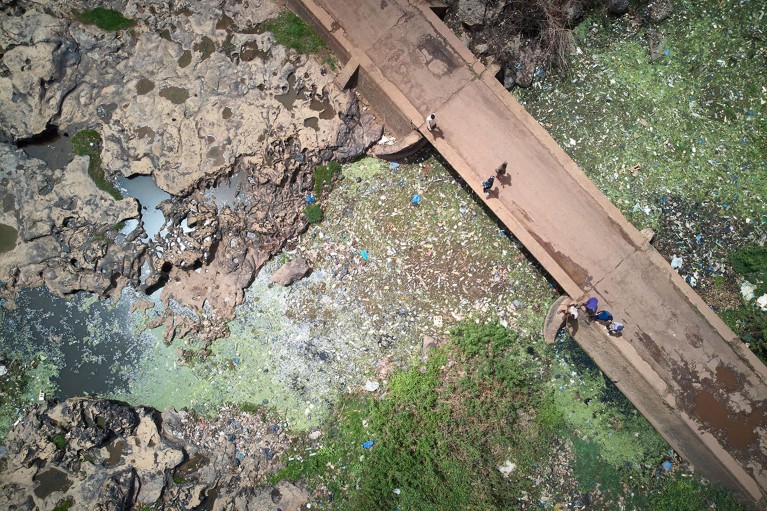
Plastic waste is clogging the Niger River in Bamako, Mali. After it sediments, plastic will become part of the geological record of human impacts on the planet. Credit: Michele Cattani/AFP via Getty
After 15 years of discussion, geologists last week decided that the Anthropocene — generally understood to be the age of irreversible human impacts on the planet — will not become an official epoch in Earth’s geological timeline.
The rejected proposal would have codified the end of the current Holocene epoch, which has been in place since the end of the last ice age 11,700 years ago. It suggested that the Anthropocene started in 1952, when plutonium from hydrogen-bomb tests showed up in the sediment of Crawford Lake near Toronto, Canada.
The vote has drawn controversy over procedural details, and debate about its legitimacy continues. But whether or not it’s formally approved as a stratigraphic term, the idea of the Anthropocene is now firmly rooted in research. So, how are scientists using the term, and what does it mean to them and their fields?
‘It’s a term that belongs to everyone’
As head of the Leverhulme Centre for Anthropocene Biodiversity at the University of York, UK, Chris Thomas has perhaps more riding on the term than most. “When the news of this — what sounds like a slightly dodgy vote — happened, I sort of wondered, is it the end of us? But I think not,” he says.
For Thomas, the word Anthropocene neatly summarizes the sense that humans are part of Earth’s system and integral to its processes — what he calls indivisible connectedness. “That helps move us away from the notion that somehow humanity is apart from the rest of nature and natural systems,” he says. “It’s undoable — the change is everywhere.”
The concept of an era of human-driven change also provides convenient common ground for him to collaborate with researchers from other disciplines. “This is something that people in the arts and humanities and the social sciences have picked up as well,” he says. “It is a means of enabling communication about the extent to which we are living in a truly unprecedented and human-altered world.”
Seen through that lens, the fact that the Anthropocene has been formally rejected because scientists can’t agree on when it began seems immaterial. “Many people in the humanities who are using the phrase find the concept of the articulation of a particular year, based on a deposit in a particular lake, a ridiculous way of framing the concept of a human-altered planet.”
Jacquelyn Gill, a palaeoecologist at the University of Maine in Orono, agrees. “It’s a term that belongs to everyone. To people working in philosophy and literary criticism, in the arts, in the humanities, the sciences,” she says. “I think it’s far more meaningful in the way that it is currently being used, than in any attempts that stratigraphers could have made to restrict or define it in some narrow sense.”
She adds: “It serves humanity best as a loose concept that we can use to define something that we all widely understand, which is that we live in an era where humans are the dominant force on ecological and geological processes.”
Capturing human influences
The idea of the Anthropocene is especially helpful to make clear that humans have been shaping the planet for thousands of years, and that not all of those changes have been bad, Gill says. “We could do a better job of thinking about human–environment relationships in ways that are not inherently negative all the time,” she says. “People are not a monolith, and neither are our attitudes or relationships to nature.”
Some 80% of biodiversity is currently stewarded on Indigenous lands, Gill points out. “Which should tell you something, right? That it’s not the presence of people that’s the problem,” she says. “The solution to those problems is changing the way that many dominant cultures relate to the natural world.”
The concept of the Anthropocene is owned by many fields, Gill says. “This reiterates the importance of understanding that the role of people on our planet requires many different ways of knowing and many different disciplines.”
In a world in which the threat of climate change dominates environmental debates, the term Anthropocene can help to broaden the discussion, says Yadvinder Malhi, a biodiversity researcher at the University of Oxford, UK.
“I use it all the time. For me, it captures the time where human influence has a global planetary effect, and it’s multidimensional. It’s much more than just climate change,” he says. “It’s what we’re doing. The oceans, the resources we are extracting, habitats changing.”
He adds: “I need that term when I’m trying to capture this idea of humans affecting the planet in multiple ways because of the size of our activity.”
The looseness of the term is popular, but would a formal definition help in any way? Malhi thinks it would. “There’s no other term available that captures the global multidimensional impacts on the planet,” he says. “But there is a problem in not having a formal definition if people are using it in different terms, in different ways.”
Although the word ‘Anthropocene’ makes some researchers think of processes that began 10,000 years ago, others consider it to mean those of the past century. “I think a formal adoption, like a definition, would actually help to clarify that.”
A 1953 nuclear weapons test in Nevada was among the human activities that could have marked the Anthropocene. NNSA/NEVADA FIELD OFFICE/SCIENCE SOURCE
For now, we’re still in the Holocene.
Science has confirmed that a panel of two dozen geologists has voted down a proposal to end the Holocene—our current span of geologic time, which began 11,700 years ago at the end of the last ice age—and inaugurate a new epoch, the Anthropocene. Starting in the 1950s, it would have marked a time when humanity’s influence on the planet became overwhelming. The vote, first reported by The New York Times, is a stunning—though not unexpected—rebuke for the proposal, which has been working its way through a formal approval process for more than a decade.
“The decision is definitive,” says Philip Gibbard, a geologist at the University of Cambridge who is on the panel and serves as secretary-general of the International Commission on Stratigraphy (ICS), the body that governs the geologic timescale. “There are no outstanding issues to be resolved. Case closed.”
The leaders of the Anthropocene Working Group (AWG), which developed the proposal for consideration by ICS’s Subcommission on Quaternary Stratigraphy, are not yet ready to admit defeat. They note that the online tally, in which 12 out of 18 subcommission members voted against the proposal, was leaked to the press without approval of the panel’s chair. “There remain several issues that need to be resolved about the validity of the vote and the circumstances surrounding it,” says Colin Waters, a geologist at the University of Leicester who chaired AWG.
Few opponents of the Anthropocene proposal doubted the enormous impact that human influence, including climate change, is having on the planet. But some felt the proposed marker of the epoch—some 10 centimeters of mud from Canada’s Crawford Lake that captures the global surge in fossil fuel burning, fertilizer use, and atomic bomb fallout that began in the 1950s—isn’t definitive enough.
Others questioned whether it’s even possible to affix one date to the start of humanity’s broad planetary influence: Why not the rise of agriculture? Why not the vast changes that followed European encroachment on the New World? “The Anthropocene epoch was never deep enough to understand human transformation of this planet,” says Erle Ellis, a geographer at the University of Maryland, Baltimore County who resigned last year in protest from AWG.
Opponents also felt AWG made too many announcements to the press over the years while being slow to submit a proposal to the subcommission. “The Anthropocene epoch was pushed through the media from the beginning—a publicity drive,” says Stanley Finney, a stratigrapher at California State University Long Beach and head of the International Union of Geological Sciences, which would have had final approval of the proposal.
Finney also complains that from the start, AWG was determined to secure an “epoch” categorization, and ignored or countered proposals for a less formal Anthropocene designation. If they had only made their formal proposal sooner, they could have avoided much lost time, Finney adds. “It would have been rejected 10 years earlier if they had not avoided presenting it to the stratigraphic community for careful consideration.”
The Anthropocene backers will now have to wait for a decade before their proposal can be considered again. ICS has long instituted this mandatory cooling-off period, given how furious debates can turn, for example, over the boundary between the Pliocene and Pleistocene, and whether the Quaternary—our current geologic period, a category above epochs—should exist at all.
Even if it is not formally recognized by geologists, the Anthropocene is here to stay. It is used in art exhibits, journal titles, and endless books. And Gibbard, Ellis, and others have advanced the view that it can remain an informal geologic term, calling it the “Anthropocene event.” Like the Great Oxygenation Event, in which cyanobacteria flushed the atmosphere with oxygen billions of years ago, the Anthropocene marks a huge transition, but one without an exact date. “Let us work together to ensure the creation of a far deeper and more inclusive Anthropocene event,” Ellis says.
Waters and his colleagues will continue to press that the Anthropocene is worthy of recognition in the geologic timescale, even if that advocacy has to continue in an informal capacity, he says. Although small in size, Anthropocene strata such as the 10 centimeters of lake mud are distinct and can be traced using more than 100 durable geochemical signals, he says. And there is no going back to where the planet was 100 years ago, he says. “The Earth system changes that mark the Anthropocene are collectively irreversible.”
A panel of experts voted down a proposal to officially declare the start of a new interval of geologic time, one defined by humanity’s changes to the planet.
In weighing their decision, scientists considered the effect on the world of nuclear activity. A 1946 test blast over Bikini atoll. Credit: Jack Rice/Associated Press
Not yet, scientists have decided, after a debate that has spanned nearly 15 years. Or the blink of an eye, depending on how you look at it.
A committee of roughly two dozen scholars has, by a large majority, voted down a proposal to declare the start of the Anthropocene, a newly created epoch of geologic time, according to an internal announcement of the voting results seen by The New York Times.
By geologists’ current timeline of Earth’s 4.6-billion-year history, our world right now is in the Holocene, which began 11,700 years ago with the most recent retreat of the great glaciers. Amending the chronology to say we had moved on to the Anthropocene would represent an acknowledgment that recent, human-induced changes to geological conditions had been profound enough to bring the Holocene to a close.
The declaration would shape terminology in textbooks, research articles and museums worldwide. It would guide scientists in their understanding of our still-unfolding present for generations, perhaps even millenniums, to come.
In the end, though, the members of the committee that voted on the Anthropocene over the past month were not only weighing how consequential this period had been for the planet. They also had to consider when, precisely, it began.
By the definition that an earlier panel of experts spent nearly a decade and a half debating and crafting, the Anthropocene started in the mid-20th century, when nuclear bomb tests scattered radioactive fallout across our world. To several members of the scientific committee that considered the panel’s proposal in recent weeks, this definition was too limited, too awkwardly recent, to be a fitting signpost of Homo sapiens’s reshaping of planet Earth.
“It constrains, it confines, it narrows down the whole importance of the Anthropocene,” said Jan A. Piotrowski, a committee member and geologist at Aarhus University in Denmark. “What was going on during the onset of agriculture? How about the Industrial Revolution? How about the colonizing of the Americas, of Australia?”
“Human impact goes much deeper into geological time,” said another committee member, Mike Walker, an earth scientist and professor emeritus at the University of Wales Trinity Saint David. “If we ignore that, we are ignoring the true impact, the real impact, that humans have on our planet.”
Hours after the voting results were circulated within the committee early Tuesday, some members said they were surprised at the margin of votes against the Anthropocene proposal compared with those in favor: 12 to four, with two abstentions. (Another three committee members neither voted nor formally abstained.)
Even so, it was unclear on Tuesday whether the results stood as a conclusive rejection or whether they might still be challenged or appealed. In an email to The Times, the committee’s chair, Jan A. Zalasiewicz, said there were “some procedural issues to consider” but declined to discuss them further. Dr. Zalasiewicz, a geologist at the University of Leicester, has expressed support for canonizing the Anthropocene.
This question of how to situate our time in the narrative arc of Earth history has thrust the rarefied world of geological timekeepers into an unfamiliar limelight.
The grandly named chapters of our planet’s history are governed by a body of scientists, the International Union of Geological Sciences. The organization uses rigorous criteria to decide when each chapter started and which characteristics defined it. The aim is to uphold common global standards for expressing the planet’s history.
Polyethylene being extruded and fed into a cooling bath during plastics manufacture, circa 1950. Credit: Hulton Archive, via Getty Images
Geoscientists don’t deny our era stands out within that long history. Radionuclides from nuclear tests. Plastics and industrial ash. Concrete and metal pollutants. Rapid greenhouse warming. Sharply increased species extinctions. These and other products of modern civilization are leaving unmistakable remnants in the mineral record, particularly since the mid-20th century.
Still, to qualify for its own entry on the geologic time scale, the Anthropocene would have to be defined in a very particular way, one that would meet the needs of geologists and not necessarily those of the anthropologists, artists and others who are already using the term.
That’s why several experts who have voiced skepticism about enshrining the Anthropocene emphasized that the vote against it shouldn’t be read as a referendum among scientists on the broad state of the Earth. “This was a narrow, technical matter for geologists, for the most part,” said one of those skeptics, Erle C. Ellis, an environmental scientist at the University of Maryland, Baltimore County. “This has nothing to do with the evidence that people are changing the planet,” Dr. Ellis said. “The evidence just keeps growing.”
Francine M.G. McCarthy, a micropaleontologist at Brock University in St. Catharines, Ontario, is the opposite of a skeptic: She helped lead some of the research to support ratifying the new epoch.
“We are in the Anthropocene, irrespective of a line on the time scale,” Dr. McCarthy said. “And behaving accordingly is our only path forward.”
The Anthropocene proposal got its start in 2009, when a working group was convened to investigate whether recent planetary changes merited a place on the geologic timeline. After years of deliberation, the group, which came to include Dr. McCarthy, Dr. Ellis and some three dozen others, decided that they did. The group also decided that the best start date for the new period was around 1950.
The group then had to choose a physical site that would most clearly show a definitive break between the Holocene and the Anthropocene. They settled on Crawford Lake, in Ontario, where the deep waters have preserved detailed records of geochemical change within the sediments at the bottom.
Last fall, the working group submitted its Anthropocene proposal to the first of three governing committees under the International Union of Geological Sciences. Sixty percent of each committee has to approve the proposal for it to advance to the next.
The members of the first one, the Subcommission on Quaternary Stratigraphy, submitted their votes starting in early February. (Stratigraphy is the branch of geology concerned with rock layers and how they relate in time. The Quaternary is the ongoing geologic period that began 2.6 million years ago.)
Under the rules of stratigraphy, each interval of Earth time needs a clear, objective starting point, one that applies worldwide. The Anthropocene working group proposed the mid-20th century because it bracketed the postwar explosion of economic growth, globalization, urbanization and energy use. But several members of the subcommission said humankind’s upending of Earth was a far more sprawling story, one that might not even have a single start date across every part of the planet.
The world’s first full-scale atomic power station in Britain in 1956. Credit: Hulton Archive, via Getty Images
This is why Dr. Walker, Dr. Piotrowski and others prefer to describe the Anthropocene as an “event,” not an “epoch.” In the language of geology, events are a looser term. They don’t appear on the official timeline, and no committees need to approve their start dates.
Yet many of the planet’s most significant happenings are called events, including mass extinctions, rapid expansions of biodiversity and the filling of Earth’s skies with oxygen 2.1 to 2.4 billion years ago.
Even if the subcommission’s vote is upheld and the Anthropocene proposal is rebuffed, the new epoch could still be added to the timeline at some later point. It would, however, have to go through the whole process of discussion and voting all over again.
Time will march on. Evidence of our civilization’s effects on Earth will continue accumulating in the rocks. The task of interpreting what it all means, and how it fits into the grand sweep of history, might fall to the future inheritors of our world.
“Our impact is here to stay and to be recognizable in the future in the geological record — there is absolutely no question about this,” Dr. Piotrowski said. “It will be up to the people that will be coming after us to decide how to rank it.”
Raymond Zhong reports on climate and environmental issues for The Times.
Latest News on Climate Change and the Environment
Protecting groundwater. After years of decline in the nation’s groundwater, a series of developments indicate that U.S. state and federal officials may begin tightening protections for the dwindling resource. In Nevada, Idaho and Montana, court decisions have strengthened states’ ability to restrict overpumping. California is considering penalizing officials for draining aquifers. And the White House has asked scientists to advise how the federal government can help.
Weather-related disasters. An estimated 2.5 million people were forced from their homes in the United States by weather-related disasters in 2023, according to new data from the Census Bureau. The numbers paint a more complete picture than ever before of the lives of people affected by such events as climate change supercharges extreme weather.
Amazon rainforest. Up to half of the Amazon rainforest could transform into grasslands or weakened ecosystems in the coming decades, a new study found, as climate change, deforestation and severe droughts damage huge areas beyond their ability to recover. Those stresses in the most vulnerable parts of the rainforest could eventually drive the entire forest ecosystem past a tipping point that would trigger a forest-wide collapse, researchers said.
A significant threshold. Over the past 12 months, the average temperature worldwide was more than 1.5 degrees Celsius, or 2.7 degrees Fahrenheit, higher than it was at the dawn of the industrial age. That number carries special significance, as nations agreed under the 2015 Paris Agreement to try to keep the difference between average temperatures today and in preindustrial times to 1.5 degrees Celsius, or at least below 2 degrees Celsius.
New highs. The exceptional warmth that first enveloped the planet last summer is continuing strong into 2024: Last month clocked in as the hottest January ever measured, and the hottest January on record for the oceans, too. Sea surface temperatures were just slightly lower than in August 2023, the oceans’ warmest month on the books.
Un comité de expertos ha tumbado la propuesta de declarar un nuevo momento geológico, pero el propio presidente denuncia irregularidades en la votación
Manuel Ansede
Madrid –
Extracción de un testigo de sedimentos del fondo del lago Crawford, a las afueras de Toronto (Canadá). TIM PATTERSON / UNIVERSIDAD DE CARLETON
La idea del Antropoceno —que la humanidad vive desde 1950 en una nueva época geológica caracterizada por la contaminación humana— se ha hecho tan popular en los últimos años que hasta la Real Academia Española adoptó el término en el Diccionario de la Lengua en 2021. Los académicos se dieron esta vez demasiada prisa. El concepto sigue en el aire, en medio de una vehemente polémica entre especialistas. Miembros del comité de expertos que debe tomar la decisión en la Unión Internacional de Ciencias Geológicas (UICG) —la Subcomisión de Estratigrafía del Cuaternario— han filtrado este martes al diario The New York Times que han votado mayoritariamente en contra de reconocer la existencia del Antropoceno. Sin embargo, el presidente de la Subcomisión, el geólogo Jan Zalasiewicz, explica a EL PAÍS que el resultado preliminar de la votación se ha anunciado sin su autorización y que todavía quedan “algunos asuntos pendientes con los votos que hay que resolver”. La humanidad todavía no sabe en qué época geológica vive.
El químico holandés Paul Crutzen, ganador del Nobel de Química por iluminar el agujero de la capa de ozono, planteó en el año 2000 que el planeta había entrado en una nueva época, provocada por el impacto brutal de los seres humanos. Un equipo internacional de especialistas, el Grupo de Trabajo del Antropoceno, ha analizado los hechos científicos desde 2009 y el año pasado presentó una propuesta para proclamar oficialmente esta nueva época geológica, marcada por la radiactividad de las bombas atómicas y los contaminantes procedentes de la quema de carbón y petróleo. El diminuto lago Crawford, a las afueras de Toronto (Canadá), era el lugar indicado para ejemplificar el inicio del Antropoceno, gracias a los sedimentos de su fondo, imperturbados desde hace siglos.
La mayoría de los miembros de la Subcomisión de Estratigrafía del Cuaternario de la UICG ha votado en contra de la propuesta, según el periódico estadounidense. El geólogo británico Colin Waters, líder del Grupo de Trabajo del Antropoceno, explica a EL PAÍS que se ha enterado por la prensa. “Todavía no hemos recibido una confirmación oficial directamente del secretario de la Subcomisión de Estratigrafía del Cuaternario. Parece que The New York Times recibe los resultados antes que nosotros, es muy decepcionante”, lamenta Waters.
El geólogo reconoce que el dictamen, si se confirma, sería el fin de su propuesta actual, pero no se rinde. “Tenemos muchos investigadores eminentes que desean continuar como grupo, de manera informal, defendiendo las evidencias de que el Antropoceno debería ser formalizado como una época”, afirma. A su juicio, los estratos geológicos actuales —contaminados por isótopos radiactivos, microplásticos, cenizas y pesticidas— han cambiado de manera irreversible respecto a los del Holoceno, la época geológica iniciada hace más de 10.000 años, tras la última glaciación. “Dadas las pruebas existentes, que siguen aumentando, no me sorprendería un futuro llamamiento a reconsiderar nuestra propuesta”, opina Waters, de la Universidad de Leicester.
El jefe del Grupo de Trabajo del Antropoceno sostiene que hay “algunas cuestiones de procedimiento” que ponen en duda la validez de la votación. La geóloga italiana Silvia Peppoloni, jefa de la Comisión de Geoética de la UICG, confirma que su equipo ha realizado un informe sobre esta pelea entre la Subcomisión de Estratigrafía del Cuaternario y el Grupo de Trabajo del Antropoceno. El documento está sobre la mesa del presidente de la UICG, el británico John Ludden.
La geóloga canadiense Francine McCarthy estaba convencida de que el lago Crawford convencería a los escépticos. Desde fuera parece pequeño, con apenas 250 metros de largo, pero su profundidad roza los 25 metros. Sus aguas superficiales no se mezclan con las de su lecho, por lo que el suelo del fondo se puede analizar como una lasaña, en la que cada capa acumula sedimentos procedentes de la atmósfera. Ese calendario subacuático del lago Crawford revela la denominada Gran Aceleración, el momento alrededor de 1950 en el que la humanidad empezó a dejar una huella cada vez más evidente, con el lanzamiento de bombas atómicas, la quema masiva de petróleo y carbón y la extinción de especies.
“Ignorar el enorme impacto de los humanos en nuestro planeta desde mediados del siglo XX tiene potencialmente consecuencias dañinas, al minimizar la importancia de los datos científicos para hacer frente al evidente cambio en el sistema de la Tierra, como ya señaló Paul Crutzen hace casi 25 años”, advierte McCarthy.
Grupo rejeitou que mudanças sejam profundas o bastante para encerrar o Holoceno
Raymond Zhong
5 de março de 2024
O Triássico foi o amanhecer dos dinossauros. O Paleogeno viu a ascensão dos mamíferos. O Pleistoceno incluiu as últimas eras glaciais.
Está na hora de marcar a transformação da humanidade no planeta com seu próprio capítulo na história da Terra, o “Antropoceno”, ou a época humana?
Ainda não, decidiram os cientistas, após um debate que durou quase 15 anos. Ou um piscar de olhos, dependendo do ângulo pelo qual você olha.
Um comitê de cerca de duas dezenas de estudiosos votou, em grande maioria, contra uma proposta de declarar o início do Antropoceno, uma época recém-criada do tempo geológico, de acordo com um anúncio interno dos resultados da votação visto pelo The New York Times.
Pela linha do tempo atual dos geólogos da história de 4,6 bilhões de anos da Terra, nosso mundo agora está no Holoceno, que começou há 11,7 mil anos com o recuo mais recente dos grandes glaciares.
Alterar a cronologia para dizer que avançamos para o Antropoceno representaria um reconhecimento de que as mudanças recentes induzidas pelo homem nas condições geológicas foram profundas o suficiente para encerrar o Holoceno.
A declaração moldaria a terminologia em livros didáticos, artigos de pesquisa e museus em todo o mundo. Orientaria os cientistas em sua compreensão do nosso presente ainda em desenvolvimento por gerações, talvez até por milênios.
No fim das contas, porém, os membros do comitê que votaram sobre o Antropoceno nas últimas semanas não estavam apenas considerando o quão determinante esse período havia sido para o planeta. Eles também tiveram que considerar quando, precisamente, ele começou.
Pela definição que um painel anterior de especialistas passou quase uma década e meia debatendo e elaborando, o Antropoceno começou na metade do século 20, quando testes de bombas nucleares espalharam material radioativo por todo o nosso mundo.
Para vários membros do comitê científico que avaliaram a proposta do painel nas últimas semanas, essa definição era muito limitada, muito recente e inadequada para ser um marco adequado da remodelação do Homo sapiens no planeta Terra.
“Isso restringe, confina, estreita toda a importância do Antropoceno”, disse Jan A. Piotrowski, membro do comitê e geólogo da Universidade de Aarhus, na Dinamarca. “O que estava acontecendo durante o início da agricultura? E a Revolução Industrial? E a colonização das Américas, da Austrália?”
“O impacto humano vai muito mais fundo no tempo geológico”, disse outro membro do comitê, Mike Walker, cientista da Terra e professor emérito da Universidade de Gales Trinity Saint David. “Se ignorarmos isso, estamos ignorando o verdadeiro impacto que os humanos têm em nosso planeta.”
Horas após a circulação dos resultados da votação dentro do comitê nesta terça-feira (5) de manhã, alguns membros disseram que ficaram surpresos com a margem de votos contra a proposta do Antropoceno em comparação com os a favor: 12 a 4, com 2 abstenções.
Mesmo assim, nesta terça de manhã não ficou claro se os resultados representavam uma rejeição conclusiva ou se ainda poderiam ser contestados ou apelados. Em um e-mail para o Times, o presidente do comitê, Jan A. Zalasiewicz, disse que havia “algumas questões procedimentais a considerar”, mas se recusou a discuti-las mais a fundo.
Zalasiewicz, geólogo da Universidade de Leicester, expressou apoio à canonização do Antropoceno.
Essa questão de como situar nosso tempo na narrativa da história da Terra colocou o mundo dos guardiões do tempo geológico sob uma luz desconhecida.
Os capítulos grandiosamente nomeados da história de nosso planeta são governados por um grupo de cientistas, a União Internacional de Ciências Geológicas. A organização usa critérios rigorosos para decidir quando cada capítulo começou e quais características o definiram. O objetivo é manter padrões globais comuns para expressar a história do planeta.
Os geocientistas não negam que nossa era se destaca dentro dessa longa história. Radionuclídeos de testes nucleares. Plásticos e cinzas industriais. Poluentes de concreto e metal. Aquecimento global rápido. Aumento acentuado de extinções de espécies. Esses e outros produtos da civilização moderna estão deixando vestígios inconfundíveis no registro mineral, especialmente desde meados do século 20.
Ainda assim, para se qualificar para a entrada na escala de tempo geológico, o Antropoceno teria que ser definido de uma maneira muito específica, que atendesse às necessidades dos geólogos e não necessariamente dos antropólogos, artistas e outros que já estão usando o termo.
Por isso, vários especialistas que expressaram ceticismo quanto à consagração do Antropoceno enfatizaram que o voto contra não deve ser interpretado como um referendo entre cientistas sobre o amplo estado da Terra.
“Este é um assunto específico e técnico para os geólogos, em sua maioria”, disse um desses céticos, Erle C. Ellis, um cientista ambiental da Universidade de Maryland. “Isso não tem nada a ver com a evidência de que as pessoas estão mudando o planeta”, afirmou Ellis. “A evidência continua crescendo.”
Francine M.G. McCarthy, micropaleontóloga da Universidade Brock em St. Catharines, Ontário (Canadá), é tem visão oposta: ela ajudou a liderar algumas das pesquisas para apoiar a ratificação da nova época.
“Estamos no Antropoceno, independentemente de uma linha na escala de tempo”, disse McCarthy. “E agir de acordo é o nosso único caminho a seguir.”
A proposta do Antropoceno teve início em 2009, quando um grupo de trabalho foi convocado para investigar se as recentes mudanças planetárias mereciam um lugar na linha do tempo geológica.
Após anos de deliberação, o grupo, que passou a incluir McCarthy, Ellis e cerca de três dezenas de outros, decidiu que sim. O grupo também decidiu que a melhor data de início para o novo período era por volta de 1950.
O grupo então teve que escolher um local físico que mostrasse de forma mais clara uma quebra definitiva entre o Holoceno e o Antropoceno. Eles escolheram o Lago Crawford, em Ontário, no Canadá, onde as águas profundas preservaram registros detalhados de mudanças geoquímicas nos sedimentos do fundo.
No outono passado, o grupo de trabalho enviou sua proposta do Antropoceno para o primeiro dos três comitês governantes da União Internacional de Ciências Geológicas —60% de cada comitê precisam aprovar a proposta para que ela avance para o próximo.
Os membros do primeiro comitê, a Subcomissão de Estratigrafia do Quaternário, enviaram seus votos a partir do início de fevereiro. (Estratigrafia é o ramo da geologia que se dedica ao estudo das camadas de rocha e como elas se relacionam no tempo. O Quaternário é o período geológico em curso que começou há 2,6 milhões de anos.)
De acordo com as regras da estratigrafia, cada intervalo de tempo da Terra precisa de um ponto de partida claro e objetivo, que se aplique em todo o mundo. O grupo de trabalho do Antropoceno propôs meados do século 20 porque isso abrangia a explosão do crescimento econômico pós-guerra, a globalização, a urbanização e o uso de energia.
Mas vários membros da subcomissão disseram que a transformação da humanidade na Terra era uma história muito mais abrangente, que talvez nem tenha uma única data de início em todas as partes do planeta.
Por isso, Walker, Piotrowski e outros preferem descrever o Antropoceno como um “evento”, não como uma “época”. Na linguagem da geologia, eventos são um termo mais amplo. Eles não aparecem na linha do tempo oficial, e nenhum comitê precisa aprovar suas datas de início.
No entanto, muitos dos acontecimentos mais significativos do planeta são chamados de eventos, incluindo extinções em massa, expansões rápidas da biodiversidade e o preenchimento dos céus da Terra com oxigênio há 2,1 bilhões a 2,4 bilhões de anos.
Mesmo que o voto da subcomissão seja mantido e a proposta do Antropoceno seja rejeitada, a nova época ainda poderá ser adicionada à linha do tempo em algum momento posterior. No entanto, terá que passar por todo o processo de discussão e votação novamente.
We can reduce global temperatures faster than we once thought — if we act now
One of the biggest obstacles to avoiding global climate breakdown is that so many people think there’s nothing we can do about it.
They point out that record-breaking heat waves, fires and storms are already devastating communities and economies throughout the world. And they’ve long been told that temperatures will keep rising for decades to come, no matter how many solar panels replace oil derricks or how many meat-eaters go vegetarian. No wonder they think we’re doomed.
But climate science actually doesn’t say this. To the contrary, the best climate science you’ve probably never heard of suggests that humanity can still limit the damage to a fraction of the worst projections if — and, we admit, this is a big if — governments, businesses and all of us take strong action starting now.
For many years, the scientific rule of thumb was that a sizable amount of temperature rise was locked into the Earth’s climate system. Scientists believed — and told policymakers and journalists, who in turn told the public — that even if humanity hypothetically halted all heat-trapping emissions overnight, carbon dioxide’s long lifetime in the atmosphere, combined with the sluggish thermal properties of the oceans, would nevertheless keep global temperatures rising for 30 to 40 more years. Since shifting to a zero-carbon global economy would take at least a decade or two, temperatures were bound to keep rising for at least another half-century.
But guided by subsequent research, scientists dramatically revised that lag time estimate down to as little as three to five years. That is an enormous difference that carries paradigm-shifting and broadly hopeful implications for how people, especially young people, think and feel about the climate emergency and how societies can respond to it.
This revised science means that if humanity slashes emissions to zero, global temperatures will stop rising almost immediately. To be clear, this is not a get-out-of-jail-free card. Global temperatures will not fall if emissions go to zero, so the planet’s ice will keep melting and sea levels will keep rising. But global temperatures will stop their relentless climb, buying humanity time to devise ways to deal with such unavoidable impacts. In short, we are not irrevocably doomed — or at least we don’t have to be, if we take bold, rapid action.
The science we’re referencing was included — but buried — in the United Nations Intergovernmental Panel on Climate Change’s most recent report, issued in August. Indeed, it was first featured in the IPCC’s landmark 2018 report, “Global warming of 1.5 C.”That report’s key finding — that global emissions must fall by 45 percent by 2030 to avoid catastrophic climate disruption — generated headlines declaring that we had “12 years to save the planet.” That 12-year timeline, and the related concept of a “carbon budget” — the amount of carbon that can be burned while still limiting temperature rise to 1.5 degrees Celsius above preindustrial levels — were both rooted in this revised science. Meanwhile, the public and policy worlds have largely neglected the revised science that enabled these very estimates.
Nonscientists can reasonably ask: What made scientists change their minds? Why should we believe their new estimate of a three-to-five-year lag time if their previous estimate of 30 to 40 years is now known to be incorrect? And does this mean the world still must cut emissions in half by 2030 to avoid climate catastrophe?
The short answer to the last question is yes. Remember, temperatures only stop rising once global emissions fall to zero. Currently, emissions are not falling. Instead, humanity continues to pump approximately 36 billion tons of carbon dioxide a year into the atmosphere. The longer it takes to cut those 36 billion tons to zero, the more temperature rise humanity eventually will face. And as the IPCC’s 2018 report made hauntingly clear, pushing temperatures above 1.5 degrees C would cause unspeakable amounts of human suffering, economic loss and social breakdown — and perhaps trigger genuinely irreversible impacts.
Scientists changed their minds about how much warming is locked in because additional research gave them a much better understanding of how the climate system works. Their initial 30-to-40-year estimates were based on relatively simple computer models that treated the concentration of carbon dioxide in the atmosphere as a “control knob” that determines temperature levels. The long lag in the warming impact is due to the oceans, which continue to warm long after the control knob is turned up. More recent climate models account for the more dynamic nature of carbon emissions. Yes, CO2 pushes temperatures higher, but carbon “sinks,” including forests and in particular the oceans, absorb almost half of the CO2 that is emitted, causing atmospheric CO2 levels to drop, offsetting the delayed warming effect.
Knowing that 30 more years of rising temperatures are not necessarily locked in can be a game-changer for how people, governments and businesses respond to the climate crisis. Understanding that we can still save our civilization if we take strong, fast action can banish the psychological despair that paralyzes people and instead motivate them to get involved. Lifestyle changes can help, but that involvement must also include political engagement. Slashing emissions in half by 2030 demands the fastest possible transition away from today’s fossil-fueled economies in favor of wind, solar and other non-carbon alternatives. That can happen only if governments enact dramatically different policies. If citizens understand that things aren’t hopeless, they can better push elected officials to make such changes.
As important as minimizing temperature rise is to the United States, where last year’s record wildfires in California and the Pacific Northwest illustrated just how deadly climate change can be, it matters most in the highly climate-vulnerable communities throughout the global South. Countless people in Bangladesh, the Philippines, Madagascar, Africa’s Sahel nations, Brazil, Honduras and other low-income countries have already been suffering from climate disasters for decades because their communities tend to be more exposed to climate impacts and have less financial capacity to protect themselves. For millions of people in such countries, limiting temperature rise to 1.5 degrees C is not a scientific abstraction.
The IPCC’s next report, due for release Feb. 28, will address how societies can adapt to the temperature rise now underway and the fires, storms and rising seas it unleashes. If we want a livable future for today’s young people, temperature rise must be kept as close as possible to 1.5 C. The best climate science most people have never heard of says that goal remains within reach. The question is whether enough of us will act on that knowledge in time.


/cloudfront-eu-central-1.images.arcpublishing.com/prisa/KAZHWIUCH5FM5JORPAPL5JTWWE.jpg)
 Uma (in)certa antropologia