Arquivo da tag: Bias

The Mystery Genes That Are Keeping You Alive (Wired)

Nobody knows what around a fifth of your genes actually do. It’s hoped they could hold the secret to fixing developmental disorders, cancer, neurodegeneration, and more.
Original article

dna molecule illustration

Roger Highfield – Aug 8, 2023 2:00 PM

One could be forgiven for a little genetic déjà vu.

Launched in 1990, the Human Genome Project unveiled its first readout of the human DNA sequence with great fanfare in 2000. The human genome was declared essentially complete in 2003—but it took nearly 20 more years before the final, complete version was released.

This did not mark the end of humankind’s genetic puzzle, however. A new study has mapped the yawning gap between reading our genes and understanding them. Vast parts of the genome—areas the study authors have nicknamed the “Unknome”—are made of genes whose function we still don’t know.

This has important implications for medicine: Genes are the instructions for making the protein building blocks of the body. Plenty of those still shrouded in darkness could have profound medical significance and may hold the keys to disorders of development, cancer, neurodegeneration, and more.

The study makes it embarrassingly clear just how many important genes we know little to nothing about. It estimates that a fifth of human genes with a vital function are still essentially a mystery. The good news is that the research also outlines how scientists can focus on those mystery genes. “We might now be at the beginning of the end of the Unknome,” says Matthew Freeman of the Dunn School of Pathology at the University of Oxford, a coauthor of the study.

The research team used two tools to find the gaps in our knowledge. First, using the plethora of existing databases of genetic information, they compared the genetic codes of many different species to reveal genes that look roughly similar.

These riffs on a genetic theme are known as conserved genes, and even if we don’t understand what they do, we know that they must be important because nature is parsimonious and tends to use the same genetic machinery to do important jobs in different organisms. “The one thing we could be confident of is that, if important, these genes would be quite well-conserved across evolution,” says Freeman.

Once they had found similar genetic riffs in worms, humans, flies, bacteria, and other organisms, the researchers could look at what was known about the function of these clearly important genes and score them accordingly, with a high “knownness” score reflecting solid understanding.

Because so much genetic information is already available on hundreds of genomes and recorded in a standardized way, it was possible to automate this scoring process. “We then asked how many of those [conserved genes] have a score of less than one, where essentially nothing is known about them,” says Freeman. “To our surprise, two decades after the first human genome, it is still an extraordinary number.”

In all, the total number of human genes with a knownness score of 1 or less is currently 1,723 out of 19,664.

By the same token, the top 10 genes identified by the team’s rummage through genetic databases corresponded with “all the most famous genes, which is reassuring,” says Sean Munro of the Laboratory of Molecular Biology in Cambridge, a study coauthor. “We recognized every single one of them, and there are already thousands of papers about each of them.”

When it came to the substantial number that were unknown, the team conducted one more study, using the best understood (at the genetic level) organism of all: Drosophila melanogaster. These fruit flies have been the subject of research for more than a century because they are easy and inexpensive to breed, have a short life cycle, produce lots of young, and can be genetically modified in numerous ways.

The team used gene editing to dial down the use of around 300 low-scoring genes found in both humans and fruit flies. “We found that one-quarter of these unknown genes were lethal—when knocked out, they caused the flies to die, and yet nobody had ever known anything about them,” says Freeman. “Another 25 percent of them caused changes in the flies—phenotypes—that we could detect in many ways.” These genes were linked with fertility, development, locomotion, protein quality control, and resilience to stress. “That so many fundamental genes are not understood was eye-opening,” Freeman says. It’s possible that variation in these genes could have very big impacts on human health.

All of this “unknomics” information is held on a database, which the team is making available for other researchers to use to discover new biology. The next step may be to hand the data on these mystery genes and the mystery proteins they create over to AI.

DeepMind’s AlphaFold, for example, can provide important insights into what mystery proteins do, notably by revealing how they interact with other proteins, says Alex Bateman of the European Bioinformatics Institute, based near Cambridge, UK. So can cryo-EM, which is a way of producing images of large, complex molecules, he says. And a University College London team has shown a systematic way to use machine learning to figure out what proteins do in yeast.

The Unknome is unusual in that it’s a biology database that will shrink as we understand it better. The paper shows that over the past decade “we have moved from 40 percent to 20 percent of the human proteome having a certain level of unknownness,” says Bateman. However, at current progress rates, working out the function of all human protein-coding genes could take more than half a century, Freeman estimates.

The discovery that so many genes remain misunderstood reflects what is called the streetlight effect, or the drunkard’s search principle, an observational bias that occurs when people only search for something where it is easiest to look. In this case, it has caused what Freeman and Munro call a “bias in biological research toward the previously studied.”

The same goes for researchers, who tend to get funding for research in relatively well-understood areas, rather than going off into what Freeman calls the wilderness. This is why the database is so important, Munro explains—it fights back against the economics of academia, which avoids things that are very poorly understood. “There is a need for a different type of support to address these unknowns,” says Munro.

But even with the database becoming available and researchers picking through it, there will still be some knowledge blind spots. The study focused on genes that are responsible for proteins. Over the past two decades, uncharted areas of the genome have also been found to harbor the code for small RNAs—scraps of genetic material that can affect other genes, and which are critical regulators of normal development and bodily functions. There may be more “unknown unknowns” lurking in the human genome.

For now, there’s still plenty to get into, and Freeman hopes this work will encourage others to study the genetic Terra Incognita: “There’s more than enough Unknome for anyone who wants to explore genuinely new biology.”


The Complicated Legacy of E. O. Wilson (Scientific American)

scientificamerican.com

Monica R. McLemore

We must reckon with his and other scientists’ racist ideas if we want an equitable future

December 29, 2021


American biologist E. O. Wilson in Lexington, Mass., on October 21, 2021. Credit: Gretchen Ertl/Reuters/Alamy

With the death of biologist E. O. Wilson on Sunday, I find myself again reflecting on the complicated legacies of scientists whose works are built on racist ideas and how these ideas came to define our understanding of the world.

After a long clinical career as a registered nurse, I became a laboratory-trained scientist as researchers mapped the first draft of the human genome. It was during this time that I intimately familiarized myself with Wilson’s work and his dangerous ideas on what factors influence human behavior.

His influential text Sociobiology: The New Synthesis contributed to the false dichotomy of nature versus nurture and spawned an entire field of behavioral psychology grounded in the notion that differences among humans could be explained by genetics, inheritance and other biological mechanisms. Finding out that Wilson thought this way was a huge disappointment, because I had enjoyed his novel Anthill, which was published much later and written for the public.

Wilson was hardly alone in his problematic beliefs. His predecessors—mathematician Karl Pearson, anthropologist Francis Galton, Charles Darwin, Gregor Mendel and others—also published works and spoke of theories fraught with racist ideas about distributions of health and illness in populations without any attention to the context in which these distributions occur.

Even modern geneticists and genome scientists struggle with inherent racism in the way they gather and analyze data. In his memoir A Life Decoded: My Genome: My Life, geneticist J. Craig Venter writes, “The complex provenance of ideas means their origin is often open to interpretation.”

To put the legacy of their work in the proper perspective, a more nuanced understanding of problematic scientists is necessary. It is true that work can be both important and problematic—they can coexist. Therefore it is necessary to evaluate and critique these scientists, considering, specifically the value of their work and, at the same time, their contributions to scientific racism.

First, the so-called normal distribution of statistics assumes that there are default humans who serve as the standard that the rest of us can be accurately measured against. The fact that we don’t adequately take into account differences between experimental and reference group determinants of risk and resilience, particularly in the health sciences, has been a hallmark of inadequate scientific methods based on theoretical underpinnings of a superior subject and an inferior one. Commenting on COVID and vaccine acceptance in an interview with PBS NewsHour, recently retired director of the National Institutes of Health Francis Collins pointed out, “You know, maybe we underinvested in research on human behavior.”

Second, the application of the scientific method matters: what works for ants and other nonhuman species is not always relevant for health and/or human outcomes. For example, the associations of Black people with poor health outcomes, economic disadvantage and reduced life expectancy can be explained by structural racism, yet Blackness or Black culture is frequently cited as the driver of those health disparities. Ant culture is hierarchal and matriarchal, based on human understandings of gender. And the descriptions and importance of ant societies existing as colonies is a component of Wilson’s work that should have been critiqued. Context matters.

Lastly, examining nurture versus nature without any attention to externalities, such as opportunities and potential (financial structures, religiosity, community resources and other societal structures), that deeply influence human existence and experiences is both a crude and cruel lens. This dispassionate query will lead to individualistic notions of the value and meaning of human lives while, as a society, our collective fates are inextricably linked.

As we are currently seeing in the COVID-19 pandemic, public health and prevention measures are colliding with health services delivery and individual responsibility. Coexistence of approaches that take both of these  into account are interrelated and necessary.

So how do we engage with the problematic work of scientists whose legacy is complicated? I would suggest three strategies to move toward a more nuanced understanding of their work in context.

First, truth and reconciliation are necessary in the scientific record, including attention to citational practices when using or reporting on problematic work. This approach includes thinking critically about where and when to include historically problematic work and the context necessary for readers to understand the limitations of the ideas embedded in it. This will require commitments from journal editors, peer reviewers and the scientific community to invest in retrofitting existing publications with this expertise. They can do so by employing humanities scholars, journalists and other science communicators with the appropriate expertise to evaluate health and life sciences manuscripts submitted for publication.

Second, diversifying the scientific workforce is crucial not only to asking new types of research questions and unlocking new discoveries but also to conducting better science. Other scholars have pointed out that feminist standpoint theory is helpful in understanding white empiricism and who is eligible to be a worthy observer of the human condition and our world. We can apply the same approach to scientific research. All of society loses when there are limited perspectives that are grounded in faulty notions of one or another group of humans’ potential. As my work and that of others have shown, the people most burdened by poor health conditions are more often the ones trying to address the underlying causes with innovative solutions and strategies that can be scientifically tested.

Finally, we need new methods. One of the many gifts of the Human Genome Project was the creativity it spawned beyond revealing the secrets of the genome, such as new rules about public availability and use of data. Multiple labs and trainees were able to collaborate and share work while establishing independent careers. New rules of engagement emerged around the ethical, legal and social implications of the work. Undoing scientific racism will require commitments from the entire scientific community to determine the portions of historically problematic work that are relevant and to let the scientific method function the way it was designed—to allow for dated ideas to be debunked and replaced.

The early work of Venter and Collins was foundational to my dissertation, which examined tumor markers of ovarian cancer. I spent time during my training at the NIH learning from these iconic clinicians and scholars and had occasion to meet and question both of them. As a person who uses science as one of many tools to understand the world, it is important to remain curious in our work. Creative minds should not be resistant to change when rigorous new data are presented. How we engage with old racist ideas is no exception.

Exponential growth bias: The numerical error behind Covid-19 (BBC/Future)

A basic mathematical calculation error has fuelled the spread of coronavirus (Credit: Reuters)

Original article

By David Robson – 12th August 2020

A simple mathematical mistake may explain why many people underestimate the dangers of coronavirus, shunning social distancing, masks and hand-washing.

Imagine you are offered a deal with your bank, where your money doubles every three days. If you invest just $1 today, roughly how long will it take for you to become a millionaire?

Would it be a year? Six months? 100 days?

The precise answer is 60 days from your initial investment, when your balance would be exactly $1,048,576. Within a further 30 days, you’d have earnt more than a billion. And by the end of the year, you’d have more than $1,000,000,000,000,000,000,000,000,000,000,000,000 – an “undecillion” dollars.

If your estimates were way out, you are not alone. Many people consistently underestimate how fast the value increases – a mistake known as the “exponential growth bias” – and while it may seem abstract, it may have had profound consequences for people’s behaviour this year.

A spate of studies has shown that people who are susceptible to the exponential growth bias are less concerned about Covid-19’s spread, and less likely to endorse measures like social distancing, hand washing or mask wearing. In other words, this simple mathematical error could be costing lives – meaning that the correction of the bias should be a priority as we attempt to flatten curves and avoid second waves of the pandemic around the world.

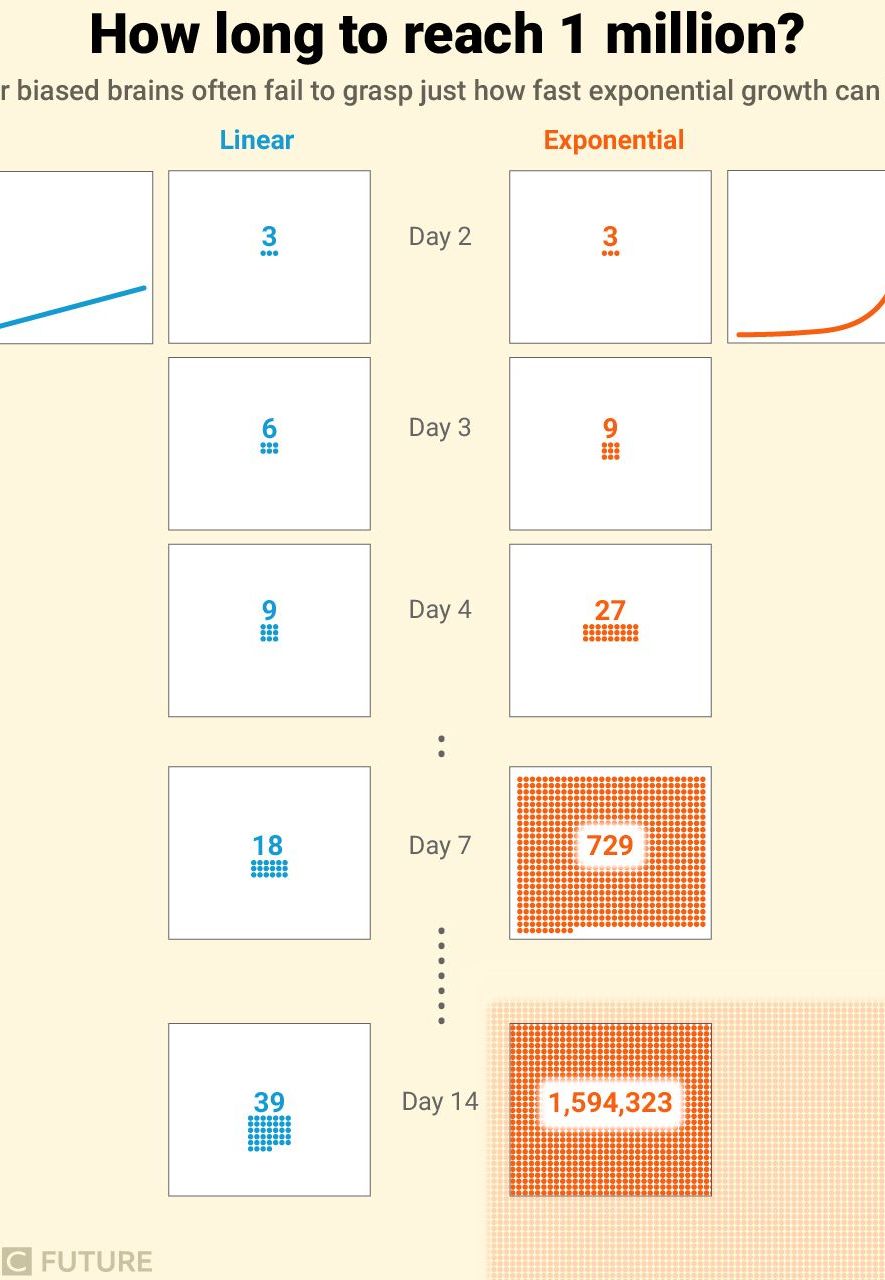
To understand the origins of this particular bias, we first need to consider different kinds of growth. The most familiar is “linear”. If your garden produces three apples every day, you have six after two days, nine after three days, and so on.

Exponential growth, by contrast, accelerates over time. Perhaps the simplest example is population growth; the more people you have reproducing, the faster the population grows. Or if you have a weed in your pond that triples each day, the number of plants may start out low – just three on day two, and nine on day three – but it soon escalates (see diagram, below).

Many people assume that coronavirus spreads in a linear fashion, but unchecked it's exponential (Credit: Nigel Hawtin)

Many people assume that coronavirus spreads in a linear fashion, but unchecked it’s exponential (Credit: Nigel Hawtin)

Our tendency to overlook exponential growth has been known for millennia. According to an Indian legend, the brahmin Sissa ibn Dahir was offered a prize for inventing an early version of chess. He asked for one grain of wheat to be placed on the first square on the board, two for the second square, four for the third square, doubling each time up to the 64th square. The king apparently laughed at the humility of ibn Dahir’s request – until his treasurers reported that it would outstrip all the food in the land (18,446,744,073,709,551,615 grains in total).

It was only in the late 2000s that scientists started to study the bias formally, with research showing that most people – like Sissa ibn Dahir’s king – intuitively assume that most growth is linear, leading them to vastly underestimate the speed of exponential increase.

These initial studies were primarily concerned with the consequences for our bank balance. Most savings accounts offer compound interest, for example, where you accrue additional interest on the interest you have already earned. This is a classic example of exponential growth, and it means that even low interest rates pay off handsomely over time. If you have a 5% interest rate, then £1,000 invested today will be worth £1,050 next year, and £1,102.50 the year after… which adds up to more than £7,000 in 40 years’ time. Yet most people don’t recognise how much more bang for their buck they will receive if they start investing early, so they leave themselves short for their retirement.

If the number of grains on a chess board doubled for each square, the 64th would 'hold' 18 quintillion (Credit: Getty Images)

If the number of grains on a chess board doubled for each square, the 64th would ‘hold’ 18 quintillion (Credit: Getty Images)

Besides reducing their savings, the bias also renders people more vulnerable to unfavourable loans, where debt escalates over time. According to one study from 2008, the bias increases someone’s debt-to-income ratio from an average of 23% to an average of 54%.

Surprisingly, a higher level of education does not prevent people from making these errors. Even mathematically trained science students can be vulnerable, says Daniela Sele, who researchs economic decision making at the Swiss Federal Institute of Technology in Zurich. “It does help somewhat, but it doesn’t preclude the bias,” she says.

This may be because they are relying on their intuition rather than deliberative thinking, so that even if they have learned about things like compound interest, they forget to apply them. To make matters worse, most people will confidently report understanding exponential growth but then still fall for the bias when asked to estimate things like compound interest.

As I explored in my book The Intelligence Trap, intelligent and educated people often have a “bias blind spot”, believing themselves to be less susceptible to error than others – and the exponential growth bias appears to fall dead in its centre.

Most people will confidently report understanding exponential growth but then still fall for the bias

It was only this year – at the start of the Covid-19 pandemic – that researchers began to consider whether the bias might also influence our understanding of infectious diseases.

According to various epidemiological studies, without intervention the number of new Covid-19 cases doubles every three to four days, which was the reason that so many scientists advised rapid lockdowns to prevent the pandemic from spiralling out of control.

In March, Joris Lammers at the University of Bremen in Germany joined forces with Jan Crusius and Anne Gast at the University of Cologne to roll out online surveys questioning people about the potential spread of the disease. Their results showed that the exponential growth bias was prevalent in people’s understanding of the virus’s spread, with most people vastly underestimating the rate of increase. More importantly, the team found that those beliefs were directly linked to the participants’ views on the best ways to contain the spread. The worse their estimates, the less likely they were to understand the need for social distancing: the exponential growth bias had made them complacent about the official advice.

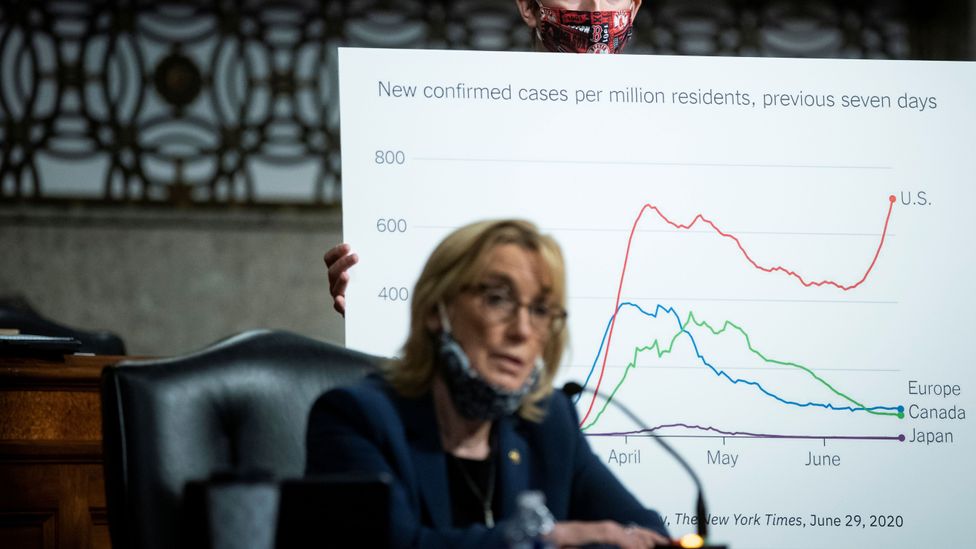
The charts that politicians show often fail to communicate exponential growth effectively (Credit: Reuters)

The charts that politicians show often fail to communicate exponential growth effectively (Credit: Reuters)

This chimes with other findings by Ritwik Banerjee and Priyama Majumda at the Indian Institute of Management in Bangalore, and Joydeep Bhattacharya at Iowa State University. In their study (currently under peer-review), they found susceptibility to the exponential growth bias can predict reduced compliance with the World Health Organization’s recommendations – including mask wearing, handwashing, the use of sanitisers and self-isolation.

The researchers speculate that some of the graphical representations found in the media may have been counter-productive. It’s common for the number of infections to be presented on a “logarithmic scale”, in which the figures on the y-axis increase by a power of 10 (so the gap between 1 and 10 is the same as the gap between 10 and 100, or 100 and 1000).

While this makes it easier to plot different regions with low and high growth rates, it means that exponential growth looks more linear than it really is, which could reinforce the exponential growth bias. “To expect people to use the logarithmic scale to extrapolate the growth path of a disease is to demand a very high level of cognitive ability,” the authors told me in an email. In their view, simple numerical tables may actually be more powerful.

Even a small effort to correct this bias could bring huge benefits

The good news is that people’s views are malleable. When Lammers and colleagues reminded the participants of the exponential growth bias, and asked them to calculate the growth in regular steps over a two week period, people hugely improved their estimates of the disease’s spread – and this, in turn, changed their views on social distancing. Sele, meanwhile, has recently shown that small changes in framing can matter. Emphasising the short amount of time that it will take to reach a large number of cases, for instance – and the time that would be gained by social distancing measures – improves people’s understanding of accelerating growth, rather than simply stating the percentage increase each day.

Lammers believes that the exponential nature of the virus needs to be made more salient in coverage of the pandemic. “I think this study shows how media and government should report on a pandemic in such a situation. Not only report the numbers of today and growth over the past week, but also explain what will happen in the next days, week, month, if the same accelerating growth persists,” he says.

He is confident that even a small effort to correct this bias could bring huge benefits. In the US, where the pandemic has hit hardest, it took only a few months for the virus to infect more than five million people, he says. “If we could have overcome the exponential growth bias and had convinced all Americans of this risk back in March, I am sure 99% would have embraced all possible distancing measures.”

David Robson is the author of The Intelligence Trap: Why Smart People Do Dumb Things (WW Norton/Hodder & Stoughton), which examines the psychology of irrational thinking and the best ways to make wiser decisions.