[RESUMO] Livro “Uma Enciclopédia nos Trópicos – Memórias de um Socioambientalista” conta a história de Beto Ricardo, do Instituto Socioambiental, ONG que Ailton Krenak descreve como fortaleza civil contra a desinformação sobre os indígenas no Brasil, animando o debate público com mapas e dados de qualidade. Militante discreto e solidário, mas firme, Beto teve participação destacada em momentos decisivos, como a mobilização que rendeu um capítulo inteiro na Constituição de 1988 sobre a questão indígena.
Na segunda metade dos anos 1980, provavelmente em 1987, uma sugestão do jornalista Leão Serva me levou a subir pela primeira vez a escadaria do anexo do Colégio Sion na avenida Higienópolis, 983. Foi um encontro com duas forças da natureza: Beto e Fany Ricardo, na primeira aula de um curso intensivo de indigenismo que não terminaria tão cedo.
Ali, no Centro Ecumênico de Documentação e Informação (Cedi), se publicava desde 1980 um compêndio que seria de consulta obrigatória nas quatro décadas seguintes, “Povos Indígenas no Brasil”. Apelidado de PIBão, pelo número de páginas e pela ambição, a obra já conta 13 edições, com 6.000 páginas de análises e notícias, além de 2.500 mapas, 1.700 vídeos e 100 mil fotos no acervo digital.
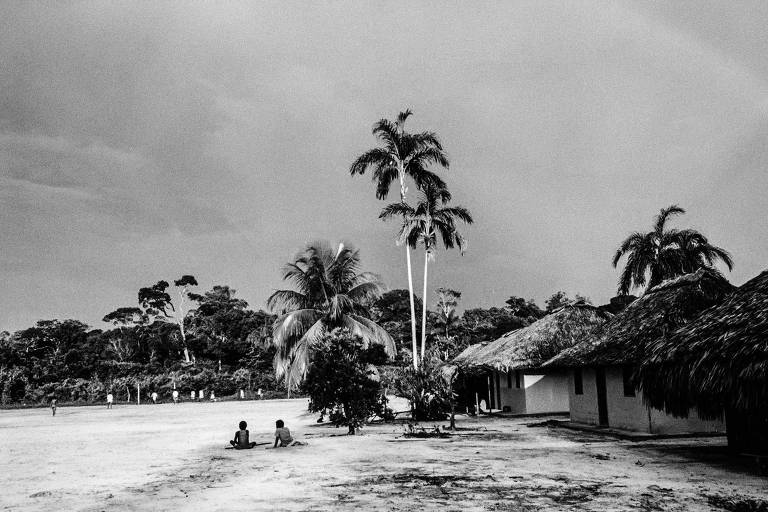
Comunidade Tucumã Rupitã, na região do Alto Rio Negro, no Amazonas, em 1999 – Pedro Martinelli/ISA
O PIBão está no epicentro do volume autobiográfico de Beto Ricardo, “Uma Enciclopédia nos Trópicos – Memórias de um Socioambientalista”, escrito com Ricardo Arnt, à venda também na loja do Instituto Socioambiental. Como afirma Serva no posfácio, “o Programa Povos Indígenas no Brasil assegurou a informação necessária para que o Estado racista não apagasse de vez a existência dos índios”.
Avesso a holofotes, Beto, articulador paciente, solidário, determinado e firme a ponto de soar incômodo, foi o protagonista de bastidores (passe o oximoro) de avanços marcantes na questão indígena brasileira, assim como na pauta ambiental. Não sem retrocessos amargos, pelo menos de 2007 para cá, mas de toda maneira com uma derivada ascendente, como fica claro no livro.
O ponto de virada se deu com a Constituição de 1988 e seu oitavo capítulo, Dos Índios. Logo no primeiro artigo (231), essa parte da Carta reconhece “sua organização social, costumes, línguas, crenças e tradições, e os direitos originários sobre as terras que tradicionalmente ocupam, competindo à União demarcá-las, proteger e fazer respeitar todos os seus bens”.
Invertia-se nessa época o que antes se considerava uma tendência irreversível de extinção dos povos indígenas, por sua “aculturação” ou “integração” à sociedade brasileira. A reviravolta se iniciara anos antes, e Beto estava lá, trabalhando em articulação que levaria um jovem Ailton Krenak ao gesto icônico de pintar o rosto de preto na tribuna do Congresso Constituinte.
Só na primeira metade do século 20 haviam desaparecido 83 etnias, constatara Darcy Ribeiro em “Os Índios e a Civilização” (1970), com base em dados recolhidos por inspetorias do Serviço de Proteção aos Índios (SPI), precursor da Funai, quando foi diretor de sua seção de estudos, em 1957. Beto, já formado em antropologia na USP e integrante do Cedi desde 1974, achava crucial retomar o levantamento das populações, mas não com a metodologia antiga.
Em lugar de órgãos do Estado na ditadura militar, o jovem discípulo encasquetou de reunir informações por meio de uma rede ampla da sociedade civil, com antropólogos, padres católicos, pessoal de saúde e assistentes sociais. Darcy Ribeiro não gostou. “Me recusar a trabalhar com Darcy era uma opção aflitiva. Eu o admirava muito”, conta Beto em “Uma Enciclopédia nos Trópicos”.
Já professor de antropologia na Unicamp, ele contava arregimentar estudantes para colher dados nas aldeias. Em três anos na universidade paulista, consolidou amizades com pesquisadores da estatura de Peter Fry e Manuela Carneiro da Cunha e travou contato com um antropólogo que se tornaria o maior parceiro intelectual, Eduardo Viveiros de Castro –ainda que tenha participado da banca campineira que preteriu o estudioso carioca em concurso para professor de etnologia.
Em 1978, tornou-se secretário-geral do Cedi. Dois anos depois sairia a primeira edição do PIBão, ainda com o título Aconteceu e periodicidade anual, expandida a partir de 1985 até virar quinquenal. A última versão, 2017/22, saiu no ano passado com 828 páginas de dados e registros de 252 povos falantes de mais de 160 línguas, ocupando 13,7% do território nacional em terras protegidas.
A transformação do cenário desolador dos anos 1970 foi incubada no Cedi e nas organizações que seu grupo ajudou a criar. Em 1979 tinha nascido a União das Nações Indígenas (UNI), com lideranças xavantes, terenas e kadiwéus —e um jovem editor de publicações, Ailton Krenak.
No prefácio de “Uma Enciclopédia”, o agora imortal da Academia Brasileira de Letras descreve o Cedi como “uma fortaleza civil contra a desinformação sobre os indígenas no Brasil, com Beto Ricardo animando os debates públicos”.
Animação não faltava. Nos anos 1980, logo após a anistia e o retorno de exilados em 1979, indígenas e ambientalistas brasileiros começaram a levar suas demandas para fóruns nos Estados Unidos, o centro do capitalismo mundial, como as 17 audiências em comitês do Congresso norte-americano entre 1983 e 1986, e reuniões do Banco Mundial.
Com ajuda de Steve Schwartzman (Environmental Defense Fund), Barbara Bramble (National Wildlife Federation) e Jason Clay (Cultural Survival), viajaram Krenak, José Lutzenberger, Mary Allegretti, Chico Mendes e Paulo Paiakan. As campanhas internacionais começaram a afetar recursos de auxílio ao desenvolvimento, enfurecendo o governo militar brasileiro, nos estertores ditadura, e a recém-inaugurada Nova República com José Sarney, como na suspensão de desembolsos para o Polonoroeste que devastava Rondônia.
Vencidas algumas das batalhas que culminaram no artigo 231 da Constituição —com a ajuda do antigo coronel Jarbas Passarinho, ex-ministro da ditadura militar—, a luta indígena ganhou momento. Em 1988, surge uma nova organização na esfera do Cedi, desta vez em Brasília: o Núcleo de Direitos Indígenas (NDI), com Krenak, Marcos Terena, Paiakan, Manuela, Carlos Frederico Marés, Márcio Santilli (estes dois futuros presidentes da Funai), André Villas-Bôas e José Carlos Libânio.
No mesmo ano, o etnobiólogo norte-americano Darrell Posey foi processado com base no Estatuto do Estrangeiro por levar os líderes Paiakan e Kube-I aos EUA. O líder seringueiro Chico Mendes foi assassinado em dezembro, atraindo mais atenção para a Amazônia. Paiakan pediu na Europa suspensão de meio bilhão de dólares que o Banco Mundial carrearia para o setor elétrico no Brasil.
Em fevereiro de 1989, Beto se empenhou com Márcio e André na organização do Encontro das Nações Indígenas do Xingu convocado por Paiakan. Compareceram o roqueiro Sting, Anita Roddick, dona da Body Shop, a atriz Lucélia Santos e os deputados Fabio Feldmann, Benedita da Silva, Haroldo Lima e Fernando Gabeira. Pelo menos 60 órgãos de imprensa estrangeira se deslocaram até Altamira (PA).
O encontro tinha por mote central protestar contra a construção das hidrelétricas Kararaô e Babaquara no rio Xingu. Uma fotografia feita ali estampou a capa do Jornal do Brasil e correu o mundo: um facão encostado pela índia Tuíra na bochecha de José Muniz Lopes, representante da empresa Eletronorte. Repaginado como Belo Monte, o represamento do Xingu terminaria sendo efetivado nos governos petistas de Lula e Dilma.
“Altamira foi um primeiro ensaio de articulação socioambiental”, avalia Beto em suas memórias. “Indígenas, ativistas dos direitos humanos e ambientalistas se aproximaram, superando preconceitos. A experiência comum seria replicada, mais tarde, no Fórum Global das ONGs da Eco-92. Os dois eventos cozinharam um caldo de cultura que ferveria até consolidar um dos alicerces da fundação do Instituto Socioambiental [ISA], em 1994.”
O antropólogo-ambientalista, entretanto, não acompanharia pessoalmente a maior reunião multilateral já realizada em favor da saúde do planeta. A sua própria lhe pregou uma peça: logo após retornar dos EUA, onde recebeu o Prêmio Goldman e teve um encontro como o então presidente George Bush (pai), caiu doente com uma amebíase que o internou no hospital Oswaldo Cruz, quando emagreceu 14 quilos.
Albert é o interlocutor nas gravações com o ianomâmi Davi Kopenawa que resultariam no best-seller “A Queda do Céu”, no qual o xamã alerta que os brancos estão destruindo o planeta com o aquecimento global. Em 1992, às vésperas da Cúpula da Terra, o então presidente Fernando Collor havia homologado a Terra Indígena Yanomami, com 94 mil km2, maior que Portugal, mas os garimpeiros ainda andam por lá.
A confluência das pautas indigenista e ambiental levou à fundação do ISA como uma das quatro instituições em que se desmembrara o Cedi. As outras foram Ação Educativa, Koinonia Presença Ecumênica e Serviço e Núcleo de Estudos Trabalho e Sociedade.
Um dos lemas da organização viria a ser: “Socioambiental se escreve junto”. Era um jogo de palavras que recorria à omissão do hífen para indicar a interpenetração de movimentos militantes que costumavam andar às turras: conservacionistas que não se preocupavam com populações tradicionais e indigenistas que só tinham olhos para a preservação de línguas e rituais.
Entre os 33 sócios fundadores estavam os antropólogos do Cedi e figuras de proa da organização SOS Mata Atlântica, como Mário Mantovani e João Paulo Capobianco (atual secretário-executivo do Ministério do Meio Ambiente/MMA, cargo que já ocupara na primeira encarnação de Marina Silva como ministra). O ISA cresceria como uma fábrica hiperativa de estudos e dados sobre temas indígenas e ambientais, alimentando militantes, políticos e jornalistas.
Os índios panarás, que em 1975 haviam sido deslocados compulsoriamente de suas terras na região para o Parque Indígena do Xingu, manifestaram a André Villas-Bôas, em 1991, o desejo de retomar seu antigo território. Para embasar as ações que esse povo impetraria com o NDI contra a União, em 1994, o ISA fez um levantamento por satélite dos trechos de floresta ainda não derrubados pelos brancos.
Os panarás terminaram indenizados pelo Estado brasileiro, uma jurisprudência inédita, e tiveram 4.900 km2 de terras devolvidas em 1996, nos municípios de Guarantã do Norte (MT) e Altamira (PA). Em março de 1997, com apoio do ISA, eles se mudaram para a nova aldeia Nacypotire, no rio Iriri. A saga deu origem ao livro “A Volta dos Índios Gigantes”, com textos dos jornalistas Lúcio Flávio Pinto, Raimundo Pinto e Ricardo Arnt, mais fotos de Pedro Martinelli, outro companheiro de longa data.
Daí por diante, a sigla ISA se converteu em sinônimo de muitos sucessos (e uns poucos fracassos). Entre os êxitos, contra todas as probabilidades, figura o estabelecimento de sistemas e rotas comerciais para fazer a cestaria baniwa e a pimenta jiquitaia, da longínqua região da Cabeça do Cachorro, chegarem aos balcões das melhores lojas do Sudeste.
O programa no Alto Rio Negro, aliás, foi a obra dileta de Beto como antropólogo militante. O ISA transformou São Gabriel da Cachoeira (AM) em dínamo de atividades visitado por indígenas, pesquisadores, militares e celebridades como Milton Nascimento, Gilberto Gil, Fernando Henrique Cardoso, Lula, Bela Gil, Alex Atala e Sebastião Salgado.
A sede do instituto na cidade, o Curupirão, hospeda legiões de interessados nas dezenas de projetos de educação, piscicultura, agroflorestas e ecoturismo. Foi dali que parti para algumas coberturas jornalísticas sugeridas por Beto.
Entre as mais memoráveis: “A exceção e a regra” (2010), sobre ensino médio indígena entre os tuyukas do Alto Rio Tiquié, com o antropólogo Aloisio Cabalzar, e “Yaripo, a montanha sagrada dos ianomâmis” (2017), sobre programa de renda em que membros da etnia levam turistas até o pico da Neblina (2.995 m), o mais alto do Brasil, com Marcos Wesley Oliveira.
Houve distanciamentos e divergências, por certo, atritos normais entre jornalistas e militantes movidos por objetivos nem sempre conciliáveis. Foi assim, por exemplo, com o esforço de manter equilíbrio entre defensores e adversários de obras de infraestrutura em regiões sensíveis, como a rodovia BR-163 e Belo Monte. Nada, porém, capaz de abalar a confiança na “fortaleza civil” comandada por Beto.
O antropólogo, afinal, é de uma honestidade ímpar, pessoal e intelectualmente. Ao narrar no livro um atrito com FHC sobre norma que admitia a terceiros contestar demarcações de terras indígenas, ele afirma sem meias palavras: “Na verdade, estávamos errados. Exageramos. O decreto número 1.775 não reduziu nenhuma terra indígena e acabou dando consistência às demarcações posteriores”.
A mesma honestidade não mede elogios a alguns poucos militares de boa vontade com que cruzou na Amazônia. Nem deixa de lamentar os retrocessos ambientais que começaram com as autorizações para hidrelétricas no rio Madeira (2007) e a saída de Marina Silva do MMA (2008), nos primeiros governos Lula, e culminaram com o licenciamento de Belo Monte (2010) e a aprovação de um novo Código Florestal (2011) que anistiou 470 mil km2 de florestas derrubadas irregularmente. Para nada dizer da hecatombe advinda com o ecocida Jair Bolsonaro, claro.
Beto, em que pesem os revezes, nunca abandonou o otimismo. Em 2007, capitaneou uma convocatória para estender os mapas temáticos do Cedi/ISA para incluir todos os outros sete países com floresta amazônica (Bolívia, Colômbia, Equador, Guiana, Peru, Venezuela e Suriname).
Tinha tudo para não dar certo, mas Beto se provou, mais uma vez, um articulador paciente, solidário, determinado e firme. “Mapas exprimem poder”, foi a mensagem que levou. Pôs de pé, com recursos iniciais da fundação norueguesa Rainforest, a Rede Amazônica de Informação Socioambiental Georreferenciada (Raisg). Cinco anos após a convocação, saiu o “Atlas Amazônia sob Pressão”.
É mais um monumento ao estilo do enciclopédico PIBão, erguido por um militante discreto, que segue a sabedoria indígena amazônica quando esta diz que quem aparece demais atrai feitiçaria. Hoje o ISA, uma obra coletiva, como gosta de dizer, tem duas centenas de funcionários em oito escritórios pelo país, mil afiliados e 450 mil seguidores em redes sociais. E uma vida inteira para se admirar.
Uma Enciclopédia nos Trópicos: Memórias de um Socioambientalista
One spring morning in Tucson, Arizona, in 1994, an unknown philosopher named David Chalmers got up to give a talk on consciousness, by which he meant the feeling of being inside your head, looking out – or, to use the kind of language that might give a neuroscientist an aneurysm, of having a soul. Though he didn’t realise it at the time, the young Australian academic was about to ignite a war between philosophers and scientists, by drawing attention to a central mystery of human life – perhaps the central mystery of human life – and revealing how embarrassingly far they were from solving it.
The scholars gathered at the University of Arizona – for what would later go down as a landmark conference on the subject – knew they were doing something edgy: in many quarters, consciousness was still taboo, too weird and new agey to take seriously, and some of the scientists in the audience were risking their reputations by attending. Yet the first two talks that day, before Chalmers’s, hadn’t proved thrilling. “Quite honestly, they were totally unintelligible and boring – I had no idea what anyone was talking about,” recalled Stuart Hameroff, the Arizona professor responsible for the event. “As the organiser, I’m looking around, and people are falling asleep, or getting restless.” He grew worried. “But then the third talk, right before the coffee break – that was Dave.” With his long, straggly hair and fondness for all-body denim, the 27-year-old Chalmers looked like he’d got lost en route to a Metallica concert. “He comes on stage, hair down to his butt, he’s prancing around like Mick Jagger,” Hameroff said. “But then he speaks. And that’s when everyone wakes up.”
The brain, Chalmers began by pointing out, poses all sorts of problems to keep scientists busy. How do we learn, store memories, or perceive things? How do you know to jerk your hand away from scalding water, or hear your name spoken across the room at a noisy party? But these were all “easy problems”, in the scheme of things: given enough time and money, experts would figure them out. There was only one truly hard problem of consciousness, Chalmers said. It was a puzzle so bewildering that, in the months after his talk, people started dignifying it with capital letters – the Hard Problem of Consciousness – and it’s this: why on earth should all those complicated brain processes feel like anything from the inside? Why aren’t we just brilliant robots, capable of retaining information, of responding to noises and smells and hot saucepans, but dark inside, lacking an inner life? And how does the brain manage it? How could the 1.4kg lump of moist, pinkish-beige tissue inside your skull give rise to something as mysterious as the experience of being that pinkish-beige lump, and the body to which it is attached?
What jolted Chalmers’s audience from their torpor was how he had framed the question. “At the coffee break, I went around like a playwright on opening night, eavesdropping,” Hameroff said. “And everyone was like: ‘Oh! The Hard Problem! The Hard Problem! That’s why we’re here!’” Philosophers had pondered the so-called “mind-body problem” for centuries. But Chalmers’s particular manner of reviving it “reached outside philosophy and galvanised everyone. It defined the field. It made us ask: what the hell is this that we’re dealing with here?”
Two decades later, we know an astonishing amount about the brain: you can’t follow the news for a week without encountering at least one more tale about scientists discovering the brain region associated with gambling, or laziness, or love at first sight, or regret – and that’s only the research that makes the headlines. Meanwhile, the field of artificial intelligence – which focuses on recreating the abilities of the human brain, rather than on what it feels like to be one – has advanced stupendously. But like an obnoxious relative who invites himself to stay for a week and then won’t leave, the Hard Problem remains. When I stubbed my toe on the leg of the dining table this morning, as any student of the brain could tell you, nerve fibres called “C-fibres” shot a message to my spinal cord, sending neurotransmitters to the part of my brain called the thalamus, which activated (among other things) my limbic system. Fine. But how come all that was accompanied by an agonising flash of pain? And what is pain, anyway?
Questions like these, which straddle the border between science and philosophy, make some experts openly angry. They have caused others to argue that conscious sensations, such as pain, don’t really exist, no matter what I felt as I hopped in anguish around the kitchen; or, alternatively, that plants and trees must also be conscious. The Hard Problem has prompted arguments in serious journals about what is going on in the mind of a zombie, or – to quote the title of a famous 1974 paper by the philosopher Thomas Nagel – the question “What is it like to be a bat?” Some argue that the problem marks the boundary not just of what we currently know, but of what science could ever explain. On the other hand, in recent years, a handful of neuroscientists have come to believe that it may finally be about to be solved – but only if we are willing to accept the profoundly unsettling conclusion that computers or the internet might soon become conscious, too.
Next week, the conundrum will move further into public awareness with the opening of Tom Stoppard’s new play, The Hard Problem, at the National Theatre – the first play Stoppard has written for the National since 2006, and the last that the theatre’s head, Nicholas Hytner, will direct before leaving his post in March. The 77-year-old playwright has revealed little about the play’s contents, except that it concerns the question of “what consciousness is and why it exists”, considered from the perspective of a young researcher played by Olivia Vinall. Speaking to the Daily Mail, Stoppard also clarified a potential misinterpretation of the title. “It’s not about erectile dysfunction,” he said.
Stoppard’s work has long focused on grand, existential themes, so the subject is fitting: when conversation turns to the Hard Problem, even the most stubborn rationalists lapse quickly into musings on the meaning of life. Christof Koch, the chief scientific officer at the Allen Institute for Brain Science, and a key player in the Obama administration’s multibillion-dollar initiative to map the human brain, is about as credible as neuroscientists get. But, he told me in December: “I think the earliest desire that drove me to study consciousness was that I wanted, secretly, to show myself that it couldn’t be explained scientifically. I was raised Roman Catholic, and I wanted to find a place where I could say: OK, here, God has intervened. God created souls, and put them into people.” Koch assured me that he had long ago abandoned such improbable notions. Then, not much later, and in all seriousness, he said that on the basis of his recent research he thought it wasn’t impossible that his iPhone might have feelings.
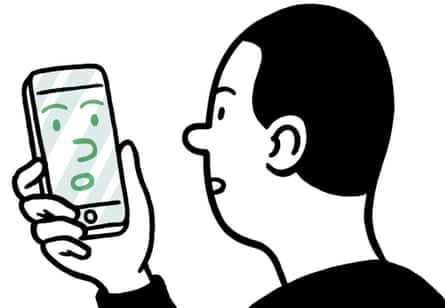
In all seriousness, Koch said he thought it wasn’t impossible that his iPhone might have feelings
By the time Chalmers delivered his speech in Tucson, science had been vigorously attempting to ignore the problem of consciousness for a long time. The source of the animosity dates back to the 1600s, when René Descartes identified the dilemma that would tie scholars in knots for years to come. On the one hand, Descartes realised, nothing is more obvious and undeniable than the fact that you’re conscious. In theory, everything else you think you know about the world could be an elaborate illusion cooked up to deceive you – at this point, present-day writers invariably invoke The Matrix – but your consciousness itself can’t be illusory. On the other hand, this most certain and familiar of phenomena obeys none of the usual rules of science. It doesn’t seem to be physical. It can’t be observed, except from within, by the conscious person. It can’t even really be described. The mind, Descartes concluded, must be made of some special, immaterial stuff that didn’t abide by the laws of nature; it had been bequeathed to us by God.
This religious and rather hand-wavy position, known as Cartesian dualism, remained the governing assumption into the 18th century and the early days of modern brain study. But it was always bound to grow unacceptable to an increasingly secular scientific establishment that took physicalism – the position that only physical things exist – as its most basic principle. And yet, even as neuroscience gathered pace in the 20th century, no convincing alternative explanation was forthcoming. So little by little, the topic became taboo. Few people doubted that the brain and mind were very closely linked: if you question this, try stabbing your brain repeatedly with a kitchen knife, and see what happens to your consciousness. But how they were linked – or if they were somehow exactly the same thing – seemed a mystery best left to philosophers in their armchairs. As late as 1989, writing in the International Dictionary of Psychology, the British psychologist Stuart Sutherland could irascibly declare of consciousness that “it is impossible to specify what it is, what it does, or why it evolved. Nothing worth reading has been written on it.”
It was only in 1990 that Francis Crick, the joint discoverer of the double helix, used his position of eminence to break ranks. Neuroscience was far enough along by now, he declared in a slightly tetchy paper co-written with Christof Koch, that consciousness could no longer be ignored. “It is remarkable,” they began, “that most of the work in both cognitive science and the neurosciences makes no reference to consciousness” – partly, they suspected, “because most workers in these areas cannot see any useful way of approaching the problem”. They presented their own “sketch of a theory”, arguing that certain neurons, firing at certain frequencies, might somehow be the cause of our inner awareness – though it was not clear how.
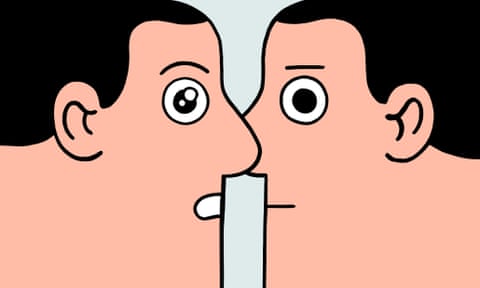
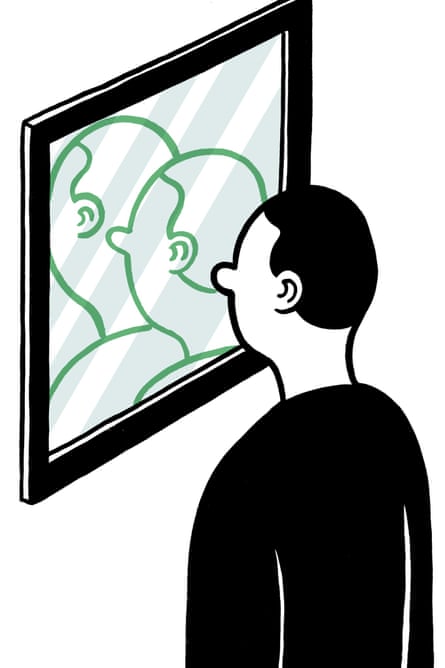
Illustration by Pete Gamlen
“People thought I was crazy to be getting involved,” Koch recalled. “A senior colleague took me out to lunch and said, yes, he had the utmost respect for Francis, but Francis was a Nobel laureate and a half-god and he could do whatever he wanted, whereas I didn’t have tenure yet, so I should be incredibly careful. Stick to more mainstream science! These fringey things – why not leave them until retirement, when you’re coming close to death, and you can worry about the soul and stuff like that?”
It was around this time that David Chalmers started talking about zombies.
As a child, Chalmers was short-sighted in one eye, and he vividly recalls the day he was first fitted with glasses to rectify the problem. “Suddenly I had proper binocular vision,” he said. “And the world just popped out. It was three-dimensional to me in a way it hadn’t been.” He thought about that moment frequently as he grew older. Of course, you could tell a simple mechanical story about what was going on in the lens of his glasses, his eyeball, his retina, and his brain. “But how does that explain the way the world just pops out like that?” To a physicalist, the glasses-eyeball-retina story is the only story. But to a thinker of Chalmers’s persuasion, it was clear that it wasn’t enough: it told you what the machinery of the eye was doing, but it didn’t begin to explain that sudden, breathtaking experience of depth and clarity. Chalmers’s “zombie” thought experiment is his attempt to show why the mechanical account is not enough – why the mystery of conscious awareness goes deeper than a purely material science can explain.
“Look, I’m not a zombie, and I pray that you’re not a zombie,” Chalmers said, one Sunday before Christmas, “but the point is that evolution could have produced zombies instead of conscious creatures – and it didn’t!” We were drinking espressos in his faculty apartment at New York University, where he recently took up a full-time post at what is widely considered the leading philosophy department in the Anglophone world; boxes of his belongings, shipped over from Australia, lay unpacked around his living-room. Chalmers, now 48, recently cut his hair in a concession to academic respectability, and he wears less denim, but his ideas remain as heavy-metal as ever. The zombie scenario goes as follows: imagine that you have a doppelgänger. This person physically resembles you in every respect, and behaves identically to you; he or she holds conversations, eats and sleeps, looks happy or anxious precisely as you do. The sole difference is that the doppelgänger has no consciousness; this – as opposed to a groaning, blood-spattered walking corpse from a movie – is what philosophers mean by a “zombie”.
Such non-conscious humanoids don’t exist, of course. (Or perhaps it would be better to say that I know I’m not one, anyhow; I could never know for certain that you aren’t.) But the point is that, in principle, it feels as if they could. Evolution might have produced creatures that were atom-for-atom the same as humans, capable of everything humans can do, except with no spark of awareness inside. As Chalmers explained: “I’m talking to you now, and I can see how you’re behaving; I could do a brain scan, and find out exactly what’s going on in your brain – yet it seems it could be consistent with all that evidence that you have no consciousness at all.” If you were approached by me and my doppelgänger, not knowing which was which, not even the most powerful brain scanner in existence could tell us apart. And the fact that one can even imagine this scenario is sufficient to show that consciousness can’t just be made of ordinary physical atoms. So consciousness must, somehow, be something extra – an additional ingredient in nature.
Chalmers recently cut his hair and he wears less denim, but his ideas remain as heavy-metal as ever
It would be understating things a bit to say that this argument wasn’t universally well-received when Chalmers began to advance it, most prominently in his 1996 book The Conscious Mind. The withering tone of the philosopher Massimo Pigliucci sums up the thousands of words that have been written attacking the zombie notion: “Let’s relegate zombies to B-movies and try to be a little more serious about our philosophy, shall we?” Yes, it may be true that most of us, in our daily lives, think of consciousness as something over and above our physical being – as if your mind were “a chauffeur inside your own body”, to quote the spiritual author Alan Watts. But to accept this as a scientific principle would mean rewriting the laws of physics. Everything we know about the universe tells us that reality consists only of physical things: atoms and their component particles, busily colliding and combining. Above all, critics point out, if this non-physical mental stuff did exist, how could it cause physical things to happen – as when the feeling of pain causes me to jerk my fingers away from the saucepan’s edge?
Nonetheless, just occasionally, science has dropped tantalising hints that this spooky extra ingredient might be real. In the 1970s, at what was then the National Hospital for Nervous Diseases in London, the neurologist Lawrence Weiskrantz encountered a patient, known as “DB”, with a blind spot in his left visual field, caused by brain damage. Weiskrantz showed him patterns of striped lines, positioned so that they fell on his area of blindness, then asked him to say whether the stripes were vertical or horizontal. Naturally, DB protested that he could see no stripes at all. But Weiskrantz insisted that he guess the answers anyway – and DB got them right almost 90% of the time. Apparently, his brain was perceiving the stripes without his mind being conscious of them. One interpretation is that DB was a semi-zombie, with a brain like any other brain, but partially lacking the magical add-on of consciousness.
Chalmers knows how wildly improbable his ideas can seem, and takes this in his stride: at philosophy conferences, he is fond of clambering on stage to sing The Zombie Blues, a lament about the miseries of having no consciousness. (“I act like you act / I do what you do / But I don’t know / What it’s like to be you.”) “The conceit is: wouldn’t it be a drag to be a zombie? Consciousness is what makes life worth living, and I don’t even have that: I’ve got the zombie blues.” The song has improved since its debut more than a decade ago, when he used to try to hold a tune. “Now I’ve realised it sounds better if you just shout,” he said.
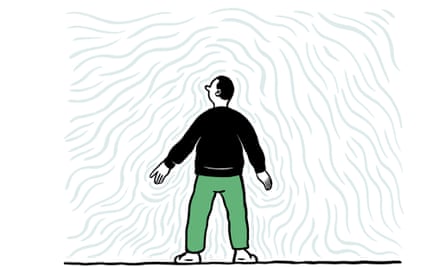
Illustration by Pete Gamlen
The consciousness debates have provoked more mudslinging and fury than most in modern philosophy, perhaps because of how baffling the problem is: opposing combatants tend not merely to disagree, but to find each other’s positions manifestly preposterous. An admittedly extreme example concerns the Canadian-born philosopher Ted Honderich, whose book On Consciousness was described, in an article by his fellow philosopher Colin McGinn in 2007, as “banal and pointless”, “excruciating”, “absurd”, running “the full gamut from the mediocre to the ludicrous to the merely bad”. McGinn added, in a footnote: “The review that appears here is not as I originally wrote it. The editors asked me to ‘soften the tone’ of the original [and] I have done so.” (The attack may have been partly motivated by a passage in Honderich’s autobiography, in which he mentions “my small colleague Colin McGinn”; at the time, Honderich told this newspaper he’d enraged McGinn by referring to a girlfriend of his as “not as plain as the old one”.)
McGinn, to be fair, has made a career from such hatchet jobs. But strong feelings only slightly more politely expressed are commonplace. Not everybody agrees there is a Hard Problem to begin with – making the whole debate kickstarted by Chalmers an exercise in pointlessness. Daniel Dennett, the high-profile atheist and professor at Tufts University outside Boston, argues that consciousness, as we think of it, is an illusion: there just isn’t anything in addition to the spongy stuff of the brain, and that spongy stuff doesn’t actually give rise to something called consciousness. Common sense may tell us there’s a subjective world of inner experience – but then common sense told us that the sun orbits the Earth, and that the world was flat. Consciousness, according to Dennett’s theory, is like a conjuring trick: the normal functioning of the brain just makes it look as if there is something non-physical going on. To look for a real, substantive thing called consciousness, Dennett argues, is as silly as insisting that characters in novels, such as Sherlock Holmes or Harry Potter, must be made up of a peculiar substance named “fictoplasm”; the idea is absurd and unnecessary, since the characters do not exist to begin with. This is the point at which the debate tends to collapse into incredulous laughter and head-shaking: neither camp can quite believe what the other is saying. To Dennett’s opponents, he is simply denying the existence of something everyone knows for certain: their inner experience of sights, smells, emotions and the rest. (Chalmers has speculated, largely in jest, that Dennett himself might be a zombie.) It’s like asserting that cancer doesn’t exist, then claiming you’ve cured cancer; more than one critic of Dennett’s most famous book, Consciousness Explained, has joked that its title ought to be Consciousness Explained Away. Dennett’s reply is characteristically breezy: explaining things away, he insists, is exactly what scientists do. When physicists first concluded that the only difference between gold and silver was the number of subatomic particles in their atoms, he writes, people could have felt cheated, complaining that their special “goldness” and “silveriness” had been explained away. But everybody now accepts that goldness and silveriness are really just differences in atoms. However hard it feels to accept, we should concede that consciousness is just the physical brain, doing what brains do.
“The history of science is full of cases where people thought a phenomenon was utterly unique, that there couldn’t be any possible mechanism for it, that we might never solve it, that there was nothing in the universe like it,” said Patricia Churchland of the University of California, a self-described “neurophilosopher” and one of Chalmers’s most forthright critics. Churchland’s opinion of the Hard Problem, which she expresses in caustic vocal italics, is that it is nonsense, kept alive by philosophers who fear that science might be about to eliminate one of the puzzles that has kept them gainfully employed for years. Look at the precedents: in the 17th century, scholars were convinced that light couldn’t possibly be physical – that it had to be something occult, beyond the usual laws of nature. Or take life itself: early scientists were convinced that there had to be some magical spirit – the élan vital – that distinguished living beings from mere machines. But there wasn’t, of course. Light is electromagnetic radiation; life is just the label we give to certain kinds of objects that can grow and reproduce. Eventually, neuroscience will show that consciousness is just brain states. Churchland said: “The history of science really gives you perspective on how easy it is to talk ourselves into this sort of thinking – that if my big, wonderful brain can’t envisage the solution, then it must be a really, really hard problem!”
Solutions have regularly been floated: the literature is awash in references to “global workspace theory”, “ego tunnels”, “microtubules”, and speculation that quantum theory may provide a way forward. But the intractability of the arguments has caused some thinkers, such as Colin McGinn, to raise an intriguing if ultimately defeatist possibility: what if we’re just constitutionally incapable of ever solving the Hard Problem? After all, our brains evolved to help us solve down-to-earth problems of survival and reproduction; there is no particular reason to assume they should be capable of cracking every big philosophical puzzle we happen to throw at them. This stance has become known as “mysterianism” – after the 1960s Michigan rock’n’roll band ? and the Mysterians, who themselves borrowed the name from a work of Japanese sci-fi – but the essence of it is that there’s actually no mystery to why consciousness hasn’t been explained: it’s that humans aren’t up to the job. If we struggle to understand what it could possibly mean for the mind to be physical, maybe that’s because we are, to quote the American philosopher Josh Weisberg, in the position of “squirrels trying to understand quantum mechanics”. In other words: “It’s just not going to happen.”
Or maybe it is: in the last few years, several scientists and philosophers, Chalmers and Koch among them, have begun to look seriously again at a viewpoint so bizarre that it has been neglected for more than a century, except among followers of eastern spiritual traditions, or in the kookier corners of the new age. This is “panpsychism”, the dizzying notion that everything in the universe might be conscious, or at least potentially conscious, or conscious when put into certain configurations. Koch concedes that this sounds ridiculous: when he mentions panpsychism, he has written, “I often encounter blank stares of incomprehension.” But when it comes to grappling with the Hard Problem, crazy-sounding theories are an occupational hazard. Besides, panpsychism might help unravel an enigma that has attached to the study of consciousness from the start: if humans have it, and apes have it, and dogs and pigs probably have it, and maybe birds, too – well, where does it stop?
Illustration by Pete Gamlen
Growing up as the child of German-born Catholics, Koch had a dachshund named Purzel. According to the church, because he was a dog, that meant he didn’t have a soul. But he whined when anxious and yelped when injured – “he certainly gave every appearance of having a rich inner life”. These days we don’t much speak of souls, but it is widely assumed that many non-human brains are conscious – that a dog really does feel pain when he is hurt. The problem is that there seems to be no logical reason to draw the line at dogs, or sparrows or mice or insects, or, for that matter, trees or rocks. Since we don’t know how the brains of mammals create consciousness, we have no grounds for assuming it’s only the brains of mammals that do so – or even that consciousness requires a brain at all. Which is how Koch and Chalmers have both found themselves arguing, in the pages of the New York Review of Books, that an ordinary household thermostat or a photodiode, of the kind you might find in your smoke detector, might in principle be conscious.
The argument unfolds as follows: physicists have no problem accepting that certain fundamental aspects of reality – such as space, mass, or electrical charge – just do exist. They can’t be explained as being the result of anything else. Explanations have to stop somewhere. The panpsychist hunch is that consciousness could be like that, too – and that if it is, there is no particular reason to assume that it only occurs in certain kinds of matter.
Koch’s specific twist on this idea, developed with the neuroscientist and psychiatrist Giulio Tononi, is narrower and more precise than traditional panpsychism. It is the argument that anything at all could be conscious, providing that the information it contains is sufficiently interconnected and organised. The human brain certainly fits the bill; so do the brains of cats and dogs, though their consciousness probably doesn’t resemble ours. But in principle the same might apply to the internet, or a smartphone, or a thermostat. (The ethical implications are unsettling: might we owe the same care to conscious machines that we bestow on animals? Koch, for his part, tries to avoid stepping on insects as he walks.)
Unlike the vast majority of musings on the Hard Problem, moreover, Tononi and Koch’s “integrated information theory” has actually been tested. A team of researchers led by Tononi has designed a device that stimulates the brain with electrical voltage, to measure how interconnected and organised – how “integrated” – its neural circuits are. Sure enough, when people fall into a deep sleep, or receive an injection of anaesthetic, as they slip into unconsciousness, the device demonstrates that their brain integration declines, too. Among patients suffering “locked-in syndrome” – who are as conscious as the rest of us – levels of brain integration remain high; among patients in coma – who aren’t – it doesn’t. Gather enough of this kind of evidence, Koch argues and in theory you could take any device, measure the complexity of the information contained in it, then deduce whether or not it was conscious.
But even if one were willing to accept the perplexing claim that a smartphone could be conscious, could you ever know that it was true? Surely only the smartphone itself could ever know that? Koch shrugged. “It’s like black holes,” he said. “I’ve never been in a black hole. Personally, I have no experience of black holes. But the theory [that predicts black holes] seems always to be true, so I tend to accept it.”
Illustration by Pete Gamlen
It would be satisfying for multiple reasons if a theory like this were eventually to vanquish the Hard Problem. On the one hand, it wouldn’t require a belief in spooky mind-substances that reside inside brains; the laws of physics would escape largely unscathed. On the other hand, we wouldn’t need to accept the strange and soulless claim that consciousness doesn’t exist, when it’s so obvious that it does. On the contrary, panpsychism says, it’s everywhere. The universe is throbbing with it.
Last June, several of the most prominent combatants in the consciousness debates – including Chalmers, Churchland and Dennett – boarded a tall-masted yacht for a trip among the ice floes of Greenland. This conference-at-sea was funded by a Russian internet entrepreneur, Dmitry Volkov, the founder of the Moscow Centre for Consciousness Studies. About 30 academics and graduate students, plus crew, spent a week gliding through dark waters, past looming snow-topped mountains and glaciers, in a bracing chill conducive to focused thought, giving the problem of consciousness another shot. In the mornings, they visited islands to go hiking, or examine the ruins of ancient stone huts; in the afternoons, they held conference sessions on the boat. For Chalmers, the setting only sharpened the urgency of the mystery: how could you feel the Arctic wind on your face, take in the visual sweep of vivid greys and whites and greens, and still claim conscious experience was unreal, or that it was simply the result of ordinary physical stuff, behaving ordinarily?
The question was rhetorical. Dennett and Churchland were not converted; indeed, Chalmers has no particular confidence that a consensus will emerge in the next century. “Maybe there’ll be some amazing new development that leaves us all, now, looking like pre-Darwinians arguing about biology,” he said. “But it wouldn’t surprise me in the least if in 100 years, neuroscience is incredibly sophisticated, if we have a complete map of the brain – and yet some people are still saying, ‘Yes, but how does any of that give you consciousness?’ while others are saying ‘No, no, no – that just is the consciousness!’” The Greenland cruise concluded in collegial spirits, and mutual incomprehension.
It would be poetic – albeit deeply frustrating – were it ultimately to prove that the one thing the human mind is incapable of comprehending is itself. An answer must be out there somewhere. And finding it matters: indeed, one could argue that nothing else could ever matter more – since anything at all that matters, in life, only does so as a consequence of its impact on conscious brains. Yet there’s no reason to assume that our brains will be adequate vessels for the voyage towards that answer. Nor that, were we to stumble on a solution to the Hard Problem, on some distant shore where neuroscience meets philosophy, we would even recognise that we’d found it.
This article was amended on 21 January 2015. The conference-at-sea was funded by the Russian internet entrepreneur Dmitry Volkov, not Dmitry Itskov as was originally stated. This has been corrected.
Patient One was 24 years old and pregnant with her third child when she was taken off life support. It was 2014. A couple of years earlier, she had been diagnosed with a disorder that caused an irregular heartbeat, and during her two previous pregnancies she had suffered seizures and faintings. Four weeks into her third pregnancy, she collapsed on the floor of her home. Her mother, who was with her, called 911. By the time an ambulance arrived, Patient One had been unconscious for more than 10 minutes. Paramedics found that her heart had stopped.
After being driven to a hospital where she couldn’t be treated, Patient One was taken to the emergency department at the University of Michigan. There, medical staff had to shock her chest three times with a defibrillator before they could restart her heart. She was placed on an external ventilator and pacemaker, and transferred to the neurointensive care unit, where doctors monitored her brain activity. She was unresponsive to external stimuli, and had a massive swelling in her brain. After she lay in a deep coma for three days, her family decided it was best to take her off life support. It was at that point – after her oxygen was turned off and nurses pulled the breathing tube from her throat – that Patient One became one of the most intriguing scientific subjects in recent history.
For several years, Jimo Borjigin, a professor of neurology at the University of Michigan, had been troubled by the question of what happens to us when we die. She had read about the near-death experiences of certain cardiac-arrest survivors who had undergone extraordinary psychic journeys before being resuscitated. Sometimes, these people reported travelling outside of their bodies towards overwhelming sources of light where they were greeted by dead relatives. Others spoke of coming to a new understanding of their lives, or encountering beings of profound goodness. Borjigin didn’t believe the content of those stories was true – she didn’t think the souls of dying people actually travelled to an afterworld – but she suspected something very real was happening in those patients’ brains. In her own laboratory, she had discovered that rats undergo a dramatic storm of many neurotransmitters, including serotonin and dopamine, after their hearts stop and their brains lose oxygen. She wondered if humans’ near-death experiences might spring from a similar phenomenon, and if it was occurring even in people who couldn’t be revived.
Dying seemed like such an important area of research – we all do it, after all – that Borjigin assumed other scientists had already developed a thorough understanding of what happens to the brain in the process of death. But when she looked at the scientific literature, she found little enlightenment. “To die is such an essential part of life,” she told me recently. “But we knew almost nothing about the dying brain.” So she decided to go back and figure out what had happened inside the brains of people who died at the University of Michigan neurointensive care unit. Among them was Patient One.
At the time Borjigin began her research into Patient One, the scientific understanding of death had reached an impasse. Since the 1960s, advances in resuscitation had helped to revive thousands of people who might otherwise have died. About 10% or 20% of those people brought with them stories of near-death experiences in which they felt their souls or selves departing from their bodies. A handful of those patients even claimed to witness, from above, doctors’ attempts to resuscitate them. According to several international surveys and studies, one in 10 people claims to have had a near-death experience involving cardiac arrest, or a similar experience in circumstances where they may have come close to death. That’s roughly 800 million souls worldwide who may have dipped a toe in the afterlife.
As remarkable as these near-death experiences sounded, they were consistent enough that some scientists began to believe there was truth to them: maybe people really did have minds or souls that existed separately from their living bodies. In the 1970s, a small network of cardiologists, psychiatrists, medical sociologists and social psychologists in North America and Europe began investigating whether near-death experiences proved that dying is not the end of being, and that consciousness can exist independently of the brain. The field of near-death studies was born.
Over the next 30 years, researchers collected thousands of case reports of people who had had near-death experiences. Meanwhile, new technologies and techniques were helping doctors revive more and more people who, in earlier periods of history, would have almost certainly been permanently deceased. “We are now at the point where we have both the tools and the means to scientifically answer the age-old question: What happens when we die?” wrote Sam Parnia, an accomplished resuscitation specialist and one of the world’s leading experts on near-death experiences, in 2006. Parnia himself was devising an international study to test whether patients could have conscious awareness even after they were found clinically dead.
But by 2015, experiments such as Parnia’s had yielded ambiguous results, and the field of near-death studies was not much closer to understanding death than it had been when it was founded four decades earlier. That’s when Borjigin, together with several colleagues, took the first close look at the record of electrical activity in the brain of Patient One after she was taken off life support. What they discovered – in results reported for the first time last year – was almost entirely unexpected, and has the potential to rewrite our understanding of death.
“I believe what we found is only the tip of a vast iceberg,” Borjigin told me. “What’s still beneath the surface is a full account of how dying actually takes place. Because there’s something happening in there, in the brain, that makes no sense.”
For all that science has learned about the workings of life, death remains among the most intractable of mysteries. “At times I have been tempted to believe that the creator has eternally intended this department of nature to remain baffling, to prompt our curiosities and hopes and suspicions all in equal measure,” the philosopher William James wrote in 1909.
The first time that the question Borjigin began asking in 2015 was posed – about what happens to the brain during death – was a quarter of a millennium earlier. Around 1740, a French military physician reviewed the case of a famous apothecary who, after a “malign fever” and several blood-lettings, fell unconscious and thought he hadtravelled to the Kingdom of the Blessed. The physician speculated that the apothecary’s experience had been caused by a surge of blood to the brain. But between that early report and the mid-20th century, scientific interest in near-death experiences remained sporadic.
In 1892, the Swiss climber and geologist Albert Heim collected the first systematic accounts of near-death experiences from 30 fellow climbers who had suffered near-fatal falls. In many cases, the climbers underwent a sudden review of their entire past, heard beautiful music, and “fell in a superbly blue heaven containing roseate cloudlets”, Heim wrote. “Then consciousness was painlessly extinguished, usually at the moment of impact.” There were a few more attempts to do research in the early 20th century, but little progress was made in understanding near-death experiences scientifically. Then, in 1975, an American medical student named Raymond Moody published a book called Life After Life.
Photograph: Getty Images/Blend Images
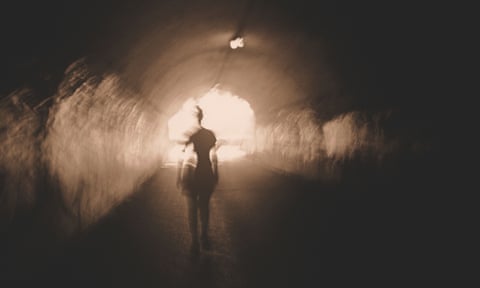
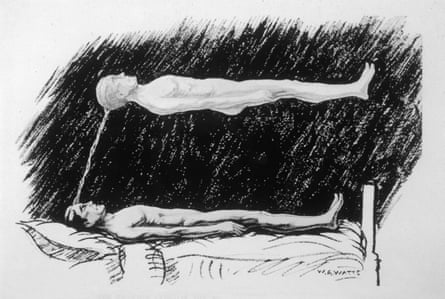
In his book, Moody distilled the reports of 150 people who had had intense, life-altering experiences in the moments surrounding a cardiac arrest. Although the reports varied, he found that they often shared one or more common features or themes. The narrative arc of the most detailed of those reports – departing the body and travelling through a long tunnel, having an out-of-body experience, encountering spirits and a being of light, one’s whole life flashing before one’s eyes, and returning to the body from some outer limit – became so canonical that the art critic Robert Hughes could refer to it years later as “the familiar kitsch of near-death experience”. Moody’s book became an international bestseller.
In 1976, the New York Times reported on the burgeoning scientific interest in “life after death” and the “emerging field of thanatology”. The following year, Moody and several fellow thanatologists founded an organisation that became the International Association for Near-Death Studies. In 1981, they printed the inaugural issue of Vital Signs, a magazine for the general reader that was largely devoted to stories of near-death experiences. The following year they began producing the field’s first peer-reviewed journal, which became the Journal of Near-Death Studies. The field was growing, and taking on the trappings of scientific respectability. Reviewing its rise in 1988, the British Journal of Psychiatry captured the field’s animating spirit: “A grand hope has been expressed that, through NDE research, new insights can be gained into the ageless mystery of human mortality and its ultimate significance, and that, for the first time, empirical perspectives on the nature of death may be achieved.”
But near-death studies was already splitting into several schools of belief, whose tensions continue to this day. One influential camp was made up of spiritualists, some of them evangelical Christians, who were convinced that near-death experiences were genuine sojourns in the land of the dead and divine. As researchers, the spiritualists’ aim was to collect as many reports of near-death experience as possible, and to proselytise society about the reality of life after death. Moody was their most important spokesman; he eventually claimed to have had multiple past lives and built a “psychomanteum” in rural Alabama where people could attempt to summon the spirits of the dead by gazing into a dimly lit mirror.
The second, and largest, faction of near-death researchers were the parapsychologists, those interested in phenomena that seemed to undermine the scientific orthodoxy that the mind could not exist independently of the brain. These researchers, who were by and large trained scientists following well established research methods, tended to believe that near-death experiences offered evidence that consciousness could persist after the death of the individual. Many of them were physicians and psychiatrists who had been deeply affected after hearing the near-death stories of patients they had treated in the ICU. Their aim was to find ways to test their theories of consciousness empirically, and to turn near-death studies into a legitimate scientific endeavour.
Finally, there emerged the smallest contingent of near-death researchers, who could be labelled the physicalists. These were scientists, many of whom studied the brain, who were committed to a strictly biological account of near-death experiences. Like dreams, the physicalists argued, near-death experiences might reveal psychological truths, but they did so through hallucinatory fictions that emerged from the workings of the body and the brain. (Indeed, many of the states reported by near-death experiencers can apparently be achieved by taking a hero’s dose of ketamine.) Their basic premise was: no functioning brain means no consciousness, and certainly no life after death. Their task, which Borjigin took up in 2015, was to discover what was happening during near-death experiences on a fundamentally physical level.
Slowly, the spiritualists left the field of research for the loftier domains of Christian talk radio, and the parapsychologists and physicalists started bringing near-death studies closer to the scientific mainstream. Between 1975, when Moody published Life After Life, and 1984, only 17 articles in the PubMed database of scientific publications mentioned near-death experiences. In the following decade, there were 62. In the most recent 10-year span, there were 221. Those articles have appeared everywhere from the Canadian Urological Association Journal to the esteemed pages of The Lancet.
Today, there is a widespread sense throughout the community of near-death researchers that we are on the verge of great discoveries. Charlotte Martial, a neuroscientist at the University of Liège in Belgium who has done some of the best physicalist work on near-death experiences, hopes we will soon develop a new understanding of the relationship between the internal experience of consciousness and its outward manifestations, for example in coma patients. “We really are in a crucial moment where we have to disentangle consciousness from responsiveness, and maybe question every state that we consider unconscious,” she told me. Parnia, the resuscitation specialist, who studies the physical processes of dying but is also sympathetic to a parapsychological theory of consciousness, has a radically different take on what we are poised to find out. “I think in 50 or 100 years time we will have discovered the entity that is consciousness,” he told me. “It will be taken for granted that it wasn’t produced by the brain, and it doesn’t die when you die.”
If the field of near-death studies is at the threshold of new discoveries about consciousness and death, it is in large part because of a revolution in our ability to resuscitate people who have suffered cardiac arrest. Lance Becker has been a leader in resuscitation science for more than 30 years. As a young doctor attempting to revive people through CPR in the mid-1980s, senior physicians would often step in to declare patients dead. “At a certain point, they would just say, ‘OK, that’s enough. Let’s stop. This is unsuccessful. Time of death: 1.37pm,’” he recalled recently. “And that would be the last thing. And one of the things running through my head as a young doctor was, ‘Well, what really happened at 1.37?’”
In a medical setting, “clinical death” is said to occur at the moment the heart stops pumping blood, and the pulse stops. This is widely known as cardiac arrest. (It is different from a heart attack, in which there is a blockage in a heart that’s still pumping.) Loss of oxygen to the brain and other organs generally follows within seconds or minutes, although the complete cessation of activity in the heart and brain – which is often called “flatlining” or, in the case of the latter, “brain death” – may not occur for many minutes or even hours.
For almost all people at all times in history, cardiac arrest was basically the end of the line. That began to change in 1960, when the combination of mouth-to-mouth ventilation, chest compressions and external defibrillation known as cardiopulmonary resuscitation, or CPR, was formalised. Shortly thereafter, a massive campaign was launched to educate clinicians and the public on CPR’s basic techniques, and soon people were being revived in previously unthinkable, if still modest, numbers.
As more and more people were resuscitated, scientists learned that, even in its acute final stages, death is not a point, but a process. After cardiac arrest, blood and oxygen stop circulating through the body, cells begin to break down, and normal electrical activity in the brain gets disrupted. But the organs don’t fail irreversibly right away, and the brain doesn’t necessarily cease functioning altogether. There is often still the possibility of a return to life. In some cases, cell death can be stopped or significantly slowed, the heart can be restarted, and brain function can be restored. In other words, the process of death can be reversed.
It is no longer unheard of for people to be revived even six hours after being declared clinically dead. In 2011, Japanese doctors reported the case of a young woman who was found in a forest one morning after an overdose stopped her heart the previous night; using advanced technology to circulate blood and oxygen through her body, the doctors were able to revive her more than six hours later, and she was able to walk out of the hospital after three weeks of care. In 2019, a British woman named Audrey Schoeman who was caught in a snowstorm spent six hours in cardiac arrest before doctors brought her back to life with no evident brain damage.
“I don’t think there’s ever been a more exciting time for the field,” Becker told me. “We’re discovering new drugs, we’re discovering new devices, and we’re discovering new things about the brain.”
The brain – that’s the tricky part. In January 2021, as the Covid-19 pandemic was surging toward what would become its deadliest week on record, Netflix released a documentary series called Surviving Death. In the first episode, some of near-death studies’ most prominent parapsychologists presented the core of their arguments for why they believe near-death experiences show that consciousness exists independently of the brain. “When the heart stops, within 20 seconds or so, you get flatlining, which means no brain activity,” Bruce Greyson, an emeritus professor of psychiatry at the University of Virginia and one of the founding members of the International Association for Near-Death Studies, says in the documentary. “And yet,” he goes on to claim, “people have near-death experiences when they’ve been (quote) ‘flatlined’ for longer than that.”
That is a key tenet of the parapsychologists’ arguments: if there is consciousness without brain activity, then consciousness must dwell somewhere beyond the brain. Some of the parapsychologists speculate that it is a “non-local” force that pervades the universe, like electromagnetism. This force is received by the brain, but is not generated by it, the way a television receives a broadcast.
In order for this argument to hold, something else has to be true: near-death experiences have to happen during death, after the brain shuts down. To prove this, parapsychologists point to a number of rare but astounding cases known as “veridical” near-death experiences, in which patients seem to report details from the operating room that they might have known only if they had conscious awareness during the time that they were clinically dead. Dozens of such reports exist. One of the most famous is about a woman who apparently travelled so far outside her body that she was able to spot a shoe on a window ledge in another part of the hospital where she went into cardiac arrest; the shoe was later reportedly found by a nurse.
Photograph: Chronicle/Alamy
At the very least, Parnia and his colleagues have written, such phenomena are “inexplicable through current neuroscientific models”. Unfortunately for the parapsychologists, however, none of the reports of post-death awareness holds up to strict scientific scrutiny. “There are many claims of this kind, but in my long decades of research into out-of-body and near-death experiences I never met any convincing evidence that this is true,” Sue Blackmore, a well-known researcher into parapsychology who had her own near-death experience as a young woman in 1970, has written.
The case of the shoe, Blackmore pointed out, relied solely on the report of the nurse who claimed to have found it. That’s far from the standard of proof the scientific community would require to accept a result as radical as that consciousness can travel beyond the body and exist after death. In other cases, there’s not enough evidence to prove that the experiences reported by cardiac arrest survivors happened when their brains were shut down, as opposed to in the period before or after they supposedly “flatlined”. “So far, there is no sufficiently rigorous, convincing empirical evidence that people can observe their surroundings during a near-death experience,” Charlotte Martial, the University of Liège neuroscientist, told me.
The parapsychologists tend to push back by arguing that even if each of the cases of veridical near-death experiences leaves room for scientific doubt, surely the accumulation of dozens of these reports must count for something. But that argument can be turned on its head: if there are so many genuine instances of consciousness surviving death, then why should it have so far proven impossible to catch one empirically?
Perhaps the story to be written about near-death experiences is not that they prove consciousness is radically different from what we thought it was. Instead, it is that the process of dying is far stranger than scientists ever suspected. The spiritualists and parapsychologists are right to insist that something deeply weird is happening to people when they die, but they are wrong to assume it is happening in the next life rather than this one. At least, that is the implication of what Jimo Borjigin found when she investigated the case of Patient One.
In the moments after Patient One was taken off oxygen, there was a surge of activity in her dying brain. Areas that had been nearly silent while she was on life support suddenly thrummed with high-frequency electrical signals called gamma waves. In particular, the parts of the brain that scientists consider a “hot zone” for consciousness became dramatically alive. In one section, the signals remained detectable for more than six minutes. In another, they were 11 to 12 times higher than they had been before Patient One’s ventilator was removed.
“As she died, Patient One’s brain was functioning in a kind of hyperdrive,” Borjigin told me. For about two minutes after her oxygen was cut off, there was an intense synchronisation of her brain waves, a state associated with many cognitive functions, including heightened attention and memory. The synchronisation dampened for about 18 seconds, then intensified again for more than four minutes. It faded for a minute, then came back for a third time.
In those same periods of dying, different parts of Patient One’s brain were suddenly in close communication with each other. The most intense connections started immediately after her oxygen stopped, and lasted for nearly four minutes. There was another burst of connectivity more than five minutes and 20 seconds after she was taken off life support. In particular, areas of her brain associated with processing conscious experience – areas that are active when we move through the waking world, and when we have vivid dreams – were communicating with those involved in memory formation. So were parts of the brain associated with empathy. Even as she slipped irrevocably deeper into death, something that looked astonishingly like life was taking place over several minutes in Patient One’s brain.
Photograph: Richard Baker/Corbis/Getty Images
Those glimmers and flashes of something like life contradict the expectations of almost everyone working in the field of resuscitation science and near-death studies. The predominant belief – expressed by Greyson, the psychiatrist and co-founder of the International Association of Near Death Studies, in the Netflix series Surviving Death – was that as soon as oxygen stops going to the brain, neurological activity falls precipitously. Although a few earlier instances of brain waves had been reported in dying human brains, nothing as detailed and complex as what occurred in Patient One had ever been detected.
Given the levels of activity and connectivity in particular regions of her dying brain, Borjigin believes it’s likely that Patient One had a profound near-death experience with many of its major features: out-of-body sensations, visions of light, feelings of joy or serenity, and moral re-evaluations of one’s life. Of course, Patient One did not recover, so no one can prove that the extraordinary happenings in her dying brain had experiential counterparts. Greyson and one of the other grandees of near-death studies, a Dutch cardiologist named Pim van Lommel, have asserted that Patient One’s brain activity can shed no light on near-death experiences because her heart hadn’t fully flatlined, but that is a self-defeating argument: there is no rigorous empirical evidence that near-death experiences occur in people whose hearts have completely stopped.
At the very least, Patient One’s brain activity – and the activity in the dying brain of another patient Borjigin studied, a 77-year-old woman known as Patient Three – seems to close the door on the argument that the brain always and nearly immediately ceases to function in a coherent manner in the moments after clinical death. “The brain, contrary to everybody’s belief, is actually super active during cardiac arrest,” Borjigin said. Death may be far more alive than we ever thought possible.
Borjigin believes that understanding the dying brain is one of the “holy grails” of neuroscience. “The brain is so resilient, the heart is so resilient, that it takes years of abuse to kill them,” she pointed out. “Why then, without oxygen, can a perfectly healthy person die within 30 minutes, irreversibly?” Although most people would take that result for granted, Borjigin thinks that, on a physical level, it actually makes little sense.
Borjigin hopes that understanding the neurophysiology of death can help us to reverse it. She already has brain activity data from dozens of deceased patients that she is waiting to analyse. But because of the paranormal stigma associated with near-death studies, she says, few research agencies want to grant her funding. “Consciousness is almost a dirty word amongst funders,” she added. “Hardcore scientists think research into it should belong to maybe theology, philosophy, but not in hardcore science. Other people ask, ‘What’s the use? The patients are gonna die anyway, so why study that process? There’s nothing you can do about it.’”
Evidence is already emerging that even total brain death may someday be reversible. In 2019, scientists at Yale University harvested the brains of pigs that had been decapitated in a commercial slaughterhouse four hours earlier. Then they perfused the brains for six hours with a special cocktail of drugs and synthetic blood. Astoundingly, some of the cells in the brains began to show metabolic activity again, and some of the synapses even began firing. The pigs’ brain scans didn’t show the widespread electrical activity that we typically associate with sentience or consciousness. But the fact that there was any activity at all suggests the frontiers of life may one day extend much, much farther into the realms of death than most scientists currently imagine.
Other serious avenues of research into near-death experience are ongoing. Martial and her colleagues at the University of Liège are working on many issues relating to near-death experiences. One is whether people with a history of trauma, or with more creative minds, tend to have such experiences at higher rates than the general population. Another is on the evolutionary biology of near-death experiences. Why, evolutionarily speaking, should we have such experiences at all? Martial and her colleagues speculate that it may be a form of the phenomenon known as thanatosis, in which creatures throughout the animal kingdom feign death to escape mortal dangers. Other researchers have proposed that the surge of electrical activity in the moments after cardiac arrest is just the final seizure of a dying brain, or have hypothesised that it’s a last-ditch attempt by the brain to restart itself, like jump-starting the engine on a car.
Meanwhile, in parts of the culture where enthusiasm is reserved not for scientific discovery in this world, but for absolution or benediction in the next, the spiritualists, along with sundry other kooks and grifters, are busily peddling their tales of the afterlife. Forget the proverbial tunnel of light: in America in particular, a pipeline of money has been discovered from death’s door, through Christian media, to the New York Times bestseller list and thence to the fawning, gullible armchairs of the nation’s daytime talk shows. First stop, paradise; next stop, Dr Oz.
But there is something that binds many of these people – the physicalists, the parapsychologists, the spiritualists – together. It is the hope that by transcending the current limits of science and of our bodies, we will achieve not a deeper understanding of death, but a longer and more profound experience of life. That, perhaps, is the real attraction of the near-death experience: it shows us what is possible not in the next world, but in this one.
Follow the Long Read on X at @gdnlongread, listen to our podcasts here and sign up to the long read weekly email here.



 Uma (in)certa antropologia