By Olivia Rosane – Jan 26, 2022 12:11PM EST
When you think of the tropical Pacific, you might picture a rainbow of fish ribboning their way between pinnacles of coral, or large sea turtles swimming beneath diamonds of sunlight. But there are two mysterious zones in the Pacific Ocean where life like this cannot survive.
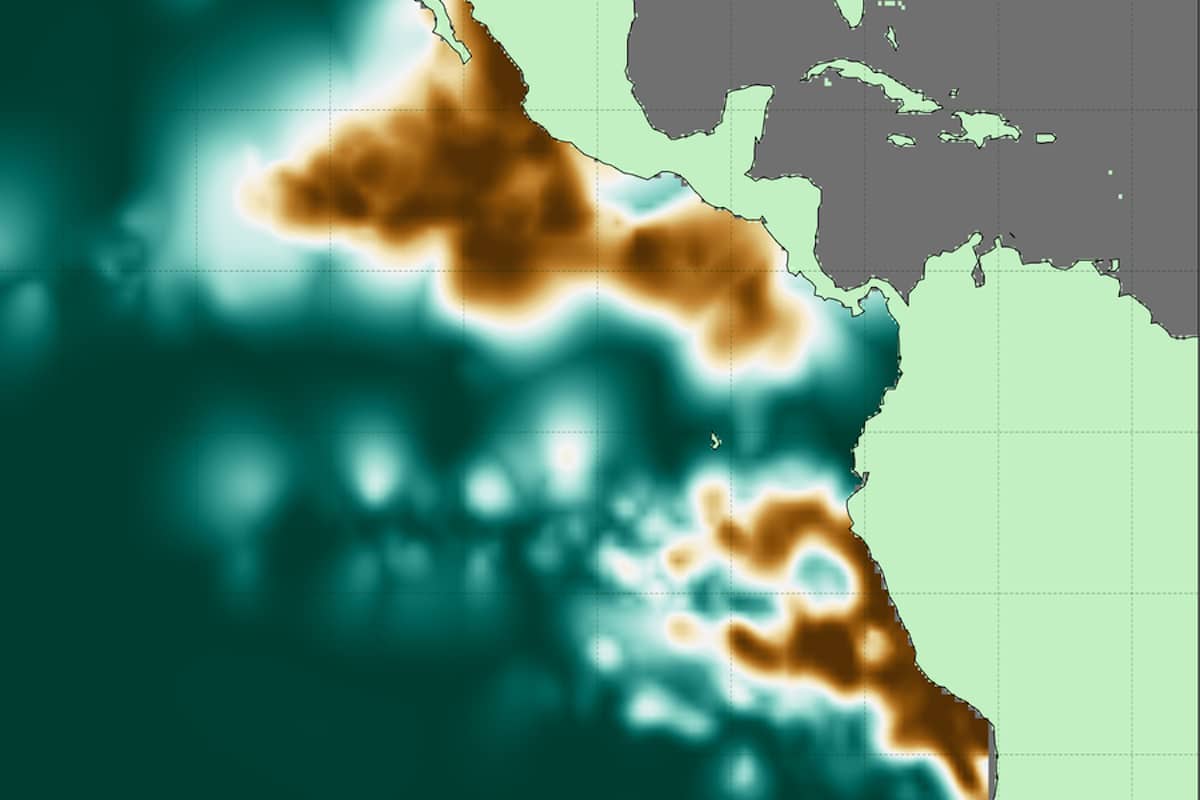
That is because they are the two largest oxygen-deficient zones (ODZ) in the world, which means they are a no-go zone for most aerobic (oxygen-dependent) organisms. Two Massachusetts Institute of Technology (MIT) scientists recently succeeded in making the most detailed atlas to date of these important oceanic regions, revealing crucial new facts about them in the process. The new high-resolution atlas was described last month in the journal Global Biogeochemical Cycles.
“We learned just how big these two zones in the Pacific are, reducing the uncertainty in the measurement, their horizontal extent, how much and where these zones are ventilated by oxygenated waters, and so much more,” Andrew Babbin told EcoWatch in an email. Babbin is one of the atlas’s two developers and Cecil and Ida Green Career Development Professor in MIT’s Department of Earth, Atmospheric and Planetary Sciences. “Being able to visualize in high resolution the low oxygen zones really is a necessary first step to fully understanding the processes and phenomena that lead to their emergence,” he said.
Natural Dead Zones
Oxygen-deficient zones can also be referred to as hypoxic zones or dead zones, as the National Oceanic and Atmospheric Administration explains. They can be caused by human activity, especially nutrient pollution. For example, the world’s second-largest dead zone is in the Gulf of Mexico, and is largely caused by the runoff of nitrogen and phosphorus from cities and factory farms.
The new atlas focuses on two naturally-occurring ODZs in the tropical Pacific, however. One is located off the coast of South America and measures about 600,000 cubic kilometers (approximately 143,948 cubic miles), or the equivalent of 240-billion Olympic swimming pools, MIT News reported. The second is around three times larger and located in the northern hemisphere, off the coast of Central America.
Both natural and anthropogenic ODZs have something in common: too many nutrients. In the case of the Pacific ODZs, Babbin said, those nutrients build up because of wind patterns that push water offshore.
“Deeper water then upwells to fill in this void, bringing higher nutrients to the surface,” Babbin told EcoWatch. “Those nutrients stimulate a massive amount of growth of phytoplankton, akin to how we fertilize crop lands and even our potted plants at home. When those phytoplankton then sink, heterotrophic bacteria act to decompose the organic material, consuming oxygen just like humans do to respire our food.”
However, because of where these zones are located, it takes a long time for oxygen-rich waters to reach the area and replenish what the bacteria gobble up.
“In essence, the biological demand of oxygen outpaces the physical resupply,” Babbin concluded.
While these specific zones aren’t caused by human pollution, understanding them is still important in the context of human activity. ODZs can emit the greenhouse gas nitrous oxide, and there is a concern that the climate crisis may cause them to expand.
“It’s broadly expected that the oceans will lose oxygen as the climate gets warmer. But the situation is more complicated in the tropics where there are large oxygen-deficient zones,” atlas co-developer Jarek Kwiecinski told MIT News. “It’s important to create a detailed map of these zones so we have a point of comparison for future change.”
A ‘Leap Forward’
The new atlas improves on previous attempts to measure the Pacific ODZs because of the amount of information it incorporates and the approach it took to measuring the oxygen content of the water. Instead of relying on direct measurements of the water’s oxygen content, the atlas designers looked for places in the water where the oxygen content did not change no matter the depth. They interpreted the lack of change as an absence of oxygen.
“This new approach, compiling tens of thousands of profiles and over 15 million individual measurements, is a leap forward in the representation of these climate critical regions,” Babbin and Kwiecinski wrote in Global Biogeochemical Cycles.
The data Babbin and Kwiecinski used for the atlas was gathered by research cruisers and robotic floats over a period of more than 40 years, MIT News reported. Scientists have typically dropped bottles to various depths and measured the oxygen content of the water collected by the bottle. However, this measurement is not entirely accurate because the plastic from the bottle itself also contains oxygen.
To avoid this problem, the team behind the atlas instead looked at data from sensors attached to the bottles or to robotic platforms, which allowed them to track oxygen content as the sensors descended through the water column.
“This method then allows us to get around a bias that exists in the absolute data to only look at whether oxygen is increasing, decreasing, or staying the same,” Babbin said.
The result is a high-resolution atlas that maps the volume, shape and borders of the two ODZs, as well as places where the oxygen-deprived waters are thicker or thinner. They found that the lack of oxygen is more concentrated towards the middle, while more oxygen-rich waters enter towards the edges.
Now that the atlas is complete, Babbin hopes to use it to plan more research in the area. Specifically, he intends to study the metabolism of the bacteria in the zones in order to better assess nitrous oxide pollution. But the atlas was not just designed to further one team’s research.
“We hope the atlas will be used by everyone!” Babbin said. “We can anticipate oceanographers and climate scientists to use it to plan expeditions or relate some of their data to a broad atlas/compilation. We hope climate modelers might use it to validate their models that try to reproduce the extent of low oxygen in their models. We further think that this compilation will act as a comparison point against which future measurements can be compared to finally reveal how these zones respond in the face of a changing climate.”
If you are interested in checking it out, the atlas is available from the Biological and Chemical Oceanography Data Management Office (BCO-DMO), and the data can be downloaded from the Woods Hole Open Access Server.
Correction: A previous version of this article incorrectly stated that anaerobic organisms were oxygen-dependent. Aerobic organisms are oxygen-dependent. This page has been updated.

 Uma (in)certa antropologia