Arquivo da tag: Ayurveda

Amid Indian Nationalism, Pseudoscience Seeps Into Academia (Undark)

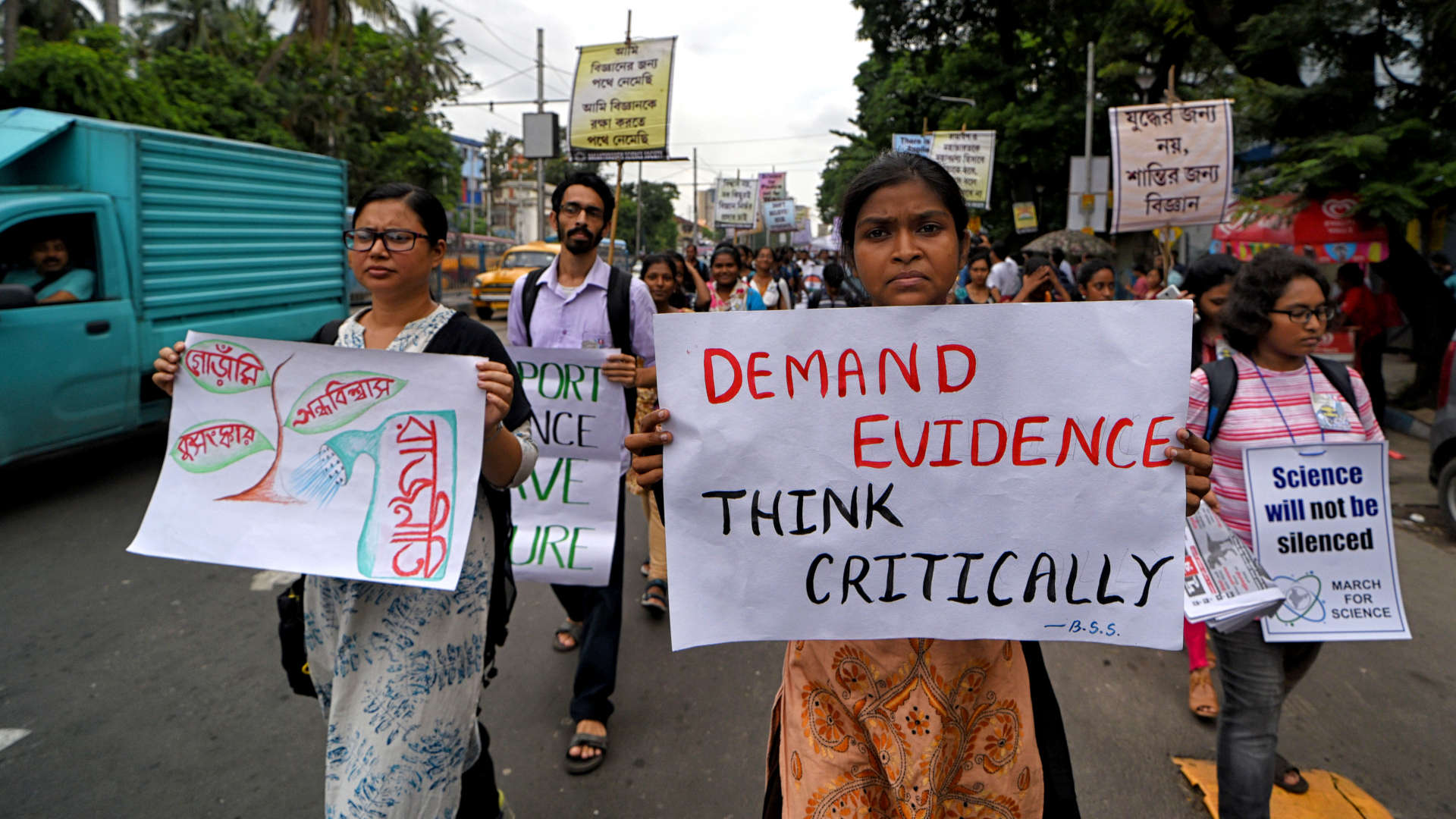
Scientists and students participate in the 2019 March for Science at Rajabazar Science College, Kolkata, West Bengal, India. Visual: Avishek Das/SOPA Images/LightRocket via Getty Images

Republish

In recent years, falsehoods have spread to institutions, where the next generation of scientists are being educated.

By Arbab Ali & Nadeem Sarwar

07.26.2023

In Oct. 2022, India’s Ministry of Science and Technology, in collaboration with other ministries and departments, announced that it would host a four-day conference called “Akash For Life” at a university in the northern Indian city of Dehradun.

“Akash” translates to “sky” or “spirit” in Hindi, and refers to one of five universal elements according to Hinduism. The event, according to its organizers, would integrate such traditional concepts into an academic sphere, and seek to “educate the youth of India to the wisdom of ancient science along with modern scientific advancements.”

But no sooner than the event was announced, it stirred furor in the Indian scientific community.
Related: The Threat of Pseudoscience in India

In a statement issued later that month, the Karnataka chapter of the nonprofit India March for Science wrote, “We reject the concept of Panchabhootas” — referring to the Hindu concept of the five elements. “The sky, earth, water are not elements. Such concepts have been deleted from science books a long time back.”

The West Bengal chapter was similarly clear in its disapproval: “Any attempt to belittle or trivialize humanity’s quest for knowledge through the scientific method has to be debunked and thoroughly rejected.”

The Ministry of Science and Technology did not respond to multiple requests for comment from Undark.

The “Akash” conference was just one of the latest events in India to face charges of pseudoscience as academics grow concerned about the country’s rise of conspiracies and falsehoods. Journalist Ruchi Kumar reported on this phenomenon for Undark in 2018, but experts say such discourse has only picked up in pace — and increasingly spread to institutions, where the next generation of scientists are being educated.

Aniket Sule, an associate professor at the Tata Institute of Fundamental Research in Mumbai, noted that while fringe voices can be few and far between, they are still given prominence at conferences and meetings, which paints a wrong picture for the entire faculty.

“Now, what has happened is that these fringe right-wing sympathizers have been given prominence,” said Sule. “Even if, for example, out of a hundred people, if there is one right-wing sympathizer, then that one person would be called to all events.”


Many experts have tied the rise of pseudoscience in India to the Bharatiya Janata Party, a right-wing political party that came to power in 2014, when Prime Minister Narendra Modi was elected. Members of the party have repeatedly amplified scientific falsehoods — for instance, that cow urine can cure cancer, or that ancient Indians invented the internet.

“It is clear that the government is propagating this sort of pseudoscience,” said Soumitro Banerjee, an engineering professor at the Indian Institute of Science Education and Research in Kolkata.

Such claims often tout the superiority of traditional knowledge over modern science and cite ancient Hindu texts as evidence. In recent years, they have leapt over to academic circles.
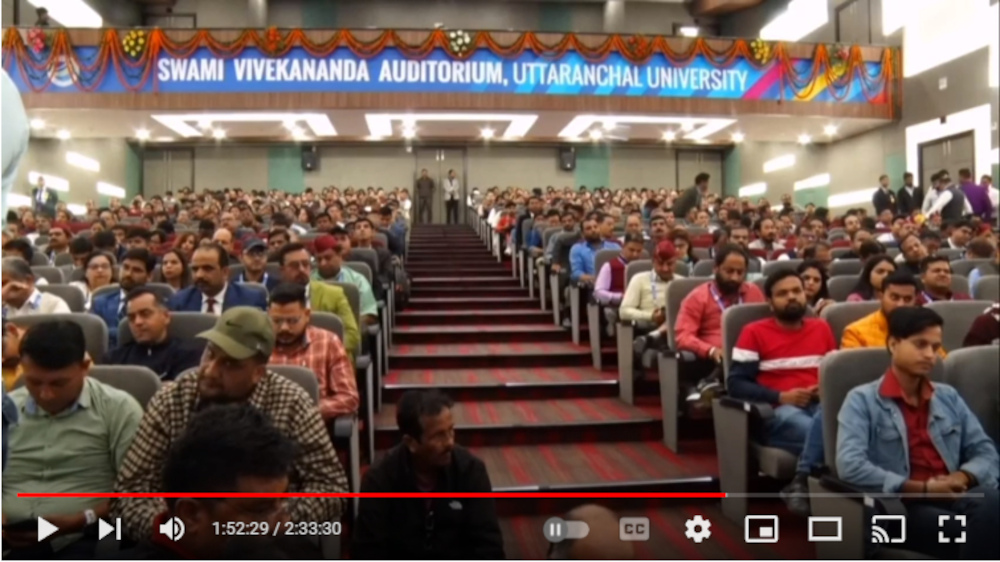
A screenshot of the audience in attendance at “Akash For Life” in the fall of 2022. Visual: Uttaranchal University/YouTube

In 2019, for example, G. Nageswara Rao, then vice chancellor of Andhra University, said that the Kauravas — who appear in the Hindu epic Mahabharata — were born of “stem cell and test tube technology.

More recently, news came out that Laxmidhar Behera, director of the Indian Institute of Technology Mandi, once claimed to have performed an exorcism with holy chants. When asked about the experience, Behera later told the newspaper The Indian Express, “Ghosts exist, yes.”

Scientific falsehoods have not only been espoused by academics, but have also made their way into course teachings.

In 2020, the Indian Institute of Technology Indore introduced a class to impart mathematical and scientific knowledge from ancient texts in the Sanskrit language. And in February of this year, IIT Kanpur — one of the country’s most elite universities — invited Rajiv Malhotra for a guest lecture. In the past, Malhotra cited an satirical article in denying the Greek civilization’s existence and touted the spiritual concept of the “third eye” as a substitute for medical diagnosis.

The same month, a group of scientists and researchers criticized the National Commission for Indian System of Medicine — the regulatory body governing public medical institutions’ policies — for introducing medical astrology as an elective in the Bachelor of Ayurvedic Medicine and Surgery program, which is offered at hundreds of institutions in India. The course material offers remedies in the form of mantras, amulets with protective powers, rituals, and counseling based on astrological calculations.

Aniket Sule noted that while fringe voices can be few and far between, they are still given prominence at conferences and meetings.

Ayurveda is a traditional system of Indian medicine that takes a natural approach to healing. Practitioners believe that diseases happen due to an imbalance in a person’s consciousness, and therefore, rely on a healing system that involves herbs, exercises, and meditation.

But Ayurveda is a topic of contention, and its claims can be at odds with modern medical science. Cyriac Abby Philips, an Indian liver doctor based in Kerala who regularly debunks pseudoscientific claims on social media, said the alternative Ayurvedic medical system is based on pseudoscientific principles.

Ayurveda has no basis in science, “but the whole aspect is that it has deep links to culture, tradition, and religion in India,” Philips told Undark. Yet, he said, the government is promoting Ayurvedic practices. A few years ago, for example, the National Health Mission, a government program that aims to improve access to health care, introduced a bridge course — designed to help students transition from one academic level to another — to allow Ayurveda doctors to prescribe treatments based on western medical sciences despite never studying it as part of their degree course. The move, according to the government, was to address the lack of doctors in rural areas, but the president of the Indian Medical Association has said there is no shortage. While the bridge course was ultimately dropped, some states have allowed Ayurveda doctors to prescribe and dispense medicines.

The National Health Mission did not respond to multiple requests for comment from Undark.

Meanwhile, the University Grants Commission, the statutory body responsible for maintaining the country’s higher education standards, asked all universities in India to “encourage” their students to take the Kamdhenu Gau Vigyan Prachar-Prasar Examination, a national-level test on “gau vigyan” or “cow science” — referring to research on the animal, which is considered sacred in Hinduism. The syllabus for the exam made claims including that earthquakes happen due to cow slaughter, and that cow byproducts are capable of curing a whole host of diseases.

The University Grants Commission did not respond to multiple requests for comment from Undark.

“It is clear that the government is propagating this sort of pseudoscience,” said Soumitra Banarjee.

In India, higher education institutions are intricately tied to the national government.“Save for a few exceptions, almost every single academic institution is reliant heavily on government funding,” said Mohammad Nadeem, an assistant professor in the Department of Computer Science at Aligarh Muslim University.

Nadeem said that, while he believes it’s important to take pride in Indian culture and heritage, glorifying its past with false claims does not serve anyone.

Natesan Yogesh, an assistant professor of physics at the National Institute of Technology Calicut, noted that many professors at these prestigious universities believe in superstitions, but “it is not just a single faculty is approving and they come up with certain ideas. From the top itself, they are asking for proposals.”


In April, the exclusion of Charles Darwin’s theory of biological evolution from high school textbooks became national news in India. More than 1,800 scientists, educators, and community members signed a letter condemning the move, calling it a “travesty of education.”

But while some students and academics have been vocal in speaking out against the rise of pseudoscience and Hindu nationalism, experts noted that many are quiet, whether it be out of fear of retaliation — including denying funding and promotional opportunities — or simple opportunism.

According to Banerjee, higher-ups at Indian scientific institutes have tried to stymie anti-pseudoscience protests since they are nearing retirement. “These people have aspirations or ambitions of being vice chancellors somewhere,” Banerjee added.

“In India, save for a few exceptions, almost every single academic institution is reliant heavily on government funding,” said Mohammad Nadeem.

In an email to Undark, G.L. Krishna, an Ayurvedic physician and a visiting scholar at the Indian Institute of Science in Bengaluru, wrote that dissenting voices are often “unnecessarily scared.” But according to Sule, the professor at the Tata Institute of Fundamental Research, even though those who actually believe in pseudoscience are a minority, such public statements can impact careers.

In universities and institutions “where promotions are in the hands of top authorities, there this political favoritism is happening a lot,” said Sule. He, along with other faculty members interviewed by Undark, said that political affiliations dictate progress in academic careers, so people often choose to stay silent.

Indeed, many heads of educational institutions in India have been vocal supporters of or involved in the national government. Santishree Dhulipudi Pandit, for example, was named the vice chancellor of Jawaharlal Nehru University early last year, and has voiced support for the ruling BJP party as well as called for “China-style” persecution of left-leaning voices. Rupinder Tewari, a previous candidate for the vice-chancellor post in Panjab University, alleged that only BJP-affiliated candidates were called in for the interview.

The Panjab University did not respond to multiple requests for comment from Undark.

    Some academics wonder what effect the pseudoscientific trend might have on India’s reputation among the international scientific community. “But in the long run, it’s these pseudoscience peddlers who are being watched and earning the ire of the international academia and science diaspora,” said Sule.

    Still, dissenting voices such as Banerjee and Krishna are hopeful that more people will speak out, and that scientific methods will take precedence in Indian academic spheres.

    “Reality-based thinking as opposed to belief-based thinking must carry weight,” wrote Krishna. “That’s the only way.”


    Arbab Ali and Nadeem Sarwar are independent reporters based in Delhi, India.

    To Tackle a Virus, Indian Officials Peddle Pseudoscience (Undark)

    Original article

    By Ruchi Kumar 04.19.2020

    Blending nationalism and pseudoscience, the “cures” touted by an Indian ministry are raising public health concerns.

    A government banner at Arogya, an Ayurvedic expo funded by the government of India, in December of 2010. Visual: Hari Prasad Nadig / flickr By Ruchi Kumar 04.19.2020

    When it was announced in late March that Prince Charles, heir to the British throne, was well on his way to recovering from Covid-19, there was some celebration 4,000 miles away in India, a former British colony. But it was not colonial nostalgia that brought on the cheer, so much as the declaration a few days later by an Indian government minister that the Prince of Wales had been cured using Ayurveda — a blend of, among other things, herbal medicine, breathing exercises, and meditation.

    At an April 2 press conference, Shripad Naik, India’s minister for alternative medicines, declared that the treatment’s supposed success “validates our age-old practice.” The British government swiftly issued a statement rejecting his claim. “This information is incorrect. The Prince of Wales followed the medical advice of the National Health Service in the U.K. and nothing more,” a spokesperson said the following day.

    But this hasn’t deterred Naik’s Ministry of Ayurveda, Yoga & Naturopathy, Unani, Siddha, and Homeopathy — or AYUSH for short — from promoting Indian alternative medicines as treatments for Covid-19. Established in 2014, the goal of AYUSH is to develop and popularize these treatments, many of which have their historical roots in India. Ayurveda, for example, has been practiced in India for thousands of years.

    Now, Naik said, the ministry aims to confirm that Prince Charles was cured using a combination of Ayurveda and the pseudoscience known as homeopathy, which has its roots in Germany, so that the treatment can be rolled out to the masses. This is in stark contrast to the position of mainstream medicine, which has not yet confirmed any evidence-based medicine for Covid-19, and is still highly cautious of giving experimental drugs to patients.

    And yet for many, the actions of the right-wing Indian government don’t come as a surprise. Aside from the popularity of alternative medicine in India generally, the ruling Bharatiya Janata Party (BJP) is known for supporting Hindutva, a form of nationalism that seeks to transform India from being a secular nation into an openly Hindu one. This partly plays out in the field of health, where alternative therapies that have their roots in India, such as Ayurveda, are considered more “Hindu” or “Indian” than modern medicine. Supporting them becomes an opportunity to push forward this nationalist agenda.

    In the early days of the epidemic, AYUSH heavily promoted therapies that lack an evidence base, said Sumaiya Shaikh, a neuroscientist based at the Center for Social and Affective Neuroscience at Linköping University Hospital in Sweden. Shaikh is also editor of science at Alt News, an Indian website that works to expose misinformation.

    Examples of treatments pushed by AYUSH included a homeopathic medicine containing diluted arsenic, an Ayurvedic drug developed by the ministry to treat malaria, and dietary changes including drinking warm water, putting sesame oil inside the nose, or consuming holy basil, ginger, cloves, and turmeric. The ministry suggested these interventions could prevent people from developing Covid-19 as well as treat its symptoms.

    “There was some amount of criticism to that,” said Shaikh. And so in response, the ministry provided a list of “scientific evidence” to bolster its claims. Aside from the fact that homeopathy has been repeatedly shown to have no biological effects, Shaikh said that when she and her team reviewed the list, the only actual research they could find was one analysis that examined the the same homeopathic treatment in bovines with gastric infections. Despite this, the ministry’s promotion of the therapy increased demand in many Indian states.

    This isn’t the first time the ministry has faced criticism for promoting unscientific claims or backing research derived from religious myths and beliefs. One of its repeated focuses has been cow urine, which is believed by many Hindus to have healing properties given the sacred nature of cows in Hinduism. The urine has been touted as a treatment for many illnesses, including diabetes, epilepsy, and AIDS. Naik himself has made several comments in parliament about how cow urine can cure cancer. In reality, its use can be dangerous.

    In fact, so widespread is the belief in cow urine that on March 17, an activist working for the BJP in Kolkata organized a “gomutra (cow urine) party” to ward off Covid-19. He believed that drinking the urine would protect them from the disease. Unfortunately, one of the volunteers fell seriously ill after ingesting the urine.

    The Ministry of AYUSH’s research portal carries papers on the uses of panchagavya, the five products derived from a cow, of which urine is one, supporting its use as a medical product. However, Ipsita Mohanty, who co-wrote a paper listed there titled “Diversified Uses of Cow Urine,” said in an email that she couldn’t definitively answer whether cow urine fights off Covid-19, as “it has not been proven by independent researchers.”

    This reflects how AYUSH researchers and doctors seek validation, explained Shaikh. “If a paper gets published anywhere — doesn’t matter what type of journal it is or how bad the statistics are — they take it as scientific proof,” she said, adding that the alternative medicine community also has a lot of journals of its own. These are regulated and edited by the same people who are published in them, Shaikh said.

    Despite being an advocate of cow urine, Mohanty urges doctors to not spread misinformation. “It is misleading to spread the rumor about something so important when more than half of our world is engulfed by Covid-19,” she said. “There is no vaccine nor any treatment for it. At this point, promoting cow urine against Covid-19 can be very fatal, as people might resort to it for treatment as their only hope.”

    The Ministry of AYUSH did not respond to requests for comments from Undark.

    “Practitioners of such therapies get their clientele from two distinct groups,” said Aniket Sule, a science education researcher and astronomer at the Homi Bhabha Center for Science Education. He is part of a steadily growing rationalist movement in India that is encouraging dialogue and critical thinking to counter misinformation, including within the realm of alternative medicine.

    The first group Sule identified is patients from impoverished communities and remote villages, “who don’t have access to doctors prescribing modern medicines.” The other set of clients is the “affluent and educated class in the cities, who have read half-baked internet posts and develop strong skepticism towards modern medicines,” he said.

    “Pushing such a narrative to gullible masses is akin to actively spreading misinformation, and senior functionaries of government should take strict action against such baseless propaganda,” he urged.

    The ministry has faced some institutional backlash. The Press Council of India, the statutory body responsible for maintaining good media standards, has issued an order asking print media to stop publicity and advertisements of AYUSH-related claims for Covid-19 treatments.

    But despite that, the Ministry of AYUSH continues not only to receive political backing but also a large share of the annual health budget. From 2019 to 2020, the Indian government allotted approximately $250 million for study and promotion of alternative medicines, a 15 percent increase from the previous year. According to Shaikh, only the defense ministry saw a larger proportional increase to its budget last year.

    Indian scientists fighting disinformation say there is an underlying nationalist agenda to this move. Certain radical groups affiliated with the government have dreams of spreading Hindu values beyond India’s borders to create an “Akhand Bharat,” or “consolidated Hindu nation,” which would include annexing a large part of the Indian subcontinent. One of these is Rashtriya Swayamsevak Sangh, a militant organization that has a long history of promoting Hindutva. Its leader recently said that Ayurveda is part of India’s “soft power” in the South Asian region, said Shaikh.

    The Press Council of India, the statutory body responsible for maintaining good media standards, has issued an order asking print media to stop publicity and advertisements of AYUSH-related claims for Covid-19 treatments.

    Since coming to power in 2014, India’s current government (BJP) has increasingly backed divisive policies that consolidate the power of the majoritarian Hindu population. “Overall, this government has made virtue out of extreme and thoughtless nationalism. Increased support to all these questionable therapies is a natural byproduct of that,” Sule said, adding there is also a distinct motivation among many people who believe in these claims. “There are people who are so completely blinded by ‘glorious ancient India’ that they willingly walk into any trap if it is presented as ‘this is what our great ancestors did,’” he said.

    Sule also thinks that AYUSH exists, in part, to protect commercial interests. There are nearly 800,000 practitioners of alternative medicine in India, he said, and over 650 colleges teaching related courses. The Ayurveda industry alone in India is worth $4.4 billion and is expected to grow by 16 percent in the next five years.

    Shaikh, Sule, and others have been critical of the Ministry of AYUSH for years, exposing and unmasking its questionable research and dubious medical advice. “It is very dangerous, especially now. We are the only country that has a parallel ministry for alternative systems,” Shaikh said. “Why not just have the one ministry and then have everything under it? Use whatever herbs you want, but run them through appropriate trials, and if they work then they should be in the mainstream and everybody should benefit from them,” she said.

    Shaikh doesn’t call for closing the ministry but insists the way it works needs to change.

    “Don’t start with a belief system, start with the hypothesis,” she advised. “Don’t start with the basis that this drug is going to work. Start with realizing that ‘we don’t know and we want to find out.’ That is unbiased research.”

    Many experts say that statements like Naik’s are false and dangerous, particularly now that the country is struggling to control the spread of the novel coronavirus, SARS-CoV-2, among its 1.35 billion people. With a lack of testing and a shortage of physicians, many experts feel the Indian government is failing its people by directing attention and resources to unsubstantiated and unscientific practices — especially when these practices themselves can be harmful.

    Related

    In Germany, a Heated Debate Over Homeopathy