Arquivo da tag: Psicologia

As raízes coloniais do entendimento da alma nacional (FAPESP)

HUMANIDADES | MELANCOLIA
A psicologia do púlpito

Carlos Haag
Edição Impressa 185 – Julho 2011

© MELENCOLIA I (GRAVURA DE ALBRECHT DÜRER / WIKIMEDIA COMMONS)

Em seu Sermão da quarta dominga depois da Páscoa, o padre Antônio Vieira (1608-1697) discute a tristeza a partir da passagem bíblica em que Cristo anuncia sua morte aos apóstolos, que se entristecem. Para Vieira, porém, a causa daquela tristeza não era a ausência iminente do mestre, mas o silêncio diante de sua partida. Se tivessem perguntado aonde Cristo iria teriam compreendido que não havia motivos para sofrer. Assim, a causa da tristeza era o silêncio. Num curioso paralelo, em 1895, Freud afirmou: “Sofremos de reminiscências que se curam lembrando”. A base da psicanálise freudiana era a cura pela palavra e pelo autoconhecimento da alma. Algo a que, em 1676, Vieira (leia mais na página 86) já aludia em As cinco pedras da funda de Davi: “O primeiro móbil de todas as nossas ações é o conhecimento de nós mesmos”, acrescentando no Sermão da quarta dominga do advento: “Nenhuma coisa trazemos mais esquecida, mais detrás de nós que a nós mesmos”.

“Nessa primeira modernidade havia uma forma de terapia que usava as palavras para tratar as dores da alma, ainda que identificá-la diretamente com a psicoterapia atual seja uma imprecisão”, explica o psicólogo Paulo José Carvalho da Silva, professor da Pontifícia Universidade Católica de São Paulo (PUC-SP), autor da pesquisa Ideias sobre as dores da alma no Brasil entre os séculos XVI e XVIII, apoiada pela FAPESP. “Ainda assim, investigar as noções de dores da alma nesse período é um desdobramento original da história das ideias psicológicas, uma área de pesquisa emergente na história da ciência. A psicologia como ciência de práticas terapêuticas só foi sistematizada no final do século XIX, mas desde a Antiguidade muitos pensadores quiseram compreender e tratar a alma e um dos nomes desses saberes era a medicina da alma”, analisa o pesquisador. “Muitos dos conceitos da psicologia moderna têm raízes no passado e olhar para esse passado nos permite reconhecer os elos de continuidade com nosso presente, as origens de teorias e métodos próprios do nosso modo de pensar. Se analisarmos o conjunto da produção luso-brasileira colonial, destacando-se o aporte dos jesuítas, notamos a criação de formas e métodos para a construção de um tipo de conhecimento da subjetividade e do comportamento humanos muito relevantes para a definição dos alicerces que darão origem à psicologia moderna”, afirma a psicóloga Marina Massimi, professora da Faculdade de Psicologia da Universidade de São Paulo e autora, entre outros, de História da psicologia brasileira (E.P.U.) “A preocupação com os fenômenos psicológicos no Brasil não é recente e desde os tempos da colônia eles aparecem em obras de filosofia, moral, teologia, medicina, política etc. cujo estudo mostra uma produção muitas vezes original e mesmo questões até hoje atuais”, concorda a psicóloga Mitsuko Makino Antunes, da PUC-SP, e autora de A psicologia no Brasil: leitura histórica sobre sua constituição.

O psicólogo e professor da USP Isaías Pessotti observa em seu estudo Notas para uma história da psicologia brasileira que “a evolução da psicologia moderna começa no Brasil colonial em que se veiculam ideias de interesse para a área em diversas áreas do saber mesmo sem a presunção de construir uma psicologia”. Segundo o pesquisador, esses textos eram explicitamente sobre outros temas, mas tratavam de questões como método de ensino, controle das emoções, causas da loucura, diferença de comportamentos entre sexos e raças etc. compondo o pensamento da elite cultural da época colonial. “É um período pré-institucional, pois o que se publica são obras desvinculadas de instituições da psicologia. São trabalhos individuais, sem compromisso com a construção ou difusão do saber psicológico, escritos por autores indiferentes ao progresso do saber psicológico per se. Na sua maioria são religiosos ou políticos, homens de projeção e poder, iluminados pela cultura europeia e interessados em usar essa ‘psicologia’ para a organização da sociedade e do Estado brasileiro.”

Os tratamentos para as patologias da alma eram assumidos, no início, pelos religiosos, no caso do Brasil colônia pelos missionários jesuítas, seguidos de outros, embora isso não significasse que a medicina da alma fosse uma empresa estritamente religiosa. Postulava-se, de modo geral, uma continuidade entre a dor do corpo e a da alma, identificada como tristeza, luto ou descontentamento. “Na primeira modernidade, o debate filosófico sobre a definição da natureza das paixões também incluía sua relação com a violência. Muitos sustentavam que a paixão era um perigoso elemento da natureza humana com enorme potencial subversivo. Filósofos das mais variadas tradições afirmavam que as paixões são capazes de corromper governos, arruinar sociedades ou mesmo provocar a morte. A paixão era um problema da ordem da ética, da política, estética, medicina e da teologia”, nota Carvalho da Silva. Para os que viviam no Brasil dos séculos XVI e XVII, experimentar uma paixão era sinônimo de “sentir”, de ter sentimentos, e ser afetado por uma paixão significava emocionar-se, viver uma emoção. “Há uma produção cultural elaborada no Brasil que mostra o interesse predominante dessa dimensão poderosa e frágil da experiência humana. O conhecimento, controle e manipulação das paixões, em sua natureza teórica e prática, eram um instrumento particularmente importante para os objetivos religiosos, sociais e políticos da Companhia de Jesus, como revela o interesse dos jesuítas sobre o tema”, avalia Marina Massimi.

© NARCISO (MICHELANGELO CARAVAGGIO / WIKIMEDIA COMMONS)

O sistema baseava-se nas teorias formuladas por Aristóteles, revisitado no século XIII por Tomás de Aquino (daí a sua denominação de doutrina “aristotélico-tomista”), um caldo reelaborado pelos pensadores da companhia, nos chamados tratados Conimbrences (termo derivado de Conimbrica, nome latino da cidade de Coimbra, onde os estudos foram elaborados), comentários das obras aristotélicas sobre as paixões. Esses estudiosos atribuíam grande importância aos estados da alma definidos como paixões, entendidas como movimentos do apetite sensitivo, provenientes da apreensão do bem ou do mal, acarretando algum tipo de mutação não natural do corpo. “Os filósofos jesuítas reafirmaram, nos moldes de Aristóteles e Aquino, a função positiva das paixões, caso fossem ordenadas pela razão, o que ajudaria na sobrevivência do homem e o ajudariam a alcançar a virtude. Elas se transformariam em doenças ou distúrbios do ânimo apenas enquanto se afastam da regra e moderação da razão. Assim, a ‘psicologia’ dos Conimbrences é expressiva da posição cultural da modernidade nascente”, avalia Marina. Nesse movimento se estabelece uma analogia profunda entre o organismo do homem, considerado como realidade psicossomática, e o organismo político-social. “É nesse encontro que o controle e a terapia das paixões parecem encontrar sua função teórica e prática. Na dinâmica do corpo social, bem como na do corpo individual, o ‘despotismo’ das paixões deve ser submetido a uma ‘monarquia’ onde o governo da razão e da liberdade atribua a cada aspecto da vida psíquica sua função e seu lugar peculiar”, completa a pesquisadora.

“Daí decorre a importância da pregação, vista como fonte de transmissão de conceitos e práticas psicológicas, mas também como expressão da articulação entre retórica, teoria do conhecimento e psicologia filosófica, resultando numa prática de uso da palavra muito significativa e, num certo sentido, precursora da moderna confiança na força da palavra e do discurso que está presente na psicanálise e nas psicoterapias em geral.” A palavra do pregador seria capaz de mudar juízos e atitudes dos ouvintes e um dos alicerces desse poder, nota a autora, seria a possibilidade de a palavra atingir e mobilizar o dinamismo psíquico dos destinatários, nos termos das psicologias formuladas por Aristóteles, Tomás e Agostinho. “A palavra pregada visa ensinar o ato de conhecimento envolvendo todo o psiquismo humano”, afirma Marina. Um caso exemplar disso seriam os Sermões de Vieira, onde se combinariam a preocupação jesuítica com os efeitos morais da tristeza entre a população brasileira, a apreensão pela insatisfação melancólica dos colonos e a longa tradição europeia de meditações médicas, filosóficas e teológicas sobre essa paixão da alma. “Vieira enfatiza a universalidade e a gravidade da tristeza a que estão sujeitos mesmo os reis de todas as terras, os imperadores mais poderosos e os papa. Ela é tão perigosa para a saúde do corpo como para a salvação da alma. Mais ou menos aguda, a tristeza é sempre mortal, é como um verme que come por dentro, secando tudo até que o princípio da vida se apague. Também segundo ele, as tristezas que permanecem ocultas são as mais opressivas, sensíveis e perigosas”, explica Carvalho.

Mas a dor era entendida como um fenômeno da condição humana que extravasa os limites concebíveis entre a alma, o corpo e mesmo os limites que separariam um indivíduo de outro. O que revela que existia uma confluência de saberes e campos que ora se apresentavam dissociados, mas que, naquele período, dialogavam de modo mais ou menos fluente. Falar sobre a dor implicava abordar não apenas a saúde e a doença, mas temas como finitude e eternidade, perda e separação, fantasia e realidade, afeto e razão, gozo e sofrimento, vida e morte”, continua o pesquisador. “Que é este mundo senão um mapa universal de misérias, de trabalhos, de perigos, de desgraças e mortes?”, escreveu o Padre Vieira. A consolação passou, então, a fazer parte das atividades pastorais, e ao lado da administração dos sacramentos os padres ofereciam a medicina da alma para aqueles que se encontravam na dor. “Para tanto, a identificação da verdadeira e legítima dor é uma referência fundamental para o consolador cristão e uma condição para a experiência de ir além da dor, necessária para a salvação da alma. Todo consolador, como todo confessor, deve saber nomear a dor de quem sofre”, diz Carvalho. Segundo o pesquisador, os sermões eram o meio mais utilizado para a realização da arte da consolação e da medicina da alma em sua função psicológica e espiritual, o que pressupunha um conhecimento prático sobre a importância da memória na experiência da dor e no seu tratamento, em especial, na sua função na origem e na permanência das dores da alma e, portanto, na sua superação. “Mas é importante lembrar que consolar-se é fruto de uma decisão solitária e pessoal. Na medida em que a noção de indivíduo e de vida interior ganhou mais espaço na mentalidade moderna, a relação entre conhecimento de si e a experiência da consolação foi se estreitando cada vez mais.”

Vieira, em particular, apostava na autonomia da razão humana para dominar suas paixões e apetites quando afirma que “o conhecimento de si mesmo, e o conceito que cada um faz de si, é uma força poderosa sobre as próprias ações”. É preciso voltar os olhos, sempre abertos em coisas exteriores, para o interior. “Frei Chagas, por exemplo, recomendava que era melhor empregar o tempo e a inteligência não tanto no exame da história, da geografia e da cultura, mas no da própria alma. Essa anatomia de si é o equivalente moderno do que se viria a ser a análise da alma, ou seja, a decomposição nas menores partes para poder compreendê-la melhor”, nota o autor. “O saber de si mesmo é visto como funcional para o controle sobre suas próprias ações, fundamentando-se na possibilidade de o sujeito representar sua vivência interior através do discurso. A necessidade da palavra para formular o autoconhecimento faz com que esse não seja possível, por exemplo, em experiências intensas como o choro simplesmente. O autoconhecimento se traduz num discurso cuja finalidade é comunicar para o outro a experiência vivenciada. O outro é um ouvinte. A escuta, que ele oferece ao sujeito, permite a este a melhor articulação de sua comunicação verbal e a catarse. O relacionamento interpessoal e o diálogo assumem uma função terapêutica, princípio, aliás, de toda psicoterapia moderna”, analisa Marina. Assim, o sujeito ocupa um lugar ativo, sendo o conhecimento possível pela transformação em discurso da vivência interior que ele próprio elabora. A consciência dos fenômenos e sua comunicação verbal são as condições para o entendimento deste fenômeno.
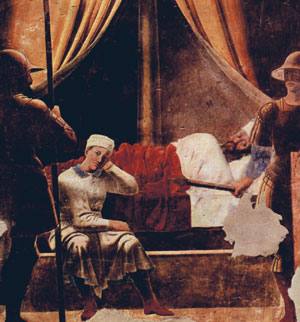
© DETALHE DE O SONHO DE CONSTANTINO (PIERO DELLA FRANCESCA / WIKIMEDIA COMMONS)

“As palavras, ao mesmo tempo que objetivam os fenômenos subjetivos, exteriorizando o que era contido na intimidade da pessoa, favorecem a libertação das emoções penosas desses estados.” Falar das dores podia aliviar o coração, bem como silenciá-las fazia com que essas se acumulassem e aumentassem ainda mais. “Era possível curar por meio da palavra. Acreditava-se também que o verdadeiro orador, como um médico de almas, curaria seus auditórios de suas enfermidades, combatendo as paixões que lhes são contrárias: eles apaziguam a cólera, aumentam a coragem e fazem suceder o amor ao ódio, e assim por diante”, fala Carvalho. “Vale lembrar ainda a importância da imagem, que, juntamente com a palavra, é um grande recurso de transmissão cultural em sociedades marcadas pela oralidade”, observa Marina.

A chegada de novos princípios científicos ao Brasil colonial trazem mudanças nessa visão psicológica do homem. “Desenvolvem-se uma psicologia e uma psicopatologia inovadoras em relação à tradição cultural anterior. Sendo a mente redutível ao organismo e sendo este regulado pelas leis da natureza, é possível abordar o seu estudo por meio do método científico, que já se mostrara efetivo na física e na biologia. Os distúrbios psíquicos, assim, que dependem do funcionamento do organismo segundo essa nova visão iluminada, poderiam ser conhecidos causalmente, prevenidos e tratados, modificando as variáveis por remédios físicos e normas higiênicas”, explica a pesquisadora. “A terapêutica das dores da alma, agora, deve ser realizada por remédios farmacêuticos que acabam por subordinar a teologia moral à medicina, considerada a disciplina que ultimamente pode instrumentar os tratamentos da alma, inclusive aqueles tradicionalmente cuidados pelos confessores”, concorda Carvalho.

É o caso, por exemplo, de Francisco de Mello Franco (1757-1822), que em sua Medicina teológica postula que a figura do confessor seja substituída pela do médico que detém o conhecimento exato das causas das enfermidades da alma e proporciona os métodos terapêuticos como remédio, tudo fruto de uma análise objetiva e causal. “O objetivo da psicologia médica do século XVIII, que será consolidada no século XIX, é o de definir uma ‘verdade’ sobre o homem, alternativa à proclamada pelo saber tradicional de matriz cristã. A felicidade é identificada com a boa regulação da máquina corporal, segundo a ordem do sistema da natureza”, diz Marina. “Não é uma cura pela palavra, mas uma medicina propriamente dita. Obras como a de Mello Franco propõem a substituição dos confessores pela nova medicina dos nervos e defende que é necessário conhecer os nervos, sua estrutura, para poder tratar os vícios humanos. Na contramão da medicina da alma, abre-se uma nova via à medicina, fundada nas bases de uma nova concepção de homem, de ciência e de racionalidade”, defende Carvalho.

Afinal, o mundo ideal preconizado em sermões não se sustentava mais. “O sonho de uma sociedade ordenada pela verdade e pela justiça é substituído pela consciência da inevitabilidade do destino imposto pelo regime colonial. Então, a dimensão psicológica interior do homem não é mais concebida como o espelho da harmonia universal, como queria a reforma ordenada aristotélico-tomista, nem como o lugar onde mora no homem aquela faísca divina que garante a sua imortalidade, mas como o refúgio precário e passageiro do indivíduo ante os absolutismos do poder e a desordem exterior da sociedade”, explica a pesquisadora. Aos poucos, nasce a ideologia do caráter nacional brasileiro que manipula traços psicológicos na construção de teorias para definir características coletivas do “brasileiro”. “No século XIX, o processo de organização da sociedade nacional traz a necessidade de nivelar os sujeitos sociais e culturais. A nova pergunta é ‘quem somos nós?’ Creio que foi a ocorrência desse processo um dos motivos que explicam, parcialmente, por que a introdução e a difusão da psicologia moderna no país, em suas vertentes de ciência do comportamento ou da psicologia das diferenças individuais, com suas técnicas de avaliação e de medida do ser humano, foi muito favorecida e apoiada como instrumento oportuno e moderno a ser utilizado nessa perspectiva.” Até o início do século XIX não havia no Brasil uma psicologia propriamente dita como prática reconhecida. Mas era crescente o interesse da elite nacional pela produção e aplicação de saberes psicológicos, em especial nas recém-criadas faculdades de Medicina do Rio e da Bahia, onde se produziram várias teses sobre o tema.

Na Bahia, a preocupação principal era a aplicação da psicologia nos problemas sociais, como na higiene mental e psiquiatria forense. No Rio, o interesse era sobre a relação da psicologia com a neuropsiquiatria e a neurologia, com estudos de psicologia experimental. “Boa parte dessas produções se ligava ao movimento que buscava o saneamento das cidades, o que envolvia a eliminação das ‘imundícies’ físicas e morais dos centros urbanos. Os médicos se envolviam em ações para erradicar esses problemas e criar uma sociedade sadia, organizada, normalizada, livre da desordem e dos desvios da escória social. Chegaram os hospícios, com o argumento de ajudar o louco, os quais seriam asilos higiênicos, com base no tratamento moral, mas serviram apenas para excluir do convívio social os indesejáveis”, nota Mitsuko Antunes. Uma escolha que trouxe graves consequências para a psicologia nacional. “Um psicólogo enraizado em sua cultura e sociedade é um agente de transformação social e não de normalização. Hoje temos uma escolha: atuar na redução do ser humano como peça produtiva da sociedade globalizada ou atuar para afirmá-lo como protagonista da sociedade. Acho que o conhecimento das ideias psicológicas surgidas no âmago da história cultural de nosso país tem a função de iluminar essa escolha”, avalia Marina.

World-Wide Assessment Determines Differences in Cultures (NSF)

[Apesar dos problemas metodológicos desse tipo de pesquisa (identificação de fronteiras nacionais com fronteiras culturais, reificação do conceito de cultura, abordagem sincrônica, dentre muitos outros), os resultados são provocadores, e portanto incitam a um debate interessante. RT]

Press Release 11-106 – Video
Michele Gelfand discusses what makes cultures restrictive versus permissive.

Watch video here.

University of Maryland Psychology Professor Michele Gelfand discusses recent research that investigates the “tightness” and “looseness” of 33 countries. “Tight” refers to nations that have strong social norms and low tolerance for deviation from those norms, whereas another term, “loose,” refers to nations with weak social norms and a high tolerance for deviation from those norms.

Credit: University of Maryland/National Science Foundation.

Press Release 11-106
World-Wide Assessment Determines Differences in Cultures

Ukraine, Israel, Brazil and the United States are “loose” cultures

Population density helps determine whether a country is tight or loose as this German street hints.

May 26, 2011

Conflicts and misunderstandings frequently arise between individuals from different cultures. But what makes cultures different; what makes one more restrictive and another less so?

A new international study led by the University of Maryland and supported by the National Science Foundation’s Division of Behavioral and Cognitive Sciences offers insights that may help explain such cultural differences and bridge the gaps between them.

Published in the May 27 issue of the journal Science, the study for the first time assesses the degree to which countries are restrictive versus permissive and it all comes down to factors that shape societal norms.

The researchers found a wide variation in the degree to which various societies impose social norms, enforce conformity and punish anti-social behavior. They also found the more threats experienced by a society, the more likely the society is to be restrictive, the authors say.

“There is less public dissent in tight cultures,” said University of Maryland Psychology Professor Michele Gelfand, who led the study. “Tight societies require much stronger norms and are much less tolerant of behavior that violates norms.”

“Tight” refers to nations that have strong social norms and low tolerance for deviation from those norms, whereas another term, “loose,” refers to nations with weak social norms and a high tolerance for deviation from them.

Gelfand and colleagues found that countries such as Japan, Korea, Singapore and Pakistan are much tighter whereas countries such as the Ukraine, Israel, Brazil and the United States are looser.

“Is important, within our view, to be mindful that we don’t think that either culture is worse or better,” said Gelfand.

She and her colleagues examined cultural variation in both types of societies.

“We believe this knowledge about how tight or loose a country is and why it is that way can foster greater cross-cultural tolerance and understanding,” said Gelfand. “Such understanding is critical in a world where both global interdependence and global threats are increasing.”

The researchers surveyed 6,823 respondents in 33 nations. In each nation, individuals from a wide range of occupations, as well as university students, were included. Data on environmental and historical threats and on societal institutions were collected from numerous established databases. Historical data–population density in 1500, history of conflict over the last hundred years, historical prevalence of disease outbreaks–were included whenever possible, and data on a wide range of societal institutions, including government, media and criminal justice, were obtained.

“You can see tightness reflected in the response in Japan to the natural disasters recently,” said Gelfand referring to the massive earthquake and tsunami that hit the country on March 11 of this year.

“The order and social coordination after the event, we believe, is a function of the tightness of the society,” Gelfand said, noting that tightness is needed in Japan to face these kinds of ecological vulnerabilities.

The research further showed that a nation’s tightness or looseness is in part determined by the environmental and human factors that have shaped a nation’s history–including wars, natural disasters, disease outbreaks, population density and scarcity of natural resources.

Tight and loose societies also vary in their institutions, with tight societies having more autocratic governments, more closed media and criminal justice systems that have more monitoring and greater deterrence of crime as compared to loose societies.

The study found that the situations that people encounter differ in tight and loose societies. For example, everyday situations–like being in a park, a classroom, the movies, a bus, at job interviews, restaurants and even one’s bedroom–constrain behavior much more in tight societies and afford a wider range of behavior in loose societies.

“We also found that the psychological makeup of individual citizens varies in tight and loose societies,” Gelfand said. “For example, individuals in tight societies are more prevention focused, have higher self-regulation strength and have higher needs for order and self-monitoring abilities than individuals in loose societies.”

These attributes, Gelfand said, help people to adapt to the level of constraint, or latitude, in their cultural context, and at the same time, reinforce it.

The research team combined all these measures in a multi-level model that shows how tight and loose systems are developed and maintained.

Gelfand said knowledge about these cultural differences can be invaluable to many people–from diplomats and global managers to military personal, immigrants and travelers–who have to traverse the tight-loose divide.

“When we understand why cultures, and the individuals in those cultures, are the way they are, it helps us to become less judgmental. It helps us to understand and appreciate societal differences.”

-NSF-

Media Contacts
Bobbie Mixon, NSF (703) 292-8485 bmixon@nsf.gov
Lee Tune, University of Maryland (301) 405-4679 ltune@umd.edu

Principal Investigators
Michele Gelfand, University of Maryland (301) 405-6972 mgelfand@psyc.umd.edu

It’s Even Less in Your Genes (The New York Review of Books)

MAY 26, 2011
Richard C. Lewontin

The Mirage of a Space Between Nature and Nurture
by Evelyn Fox Keller
Duke University Press, 107 pp., $64.95; $18.95 (paper)

In trying to analyze the natural world, scientists are seldom aware of the degree to which their ideas are influenced both by their way of perceiving the everyday world and by the constraints that our cognitive development puts on our formulations. At every moment of perception of the world around us, we isolate objects as discrete entities with clear boundaries while we relegate the rest to a background in which the objects exist.

That tendency, as Evelyn Fox Keller’s new book suggests, is one of the most powerful influences on our scientific understanding. As we change our intent, also we identify anew what is object and what is background. When I glance out the window as I write these lines I notice my neighbor’s car, its size, its shape, its color, and I note that it is parked in a snow bank. My interest then changes to the results of the recent storm and it is the snow that becomes my object of attention with the car relegated to the background of shapes embedded in the snow. What is an object as opposed to background is a mental construct and requires the identification of clear boundaries. As one of my children’s favorite songs reminded them:

You gotta have skin.
All you really need is skin.
Skin’s the thing that if you’ve got it outside,
It helps keep your insides in.
Organisms have skin, but their total environments do not. It is by no means clear how to delineate the effective environment of an organism.

One of the complications is that the effective environment is defined by the life activities of the organism itself. “Fish gotta swim and birds gotta fly,” as we are reminded by yet another popular lyric. Thus, as organisms evolve, their environments necessarily evolve with them. Although classic Darwinism is framed by referring to organisms adapting to environments, the actual process of evolution involves the creation of new “ecological niches” as new life forms come into existence. Part of the ecological niche of an earthworm is the tunnel excavated by the worm and part of the ecological niche of a tree is the assemblage of fungi associated with the tree’s root system that provide it with nutrients.

The vulgarization of Darwinism that sees the “struggle for existence” as nothing but the competition for some environmental resource in short supply ignores the large body of evidence about the actual complexity of the relationship between organisms and their resources. First, despite the standard models created by ecologists in which survivorship decreases with increasing population density, the survival of individuals in a population is often greatest not when their “competitors” are at their lowest density but at an intermediate one. That is because organisms are involved not only in the consumption of resources, but in their creation as well. For example, in fruit flies, which live on yeast, the worm-like immature stages of the fly tunnel into rotting fruit, creating more surface on which the yeast can grow, so that, up to a point, the more larvae, the greater the amount of food available. Fruit flies are not only consumers but also farmers.

Second, the presence in close proximity of individual organisms that are genetically different can increase the growth rate of a given type, presumably since they exude growth-promoting substances into the soil. If a rice plant of a particular type is planted so that it is surrounded by rice plants of a different type, it will give a higher yield than if surrounded by its own type. This phenomenon, known for more than a half-century, is the basis of a common practice of mixed-variety rice cultivation in China, and mixed-crop planting has become a method used by practitioners of organic agriculture.

Despite the evidence that organisms do not simply use resources present in the environment but, through their life activities, produce such resources and manufacture their environments, the distinction between organisms and their environments remains deeply embedded in our consciousness. Partly this is due to the inertia of educational institutions and materials. As a coauthor of a widely used college textbook of genetics,(1) I have had to engage in a constant struggle with my coauthors over the course of thirty years in order to introduce students to the notion that the relative reproductive fitness of organisms with different genetic makeups may be sensitive to their frequency in the population.

But the problem is deeper than simply intellectual inertia. It goes back, ultimately, to the unconsidered differentiations we make—at every moment when we distinguish among objects—between those in the foreground of our consciousness and the background places in which the objects happen to be situated. Moreover, this distinction creates a hierarchy of objects. We are conscious not only of the skin that encloses and defines the object, but of bits and pieces of that object, each of which must have its own “skin.” That is the problem of anatomization. A car has a motor and brakes and a transmission and an outer body that, at appropriate moments, become separate objects of our consciousness, objects that at least some knowledgeable person recognizes as coherent entities.

It has been an agony of biology to find boundaries between parts of organisms that are appropriate for an understanding of particular questions. We murder to dissect. The realization of the complex functional interactions and feedbacks that occur between different metabolic pathways has been a slow and difficult process. We do not have simply an “endocrine system” and a “nervous system” and a “circulatory system,” but “neurosecretory” and “neurocirculatory” systems that become the objects of inquiry because of strong forces connecting them. We may indeed stir a flower without troubling a star, but we cannot stir up a hornet’s nest without troubling our hormones. One of the ironies of language is that we use the term “organic” to imply a complex functional feedback and interaction of parts characteristic of living “organisms.” But musical organs, from which the word was adopted, have none of the complex feedback interactions that organisms possess. Indeed the most complex musical organ has multiple keyboards, pedal arrays, and a huge array of stops precisely so that different notes with different timbres can be played simultaneously and independently.

Evelyn Fox Keller sees “The Mirage of a Space Between Nature and Nurture” as a consequence of our false division of the world into living objects without sufficient consideration of the external milieu in which they are embedded, since organisms help create effective environments through their own life activities. Fox Keller is one of the most sophisticated and intelligent analysts of the social and psychological forces that operate in intellectual life and, in particular, of the relation of gender in our society both to the creation and acceptance of scientific ideas. The central point of her analysis has been that gender itself (as opposed to sex) is socially constructed, and that construction has influenced the development of science:

If there is a single point on which all feminist scholarship…has converged, it is the importance of recognizing the social construction of gender…. All of my work on gender and science proceeds from this basic recognition. My endeavor has been to call attention to the ways in which the social construction of a binary opposition between “masculine” and “feminine” has influenced the social construction of science.(2)

Beginning with her consciousness of the role of gender in influencing the construction of scientific ideas, she has, over the last twenty-five years, considered how language, models, and metaphors have had a determinative role in the construction of scientific explanation in biology.

A major critical concern of Fox Keller’s present book is the widespread attempt to partition in some quantitative way the contribution made to human variation by differences in biological inheritance, that is, differences in genes, as opposed to differences in life experience. She wants to make clear a distinction between analyzing the relative strength of the causes of variation among individuals and groups, an analysis that is coherent in principle, and simply assigning the relative contributions of biological and environmental causes to the value of some character in an individual.

It is, for example, all very well to say that genetic variation is responsible for 76 percent of the observed variation in adult height among American women while the remaining 24 percent is a consequence of differences in nutrition. The implication is that if all variation in nutrition were abolished then 24 percent of the observed height variation among individuals in the population in the next generation would disappear. To say, however, that 76 percent of Evelyn Fox Keller’s height was caused by her genes and 24 percent by her nutrition does not make sense. The nonsensical implication of trying to partition the causes of her individual height would be that if she never ate anything she would still be three quarters as tall as she is.

In fact, Keller is too optimistic about the assignment of causes of variation even when considering variation in a population. As she herself notes parenthetically, the assignment of relative proportions of population variation to different causes in a population depends on there being no specific interaction between the causes. She gives as a simple example the sound of two different drummers playing at a distance from us. If each drummer plays each drum for us, we should be able to tell the effect of different drummers as opposed to differences between drums. But she admits that is only true if the drummers themselves do not change their ways of playing when they change drums.

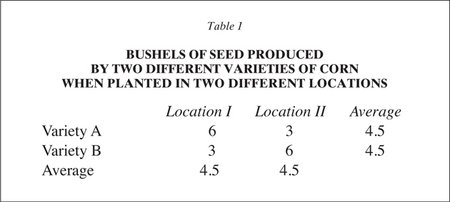
Keller’s rather casual treatment of the interaction between causal factors in the case of the drummers, despite her very great sophistication in analyzing the meaning of variation, is a symptom of a fault that is deeply embedded in the analytic training and thinking of both natural and social scientists. If there are several variable factors influencing some phenomenon, how are we to assign the relative importance to each in determining total variation? Let us take an extreme example. Suppose that we plant seeds of each of two different varieties of corn in two different locations with the following results measured in bushels of corn produced (see Table 1).

There are differences between the varieties in their yield from location to location and there are differences between locations from variety to variety. So, both variety and location matter. But there is no average variation between locations when averaged over varieties or between varieties when averaged over locations. Just by knowing the variation in yield associated with location and variety separately does not tell us which factor is the more important source of variation; nor do the facts of location and variety exhaust the description of that variation.

There is a third source of variation called the “interaction,” the variation that cannot be accounted for simply by the separate average effects of location and variety. There is no difference that appears between the average of different varieties or average of different locations, suggesting that neither location or variety matters to yield. Yet the yields of corn were different when different particular combinations of variety and location are observed. These effects of particular combinations of factors, not accounted for by the average effects of each factor separately, are thrown into an unanalyzed category called “interaction” with no concrete physical model made explicit.

In real life there will be some difference between the varieties when averaged over locations and some variation between locations when averaged over varieties; but there will also be some interaction variation accounting for the failure of the separately identified main effects to add up to the total variation. In an extreme case, as for example our jungle drummers with a common consciousness of what drums should sound like, it may turn out to be all interaction.

The Mirage of a Space Between Nature and Nurture appears in an era when biological—and specifically, genetic—causation is taken as the preferred explanation for all human physical differences. Although the early and mid-twentieth century was a period of immense popularity of genetic explanations for class and race differences in mental ability and temperament, especially among social scientists, such theories have now virtually disappeared from public view, largely as a result of a considerable effort of biologists to explain the errors of those claims.

The genes for IQ have never been found. Ironically, at the same time that genetics has ceased to be a popular explanation for human intellectual and temperamental differences, genetic theories for the causation of virtually every physical disorder have become the mode. “DNA” has replaced “IQ” as the abbreviation of social import. The announcement in February 2001 that two groups of investigators had sequenced the entire human genome was taken as the beginning of a new era in medicine, an era in which all diseases would be treated and cured by the replacement of faulty DNA. William Haseltine, the chairman of the board of the private company Human Genome Sciences, which participated in the genome project, assured us that “death is a series of preventable diseases.” Immortality, it appeared, was around the corner. For nearly ten years announcements of yet more genetic differences between diseased and healthy individuals were a regular occurrence in the pages of The New York Times and in leading general scientific publications like Science and Nature.

Then, on April 15, 2009, there appeared in The New York Times an article by the influential science reporter and fan of DNA research Nicholas Wade, under the headline “Study of Genes and Diseases at an Impasse.” In the same week the journal Science reported that DNA studies of disease causation had a “relatively low impact.” Both of these articles were instigated by several articles in The New England Journal of Medicine, which had come to the conclusion that the search for genes underlying common causes of mortality had so far yielded virtually nothing useful. The failure to find such genes continues and it seems likely that the search for the genes causing most common diseases will go the way of the search for the genes for IQ.

A major problem in understanding what geneticists have found out about the relation between genes and manifest characteristics of organisms is an overly flexible use of language that creates ambiguities of meaning. In particular, their use of the terms “heritable” and “heritability” is so confusing that an attempt at its clarification occupies the last two chapters of The Mirage of a Space Between Nature and Nurture. When a biological characteristic is said to be “heritable,” it means that it is capable of being transmitted from parents to offspring, just as money may be inherited, although neither is inevitable. In contrast, “heritability” is a statistical concept, the proportion of variation of a characteristic in a population that is attributable to genetic variation among individuals. The implication of “heritability” is that some proportion of the next generation will possess it.

The move from “heritable” to “heritability” is a switch from a qualitative property at the level of an individual to a statistical characterization of a population. Of course, to have a nonzero heritability in a population, a trait must be heritable at the individual level. But it is important to note that even a trait that is perfectly heritable at the individual level might have essentially zero heritability at the population level. If I possess a unique genetic variant that enables me with no effort at all to perform a task that many other people have learned to do only after great effort, then that ability is heritable in me and may possibly be passed on to my children, but it may also be of zero heritability in the population.

One of the problems of exploring an intellectual discipline from the outside is that the importance of certain basic methodological considerations is not always apparent to the observer, considerations that mold the entire intellectual structure that characterizes the field. So, in her first chapter, “Nature and Nurture as Alternatives,” Fox Keller writes that “my concern is with the tendency to think of nature and nurture as separable and hence as comparable, as forces to which relative strength can be assigned.” That concern is entirely appropriate for an external critic, and especially one who, like Fox Keller, comes from theoretical physics rather than experimental biology. Experimental geneticists, however, find environmental effects a serious distraction from the study of genetic and molecular mechanisms that are at the center of their interest, so they do their best to work with cases in which environmental effects are at a minimum or in which those effects can be manipulated at will. If the machine model of organisms that underlies our entire approach to the study of biology is to work for us, we must restrict our objects of study to those in which we can observe and manipulate all the gears and levers.

For much of the history of experimental genetics the chief organism of study was the fruit fly, Drosophila melanogaster, in which very large numbers of different gene mutations with visible effects on the form and behavior of the flies had been discovered. The catalog of these mutations described, in addition to genetic information, a description of the way in which mutant flies differed from normal (“wild type”) and assigned each mutation a “Rank” between 1 and 4. Rank 1 mutations were the most reliable for genetic study because every individual with the mutant genetic type could be easily and reliably recognized by the observer, whereas some proportion of individuals carrying mutations of other ranks could be indistinguishable from normal, depending on the environmental conditions in which they developed. Geneticists, if they could, avoided depending on poorer-rank mutations for their experiments. Only about 20 percent of known mutations were of Rank 1.

With the recent shift from the study of classical genes in controlled breeding experiments to the sequencing of DNA as the standard method of genetic study, the situation has gotten much worse. On the one hand, about 99 percent of the DNA in a cell is of completely unknown functional significance and any two unrelated individuals will differ from each other at large numbers of DNA positions. On the other hand, the attempt to assign the causes of particular diseases and metabolic malfunctions in humans to specific mutations has been a failure, with the exception of a few classical cases like sickle-cell anemia. The study of genes for specific diseases has indeed been of limited value. The reason for that limited value is in the very nature of genetics as a way of studying organisms.

Genetics, from its very beginning, has been a “subtractive” science. That is, it is based on the analysis of the difference between natural or “wild-type” organisms and those with some genetic defect that may interfere in some observable way with regular function. But to carry out such comparison it is necessary that the organisms being studied are, to the extent possible, identical in all other respects, and that the comparison is carried out in an environment that does not, itself, generate atypical responses yet allows the possible effect of the genetic perturbation to be observed. We must face the possibility that such a subtractive approach will never be able to reveal the way in which nature and nurture interact in normal circumstances.

An alternative to the standard subtractive method of genetic perturbations would be a synthetic approach in which living systems would be constructed ab initio from their molecular elements. It is now clear that most of the DNA in an organism is not contained in genes in the usual sense. That is, 98–99 percent of the DNA is not a code for a sequence of amino acids that will be assembled into long chains that will fold up to become the proteins that are essential to the formation of organisms; yet that nongenic DNA is transmitted faithfully from generation to generation just like the genic DNA.

It appears that the sequence of this nongenic DNA, which used to be called “junk-DNA,” is concerned with regulating how often, when, and in which cells the DNA of genes is read in order to produce the long strings of amino acids that will be folded into proteins and which of the many alternative possible foldings will occur. As the understanding and possibility of control of the synthesis of the bits and pieces of living cells become more complete, the temptation to create living systems from elementary bits and pieces will become greater and greater. Molecular biologists, already intoxicated with their ability to manipulate life at its molecular roots, are driven by the ambition to create it. The enterprise of “Synthetic Biology” is already in existence.

In May 2010 the consortium originally created by J. Craig Venter to sequence the human genome gave birth to a new organization, Synthetic Genomics, which announced that it had created an organism by implanting a synthetic genome in a bacterial cell whose own original genome had been removed. The cell then proceeded to carry out the functions of a living organism, including reproduction. One may argue that the hardest work, putting together all the rest of the cell from bits and pieces, is still to be done before it can be said that life has been manufactured, but even Victor Frankenstein started with a dead body. We all know what the consequences of that may be.

1. Anthony J.F. Griffiths, Susan R. Wessler, Sean B. Carroll, and Richard C. Lewontin, Introduction to Genetic Analysis , ninth edition (W.H. Freeman, 2008).

2. The Scientist , Vol. 5, No. 1 (January 7, 1991

Is a Human “Here and Now” Bias Clouding Climate Reasoning? (N.Y. Times)

By ANDREW C. REVKIN
N.Y. Times, Dot Earth – May 8, 2011, 7:36 AM

Here’s a “Your Dot” contribution from Jacob Tanenbaum, a computer technology teacher from Tappan, N.Y., who sent the following thoughts after reading “On Birth Certificates, Climate Risk and an Inconvenient Mind“:

Our lack of ability to perceive and react to climate is not just simply a problem rooted in social norms. It goes far deeper into the evolutionary structure of the human mind. We are an animal that evolved over time somewhere in southern Africa. Our minds are set up to quickly and effectively assess an environment and perceive danger in it. This is what Macolm Gladwell calls “thin slicing” and it is very effective in many situations. What we consider higher thought processes appeared far later in our evolutionary path. When we are facing danger, it makes sense that we rely on those higher processes far less than we rely on our “gut instinct” –- those older processes that kept us safe for so much longer in our species’ history. So how does this help us understand our reactions to something like climate?

Consider this:

1. Once we are accustomed to something, change is very difficult. An animal that understands its environment can pick out subtle changes that indicate danger more effectively. An animal in new environment perceives difference, and so danger, everywhere it looks. Our reaction to climate must involve significant change in how we live our lives. This is difficult for any animal. Even us.

2. Our understanding of danger is event driven. The presence of a predator, or a fire or a storm or flood are all events. Climate is not an event, it is a trend. Weather is an event. To understand climate, you must suspend the belief that what you see outside your window is all that can be a threat to you. To understand climate you must look at the numbers over a long time and a large geographical space. That is how you can “see” a trend. This, unfortunately, may be antithetical to the way that the human animal understands danger since the threat is not immediately in front of us in a way that causes our lower thought processes to perceive a threat, pump us full of adrenalin, and push us to react.

3. Since our understanding of danger is event driven, it makes sense that our understanding of danger is also temporally driven. We are best wired to react to events that are immediate in nature and short in duration. We are wired to react to an event quickly and to make whatever adjustments are needed so that things return to what we perceive as normal. We want a short burst of adrenalin to help us get away from the threat and back to our “comfort zone.” Climate, again, asks us to suspend this part of our understanding of danger and may, again, be antithetical to the way in which we are wired to think about danger. We must react now to avoid a threat that may be several decades away. We must suspend our belief that what we perceive as normal may not be OK. We do, after all, live in an environment that has already undergone change, and our normal way of life is causing that change.

If you couple those facts with a media campaign that encourages denial as well as a media and political structure that largely reflects the way that we are wired and you have a perfect storm. So what we are really being asked to do as a species is evolve. We must evolve the ability to rely on more recent brain constructs, rather than our more primitive ones, to assess and react to danger This means we must evolve in our understanding of danger, of risk, of time, and in our ability control what we have created. But, of course, about half the U.S. does not believe in evolution, so asking us to continue the process may be beyond us. These are the things that keep me up at night.

Tanenbaum’s commentary on climate risk and response, or lack thereof, leads back to the recent Edge.org question: Do we need to bolster our cognitive toolkit?

What’s Missing From Our ‘Cognitive Toolkit’?

By ANDREW C. REVKIN
N.Y. Times, Dot Earth – January 17, 2011, 1:18 PM

This is your brain on words:

It’s clearly a pretty hard-wired system. But can we find ways to use what’s locked in our skulls to better effect? I’ll be writing more soon on that broad question, with a hint of my thoughts provided in a recent Tweet. Some variant on noosphere is clearly nigh.

In the meantime, there’s a rich discussion of aspects of this question on Edge.org, a forum for all manner of minds, curated by the agent and intellectual impressario John Brockman. Once or twice a year since 1998, Edge has tossed provocative questions to variegated batches of scientists, writers, artists and innovators.

Some examples: How is the Internet changing the way you think? What have you changed your mind about? Why? What do you believe is true even though you cannot prove it?

This year’s question, proposed by Steven Pinker and shaped with input from Daniel Kahneman, has been addressed by more than 150 people so far:

What scientific concept would improve everybody’s cognitive toolkit? (The phrase “scientific concept” has a very broad meaning, explained at the link.)

You can read my Edge contribution, centering on a concept I call anthropophilia, below, with links to relevant context added (the Edge format is straight text).

I’m in the early stages of reading the other contributions. There’s much to chew on and enjoy. Here are a few highlights:

Gerd Gigrenzer, a psychologist and director of the Center for Adaptive Behavior and Cognition at the Max Planck Institute for Human Development, is one of several contributors who focus on the need for broader, and better, appreciation of risk:

[M]any parents are unaware that one million U.S. children have unnecessary CT scans annually and that a full body scan can deliver one thousand times the radiation dose of a mammogram, resulting in an estimated 29,000 cancers per year.

I believe that the answer to modern crises is not simply more laws, more bureaucracy, or more money, but, first and foremost, more citizens who are risk literate. This can be achieved by cultivating statistical thinking. [Read on.]

He seems to be endorsing a notion explored on Dot Earth not long ago — that we find a way to go to “risk school.”

Gary Marcus, an associate professor of psychology at New York University, chooses “cognitive humility,” noting, among other things:

[H]uman beings tend almost invariably to be better at remembering evidence that is consistent with their beliefs than evidence that might disconfirm them. [Read on.]

Helen Fisher, an author and anthropologist at Rutgers University, focuses on the opportunities that would arise from a deeper awareness of the four dimensions that shape a human personality — particularly the “temperament dimension.”

We are capable of acting “out of character,” but doing so is tiring. People are biologically inclined to think and act in specific patterns — temperament dimensions. But why would this concept of temperament dimensions be useful in our human cognitive tool kit? Because we are social creatures, and a deeper understanding of who we (and others) are can provide a valuable tool for understanding, pleasing, cajoling, reprimanding, rewarding and loving others — from friends and relatives to world leaders…. [Read on.]

Maybe there’s a research opportunity in Dot Earth’s comment string — a comparative psychological deconstruction of blog commenters’ character?

Haim Harari, a physicist and former president of the Weizmann Institute of Science, writes of the “edge of the circle” in referring to today’s polarized, and largely nonproductive, policy fights:

Societies, preaching for absolute equality among their citizens, always end up with the largest economic gaps. Fanatic extremist proponents of developing only renewable energy sources, with no nuclear power, delay or prevent acceptable interim solutions to global energy issues, just as much as the oil producers. Misuse of animals in biology research is as damaging as the objections of fanatic animal right groups. One can go on and on with illustrations, which are more visible now than they were a decade or two ago. We live on the verge of an age of extremism… [Read on.]

Jay Rosen, an associate professor of journalism at New York University, provides a nice take on normalizing society’s approach to “wicked” problems. (The climate challenge, as as been discussed here before is “beyond super wicked.) Here’s an excerpt:

If we could designate some problems as wicked we might realize that “normal” approaches to problem-solving don’t work. We can’t define the problem, evaluate possible solutions, pick the best one, hire the experts and implement. No matter how much we may want to follow a routine like that, it won’t succeed. Institutions may require it, habit may favor it, the boss may order it, but wicked problems don’t care.

Presidential debates that divided wicked from tame problems would be very different debates. Better, I think. Journalists who covered wicked problems differently than they covered normal problems would be smarter journalists. Institutions that knew when how to distinguish wicked problems from the other kind would eventually learn the limits of command and control.

Wicked problems demand people who are creative, pragmatic, flexible and collaborative. They never invest too much in their ideas because they know they are going to have to alter them. They know there’s no right place to start so they simply start somewhere and see what happens. They accept the fact that they’re more likely to understand the problem after its “solved” than before. They don’t expect to get a good solution; they keep working until they’ve found something that’s good enough. They’re never convinced that they know enough to solve the problem, so they are constantly testing their ideas on different stakeholders. [Read on.]

Hmm. That last section kind of sounds like Dot Earth, or at least some variant on this process. There’s much, much more to read and discuss.

Edge doesn’t have a comment string, so I encourage you to weigh in here with your own answer to the question and evaluation of others.

As promised, here’s what I wrote for Edge (filed on deadline Friday night):

Anthropophilia

To sustain progress on a finite planet that is increasingly under human sway, but also full of surprises, what is needed is a strong dose of anthropophilia. I propose this word as shorthand for a rigorous and dispassionate kind of self regard, even self appreciation, to be employed when individuals or communities face consequential decisions attended by substantial uncertainty and polarizing disagreement.

The term is an intentional echo of Ed Wilson’s valuable effort to nurture biophilia, the part of humanness that values and cares for the facets of the non-human world we call nature. What’s been missing too long is an effort to fully consider, even embrace, the human role within nature and — perhaps more important still — to consider our own inner nature, as well.

Historically, many efforts to propel a durable human approach to advancement were shaped around two organizing ideas: “woe is me” and “shame on us,” with a good dose of “shame on you” thrown in.

The problem?

Woe is paralytic, while blame is both divisive and often misses the real target. (Who’s the bad guy, BP or those of us who drive and heat with oil?)

Discourse framed around those concepts too often produces policy debates that someone once described to me, in the context of climate, as “blah, blah, blah bang.” The same phenomenon can as easily be seen in the unheeded warnings leading to the most recent financial implosion and the attack on the World Trade Center.

More fully considering our nature — both the “divine and felonious” sides, as Bill Bryson has summed us up — could help identify certain kinds of challenges that we know we’ll tend to get wrong.

The simple act of recognizing such tendencies could help refine how choices are made — at least giving slightly better odds of getting things a little less wrong the next time. At the personal level, I know when I cruise into the kitchen tonight I’ll tend to prefer to reach for a cookie instead of an apple. By pre-considering that trait, I might have a slightly better chance of avoiding a couple of hundred unnecessary calories.

Here are a few instances where this concept is relevant on larger scales.

There’s a persistent human pattern of not taking broad lessons from localized disasters. When China’s Sichuan province was rocked by a severe earthquake, tens of thousands of students (and their teachers) died in collapsed schools. Yet the American state of Oregon, where more than a thousand schools are already known to be similarly vulnerable when the great Cascadia fault off the Northwest Coast next heaves, still lags terribly in speeding investments in retrofitting.

Sociologists understand with quite a bit of empirical backing why this disconnect exists even though the example was horrifying and the risk in Oregon is about as clear as any scientific assessment can be. But does that knowledge of human biases toward the “near and now” get taken seriously in the realms where policies are shaped and the money to carry them out is authorized? Rarely, it seems.

Social scientists also know, with decent rigor, that the fight over human-driven global warming — both over the science and policy choices — is largely cultural. As in many other disputes (consider health care) the battle is between two quite fundamental subsets of human communities — communitarians (aka, liberals) and individualists (aka, libertarians). In such situations, a compelling body of research has emerged showing how information is fairly meaningless. Each group selects information to reinforce a position and there are scant instances where information ends up shifting a position.

That’s why no one should expect the next review of climate science from the Intergovernmental Panel on Climate Change to suddenly create a harmonious path forward.

The more such realities are recognized, the more likely it is that innovative approaches to negotiation can build from the middle, instead of arguing endlessly from the edge. The same body of research on climate attitudes, for example, shows far less disagreement on the need for advancing the world’s limited menu of affordable energy choices.

Murray Gell-Mann has spoken often of the need, when faced with multi-dimensional problems, to take a “crude look at the whole” — a process he has even given an acronym, CLAW. It’s imperative, where possible, for that look to include an honest analysis of the species doing the looking, as well.

There will never be a way to invent a replacement for, say, the United Nations or the House of Representatives. But there is a ripe opportunity to try new approaches to constructive discourse and problem solving, with the first step being an acceptance of our humanness, for better and worse.

That’s anthropophilia.

Jesse Ausubel of Rockefeller University has long been fond of saying, “Because the human brain does not change, technology must.”

But many analysts now see the need to consciously intensify efforts to foster innovation — technological, social, and otherwise — to limit regrets in the next few generations.

So far, it’s not clear to me that our existing “cognitive toolkit” has allowed societies to absorb this reality. (A case in point is our “shock to trance” energy policies.)

Whether you embrace Ausubel’s technology imperative or seek ways to shift human values and norms to fit infinite aspirations on a finite planet (or both, as I do), a thorough look in the mirror appears worthwhile.

This leads back the value of the question posed on Edge, and a sustained exploration of the answers.

[Original post here.]

Como a Linguagem Modela o Pensamento (Scientific American Brasil)

Diferentes idiomas afetam de maneiras distintas a percepção do mundo

por Lera Boroditsky
Scientific American Brasil – edição 106 – Março 2011

Estou diante de uma menina de 5 anos em pormpuraaw, uma pequena comunidade aborígene na borda oeste do Cabo York, no norte da Austrália Quando peço para ela me mostrar o norte, ela aponta com precisão e sem hesitação. A bússola confirma que ela está certa. Mais tarde, de volta a uma sala de conferências na Stanford University, faço o mesmo pedido a um público de ilustres acadêmicos, ganhadores de medalhas de ciência e prêmios de gênios. Peço-lhes para fechar os olhos (para que não nos enganem) e apontem o norte. Muitos se recusam por não saberem a resposta. Aqueles que fazem questão de se demorar um pouco para refletir sobre o assunto, em seguida apontam em todas as direções possíveis. Venho repetindo esse exercício em Harvard e Princeton e em Moscou, Londres e Pequim, sempre com os mesmos resultados.

Uma criança de cinco anos de idade em uma cultura pode fazer algo com facilidade que cientistas eminentes de outras culturas lutam para conseguir. O que poderia explicar isso? Parece que a resposta surpreendente é a linguagem.

A noção de que diferentes idiomas possam transmitir diferentes habilidades cognitivas remonta a séculos. Desde 1930, essa associação foi indicada pelos linguistas americanos Edward Sapir e Benjamin Lee Whorf, que estudaram como as línguas variam, e propuseram maneiras pelas quais os falantes de idiomas distintos podem pensar de forma diferente. Na década de 70, muitos cientistas ficaram decepcionados com a hipótese de Sapir-Whorf, e ela foi praticamente abandonada. Mas agora, décadas depois, um sólido corpo de evidências empíricas demonstrando como os diferentes idiomas modelam o pensamento finalmente emergiu. As evidências derrubam o dogma de longa data sobre a universalidade e rendem visões fascinantes sobre as origens do conhecimento e a construção da realidade. Os resultados têm implicações relevantes para o direito, a política e a educação.

Ao redor do mundo, as pessoas se comunicam usando uma deslumbrante variedade de idiomas – mais ou menos 7 mil ao todo –, e cada um deles exige condições muito diferentes de seus falantes. Suponha, por exemplo, que eu queira dizer que vi a peça Tio Vânia na Rua 42. Em mian, língua falada em Papua, Nova Guiné, o verbo que usei revelaria se o evento acabou de acontecer, aconteceu ontem ou em passado remoto, enquanto na Indonésia, o verbo não denotaria sequer se o evento já aconteceu ou ainda está para acontecer. Em russo, o verbo revelaria o meu gênero. Em mandarim, eu teria de especificar se o tio do título é materno ou paterno e se ele está relacionado por laços de sangue ou de casamento, porque há vocábulos diferentes para todos esses tipos diferentes de tios e assim por diante (ele é irmão da mãe, como a tradução chinesa claramente expressa). E em pirarrã, língua falada no Amazonas, eu não poderia dizer “42”, porque não há palavras que expressem números exatos, apenas vocábulos para “poucos” e “muitos”.

Pesquisas em meu laboratório e em vários outros vêm descobrindo como a linguagem molda até mesmo as dimensões mais fundamentais da experiência humana: espaço, tempo, causalidade e relacionamentos com os outros.

Voltemos a Pormpuraaw. Ao contrário do inglês, o kuuk thaayorre, idioma falado em Pormpuraaw não usa termos relativos ao espaço como esquerda e direita. Em vez disso, os falantes de kuuk thaayorre conversam em termos de pontos cardeais absolutos (norte, sul, leste, oeste, e assim por diante). Claro que, em inglês também há termos designando os pontos cardeais, mas apenas em grandes escalas espaciais. Não diríamos, por exemplo: “Eles colocaram os garfos de sobremesa a sudeste dos garfos grandes.” Mas em kuuk thaayorre os pontos cardeais são usados em todas as escalas. Isso significa que acaba se dizendo coisas como “o copo está a sudeste do prato” ou “o menino em pé ao sul de Mary é meu irmão”. Em Pormpuraaw, deve-se estar permanentemente orientado, apenas para conseguir falar corretamente.

Além disso, o trabalho inovador realizado por Stephen C. Levinson, do Instituto Max Planck de Psicolinguística, em Nijmegen, na Holanda, e John B. Haviland, da University of California em San Diego, durante as duas últimas décadas têm demonstrado que falantes de idiomas que se valem de direções absolutas são especialmente bons em manter o registro de onde estão, mesmo em paisagens desconhecidas ou no interior de edifícios estranhos. Eles fazem isso melhor que quem vive nos mesmos ambientes, mas não falam essas línguas.

Pessoas que pensam de modo diferente sobre o espaço também são suscetíveis a pensar de forma diferente sobre o tempo. Por exemplo, minha colega Alice Gaby, da University of California em Berkeley e eu demos aos falantes de kuuk thaayorre conjuntos de fotos que mostravam progressões temporais: o envelhecimento de um homem, o crescimento de um crocodilo, uma banana sendo consumida. Em seguida, pedimos que organizassem as imagens embaralhadas no chão para indicar a sequência temporal correta.

Testamos cada pessoa duas vezes, cada vez elas olhavam para um ponto cardeal diferente. Os falantes de inglês que recebem esta tarefa vão organizar as cartas de modo que o passar do tempo seja da esquerda para a direita. Os de língua hebraica tenderão a colocar as cartas da direita para a esquerda. Isso mostra que a direção da escrita em uma linguagem influencia a forma como organizamos o tempo. Os kuuk thaayorre, porém, rotineiramente não organizam as cartas da esquerda para a direita ou da direita para a esquerda. Eles as arrumaram de leste para o oeste. Isto é, quando estavam sentados de frente para o sul, as cartas ficaram da esquerda para a direita. Quando encaravam o norte, as cartas ficaram da direita para a esquerda. Quando olhavam para o leste, as cartas vinham na direção do corpo, e assim por diante. Nunca dissemos a ninguém que direção eles estavam encarando – os thaayorre kuuk já sabiam disso e espontaneamente usaram essa orientação espacial para construir suas representações do tempo.

As representações do tempo variam de muitas outras maneiras pelo mundo. Por exemplo, os falantes de inglês consideram que o futuro fica “adiante” e o passado “para trás”. Em 2010, Lynden Miles da University of Aberdeen, na Escócia, e seus colegas descobriram que os falantes de inglês, inconscientemente, balançam seus corpos para a frente, ao pensar no futuro, e, para trás, ao considerar o passado. Mas em aimará, um idioma falado na cordilheira dos Andes, dizem que o passado está à frente e o futuro atrás. E a linguagem corporal dos falantes de aimará corresponde ao seu modo de falar: em 2006, Rafael Núñez, da University of Califórnia em San Diego e Eve Sweetser, da mesmo universidade, no campus de Berkeley, descobriram que os aimarás gesticulam na frente deles quando falam do passado, e atrás deles
quando discutem o futuro.

Lembrando “quem fez o quê?”
Os falantes de línguas diferentes também diferem na forma como descrevem os eventos e podem se lembrar bem de quem fez o quê. Todos os acontecimentos, mesmo os acidentes ocorridos em frações de segundos, são complexos e exigem que analisemos e interpretemos o que aconteceu. Tomemos, por exemplo, o caso do ex-vice- presidente Dick Cheney na caça de codornas, na qual, ele atirou em Harry Whittington, por acidente. Pode-se dizer que “Cheney atirou em Whittington” (em que Cheney é a causa direta), ou “Whittington foi baleado por Cheney” (distanciando Cheney do resultado), ou “Whittington levou um bom chumbinho” (deixando Cheney totalmente de fora). O próprio Cheney disse: “Resumindo, eu sou o cara que puxou o gatilho que disparou a bala que atingiu Harry”, interpondo uma longa cadeia de ações entre ele e o resultado. A fala do então presidente George Bush: “Ele ouviu um movimento de pássaro, virou-se, puxou o gatilho e viu seu amigo se ferir”, foi uma desculpa ainda mais magistral, transformando Cheney de agente a mera testemunha em menos de uma frase.

Minha aluna Caitlin M. Fausey e eu descobrimos que diferenças linguísticas influenciam o modo pelo qual as pessoas analisam o que aconteceu e exercem consequências na memória de testemunhas. Em nossos estudos, publicados em 2010, falantes de inglês, espanhol e japonês assistiram a vídeos de dois rapazes estourando balões, quebrando ovos e derramando bebidas intencionalmente, ou sem querer. Mais tarde, passamos aos participantes um teste de memória pelo qual tinham de dizer qual sujeito havia feito a ação, exatamente como numa fileira diante da polícia. Outro grupo de falantes de inglês, espanhol e japonês descreveu os mesmos acontecimentos. Quando olhamos para as informações da memória, encontramos exatamente as diferenças na memória de testemunhas oculares previstas pelos padrões de linguagem. Os falantes de todos os três idiomas descreveram as ações intencionais usando o agente, dizendo coisas como “Ele estourou o balão”, e todos os três grupos lembraram igualmente bem de quem fizera essas ações intencionais. Entretanto, quando passaram para os acidentais, surgiram diferenças interessantes. Os falantes de espanhol e japonês foram menos propensos a descrever os acidentes que os que falavam inglês. E, da mesma forma, lembraram- se menos do agente que os que falavam inglês. Isso não aconteceu por terem pior memória global – eles se lembraram dos agentes de eventos intencionais (para os quais seus idiomas naturalmente mencionariam os agentes), da mesma forma que fizeram os indivíduos de língua inglesa.

Não apenas as línguas influenciam o que lembramos, mas as estruturas dos idiomas podem facilitar ou dificultar o nosso aprendizado de coisas novas. Por exemplo, pelo fato de as palavras correspondentes a número em alguns idiomas revelarem a base decimal implícita mais claramente que em inglês (não há adolescentes problemáticos, com 11 ou 13 anos, em mandarim, por exemplo), as crianças que aprendem essas línguas são capazes de interiorizar mais rapidamente a base decimal. E, dependendo de quantas sílabas as palavras relativas a números têm, será mais fácil ou mais difícil memorizar um número de telefone ou fazer cálculo mental. A linguagem pode até afetar a rapidez com que as crianças descobrem se pertencem ao sexo masculino ou feminino.

O QUE MODELA O QUÊ?
Essas são apenas algumas das fascinantes descobertas das diferenças translinguísticas em cognição. Mas, como saber se as diferenças na linguagem criam diferenças em pensamento, ou se é o contrário? Parece que a resposta inclui os dois: a maneira como pensamos influencia a maneira de falar, mas a influência também age na direção contrária. Durante a década anterior, vimos uma infinidade de demonstrações engenhosas estabelecendo que a linguagem realmente desempenha papel causal na formação da cognição. Estudos demonstraram que ao mudar o modo de falar, mudamos a maneira de pensar. O ensino de novas denominações de cores, por exemplo, muda a capacidade de as pessoas as discriminarem. Pessoas bilíngues mudam o modo de enxergar o mundo dependendo do idioma que falam. Duas descobertas publicadas em 2010 demonstram que mesmo algo tão fundamental quanto de quem você gosta e não gosta depende do idioma em que é feita a pergunta.

Esses estudos, um de Oludamini Ogunnaike e seus colegas de Harvard e outro de Shai Danziger e seus colegas da Universidade Ben-Gurion de Negev, Israel, observaram bilíngues nos idiomas árabe e francês em Marrocos, espanhol e inglês nos Estados Unidos, e árabe e hebraico em Israel, em cada caso foram testadas as tendências implícitas dos participantes. Por exemplo, pediram às pessoass bilíngues em árabe e hebraico que apertassem rapidamente botões em resposta a palavras, mediante várias situações. Em uma delas, foram instruídos para, ao verem um nome hebreu como “Yair”, ou uma característica positiva como “bom” ou “forte”, pressionarem “M”; se vissem um nome árabe como “Ahmed” ou um aspecto negativo como “mesquinho” ou “fraco”, deveriam pressionar “X”. Em outra situação, a paridade foi revertida, de modo que os nomes judaicos e características negativas partilhavam um botão e nomes árabes e aspectos positivos correspondiam a um só botão. Os pesquisadores mediram a rapidez com que os indivíduos foram capazes de responder nas duas condições. Essa tarefa tem sido amplamente utilizada para medir tendências involuntárias ou automáticas – com que naturalidade coisas como características positivas e grupos étnicos parecem se corresponder na mente das pessoas.

Surpreendentemente, os pesquisadores verificaram grandes mudanças nessas tendências involuntárias automáticas em indivíduos bilíngues, dependendo do idioma em que foram testadas. Os bilíngues em árabe e hebraico mostraram atitudes implícitas mais positivas em relação aos judeus quando testados em hebraico que quando testados em árabe.

A linguagem também parece estar envolvida em muitos mais aspectos de nossa vida mental que os cientistas previamente supunham. As pessoas confiam na língua, mesmo quando fazem coisas simples como distinguir manchas de cor, contar pontos em uma tela ou se orientar em uma pequena sala: meus colegas e eu descobrimos que, ao limitar a capacidade de acesso às faculdades linguísticas fluentes de um indivíduo, dando-lhe uma tarefa verbal que exige competição, como repetir uma notícia, prejudica a capacidade de executá-la. Isso significa que as categorias e as distinções que existem em determinados idiomas interferem amplamente em nossa vida mental. O que os pesquisadores vêm chamando de “pensamento” esse tempo todo na verdade parece ser uma reunião de ambos: processos linguísticos e não linguísticos. Assim, pode não existir grande quantidade de pensamento humano adulto quando a linguagem não desempenha um papel significativo.

Uma característica marcante da inteligência humana é a sua adaptabilidade, a capacidade de inventar e reorganizar os conceitos do mundo de modo a se adequar às mudanças de metas e ambientes. Uma consequência dessa flexibilidade é a enorme diversidade de idiomas que surgiu ao redor do mundo. Cada um oferece o seu próprio conjunto de ferramentas cognitivas e engloba o conhecimento e a visão de mundo desenvolvidos ao longo de milhares de anos dentro de uma cultura. Cada um tem uma forma de perceber, classificar e fazer sentido no mundo, um guia inestimável desenvolvido e aperfeiçoado por nossos antepassados. A investigação sobre a forma como o idioma que falamos molda a nossa forma de pensar está ajudando os cientistas a desvendar o modo como criamos o conhecimento e construímos a realidade e como conseguimos ser tão inteligentes e sofisticados. E essa percepção ajuda- nos a compreender exatamente a essência daquilo que nos faz humanos.

Lera Boroditsky é professora-assistente de psicologia cognitiva da Stanford University e editora-chefe de Frontiers in Cultural Psychology. Seu laboratório faz experimentos em todo o mundo, concentrando-se em representações mentais e nos efeitos do idioma na cognição.

© Duetto Editorial. Todos os direitos reservados. Link original aqui.

Study of Facebook Users Connects Narcissism and Low Self-Esteem (Scientific American)

If your status update was “I’m so glamorous,” you might not really think much of yourself

By John H. Tucker November 2, 2010

Image: Dan Saelinger Getty Images

Are you a narcissist? Check your recent Facebook activity.

Social-networking sites offer users easy ways to present idealized images of themselves, even if those ideals don’t always square with their real-world personalities. Psychology researcher Soraya Mehdizadeh has discovered a way to poke through the offline-online curtain: she has used Facebook to predict a person’s level of narcissism and self-esteem.

Mehdizadeh, who conducted the study as an undergraduate at Toronto’s York University, gained access to the Facebook accounts of 100 college students and measured activities like photo sharing, wall postings and status updates; she also studied how frequently users logged on and how often they remained online during each session. Her findings were published recently in Cyberpsychology, Behavior and Social Networking.

After measuring each subject using the Narcissism Personality Inventory and Rosenberg Self-Esteem Scale, Meh­dizadeh, who graduated from York this past spring, discovered narcissists and people with lower self-esteem were more likely to spend more than an hour a day on Facebook and were more prone to post self-promotional photos (striking a pose or using Photoshop, for example). Narcissists were also more likely to showcase themselves through status updates (using phrases like “I’m so glamorous I bleed glitter”) and wall activity (posting self-serving links like “My Celebrity Look-alikes”).

Self-esteem and narcissism are often interrelated but don’t always go hand in hand. Some psychologists believe that narcissists—those who have a pervasive pattern of grandiosity, a need for admiration, as well as a lack of empathy—unconsciously inflate their sense of self-importance as a defense against feeling inadequate. Not enough empirical research has been produced to confirm that link, although Mehdizadeh’s study seems to support it. Because narcissists have less capacity to sustain intimate or long-term relationships, Mehdizadeh thinks that they would be more drawn to the online world of virtual friends and emotionally detached communication.

Although it seems that Facebook can be used by narcissists to fuel their inflated egos, Mehdizadeh stops short of proclaiming that excessive time spent on Facebook can turn regular users into narcissists. She also notes that social-networking sites might ultimately be found to have positive effects when used by people with low self-esteem or depression.

“If individuals with lower self-esteem are more prone to using Facebook,” she says, “the question becomes, ‘Can Facebook help raise self-esteem by allowing patients to talk to each other and help each other in a socially interactive environment?’ I don’t think it’s necessarily a bad thing that people with low self-esteem use Facebook.”

Editor’s note: This article was published in the print issue with the title, “Status Update: ‘I’m So Glamorous’.”