TECHNOLOGY FEATURE
02 May 2025
Michael Running Wolf leads artificial-intelligence initiatives to revive lost languages and empower Indigenous people.
By Amanda Heidt
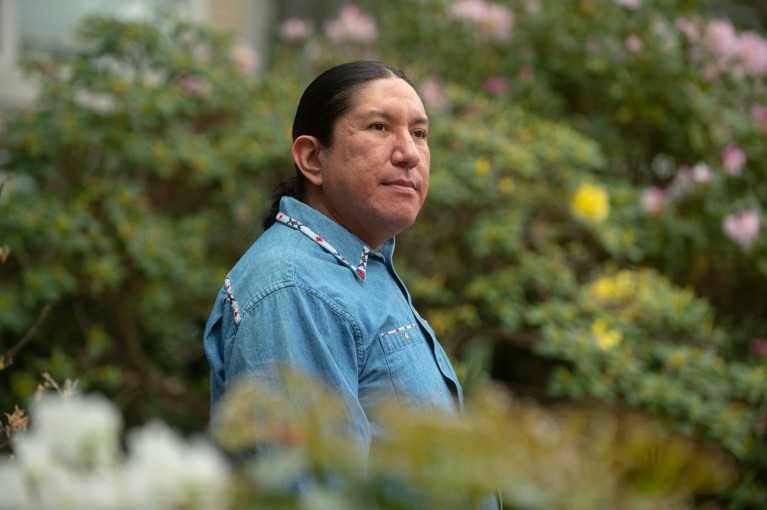
Colleagues routinely describe Michael Running Wolf as someone who walks seamlessly between two worlds.
As an artificial intelligence (AI) researcher at the software-development company SynthBee in Fort Lauderdale, Florida, and as co-founder of the First Languages AI Reality (FLAIR) programme at the Mila–Quebec Artificial Intelligence Institute in Montreal, Canada, Running Wolf holds a deep understanding of both the technology underlying AI and the societal benefits it could unlock. And as the son of Lakota and Cheyenne parents, he also knows how technology and data have been weaponized to harm Indigenous communities. Running Wolf therefore approaches his work — in which he revitalizes disappearing languages using AI and virtual-reality tools — with patience, empathy and a healthy dose of scepticism.
“The work that Michael does is so sophisticated and complex because it’s bridging the sacred with the science,” says Estakio Beltran, a partnership adviser at the non-profit organization Native Americans in Philanthropy in Washington DC, who collaborates with Running Wolf and is of Tolteca-Mexica and Tlatoani origin. “We’re fortunate to have him overseeing efforts to reclaim Indigenous languages because his foremost thoughts are to protect and honour Indigenous sovereignty.”
Running Wolf grew up just outside the Northern Cheyenne Indian Reservation in southeastern Montana, in a remote town called Birney (2020 population: 97). The settlement often lacked running water and electricity, but it was nevertheless a comforting place where he was surrounded by family, literally — everyone in the town was an extended relative through his mother, and Running Wolf didn’t meet a stranger until he left for university age 18. He spent his childhood learning traditional Cheyenne and Lakota artistry and hearing Indigenous languages spoken around him, an experience that is now increasingly rare.
“For decades, the US government oversaw policies of forced assimilation, and as part of that, it was illegal to speak traditional languages or to practise our cultures openly,” he says. “Those policies were often enforced violently, and so we lost generations of fluent speakers that make it really difficult to come back from now.”
Running Wolf was a strong student from a young age, he says, and quickly developed an interest in technology, spurred by his mother’s career as a laser lithographer designing microchips for the computing firm Hewlett-Packard in Colorado. He learnt the basics of computer programming in primary school — including working out how to reprogram his graphing calculator to play games such as Snake. However, when it came to choosing a degree course at Montana State University in Bozeman in 1999, Running Wolf says he picked the then-nascent field of computer science on instinct. “No one in my family, or even my guidance counsellor, actually knew what it was.”
Even as he gravitated towards software development, Running Wolf retained an interest in Indigenous histories, noting that if he hadn’t become an AI researcher, he probably would have become an artist or a poet like his father, who holds a degree in fine arts. When he returned to Bozeman in 2007 after a three-year stint in industry to complete a master’s degree in computer science, Running Wolf’s future bridging the two fields began to take shape.
For his master’s thesis, Running Wolf drew inspiration from the work of researchers who had used oral histories to trace the origins of tales such as Little Red Riding Hood and to identify items eligible for repatriation under the Native American Graves Protection and Repatriation Act. He spent the summer of 2014 in Siberia, Russia, collecting stories from local Indigenous peoples and using a type of AI called natural language processing to look for similarities between their cultures and those closer to his home. “Ecologically, the area is very similar to the Yellowstone biome in Montana, and so I was interested in how those types of force shape language and culture,” he says. “It stopped being pure computer science and brought in aspects of anthropology.”
Around this time, Running Wolf also met his wife Caroline, a member of the Apsáalooke Nation who speaks 11 languages and was then earning her master’s degree in Native American studies. Together, the two became consumed by thoughts of how computational tools and big data could be used to improve understanding of Indigenous cultures and to reclaim lost languages. The United Nations estimates that roughly half of the world’s 6,700 languages — the majority of which are spoken by Indigenous peoples — are on track to disappear by 2100, yet Running Wolf says there are rarely rigorous plans in place to save them.
“We were both frustrated with the lack of good progress in what was being done at the time,” Running Wolf says. He adds that Caroline has since joined him in co-founding an Indigenous non-profit technology firm called Buffalo Tongue and in managing ongoing projects focused on the applications of AI and immersive technologies for reclaiming Indigenous languages and cultures. “What began as these late-night conversations eventually kicked off this whole new chapter of using technology for language reclamation, and we’ve just become enmeshed in that space.”
The challenges of AI
Indigenous languages differ from those with Latin roots in ways that make them a challenge to reconcile with existing machine-learning frameworks, Running Wolf says. Many Western languages follow a subject–verb–object sentence structure, for example, whereas Indigenous languages tend to be verb-based and polysynthetic, meaning that a single word can include multiple elements that, in English, would be written out as entire sentences. ‘Bird’, for instance, might translate to something like ‘the winged, flying animal that caws’.
Because generative AI models predict the next word in a sentence on the basis of the preceding words, these differences mean that algorithms often do a poor job of recognizing and translating Indigenous languages. However, models perform better when they include Indigenous languages, Running Wolf says, because training on a greater diversity of data ultimately makes the underlying algorithms more adaptive and flexible, just as people who know two languages typically have an easier time learning a third. “But that does create a risk for communities when our language data are suddenly valuable,” he adds.

Already, there has been a rush by companies such as OpenAI, Amazon and Google to gain access to Indigenous data on language and more; the firms use that information to develop services and products that are then offered back to users, often at a cost. Long-standing mistrust over how their information is likely to be misused has caused some Indigenous communities to disavow themselves of ever turning to AI-based technologies, a stance that Running Wolf respects.
“A lot of this kind of research is without consent, unfortunately, and it has soured people on even trying to engage,” he says. “There’s a lot of risk with AI, and so I think that’s a very healthy response.”
Creating tools for societal good
Running Wolf is working to overcome these hesitations through creating resources by and for Indigenous communities that help to educate them both about their cultures and the technology and, in turn, give them more control over how their data are used.
His early efforts began as employee network groups, including one for Indigenous researchers at Amazon when Running Wolf was there working on the company’s AI-powered assistant, Alexa. Later, he and Caroline were involved in launching two wider initiatives, Indigenous in AI and IndigiGenius. These partner with peer groups such as the information-technology consultancy firm Natives in Tech in Oklahoma City, Oklahoma, the Indigenous Protocol and Artificial Intelligence Working Group and the Abundant Intelligences research project to shape the future of Indigenous-led AI efforts. In 2019, the Running Wolfs participated in two workshops alongside dozens of other researchers to produce a paper outlining how best to ethically design and create AI tools (J. E. Lewis et al. Indigenous Protocol and Artificial Intelligence Position Paper; CIFAR, 2020).
In many instances, one challenge these groups face is a lack of fluent speakers of Indigenous languages to both teach the next generation and to help train AI language models. Although children once learnt their ancestral languages at home, they now mostly engage with languages in the classroom. There’s an urgent need, Running Wolf says, for curricula and other resources — not to replace Indigenous speakers, but to train new teachers and standardize how Indigenous languages are taught. “Now, we have a lot of Native Americans trying to learn in classes using methodologies that don’t have good pedagogy or even good metrics for success,” he says.
Early on in his professional career, Running Wolf sought the advice of Peter-Lucas Jones, chief executive of Te Hiku Media in Kaitaia, New Zealand, who is of Te Aupōuri, Ngāi Takoto and Ngāti Kahu origin and co-created an automatic speech-recognition system for the Māori language te reo. By soliciting input from local communities, Jones was able to amass nearly 200,000 recordings from thousands of people — a data-set size largely unheard of in Indigenous language revitalization work. The resulting system can translate spoken te reo into English text with 92% accuracy, and translate bilingual speech that uses both languages with 82% accuracy. It has been used as the foundation for a platform called Papa Reo, which is intended to help other Indigenous communities to emulate its success. A key part of that equation, Jones says, is relinking language and culture.
“Language springs from the life and the landscape that it describes, and so when we think about language, it’s important to recognize that it is the ideal vehicle for the transmission of culture,” Jones says. “When language is separated from culture, we find that it’s much harder for people to achieve fluency, and so we treat them as the same thing, walking hand in hand.”
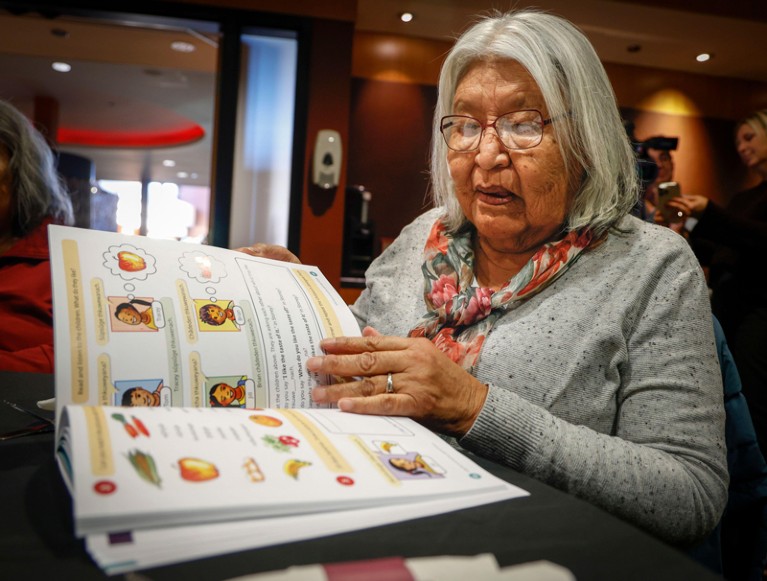
Running Wolf is now working with researchers including T’łaḵwama’og̱wa (Sara Child), an Indigenous language educator at North Island College in Courtenay, Canada, who is a member of the Kwakiutl Nation, on a programme centred on Kwak’wala, a language spoken by a few hundred people around Vancouver Island in Canada. The team is following a similar approach to that of Jones, collecting and curating a bank of words and phrases to create a speech-to-text program and an oral dictionary. With those tools in hand, the research group will use virtual reality to create a ‘cultural immersion experience’ in which users accompany virtual, interactive characters as they take a canoe journey to several sacred islands in the area.
“This project has the added bonus of not just teaching language, but in helping us get elders back to places of meaning, which helps them unlock memories from their past,” Child says, adding that bringing community elders into the work has helped the team to structure content in ways that honour history without oversharing.
The hope, Running Wolf says, is that because many Indigenous communities in the area share similar cultures and facets of language, once the resources are made, it will be easy to adapt them for others. The same is true among Indigenous communities such as the Cherokee, Chickasaw, Choctaw, Creek (Muscogee) and Seminole, and Running Wolf is working towards partnerships with those groups as well. “Languages within the same family have a high overlap of sounds and grammatical structures, and so we can amplify the data with some AI tricks to expand the reach that these tools can have,” he says.
A north star for trust
Even as Indigenous-led efforts take off, there’s an understanding that it will become necessary to work with other partners to fully integrate such efforts into the wider technological ecosystem. Running Wolf says this is especially true when introducing Indigenous languages into spaces such as the digital economy, in which he says Indigenous communities must have a place.
“AI is being rolled into so many aspects of everyday life, and if these new technologies only speak Western languages, Indigenous communities will end up excluded,” says Running Wolf. “Data is something of a new frontier and cutting off access a new form of colonized violence. If we have no place in the digital economy, it’s going to be really hard for us to thrive.”
When looking for collaborative partners, Running Wolf is guided by three principles that others can easily adopt. First, any project he’s part of must have strong and explicit buy-in from the communities involved and a sense of duty to language reclamation. A crucial part of this, he adds, is the second principle — that communities must retain ownership of their information such that they can withdraw access at any time. Third, giving credit to community partners in research publications, presentations and outreach material goes a long way towards creating trust, he says.
“We have very few speakers in many of these communities, and so if one of our partners pulls out because they distrust us, it hurts the overall research,” he says. “We’re always aiming to create an environment of high trust as our north star.”
Derek Eagle LaRance, a language revitalization specialist of Quechan and Morongo descent at Cherokee Film, the Cherokee Nation’s first film and media education centre, in Tulsa, Oklahoma, agrees that although Indigenous people need to lead these efforts, that doesn’t mean there’s no room for others to get involved. “The invitation is out there from Indian country to come to our communities and show up ready to listen,” he says. “The work has to be done by us because there’s a connection we have to the languages that gives us a deeper insight, but it doesn’t mean that an ally couldn’t be right there with us, supporting and protecting and creating a safe environment for this work to be done.”
Nature 641, 548-550 (2025)
doi: https://doi.org/10.1038/d41586-025-01354-y
More:
How researchers can work fairly with Indigenous and local knowledge
 Uma (in)certa antropologia