Arquivo da tag: Califórnia

National Science Foundation: Record California Drought Directly Linked To Climate Change (Climate Progress)

BY JOE ROMM

POSTED ON SEPTEMBER 29, 2014 AT 2:59 PM

NSF: “The drought crippling California is by some measures the worst in the state’s history.” CREDIT: NOAA

A Stanford study funded by the National Science Foundation (NSF) confirms a growing body of research that finds “The atmospheric conditions associated with the unprecedented drought in California are very likely linked to human-caused climate change.”

The NSF news release, headlined, “Cause of California drought linked to climate change,” explains:

Climate scientist Noah Diffenbaugh of Stanford University and colleagues used a novel combination of computer simulations and statistical techniques to show that a persistent region of high atmospheric pressure over the Pacific Ocean–one that diverted storms away from California–was much more likely to form in the presence of modern greenhouse gas concentrations.

Unprecedented droughts often combine a reduction in precipitation with higher temperatures that increase evaporation, leaving soil parched. As the NSF notes in this case, “Combined with unusually warm temperatures and stagnant air conditions, the lack of precipitation has triggered a dangerous increase in wildfires and incidents of air pollution across the state.”

We know, of course, that global warming is making heat waves longer and stronger and more frequent, which in turn makes droughts worse everywhere. But climate change is also causing reduced precipitation in many regions, such as the Mediterranean and southwestern United States. This double whammy from carbon pollution means we’ll be seeing more and more dangerous record droughts.

California’s 3-year drought has reached epic proportions. The L.A. Times reported last week, “Drought has 14 communities on the brink of waterlessness.”

Here’s the most recent Drought Monitor for the state:

20140923_CA_trd

So what is the proximate cause of the reduced precipitation over California? New studies suggest that increases in sea surface temperatures are not the cause of the drying. The NSF study, however, explains:

Scientists agree that the immediate cause of the drought is a particularly tenacious “blocking ridge” over the northeastern Pacific — popularly known as the Ridiculously Resilient Ridge, or “Triple R” — that prevented winter storms from reaching California during the 2013 and 2014 rainy seasons.

Blocking ridges are regions of high atmospheric pressure that disrupt typical wind patterns in the atmosphere.

The NSF study analyzed “the period since 1948, for which comprehensive atmospheric data are available.” Researchers “found that the persistence and intensity of the Triple R in 2013 were unrivaled by any previous event.” Stanford’s Bala Rajaratnam then “applied advanced statistical techniques to a large suite of climate model simulations.”

Finally, researchers looked at two sets of models — one set that duplicated the current climate, in which carbon pollution is warming the atmosphere, and the other set in which carbon pollution levels were comparable to those just before the Industrial Revolution.

The researchers found that the extreme heights of the Triple R in 2013 were at least three times as likely to occur in the present climate as in the preindustrial climate.

They also found that such extreme values are consistently tied to unusually low precipitation in California, and to the formation of atmospheric ridges over the northeastern Pacific.

Prof. Rajaratnam concluded, “We’ve demonstrated with high statistical confidence that large-scale atmospheric conditions similar to those of the Triple R are far more likely to occur now than in the climate before we emitted large amounts of greenhouse gases.”

This matches the finding in an April study that “there is a traceable anthropogenic warming footprint in the enormous intensity of the anomalous ridge during winter 2013-14, the associated drought and its intensity.” The lead author of that study, Dr. Simon Wang of the Utah Climate Center, told me in an email earlier this year, “I personally think that the debate over global warming leading to stronger blocking has passed. The ongoing challenge is how we predict WHEN and WHERE those blocking will happen and affect WHICH region.”

Indeed, as I’ve reported, scientists a decade ago not only predicted the loss of Arctic ice would dry out California, they also precisely predicted the specific, unprecedented change in the jet stream that has in fact caused the unprecedented nature of the California drought.

In fact, a growing body of evidence — documented by Senior Weather Channel meteorologist Stu Ostro and others — that “global warming is increasing the atmosphere’s thickness, leading to stronger and more persistent ridges of high pressure, which in turn are a key to temperature, rainfall, and snowfall extremes and topsy-turvy weather patterns like we’ve had in recent years.”

Bottom Line: Human activity has made droughts longer and stronger in many places, including California. If we continue on our current path of unrestricted carbon pollution, we will be sharply increasing the chances of civilization-threatening mega-droughts here and abroad.

California water witches see big business as the drought drags on (The Guardian)

Dowsers, sometimes known as ‘water witches,’ are in high demand in drought-stricken California, where four dry years find farmers and vintners taking desperate measures

Mary Catherine O’Connor

Monday 15 September 2014 07.00 BST

VIDEO:

Sharron Hope has been a dowser since 1997. Markedly cheaper than hiring a hydrogeologist – which can cost as much as $50,000 – Hope OFFERS her services for around $500 a consultation. Video: Mary Catherine O’Connor

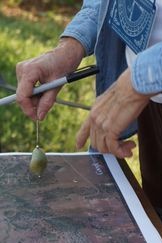
Outside of a farmhouse on a 1,800-acre organic dairy farm near Oroville, California, Sharron Hope bends over a printout of a Google Earth map, holding a small jade Buddha pendant. The map shows a small section of the farm to the east, and Hope is hunting for water. As the pendant swings, she notes a subtle change in motion that, she says, indicates she has found some.

Is there any significance to the jade? No, she says, I just like it. Plus, she adds, “I figure Buddha’s gotta know.”

Hope is a water dowser, or someone who uses intuition, energy VIBRATIONS and divining rods or pendulums to mark the best spots for wells.

As California rounds the corner towards a four-year historic drought, many farmers and vintners have become completely reliant on groundwater. After divvying surface water allotments to satisfy urban, ecosystem and industrial needs, farmers in many parts of the state received little or no irrigation water from state agencies this year. In a normal year, allotments would cover roughly two-thirds of farmers’ needs.

1Sharron Hope, a water dowser in California, uses a jade pendant to locate underground water on a map. Photograph: Mary Catherine O’Connor

Under these severe drought conditions, the success or failure of a well can mean the success or failure of a farm or vineyard, so before the drill bit hits the dirt, landowners need an educated guess as to where to find the most productive well site on their property. To get that, they can call in a professional hydrogeologist, which can cost tens of thousands of dollars – or they can drop a fraction of the cost on a dowser, such as Hope.

Despite a distinct lack of empirical evidence regarding dowsers’ efficacy, demand is high and dowsers’ phones are ringing off the hook.

“I’ve gotten far more calls this year from farmers looking for a water dowser than in most years,” says Sacramento-based Donna Alhers, who heads the Sierra Dowsers, a chapter of the American Society of Dowsers.

Water dowsers from around the state are also seeing a spike in demand. “I’m getting a lot of calls from people whose wells have run dry,” Hope says.

Where did dowsing come from?

The exact origins of dowsing are murky, but its roots can be traced back as far as the Middle Ages. The practice, sometimes used by miners and fortune seekers, was reportedly condemned in the 16th century as the work of the devil.

Today, dowsers hail from one of two camps. Some have agrarian backgrounds, and learned the practice from ancestors who used it to locate good sites for wells on their own or their neighbors’ farms. The second group hails from the New Age movement and tend to be devotees of a wide range of mystical practices and “energy work”.

Traditionally, dowsing has been used not just to find groundwater, but also minerals and natural gas. Many dowsers claim they can dowse anything, from lost items or pets to criminals on the lam. You name it, they say they can divine it.

Hope began dowsing for water in 1977 after learning about the practice from Walter Woods, a science teacher at Butte College, where she was a STUDENT. Woods had learned dowsing from his father, a farmer, and eventually became a well-known authority on dowsing. He authored a widely read dowsing primer, Letter to Robin, and served as president of the American Society of Dowsers.

Woods taught Hope to scan for signs of groundwater by observing the landscape and looking for signs like deer trails. “Deer have magnetite in their pineal gland [an endocrine gland in the brain]. As water moves underground, electrons are stripped out and move to the surface,” Hope says. “Deer can sense it and tend to walk along that vein of underground water toward a spring.” Dowsing is based on the premise that humans can tap into that energy, too, using instruments such as branches and pendulums.

Energy marks the spot

After Hope finishes with the map, she heads out to the spots she has marked, walking the land and searching for very faint energy markings over the landscape, which she’ll use more talismans to locate.

She begins a general scan of the area with a forked pine branch, holding the ends in her hands and sweeping it through the air. Despite scientific evidence, Hope believes that the branch she holds channels the energy emitted by submerged water. Once she homes in on the most promising region (which matches, as it turns out, the area she had marked on the map) she TRADES the branch for what are known in the dowsing world as “L-rods”, two long metal bars with a short handle and long extension, forming an L.

2Sharron Hope works as a dowser in California’s CENTRAL VALLEY. Here she uses a pine branch to lead her to to a potential well site. Photograph: Mary Catherine O’Connor

Hope holds these in front of her, with her elbows at 90 degrees, and walks slowly up – and then laterally along – the rise. As the long ends of the bars begin to fall away from each other, she stops.

The energy moving up from the groundwater, she says, creates a field that L-rods respond to. This, she says, marks the edge of the underground stream. She then traverses the hillside, down slope, and stops again when the bars cross in front of her. This, she explains, marks the spot where two veins of groundwater cross over each other, making it a potentially very productive well site.

“I have goosebumps,” Hope says with a smile. “I feel the energy moving up from the ground.”

Although Hope and other dowsers often refer to underground veins and streams, USGS hydrologist Ralph Health, in a highly cited report on groundwater basics, says the vast majority of groundwater is found in relatively still aquifers. Swiftly moving streams are quite rare.

Water, water everywhere

Out in the field, Hope locates three possible well sites in roughly 30 minutes. She decides that the third is the best option, even though she doesn’t think it has the strongest flow rate, because it is relatively shallow at 200 feet (about 61 meters) below ground and is the most accessible and FLAT option. Daley stakes the spot and the dowsing is done. Daley is now awaiting drilling permits, and once those come through, she’ll call in a local driller.

“I have about 90% accuracy,” Hope claims, meaning that 90% of the sites she recommends produce water.

This actually isn’t that surprising, hydrogeologists say. “Dowsers may seem convincing, but when [their practice is] exposed to scientific review, groundwater is very prevalent, so it’s hard to miss it when you drill a well,” says Ted Johnson, chief hydrogeologist for the Water Replenishment District of Southern California and president of the board of the Groundwater Resources Association of California. “When you use science to site a well, you can test for quality, depth and how long [the flow] will last.”

To site a well, hydrogeologists will review driller well logs from the Department of Water Resources and geologic maps that show areas of alluvial soils, under which groundwater is most likely to accumulate. To really zero in on well sites, they drill a test well, which produces cuttings of the various strata. They then test for each layer’s ability to transport water. It’s a time-consuming and expensive process.

Because a landowner is unlikely to hire both a dowser and a hydrogeologist to see who finds the best-producing well (though that could make for some mildly entertaining reality television), the two groups coexist and generally ignore each other, aside from tossing verbal jabs.

“I’m a scientist and I’ve been trained on scientific principles, and that’s what I use [to locate groundwater],” says Tim Parker, a hydrogeologist and independent consultant based in Sacramento. “There’s no scientific evidence that dowsing is more effective than random chance.”

Of cash and crops

So why are so many farmers turning to dowsers instead of hydrologists? Part of it’s probably the money: dowsers might charge $1,000 (Hope charges most of her clients around $500, and less for a small residential well), while a big consulting firm costs $10,000 to $50,000, Johnson says. “All a farmer cares about is getting the groundwater,” he says.

But Cynthia Daley, who hired Sharron Hope to dowse for a well on her dairy farm, says it’s not about costs. “Dowsing is based on energy and it is something that the scientific community has not embraced, but I’m not arrogant enough to think science knows everything – and I am a scientist; I have a PhD,” she says.

Whether farmers and vintners are using dowsers merely as a result of their relative affordability or out of a strong belief in the practice is hard to, well, divine. What is clear is that the popularity of dowsing is growing, not just in the CENTRAL VALLEY, but throughout the state.

Daley, who has degrees in animal science with a doctorate in endocrinology, is a professor in the College of Agriculture at nearby California State University at Chico, where she runs an organic dairy program. She is developing an organic dairy operation on her property, which is why she’s drilling wells. “Everyone I know who has had wells put in around here has used dowsers.”

Many more wells are springing up. State agencies from counties around California are issuing twice – and sometimes three times as many – well drilling permits this summer than last summer, according to the Associated Press.

Keeping Marc Mondavi busy

Marc Mondavi, grandson of Napa Valley WINE pioneer Cesare Mondavi and a longtime dowser, says that he can’t keep up with the demand: “I’m doing anywhere from two to four projects a week and I’m backlogged, and drillers around here are backlogged for three to five months.”

Mondavi uses dowsing not only as a revenue stream, but also as a means of marketing his own brand, The Divining Rod. He doesn’t shy away from the name “water witch”, a term other dowsers consider pejorative. His daughter Alycia Mondavi even made a short promo VIDEO CALLED “My Dad is a Witch.”

He acknowledges it’s hard not to strike groundwater, but says that using his intuitive dowsing skills allows him to find the best spots, especially as the drought depletes the water table. “No matter where you drill, you might hit [a flow of] four gallons per minute,” he says. “In those areas maybe I can find eight to 10 gallons per minute.”

The dowsing divide might persist for decades to come, but there is plenty of indisputable evidence that groundwater is being overtaxed as the drought drags on. Amplifying the problem of groundwater scarcity, policy experts say, is a lack of regulation. That looks likely to change. Governor Brown is expected to sign one of three separate groundwater regulation bills currently sitting on his desk.

Some agriculture groups, including the Agriculture Council of California and Blue Diamond Growers, have rallied against the bills, saying they will drive up costs for already cash-strapped farmers and deny long-held water rights.

But Daley says groundwater is too important to remain unchecked. “We have to regulate it. It’s a very important resource.”

Until that happens, however, sun-baked farmers will keep digging for rain.

Mary Catherine O’Connor is an independent reporter and co-founder of Climate Confidential.

The Vital Signs platform is funded by Avery Dennison, Domtar and Chiquita. All content is editorially independent except for pieces labelled advertisement feature. Find out more here.

California drought similar to historic drought in Texas (Science Daily)

Date: February 10, 2014

Source: Texas A&M University

Summary: The worst drought ever to hit California could rival the historic 2011 drought that devastated Texas, says a Texas A&M University professor.

Mojave Desert, California. The worst drought ever to hit California could rival the historic 2011 drought that devastated Texas. Credit: © Tomasz Zajda / Fotolia

The worst drought ever to hit California could rival the historic 2011 drought that devastated Texas, says a Texas A&M University professor.

John Nielsen-Gammon, professor of atmospheric sciences who also serves as Texas’ State Climatologist, says the current drought in California is so far comparable in many ways to the 2011 Texas drought, the worst one-year drought in the state’s history that caused more than $10 billion in damages and led to numerous wildfires and lake closings.

“This is the third year of California’s drought and it is on pace to be as dry as Texas was in 2011,” Nielsen-Gammon, a California native who grew up in the San Francisco area, explains.

“However, because our severe drought year came at the beginning of the drought, reservoirs across much of the state were full. In California, reservoir levels were low to begin with.

“In addition, they are dealing with environmental flows through the Sacramento Delta that weren’t explicitly laid out until a few years ago.”

Weather patterns for both states appear similar, he adds.

“The same ridge that has kept California dry has also been keeping Texas dry,” he notes. “As the pattern changes, California is finally getting some rain and snow and the chances for precipitation in Texas are increasing as well.”

California’s drought is especially worrisome because the state produces about one-half of the country’s fruits, vegetables and nuts. It is the No.1 agricultural state in the U.S.

The 2011 drought devastated Texas farmers and ranchers, and lake levels were down as much as 50 feet in some lakes while several West Texas lakes completely dried up.

Numerous Texas cities set heat records in 2011, such as Wichita Falls, which recorded 100 days of 100-degree heat, the most ever for that city. Dallas also set a record with 70 days of 100-degree heat.

Texas’ drought is now in its fourth year, Nielsen-Gammon says, and about 52 percent of Texas is still in some form of drought status, ranging from moderate to exceptionally dry.

“January was unusually dry with an average of only about one-half an inch of precipitation statewide,” he adds.

“Reservoir levels have actually declined at a time when they should be rising. So the drought is still here. In fact, the prevalence of drought in Texas has not dropped below 40 percent since 2010 when this drought first started.”

The Texas Panhandle area has been especially hard hit.

“The past three calendar years have been among the driest three on record for the Panhandle,” he notes. “Dalhart shattered its record with just 20.54 inches total in 2011-2013.

“This current drought started with more intensity than the drought of 1950-56, the driest on record. We again have a generally warm Atlantic Ocean, and that tends to mean dry conditions. An El Nino (warmer water in the tropical Pacific Ocean) might develop later this year, but it’s still a little too early to say.”

Satellites show ‘total’ California water storage at near decade low (Science Daily)

Date: February 3, 2014

Source: UC Center for Hydrologic Modeling

Summary: Updates to satellite data show that California’s Sacramento and San Joaquin River basins are at near decade-low water storage levels.

Updates to satellite data show that California’s Sacramento and San Joaquin River basins are at near decade-low water storage levels. These and other findings on the State’s dwindling water resources were documented in an advisory report released today from the UC Center for Hydrologic Modeling (UCCHM) at the University of California, Irvine.

Responding to Governor Jerry Brown’s recent declaration of a drought emergency in California, a team of UCCHM researchers has updated its research on the state’s two largest river basins, and the source of most its water. The region also encompasses the Central Valley, the most productive agriculture region in the country. The Central Valley depends entirely on the surface and groundwater resources within the river basins to meet its irrigation needs and to produce food for the nation.

Using satellite data from NASA’s Gravity Recovery and Climate Experiment (GRACE) mission, the researchers, led by UCCHM Director and UC Irvine Professor Jay Famiglietti, found that as of November 2013, total water storage in the river basins — the combination of all of the snow, surface water, soil moisture and groundwater, and an integrated measure of basin-wide water availability — had declined to its lowest point in nearly a decade. GRACE data for the record-dry 2013-2014 winter months were not yet available for analysis.

The data show particularly steep water losses between November 2011 and November 2013, the early phase of the current drought. Famiglietti and fellow UCCHM researchers estimate that the basins have already lost 10 cubic kilometers of fresh water in each of the last two years — equivalent to virtually all of California’s urban and household water use each year. “That’s the steepest decline in total water storage that we’ve seen in California since the GRACE mission was launched in 2002,” Famiglietti said.

The researchers noted that snowpack, surface water and soil moisture storage in the river basins were all at their lowest points in nearly a decade, illustrating a growing threat to groundwater supplies in the Central Valley, and highlighting the urgent need to manage them sustainably. Groundwater is typically viewed as a strategic reserve that supplements sparse surface water supplies in times of drought.

By combining their satellite-based estimates of 10 years (October 2003 — November 2013) of Central Valley groundwater storage changes with long-term estimates of groundwater losses from the U. S. Geological Survey, the researchers noted that steep declines in groundwater storage are typical during droughts, when Central Valley farmers are forced to rely more heavily on groundwater to meet irrigation demands.

The advisory report underscores that the rates of declining groundwater storage during drought almost always outstrip rates of groundwater replenishment during wet periods, and raises fears about the impact of long-term groundwater depletion on sustaining a reliable water supply in the current, record-setting drought. The team’s previous 2011 study estimated that the Central Valley lost 20 cubic kilometers of groundwater during the 2006-2010 drought.

Historically, drought conditions and groundwater depletion in the Central Valley are responsible for widespread land subsidence, reductions in planted acreage, higher food costs and ecological damage.

Famiglietti notes that if the drought continues “Central Valley groundwater levels will fall to all-time lows.” Stephanie Castle, a UCCHM researcher who contributed to the report, believes that groundwater supplies should be more actively managed. Castle states that “the path of groundwater use that we are on threatens the sustainability of future water supplies for all Californians.” She noted that several communities within the state are on track to run out of water within the next few months.

Download the report at http://www.ucchm.org/publications