Arquivo da categoria: Uncategorized

Hacking the atmosphere: Geoengineering gets a reality check (MIT Technology Review)

technologyreview.com

Original article

James Temple

June 17, 2026


Jim Franke pulls away the cover page of a presentation on the wraparound desk in his office, revealing an illustration of an odd-­looking aircraft with massive wings stretching out from a stubby fuselage.

The uncrewed plane is soaring thousands of meters higher than commercial jets fly—so high you can see the curvature of the Earth. It’s precisely the type of aircraft one would need to begin artificially cooling the planet. Those outsize wings would keep the plane and its payload aloft in the stratosphere, about a dozen miles (or 20 kilometers) above the surface, where the air is much thinner—as little as 5% the density near the ground. Once at altitude, the plane would release materials that could, after a few steps of chemistry, reflect sunlight back into space.

“If you want to get to 20 kilometers in the near term, this is probably the best bet,” says Franke, a research assistant professor at the University of Chicago.

Franke is one of a small but growing cohort of scientists focused on the engineering challenges associated with solar geoengineering, the controversial idea that we could deliberately intervene in the climate system to counteract global warming.

The concept came from volcanoes. Massive eruptions in the past have reduced temperatures worldwide by blasting sulfur dioxide and other compounds into the stratosphere, where they convert into sunlight-scattering particles. Hundreds of studies in recent decades have suggested that a human attempt to mimic this mechanism would work quickly and efficiently—at least within the confines of climate models.

But these computer simulations are approximations of how the real world works. They gloss over numerous challenges. Like the fact that aircraft capable of carrying the necessary loads to the necessary altitudes don’t exist. Or that we don’t know for sure how to release material so that most of it turns into tiny reflective aerosols instead of, say, clumping together and falling out of the sky. Or even what specific substance we would want to load onto an aircraft, given open questions about safety, cost, and effectiveness. 

Amid these compounding unknowns, more and more research on solar geoengineering is moving beyond computer simulations, delving into the detailed design and practical engineering work that would be needed before we could carry out a campaign to dial down temperatures. The tasks required range from inventing high-altitude aircraft to mastering the precise chemistry and delivery mechanisms for dispersing materials to building out the monitoring infrastructure that we’ll need in order to know if any of it actually works.

The question of whether we should geoengineer the planet has no clear-cut answer. It might save millions of lives by reducing the dangers of catastrophic heat waves, floods, droughts, and famines. But many fear it’s too dangerous to even consider, much less seriously study, arguing that we can’t possibly predict the spiraling consequences of manipulating such large, complex, interconnected planetary systems. 

Critics argue that the building momentum in this phase of research will make it ever more likely that someone, somewhere in the world, will eventually pull the trigger on geoengineering, no matter the remaining unknowns or the dangers for certain parts of the world.  

“I do think it’s very dangerous because of what we know about science and technology,” says Jennie Stephens, a professor of climate justice at Maynooth University in Ireland. “The more investment that’s made, the further the advances, the more likely it is that it will be deployed.”

But proponents of this practical research argue that playing out how we’d mount a solar geoengineering program will improve our understanding of the potential benefits and risks, helping to ensure that if anyone does try to tweak the climate, they might at least do so in an informed and potentially safer way.

David Keith
The Climate Systems Engineering Initiative (CSEi) at the University of Chicago formally launched in 2024 under the leadership of the prominent geoengineering researcher David Keith.

It’s still very much a niche field. Much of the work now underway is happening at the Climate Systems Engineering Initiative (CSEi) at the University of Chicago, which formally launched in 2024 under the leadership of the prominent geoengineering researcher David Keith. 

Franke, a professional engineer before earning his doctorate in geosciences, is overseeing a series of overlapping research projects and collaborations aimed at resolving many of the engineering uncertainties. That includes working out the designs now on his desk—renderings of the type of aircraft that could be used in the initial phase of a geoengineering program. 

Franke argues that more computer simulations are simply not going to answer the big remaining questions in the field, including the most compelling one: the “boogeyman” of what could go wrong. 

“I’m kind of personally skeptical that additional model development or more simulations are going to satisfactorily resolve those things,” he says. “And so I’m not really that interested in turning the crank on more models.”

For Franke, it’s time for the next step: “We’re interested in seeing how you’d actually do this thing if you wanted to do it.”

What we don’t know

Solar geoengineering is often portrayed as a relatively cheap and easy fix for climate change. But as researchers take a harder look at the nuts and bolts, they’re finding considerable uncertainties, missing tools, and unbuilt infrastructure.

None of that may be a showstopper, but we’ll need time and money to develop the components necessary to implement even the early stages of a solar geoengineering program. What this research is about, at its core, is not actually launching something, but figuring out what it would take to do so. 

A young San Francisco nonprofit, Reflective, recently worked with scientists in the field to figure out just how much we still don’t know.

The process began by outlining what the organization, which pools money from donors to fund geoengineering studies, describes as a “well-managed, moderate” scenario: In 2035, some nation or group of nations begins a small-scale geoengineering deployment, spraying an equal amount of sulfur dioxide or hydrogen sulfide—gases that should convert into reflective aerosols in the stratosphere—near both the North and South Poles. The initial program would release enough material to reduce temperatures by about 0.1 °C, shaving off a fraction of the roughly 1.4 °C of worldwide warming that’s occurred since the start of the industrial era.

The poles figure prominently in this and other early-stage geoengineering scenarios, for a simple reason: The stratosphere starts as low as seven kilometers there—as opposed to around 18 to 20 kilometers at the equator. That makes it easier to reach, enabling existing aircraft, with some modifications, to carry sizable payloads up there. 

The wrinkle is that the cooling effect would be more pronounced in the northernmost and southernmost latitudes. That’s because, among other complicated mechanisms, higher temperatures in the tropical stratosphere would mostly prevent aerosols released around the poles from drifting toward the equator. So deploying geoengineering in those areas would likely have milder effects on the hotter and poorer nations around the tropics, which are also some of the areas most vulnerable to climate change.

To cool the world evenly—and fairly—you’d eventually want to add flights closer to the equator. Over the following decade or so, under Reflective’s scenario, the program would scale up, shift to novel aircraft flying above the subtropics, and release enough material to achieve global cooling of 0.5 °C. 

The question the researchers then examined was: If we wanted to carry out such a scenario, what would we still need to do to pull it off? 

Quite a bit, it turns out. Earlier this year, Reflective published its SAI Uncertainty Database (SAI stands for “stratospheric aerosol injection”), highlighting a variety of scientific unknowns and six engineering obstacles.

Among them: sorting out how hard or expensive it would be to retrofit existing aircraft to carry out the early stages of the project. Deploying at the poles could also require constructing new airports, establishing new shipping lanes or railways to transport supplies, and building facilities that could process raw materials—by, for example, combusting elemental sulfur to produce sulfur dioxide.

We would also need to build more instruments and send them up to the stratosphere aboard balloons, drones, or other aircraft to observe the baseline chemistry, reflectivity, and distribution of compounds there—and to track what changed once new materials were released.

Finally, the main satellites that observe the stratosphere from space are set to go out of commission in the coming years, creating the risk of an “imminent data desert,” as a 2025 paper in the Bulletin of the American Meteorological Society warned. Several new instruments are in development or available for launch, but there could be a gap in observations at a point where we’d want to have a clear picture of the baseline conditions, Reflective notes.

Dakota Gruener, the chief executive officer of the nonprofit, stresses that the organization isn’t advocating the use of solar geoengineering. But she says it’s important for the field to begin addressing engineering uncertainties now because it stress-tests the assumptions in climate models. It helps us determine whether the scenarios explored in silico are feasible in the real world.

It’s also important to do this, she says, because it may take a long time to resolve all these unknowns while the climate grows steadily warmer. “If we aren’t putting adequate attention to them now, we might be caught flat-footed,” Gruener told MIT Technology Review.

A 2024 analysis in the journal Earth’s Future highlighted just how expensive and time-consuming it might be to develop the aircraft and infrastructure required for an initial deployment. The study explored what it would take for a geoengineering program around the poles, capable of reducing temperatures by 2 °C in the northernmost and southernmost parts of the planet, to be up and running by 2040. The conclusion: It could require at least a decade of work and a $35 billion investment. 

Wake Smith, a research fellow at Harvard and lead author of the study, also says that researchers need to move forward with engineering studies now, because the urge to use the technology will likely grow stronger as climate change becomes increasingly catastrophic.

“The risk I worry about is needing it before we understand it and therefore doing it badly,” he says, later adding: “The sooner we get going with it, the better decisions we’ll be able to make a few decades hence in terms of whether to do it, how to do it, when to do it.”

A novel aircraft

The aircraft pictured on Franke’s desk, which is still just a concept, could reach just beyond the threshold of the stratosphere above the tropics when fully loaded. A fleet of 270 of them could disperse about a million metric tons of material per year, enough to ease global surface temperatures by about 0.26 °C. 

The CSEi outsourced the work of designing it to John Langford, a well-known aeronautical engineer and entrepreneur. Langford’s company, Electra.aero, had previously collaborated with the MIT Department of Aeronautics and Astronautics to develop autonomous, solar-powered aircraft that could carry out extended scientific missions in the stratosphere. He is now spinning out a new business, Iris Aero, to produce those planes, which are assembled from a single, continuous wing covered in solar panels and suspended above a tiny fuselage.

Langford expects the solar plane to find its main initial commercial applications in wildfire monitoring and forecasting. But by swapping in a different set of instruments, it could be used to monitor how materials dispersed in the stratosphere might alter conditions there, he says.

The novel aircraft is a variation on the observational plane, with the added space and thrust necessary to carry these materials to the stratosphere and release them. It has a wider wingspan and swaps out those solar panels for a pair of Rolls-Royce AE 3007 engines.

The aircraft would also include a detachable tank that would function something like a trailer on a semi. This would make it possible to load materials between flights and prevent any damage to the plane itself from those materials, some of which are corrosive, Langford says. 

He says he and his team have completed the initial designs and are now doing more detailed engineering and cost analyses. They intend to publish the findings when the effort is complete. 

“We’d love to build a prototype of such an airplane and feel we could do so relatively quickly,” Langford says. “But that all depends on what David’s group wants to do.”

The program

David Keith’s group, CSEi, is still coming together.

The University of Chicago unveiled the research initiative in 2024 and has committed to hiring 10 additional faculty members to advance scientific understanding of various forms of geoengineering and explore the thorny questions related to policy, ethics, and governance. It had hired two of them as of press time.

The university saw an opportunity to step up as a leader in a field that wasn’t getting adequate academic attention despite its potential to address the dangers of climate change, says Michael Greenstone, a climate economist and the founding director of the university’s Institute for Climate and Sustainable Growth.

“Universities, as a whole, were committing academic malpractice by not investigating the technical, the social, the political, and the even kind of humanist elements of geoengineering,” Greenstone says.

He helped recruit Keith to lead the initiative. 

Keith, 62, previously spent nearly 13 years as a professor of applied physics and public policy at Harvard, where he led the establishment of the university’s Solar Geoengineering Research Program. More famously, he strove to carry out what could have been the first solar geoengineering experiment to release material in the stratosphere, known as SCoPEx. But after years of work and multiple delays, the research team finally scrapped the project in early 2024, following mounting criticism from environmental and Indigenous groups and the eventual intervention of the Swedish government.

Keith has long argued that researchers should seriously study geoengineering because it might substantially reduce the dangers of climate change, alleviating death, destruction, and suffering on massive scales.

He says that the overarching goal of the Chicago initiative is to expand the field by bringing together “enough independent professors and other research professionals” to “build a community around climate engineering as a broad field of inquiry.”

“Solar geoengineering certainly has complex and potentially dangerous political consequences, but so do a host of other emerging ideas and technologies.” David Keith, geoengineering researcher

“The University of Chicago was the first big university to try and build this as a field in a serious way, to make it not about one person,” he tells me. “It’s a giant commitment.”

Keith himself has become a divisive figure, the face of geoengineering to some. He says he now wants to help build a larger, sustainable research program that will outlive his involvement. He told the administrators that he shouldn’t run the program for more than five years.

“It’s important to have a generational handover,” he says, adding: “I think it’s really important that this not be ‘the David Keith Show.’”

The CSEi researchers are now exploring nearly every engineering challenge that Reflective highlighted in its analysis. In addition to the work on novel aircraft and in situ observations, the group is designing small “cube” satellites with optical sensors optimized for observing the stratosphere. It is also studying which materials might prove most practical to ship to the stratosphere and how best to release them.

The goal is “producing public information which can be independently assessed, critically assessed, so policymakers can understand more about what’s possible and not,” Keith says.

Normalizing a dangerous idea

The debate around solar geoengineering is quickly moving beyond the academic and theoretical realm. A handful of startups, some more serious than others, have begun testing technologies that could one day be used to cool the planet. 

Yet to critics, solar geoengineering is the peak of techno-solutionism, affixing a high-tech Band-Aid to a global crisis caused by earlier technologies instead of addressing the root cause. Further, they argue that there’s no way to deploy or govern it in a globally equitable way, because any use of it will prove more advantageous to some regions than others. 

Even if solar geoengineering succeeded in reducing the average global temperature by 1 °C or so, that would mean very different things in different regions.

It could keep farmers prosperous and cities safe across, say, much of the US and the world’s temperate zones. But the lower temperature might be too cool for Russia to boost its agricultural productivity, while it might still be too hot for subsistence farming in northern Africa. 

Some studies also suggest that high levels of solar geoengineering could create new dangers in some regions, potentially altering monsoon rains, decreasing agricultural output, shifting the range of infectious diseases, and more. 

These complications raise a long list of thorny and divisive ethical questions. Even if solar geoengineering produced better conditions across most of the planet relative to a world with unchecked climate change, would it still be acceptable if it unleashed deadly famines or floods in a few regions? What kind of global consensus should be required to decide it’s okay to deploy it? And how should we determine where to set the planet’s temperature—and when, if ever, to shut the technology off?

Stephens argues that the answers, like so much else in the world, will come down to wealth and power. Countries, corporations, or even wealthy individuals with the resources to deploy such a system would have every incentive to tune it for their optimal benefit, no matter what it might mean for others. 

“It will be certain people who have a lot of wealth and power deciding when and how, and who should benefit and who will get screwed,” she says. “That’s the fundamental reason I think any advance in this technology is so dangerous.”

Duncan McLaren, an environmental researcher and political scientist, argues that the shift into practical engineering studies demands more oversight of the research field.  

For many critics of outdoor experiments like SCoPEx, he explains, the major concern wasn’t the environmental or safety risks, which were minimal; the issue was the normalization of a concept that could reduce pressures to cut greenhouse-­gas emissions. 

He says that any advance in research—whether it’s on paper, in the lab, or in the stratosphere—raises a similar risk: undermining progress on climate action by allowing the fossil-fuel sector and other business interests to say there’s an easier solution in development that doesn’t require overhauling our energy systems. A policy paper that the Texas Conservative Coalition Research Institute released in March advanced this very argument, citing the far lower costs of solar geoengineering relative to the “staggering costs” of a “forced transition.” 

Given this so-called moral hazard risk, design and engineering work should demand the same level of scientific supervision that outdoor experiments do, including ethical review, risk assessments, and public engagement, McLaren says.

“It ought to be more onerous,” he says. “There ought to be more barriers to researchers saying they want to do this.”

“The next ethical step”

Keith pushes back forcefully on that assertion, condemning as “profoundly illiberal” the idea that we should regulate open academic research posing no physical risks. 

“Solar geoengineering certainly has complex and potentially dangerous political consequences, but so do a host of other emerging ideas and technologies,” he said in an email. “The best chance to manage these challenges is to debate them openly and freely.”

Keith is all for keeping solar geoengineering technology in the public domain, and he agrees that the first line of climate defense must be rapid and deep reduction of greenhouse-gas emissions. But the world has made little progress in cutting climate pollution, carbon dioxide can persist for thousands of years in the atmosphere, and the planet is heating up fast. So, he argues, we may need to pursue other measures to temper the growing threats.

The bar for restricting research in this field should be “very high,” he says, given the potential promise of the technology. 

After visiting flood-devastated villages in Bangladesh, Keith underscored this point in an interview with the director of Plan C for Civilization, a recent documentary that profiles his work. “I think people have to take the next ethical step,” he said. “Because if you are really going to withhold access to and knowledge of a technology that could potentially save enormous numbers of lives—real lives, people we’ve met in the last few days—you’ve got to be very confident that that technology is going to be misused.”

The particles

Mingyi Wang, an assistant professor at the University of Chicago, leads me down the hall to a square, white lab room in the Henry Hinds Laboratory for Geophysical Sciences.

He pulls open the doors to a gray Haier biomedical freezer just inside the entrance, revealing a transparent flow tube hanging vertically and tapering at the bottom.

It’s a miniature stratosphere, chilled below −50 °C and filled with the same mix  of oxygen, nitrogen, and other air molecules you’d find 20 or so kilometers above us. A series of Teflon and stainless-­steel tubes run into the vessel, allowing Wang and his team to add various gases or particles and observe how they react.

Wang is an atmospheric scientist who studies how aerosols form, and he is now exploring what materials might be the most effective for reducing temperatures. 

an aircraft shown from above flying over the clouds
This rendering illustrates the type of high-altitude aircraft that could one day be used to deliver Earth-cooling material into the stratosphere.

Most modeling experiments focusing on solar geoengineering explore the impact of adding sulfuric acid to the stratosphere, because that’s what ultimately ends up there after a volcanic blast. 

But it would be costly and complicated to simply haul sulfuric acid up there and release it, because it’s heavy and sticky. So Wang and his team are conducting experiments in that chilly flow tube to determine what substances, including precursors to the acid, might do the best job of producing aerosols of the ideal size for reflecting away sunlight—and how best to prevent the materials from simply clumping together with existing particles and falling out of the stratosphere.

Wang, whom Keith refers to as a “young star,” has arrived at a novel solution to this problem, though he’s not ready to share the full details yet. He and his team are feeding the findings from their experiments into computer simulations of stratospheric plumes that they’ve developed. These, in turn, can be plugged into large-scale climate models to improve their simulation of smaller-scale effects—and thus enhance our understanding of stratospheric chemistry.

Wang says that it’s important to do this detailed research because until now, climate models simply assumed you’d wind up with the right aerosols of the right size. 

“Scientifically, we may understand it reasonably well, but on the engineering perspective—do we really know how to do it right?” he asks. “That’s a big question.” 

What’s next

As I began reporting on CSEi, I assumed that some of the engineering and design work would lead to new proposals for stratospheric experiments, picking up from where SCoPEx left off. 

Keith, though, insists he has no interest in reliving that experience, given the weight the experiment took on as the focal point for a broader societal debate over solar geoengineering. He doesn’t see any of the other “practical engineering” work at the initiative leading toward field experiments either, at least at this stage.

Much of the work, in fact, is focused on a step beyond that: exploring what it would take to start a geoengineering campaign, if a nation or group of them eventually decides to. Franke notes that we already have balloons and other aircraft that could get to the lower bounds of the stratosphere to release an experimental amount of, say, sulfur dioxide. 

“We’re thinking of it right now as: We’re trying to develop, we think, the tools should someone want to start doing SAI,” he says. 

He and Keith are quick to stress that the research group does not intend to actually build the physical hardware that would be needed to deploy solar geoengineering—not even the aircraft that Langford’s company is designing. 

Indeed, most of the researchers at the University of Chicago stress that they are not advocating for use of geoengineering; they’re doing the research to inform the public and policymakers about its benefits and risks.

But after decades closely studying the topic, Keith, at least, has evolved in his thinking on this point, and his public comments reflect that. 

“As a scientist, I think the evidence [indicates] that early deployment—careful, hemispherically balanced, slow, monitored early deployment—would have benefits that are higher than the risks,” he says. “I think that evidence is very strong.”

Keith adds that if there were somehow a global referendum on whether to start, he would vote yes. 

“I think that this field needs to stop being so ashamed of using the ‘deployment’ word,” he says. 
Climate Science in “Bonn climate talks: Key outcomes from the June 2026 UN climate conference” (Carbon Brief)

19 June 2026  16:16

Original post

Climate science

Throughout the Bonn talks, there were major disagreements about how climate science should feed into the UN climate process.

Parties traded accusations of “misinformation” and oversimplifying science. There were also disputes about the Paris Agreement’s 1.5C temperature goal and the role of the UN’s Intergovernmental Panel on Climate Change (IPCC).

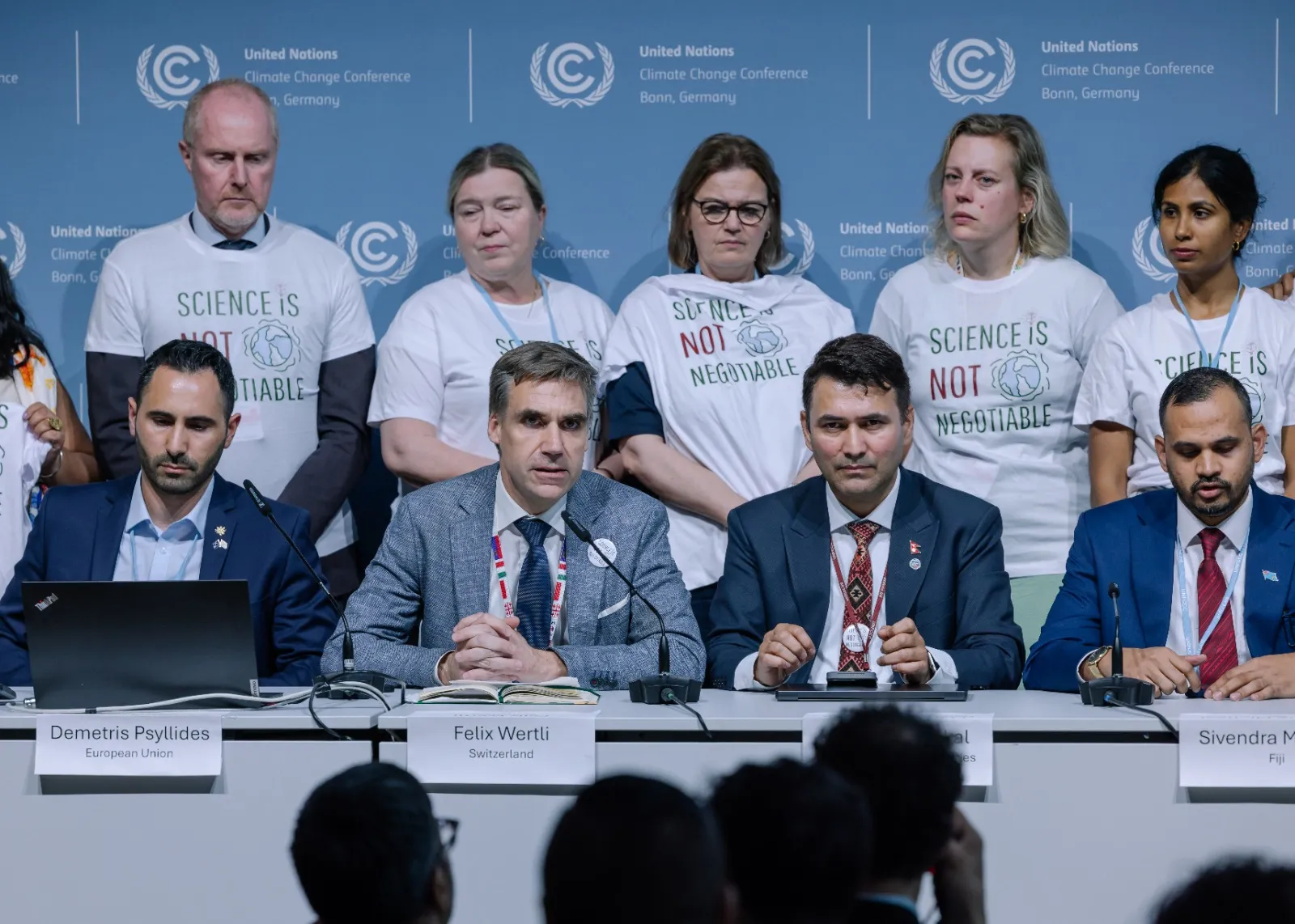
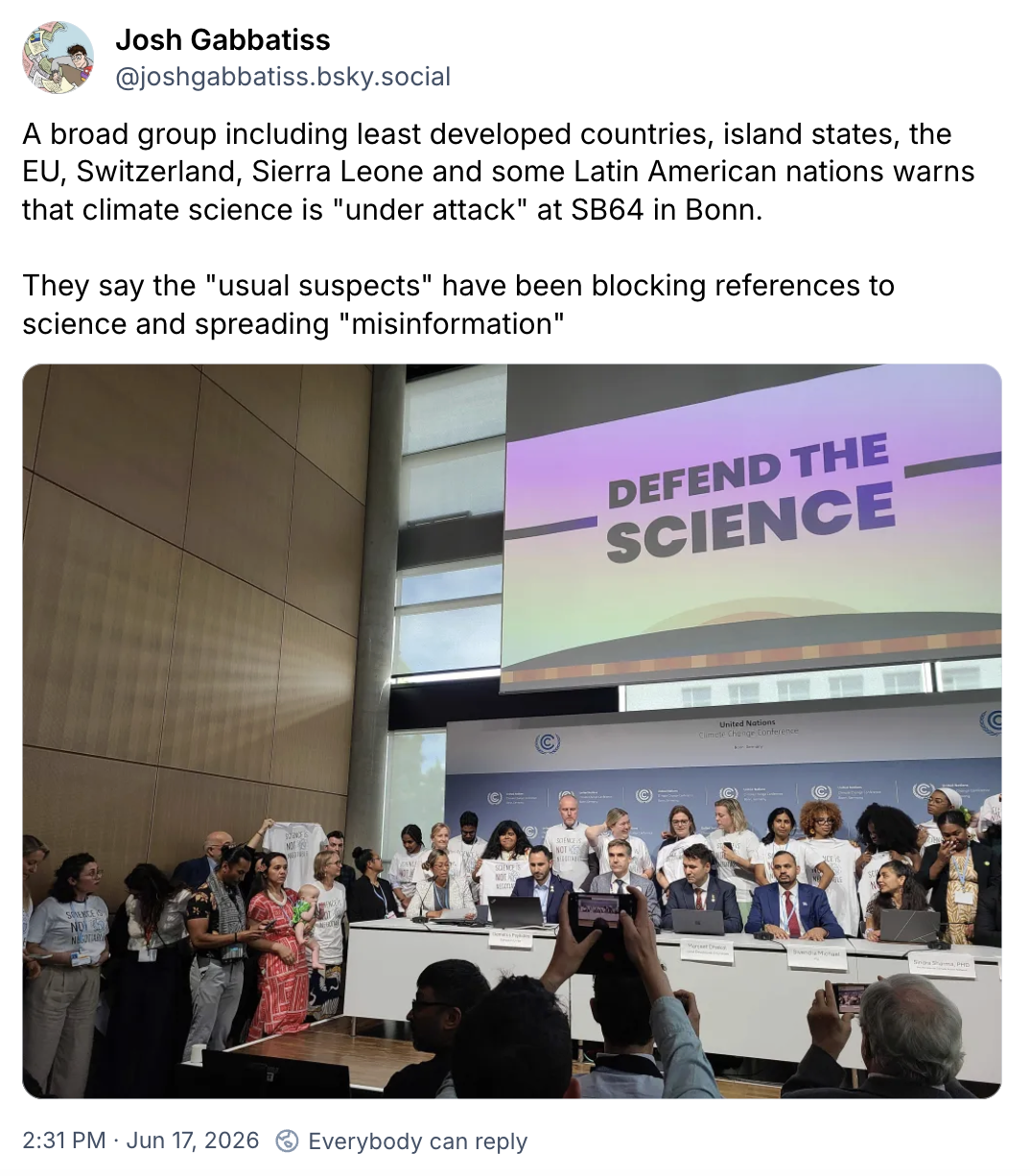
This came to a head when a press briefing was assembled with representatives from the EU, Switzerland and various developing countries to denounce “coordinated attacks” on science by “fossil-fuel interests”.

Josh Gabbatiss on Bluesky: A broad group including least developed countries

When asked which parties were behind these “attacks”, Sivendra Michael, chief negotiator for Fiji, told Carbon Brief:

“It is the usual suspects that seek to block progress…We are seeing efforts to remove references to the IPCC and the 1.5C temperature limit.”

A negotiator from one of the countries in the press conference later elaborated, telling Carbon Brief that Saudi Arabia and India were among those “undermining” climate science.

They also told Carbon Brief that Saudi Arabia had started referencing a Paris Agreement target of limiting warming to 2C – failing to mention the 1.5C component altogether. Saudi Arabia, a major oil-and-gas producer, has long opposed the 1.5C goal. 

(The Paris Agreement technically has a single temperature target of “well-below 2C above pre-industrial levels and pursuing efforts to limit the temperature increase to 1.5C”.)

All economies face very steep emissions cuts if the world is to meet the 1.5C target and this could have major societal impacts, especially for emerging economies with fossil-fuel industries.

However, small islands and climate-vulnerable states frame warming beyond 1.5C as an existential threat.

Anne Rasmussen, lead negotiator of AOSIS, told Carbon Brief that they were concerned about the “attempt to delink any relevance of the 1.5C” across several tracks, including the JTWP and the MWP.

As at COP30, differences of opinion were most evident in negotiations on “research and systematic observation”, where parties discussed scientific inputs into UN climate talks.

The EU was among parties voicing concerns about “misinformation” and the importance of 1.5C. Saudi Arabia and India were among those arguing against references to “misinformation and disinformation”, as well as 1.5C.

(There was also some debate about the inclusion of references to El Niño and climate “tipping points”. Both were opposed by some large, developing countries, with India and Saudi Arabia arguing there were “varying perspectives” on tipping points science.) 

Dr Kate Dooley, a senior research fellow at the University of Melbourne who followed the Bonn negotiations, told Carbon Brief that the accusations levelled by some parties in the press conference were oversimplified. She said:

“We’ve got both sides finger-pointing at each other – the EU and Switzerland pointing the finger at large, developing countries and saying: ‘What you’re doing is climate denial.’ And it’s not.”

There is growing acceptance that the world is likely to breach 1.5C. If that happens, the “overshoot” could be temporary if there is mass deployment of carbon removal technologies and tree-planting to suck carbon dioxide (CO2) from the atmosphere. 

As ever, this raises questions as to who will be responsible for cutting emissions and for the mass deployment of CO2 removal – and when and where these actions should take place.

Dooley said that “1.5C is the temperature goal and we need all hands on deck to achieve that”, but there was nothing wrong with “interrogating the risks of mitigation pathways and trying to make sure those risks are minimised”.

Large, developing nations argue on the basis of “equity” that they should have more leeway, whereas developed countries bear significant historical responsibility for climate change and that, as a result, they should cut emissions further and faster in line with the 1.5C goal.

Moreover, they argue that developed countries have failed to provide sufficient climate finance and technological support to help developing countries cut emissions.

Responding to this idea, Fiji negotiator Michael told the press briefing there would be “no equity for the most vulnerable” if 1.5C is breached:

“There is this growing narrative that science and equity are in competition…We reject this notion.”

Saudi Arabia and India were also prominent in questioning the role of the IPCC – considered the world’s most authoritative voice on climate science – in the UN process.

Some Indian researchers have been vocal in arguing that the scenarios assessed by the IPCC place an unfair burden on developing countries.

There was also a wider conversation about IPCC timelines in Bonn. Many parties, including the EU, AOSIS and South Africa, argued that the panel’s “seventh assessment report” (AR7) should be brought forward so the “best available science” can feed into the second “global stocktake” in UN climate talks, which is set to conclude in 2028. (See: Global stocktake.)

A group of countries, including Saudi Arabia, India, China, Kenya and Russia, have pushed back against any effort to accelerate the report timing. As a result, for five consecutive IPCC meetings, countries have failed to agree on the AR7 timeline.

These debates spilled over into SB64 talks, with the same parties arguing against alignment with the second GST. Again, these countries often make arguments on the basis of equity, stating that accelerating the process would disadvantage developing-country scientists.

Biólogos encontram antidepressivo no cérebro de tubarões do litoral do Rio de Janeiro (The Conversation)

Artigo original

Publicado: 16 junho 2026 06:50 -03

Por Mariana Batha Alonso e Leonardo Vazquez

A sertralina é o antidepressivo mais prescrito do Brasil. Em 2025, as vendas de antidepressivos e estabilizadores de humor cresceram 11% em relação ao ano anterior.

Um levantamento nacional indica que 18,6% mais brasileiros usaram medicamentos para saúde mental entre 2022 e 2024.

O que poucos sabem é que parte dessas pílulas percorre um segundo caminho depois de metabolizada pelo organismo: sai pela urina, entra no esgoto e vai direto para o mar.

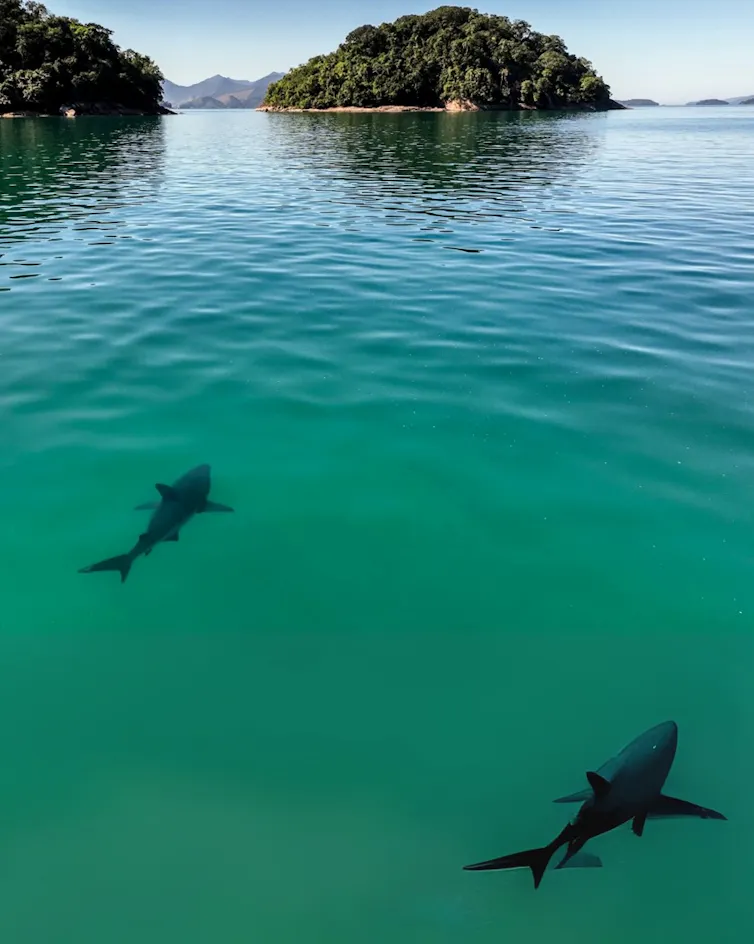
E no Rio de Janeiro, além de toda a beleza do mar, também tem tubarões.

O encontro que ninguém esperava

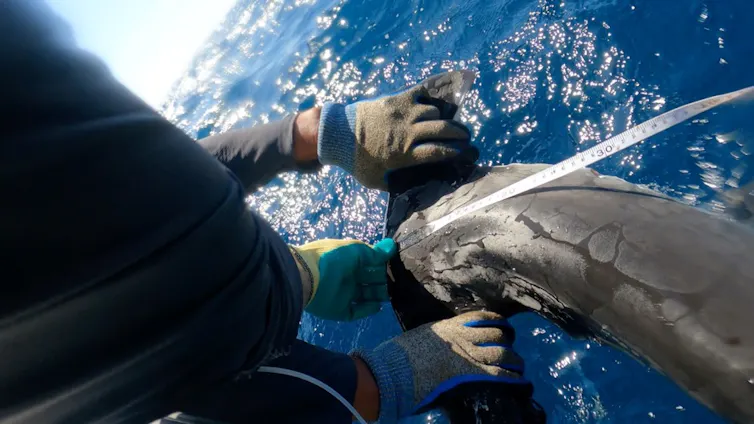
O Projeto EcoShark, coordenado por mim, professora do Instituto de Biofísica Carlos Chagas Filho da UFRJ, monitora a saúde de tubarões na costa fluminense desde 2018. Essa investigação contou também com outros cientistas como José Neto e Victor Alves, e é uma iniciativa pioneira sobre contaminantes emergentes em elasmobrânquios.

Biólogos do EcoShark no processo de identificação e estudo de tubarões no litoral Sul Fluminense. Arquivo pessoal.

Ainda a ser publicado, mas já compartilhado no âmbito da UFRJ, o estudo identificou a sertralina — o ingrediente ativo do Zoloft e de dezenas de genéricos — no tecido cerebral de tubarões-martelo (Sphyrna lewini e S. zygaena), classificados como espécies criticamente ameaçadas de extinção (IUCN, Ibama)

Tubarões-martelo foram capturados acidentalmente em redes de pesca no Recreio, Barra da Tijuca e Copacabana – graças a uma parceria entre pescadores e pesquisadores da UFRJ. Como predadores de topo, eles bioacumulam tudo o que está na cadeia alimentar, na água e no sedimento. E, cada vez mais, o que sobra nessa cadeia são os resíduos da nossa medicina.

A rota do remédio

Como um antidepressivo humano chega ao cérebro de um tubarão? O caminho é menos surpreendente do que parece.

Uma pessoa quando toma sertralina, o organismo metaboliza grande parte do fármaco no fígado. A sertralina pode ser excretada inalterada ou metabolizada e ambos alcançam os sistemas de esgoto.

As estações convencionais de tratamento de esgoto foram projetadas principalmente para remover matéria orgânica, nutrientes e microrganismos. E a remoção de compostos farmacêuticos costuma ser incompleta. Por isso, resíduos de antidepressivos e seus metabólitos são detectados em efluentes tratados e em ambientes aquáticos.

No estado do Rio de Janeiro, apenas cerca de 47% do esgoto gerado era efetivamente tratado, segundo dados recentes do Sistema Nacional de Informações sobre Saneamento (SNIS).

Parte significativa do esgoto é lançada no oceano pelos emissários submarinos de Ipanema e da Barra da Tijuca. Com tratamento preliminar, esses sistemas não removem fármacos, liberando moléculas no ambiente costeiro, absorvidas por peixes e invertebrados marinhos diretamente da água ou da alimentação.

Em tubarões, diversos contaminantes se acumulam em tecidos específicos, especialmente no fígado. No caso da sertralina, sua afinidade por tecidos ricos em lipídios e pelo sistema nervoso pode ajudar a explicar sua detecção no cérebro dos animais.

Não é um caso isolado

O Rio de Janeiro não está sozinho nesse mapa. Em março de 2026, um estudo publicado na revista Environmental Pollution revelou que 28 de 85 tubarões amostrados próximos à ilha de Eleuthera (Bahamas), apresentaram concentrações detectáveis de cocaína, cafeína e analgésicos no sangue.

Arquivo pessoal.

Pesquisadores brasileiros testaram amostras e encontraram antibióticos e opioides em tubarões. O achado mudou a percepção: se drogas aparecem em tubarões de uma ilha caribenha com baixa densidade urbana, o que esperar dos que nadam a menos de 1 km das praias do Rio? O estudo também detectou alterações fisiológicas nos animais, sugerindo que essas substâncias podem afetar sua bioquímica.

Por que o cérebro do tubarão é o problema

A sertralina, que age sobre a serotonina no cérebro humano, foi detectada no tecido cerebral de tubarões. Isso remete à exposição e bioacumulação. Como esse transportador de serotonina é muito semelhante entre vertebrados, a droga poderia teoricamente interagir com proteínas de animais. Mas atenção: a detecção, por si só, ainda não permite afirmar que houve alteração comportamental ou fisiológica nos bichos.

A ciência já sabe: em laboratório, zebrafish expostos a 0,1 µg/L de sertralina – concentração achada em águas costeiras – desenvolveram hipolocomoção e retardo no aprendizado, com alterações no sistema serotoninérgico.

O que ainda não se sabe – e é a pergunta que o EcoShark tenta responder – é o que esses compostos fazem com um elasmobrânquio. Tubarões têm neuroquímica distinta dos peixes ósseos, mais parecida com a dos mamíferos. A resposta, por ora, é um ponto de interrogação com uma centena de quilos.

Uma pergunta que não pode ser ignorada

O Brasil registra o maior índice de letalidade de incidentes com tubarões no mundo. Em 2021, a taxa de mortalidade registrada chegou a 30% — comparado a 1% nos Estados Unidos e 14% na Austrália.

Arquivo pessoal.

Não, não estamos sugerindo que antidepressivos nos oceanos causem ataques. Mas a pergunta que a ciência tem a obrigação de fazer é outra: se essas drogas, em concentrações relevantes, alteram o comportamento de peixes em laboratório, o que realmente acontece com tubarões cronicamente expostos a elas nas zonas costeiras mais poluídas do mundo?

O que está em jogo além do óbvio

A descoberta de sertralina no cérebro de tubarões-martelo do Rio de Janeiro toca em três crises que o Brasil ainda trata como separadas.

A primeira é a crise de saúde mental. O consumo de antidepressivos no Brasil cresceu 12,4% entre adultos de 29 a 58 anos no período de 2023 a 2025. Esse crescimento não é um problema em si. É um avanço no diagnóstico e no acesso ao tratamento. Mas cada comprimido tem um segundo destino que não está sendo monitorado.

A segunda é a crise de saneamento. Enquanto cerca de metade do esgoto fluminense segue sem tratamento capaz de remover compostos farmacêuticos, o oceano continuará funcionando como receptor da nossa farmácia doméstica.

A terceira crise é a da conservação: o tubarão-martelo, espécie criticamente ameaçada, é essencial para o equilíbrio marinho – sua presença regula e estabiliza a cadeia trófica. Alterar a neuroquímica desse animal é um experimento involuntário e sem controle.

O que precisa mudar

Três ações são urgentes e não se excluem. Os protocolos de monitoramento ambiental do Brasil precisam incluir o rastreamento sistemático de fármacos em tubarões, raias e cetáceos. A metodologia já existe – são os projetos EcoShark e EcoDELFIS. O que falta? Financiamento continuado e uma política pública que valorize e reconheça os medicamentos como poluentes emergentes.

As estações de tratamento de esgoto do país precisam ser modernizadas para remover micropoluentes farmacêuticos.

O financiamento à pesquisa de ecotoxicologia marinha precisa ser ampliado. O Brasil tem uma costa de quase 8 mil quilômetros, uma das maiores biodiversidades do planeta e, agora, tubarões com antidepressivos no cérebro.

A sertralina foi criada para aliviar o sofrimento humano. Que ela chegue ao sistema nervoso de um predador a poucos quilômetros de Copacabana é o registro mais preciso de até onde essa geração deixa suas marcas.


As pesquisas foram financiadas pelo PIBIC-UFRJ, Capes e Faperj. A realização do SubProjeto EcoShark dentro do Projeto de Pesquisa Marinha e Pesqueira foi uma medida compensatória estabelecida pelo Termo de Ajustamento de Conduta de responsabilidade da empresa PRIO, conduzido pelo Ministério Público Federal – MPF/RJ.

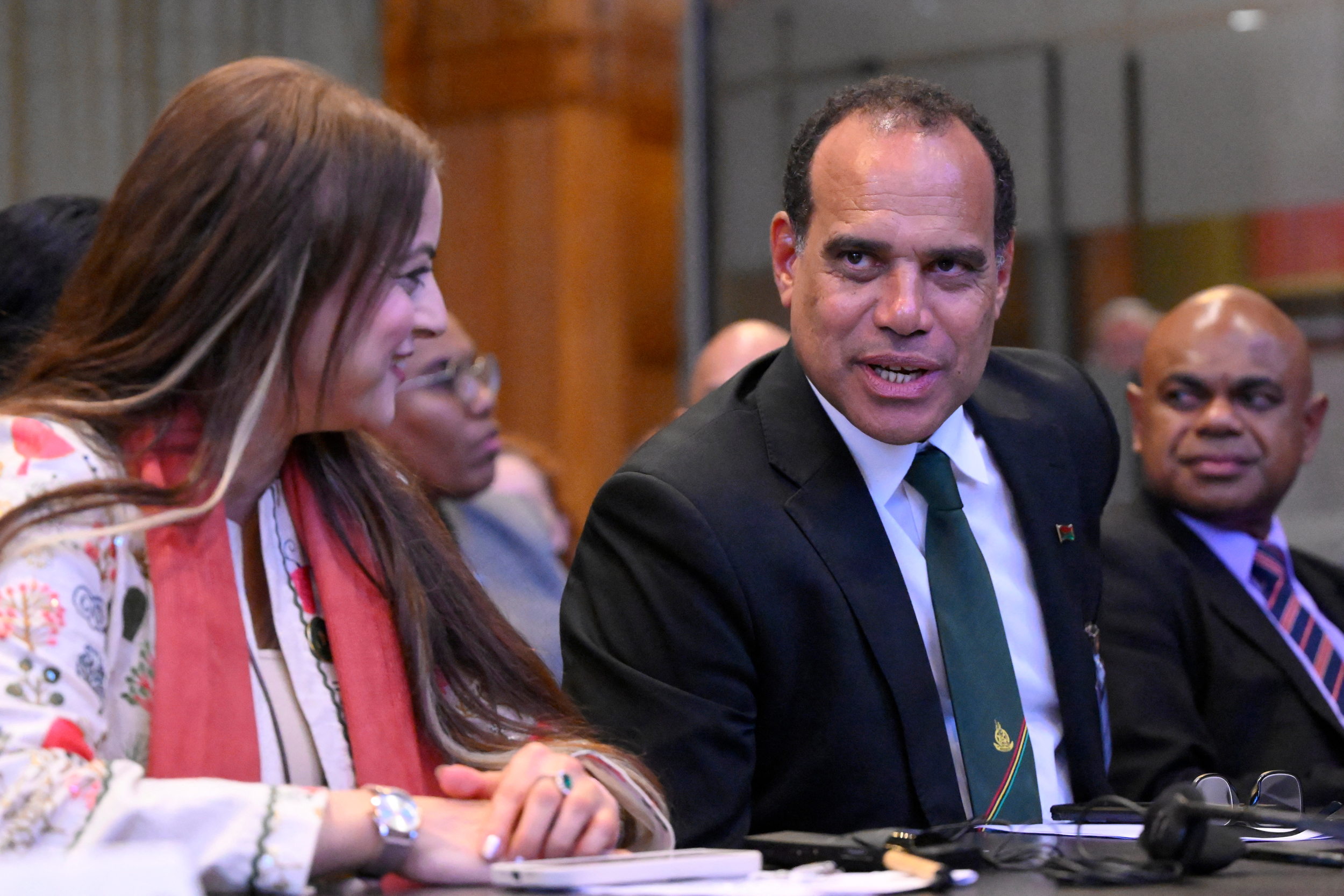
Science ‘under attack’ from fossil fuel interests at UN climate talks (Climate Home News)

Jun 17, 2026 | Last Update: Jun 18, 2026

Original article

A coalition of some rich nations and the world’s most vulnerable have vowed to protect climate science in UN negotiations

Countries give a press briefing to underline the importance of science in the UN climate process at the mid-year talks in Bonn on June 17, 2026. (Photo: Marie Jacquemine/Greenpeace)

Matteo Civillini (Reporter) & Joe Lo (News editor)

Editing: Megan Rowling

Dozens of countries have called out growing “coordinated attacks” by fossil fuel interests aimed at undermining the role of climate science in the UN negotiations at the mid-year talks in Bonn.

Under the banner of ‘Friends of Science’, in an overflowing press conference room lined with negotiators and civil society supporters, diplomats from Fiji, Nepal, the European Union, Switzerland, Sierra Leone and Panama vowed to ensure that decision-making in the UN climate process remains based on the “best available science”. That includes reports from the Intergovernmental Panel on Climate Change (IPCC), the UN’s climate science body, they said.

While steering clear of singling out any specific country, they said efforts to cast doubt on established scientific concepts, such as the 1.5 global warming limit, are led by “the usual suspects” and those who think “science threatens their economic prospects”. 

Saudi Arabia and India have opposed calls in draft texts to encourage scientific work on scenarios that would minimise the magnitude and duration of any overshoot of 1.5C, according to one negotiator in the room and summaries of closed-door discussions published by a reporting service. 

UN chief António Guterres conceded last year that a temporary breach of the key warming limit is inevitable, while urging countries to redouble efforts to bring temperatures back down.

‘Polluted narrative’

Scientists have long established that burning fossil fuels is the primary cause of man-made climate change and a rapid shift away from oil, coal and gas is essential to curb global warming.

Saudi Arabia is dependent on oil and gas exports, while India largely relies on coal to power its economic development.

One negotiator said that research on how climate action can be equitable for developing countries, produced by Indian universities, had been published too late to be incorporated into the last IPCC assessment report in 2023. This incident led the Indian government to try and discredit the IPCC, they said. Some Indian scientists have argued that the IPCC’s scenarios are unfair on developing countries.

Saudi Arabia and India have played down the importance of making sure that the latest IPCC assessments – regarded as the gold standard of climate science – are available for the next global stocktake, the UN scorecard of climate action around the world. 

“Anyone that is blocking references to science – they are not our friends,” Sivendra Michael, lead negotiator for Fiji, told a press conference, highlighting the rise of a “polluted narrative” both inside and outside the negotiating rooms.

1.5C is a ‘hard limit’

Speaking for the AILAC coalition of Latin American countries, Panama’s Ana Aguilar said they went to Bonn to negotiate positions, not to negotiate the facts laid out by science.

“We see coordinated efforts to cast doubt on the best available science driven by a narrow set of interests, not by the needs of our people,” she added. “We have seen this playbook before… manufacture doubt, delay the response and let the vulnerable people pay this bill.”

Negotiators, researchers and civil society activists attend a press conference on defending science in the UN climate process in Bonn, Germany on June 17, 2026. (Photo: Teo Ormond-Skeaping)

The ‘Friends of Science’ coalition stressed that the 1.5C goal of the Paris Agreement cannot be negotiated, as the survival of the most climate vulnerable communities is at stake if it is permanently breached.

“Science tells us that 1.5C is a hard limit for many countries, including the small island developing states and least developed countries,” said Manjeet Dhakal, a negotiator for Nepal. “We still have a chance to keep 1.5 degrees in reach and minimise the overshoot if we act fast and drastically.”

Long-running IPCC standoff

While diplomats claimed attacks on science are broadening, one long-standing issue of contention is whether the latest assessment reports of the IPCC will be ready in time for the next UN global stocktake due to start this November and end in 2028. 

This matters because, as some experts have pointed out, previous IPCC findings played a key role in the first such exercise, which culminated at COP28 in Dubai in the landmark agreement on transitioning away from fossil fuels in energy systems.

The UN climate process needs ambition – the law demands it

The IPCC, which works with academics worldwide, publishes its comprehensive scientific assessment reports every five to seven years. The process for the last one, AR6, lasted around seven and a half years. The seventh assessment cycle, AR7, began in July 2023, but a political battle over the timing has dragged on for over two years at successive IPCC meetings, with governments repeatedly failing to find a solution. 

A large majority of nations have been pushing for an accelerated timeline that would ensure the AR7 reports can be fed into the UN’s global stocktake. But a group of countries, including Saudi Arabia, India, China, Russia and Kenya, have said at previous IPCC meetings they want a longer process, arguing a fast-tracked assessment would put a burden on developing countries with limited resources.

Science and the stocktake

That fight has now bled into the Bonn talks where governments began discussing the arrangements for the next stocktake. At a session earlier this week, most developed countries, Latin American and small island states, and the world’s poorest nations emphasised the assessment of collective climate action must be guided by the “best available science” – code for the findings of the IPCC reports.

The Maldives, speaking for small island states, said IPCC science remains “essential to the integrity, credibility and usefulness” of the stocktake. AILAC said that starting the process “on the right footing” requires a political decision on the timeline to deliver the AR7 reports in time. Switzerland said IPCC reports “ask more than is politically comfortable, but that is precisely why they must guide every decision we make”.

Saudi Arabia, however, said no particular scientific input – and in particular what comes out of the IPCC – should be prioritised. Similarly, India warned against creating “some kind of preferred hierarchy” in the role that any specific source of information should play in the process.

Ghana’s Antwi-Boasiako Amoah, who chairs the African Group, told a press conference on Tuesday that some countries think rushing to get IPCC inputs into the global stocktake could “undermine or compromise the IPCC process”. “Africa is for science,” he said, without saying where the continent stands on the IPCC timeline.

Crunch talks in October

At the “Friends of Science” press conference, Dhakal pushed back on the idea that science would have to be rushed to be incorporated. He said the IPCC leadership has “perfectly made it clear” that they can deliver the report before the global stocktake. “It is the scientists who are saying they can deliver it on time,” he said. 

The “Friends of Science” press conference at UN climate talks in Bonn on June 17, 2026. Photo: Marie Jacquemine/Greenpeace)

The discussion will be picked up again at the next IPCC session in October, where its boss Jim Skea is hoping to reach an agreement. “As a scientist myself, I cannot overstate the importance of this decision,” he told governments in Bonn last week.

Andreas Sieber, head of political strategy at campaigning group 350.org, told Climate Home News that the debate may sound procedural, “but it is anything but”. “Science is the backbone of the Paris Agreement ambition cycle, and the evidence assessed through AR7 will help determine not only the emissions pathways countries pursue, but also how the world responds to mounting climate losses and who receives support,” he said in Bonn.

This story was updated after publication to add information on the IPCC assessment cycles and timing of its reports.

Governo Lula avalia verba extra contra El Niño e mapeia risco de eleições impulsionarem incêndios (Folha de S.Paulo)

  • Polícia Federal deve atuar com foco em cidades de maior risco de incêndios intencionais
  • Grupo interministerial debate medidas para caso fenômeno se confirme e Ibama já realiza notificação preventiva

Artigo original

3.jun.2026 às 13h16; Atualizado: 3.jun.2026 às 13h20

João Gabriel

Brasília

O governo de Luiz Inácio Lula da Silva (PT) ainda adota cautela sobre a probabilidade de um possível El Niño neste ano, mas prepara ações para mitigar os impactos do fenômeno e evitar que incêndios florestais se espalhem pelo país durante a seca —o que pode exigir a abertura de crédito extraordinário.

Segundo informações obtidas pela Folha, o tema foi debatido em uma reunião da sala de situação contra incêndios (que reúne diversos ministérios) na segunda quinzena de maio, e voltará à pauta no próximo encontro do grupo, previsto para junho.

0
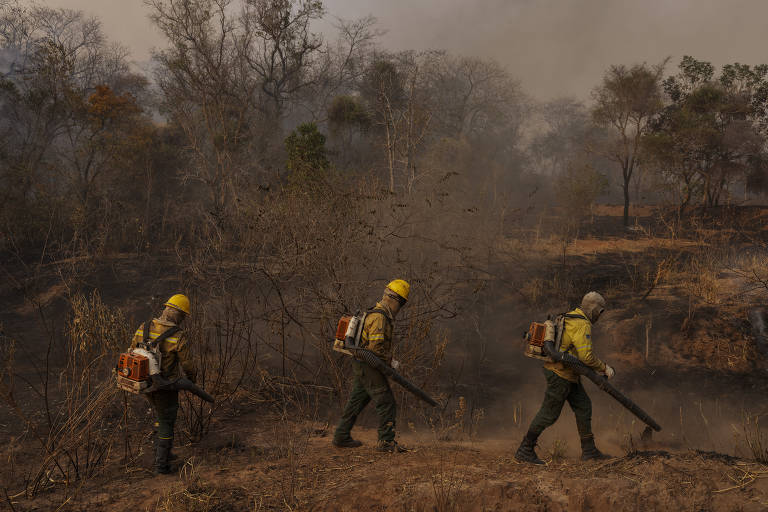
Brigadistas do Prevfogo combatem o incêndio em uma fazenda na região de Miranda, Mato Grosso do Sul, durante crise de queimadas no pantanal em 2024 – Lalo de Almeida – 4.ago.24/Folhapress

O ano eleitoral de 2026 preocupa. Foi elaborado um mapa identificando regiões onde há maior risco de que um clima político inflamado motive queimadas intencionais para alimentar ataques de opositores ao governo Lula.

Em geral, o plano prevê a participação das forças de segurança para apoio em operações de fiscalização e investigação, da Defesa na logística e dos Transportes no controle de rodovias, dentro outras atribuições.

O Ibama (Instituto Brasileiro do Meio Ambiente) e ICMBio (Instituto Chico Mendes de Conservação da Biodiversidade) devem precisar de cerca de R$ 200 milhões em crédito extraordinário, parte para recompor perdas orçamentárias.

A AGU (Advocacia-Geral da União) prepara uma resposta formal a questionamento feito pelo ministro Flávio Dino, do Supremo Tribunal Federal, sobre as ações que o Executivo realiza para conter os efeitos do El Niño.

Durante a reunião ministerial desta quarta-feira (3), a ministra da Casa Civil, Miriam Belchior, ressaltou que o governo entregou R$ 150 milhões do Fundo Amazônia em equipamentos de combate a incêndios para seis estados do pantanal e do cerrado.

“Muito importante, a gente sabe que o El Niño está chegando ameaçadoramente, mas nós estamos nos preparando para enfrentar da melhor maneira os seus efeitos”, afirmou.

As mudanças climáticas agravaram as secas, os incêndios e as tempestades nos últimos anos em todo o planeta.

O mesmo acontece com o El Niño, fenômeno meteorológico que se configura quando as águas superficiais do oceano Pacífico aquecem acima de forma atípica e que se tornou mais constante e intenso nos últimos anos.

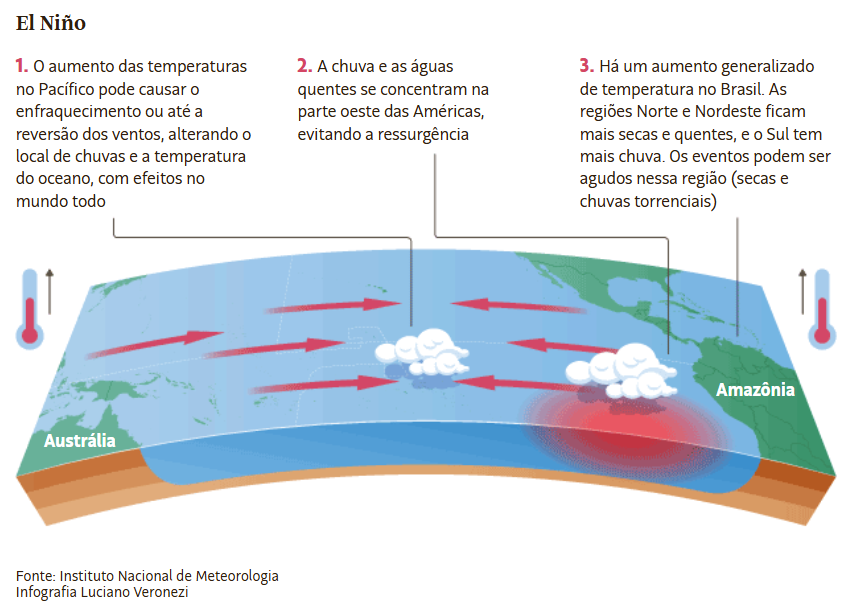
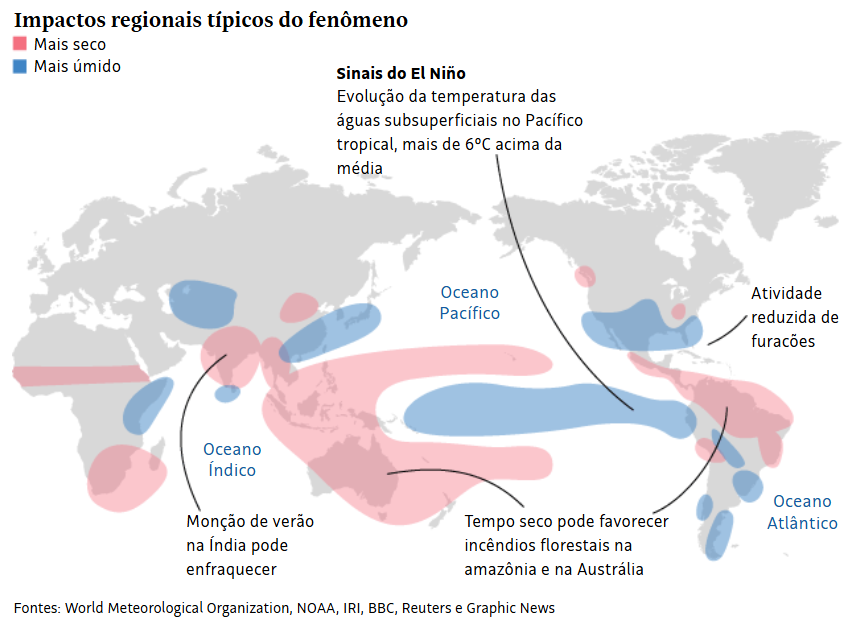
Sobre o Brasil, ele traz uma onda de calor que favorece incêndios florestais e causa secas no Norte e no Nordeste, enquanto traz chuvas torrenciais para o Sul —como as registradas na região de Porto Alegre (RS), em 2024.

O cenário impacta diretamente as plantações do agronegócio e impulsiona o desmatamento. O El Niño é um dos motivos pelos quais o país viveu grandes crises de queimadas em 2020 e em 2024.

O Ministério do Meio Ambiente conduz reuniões periódicas com meteorologistas de diversos órgãos —como Agência Nacional de Águas, Cemaden, UFRJ, Ibama, dentre outros— para monitorar a situação.

O panorama até aqui é descrito como um sinal amarelo: a chance de acontecer um El Niño forte ou pior é de cerca de 70%, mas as previsões atuais apresentam uma taxa de incerteza de 50% e um cenário mais preciso só será previsível em julho, quando o sinal vermelho pode ser ligado definitivamente.

Por enquanto, o governo federal adota ações preventivas, como queimas prescritas, um fogo controlado para eliminar matéria orgânica que poderia virar combustível para um incêndio maior.

Esse tipo de estratégia começou a ser aplicada em 2025 e, conforme o Ministério do Meio Ambiente, resultou em uma “queda de 39% na área queimada no território nacional” naquele ano “na comparação à média dos oito anos anteriores”.

Parte importante da estratégia é a integração com estados —os bombeiros são os responsáveis pela resposta ao fogo em propriedades privadas, que é onde começam a maioria dos incêndios. Desde 2024, o governo federal cria acordos de cooperação com entes federativos, e um plano conjunto para pantanal, cerrado e amazônia é esperado ainda para este ano.

O Executivo também elabora uma nova parceria com as Polícias Militares ambientais, contingente de cerca de 8.000 agentes para atuar com policiamento ostensivo em áreas de maior risco de incêndio —o que não aconteceu em anos anteriores.

Neste ano Ibama já aplicou 574 notificações prévias. Esse instrumento permite que, caso a propriedade registre um incêndio no futuro, o seu dono seja responsabilizado, caso não tenha adotado as medidas preventivas, como formação de brigadas de incêndio.

Na última reunião da sala de situação, em maio, foram apresentadas as ações que o governo federal precisa adotar caso as previsões mais pessimistas acerca do El Niño se confirmem, e agora cada pasta irá avaliar o que já é capaz de concretizar e o que demandará novos esforços —e recursos.

A disputa eleitoral é um fator de atenção. Dentre as regiões de mais risco de incêndios por motivação política, o Pará é o principal.

Em agosto 2019, por exemplo, fazendeiros do estado realizaram o que ficou conhecido como o “dia do fogo”, ação coordenada de queimadas com intuito de demonstrar apoio às políticas antiambientais do então governo de Jair Bolsonaro (PL).

Pelo mapeamento do governo, o Pará registra os três municípios avaliados como de maior risco para este ano: Altamira, Novo Progresso e São Félix do Xingu, cidades com forte incidência de desmatamento ilegal associado a grilagem e à criação de gado, e também com tendência bolsonarista.

Outras 18 cidades foram avaliadas como um risco intermediário: quatro no Pará, seis no Amazonas, cinco no Mato Grosso e três no Tocantins. Mais cerca de cem municípios pelo país são preocupantes em um menor nível, o que inclui regiões no Norte, Nordeste, Centro-Oeste e Sudeste.

O objetivo do governo federal é que a Polícia Federal atue com foco nestes locais, registre flagrantes, investigue e responsabilize possíveis culpados.

Até aqui, o governo já mobilizou 4.410 brigadistas no país, divididos em mais de 200 equipes do Ibama e do ICMBio, um recorde.

Pelo plano, a Força Nacional precisará destacar mais de 200 agentes para compor brigadas e atuar na segurança em operações de fiscalização, junto com outros órgãos.

O governo avalia disponibilizar aeronaves do Ministério da Defesa para auxiliar nas ações, o que deve demandar contratação de horas-voo extras, e uma cooperação com a Bolívia para ações na fronteira, por meio da pasta de Relações Exteriores.

O Executivo também planeja campanhas de conscientização de produtores rurais e da população, de preparação de brigadistas e limpeza de estradas.

El Niño começou e pode se intensificar para nível muito forte, diz agência dos EUA (Folha de S.Paulo)

  • Fenômeno pode ter recorde desde o início dos registros, segundo Administração Nacional Oceânica e Atmosférica (Noaa)
  • Efeitos no Brasil podem ser menos chuva na região Norte e maiores precipitações no Sul

11.jun.2026 às 10h27Atualizado: 11.jun.2026 às 19h47

Artigo original

Phillippe Watanabe

Bogotá (Colômbia)

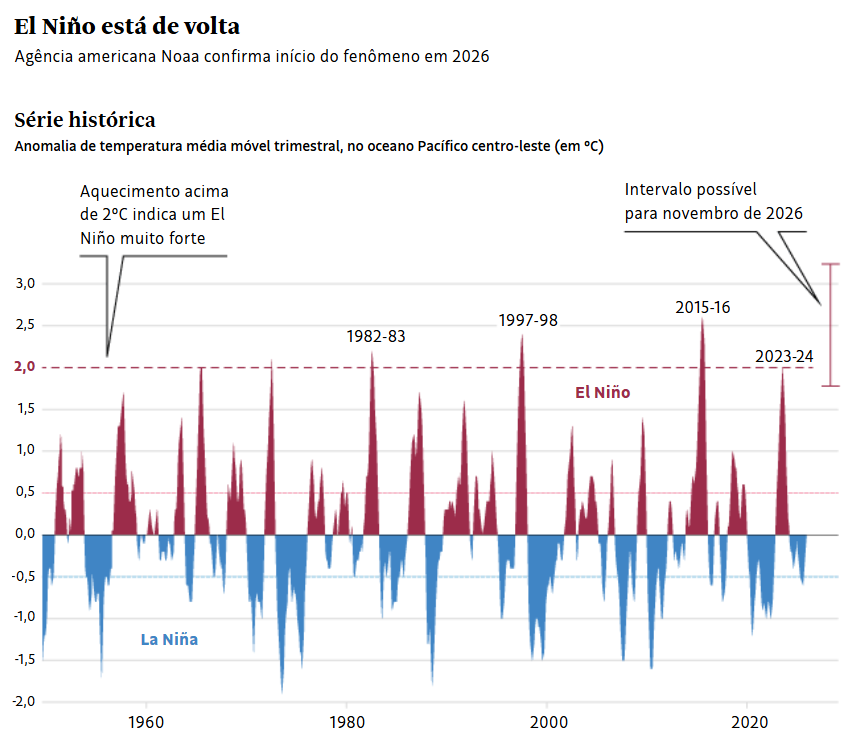
A Noaa (Administração Nacional Oceânica e Atmosférica) dos Estados Unidos confirmou, nesta quinta-feira (11), o início do El Niño.

O fenômeno climático deve se desenvolver para um nível moderado ou forte durante o outono no hemisfério norte (que vai de setembro a dezembro; primavera no sul), segundo a agência americana. Foi estimada em 63% a chance de um El Niño muito forte de novembro a janeiro —a possibilidade apresentada no mês passado era de 37%—, de acordo com a Noaa, com possibilidade de figurar entre os recordes do fenômeno desde o início dos registros, em 1950.

Apesar de o El Niño ter o poder de influenciar eventos climáticos extremos, cada ano do fenômeno é diferente. Por isso, segundo a Noaa, um El Niño considerado muito forte não necessariamente resultará em eventos climáticos maiores e mais impactos. Mas essa classificação aumenta as chances desses tipos de acontecimento.

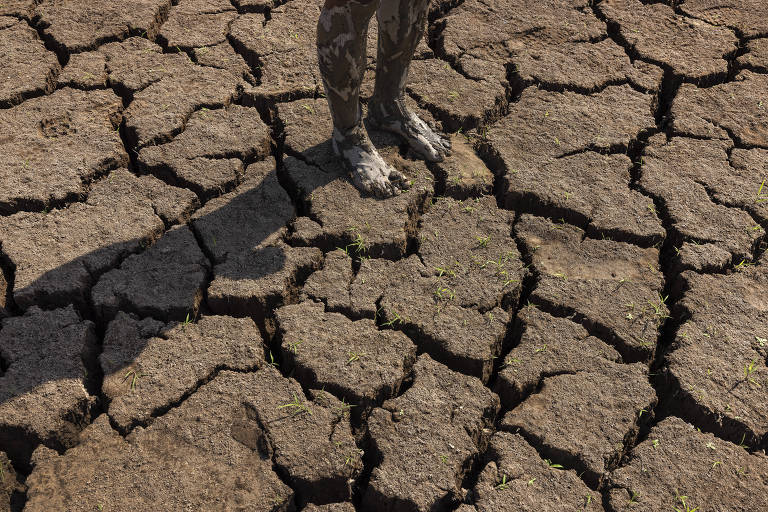
Pés enlameados de pessoa após caminhada pelo leito seco de um lago na comunidade quilombola Saracura, na área de várzea do rio Amazonas, próxima a Santarém, no Pará – Lalo de Almeida – 22.nov.24/Folhapress

Por sinal, o El Niño mais recente, ocorrido em 2023 e 2024, foi um dos grandes já registrados. No Brasil, vimos uma seca histórica na amazônia e uma enchente catastrófica no Rio Grande do Sul.

O ano de 2024 foi também o mais quente registrado no mundo desde o século 19. Dado que o fenômeno meteorológico impacta nas temperaturas, já se especula a possibilidade de um novo recorde de calor se avizinhando.

Um El Niño muito forte significa um aquecimento igual ou maior a 2°C, comparado à média histórica, das águas superficiais do oceano Pacífico em uma região próxima à linha do Equador (veja mais abaixo).

As demais classificações de intensidade do fenômeno seguem a mesma lógica da temperatura da água, variando, em linhas gerais, a cada 0,5°C.

Dessa forma, um El Niño forte representa um aquecimento de 1,5°C a 2°C acima do nível normal; um moderado, de 1°C a 1,5°C; um fraco de 0,5°C a 1°C; e um neutro de -0,5°C a 0,5°C.

Para o meteorologista Márcio Cataldi, professor do departamento de Engenharia Agrícola e Meio Ambiente da Universidade Federal Fluminense (UFF), “as previsões indicam que esse pode ser um El Niño muito forte, mais forte do que o que a gente tem registrado até hoje”. Ele lembra, porém, que só há registros confiáveis de El Niño a partir da década de 1980, quando satélites passaram a contribuir com a coleta de dados.

O climatologista Francisco Eliseu Aquino, professor do Departamento de Geografia da Universidade Federal do Rio Grande do Sul (UFRGS), disse que o apelido super El Niño, que passou a ser usado para se referir ao evento agora em curso, destaca a intensidade do fenômeno em comparação aos demais, mas não é um termo técnico.

O que é o El Niño

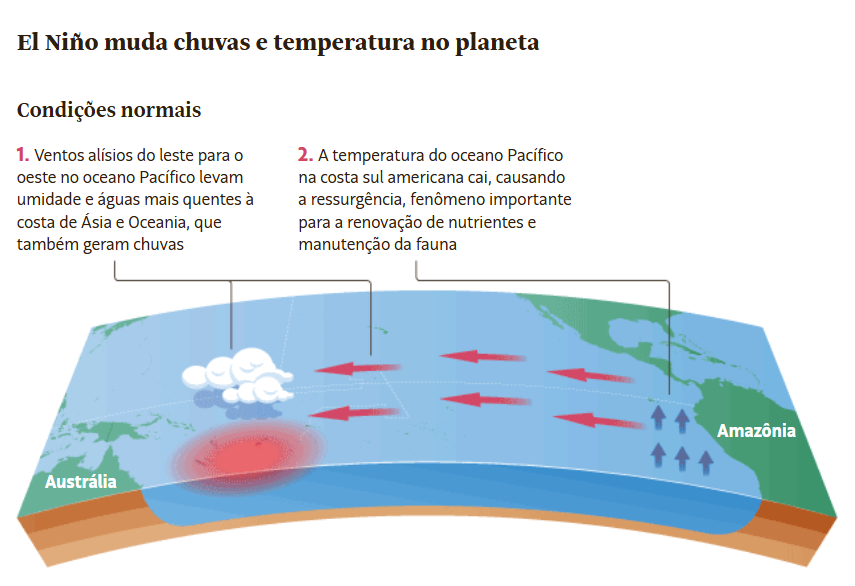
O El Niño é um acontecimento natural e é caracterizado pelo aquecimento, acima da média, da superfície do oceano Pacífico, perto da linha do Equador. Vale lembrar que, apesar da sua ocorrência histórica, esse fenômeno agora ocorre em um mundo alterado pela crise climática, o que muda jogo, podendo amplificar impactos —e levando, inclusive, a uma alteração na medição do El Niño.

O fenômeno tem relação com os ventos alísios, que usualmente empurram águas quentes em direção à Ásia. Em alguns anos anos, porém, que tais ventos se enfraquecem, segundo a Noaa. Esses são os anos de El Niño.

Há ainda um outro fenômeno associado, a La Niña. Ainda segundo a agência americana, esse segundo acontecimento se dá quando os alísios se tornam mais intensos do que o normal. O fenômeno se caracteriza, com isso, pela superfície da água mais fria do que a média histórica.

O El Niño costuma durar entre 9 e 12 meses, segundo a Organização Meteorológica Mundial (OMM). Em geral, começa no final do inverno do hemisfério Sul e atinge o pico entre novembro e janeiro. O fenômeno começa a desaparecer a partir do primeiro mês do ano.

Como afeta o Brasil

Segundo nota técnica do Inpe (Instituto Nacional de Pesquisas Espaciais), o El Niño deste ano pode reduzir o volume de chuvas na amazônia. Isso levaria a um aumento no risco de fogo no bioma.

Por esse motivo, o ministro Flávio Dino, do STF (Supremo Tribunal Federal), chegou a determinar que a União e os estados parte da amazônia e do pantanal apresentassem planejamento e os preparativos frente ao aumento do risco de incêndios florestais.

O presidente Luiz Inácio Lula da Silva (PT) declarou recentemente que o governo federal está preparado para enfrentar os possíveis reflexos do El Niño no país. A gestão planeja ações para mitigar os impactos do fenômeno e evitar que incêndios florestais se espalhem pelo país em um eventual período de seca.

Enquanto o Norte e Nordeste usualmente ficam com menos chuvas, anos de El Niño costumam ter maior volume de precipitação no Sul do Brasil.

A região Centro-Oeste costuma ter temperaturas mais elevadas, aumentando também o risco de fogo.

Já no Sudeste, anos de El Niño costumam registrar aumento da temperatura média, especialmente na primavera e verão, mais chuvas no sudeste de São Paulo, centro-sul do Rio de Janeiro e de Minas Gerais e redução de precipitação em áreas mais ao norte. Também podem ocorrer secas na região, o que varia de acordo com a intensidade do fenômeno.

Como afeta outras partes do mundo

O El Niño provavelmente terá um impacto negativo na produção agrícola no Sudeste Asiático e na Índia, onde o fenômeno é tipicamente associado a chuvas abaixo da média, segundo Kyle Tapley, executivo de vendas empresariais do WeatherDesk da Vaisala Xweather.

As monções fornecem quase 70% das chuvas na Índia e são vitais para o setor agrícola, que representa cerca de 18% da economia de quase US$ 4 trilhões. Chuvas abaixo da média podem significar colheitas menores de culturas como arroz, algodão e soja, além de afetar as safras de inverno.

Enquanto isso, os produtores de arroz da Indonésia estão correndo para antecipar o calendário habitual de plantio enquanto enfrentam a ameaça de um longo período de seca neste ano. O ministro da Economia da Malásia alertou que o El Niño pode causar uma queda média de 8% a 10% na produção agrícola.

“O El Niño normalmente leva a uma temporada de furacões menos ativa nos EUA, e esperamos uma temporada de furacões no Atlântico abaixo da média neste ano. No entanto, é importante lembrar que um furacão forte ainda é possível mesmo em uma temporada menos ativa”, disse Tapley.

A temporada de furacões nos EUA começou em 1º de junho e vai até 30 de novembro.

Com Reuters

Adaptação emergencial ao El Niño vai de protocolos para chuvas a centros públicos de resfriamento (Folha de S.Paulo)

  • Planos incluem definir rotas de fuga e abrigos, além de treinar população com simulados
  • Prevenção é mais barata que impactos econômicos de eventos climáticos extremos, sentidos por até cinco anos

11.jun.2026 às 10h43

Jéssica Maes

Artigo original

Com a chegada do El Niño, anunciada nesta quinta-feira (11) pela Noaa (Administração Oceânica e Atmosférica Nacional), as cidades precisarão ter mais bem definidos os planos de preparação para enfrentar o fenômeno climático.

A preocupação com os impactos chegou na mobilizar o STF (Supremo Tribunal Federal) —que não costuma se debruçar sobre debates climáticos— e, no final de maio, o ministro Flávio Dino determinou que os governos federal e estaduais apresentassem planos de preparação para a chegada do El Niño.

Bairro da cidade de Cruzeiro do Sul foi devastado pelas enchentes que atingiram o Rio Grande do Sul em 2024; El Niño deve aumentar recorrência de temporais na região sul – Folhapress/Anselmo Cunha – 4.jun.2024

Mas, e as autoridades que não obedeceram Dino, que medidas podem tomar agora que o fenômeno começou?

Mesmo diante de um planeta cada vez mais instável, eventos passados e modelos climáticos são os melhores mapas para definir as estratégias para enfrentar este El Niño. O fenômeno, provocado pelo aquecimento do Pacífico Equatorial, tende a gerar chuvas acima da média na região Sul, enquanto Norte e Nordeste normalmente sofrem com secas mais intensas.

“O Pacífico corresponde a metade da Terra em longitude. É muita água. Quando essa água se move e muda de lugar, ela cutuca a atmosfera e gera ondas atmosféricas”, diz a oceanóloga Regina Rodrigues, pesquisadora da UFSC (Universidade Federal de Santa Catarina).

“No Brasil, o que geralmente acontece é que essas ondas criam o que chamamos de bloqueio atmosférico —uma alta pressão que fica sobre o Sudeste. As frentes frias chegam e não conseguem passar. Então, fica chovendo no mesmo lugar”, explica.

Planos de contingenciamento

Rodrigues acrescenta que saber onde, exatamente, essas chuvas vão acontecer, se no Rio Grande do Sul ou em Santa Catarina, por exemplo, é mais difícil de prever no longo prazo. Mas as simulações climáticas usadas atualmente já conseguem fazer a previsão no médio prazo, com 10 a 15 dias de antecedência.

“Se os estados e cidades estivessem preparados, bastaria acionar os planos de contingência para atuar. Evitar tudo não é possível, mas há uma série de medidas que podem aliviar os impactos”, diz a cientista, acrescentando que essas ações de adaptação precisam ser locais.

Planos de contingência incluem, por exemplo, saber quais lugares correm risco de deslizamento de terra e comunicar a população sobre o que fazer quando começar a chover.

O meteorologista Marcelo Seluchi, coordenador-geral de Operações e Modelagem do Cemaden (Centro Nacional de Monitoramento e Alertas de Desastres Naturais), afirma que as cidades precisam detalhar elementos como a rota de fuga e a definição prévia de espaços que servirão como abrigos na hora da emergência.

“E o ideal é que tudo isso seja treinado, simulado. É difícil fazer um plano de contingência para uma cidade como Porto Alegre? É muito difícil, mas tem que ser feito”, adverte o pesquisador.

Ele conta que cidades como Valparaíso, que precisa se preparar para a ocorrência de tsunamis, faz simulados regularmente com toda a população, de mais de 300 mil habitantes.

Seluchi ressalta, ainda, a importância da conscientização da população em seguir as orientações das autoridades.

“Quando a Defesa Civil chega, a pessoa fala: ‘Ah, moro aqui há 40 anos e aqui não acontece nada. O rio nunca chegou até aqui’. Até que o rio chega e as pessoas morrem afogadas. Isso é terrível. É preciso conscientizar as pessoas com certo cuidado, sem gerar pânico, mas indicando o que deve ser feito”, diz.

O mesmo vale para alertas de condições extremas que são enviadas por mensagem de texto, como é o caso da prefeitura de São Paulo. “Não adianta você ter um celular tocando se você não sabe o que tem que fazer”, afirma o meteorologista.

Estrutura física e burocrática

Além das tempestades, o El Niño também tende a aumentar a ocorrência de ondas de calor e secas, o que pode levar a problemas de saúde e incêndios florestais.

“É possível que nos meses de agosto a outubro tenhamos muitas ondas de calor, com temperaturas muito elevadas e umidade muito baixa. É necessário ter um protocolo, incluindo suspender algumas atividades, como aquelas ao ar livre”, opina Seluchi.

Entre as estratégias para evitar que as pessoas se exponham às altas temperaturas estão a definição de locais públicos para resfriamento: estabelecimentos com ar-condicionado e água à disposição da população.

No caso dos incêndios florestais, o governo federal vem fazendo há meses uma mobilização com os entes subnacionais para estruturação de brigadas e outras providências, como fazer aceiros para evitar que as chamas se espalhem.

Além disso, é possível reforçar campanhas de comunicação para que não sejam feitas fogueiras ou queimadas durante a seca e endurecer a fiscalização de crimes ambientais.

Rodrigues afirma, ainda, que algumas medidas burocráticas podem ser uma boa carta na manga para as prefeituras e governos estaduais. “A Defesa Civil de Santa Catarina, por exemplo, já tem contratos pré-licitados com empresas para casos de emergência, estrutura de liderança comunitária e contingenciamento pronto para ser acionado.”

Em caso de previsão de chuvas fortes, uma atitude simples é limpar os sistemas de drenagem das cidades, ajudando a prevenir inundações.

“Não é muito dinheiro se você pensar nos impactos”, diz a pesquisadora da UFSC. “Estudos mostram que cinco anos depois de um evento climático extremo o impacto econômico ainda é sentido. Vamos sentir até 2029 os impactos do El Niño de 2023/24 —mas já temos outro. A prevenção é muito mais barata.”

O drama da ‘Ilha dos Gatos’, na Costa Verde do Rio: abandono de felinos acende alerta para a saúde humana e da fauna marinha (O Globo)

População de mais de 700 animais na Ilha Furtada, em Mangaratiba, mobiliza força-tarefa de cientistas; parasita da toxoplasmose já atinge golfinhos e põe em risco consumo de frutos do mar.

Artigo original

Por Jéssica Marques

 — Rio de Janeiro

31/05/2026 05h00  Atualizado há 3 dias

Projeto Uma só Saúde na Ilha Furtada tenta resgatar centenas de gatos que vivem na  chamada Ilha dos Gatos, em Mangaratiba
Projeto Uma só Saúde na Ilha Furtada tenta resgatar centenas de gatos que vivem na chamada Ilha dos Gatos, em Mangaratiba — Foto: Foto Custodio Coimbra / Agência O Globo

De longe, o verde que cobre o terreno íngreme, do topo até as águas que o cercam por todos os lados, se destaca na paisagem, entre as baías de Mangaratiba e de Angra dos Reis, na Costa Verde fluminense. De perto, o navegante não demora a constatar porque a Ilha Furtada é mais conhecida como “Ilha dos gatos”. Uma população atualmente estimada em mais de 700 felinos habita o lugar. Com a aproximação de embarcações, vários trocam a mata fechada pelas pedras à beira-mar, movidos por curiosidade — ou talvez por fome mesmo. Segundo moradores da região, os primeiros teriam sido abandonados depois que uma família se aventurou a viver por lá, na década de 1950. Inaugurou-se uma tradição e, dizem os locais, há pilotos de taxi boat que hoje cobram entre R$ 50 e R$ 150 para deixar os animais na ilha. O valor depende da distância a ser percorrida e até do tamanho do bichano.

Ilha dos Gatos, em Mangaratiba: local onde habitam mais de 700 animais é cenário de abandono e crise ambiental — Foto: Arte O GLOBO

A oito quilômetros da costa de Mangaratiba, a ilha virou um problema: em março deste ano, inspirou audiência pública na Assembleia Legislativa do Rio, convocada pelo deputado Carlos Minc (PSB). Uma força-tarefa foi formada: reúne a Universidade Federal Rural do Rio de Janeiro (UFRRJ), a Fundação Oswaldo Cruz (Fiocruz), o Conselho Regional de Medicina Veterinária do Estado do Rio de Janeiro (CRMV-RJ), o Instituto Boto Cinza e a Prefeitura de Mangaratiba. O grupo desenvolve o projeto “Uma só saúde na Ilha Furtada”, que busca investigar os impactos da presença maciça de gatos no ecossistema local e elaborar soluções para reduzir danos ambientais e sanitários.

A Ilha Furtada não tem fontes naturais de água doce e, como se sabe, ração não dá em árvore. Os bichos deixados — e os nascidos — por lá dependem da ação de voluntários para sobreviver. ONGs e defensores dos animais tentam manter uma rotina de assistência enfrentando a geografia pouco amistosa da ilha. Foi preciso instalar cordas entre as árvores para que os visitantes não acabassem despencando no mar. Joyce Puchalski, de 53 anos, fundadora da ONG Emergência Animal e moradora da região, lembra de gestões municipais anteriores que viam os recipientes de alimentos e bebedouros instalados como um incentivo ao abandono.

Ilha dos Gatos, em Mangaratiba: local onde habitam mais de 700 animais é cenário de abandono e crise ambiental

Projeto Uma só Saúde na Ilha Furtada tenta resgatar centenas de gatos que vivem na   chamada Ilha dos Gatos — Foto: Custodio Coimbra / Agência O Globo

— Eram dois problemas: a preocupação de incitar o crime (do descarte dos animais) e a realidade dos que já estavam lá. Mas os bichos são inocentes. A legislação protege o animal comunitário, não podemos deixá-los morrer de fome e sede. O que fazemos é alimentar e, quando encontramos algum machucado, debilitado ou com zoonose, fazemos o resgate e a internação — diz ela.

O conceito de “Uma só saúde” explica o encontro de instituições de áreas variadas no projeto. A situação da “Ilha dos gatos” é caso exemplar de interdependência entre as condições humana, dos animais e do equilíbrio ambiental. A pesquisadora Carla de Freitas Campos, do Instituto de Ciência e Tecnologia em Biomodelos da Fiocruz, explica:

— Quando conhecemos a realidade da ilha, percebemos que não se tratava apenas de uma questão de bem-estar animal. Há repercussões ambientais e potenciais impactos para a saúde das pessoas.

Ilha dos Gatos, em Mangaratiba: local onde habitam mais de 700 animais é cenário de abandono e crise ambiental — Foto: Custódio Coimbra/ Agência O GLOBO

Risco para humanos

Andressa Ferreira da Silva, professora e pesquisadora da UFRRJ, é presidente da Rede Brasileira de Pesquisa em Toxoplasmose, dedicada a estudar a doença provocada por um parasita que geralmente é encontrado nas fezes de gatos. Trata-se de uma moléstia comum, muitas vezes assintomática, mas que pode trazer riscos mais significativos para a saúde de gestantes e pessoas com o sistema imunológico enfraquecido.

— O foco do nosso grupo é entender quais patógenos estão circulando na ilha e quais impactos podem causar ao meio ambiente, aos animais e às pessoas. Detectamos uma circulação significativa de Toxoplasma gondii (o protozoário causador da doença) nos gatos e isso acende um alerta — afirma ela.

Os gatos infectados eliminam oocistos (que são como os ovos dos parasitas). Com as chuvas, esse material contamina o solo e, no caso da Ilha Furtada, pode alcançar o mar e chegar a organismos filtradores, como ostras e mexilhões, que posteriormente podem ser consumidos por humanos.

Ilha dos Gatos, em Mangaratiba: local onde habitam mais de 700 animais é cenário de abandono e crise ambiental — Foto: Custódio Coimbra/ Agência O GLOBO

— Os oocistos podem chegar às áreas costeiras. Pessoas podem se infectar por meio do consumo de ostras, mexilhões e outros organismos que filtram a água contaminada — alerta a professora, antes de fazer uma ressalva: — O gato é vítima nesse processo. Foi abandonado na ilha. Ninguém contrai toxoplasmose ao tocar em um gato. Isso não acontece. A transmissão está relacionada principalmente ao contato com fezes contaminadas e ao consumo de alimentos contaminados.

A pesquisadora observa ainda que, na questão da saúde pública, a simples retirada dos animais da ilha não resolverá o problema:

— Mesmo que todos os gatos sejam removidos, os oocistos podem permanecer viáveis no ambiente por meses ou até anos. Será necessário monitoramento ambiental contínuo.

Ilha dos Gatos, em Mangaratiba: local onde habitam mais de 700 animais é cenário de abandono e crise ambiental — Foto: Custódio Coimbra/ Agência O GLOBO

Pesquisadores da UFRRJ identificaram anticorpos contra o parasita em cerca de 40% dos gatos analisados na ilha. O resultado foi publicado na revista científica internacional EcoHealth e abriu uma nova frente de investigação sobre possíveis impactos na fauna marinha e na saúde humana. Integrantes do Instituto Boto Cinza monitoram mamíferos marinhos na região.

Golfinhos contaminados

Biólogo e coordenador do Instituto, Leonardo Flach lembra que pesquisas realizadas após um episódio de mortalidade de golfinhos na Baía de Sepetiba, próxima à região, identificaram a presença do parasita em animais examinados.

— Em um estudo com dez golfinhos necropsiados, três apresentavam toxoplasmose. Isso representa uma prevalência muito superior à observada em outras regiões do litoral brasileiro — afirma ele, antes de ressaltar que não é possível atribuir à Ilha Furtada a origem da contaminação. — Nosso objetivo agora é justamente entender se existe uma relação direta com a ilha ou se a contaminação está associada também ao esgoto lançado na baía por rios e municípios.

A “Ilha dos gatos” foi retomada pela União, por interesse público, em 2024, após processos judiciais decorrentes de inadimplência. A prefeitura de Mangaratiba aprovou legislação específica para a Ilha Furtada, criando regras para o manejo populacional dos gatos e aumentando as punições para abandono de animais em ilhas.


‘Ilha dos Gatos’, no litoral do Rio: entenda em seis tópicos questões ambientais e de saúde envolvidas (O Globo)

População de mais de 700 animais na Ilha Furtada, em Mangaratiba, mobiliza força-tarefa de cientistas; parasita da toxoplasmose já atinge golfinhos e põe em risco consumo de frutos do mar

Por O O GLOBO

 — Rio de Janeiro

01/06/2026 11h22  Atualizado há 3 dias

Ilha Furtada, na Costa Verde, foi rebatizada de 'Ilha dos gatos', após abandono de felinos que perdura por décadas
Ilha Furtada, na Costa Verde, foi rebatizada de ‘Ilha dos gatos’, após abandono de felinos que perdura por décadas — Foto: Custódio Coimbra

Os mais de 700 gatos que vivem na Ilha Furtada, rebatizada de “Ilha dos gatos”, entre as baías de Mangaratiba e de Angra dos Reis, na Costa Verde fluminense, atraem organizações protetoras de animais e acendem o alerta de como políticas públicas ambientais podem ser usadas para evitar maus-tratos e, consequentemente, a reprodução de doenças entre os felinos abandonados. Numa reportagem publicada nesta fim de semana, O GLOBO contou que se tornou recorrente a visita de moradores de ilhas vizinhas para deixar os animais na ilha.

Em março deste ano, o que acontece na ilha que fica a oito quilômetros de Mangaratiba inspirou uma audiência pública na Assembleia Legislativa do Rio, convocada pelo deputado Carlos Minc (PSB). Uma força-tarefa foi formada: reúne a Universidade Federal Rural do Rio de Janeiro (UFRRJ), a Fundação Oswaldo Cruz (Fiocruz), o Conselho Regional de Medicina Veterinária do Estado do Rio de Janeiro (CRMV-RJ), o Instituto Boto Cinza e a Prefeitura de Mangaratiba. O grupo desenvolve o projeto “Uma só saúde na Ilha Furtada”, que busca investigar os impactos da presença maciça de gatos no ecossistema local e elaborar soluções para reduzir danos ambientais e sanitários.

Entenda em seis tópicos a questão:

  1. Superpopulação de gatos na ilha: O abandono contínuo de animais levou ao aumento da população de gatos, causando desequilíbrio no ambiente local;
  2. Dependência de ajuda humana para sobrevivência: A ilha não tem fontes naturais de água doce nem alimentos suficientes, tornando os animais dependentes de voluntários e ONGs;
  3. Risco de disseminação da toxoplasmose: Pesquisas identificaram a presença do parasita Toxoplasma gondii em gatos da ilha, levantando preocupações sanitárias;
  4. Contaminação do solo e do mar: As fezes de gatos infectados podem liberar parasitas que chegam ao ambiente marinho por meio das chuvas;
  5. Possíveis impactos na fauna marinha: Organismos como ostras, mexilhões e até mamíferos marinhos, como golfinhos, podem ser afetados pela contaminação;
  6. Desafios para solucionar o problema: Mesmo com a retirada dos gatos ou com melhores cuidados aos felinos que habitam o lugar, os parasitas podem permanecer ativos no ambiente por meses ou anos, exigindo monitoramento contínuo e medidas de controle.
Ilha dos Gatos, em Mangaratiba: local onde habitam mais de 700 animais é cenário de abandono e crise ambiental — Foto: Custódio Coimbra/ Agência O GLOBO

A “Ilha dos gatos” foi retomada pela União, por interesse público, em 2024, após processos judiciais decorrentes de inadimplência. A prefeitura de Mangaratiba aprovou legislação específica para a Ilha Furtada, criando regras para o manejo populacional dos gatos e aumentando as punições para abandono de animais em ilhas.

Ilha dos Gatos, em Mangaratiba: local onde habitam mais de 700 animais é cenário de abandono e crise ambiental — Foto: Custódio Coimbra/ Agência O GLOBO

‘Good lord, what a smell’: can Brazil’s biggest city save a vital source of water from sewage, bacteria and organised crime? (Guardian)

Original article

As São Paulo faces a climate-induced water crisis, campaigners are fighting to reverse the impact of pollution and illegal deforestation on its largest reservoir

By Sam Cowie and Avener Prado in São Paulo

Thu 4 Jun 2026 14.15 BSTShare

In a small motorboat laden with water-monitoring equipment, biologist Marta Marcondes and community activist Wesley Silvestre Rosa cross Billings reservoir on the far southern edge of São Paulo. Bright white herons glide over the water, which is flanked by thick dark green clusters of Brazil’s Atlantic forest, as the boat heads towards one of the more polluted parts of the reservoir.

“We see where sewage is entering, we see what has been deforested and how that has affected the water quality of the reservoir,” Marcondes says.

Marcondes and Rosa are dedicated to the upkeep of Billings, which at 127 sq km (49 sq miles) is Brazil’s largest urban reservoir by surface area and volume and a vital water source for the almost 22 million people who live in São Paulo’s metropolitan area. It also generates energy via a hydroelectric dam and plays a crucial role in flood control and irrigation; it provides a cooling effect during periods of extreme heat and people use its cleaner parts for recreation and fishing.

A woman in a small boat collects water using a container from a reservoir.
Biologist Marta Marcondes collects water samples from the reservoir to monitor contamination levels. Photograph: Avener Prado/The Guardian

Despite its importance, large areas of Billings are polluted: contaminated with household and industrial waste, pharmaceutical residues, microplastics and fecal matter. Urban planners blame neglect by local authorities, flawed water management policies and uncontrolled urban expansion.

This problem has been dragging on for decades. If we don’t do something now, we risk having a collapsed system

Marta Marcondes

As the boat reaches a heavily polluted part of Billings called Grota Funda, Marcondes observes bubbles rising from the water, which she identifies as fermenting bacteria. Donning rubber gloves, she lowers a metallic collection device into the water, empties its dark contents into a bucket before taking a sample in a plastic tube.

“Good lord, what a smell,” she says. “You could die if you drank this.”

Marcondes, who analyses water samples at the lab she runs at the nearby Municipal University of São Caetano do Sul, is also the project coordinator for the local NGO Water Pollutant Index. She notes that water quality and the reservoir’s storage capacity have deteriorated over the past 10 years.

An aerial view of a green body of water with a darker green area spreading along the bottom of the image.
A green algal bloom – typically associated with excess nutrients from sewage and urban runoff – spreads across the surface of the reservoir. Photograph: Avener Prado/The Guardian

“This problem has been dragging on for decades, and if we don’t do something about it now, we risk having a collapsed system,” she says.

In January, residents blamed São Paulo’s water utility, Sabesp, for dumping waste into the reservoir and the company was later fined by environmental authorities. Sabesp says: “The recorded incident was caused by the irregular entry of rainwater into the sewage network and the carrying of garbage, a situation intensified by the rains, which caused a hydraulic overload of the system.”


As the boat heads toward the Pedreira pumping station, which connects Billings to the Pinheiros River, the water thickens and turns green. Billings, which marked its 100th anniversary last year, was built to power the growing industrial base of São Paulo, South America’s richest city, via the Henry Borden hydroelectric plant that captures energy from water cascading over the Serra do Mar mountain range. Nabil Bonduki, a city council member with the Workers’ party and veteran urban planner, says the redirection of polluted water from the Pinheiros and Tietê rivers to supply the plant has turned Billings into an environmental sacrifice zone.

A man walks past a large pile of building materials dumped on grass under a tree near a body of water.
Environmental activist Wesley Silvestre Rosa documents construction debris left inside Parque dos Búfalos, near the Billings reservoir. Photograph: Avener Prado/The Guardian

Roughly 1.5 million people live around Billings, many in favelas or other irregular housing, up from 110,000 in 1970, after which rural migrants increasingly flocked to Brazil’s capitals in search of industrial jobs. But the pollution contributes to health problems.

“According to the São Paulo city climate plan, our region is one of the most susceptible places to climate change in the city,” says Rosa, who lives in Jardim Apurá, a densely populated, lower-income neighbourhood on the edge of the reservoir.

In 2018, authorities completed construction of Residencial Espanha, a development of nearly 4,000 public housing units for lower-income families in Jardim Apurá, but access to housing remains a critical issue in the region.

Wanderley da Silva, 46, lives in the Favela da Fumaça on the edge of Billings. His makeshift wooden home, which has a corrugated plastic roof, floods up to his knees during heavy rains. “All of a sudden it’s really hot, and then it pours down,” he says. “Everyone knows why, after humankind destroys nature, then comes the payback.”
A man holding a small child stands under a corrugated roof in a makeshift house.
Wanderley da Silva with his son in their home in Favela da Fumaça. During heavy rains the house on the edge of the Billings reservoir floods. Photograph: Avener Prado/The Guardian

Bonduki says Billings serves as a stark warning of what São Paulo’s other reservoirs could become, especially Guarapiranga, in the southern zone.

“Billings is deeply compromised, but it is not a lost battle,” he says.
Bonduki blames insufficient inspections from local authorities for the reservoir’s continued degradation. “It’s a political issue. It’s about having a public authority that wants to do something. These days, we have satellites that can detect deforestation in real time.”

Illegal deforestation along the reservoir’s banks, mostly to clear land for clandestine construction, increases sediment levels in the reservoir and reduces its water storage and flood-control capacity, Marcondes says.

Cattle graze on the shore of a green-colouted lake.
Livestock farming persists in parts of the environmentally protected watershed, raising concerns about erosion, runoff and water contamination. Photograph: Avener Prado/The Guardian

Almost all of Billings’ 700km (435 miles) of shoreline is technically protected under local environmental laws. Yet with a booming demand for real estate in São Paulo, powerful local actors seek to circumvent these rules for profit. Advertisements offering plots of land and properties for sale proliferate in the region and across online social media groups.

In a statement, São Paulo’s public prosecutor’s office for housing and urban planning blamed “the emergence and growth of illegal land subdivisions in the water catchment area of ​​the southern region of the municipality of São Paulo”, and mentioned a civil inquiry “aimed at investigating the structure, planning, and possible deficiencies of state and municipal bodies”.

A small stream flows in front of a group of informal houses surrounded by trees.
A stream runs through Favela da Fumaça before flowing into the Billings reservoir. The community lies within the protected watershed area. Photograph: Avener Prado/The Guardian

State legislation specifically prohibits heavy construction and dense urbanisation around the Billings reservoir. Yet using a drone from one of its polluted shorelines, it is possible to observe pockets of construction in cleared patches of Atlantic forest.

The structures are solid and professionally built, unlike the precarious dwellings of the Favela da Fumaça. Bonduki refers to them as “clandestine allotments”, speculative constructions often illegally built for future profits.

The Guardian spoke to sources, who asked not to be named, who cited collusion between local land barons, dominant political networks in the region and organised crime groups, enabled by corrupt lawyers and inspectors.

A horse grazes near an abandoned car at the edge of a group of makeshift houses.
An abandoned car near Favela da Fumaça. The neighbourhood experiences flooding and has limited access to infrastructure. Photograph: Avener Prado/The Guardian

Those who challenge entrenched power in the region face a threat of violence. Last year, authorities discovered bodies buried next to the reservoir in Buffalo Park bearing signs of execution, and in 2022 a Billings activist, Adolfo “Ferrugem” Duarte, was killed and his body found in the reservoir.

In a statement, São Paulo city hall acknowledged environmental crimes had happened around the reservoir, such as “deforestation of native vegetation”, “the disposal of solid waste, mainly construction waste and human waste” and “the clandestine sale of land plots, non-compliance with embargos and the illegal subdivision of land”.

It says that “in partnership with the state government, [it] operates an integrated water defence operation (OIDA) focused on protecting water sources such as Billings and Guarapiranga”. These operations “focus on inspection, fines, and seizures of materials and machinery, as well as the dismantling of unfinished or uninhabited constructions, based on court orders”. In 2026, the note concludes, about 20 operations have already been carried out.

A wooded sign on a tree by a roadside advertises land for sale in the region with a phone number.
A sign advertises land for sale on Estrada do Alvarenga, Pedreira, near Billings reservoir. Photograph: Avener Prado/The Guardian

The challenges facing Billings reservoir are becoming more urgent as São Paulo experiences mounting water shortages due to the climate crisis. In 2015, the Billings reservoir became part of São Paulo’s drought response, as authorities used it to help supply the city during the worst water crisis in its history. As a new crisis approaches, with climate-induced drought already depleting the city’s reservoirs ahead of the dry season, the NGO Institute of Water and Sanitation has warned that without planning, resilience is impossible.

Now, Billings is set to play a larger role during times of scarcity, with a new infrastructure project by Sabesp. In periods of crisis, clean water will be drawn from it to help supply the city.

To protect remaining green space around the reservoir, local people campaigned to create Buffalo Park, a home to 101 species of wildlife where local people can plant seeds. Matthew Richmond, a lecturer in political geography at Newcastle University and Alameda Institute affiliate says: “Environmental activists on São Paulo’s peripheries are fighting to salvage the green spaces that survived, in the face of continued state neglect and unmet housing demand, which drives new land occupations.”

Rosa says local people have been blamed unfairly. “We suffer from environmental racism,” he says. “They blame us for the pollution, but we, the poor, black and peripheral people, keep our green spaces clean and alive.”

A family walk along a path through a park on the outskirts of a city.
People walk through Parque dos Búfalos in Jardim Apurá, which lies within a protected watershed zone of the reservoir. Photograph: Avener Prado/The Guardian

One day of extreme heat tied to 3,400 excess deaths in India, nearly 30,000 over five days: study (Carbon Brief)

Original article

June 2, 2026

Priyanjali Narayan, Hindustan Times

A single day of extreme heat in India is associated with an estimated 3,400 excess deaths, while a heatwave lasting five consecutive days could lead to around 30,000 additional deaths, according to a study covered by the Hindustan Times. The newspaper explains that University of California, Berkeley researchers adapted findings from a multi-city study of heat-related deaths in 10 Indian cities and applied them to entire districts. India Today notes that these numbers are significant because official government counts are so low – “sometimes just a few hundred in a bad season, because many heat-related deaths are not labelled as such”. The researchers tell the Wire that their estimates are likely still “conservative”. The news outlet says “such evidence‑based estimates for heat can help us argue for investment in heat‑resilient infrastructure, systems and processes”. 

BBC News reports from Banda, Uttar Pradesh, a region that was the hottest place in India in May, reaching 47-48C. The outlet notes that, according to the new study, Uttar Pradesh alone could account for more than 8,000 excess deaths during a severe five-day heatwave.

MORE ON EXTREME HEAT

  • A Guardian article explores how “cool roofs” with reflective paint could “help millions avoid deadly heat” in Africa.
  • The Hong Kong Free Press reports on NGO calls for Hong Kong to strengthen its climate adaptation policies, “as the city is expected to endure an extremely hot summer this year”.
  • The Independent reports that invasive Asian hornet populations are “expected to soar as the UK experiences unusually hot weather”.

One day of extreme heat tied to 3,400 excess deaths in India, nearly 30,000 over five days: Study (Hindustan Times)

Temperatures have remained above 45 degrees Celsius in parts of Madhya Pradesh, Rajasthan, Uttar Pradesh and Haryana in recent days.

Original article

Updated on: May 29, 2026 4:42 PM IST

Written by Priyanjali Narayan

A day of extreme heat is associated with an estimated 3,400 excess deaths across India, while a heatwave lasting five consecutive days could lead to nearly 30,000 additional deaths, according to a new study.

Women cover themselves with scarf to beat the heat, in New Delhi on Thursday. (Jitender Gupta)

The research, conducted by Piyush Narang and Ashok Gadgil of the India Energy and Climate Center at the University of California Berkeley, sought to address the lack of accessible district-level data on heatwave-related mortality in India, according to news agency PTI.

Also Read | ‘Extreme heat in India, a result of worsening climate change’

Multi-city finding of heat-related deaths

To estimate the impact nationwide, the researchers adapted findings from a multi-city study of heat-related deaths across 10 Indian cities and applied them to districts across the country.

Excess deaths refer to the number of deaths occurring above what would normally be expected based on historical trends.

Published in the journal Frontiers in Environmental Health, the study combined district-level mortality data from the Civil Registration System with 2024 population projections to estimate deaths linked to one-day and five-day heatwave events.

Also Read | Brutal June, above-normal heat wave days, rain forecast cut further: Key IMD projections

3,400 deaths nationally, 30,000 in five-days

“We estimate that a single day of extreme heat causes approximately 3,400 excess deaths nationally; a five-day heatwave causes nearly 30,000,” the authors wrote.

The findings come as heatwave to severe heatwave conditions continue across northern, central and eastern India.

Temperatures have remained above 45 degrees Celsius in parts of Madhya Pradesh, Rajasthan, Uttar Pradesh and Haryana in recent days.

What areas were impacted most?

The analysis found that Uttar Pradesh alone could account for around 8,100 excess deaths during a five-day heatwave. Districts including Ahmedabad, Jaipur and Surat were projected to record more than 250 excess deaths each during a single heatwave event.

Researchers also identified a significant mismatch between mortality burden and economic capacity. Uttar Pradesh, Bihar, Madhya Pradesh, Rajasthan and Gujarat together accounted for 66 per cent of the country’s projected excess deaths during a five-day heatwave, despite contributing only 29 per cent of India’s GDP.

The researchers said the findings have important implications for India’s heat adaptation and resilience planning.

“The 2.3× GDP disproportion documented here provides a quantitative basis for arguing that federal adaptation investment, including funding under the National Disaster Management Authority and the National Action Plan on Climate Change, should be weighted toward high-burden, low-GDP states rather than allocated in proportion to population or administrative capacity,” they wrote.

100 most vulnerable districts

The study also found that the 100 most vulnerable districts, home to nearly one-third of India’s population, accounted for 44 per cent of projected excess deaths during a five-day heatwave.

Further, “heatwave mortality risk is not merely proportional to population size but is structurally concentrated in states with lower economic output (which are) precisely those with the least fiscal capacity to invest in adaptation,” the authors said.

They added that the district-level estimates are consistent with a growing body of epidemiological and modelling evidence indicating that South Asia, particularly India, faces heightened vulnerability to heat-related deaths.

(With PTI inputs)

Google I/O showed how the path for AI-driven science is shifting (MIT Technology Review)

Two years ago, an AI tool won Google DeepMind a Nobel. Researchers are now climbing toward a new goal.

Original article

By Grace Huckins

May 22, 2026

Demis HassabisStephanie Arnett/MIT Technology Review | Getty Images, Alphafold

During Tuesday’s Google I/O keynote, Demis Hassabis, the CEO of Google DeepMind, proclaimed that we are currently “standing in the foothills of the singularity.” It was a striking statement—the singularity is the theoretical future moment when AI rapidly exceeds human intelligence and dramatically transforms the world. But what struck me as I listened in the audience was the context in which he said those words. 

He was on stage to close out the session with a segment on scientific AI, the centerpiece of which was a video detailing how the company’s weather prediction software provided an advance alert about Hurricane Melissa’s catastrophic landfall in Jamaica last year—and potentially saved lives. If that software, called WeatherNext, helped anyone escape the storm or better fortify their home, that’s an enormous and meaningful achievement. But it’s hardly evidence of an impending singularity.

The juxtaposition of Hassabis’ lofty rhetoric with the real-world results of WeatherNext highlighted the tension between two very different approaches to AI for science. The first focuses on AI tools, like WeatherNext, that are designed and trained to solve specific scientific problems. The second is agentic, LLM-based systems that could one day execute cutting-edge research projects without human involvement.

This second vision powers a great deal of AI enthusiasm right now, including recent excitement around recursive self-improvement, or the idea that AI systems could eventually become the primary drivers of AI advancement—a process that would get faster and faster as the AI systems grow smarter. And agentic systems are now making real research contributions, sometimes with limited human guidance.

Just this week, Pushmeet Kohli, Google Cloud’s chief scientist, published a piece in a special AI and science issue of the journal Daedalus, writing: “We are moving toward AI that doesn’t just facilitate science but begins to do science.” With autonomous AI scientists on the horizon, it’s harder to justify massive efforts to develop super-specialized tools—even one like AlphaFold, for which DeepMind scientists won a Nobel Prize, or a potentially life-saving system like WeatherNext. It also heralds a far stranger future for science, in which humans and AI systems collaborate as peers—or AI even makes scientific progress on its own.

To be clear, Google does not appear to be abandoning its work on specialized AI for science tools. AlphaGenome and AlphaEarth Foundations, which are trained for genetics and Earth science applications respectively, were released last summer, and the newest version of WeatherNext came out in November.

What’s more, such tools remain extremely popular among scientists. Last year, for instance, Google reported that protein structure predictions from AlphaFold have been used by over three million researchers worldwide. And Isomorphic Labs, a Google subsidiary that aims to use AlphaFold and related technologies to develop new drugs, just raised a $2 billion Series B funding round.

But there are concrete signs of realignment, in both enthusiasm and resources. Last month, the Los Angeles Times reported that Google fellow John Jumper, who won the Nobel for AlphaFold, is now working on AI coding, not on science-specific AI tools. It’s not surprising that Google is assigning its best minds to the coding problem, as the company has recently taken a reputational hit because its coding tools don’t currently stand up to those offered by Anthropic and OpenAI. But it may also signal a prioritization of agentic science on Google’s part, as coding abilities are key to the success of some of those systems. 

Across the industry, agentic researcher systems are showing real potential. This week, OpenAI announced that one of their models had disproved an important mathematics conjecture—perhaps the most meaningful contribution that generative AI has made to mathematics so far, according to some mathematicians.

Importantly, the model used by OpenAI is not specialized for solving mathematical problems, or even for research; according to the company, it’s a general-purpose reasoning model in the vein of GPT-5.5. If general agents can make independent contributions to mathematical research, they might soon be able to do the same in science (though the fact that ideas in science must be verified experimentally makes it a tougher domain for AI).

Google is certainly devoting a lot of attention toward an agent-driven scientific future. The big scientific announcement at I/O was the new Gemini for Science package, which unites several of the company’s LLM-based scientific systems under one brand.

This includes the hypothesis-generating AI Co-Scientist and algorithm-optimizing AlphaEvolve, which are still not publicly available—but as Google is now allowing any researcher to apply for access to Gemini for Science, they may soon see wider adoption in the scientific community. Scientists who were involved in early testing are enthusiastic about their potential: Gary Peltz, a Stanford geneticist, compared using the AI Co-Scientist to “consulting the oracle of Delphi” in a Nature Medicine article.

Gemini for Science isn’t incompatible with specialized tools; to the contrary, agentic systems can be designed to call on such tools when they might be useful. And no agentic system can predict the structure that a protein will fold into without AlphaFold’s help (at least not yet). But the company seems to be shifting its public image—and at least some resources and personnel, such as Jumper—away from specifically developing those kinds of tools. Though it has only been five years since AlphaFold solved the protein-folding problem, both the technology and the discourse have quickly moved beyond that once-revolutionary achievement.

Google has been careful to position this new set of scientific agents as an accelerant for human scientists, rather than a replacement for them—the choice of the name AI Co-Scientist as opposed to AI Scientist, for instance, appears quite deliberate. Hassabis uses that same human-centric framing when he talks about changes in the landscape of scientific AI. “For the next decade or so, we should think about AI as this amazing tool to help scientists,” Hassabis said in an interview published in the Daedalus issue. “Beyond that timeframe, it is hard to say with any certainty, but perhaps these systems will become more like collaborators.”

But no one can be an effective scientific collaborator without also being a skilled scientist in their own right. And if Hassabis is anywhere near the mark when he talks about the “foothills of the singularity,” then AI scientists could eventually exceed the capabilities of their human counterparts.

In a discussion with the journalist Mike Allen at I/O, Hassabis spoke of how he was initially inspired to pursue AI when he observed how progress in physics had stagnated since the 1970s; he wondered whether the human mind had reached its limits in that domain, and if AI could help to overcome that barrier. Superhuman agentic scientists would certainly fit that bill. We might not ever get anywhere near there, but Google seems to be aiming itself toward that summit.hide

by Grace Huckins

Bernardino de Sahagún, o desconhecido frade espanhol que preservou a memória dos indígenas do México (IHU Unisinos)

Artigo original

29 Mai 2026

O frade espanhol Bernardino de Sahagún (1499–1590), uma figura pouco conhecida no México e ainda menos na Espanha, teve um papel essencial como “guardião da língua náhuatl”. Assim o define, em seu subtítulo, a biografia escrita pelo conhecido historiador e divulgador mexicano Juan Miguel Zunzunegui, publicada pela Fundação Banco Santander em sua coleção Biografias de História Fundamental.

A reportagem é de Fernando Díaz de Quijano, publicada por El Cultural, 27-05-2026.

Zunzunegui, que está nesses dias em visita à Espanha e com quem também conversamos sobre outro livro que veio apresentar, sobre Hernán Cortés, detalhou, nesta terça-feira, na sede da fundação, o importantíssimo trabalho de Bernardino de Sahagún, um homem que dedicou 60 anos de sua vida a preservar a língua e a cosmovisão dos povos nahuas, após a conquista do México. “Não trabalhou para a Igreja, nem para a Coroa, nem para o seu próprio ego, mas para os indígenas”, afirma o autor de sua biografia.

Bernardino de Sahagún (nome adotado a partir da localidade leonesa onde nasceu, embora seu nome real fosse Bernardo de Rivera) embarcou rumo à Nova Espanha, atual México, em 1529. Fez isso como parte de uma segunda leva de missionários franciscanos, depois que Frei Antonio de Ciudad Rodrigo retornou à Espanha para buscar mais religiosos que auxiliassem nas tarefas de evangelização.

Realizou a travessia no mesmo navio em que retornavam à Nova Espanha os 400 indígenas tlaxcaltecas que haviam acompanhado Hernán Cortés em sua primeira viagem de volta à península. “Teve 14 semanas de viagem para conhecê-los e ir se apropriando de sua língua, uma língua complexíssima que ninguém jamais havia ouvido e que não estava relacionada a nenhuma outra”, explica Zunzunegui.

A obra de Sahagún, especialmente sua monumental História Geral das Coisas da Nova Espanha, é considerada precursora da etnografia e da antropologia modernas. Segundo Zunzunegui, o missionário não apenas buscava evangelizar, mas também desenvolveu um método inovador baseado em entrevistas, questionários e colaboração com sábios indígenas para documentar uma cultura que corria o risco de desaparecer.

“Bernardino de Sahagún entendeu que quando uma civilização perde sua memória, perde também sua alma”, afirma o autor, destacando a relevância do frade na construção da identidade mexicana.

Uma ponte entre dois mundos

O livro aprofunda como Sahagún, formado na Universidade de Salamanca, tornou-se um elo cultural sem precedentes. Entre seus feitos, destaca-se a fundação do Colégio de Santa Cruz de Santiago Tlatelolco, em 1536, o primeiro projeto educacional mestiço das Américas destinado às elites indígenas, onde se ensinava gramática, retórica e latim, enquanto os frades aprendiam a língua náhuatl.

Zunzunegui enfatiza que esse esforço intelectual desmente a ideia de uma imposição cultural absoluta: “Compreender Sahagún ajuda a entender que não houve uma conquista como tal, mas um processo de migração, mistura, fusão e mestiçagem”.

O autor acrescenta uma reflexão contundente sobre a intenção desses missionários: “Você não elabora a gramática da língua de um povo que deseja exterminar. Você elabora a gramática da língua de um povo com o qual deseja se entender”.

Zunzunegui sustenta que Sahagún “é um homem excepcional, mas não é uma exceção. Como ele, havia outros 200 frades entregues de corpo e alma, convencidos de que era preciso proteger esses povos”.

O autor do livro ressalta que, ao pisar pela primeira vez em Veracruz, Sahagún estava descalço. Essa prática era compartilhada por outros frades da ordem franciscana. Zunzunegui menciona, por exemplo, que Frei Junípero Serra também chegou descalço e caminhou nessas condições da Cidade do México até a Califórnia, fundando missões ao longo do caminho. O próprio Sahagún, acrescenta o autor, chegou a subir o vulcão Popocatépetl, a mais de 5.000 metros de altitude, e certamente foi “descalço ou com sandálias”.

Perseguição e legado esquecido

Apesar de sua importância fundamental, Sahagún enfrentou sérios obstáculos. Foi perseguido pela Inquisição e teve seu trabalho confiscado por seus superiores, que consideravam seu interesse pelas tradições indígenas suspeito de “conivência” ou até mesmo de ser “satânico”. Sua obra permaneceu praticamente esquecida por quase 400 anos, até ser recuperada por pesquisadores no século XX.

Francisco Javier Expósito, responsável pela área de História na Fundação Banco Santander, descreve Sahagún como “um aventureiro do espírito que exerceu sua humanidade desenvolvendo uma atividade sobre-humana até os 90 anos”.

O volume não apenas narra sua biografia, mas também explora mitos fundacionais como a morte do Quinto Sol e a queda de Tenochtitlán, situando o leitor no complexo contexto do século XVI.

Com esse lançamento, busca-se não apenas homenagear um “conector de mundos”, mas também recordar que “somos um só povo”, com uma história compartilhada.

Juan Miguel Zunzunegui explica que suas principais fontes para a redação do livro foram os trabalhos de Ángel María Garibay e de seu discípulo mais destacado, Miguel León-Portilla, a quem define como os dois grandes sábios mexicanos do náhuatl.

O autor destaca que Garibay foi um sacerdote e filólogo pioneiro na primeira metade do século XX, enquanto classifica León-Portilla como uma “mente extraordinária”, fundamental por sua capacidade de traduzir e resgatar a obra de Sahagún do náhuatl, tornando compreensíveis ao público moderno textos tão complexos como o Códice Florentino.

Além dessas referências, Zunzunegui menciona ter recorrido à edição de Francisco del Paso y Troncoso da própria obra de Sahagún, bem como às crônicas de Jerónimo de Mendieta e Torquemada.


Da Wikipedia:

“Pelo seu método de trabalho, baseado na recolha nas fontes de testemunhos dos anciãos, o análise detalhado, e a compilação bilíngue (náuatle-espanhol), e pelos resultados que obteve o pesquisar sobre a cultura dos antigos mexicanos, eruditos como Miguel León-Portilla e Ángel María Garibay consideraram-no como o primeiro antropólogo da América, um precursor da inculturação. Este julgamento não é unânime: sustém-se que Sahagún teve a sua parte em no processo de demonização da religião dos antigos mexicanos, e na transculturação dos povos subjugados. Se bem que não há evidência de que haja participado na destruição física dos monumentos náuatles (como sim o fez a sua colega franciscano Pedro de Gante), como evangelizador contribuiu para a eliminação do antiga ordem indígena. Walden Browne sustém que “A reivindicação de que Sahagún é o primeiro antropólogo moderno é, no pior dos casos, um anacronismo irresponsável e, no melhor, uma afirmação vazia que na realidade não diz nada substancial sobre a sua obra“.”

Cearense une IA e profetas das chuvas e é finalista de ‘Nobel da Água Jovem’ no Brasil (Diário do Nordeste)

Artigo original

Terra de Sabidos

Cearense une IA e profetas das chuvas e é finalista de ‘Nobel da Água Jovem’ no Brasil

Thatiany Nascimento06:00 – 22 de Maio de 2026

Quando o Ceará enfrentou o mais recente ciclo de seca, entre 2012 e 2016, Raul Victor Magalhães Souza, morador de Iracema, cidade do Vale do Jaguaribe, ainda era criança. É desse período que vêm as memórias do avô Luiz Maia, de 71 anos, e das histórias que ele contava sobre pessoas capazes de prever se as águas vindas do céu vão ou não banhar o Estado: os profetas da chuva. Desde então, a possibilidade de antecipar o que virá, somada ao conhecimento científico e popular, desperta a curiosidade e os interesses de Raul Victor.

O fascínio que nasceu na infância cresceu e, na adolescência, virou pesquisa científica. Estudante de escola pública no interior do Ceará, Victor, de 16 anos, filho de uma professora e de um vendedor autônomo, tem feito dessa inquietação reveladora sobre o quanto a existência ou não de reservas de água é central para o cearense, um campo de investigação. E isso de forma ainda um tanto precoce: ele, que é aluno do Ensino Médio e almeja ingressar no curso de Medicina, propõe e participa, desde o 1º ano desta etapa, de estudos na própria escola que articulam tecnologia, saber popular e previsões. 

$alt
Legenda: Victor é aluno da Escola Estadual de Educação Profissional Antônio Rodrigues de Oliveira, em IracemaFoto: Thiago Gadelha

No percurso, Victor, que hoje está no 3º ano, na Escola de Tempo Integral Deputado Joaquim de Figueiredo Correia, já produziu artigos, ganhou bolsa de iniciação científica, faz parte de uma laboratório de pesquisa vinculado à universidade, concorreu em feiras e em eventos locais, regionais, nacionais e internacionais. 

Esse processo inclusive foi o que garantiu a Raul as primeiras viagens para fora da própria cidade, localizada a 285 km de Fortaleza. Os trajetos incluem conhecer a capital, outros estados como Rio Grande do Sul e Brasília, e até outros países, como os Estados Unidos. Isso, para apresentar os resultados das próprias pesquisas. 

O Diário do Nordeste publica, em 2026, a quinta edição do projeto Terra de Sabidos, que neste ano tem como foco a produção científica nas escolas públicas do Ceará. O especial percorre Fortaleza e cidades do interior, como Ocara, Pedra Branca e Iracema, e apresenta iniciativas e projetos de pesquisa desenvolvidos por jovens e professores orientadores que contribuem para a produção do conhecimento e para a resolução de problemas nas mais diversas áreas da ciência, ainda no ensino fundamental e médio.

Em Brasília, ele celebrou, neste ano, a entrega do Prêmio Jovem Cientista, conquistado em 2025, na categoria “Estudante do Ensino Médio”. A premiação é um dos mais importantes reconhecimentos científicos do Brasil, criado na década de 1980 pelo Conselho Nacional de Desenvolvimento Científico e Tecnológico (CNPq), agência de fomento vinculada ao Ministério da Ciência, Tecnologia e Inovação (MCTI). A pesquisa de Victor concorreu com trabalhos de estudantes de todo o país.

O mesmo estudo e os achados deste trabalho, também no ano passado, rendeu ao estudante participar da Mostra Internacional de Ciência e Tecnologia (Mostratec), maior feira do tipo na América Latina, realizada anualmente no Rio Grande do Sul. No evento, o êxito do projeto e as boas avaliações lhe renderam ser premiado com uma credencial para Regeneron International Science and Engineering Fair (ISEF), que é a maior feira internacional de ciências e engenharia para estudantes do ensino médio do mundo. 

Esse mês, o estudante levou os saberes dos profetas da chuva cearenses conectados à Inteligência Artificial aos Estados Unidos, apresentando o trabalho no salão de exposições e sendo avaliado por pesquisadores na competição que reúne mais de 1.700 jovens cientistas de mais de 60 países.

Enquanto estava na ISEF, Raul Victor recebeu a notícia que está na final do Prêmio Jovem da Água de Estocolmo, que é promovido pelo Stockholm International Water Institute desde 1997, e é considerado o “Nobel” da ciência jovem voltada às questões hídricas.

A premiação no Brasil é organizada pela Associação Brasileira de Engenharia Sanitária e Ambiental e pela Brazilcham Sweden, com o objetivo de incentivar jovens de diferentes países a desenvolver soluções inovadoras para desafios relacionados à água, saneamento e sustentabilidade. 

$alt
Legenda: Raul Victor Magalhães apresentando o trabalho em evento nacional de pesquisaFoto: Arquivo pessoal

O vencedor da etapa brasileira ganha uma viagem com todas as despesas pagas para representar o país na etapa internacional, realizada em Estocolmo. No Brasil, a premiação é organizada pela Associação Brasileira de Engenharia Sanitária e Ambiental (ABES) e pela Brazilcham Sweden, responsáveis pela seleção do projeto brasileiro que disputará a final internacional na Suécia.

Na trajetória de Raul Victor, o conhecimento e, por efeito, as conquistas, têm escalado. Ele “ganha mundo” e deseja mais, relata ao Diário do Nordeste em entrevista feita na própria escola. Quer prosperar, seguir participando de eventos, incluindo os internacionais, fazendo descobertas, produzindo. Mas, sonha com os pés no chão.

O reconhecimento é bom, sabe ele. Contudo, relata ter consciência de que esse processo tem custos: horas e horas dedicadas ao trabalho, a escrita, a troca de mensagem com orientador, produções a serem entregues, a interpretação de dados nem sempre são compreensíveis facilmente. 

ciencia na escola

O que é a pesquisa?

No início do Ensino Médio, Raul Victor já constatava aquilo que muitos pesquisadores descobrem com um certo tempo de carreira: a ciência começa nas inquietações de cada investigador. No 1° ano do Ensino Médio fez o primeiro projeto científico. A pesquisa era sobre o potencial terapêutico do óleo da tilápia no tratamento da esclerose múltipla. Com esse estudo desenvolvido na escola, ganhou uma bolsa de iniciação científica do CNPq. 

Nesse processo, começou a fazer parte do Laboratório de Farmacologia de Venenos, Toxinas e Lectinas (Lafavet) do Núcleo de Pesquisa e Desenvolvimento de Medicamentos da Universidade Federal do Ceará (UFC). Isso porque, explica ele, mesmo que a investigação não seja enquadrada na área de farmacologia, venenos ou toxinas, a conexão com o Laboratório se dá pois há o incentivo à iniciação à pesquisa, sem restrição absoluta da área de conhecimento. 

A ideia de unir tecnologia aos saberes tradicionais veio no 2º ano do ensino médio. Foi levada por ele ao orientador, Helyson Lucas Bezerra Braz, que, explica ele, “é da área de informática e principalmente a bioinformática”, aponta, e não domina também a área de climatologia, mas aceitou o desafio. 

Na pesquisa, o estudante desenvolveu um modelo para prever chuvas no Vale do Jaguaribe, e utilizou Inteligência Artificial para analisar dados meteorológicos coletados ao longo de mais de 40 anos, como temperatura, pressão do ar, umidade, vento e volume de chuva, registradas pelo Instituto Nacional de Meteorologia (Inmet) e pela Fundação Cearense de Meteorologia e Recursos Hídricos (Funceme). 

Isso, somado às observações feitas pelos profetas da chuva, pessoas que usam sinais da natureza para projetar o período chuvoso, como o comportamento de animais, o florescimento de plantas e fenômenos observados no céu. 

ciencia na escola

Como foi feita a pesquisa científica no ensino médio?

Ouvir o avô Luiz Maia contar histórias sobre os profetas da chuva, principalmente, aqueles moradores de Iracema, foi o despertar para o estudo, que hoje já circula o mundo. Em 2009, aponta Raul, um profeta da própria cidade previu que o lugar sofreria com uma grande enchente, fato que infelizmente se concretizou devido ao intenso volume de chuvas registrado no lugar em maio daquele ano. 

“Foi um trabalho bem árduo para sistematizar todos esses conhecimentos tradicionais, valorizá-los assim como eles devem ser valorizados e credibilizados e transformar eles juntamente com a inteligência artificial em um modelo preditivo que prevê o total pluviométrico para aquela determinada região, que no nosso caso é o Vale do Jaguaribe”.Raul Victor Magalhães Souza

Estudante de escola pública

Lembrou desse fato e da alegria despertada por ele. Em 2025, diz, “perguntou a si mesmo “por que não fazer um projeto que envolva os profetas da chuva já que eles têm tanta assertividade nas suas previsões e a inteligência artificial que é a tendência do momento?”. Com a proposta aceita pelo orientador, que é vinculado à UFC e atua em parceria com a escola nos projetos de iniciação científica, partiu para investigar. 

Cinco cidades (todas do Vale do Jaguaribe) foram escolhidas para viabilizar o estudo: Iracema, Morada Nova, Russas, Limoeiro do Norte e Quixeré. A pesquisa seguiu então dois movimentos de coleta de dados: 

  • Entrevistas com seis profetas da chuva do Vale do Jaguaribe nas quais são estruturadas 10 parâmetros de análise, dentre eles, da fauna, da flora e de fenômenos atmosféricos e astronômicos, como o florescer do mandacaru e do juazeiro,  a observação do caule da embiratanha (planta típica do semiárido), a presença da borboleta preta, da aranha caranguejeira, de rã, formigueiros, a observação do halo lunar e alto brilho do sete-estrelo (grupo de estrelas visíveis a olho nu);
  • Dados do Inmet e da Funceme referente ao Vale do Jaguaribe, de 1981-2024, com variáveis como: pressão atmosférica, temperatura, umidade relativa do ar, velocidade do vento e direção do vento (graus). 

As entrevistas foram feitas de forma presencial e também remotamente em 2024, via videochamadas. No processo de escuta, dois profetas da chuva de Iracema, João Odegário e Expedito, foram ouvidos pelos pesquisadores. 

As informações foram organizadas pelos dois, transformadas em dados numéricos e analisadas com técnicas estatísticas e de inteligência artificial. Como resultado, eles criaram um modelo híbrido de previsão, com uma ferramenta que usa inteligência artificial.

  • O dispositivo, que ainda será disponibilizado para acesso público, em termos simplificados funciona como um sistema que:
  • Reúne dados meteorológicos (temperatura, umidade, pressão etc.);
  • Junta esses dados às  observações dos profetas da chuva e;
  • Conecta os dois para calcular possibilidades de chuvas no Vale do Jaguaribe.

Os primeiros resultados da pesquisa foram estruturados em formato de artigo científico para que os achados possam ser avaliados publicamente. Com essa base, a pesquisa foi inscrita em feiras e competições científicas. 

“Abordamos esses fenômenos perguntando (aos profetas) se eles apareciam ou não, para fazermos uma classificação binária de dados, ou seja, converter esses conhecimentos qualitativos em quantitativos, conhecimentos numéricos, para assim a gente trabalhar com a modelagem computacional juntamente com os dados meteorológicos”.  Raul Victor Magalhães Souza

Estudante de escola pública

O papel dos profetas da chuva é destacado por Raul como essencial nesse processo: “eu acredito que desde os primórdios o homem está conectado com a natureza, querendo ou não, porque nós dependemos da natureza, isso é um fato. Então, a relação intrínseca dos profetas da chuva com a observação da natureza foi importante para realizarmos esse trabalho, porque não é uma previsão tirada da cabeça deles. É algo que realmente acontece na natureza e eles conseguiram transformar o conhecimento empírico em previsão”.  

ciencia na escola

Rotina e resultado das premiações

Com a pesquisa em desenvolvimento, orientador e estudante decidiram submeter o trabalho a uma série de competições científicas, que, felizmente, têm assegurado o reconhecimento do esforço. O Prêmio Jovem Cientista, relata Raul, foi uma das primeiras submissões realizadas, depois veio a Mostratec, que resultou na conquista da credencial para representar o Brasil no evento internacional, no Arizona, nos Estados Unidos, em maio. 

As premiações, como o Jovem Cientista, também renderam recursos materiais, como um notebook para Raul, um para o orientador e uma para a escola, além de ajuda financeira para preparação para outros eventos, já que as competições internacionais incluem custos das logísticas das viagens.   

Outro resultado positivo foi a conquista de uma bolsa no Pop Ciência, que é o Programa Nacional de Popularização da Ciência do Brasil, instituído pelo MCTI. A premiação foi oriunda da participação no Ceará Faz Ciência, que é uma mostra científica realizada pela Secretaria da Ciência, Tecnologia e Educação Superior, do Governo do Estado. 

$alt
Legenda: O fascínio de Victor pela “profecia da chuvas” nasceu na infância e, na adolescência, virou pesquisa. Foto: Thiago Gadelha

Na rotina escolar que vai das 7h às 4h40, em alguns momentos, a jornada é utilizada para as ações dos projetos científicos, como a escrita de diário de campo, registros das atividades e alguns experimentos. Mas, “a parte da construção teórica de todo o projeto, a escrita do artigo, acontece pela noite e geralmente, eu realizo na minha casa, juntamente com o meu orientador. Fazemos reuniões online.  É o tempo que a gente aproveita”, explica Raul. 

Em 2026, os planos são fazer o Exame Nacional do Ensino Médio (Enem) para tentar o curso de Medicina. O acesso à universidade, no caso de Raul, demanda a mudança de cidade, pois teria que cursar em Fortaleza. “É um pouco diferente desse projeto que eu fiz, mas é porque ele surgiu de uma curiosidade e uma vontade inexplicável de realizá-lo. Mas no meu primeiro ano eu já tinha realizado um projeto da Esclerose Múltipla e sempre fui apaixonado nessa área da ciência, da biomedicina e quero seguir na Medicina”, completa. 

Outro plano é garantir acesso público a plataforma, que é o resultado da pesquisa. “Ainda não foi lançado porque a gente pretende ampliar o número de profetas da chuva, o banco de dados vivos, como também pretende especificar mais as áreas”. A estimativa é que o projeto seja viabilizado até o final de 2026, garantindo a possibilidade de previsão da quadra chuvosa de 2027. 

“É bem difícil realizar tudo isso porque ainda estamos realizando análise mercadológica, já que pretendemos deixar acessível de graça para os agricultores locais e os profetas da chuva. Porém, se grandes empresas quiserem utilizar essa plataforma, a gente realizaria alguns planos com assinaturas para eles obterem relatórios complexos acerca daquele período chuvoso, entre outras informações”< aponta. 

ciencia na escola

Incentivo à pesquisa na escola

Raul é uma das dezenas de estudantes da rede pública do Ceará que estão em contato com a iniciação científica ainda no Ensino Médio. E isso, avalia o orientador Helyson Lucas Bezerra Braz, que é professor e pesquisador do Lafavet da UFC, “contribui em diversos aspectos, desde o incentivo à investigação até a escolha da futura graduação e o desenvolvimento pessoal”. 

Helyson é um pesquisador entusiasta do processo de contato dos estudantes secundaristas com a produção científica. 

“Ela desperta no aluno a capacidade de resolver problemas da sociedade, mostrando que ele pode entender e transformar o mundo ao seu redor. Isso é fundamental para quebrar o rótulo de que o estudante de escola pública não é capaz de promover mudanças incríveis”. Helyson Lucas Bezerra Braz

Orientador

A própria trajetória, defende ele, confirma esse argumento. Ele é e egresso da Escola Deputado Joaquim de Figueiredo Correia, em Iracema, e relata que participou da iniciação científica júnior no Ensino Médio e “isso foi o pilar primordial para a minha carreira acadêmica e para os projetos que desenvolvi. Hoje, tenho muito orgulho de repassar essa trajetória e treinar novos jovens curiosos que querem resolver problemas reais através da pesquisa”.

Mas, ele também destaca que o processo evidencia desafios já conhecidos, como  a falta de infraestrutura. “Precisamos de mais apoio financeiro, mais bolsas de pesquisa e programas de estímulo voltados para o ensino médio, garantindo uma ajuda de custo para que esses alunos possam desenvolver seus projetos e sejam verdadeiramente protagonistas”, destaca.

$image.meta.caption
Legenda: Na pesquisa, o estudante desenvolveu um modelo para prever chuvas no Vale do Jaguaribe. Foto: Thiago Gadelha

A iniciação científica também gera impactos concretos e Helyson evidencia: “ a pesquisa transforma esses alunos em sujeitos ativos, influenciando diretamente a decisão de seguir carreira acadêmica ou resolver problemas de suas próprias comunidades. Nos últimos oito anos, todos os alunos que orientei ingressaram na universidade, e muitos já estão no mestrado e doutorado, inclusive fora do Brasil”. 

Chegar à graduação com uma mentalidade distinta dos alunos focados apenas em “passar no Enem”, ingressar no ensino superior com trabalhos publicados em revistas internacionais ou já integrando grupos de pesquisa são alguns diferenciais. Além disso, assim como Raul, alunos da rede pública têm “alçado voos”, com credenciamentos para eventos internacionais. São portas abertas, aponta Helyson. E os estudantes seguem insistindo para elas não mais fecharem.  

ciencia na escola

Créditos

Thatiany Nascimento Repórter; Thiago Gadelha Produtor Audiovisual; Louise Dutra Criação SVM Arte/Animação; Dahiana Araújo Editora de DN Ceará; Karine Zaranza Coordenadora de Jornalismo; G. André Melo Gerente de Audiovisual; Ívila Bessa Gerente de Jornalismo; Gustavo Bortoli Diretor de Jornalismo.

Anti-AI extremism is taking a darker turn (The Deep View)

Original post

May 27, 2026

Nat Rubio-Licht

As much as Silicon Valley is all-in on AI, the rest of the world isn’t nearly as enthusiastic.

On Tuesday, a WIRED report found that the Department of Homeland Security, the FBI and other agencies are sounding the alarm about anti-technology extremism as concerns mount over AI-powered job displacement and protests rise against the construction of AI data centers. As a result, these agencies are closely surveilling news related to these sentiments.

In one of thousands of documents viewed by WIRED, the New York Intelligence and Counterterrorism Bureau claimed that AI could cause “large-scale protests that devolve into civil unrest and anti-tech violent extremist activity.”

Another document, from an agency in Western Pennsylvania, claimed that adversarial actors and extremist groups may target US data centers and generally “exploit the strategic importance of data centers to the US economy.”

It’s the latest signal that AI sentiment isn’t matching the heightened expectations of tech elites. Two recent Gallup polls find that Americans’ opinions towards AI are largely negative:

  • In May, a poll related to data centers found that an average of 7 in 10 Americans opposed the construction of AI infrastructure in their region, largely due to environmental impacts and quality-of-life concerns.
  • And in April, a poll of people ages 14 to 29 found that excitement about AI dropped by 14 percentage points since 2025, with many reporting that they don’t want to use AI but feel they must to keep their jobs.

And it makes sense why people have such negative associations with the tech. Almost every week, a new study or forecast is published claiming that AI could fundamentally disrupt the global economy, eliminate jobs, and hinder our ability to think for ourselves. Data centers, similarly, have a bad reputation due to their potential environmental impact, energy demand and impact on water supply.

The grand AI utopian vision tech leaders paint about the future will not be possible without large-scale adoption by the broader public. But that adoption will not happen if sentiment towards the tech doesn’t increase. For the narrative to improve, people need to feel they’re not being forced to use a technology that threatens to replace them. It’s why enterprises should think carefully before blaming AI for layoffs or forcing the tech on their employees. Almost universally, people resent being coerced into change. And when they feel they have no agency, it breeds the kind of extremism that US agencies are now tracking more closely.

Experts: Why migration is ‘not a failure of adaptation’ in a warming world (Carbon Brief)

People moving their belongings after a flooding incident in the River Ganga area.

People moving their belongings after a flooding incident in the River Ganga area. Credit: Pacific Press / Alamy Stock Photo

Original article

22 May 2026  15:24

Multiple Authors 

Hundreds of scientists gathered in London this week to discuss the role of migration as a way for communities to adapt to climate change.

The impacts of a warming world, such as sea level rise and worsening extremes, are pushing many people around the world to leave their homes.

As a form of climate adaptation, a decision to migrate involves an array of different factors, such as politics, conflict and economic opportunity.

The conference unpacked these topics, as well as the impacts of climate change on livelihoods, relocation and gender norms across Africa and Asia.

The event had a strong focus on urban areas, with one co-convenor stating that “half of the world’s population now lives in the cities…A lot of the battles of climate adaptation will be won and lost in cities.”

Another co-convenor told Carbon Brief that the conference’s “focus really is on the climate change adaptation community, showing that migration is not a failure of adaptation – it is part of adaptation”. 

Carbon Brief attended the conference to report on the sessions and speak to world-leading experts on climate-driven migration.

Migration as adaptation

The two-day conference on “mobility in adaptation to climate change” was held at Wellcome’s headquarters in London. It gathered more than 100 leading experts in migration, adaptation and climate change from countries across Europe, Africa and Asia.

On day one of the conference, co-convenor Prof Neil Adger, a professor from the University of Exeter, told Carbon Brief:

“Our focus really is on the climate change adaptation community, showing that migration is not a failure of adaptation – it is part of adaptation.”

In his opening address, Adger highlighted that there were still many unknowns on climate migration – such as how and when it is an appropriate way to adapt to climate change, and who benefits and loses in these situations.

Prof Neil Adger from the University of Exeter, opening the conference.
Prof Neil Adger from the University of Exeter, opening the conference. Credit: Hemant Kumar from the IIHS Media Lab.

Dr Manuela Di Mauro – the head of climate-adaptation research at the UK Foreign Commonwealth and Development Office – took to the stage next. She told attendees that mobility has always been a part of human life, stating:

“We are all migrants. We are all part of the same history.”

She urged the scientific community to “learn the language and the political perspective” needed to support and engage with policymakers about climate-driven migration.

Conference co-convenor Dr Chandni Singh from the Indian Institute for Human Settlements (IIHS) then delivered the first in-depth talk of the conference, outlining the current state of knowledge on climate change and migration.

She explained that cross-border migration is “emotionally and economically arduous” adding “under a changing climate, people choose to move within national borders first”. (Estimates suggest that around three-quarters of total global migration is internal.)

Singh emphasised that “mobility choices are extremely complex and nuanced, based on one’s aspirations and capabilities, social norms and asset bases”. She continued:

“Some [people] are forced to move or are displaced, others are relocated preemptively to move people out of harm’s way and others choose to stay despite escalating risk – or because resilience-building measures allow people to stay.”

She stressed that people need resources to migrate, so the poorest people are often unable to move – leaving them in a state of “immobility”. However, she also noted that most people do not want to leave their homes, stressing the “visceral reality of place attachment”.

Singh explained that many families “live dual lives”, in which family members work in the city to save money for a life back in their village. This dynamic of living across two locations is often referred to as “translocality”.

For example, Singh shared the story of residents from the Indian village of Kolar, who travel more than 100km to and from Bangalore for work every day, or else live there in informal settlements.

These workers send the money they earn back home, where it is often used to dig bore wells to access water. However, Singh warned that climate change and poor water management mean these wells often fail year after year, trapping people in this cycle of travelling to Bangalore to earn more money.

Singh also stressed the prevalence of rural-to-urban migration. She cited UN estimates (that do not explicitly include climate-driven migration), which find that around 2.5 billion people are expected to migrate from rural to urban areas by 2050. It adds that 90% of the change occurring in Africa and Asia.

Singh added:

“Half of the world’s population now lives in the cities…A lot of the battles of climate adaptation will be won and lost in cities.”

She noted that although migration “helps to manage risks”, it also has “significant financial, personal and social costs”. 

Singh went on to discuss the global goal on adaptation – a set of 59 indicators to measure global progress on adaptation. Singh said that “migration and mobility are completely invisible…and therefore completely overlooked” in the goals. 

She concluded by discussing the importance of new narratives on climate change and migration, saying:

“It’s the narratives and stories we tell of this moment that can help us first acknowledge what is happening, help subvert misinformation and untruths, and really demand accountability.”

Cities and livelihoods

Migration from villages to cities was a central theme of the conference. 

On day two of the conference, Dr Aromar Revi, founding director of the IIHS, told delegates that the “root cause of the climate emergency is maldevelopment” and emphasised the importance of pursuing adaptation, mitigation and development goals together.

Dr Aromar Revi, founding director of the IIHS, addressing conference attendees
Dr Aromar Revi, founding director of the IIHS, addressing conference attendees. Credit: Hemant Kumar from the IIHS Media Lab.

He noted that the Intergovernmental Panel on Climate Change is currently working on a special report on climate change and cities and argued that “cities will play a decisive role in shaping global climate futures”.

He continued:

“Cities concentrate opportunities, but they also concentrate poverty, inequality and risk. And that’s something that we really don’t know how to understand, especially in a changing climate.”

Throughout the conference, many of the delegates presented nuanced stories of rural-to-urban migration from individual communities. These case studies highlighted the complex, interlinking factors that drive a person’s decision to move and the wide range of outcomes.

Dr Aysha Jennath from the IIHS presented the results from her research, which unpacks the experiences of migrants who have moved from rural to urban areas, for a range of reasons including the changing climate and for better livelihoods.

Jennath and her colleagues interviewed thousands of migrants living in informal settlements, or working in informal jobs, in large cities in Bangladesh, Bhutan, India and Nepal. The researchers’ questions aimed to understand the migrants’ “wellbeing, adaptive capacity and precarity”.

Overall, Jennath found that migrants in large cities are vulnerable to poor housing, unsafe working conditions and a lack of basic social services. 

Dr Binaya Pasakhala and Dr Sabarnee Tuladhar from the International Centre for Integrated Mountain Development, presented initial results from the Climate Adaptation and Resilience (CLARE) project, in which researchers interviewed households across Bangladesh, Bhutan, India and Nepal about migration patterns.

They conducted hundreds of surveys to identify how households are adapting to the changing climate and grouped responses into a series of “pathways” describing the impacts of rural-to-urban migration on their livelihoods. 

Dr Binaya Pasakhala and Dr Sabarnee Tuladhar from the International Centre for Integrated Mountain Development and Halvard Buhaug Peace Research Institute Oslo answering questions in a panel discussion.
Dr Binaya Pasakhala and Dr Sabarnee Tuladhar from the International Centre for Integrated Mountain Development and Halvard Buhaug Peace Research Institute Oslo answering questions in a panel discussion. Credit: Hemant Kumar from the IIHS Media Lab.

For example, Tuladhar noted that in Bhutan, there is a huge emphasis on education, which has “changed the aspirations of the community – especially the youth”. This drives “huge depopulation” from rural areas as young, educated people migrate to urban areas or internationally, she said. 

This mass movement into the cities provides opportunities for young people. It also provides money for the families back home – a type of finance known as remittances.

However, it also “weakened resilience” in the villages through “gungtong” – a phrase which translates literally to “empty houses”.

However, they also described the case of Nepal’s Baragon mountain community, where remittances from people who moved to urban centres has allowed communities in the villages to shift livelihoods away from subsidence farming towards commercialised farming and tourism. In this case, “migration has actually strengthened the resilience of the community”, Tuladhar said.

Prof Nitya Rao is a researcher in gender and development at the University of East Anglia (UEA), also presented research funded by CLARE.

She told the conference that when men are forced to leave for work, due to a lack of other options, a lot of their earnings go towards “survival” and less is saved. On the other hand, “mixed migration” – such as the movement of a father and son  – is often “aspirational”. It typically yields higher remittances and improves adaptive capacity back home, according to Rao.

Speaking to Carbon Brief, Rao argued that in order to “make migration a case of adaptation and not just survival in the short term”, destination cities need to do more to welcome migrants.

Prof Nitya Rao addressing conference attendees.
Prof Nitya Rao addressing conference attendees. Credit: Hemant Kumar from the IIHS Media Lab.

Dr Maria Franco Gavonel, a lecturer at the University of York and Prof Mumuni Abu, a senior lecturer from the University of Ghana, explored the concept of “social tipping points” in migration decision-making. 

They suggested that as a drought intensifies, there may be a threshold at which households decide to leave. The authors compared drought indices to immigration patterns across communities in Ghana, Mali, Kenya and Ethiopia, but did not find evidence of a social tipping point.

This could be because households anticipate severe droughts and leave before they hit, the speakers suggested. They also noted that there are many government-led policy responses to drought that could affect a household’s decision to stay or leave. 

For example, Kenya has a livestock-insurance policy to help families who lose animals during drought. Similarly the African Union uses satellite data to assess the severity of droughts and provide compensation to affected households.

In the final session of the conference, Dr Kasia Paprocki, an associate professor of environment at the London School of Economics and Political Science, provided a counterpoint to the idea that the vast majority of villagers want to abandon farming and move to the city.

She argued that people are often displaced from rural communities and unable to live farming lifestyles, even if they want to, adding:

“I have found that agrarian dispossession is being intensified through development interventions that are today being referred to as climate change adaptation.”

She argued for the need to “reorganise economies” to enable people to stay “if they would like to”, adding:

“Climate change adaptation and climate migration without meaningful agrarian reform will not produce climate justice.”

Immobility and relocation

Movement from rural to urban areas was not the only migration pattern discussed in the conference. Experts also discussed movement patterns including planned relocation and immobility. 

The graphic below – adapted from the 2021 Groundswell report and originally published in Carbon Brief’s 2024 explainer on climate-driven migration – shows different categories of mobility and immobility due to climate change.

Different categories of human mobility and immobility due to climate change
Different categories of human mobility and immobility due to climate change. Source: Adapted from the Groundswell report (2021).

Dr Roman Hoffmann from the International Institute for Applied Systems Analysis’s migration and sustainable development research group opened a session on “immobility” by presenting a way of defining and measuring the phenomenon.

He told Carbon Brief that immobility is “basically the absence of movement”, adding:

“The are different types of immobility. We have voluntary and involuntary immobility – and sometimes these different forms are not so clearly distinguishable, but there’s more sort of a continuum. Basically, the question is whether people are able to realise their aspirations to move or to stay.”

In his talk, Hoffman noted that media narratives around migration often focus on large movements of people, while the topic of immobility “falls between the cracks”.

Immobility is often seen as a problem experienced by the poorest and most vulnerable members of society – for example, because people cannot find or afford the resources they need, such as food or transportation, because they are not healthy enough to move or because they do not have the social network they require to make such a big change.

However, Dr Joyce Soo from the Lund University Centre for Sustainability Studies, explained that there are also instances when “wealth enables immobility”. 

Soo explained that in coastal regions of Sweden that are exposed to extreme events, many residents there choose to stay, as there is “strong trust in government protection”, such as coastal defences. She explained that in this instance “immobility is linked to identity and status”.

A separate session at the conference focused on planned relocation – the organised movement of a group of people away from a site that is highly vulnerable to climate extremes. 

Dr Ricardo Safra de Campos, a senior lecturer in human geography at the University of Exeter, told the delegates that planned relocation is “arguably the most controversial aspect of mobility as a response to climate change” and is usually implemented when “all other forms of in-situ adaptation have failed”.

Safra de Campos and Nihal Ranjit, a senior research associate at IIHS, worked with a team of researchers to interview people who underwent planned relocation programmes in India and Bangladesh. 

They told delegates that planned relocation is often implemented when people feel unsafe – for example due to climate extremes – resulting in an “erosion of habitability”.

However, Ranjit explained “safety alone doesn’t make relocation successful”. He argued that the most important aspect of planned relocation is to ensure that migrants do not lose their livelihoods.

He presented the example of Ramayapatnam – a fishing village in India where houses were slowly being lost to coastal erosion. Ranjit explained that a planned relocation programme was set up to move people away from the coast, but that many people refused to move, as doing so would mean losing their only means of earning money. 

He also noted the many Indian citizens hold a deep mistrust of the government and question the authorities’ intentions.

Relocation must be “rights-based, participatory, livelihood-centred and attentive to culture, community and long-term wellbeing”, Ranjit said.

Meanwhile, Dr Annah Pigott-McKellar, a human geographer at the Queensland University of Technology, compared two case studies of relocation in Australia. 

When devastating flash floods hit Queensland in January 2011, a relocation programme led by the local government was set up to move people. The first houses were built within a year, and people were moved in “extremely fast”, Pigott-McKellar said. She explained that the goal was to keep the town together and “keep some level of social continuity”.

Conference attendees asking questions to the panel.
Conference attendees asking questions to the panel. Credit: Hemant Kumar from the IIHS Media Lab.

Conversely, when northern New South Wales faced severe flooding in 2022, the response was slow, according to Pigott-McKellar. She explained that different members of the community were offered varying levels of assistance by the state. For example, some households offered buybacks for their lost properties, while others were not. 

The result was a “fragmented and dispersed mobility pathway” that saw the community split up and mistrust in the government grow. 

Pigott-McKellar emphasised the importance of follow-through and continuity in relocation, stating:

“Relocation isn’t a moment in time. It is a process that unfolds over months or years”.

Legal pathways

Most human migration happens within borders. However, conference delegates also discussed cases in which people move to other countries, with a focus on the possible legal pathways.

Prof Jon Barnett, professor in the school of geography, Earth and atmospheric sciences at the University of Melbourne, explained migration patterns in the south Pacific islands.

He told delegates that climate change is causing “significant social impacts” across the islands, adding:

“While we can’t say that climate change is a major factor in migration decisions…there is a “fingerprint of climate change in [all] migration decisions.”

Barnett outlined legal migration routes for Pacific islanders, such as Fiji’s climate relocation trust fund, which has already had more than 2,000 requests, or seasonal worker schemes to New Zealand, which have already issued 137,000 visas.

However, he noted that there is a “massive burden” for the women who stay on the Pacific islands when their husbands leave. He explained that not only do women substitute for the labour of the men, but climate change can also amplify their workload by making farming more difficult and illnesses more widespread. 

He concluded:

“Migration cannot be the only adaptation strategy we offer to the Pacific Islands. It’s got to be one strategy in the portfolio.”

Speaking separately to Carbon Brief, he said:

“As climate change amplifies pressures on people’s livelihoods, we may end up with a whole series of transnational populations that are kind of constantly in churn – where they’re not just living on the island, but also in Australia, New Zealand, the US. 

“That’s not necessarily a bad thing, I think, so long as people still have a right to return to their islands and can do so – and are making informed choices…to manage their climate risk.”

Demographer Prof Raya Muttarak, from the University of Bologna, told delegates that Italy is the only EU country with explicit legislation for climate-related protection. 

This six-month residence permit was introduced in 2018, for people who are found to have faced a “contingent and exceptional calamity”. However, she noted that there are flaws in the evidence base for making these claims, which can make it difficult for people to obtain the permits.

Changing narratives 

Many speakers discussed the framing of climate change and migration in their talks. There was also a workshop on how to develop and promote “new narratives” around migration as an adaptation response to a changing climate on the first day of the conference.

Workshop on “new narratives”.
Workshop on “new narratives”. Credit: Hemant Kumar from the IIHS Media Lab.

Dr Reetika Subramanian, a senior research associate at UEA who helped to organise the conference, told Carbon Brief that many media narratives around migration are “alarmist” and “crisis-based”, with a focus on people from poorer countries illegally entering wealthier countries.

However, explained that the conference convenors wanted to begin work on developing a new framing for migration – both in response to climate change and more generally – focusing on its “adaptive aspects”.

Dr Benoy Peter, the executive director of the Centre for Migration and Inclusive Development, told Carbon Brief that “far right” media and politics often “leverage” migration to present a negative framing.

However, he said that he sees migration as a “solution”, describing it as the “fastest way for intergenerational upward social mobility for people from socially and economically disadvantaged populations”. 

Prof Kerilyn Schewel, assistant professor of sociology at the University of North Carolina at Chapel Hill, told Carbon Brief that the migration community has “moved beyond a ‘push factor’ narrative – that climate change is coming and uprooting communities – to a more nuanced perspective that recognises that people are already moving for all kinds of reasons”.

She said the new “research frontier” is “seeing how environmental factors intersect with these other social or developmental outcomes”, such as education.

Liby Johnson, the executive director of development organisation Gram Vikas, told the conference his reason for hope:

Attendees of the “mobility in adaptation to climate change” conference.
Attendees of the “mobility in adaptation to climate change” conference. Credit: Hemant Kumar from the IIHS Media Lab.

“Communities are figuring this out. They are not rejecting mobility – they are asking for mobility that is safer, fairer and more dignified. Communities affected by climate uncertainty are not simply enduring crises – they are actively using mobility to diversify risk, protect dignity and build better futures.”

Revi, from the IIHS, told Carbon Brief:

“The future of mobility is much more certain than the climate futures are. People have been mobile for a very long time. That’s been an important part of the transformation of societies and economies for centuries…Mobility is part of the solution. It is not the full solution, but it’s part of the solution. People are voting with their feet and with their aspirations to make a change.”

India heatwave kills over 100 in Andhra Pradesh, Telangana as power, health systems strain (Carbon Brief)

Original article

May 27, 2026

Nithin Belle, Khaleej Times

Khaleej Times reports that more than 100 people have died “following the intense heatwave” in the southern Indian states of Andhra Pradesh and Telangana. It adds that “[m]ore than a dozen districts saw temperatures above 45C” in Andhra Pradesh, with temperatures “soar[ing]” over 48C in its East and West Godavari regions. According to ETV Bharat, Telangana’s Warangal registered 23 heat deaths, the highest in the region. While national crime record data says Telangana recorded 116 heat deaths in 2024, the state’s 2026 heatwave action plan “places the deaths at just 10 for the same period”, according to the New Indian Express, sparking concern that “the true human cost of extreme heat may remain invisible in official records”. In the neighbouring eastern state of Odisha, the state government confirmed that three people died of sunstroke, reports the New Indian Express.

Meanwhile, doctors tell the Independent that health impacts are “getting worse” because of record night-time temperatures, with Delhi recording “its warmest May night in almost 14 years” this week. As temperatures approach 46C in the capital today, authorities warn that heatwave conditions will continue over large parts of central and north-western India, says the Indian Express. According to Down to Earth, the current heatwave is pushing India’s power grid into “uncharted territory”, with “residential cooling demand now overtaking industrial demand growth in several regions”. An opinion piece in the Hindustan Times by health researchers argues that heat mortality is not caused by “temperature alone”, but “infrastructure design failure” and “severely limited access to cooling”.

UK and Europe shatter heat records in ‘mind-boggling’ May (Carbon Brief)

Original article

May 27, 2026

Laura Hughes and Attracta Mooney, Financial Times

The UK and Europe have experienced “mind-boggling” new temperature records for May amid a deadly heatwave, reports the Financial Times. The extreme heat has been linked to “about a dozen” deaths across the region, the newspaper says, adding: “Temperatures hit 35.1C in London on Tuesday, breaching the record of 34.8C set the previous day, according to provisional readings from the UK’s Met Office. This was 2C higher than the previous May record set in 1944. A new record was also set in Ireland on Tuesday, and agencies said France could reach new highs under a so-called heat dome where warm air from northern Africa is trapped by a high-pressure system over western Europe.” The FT quotes Prof Peter Thorne, director ICARUS Climate Research Centre at Maynooth University, who calls the temperatures “mind-boggling crazy”.

The Associated Press reports that the UK “smashed a century-old temperature record for the second time in 24 hours on Tuesday”. It adds that London experienced a “rare ‘tropical night’, defined as one in which the temperature does not fall below 20C”. It adds: “Records also fell in France, where temperatures reached 36C on Monday in the country’s southwest and widely remained above 20C at night.” France’s national weather service, Météo-France, said that its “heat dome” was “producing temperatures more than 10C above what is usual for this time of year”, according to the newswire. ABC News says the heatwave has been linked to 11 deaths in the UK and France. This includes seven people in France, five of whom died by drowning and two who suffered heat-related deaths while competing in sporting events, says the Guardian. The Independent reports that four teenagers also drowned in the UK amid the record heat. France24 reports that “restrictions on outdoor work were imposed in parts of Italy”. CNN adds that, in the UK, “a wildfire broke out near Arthur’s Seat, a hill in Edinburgh, Scotland, and hundreds of properties in south-east England were left without water as demand spiked”.

Several publications look into why Europe is experiencing a record heatwave and the links to climate change. BBC News says: “The immediate cause of the heatwave is a ‘heat dome’ – where an area of high pressure gets ‘stuck’ over Europe, trapping warm air underneath. But scientists have little doubt that human-caused climate change – largely the result of the burning of coal, oil and gas – has supercharged the heat.” Richard Betts, head of climate impacts research at the Met Office and a professor at the University of Exeter, tells BBC News: “When we have a heatwave it’s happening more severely, because it’s on top of a warming climate. I’ve been a climate scientist for 33 years and we’re seeing exactly the kinds of things that we were warning back then… [although] these records are perhaps more extreme and coming sooner than we had expected.” The Independent reports that the heatwave “has the fingerprints of climate change all over it”. The Guardian examines why heat can be a “silent killer”. Sky News has a video on whether the UK can expect more record-smashing heat. Inside Climate News and Scientific American also cover the climate links.

Global wind and solar power outpace gas for first time in April, report shows (Reuters)

Original article

By Susanna Twidale

May 20, 2026 8:08 PM GMT-3

A solar panel park and wind turbines are seen in Geldermalsen

LONDON, May 21 (Reuters) – Wind and solar combined generated more electricity than gas globally in April for ​the first month ever, data analysed by ‌UK-based think tank Ember showed on Thursday.

  • Ember said the move was a broader trend rather than a reaction to ​soaring fossil fuel prices following the Iran conflict, ​but added it comes at a time when ⁠wind and solar generation is helping reduce reliance ​on gas imports for many countries hit by ​the crisis.
  • Together, wind and solar generated 22% of global electricity in April, compared with 20% from gas.
  • “The current energy crisis has ​further strengthened the economic case for renewables compared ​to imported gas, while also adding greater political urgency to ‌accelerate ⁠deployment,” said Kostantsa Rangelova, global electricity analyst at Ember.
  • April is often a strong month for renewables as spring conditions in the Northern Hemisphere – where most global ​solar capacity is ​concentrated – typically ⁠combine strong wind output with rising solar generation.
  • Globally, combined wind and solar output ​is estimated to have grown 13% ​year-on-year, with ⁠gains in several markets including China (+14%), the European Union (+13%), Britain (+35%), the United States (+8%), Australia (+17%), Chile (+24%) and Brazil (+4%).
  • The ⁠analysis ​is based on reported data from ​36 countries and uses conservative estimates for countries yet to publish ​April figures.

Reporting by Susanna Twidale. Editing by Mark Potter.

U.N. General Assembly Embraces Court Opinion That Says Nations Have a Legal Obligation to Take Climate Action (Inside Climate News)

The U.S. was among eight countries that voted against endorsing the nonbinding ruling that said all nations must take steps to limit temperature rise to 1.5 degrees Celsius.

By Dana Drugmand

May 20, 2026

Vanuatu’s Climate Change Minister Ralph Regenvanu attends an International Court of Justice session on July 23, 2025, in The Hague, Netherlands. Credit: John Thys/AFP via Getty Images

Related

The United Nations General Assembly on Wednesday voted overwhelmingly in favor of a climate justice resolution championed by the small Pacific Island nation of Vanuatu. The resolution welcomes the historic advisory opinion on climate change issued by the International Court of Justice in July 2025 and calls upon U.N. member states to act upon the court’s unanimous guidance, which clarified that addressing the climate crisis is not optional but rather is a legal duty under multiple sources of international law.

“Last year, the International Court of Justice ruled that countries have a legal duty to protect the climate, and today the world has not only reaffirmed that ruling, but committed to making it a reality. This must be a turning point in accountability for damaging the climate,” Vishal Prasad, director of Pacific Island Students Fighting Climate Change—the group that initiated the campaign to request a climate change advisory opinion from the ICJ—said in a statement.

While nonbinding, the court’s opinion is widely viewed as an authoritative interpretation of existing law. Legal experts say it could be used as persuasive authority in domestic climate litigation and in diplomatic arenas like the annual U.N. climate summits.

In its opinion, the ICJ—the principal judicial body of the United Nations—affirmed that limiting long-term global temperature rise to 1.5 degrees Celsius remains the primary goal for global climate action. It clarified that customary legal obligations apply to all countries regardless of whether they are parties to the U.N. climate treaties, and that protection of the environment is a precondition for the enjoyment of human rights. 

The court also said the countries have a duty to reduce their greenhouse gas emissions, including by regulating private actors, and it suggested that continued boosting of fossil fuels could be considered an internationally wrongful act.

The resolution adopted by the General Assembly on Wednesday seeks to operationalize the court’s opinion. It calls upon countries to comply with their international obligations as clarified by the court. It also urges countries to implement measures to achieve the 1.5-degree objective, including by transitioning away from fossil fuels. And it requests that the U.N. Secretary-General issue a report exploring ways to advance compliance.

When the vote finally came, following some procedural wrangling over proposed amendments, it passed by a resounding majority with 141 member states voting in support, and 28 abstaining.

Only eight countries, Belarus, Iran, Israel, Liberia, Russia, Saudi Arabia, the United States and Yemen, voted against the resolution. 

Prior to the vote, the U.S. delivered an oral statement strongly opposing the proposal and urging all countries to vote against it. “The United States continues to have serious legal and policy concerns about this resolution,” Tammy Bruce, deputy representative of the United States to the United Nations, said on the assembly floor. She called it “highly problematic” in directing states to comply with “so-called obligations,” including the duty to prevent transboundary harm to the global climate, which she said was “legally wrong.”

“The resolution includes inappropriate political demands relating to fossil fuels and on other climate topics,” Bruce added. She further argued that it makes “alarmist political statements such as the idea that climate change is an unprecedented challenge of civilizational proportions.”

In a speech before the General Assembly in September 2025, President Donald Trump called climate change the “greatest con job” in history and described renewable energy and other measures to reduce carbon emissions as a “green scam,” urging member nations to reject climate measures and consume American oil and gas. 

The court itself stated in its opinion, aligning with warnings from top climate and Earth system scientists, that climate change is an “existential problem of planetary proportions that imperils all forms of life and the very health of our planet.”

In the months leading up to the vote on the resolution, the U.S. had reportedly tried pressuring other countries to oppose it and demand that Vanuatu withdraw it altogether. Vanuatu did not drop the resolution, but it did make some compromises on the text, such as eliminating a call to establish a global registry to track climate-related loss and damage.

In the end, though, the resolution endorsing the court’s opinion passed by a considerable margin, without any last-minute amendments that climate justice advocates say would have weakened the text even further. Advocates celebrated the milestone.

“Today’s vote marks an important step in advancing climate justice,” said Camile Cortez, senior campaigner on climate justice at Amnesty International. “This resolution brings renewed momentum towards ensuring accountability for climate-driven human rights harms and protecting present and future generations.”

Joie Chowdhury, senior attorney and climate justice and accountability manager at the Center for International Environmental Law, said the resolution’s power comes from the “strong majority” of countries voting yes. “It sends a clear signal in very troubled times that governments remain committed to the rule of law, and to collective action to protect the climate,” Chowdhury told Inside Climate News. “And it’s a victory for constructive multilateralism and cooperation.”  

“It demonstrates the collective refusal by the global majority to let a handful of holdouts block the path to climate justice,” Chowdhury added. “And crucially, it helps ensure that the ICJ’s advisory opinion is not a one-off breakthrough, but is a lasting compass for advancing ambition and equity.”

Projeto que limita fiscalização do Ibama contra desmatamento ilegal é aprovado na Câmara (Folha de S.Paulo)

Texto foi reação do agronegócio a operação que aplicou mais de R$ 110 milhões em multas

Pauta avançou em uma ofensiva da bancada ruralistas por projetos de interesse do setor

Artigo original

20.mai.2026 às 20h12. Atualizado: 20.mai.2026 às 21h50

João Gabriel

Em uma ofensiva da bancada ruralista, a Câmara dos Deputados aprovou nesta quarta-feira (20) dois projetos de lei que interessam ao setor. Um deles barra ações de fiscalização do Ibama (Instituto Brasileiro do Meio Ambiente) com base em tecnologias remotas. O outro reduz a área da Floresta Nacional do Jamanxim, no Pará.

A articulação ainda pode levar à aprovação de mais textos, a exemplo da proposta que dá ao Ministério da Agricultura o poder de vetar a classificação de espécies em risco de extinção.

As propostas agora devem seguir para o Senado. Se forem aprovadas na casa, vão passar então para o Executivo, que pode sancioná-las ou vetá-las.

Nesta quarta, o ministro do Meio Ambiente, João Paulo Capobianco, chamou a iniciativa da bancada de “rolo compressor”.

Agente com colete verde escrito IBAMA inspeciona pilha extensa de toras de madeira empilhadas ao ar livre sob céu nublado. Vegetação verde aparece ao fundo.
Operação Maravalha, do Ibama, aplicou R$ 110 milhões em multas por exploração de madeira ilegal no Pará – Divulgação/Ibama

O projeto que afeta o Ibama proíbe que órgãos ambientais atuem com base apenas em tecnologias remotas, como imagens de satélite. A técnica é aplicada pelo órgão para detectar e punir a destruição irregular da floresta.

Esse projeto foi uma reação do agronegócio a uma megaoperação do instituto que teve como tática o uso de embargos remotos. A ação encontrou indícios inclusive de madeireiras fantasmas.

O método consiste em cruzar informações de desmatamento aferidas via imagens de satélite com, por exemplo, áreas em que há autorização para supressão de vegetação. Quando é constatado que não houve permissão para derrubada da floresta, o órgão aplica a punição e abre um processo. O proprietário rural pode reverter o caso, se provar que tinha aval de algum órgão para sua ação.

A estratégia possibilitou aos agentes de fiscalização uma ação em escala inédita, uma vez que antes era necessário ir pessoalmente a cada fazenda realizar a verificação da destruição ilegal. Ruralistas, por sua vez, reclamam que o método apresenta falhas e estaria punindo fazendeiros incorretamente.

A tática permitiu a realização da operação Maravalha, que nos últimos meses apreendeu 15 mil m³ de madeira ilegal e aplicou R$ 110 milhões.

As ações geraram a revolta inclusive do então governador do Pará, Helder Barbalho (MDB), que mobilizou políticos e pressionou o governo Lula (PT) contra a medida.

“Fica vedada a imposição de embargo ou de outras medidas administrativas cautelares com base exclusivamente em detecção remota de alteração de cobertura vegetal potencialmente caracterizadora de infração, sendo garantida a notificação prévia do autuado”, diz o projeto.

Redução de floresta

A Floresta Nacional do Jamanxim foi criada em 2006 na cidade de Novo Progresso, no Pará, com 1,3 milhão de hectares. Ela fica próxima ao Parque Nacional do Jamanxim, em uma região que desperta o interesse de produtores rurais e também por onde deve passar a ferrovia chamada de Ferrogrão. Este empreendimento visa escoar a produção agropecuária, é criticado por ambientalistas e tem sua construção questionada no Supremo Tribunal Federal (STF).

Originalmente, o projeto sobre a floresta nacional foi apresentado pelo Executivo em 2017, gestão de Michel Temer (MDB). Porém, desde então, a tramitação estava parada.

O texto voltou a caminhar em maio deste ano, quando foi apresentado um requerimento de urgência para que pudesse ir direto para votação no plenário.

A proposta entrou na pauta nesta terça-feira (19), por articulação da bancada ruralista. O governo Lula pediu, então, a retirada do item da pauta, já que era de autoria do Executivo.

Mas, no mesmo dia, o deputado Isnaldo Bulhões (MDB-AL) apresentou um projeto de lei igual ao que havia sido proposto pelo governo Temer. Com essa manobra, a proposta avançou.

Designado relator, José Priante (MDB-PA) apresentou o seu relatório já nesta quarta. Horas depois, foi aprovado o regime de urgência para a matéria e, pouco depois, também o seu mérito.

O projeto reduz 486 mil hectares da Floresta Nacional do Jamanxim e reorganiza sua área, transformando esse pedaço em uma APA (Área de Preservação Ambiental), um modelo com menor proteção e que permite atividades produtivas, com planos de manejo.

O objetivo dos ruralistas é permitir que fazendeiros utilizem a área para produção. A proposta fala em regularização fundiária de propriedades já existentes na área, o que abre espaço para a legalização de áreas griladas.

Na prática, a proposta pode fazer com que proprietários, que utilizavam irregularmente a área da floresta nacional, possam conseguir autorização para suas atividades. O texto ainda tem um dispositivo que permite a realização de “atividades minerárias” dentro do território da floresta.

Factcheck: Trump’s false claims about the IPCC and ‘RCP8.5’ climate scenario (Carbon Brief)

US president Donald Trump.

US president Donald Trump. Credit: Associated Press / Alamy Stock Photo

FACTCHECKS – Original post

Multiple Authors 

19.05.2026 | 5:22pm

Among a flurry of posts on social media last weekend, US president Donald Trump declared “good riddance” to a specific emissions scenario used in global climate projections.

The “RCP8.5” scenario, which envisages a future of very high carbon emissions, was “wrong, wrong, wrong”, the president wrote in block capitals.

This was “just admitted” by the UN’s “top climate committee”, he falsely claimed, referring to the Intergovernmental Panel on Climate Change (IPCC).

The post was quickly picked up by right-leaning media, amplifying Trump’s misrepresentation of emissions scenarios and the role of the IPCC.

His claim follows the publication of a new set of emissions scenarios that will feed into the next IPCC reports. 

While the new scenarios no longer include such high emissions as in RCP8.5, they also show it is “not possible” to limit global warming to 1.5C above pre-industrial levels without significant “overshoot”, one of the authors tells Carbon Brief.

Moreover, projections suggest that the world is still on course for between 2.5C and 3C of warming, another author says.

This level of warming was previously described as “catastrophic” by the UN.

In this factcheck, Carbon Brief looks at Trump’s comments, the debate around RCP8.5 and the “good” and “bad” news within the latest scenarios.

What did Trump say?

In the late evening of Saturday 16 May, Trump posted the following message on his Truth Social social-media platform:

Social media post by US president Donald Trump that says: "GOOD RIDDANCE! After 15 years of Dumocrats promising that “Climate Change” is going to destroy the Planet, the United Nations TOP Climate Committee just admitted that its own projections (RCP8.5) were WRONG! WRONG! WRONG! For far too long Climate Activism has been used by Dumocrats to scare Americans, push horrible Energy Polices, and fund BILLIONS into their bogus research programs. Unlike the Dumocrats, who use Climate Alarmism nonsense to push their GREEN NEW SCAM, my Administration will always be based on TRUTH, SCIENCE, and FACT! President DONALD J. TRUMP"

“Dumocrats” is a derogatory nickname for Democrat politicians, debuted by the president in a televised Fox News interview on Thursday 14 May, according to the Independent.

By “top climate committee”, the president was presumably referring to the IPCC, the UN body responsible for assessing science about human-caused climate change. 

However, the IPCC does not develop, control or own climate scenarios. Moreover, it has not published anything stating that any climate scenario is “wrong”. (For more, see: How is the IPCC involved?)

Nevertheless, right-leaning media outlets have reported on Trump’s comments, in many instances repeating his false assertion that the RCP8.5 climate scenario had been developed by the IPCC. 

The New York Post misleadingly claimed that the IPCC “had quietly adjusted” its framework of emission scenarios. The Daily Caller, a pro-Trump conspiratorial US outlet, adds its own falsehoods stating that “IPCC researchers revised their modelling approach last month, swapping the extreme pathway for seven alternative scenarios”. The climate-sceptic Australian claimed that scientists had “quietly scrapped the apocalyptic forecasts that have terrified policymakers and the public”.

With Fox News also covering Trump’s comments, along with an earlier article by the Times, much of the reporting around RCP8.5 in recent days has been driven by media controlled by the climate-sceptic mogul Rupert Murdoch.

It is not the first time the Trump administration has attacked RCP8.5. In an executive order  issued in May 2025 – entitled, “Restoring gold-standard science” – the White House included the climate scenario in a list of examples of how the previous government had “used or promoted scientific information in a highly misleading manner”.

Excerpt from White House executive order, saying: "Similarly, agencies have used Representative Concentration Pathway (RCP) scenario 8.5 to assess the potential effects of climate change in a “higher” warming scenario. RCP 8.5 is a worst-case scenario based on highly unlikely assumptions like end-of-century coal use exceeding estimates of recoverable coal reserves. Scientists have warned that presenting RCP 8.5 as a likely outcome is misleading."
Excerpt from White House executive order, issued in May 2025.

Federal agencies, it claimed, had been using RCP8.5 to “assess the potential effects of climate change in a higher warming scenario”, despite scientists warning that “presenting RCP8.5 as a likely outcome is misleading”.

The executive order came after Project 2025 – a policy wishlist for Trump’s second term published in 2023 by the Heritage Foundation, an influential rightwing, climate-sceptic thinktank in the US  – criticised the climate scenario.

The manifesto said a “day-one” priority for the new government should be to “eliminate” the US Environmental Protection Agency’s “use of unauthorised regulatory inputs”, such as “unrealistic climate scenarios, including those based on RCP8.5”.

What is RCP8.5?

Scientists use emissions scenarios to explore potential future climates, based on how global energy and land use could change in the decades to come. 

These scenarios are not predictions or forecasts of what will happen in the future. Therefore, Trump’s declaration that projections under RCP8.5 were “wrong, wrong, wrong” misrepresents the purpose of emissions scenarios.

Different modelling groups have produced thousands of different scenarios over the years. RCP8.5 was developed by scientists back in the early 2010s as one of a set of four consistent “representative concentration pathways”, or RCPs, for climate modellers to use. 

As their name suggests, the RCPs were representative of the vast array of scenarios in the scientific literature.

Their corresponding numbers – 2.6, 4.5, 6.0 and 8.5 – do not describe temperature rise (as some mistakenly assume), but the level of “radiative forcing” that each pathway reaches by 2100. This forcing level is a measure of the change in the Earth’s “energy balance” (in watts per square metre) caused by human-caused greenhouse gas emissions.

As the highest forcing of the set, RCP8.5 was a scenario of very high emissions and extensive global warming. 

When it was originally published in 2011, RCP8.5 was intended to reflect the high end – roughly the 90th percentile – of the baseline scenarios available in the scientific literature at the time. 

A “baseline” scenario is one that assumes no climate mitigation, explains Dr Chris Smith, senior research scholar at the International Institute for Applied Systems Analysis (IIASA) in Austria. He tells Carbon Brief:

“RCP8.5 was developed as a no-climate-policy scenario, often called ‘reference’ or ‘baseline’ scenarios. These are used to benchmark the actions of climate policy.”

Under RCP8.5, the IPCC’s fifth assessment report (AR5) in 2013 projected a best estimate of 4.3C of temperature rise by 2081-2100, compared to the pre-industrial period, with a “likely” range of 3.2C to 5.4C.

The RCPs were succeeded in 2017 by the “shared socioeconomic pathways”, or SSPs. The SSPs included a set of five socioeconomic “narratives”, which described factors such as population change, economic growth and the rate of technological development.

The SSPs were then used in the IPCC’s sixth assessment (AR6) cycle, which ran over 2015-23. The upper end of the AR6 temperature projections was provided by the successor to RCP8.5, known as SSP5-8.5, which indicated warming of 4.4C by 2081-2100, with a “very likely” range of 3.3C to 5.7C.

Why is RCP8.5 so hotly debated?

Prof Detlef van Vuuren from Utrecht University, a leading figure in the development of emissions scenarios for many years, tells Carbon Brief that RCP8.5 is a “low-probability, high-risk scenario and it was always meant like that”.

The scenario assumed a world without climate policy and was designed to explore the consequences of high levels of greenhouse gases and global warming. It was not, van Vueren says, a “best-guess scenario” of what the future held in store.

However, in some research papers, RCP8.5 was characterised as “business as usual”, suggesting that it was the likely outcome if society did not pursue climate action.

This was “incorrect”, says van Vuuren, noting that RCP8.5 “is not a likely outcome”. He adds: “It’s never been a likely outcome.”

Over time, RCP8.5 became hotly debated in academic circles, with some scientists arguing that such high emissions were becoming increasingly unlikely and others claiming that RCP8.5 was still consistent with historical cumulative carbon dioxide (CO2) emissions. 

Carbon Brief unpacked the arguments in this debate in a detailed explainer in 2019.

The charts below, originally included in a 2012 Nature commentary and then updated each year by the authors, shows how projected CO2 emissions under RCP8.5 (red line) compares with the other RCPs (bold coloured lines) and observations (black line).

The left-hand chart shows total CO2 emissions, including land-use change, while the right-hand chart shows CO2 emissions from burning fossil fuels and producing cement – the dominant drivers of 21st century emissions. 

Global total CO2 emissions from fossil fuels and land use
Global total CO2 emissions from fossil fuels and land use (left) and global fossil CO2 emissions (left) for historical observations (black lines) and the four RCP (coloured bold lines) for 1980-2050. Originally produced as part of Peters et al. (2012) and since updated by Glen Peters and Robbie Andrew.

While emission trends up to the early 2010s approximately tracked RCP8.5, a flattening of emissions growth in the years since has meant they have not kept pace with the sustained rises that were assumed in the scenario.

Over the past decade, global emissions have more closely tracked RCP4.5, one of the two “medium stabilisation scenarios” of the original four RCPs.

The debate around RCP8.5 has not just focused on current emissions, but also on the scenario’s underlying assumptions for the future. 

When it was published in 2011, the world had just seen unprecedented growth in global CO2 emissions, which had increased by 30% over the previous decade. Global coal use had increased by nearly 50% over the same period. Cleaner alternatives remained expensive in most countries and the idea of continued rapid growth in coal use seemed realistic.

Critics of RCP8.5 point to its assumptions for a dramatic expansion of coal use in the future, as well as high growth in global population.

For example, in a 2017 paper, two scientists argued that the “return to coal” envisaged in RCP8.5 would require an unprecedented five-fold increase in global coal use by the end of the century. Such an outcome was “exceptionally unlikely”, the authors wrote.

However, others have argued that while high-emissions scenarios are becoming increasingly unlikely, they still have an important role to play. For example, they highlight risks that only emerge under higher levels of warming. 

In addition, research has shown that feedbacks in the climate system – where warming triggers the release of more CO2 and methane, which warms the planet further – could mean that human-caused emissions lead to a higher radiative forcing and have a greater climate impact than initially assumed.

How has RCP8.5 been replaced?

As the IPCC heads into its seventh assessment cycle (AR7), scientists have been developing the emissions scenarios and climate model projections that will – eventually – feed into its reports.

For the emissions scenarios, that process – known as ScenarioMIP – started back in 2023 at a meeting in Reading, UK. This involved scientists representing “different climate research communities”, explains van Vuuren.

This “brainstorming” session devised the outlines for the new scenarios, he says. After more meetings, these were subsequently developed into a proposal that was – after review – translated into a journal paper. After review from scientists and the public, the final paper was published in April. 

The paper sets out seven all-new emissions scenarios, replacing the SSPs (and its predecessors, the RCPs). For simplicity, the new scenarios are named according to their levels of greenhouse gas emissions.

The figures below show the emissions (left) and the estimated global temperature changes (right) under the proposed scenarios, from the “low-to-negative” emissions scenario (turquoise) up to a “high-emissions” scenario (brown). 

The greenhouse gas emissions for each of the CMIP7 climate scenarios (left) and the associated estimated average temperature change over 2000-2150 from a 1850-1900 baseline (right) using the FaIR emulator. Source: Adapted from Van Vuuren et al. (2026)
The greenhouse gas emissions for each of the CMIP7 climate scenarios (left) and the associated estimated average temperature change over 2000-2150 from a 1850-1900 baseline (right) using the FaIR emulator. Source: Adapted from Van Vuuren et al. (2026)

(It should be noted that, while the ScenarioMIP paper has been published, there remains an embargo on using the scenario data produced by integrated assessment models – often referred to as IAMs – to publish academic papers, analysis or even social media posts until 1 September this year. Carbon Brief will publish a detailed explainer on the new scenarios once the embargo lifts.)

When compared to the SSPs that came before, the range in future emissions in the new scenarios “will be smaller”, the authors say in the paper:

“On the high-end of the range, the…high emission levels (quantified by SSP5-8.5) have become implausible, based on trends in the costs of renewables, the emergence of climate policy and recent emission trends…At the low end, many…emission trajectories have become inconsistent with observed trends during the 2020-30 period.”

In other words, the combination of technological progress and action on climate change that, to date, remains insufficient, means that scenarios of very high or very low emissions are now not considered plausible. 

Another way of looking at it is that the “range of potential futures has narrowed”, explains Smith, one of the authors on the paper.

If you “draw a fan or plume of potential future emissions that start in 2025”, it lies entirely within the spread of scenarios from a decade ago, he says:

“So you’ve ruled out futures at the high end. You’ve also ruled out futures at the low end – so it’s now not possible to limit warming to 1.5C, at least in the short term or the medium term.” 

This is a mix of “good” and “bad” news, Smith adds. 

“In the latest set of scenarios, the lowest [scenario sees] peaking at about 1.7C, so we’ve also lost that low end, but the good news is we’ve lost the high end…Back in 2010, RCP8.5 wasn’t an implausible future, we’ve now made it an implausible future, because we’ve actually bent the curve [on emissions] enough to eliminate that possibility.”

The new “high” scenario projects warming in 2100 of closer to 3.2C (with a range of 2.5C to 4.3C).

To be clear, this “high” scenario would still come with catastrophic climate impacts, even if the level of warming would remain slightly below what was set out in RCP8.5.

Van Vuuren adds that the world is “now on a trajectory to 2.5-3C of warming”. As a result, “we don’t have any scenario anymore that can reach 1.5C with limited overshoot – we will have a significant overshoot”. 

How is the IPCC involved?

Contrary to Trump’s claims, the common set of future emissions scenarios used by climate scientists are not developed by the IPCC, the UN climate-science body that produces landmark reports about climate change.

Instead, the development process described above is driven by a group of Earth system modelling experts convened by the Coupled Model Intercomparison Project (CMIP).

CMIP – an initiative of another UN body, the World Climate Research Programme – coordinates the work of dozens of climate modelling centres around the world.

Working in six-to-eight year cycles, CMIP asks modelling centres around the world to run a common set of climate-model experiments – simulations that use the same inputs and conditions – that allows for results to be collected together and more easily compared. 

For experiments that explore how the climate might change in the future, modelling centres are instructed to run simulations against a fixed set of future climate scenarios, each with different levels of concentrations of greenhouse gases, aerosols and other drivers of climate change. 

These future emissions scenarios are revisited each time CMIP embarks on a new “phase” of climate-modelling coordination, to reflect advances in scientific understanding and the pace of real-world climate action. 

The group tasked with producing the design of future scenarios, as well as the “input files” for climate models, is the “scenario model intercomparison project”, or ScenarioMIP.

CMIP aligns its work with the schedule of the IPCC, coordinating a new set of model runs for each IPCC assessment cycle. 

For example, the IPCC’s AR5 in 2013 featured climate models from the fifth phase of CMIP (CMIP5), whereas AR6 in 2021 used climate models from CMIP’s sixth phase (CMIP6).

AR7 will feature models from CMIP’s ongoing seventh phase (CMIP7). The first results from CMIP7 model runs are expected later this year. 

The IPCC is consulted during the CMIP process, van Vuuren tells Carbon Brief, but its input is “no different from any other review comment” that the ScenarioMIP team received. 

Thus, while the IPCC relies on model runs coordinated by CMIP in its landmark reports, it does not play a role in designing future emissions scenarios, nor in deciding when they should be retired. 

Dr Robert Vautard, co-chair of IPCC AR7 Working Group I, tells Carbon Brief that the IPCC does not “do or coordinate research”. Its role, he says, is to “synthesise existing knowledge” and produce “regular” reviews of climate-science literature. 

He adds that ScenarioMIP is just one set of scenarios the climate-science body assesses in its reports:

“IPCC assesses all scenarios, or sets of scenarios, that the scientific community produces. IPCC does not produce scenarios. CMIP7 will be [one] set of scenarios assessed by IPCC [for AR7] – but there will be many others.”

India’s first ‘heat lounges’ (Carbon Brief)

Chennai’s gig workers race against the heat

Aruna Chandrasekhar

Original post

15.05.2026 | 2:50pm

This week, Carbon Brief visits one of India’s first air-conditioned lounges designed to help gig workers deal with extreme heat.

An air-conditioned lounge for gig workers in Chennai’s T Nagar shopping district. Credit: Ishan Tankha / Scorched

On a single day in late April, 20 of the world’s hottest cities were all in India.

Chennai was not on the list this time, but is no stranger to high temperatures. In the south-eastern coastal capital of Tamil Nadu, extreme humidity and heat are inescapable facts of life.

“The heat is by no means manageable, but we have no choice but to deal with it,” said Mohammed S, a 29-year-old grocery platform delivery worker, speaking to Carbon Brief. 

Last year, Chennai became India’s first ever city to roll out air-conditioned lounges for millions of gig workers, like Mohammed, navigating India’s increasingly hotter cities. 

Lounge access

In the dense shopping district of T Nagar – recognised as an “urban heat island” – studded with silk sari and jewellery shops, an unassuming oblong container-like structure stands out.

Gig workers leave their slippers outside the lounge. Credit: Ishan Tankha / Scorched

Through the building’s tinted windows, workers wearing synthetic jerseys emblazoned with food delivery app logos are stretched out on wooden benches meant to seat 25 people. 

The lounge has charging points for phones, a water cooler and a unisex toilet. It might not seem like much, but workers tell Carbon Brief that it has made a “huge difference” to their lives – even on a day when the air conditioner stopped working. 

“Before this, life was very difficult,” said Mohammed. He continued:

“We would park our [electric] bikes and try to find a tree to sleep under, stop for tea and tea shop owners would tell us we couldn’t sit there for more than 10 minutes, try to rest in a building’s stairwell and be chased away, then try to find shade under a flyover. Now we can sit in the AC and avoid the worst of the heat.”

Dinesh, 27, said his day starts at dawn before the sun is up, picking up packages from companies in north Chennai – another critical heat hotspot.

For the next seven hours, there is no “off point” or breaks for Dinesh as apps rush deliveries. 

Some of Chennai’s gig workers told Carbon Brief they try to avoid the worst of afternoon temperatures from noon to 3pm, but for many – especially migrant workers – sitting back in the lounge is not a choice they can afford. One of them explained:

“If you don’t have cash to cover your bills or have to send money back home, you head out into the heat for a 12-hour shift and hope for the best.”

Dinesh checks his orders in the gig worker’s lounge. Credit: Ishan Tankha / Scorched

Feeling ‘gear’

In Chennai, heat might be normalised, but it has its own vocabulary. Speaking to Carbon Brief, the city’s gig workers, auto rickshaw drivers and fish sellers used an all-encompassing term – “gear” – to describe their symptoms, including dizziness, exhaustion and nausea. 

Last summer, researchers offered Delhi’s gig workers a Rs 200 (roughly £2) cash transfer on the first day of a heatwave, to provide them with a means to achieve “real-time” adaptation to heat risk. Workers who received a cash transfer reported fewer heat-related symptoms, according to the study.  

Asked if they would accept similar incentives to stay home on 40C days, workers in the T Nagar lounge expressed disbelief. Dinesh – who also trains technicians on how to repair air conditioners to support his income – told Carbon Brief:

“They [the apps] offer us incentives to go out in the heat when there are fewer riders.” 

Barring a few, none of the dozens of outdoor workers Carbon Brief spoke to had an air conditioner at home or in their hostels, making the lounge the only place they could cool down. 

Declare climate crisis a global public health emergency, experts tell WHO (The Guardian)

Exclusive: Commission says alert would trigger coordinated international response that could help avoid millions dying

Original article

Anna Bawden Health and social affairs correspondent

Sat 16 May 2026 05.00 BST

The climate crisis should be declared a global public health emergency by the World Health Organization, or millions more people will die unnecessarily, leading international experts have said.

The independent pan-European commission on climate and health, which was convened by the WHO, concluded the climate crisis was such a worldwide threat to health that the WHO should declare it “a public health emergency of international concern” (Pheic).

The international spread of vector-borne disease, such as dengue and chikungunya, as well as the health impacts of extreme weather events, global heating, food insecurity and air pollution make a Pheic necessary, said the commission’s report, which will be presented to European ministers on Sunday before the WHO’s world health assembly starts on Monday.

Pheics are the highest level of health alert. Previous declarations include infectious diseases such as Covid and Mpox. While declaring one would not on its own reverse climate change, it would trigger the kind of coordinated international response that the scale of the health crisis demands but has not yet materialised.

The 11-strong independent commission, which includes former health and climate ministers, said: “Far from being a fading priority or fake news, climate change poses an immediate and long-term threat to health, economic, food, water, environmental, personal, community and national security.”

Andrew Haines and Katrin Jakobsdóttir pose for a photo standing in a London street
Andrew Haines and Katrin Jakobsdóttir, the commission’s chief scientific adviser and chair respectively. Photograph: WHO/Hedinn Halldorsson

In an interview with the Guardian, Katrín Jakobsdóttir, a former prime minister of Iceland who chaired the commission, said: “The climate crisis may not be a pandemic, but it’s still a public health emergency that threatens humanity’s very health and survival. And if we don’t act more quickly and comprehensively, many millions more people could die or face life-changing illness.”

Sir Andrew Haines, a professor of environmental change and public health at the London School of Hygiene & Tropical Medicine, and the commission’s chief scientific adviser, said: “WHO has already recognised that climate change is a major threat to global health. What we’re asking for is a step further.”

He added: “If we carry on emitting at current rates, that will accelerate the risks to health for both current and future generations including: more people suffering and dying from excess heat, floods and infectious diseases, air pollution from wildfires, more preterm births and more food insecurity.”

The commission also urged governments to stop subsidising fossil fuels, which are directly responsible for 600,000 premature deaths a year in Europe alone. The region spends about €444bn (£387bn) a year on subsidies for oil and gas production, the report said. In 12 European countries, fossil fuel subsidies exceeded 10% of national health expenditure in 2023 and in four exceeded the entire health budget, the report observed.

“This is not a sustainable energy policy. It’s really more of a public health failure,” Jakobsdóttir said. “And it’s one that could get a lot worse. New subsidies for fossil fuels as well as countries considering redrilling in the wake of the Iran crisis would be catastrophic for health.

“European governments are subsidising the very industries responsible for their own citizens’ premature deaths. We need health leaders to really step into the climate debate and not just be on the receiving end of it.”

The sun rises over Lindsey oil refinery in North Lincolnshire
The commission urged governments to stop subsidising fossil fuels, which are responsible for 600,000 premature deaths a year in Europe. Photograph: Christopher Furlong/Getty Images

The report also called for measures to tackle disinformation, greater use of national climate health impact assessments, as well as recognition that climate change was also a mental health crisis.

Jakobsdóttir said: “The way to challenge climate scepticism and misinformation is simple: make it personal. Climate change is not happening somewhere else, to someone else, in the future. It is shortening lives in European cities right now. It is filling hospitals. It is driving anxiety and stress and other mental health issues. And the policies that would fix it – clean air, active travel, insulated homes, sustainable food – are exactly the policies that make people healthier and happier today.

“When the health argument and the climate argument are the same argument, it becomes very hard to oppose.”

The report also recommended that countries’ healthcare systems needed to become more resilient to the rapidly changing environment in order to try to adapt as much as possible.

“Every country needs to be aware of where its health facilities are situated, how likely it is to be flooded and how they would deal with an extreme and prolonged heatwave,” Haines said, pointing out that hospitals were often built on floodplains and frequently were not energy efficient.

“Even in the UK, which is a temperate country, we know that many hospitals struggle when it comes to extreme heat,” he added. “Many of the buildings were designed before climate change.”

The healthcare sector accounts for 5% of global emissions worldwide, so needs to prioritise adaptation to become more resilient, the report concluded.

Members of the emergency military unit try to extinguish a wildfire in Ourense province, Spain, in August 2025.
Members of the emergency military unit try to extinguish a wildfire in Ourense province, Spain, in August 2025. Photograph: Pablo Blázquez Domínguez/Getty Images

Responding to the recommendations, Dr Hans Kluge, the WHO’s regional director for Europe, said: “The conflicts in Ukraine and the Middle East have clearly shown what fossil fuel dependency really means – not just higher bills, but strained or broken health systems, disrupted food and fuel supplies and societies under pressure.

“The case for acting on climate now is not just environmental. It is a security argument, a health argument and an economic argument, all at once. And it is a moral imperative.”

Kluge added: “The decisions taken by governments today will determine the disease burden carried by people who are currently in primary school. It now falls to the rest of us to act on their recommendations and protect future generations. I commit to ensuring that climate change is treated as the health emergency it is across the 53 member states of the WHO European region.”

Johan Rockström, the director of the Potsdam Institute for Climate Impact Research, welcomed the report. He said: “The current state of the planet, where we are breaching multiple planetary boundaries, and which manifests itself as public health threats impacting millions of people across the world, provides ample scientific evidence that climate change should be declared a public health emergency of international concern.”

Crickets change the speed of their chirping according to the temperature. (Interesting Facts)

Original post

by Nicole Garner Meeker

Original photo by Verry R. Wibawa 09/ Shutterstock

Physicist Amos E. Dolbear is known for his work on early telephones and other inventions, but an 1897 issue of The American Naturalist contained a different type of scientific contribution: the hypothesis that cricket chirps are linked to air temperature. Dolbear’s observations (likely of snowy tree crickets, or Oecanthus fultoni) led him to theorize that the frequency of their chirps increased with warmer weather, and slowed as the thermometer fell. Surely, the phenomenon could be used to “easily compute the temperature when the number of chirps per minute is known,” Dolbear wrote. Most entomologists now agree that his theory — called Dolbear’s Law — is pretty spot-on, thanks to how insects respond to environmental changes. As cold-blooded creatures, crickets are unable to regulate their body temperatures internally, relying on the sun’s heat to fuel their metabolisms and provide the energy they need. Warmer temperatures allow the six-legged critters to use more energy, allowing more of the chemical reactions in their bodies that produce muscle contractions (and thus chirps) to occur — which we hear in the form of faster-paced songs. 

You can easily test Dolbear’s Law on the next warm, buzzing night. Tune in to one cricket’s song, count the number of chirps you hear in 15 seconds, and add 37 for an approximate forecast in degrees Fahrenheit. (If math isn’t your strong suit, the U.S. National Weather Service has a handy cricket chirp converter that also provides a Celsius conversion). There are some limitations to using a cricket temperature gauge, however: Most crickets won’t sing when temps dip below 55 degrees or when heat pushes the thermometer past 100. And while many crickets respond to temperature shifts this way, not all chirp at the same rate. Fortunately, the snowy tree cricket is widespread throughout the United States — where, perhaps unsurprisingly, it’s also known as the thermometer cricket.