Arquivo da categoria: Uncategorized

Water – 60 minutes (CBS)

VIDEO

Lesley Stahl reports on disturbing new evidence that our planet’s groundwater is being pumped out much faster than it can be replenished

The following is a script of “Water” which aired on Nov. 16, 2014, and was rebroadcast on May 31, 2015. Lesley Stahl is the correspondent.

Last fall, we brought you a story about something that has made headlines ever since — water. It’s been said that the wars of the 21st century may well be fought over water. The Earth’s population has more than doubled over the last 50 years and the demand for fresh water — to drink and to grow food — has surged along with it. But sources of water like rainfall, rivers, streams, reservoirs, certainly haven’t doubled. So where is all that extra water coming from? More and more, it’s being pumped out of the ground.

Water experts say groundwater is like a savings account — something you draw on in times of need. But savings accounts need to be replenished, and there is new evidence that so much water is being taken out, much of the world is in danger of a groundwater overdraft.

California is now in its fourth year of a record-breaking drought. This past winter was the hottest and driest since the state started keeping written records. And yet, pay a visit to California’s Central Valley and out of that parched land you’ll see acre upon acre of corn, almond trees, pomegranates, tomatoes, grapes. And what makes them all possible: water. Where do you get water in a drought? You take it out of the savings account: groundwater.

[Jay Famiglietti: When we talk about surface water, we’re talking about lakes and rivers. And when we’re talking about groundwater, we’re really talking about water below the water table.]

Jay Famiglietti, an Earth sciences professor at the University of California, Irvine, is a leading expert on groundwater.

Jay Famiglietti: It’s like a sponge. It’s like an underground sponge.

He’s talking about the aquifers where groundwater is stored — layers of soil and rock, as he showed us in this simple graphic, that are saturated with water and can be drilled into, like the three wells shown here.

Lesley Stahl: You can actually pump it out of the crevices?

Jay Famiglietti: Imagine like trying to put a straw into a sponge. You can actually suck water right out of a sponge. It’s a very similar process.

Sucking the water out of those aquifers is big business these days in the Central Valley. Well driller Steve Arthur is a very busy man.

Steve Arthur: All the farmers, they don’t have no surface water. They’ve got to keep these crops alive. The only way to do that is to drill wells, pump the water from the ground.

Lesley Stahl: So it’s either drill or go out of business?

Steve Arthur: Yes.

So there’s something of a groundwater rush going on here. Arthur’s seven rigs are in constant use and his waiting list is well over a year. And because some wells here are running dry, he’s having to drill twice as deep as he did just a year or two ago. This well will cost the farmer a quarter of a million dollars, and go down 1,200 feet — about the height of the Empire State Building.

“If we’re talking about a deeper aquifer, that could take tens or hundreds of years to recharge.”

Lesley Stahl: Are you and are the farmers worried that by going that deep you are depleting the ground water?

Steve Arthur: Well, yes, we are depleting it. But on the other hand, what choice do you have? This is the most fertile valley in the world. You can grow anything you want here. If we don’t have water to grow something, it’s going to be a desert.

He said many farmers think the problem is cyclical and that once the drought ends, things will be okay.

Lesley Stahl: Now when they take water out and it rains…

Jay Famiglietti: Yes.

Lesley Stahl: …doesn’t the water go back down there?

Jay Famiglietti: These aquifers near the surface, they can sometimes be replenished very quickly. If we’re talking about a deeper aquifer, that could take tens or hundreds of years to recharge.

Figuring out how much is being depleted from those aquifers deep underground isn’t easy. Hydrologist Claudia Faunt took us to what looked like someone’s backyard shed, where she and her colleagues at the U.S. Geological Survey monitor groundwater levels in the Central Valley the way they always have — by dropping a sensor down a monitoring well.

grace3.jpg

Lesley Stahl: So this is a well.

Claudia Faunt: This is a well. So we have a tape here that has a sensor on the end.

Lesley Stahl: Oh, let me see.

The Geological Survey has 20,000 wells like this across the country.

Lesley Stahl: It’s a tape measure.

Claudia Faunt: It’s a tape measure.

Lesley Stahl: How will you know when it hits water?

Claudia Faunt: It’s going to beep.

By comparing measurements from different wells over time, they get the best picture they can of where groundwater levels stand. She unspooled and unspooled, until finally…

[Beep]

Lesley Stahl: Oh.

It startled me, as did the result: a five-foot drop in just one month.

Claudia Faunt: Right now, we’re reaching water levels that are at historic lows, they’re like…

Lesley Stahl: Historic lows?

Claudia Faunt: Right. At this site, water levels have dropped about 200 feet in the last few years.

Gathering data from holes in the ground like this has been the only way to get a handle on groundwater depletion. That is, until 2002, and the launch of an experimental NASA satellite called GRACE.

Lesley Stahl: What does GRACE stand for?

Mike Watkins: So GRACE stands for gravity recovery and climate experiment.

Mike Watkins is head of the Science Division at NASA’s Jet Propulsion Laboratory in Pasadena. He was the mission manager for the latest Mars rover mission and he is the project scientist for GRACE.

Mike Watkins: So the way GRACE works is it’s two satellites.

Lesley Stahl: Two?

Mike Watkins: They’re actually measuring each other’s orbit very, very accurately.

What affects that orbit is gravity.

Mike Watkins: As the first one comes up on some extra mass, an area of higher gravity, it gets pulled away…

Lesley Stahl: It goes faster.

Mike Watkins: …from the second spacecraft.

water10.jpg

And that’s where water comes in. Since water has mass, it affects the pull of gravity, so after the first GRACE satellite approaches an area that’s had lots of heavy rain for example, and is pulled ahead, the second one gets there, feels the pull and catches up. The instruments are constantly measuring the distance between the two.

Mike Watkins: Their changes in separation, their changes in their orbit are a little different this month than last month because water moved around and it changed the gravity field just enough.

So GRACE can tell whether an area has gained water weight or lost it.

Lesley Stahl: So GRACE is like a big scale in the sky?

Mike Watkins: Absolutely.

GRACE can also tell how much water an area has gained or lost. Scientists can then subtract out the amount of rain and snowfall there, and what’s left are the changes in groundwater.

Lesley Stahl: It’s kind of brilliant to think that a satellite in the sky is measuring groundwater.

Mike Watkins: It is fantastic.

Jay Famiglietti: I thought it was complete nonsense. There’s no way we can see groundwater from space.

Jay Famiglietti started out a skeptic, but that was before he began analyzing the data GRACE sent back. The first place he looked was India. He showed us a time-lapse animation of the changes GRACE detected there over the last 12 years. Note the dates on the lower right. The redder it gets, the greater the loss of water.

Lesley Stahl: Oh, look at that.

He calculated that more than half the loss was due to groundwater depletion.

Jay Famiglietti: And this is a huge agricultural region.

“So we’re talking about groundwater depletion in the aquifers that supply irrigation water to grow the world’s food.”

Lesley Stahl: Have they been doing the same kind of pumping…

Jay Famiglietti: Yes.

Lesley Stahl: …that we’re seeing in California?

Jay Famiglietti: Yes.

Lesley Stahl: It got so dark red.

Jay Famiglietti: Yeah, that’s bad.

His India findings were published in the journal “Nature.” But as he showed us, India wasn’t the only red spot on the GRACE map.

Jay Famiglietti: This is right outside Beijing, Bangladesh and then across southern Asia.

He noticed a pattern.

Jay Famiglietti: They are almost exclusively located over the major aquifers of the world. And those are also our big food-producing regions. So we’re talking about groundwater depletion in the aquifers that supply irrigation water to grow the world’s food.

If that isn’t worrisome enough, some of those aquifer systems are in volatile regions, for instance this one that is shared by Syria, Iraq, Iran and Turkey.

Jay Famiglietti: Turkey’s built a bunch of dams. Stored a bunch of water upstream. That forces the downstream neighbors to use more groundwater and the groundwater’s being depleted.

Lesley Stahl: Oh my.

Jay Famiglietti: We’re seeing this water loss spread literally right across Iran, Iraq and into Syria and down.

Lesley Stahl: It’s progressive.

“So the ground basically collapses or compresses down and the land sinks.”

Famiglietti, who’s now moved to the jet propulsion lab to work on GRACE, has started traveling around the world, trying to alert governments and academics to the problem, and he isn’t the only one who’s worried.

A 2012 report from the director of National Intelligence warned that within 10 years “many countries important to the United States will experience water problems … that will risk instability and state failure…” and cited the possible “use of water as a weapon or to further terrorist objectives.”

Lesley Stahl: Water is the new oil.

Jay Famiglietti: It’s true. It’s headed in that direction.

And what about our own food-producing regions, like California’s Central Valley, which produces 25 percent of the nation’s food. What is GRACE telling us there?

Lesley Stahl: 2008.

Jay Famiglietti: Right.

Lesley Stahl: ’09.

Jay Famiglietti: And now things are going to start to get very red.

Lesley Stahl: 2010.

GRACE is confirming what the geological survey well measures have shown, but giving a broader and more frightening picture, since it shows that the rainy years are not making up for the losses.

Lesley Stahl: ’14. Dark red.

Lesley Stahl: That’s alarming.

Jay Famiglietti: It should be.

water9.jpg

So much groundwater has been pumped out here that the geological survey says it’s causing another problem: parts of the valley are literally sinking. It’s called subsidence.

Claudia Faunt: So the ground basically collapses or compresses down and the land sinks.

Lesley Stahl: The land is sinking down.

She said at this spot, the ground is dropping several inches a year.

Claudia Faunt: And north of here, it’s more like a foot per year.

Lesley Stahl: That sounds like a lot, a foot a year.

Claudia Faunt: It’s some of the fastest rates we have ever seen in the valley, and in the world.

She says it’s caused damage to infrastructure: buckles in canals and sinking bridges. Here the land has sunk six feet. It used to be level with the top of this concrete slab.

Lesley Stahl: And this is because of the pumping of the groundwater?

Claudia Faunt: Yes.

Lesley Stahl: Is there any limit on a farmer, as to how much he can actually take out of this groundwater?

Claudia Faunt: Not right now in the state of California.

Lesley Stahl: None?

Claudia Faunt: As long as you put it to a beneficial use, you can take as much as you want.

But what’s beneficial to you may not be beneficial to your neighbor.

Lesley Stahl: When you dig a well like this, are you taking water from the next farm?

Steve Arthur: I would say yeah. We’re taking water from everybody.

Lesley Stahl: Well, is that neighbor going to be unhappy?

Steve Arthur: No. Everybody knows that there’s a water problem. Everybody knows you got to drill deeper, deeper. And it’s funny you say that because we’re actually going to drill a well for that farmer next door also.

“I can’t believe how brave I am. 45 minutes ago, this was sewer water.”

Making things worse, farmers have actually been planting what are known as “thirsty” crops. We saw orchard after orchard of almond trees. Almonds draw big profits, but they need water all year long, and farmers can never let fields go fallow, or the trees will die.

But with all the water depletion here, we did find one place that is pumping water back into its aquifer.

Lesley Stahl: Look, it really looks ickier up close.

We took a ride with Mike Markus, general manager of the Orange County Water District and a program some call “toilet to tap.” They take 96-million gallons a day of treated wastewater from a county sanitation plant — and yes, that includes sewage — and in effect, recycle it. He says in 45 minutes, this sewage water will be drinkable.

Mike Markus: You’ll love it.

Lesley Stahl: You think I’m going to drink that water?

Mike Markus: Yes, you will.

They put the wastewater through an elaborate three-step process: suck it through microscopic filters, force it through membranes, blast it with UV light. By the end, Markus insists it’s purer than the water we drink. But it doesn’t go straight to the tap. They send it to this basin and then use it to replenish the groundwater.

Jay Famiglietti: It’s amazing. Because of recycling of sewage water, they’ve been able to arrest that decline in the groundwater.

Lesley Stahl: All right. I’m going to do it. I’m going to do it.

grace8.jpg

All that was left was to try it. To tell the truth, it wasn’t bad.

Lesley Stahl: I can’t believe how brave I am. Forty-five minutes ago, this was sewer water.

Mike Markus: And now, it’s drinkable.

He says it’s a great model for big cities around the country. But it’s not the answer for areas like the Central Valley, which is sparsely populated and therefore doesn’t produce enough waste. So at least for now, it’s continuing withdrawals from that savings account.

Lesley Stahl: Will there be a time when there is zero water in the aquifer for people in California?

Jay Famiglietti: Unless we take action, yes.

California has taken several actions. Last month, Governor Brown mandated a 25 percent cut in water use by homes and businesses. And the state also enacted a law that for the first time takes steps toward regulating groundwater. But the law could take 25 years to fully implement.

Ethnography: A Scientist Discovers the Value of the Social Sciences (The Scholarly Kitchen)


Picture from an early ethnographic study

I have always liked to think of myself as a good listener. Whether you are in therapy (or should be), conversing with colleagues, working with customers, embarking on strategic planning, or collaborating on a task, a dose of emotional intelligence – that is, embracing patience and the willingness to listen — is essential.

At the American Mathematical Society, we recently embarked on ambitious strategic planning effort across the organization. On the publishing side we have a number of electronic products, pushing us to consider how we position these products for the next generation of mathematician. We quickly realized that it is easy to be complacent. In our case we have a rich history online, and yet – have we really moved with the times? Does a young mathematician need our products?

We came to a sobering and rather exciting realization: In fact, we do not have a clear idea how mathematicians use online resources to do their research, teaching, hiring, and job hunting. We of course have opinions, but these are not informed by anything other than anecdotal evidence from conversations here and there.

To gain a sense of how mathematicians are using online resources, we embarked on an effort to gather more systematic intelligence embracing a qualitative approach to the research – ethhnography. The concept of ethnographic qualitative research was a new one to me – and it felt right. I quickly felt like I was back in school and a graduate student in ethnography, reading the literature, and thinking through with colleagues how we might apply qualitative research methods to understanding mathematicians’ behavior. It is worth taking a look at two excellent books: Just Enough Research by Erika Hall, and Practical Ethnography: A Guide to Doing Ethnography in the Private Sector by Sam Ladner.

What do we mean by ethnographic research? In essence we are talking about a rich, multi-factorial descriptive approach. While quantitative research uses pre-existing categories in its analysis, qualitative research is open to new ways of categorizing data – in this case, mathematicians’ behavior in using information. The idea is that one observes the subject (“key informant” in technical jargon) in their natural habitat. Imagine you are David Attenborough, exploring an “absolutely marvelous” new species – the mathematician – as they operate in the field. The concept is really quite simple. You just want to understand what your key informants are doing, and preferably why they are doing it. One has to do it in a setting that allows for them to behave naturally – this really requires an interview with one person not a group (because group members may influence each other’s actions).

Perhaps the hardest part is the interview itself. If you are anything like me, you will go charging in saying something along the lines of “look at these great things we are doing. What do you think? Great right?” Well, of course this is plain wrong. While you have a goal going in, perhaps to see how an individual is behaving with respect to a specific product, your questions need to be agnostic in flavor. The idea is to have the key informant do what they normally do, not just say what they think they do – the two things may be quite different. The questions need to be carefully crafted so as not to lead, but to enable gentle probing and discussion as the interview progresses. It is a good idea to record the interview – both in audio form, and ideally with screen capture technology such as Camtasia. When I was involved with this I went out and bought a good, but inexpensive audio recorder.

We decided that rather than approach mathematicians directly, we should work with the library at an academic institution. Libraries are our customers. The remarkable thing about academic libraries is that ethnography is becoming part of the service they provide to their stakeholders at many institutions. We actually began with a remarkable librarian, based at Rice University – Debra Kolah. She is the head of the user experience office at the Fondren Library of Rice University in Texas. She also happens to be the physics, math and statistics librarian at Rice. Debra is remarkable, and has become an expert in ethnographic study of academic user experience. She has multiple projects underway at Rice, working with a range of stakeholders, aiming to foster the activity of the library in the academic community she directly serves. She is a picture of enthusiasm when it comes to serving her community and to gaining insights into the cultural patterns of academic user behavior. Debra was our key to understanding how important it is to work with the library to reach the mathematical community at an institution. The relationship is trusted and symbiotic. This triangle of an institution’s library, academic, and outside entity, such as a society, or publisher, may represent the future of the library.

So the interviews are done – then what? Analysis. You have to try to make sense of all of this material you’ve gathered. First, transcribing audio interviews is no easy task. You have a range of voices and much technical jargon. The best bet is to get one of the many services out there to take the files and do a first pass transcription. They will get most of it right. Perhaps they will write “archive instead of arXiv, but that can be dealt with later. Once you have all this interview text, you need to group it into meaningful categories – what’s called “coding”. The idea is that you try to look at the material with a fresh, unbiased eye, to see what themes emerge from the data. Once these themes are coded, you can then start to think about patterns in the data. Interestingly, qualitative researchers have developed a host of software programs to aid the researcher in doing this. We settled for a relatively simple, web based solution – Dedoose.

With some 62 interviews under our belt, we are beginning to see patterns emerge in the ways that mathematicians behave online. I am not going to reveal our preliminary findings here – I must save that up for when the full results are in – but I am confident that the results will show a number of consistent threads that will help us think through how to better serve our community.

In summary, this experience has been a fascinating one – a new world for me. I have been trained as a scientist. As a scientist, I have ideas about what scientific method is, and what evidence is. I now understand the value of the qualitative approach – hard for a scientist to say. Qualitative research opens a window to descriptive data and analysis. As our markets change, understanding who constitutes our market, and how users behave is more important than ever.

Carry on listening!

The surprising links between faith and evolution and climate denial — charted (The Washington Post)

 May 20, 2015

For a long time, we’ve been having a pretty confused discussion about the relationship between religious beliefs and the rejection of science — and especially its two most prominent U.S. incarnations, evolution denial and climate change denial.

At one extreme is the position that science denial is somehow deeply or fundamentally religion’s fault. But this neglects the wide diversity of views about science across faiths and denominations — and even across individuals of the same faith or denomination — not all of which are anti-climate science, or anti-evolution.

At the other extreme, meanwhile, is the view that religion has no conflict with science at all. But that can’t be right either: Though the conflict between the two may not be fundamental or necessary in all cases, it is pretty clear that the main motive for evolution denial is, indeed, a perceived conflict with faith (not to mention various aspects of human cognition that just make accepting evolution very hard for many people).

The main driver of climate science rejection, however, appears to be a free market ideology — which is tough to characterize as religious in nature. Nonetheless, it has often been observed (including by me) that evolution denial and climate science rejection often seem to overlap, at least to an extent.

[Pope Francis has given the climate movement just what it needed: faith]

And there does seem to be at least some tie between faith and climate science doubt. Research by Yale’s Dan Kahan, for instance, found a modest correlation between religiosity and less worry about climate change. Meanwhile, a 2013 study in Political Science Quarterly found that “believers in Christian end-times theology are less likely to support policies designed to curb global warming than are other Americans.”

So how do we make sense of this complex brew?

Josh Rosenau, an evolutionary biologist who works for the National Center for Science Education — which champions both evolutionary science and climate science teaching in schools — has just created a chart that, no matter what you think of the relationship between science and religion, will give you plenty to talk about.

Crunching data from the 2007 incarnation of a massive Pew survey of American religious beliefs, Rosenau plotted different U.S. faiths and denominations based on their members’ views about both the reality of specifically human evolution, and also how much they favor “stricter environmental laws and regulations.” And this was the result (click to enlarge):

As Rosenau notes, in the figure above, “The circle sizes are scaled so that their areas are in proportion to the relative population sizes in Pew’s massive sample (nearly 36,000 people!).” And as you can see, while at the top right atheists, agnostics, Buddhists, non-Orthodox Jews and others strongly accept evolution and environmental rules, at the bottom left Southern Baptists, Pentecostals and other more conservative leaning faiths are just as skeptical of both.

Obviously, it is important to emphasize that a given individual, of any faith, could be anywhere on the chart above — it’s just that this is where the denominations as a whole seemed to fall out, based on Rosenau’s analysis (which itself mirrors prior analyses of the political alignments of U.S. faiths and denominations by political scientist and Religion News Service blogger Tobin Grant).

Reached by phone Tuesday, Rosenau (whom I’ve known for a long time from the community of bloggers about science and the environment) seemed to be still trying to fully understand the implications of the figure he’d created. “People seemed to like it,” he said. “I think some people are finding hope in it” — hope, specifically, that there is a way out of seemingly unending science versus religion spats.

Here are some of Rosenau’s other conclusions from the exercise, from his blog post introducing the chart:

First, look at all those groups whose members support evolution. There are way more of them than there are of the creationist groups, and those circles are bigger. We need to get more of the pro-evolution religious out of the closet.

Second, look at all those religious groups whose members support climate change action. Catholics fall a bit below the zero line on average, but I have to suspect that the forthcoming papal encyclical on the environment will shake that up.

[Our new pro-science pontiff: Pope Francis on climate change, evolution, and the Big Bang]

Rosenau also remarks on the striking fact that for the large bulk of religions and religious denominations, as support for evolution increases, so does support for tougher environmental rules (and vice versa). The two appear to be closely related.

So what can that mean?

Rosenau told me he was still trying to work that out — still playing with the data and new analyses to try to understand it.

One possible way of interpreting the figure is that as with political parties themselves, people at least partially self-sort into faiths or denominations that seem more consonant with their own worldviews. And thus, a cluster of issue stances may travel alongside these choices of affiliation. “People are choosing what religion they want to associate with,” suggested Rosenau. “If people feel alienated from a church, they’re switching.”

There may also be a substantive point here that links together the ideas. A view of the world that thinks of human beings as having evolved, as being part of the natural world and having emerged through the same process as other organisms, may also be related to a manner of thinking that puts great overall emphasis on the value of nature and one’s connectedness with it.

In any case, while the pattern above may require more analysis, one clear punchline of the figure is that it really doesn’t make sense to say that religion is at war with science. You can say that for some people, religion is clearly linked to less science acceptance — especially on evolution. But for others, clearly, religion presents no hurdle at all.

I would also agree that these data reinforce the idea that the pope’s coming encyclical on the environment could really shake matters up. Catholics are the biggest bubble in the chart above, and they’re right in the middle of the pack on the environment.

The pope, incidentally, also appears to accept evolution.

Study explores how past Native American settlement modified WNY forests (Buffalo University)

June 2, 2015

Charlotte Hsu

Fire-tolerant trees that bear edible nuts were unusually abundant near the historical sites of Native American villages, research suggests

BUFFALO, N.Y. — A new study by University at Buffalo geographers explores how humans altered the arboreal make-up of Western New York forests before European settlers arrived in large numbers.

The research looked at land survey data from around 1799-1814, and used this information to model which tree species were present in different areas of Chautauqua County, New York, at that time.

The analysis placed hickory, chestnut and oak trees in larger-than-expected numbers near the historical sites of Native American villages, said co-author Steve Tulowiecki, who conducted the research as a geography PhD candidate at the University at Buffalo and is now an adjunct lecturer of geography at SUNY Geneseo. This finding is important because these species produce edible nuts, and are also more likely than many other trees to survive fires.

PHOTOS: http://www.buffalo.edu/news/releases/2015/05/048.html

“Our results contribute to the conversation about how natural or humanized the landscape of America was when Europeans first arrived,” Tulowiecki said. “Our society has competing views about this: On one hand, there is the argument that it was a wilderness relatively untouched by man. Recently, we’ve had this perspective challenged, with some saying that the landscape was dramatically altered, particularly through burning and other clearance practices.”

The findings of the new research — more fire-tolerant, large-nut-bearing trees than expected within about 15 kilometers of village sites — suggest that Native American communities in the study area modified the forest in ways that favored those species, Tulowiecki said. He noted that flame-sensitive beech and sugar maples, which burn readily in forest fires, appeared in smaller numbers than expected near village sites.

Forest modifications may have impacted upwards of 20 percent of total land area in modern-day Chautauqua County, according to Tulowiecki’s analysis.

The research is important, he said, because it uses data to address questions surrounding historical forest modification.

“There have been contentious debates over the past few decades regarding the spatial extent of Native American impacts upon pre-European landscapes,” he said. “Yet, very few studies have offered exhaustive methods to understand or quantify these impacts. Our study utilizes advanced quantitative models, geographic information systems, original land survey data, and historical-archaeological records of Native American settlement in order to understand these impacts.”

Tulowiecki, who finished his PhD in 2015, conducted the study with his advisor, UB Associate Professor of Geography Chris Larsen, PhD. The research was published online on May 19 in Ecological Monographs, a journal of the Ecological Society of America.

Picturing a 19th-century forest

To predict how the forest looked 200 years ago, Tulowiecki and Larsen synthesized several sources of information.

They began with the observations of surveyors from the Holland Land Company, who documented the terrain of Chautauqua County between 1799 and 1814. These assessors included details on which types of trees they found at thousands of locations in the region.

Tulowiecki and Larsen mapped this information, then overlaid it with data showing the temperature, precipitation, soil conditions and other environmental variables at different locations. This helped the researchers understand what types of trees typically grew under various conditions, and they used this information to build predictive models showing how all of Chautauqua County would have looked, tree-wise, at the turn of the 19th century if environmental conditions were the only factor at play.

Apparently, they were not, because in some places the distribution of tree species predicted by the model didn’t match the reality of what surveyors saw.

The sites where these discrepancies occurred coincided with the historical location of Native American villages as mapped or described by various sources, Tulowiecki says. This suggested that Native American societies – particularly the Seneca – modified the areas surrounding their communities.

To account for this possibility, the researchers refined their predictive models. In addition to the original environmental variables, they incorporated a new variable that captured information related to proximity to village sites.

The models improved as a result.

New Vessels Found In The Human Body That Connect Immune System And Brain (IFLScience)

June 3, 2015 | by Stephen Luntz

photo credit: Topic / Shutterstock. It used to be thought that the lymphatic system stopped at the neck, but it has now been found to reach into the brain

In contradiction to decades of medical education, a direct connection has been reported between the brain and the immune system. Claims this radical always require plenty of testing, even after winning publication, but this could be big news for research into diseases like multiple sclerosis (MS) and Alzheimer’s.

It seems astonishing that, after centuries of dissection, a system of lymphatic vessels could have survived undetected. That, however, is exactly what Professor Jonathan Kipnis of the University of Virginia claims in Nature.

Old and new representations of the lymphatic system that carries immune cells around the body. Credit: University of Virginia Health System

“It changes entirely the way we perceive the neuro-immune interaction,” says Kipnis. “We always perceived it before as something esoteric that can’t be studied. But now we can ask mechanistic questions.”

MS is known to be an example of the immune system attacking the brain, although the reasons are poorly understood. The opportunity to study lymphatic vessels that link the brain to the immune system could transform our understanding of how these attacks occur, and what could stop them. The causes of Alzheimer’s disease are even more controversial, but may also have immune system origins, and the authors suggest protein accumulation is a result of the vessels failing to do their job.

Indeed, Kipnis claims, “We believe that for every neurological disease that has an immune component to it, these vessels may play a major role.”

The discovery originated when Dr. Antoine Louveau, a researcher in Kipnis’ lab, mounted the membranes that cover mouse brains, known as meninges, on a slide. In the dural sinuses, which drain blood from the brain, he noticed linear patterns in the arrangement of immune T-cells. “I called Jony [Kipnis] to the microscope and I said, ‘I think we have something,'” Louveau recalls.

Kipnis was skeptical, and now says, “I thought that these discoveries ended somewhere around the middle of the last century. But apparently they have not.” Extensive further research convinced him and a group of co-authors from some of Virginia’s most prestigious neuroscience institutes that the vessels are real, they carry white blood cells and they also exist in humans. The network, they report, “appears to start from both eyes and track above the olfactory bulb before aligning adjacent to the sinuses.”

Kipnis pays particular credit to colleague Dr. Tajie Harris who enabled the team to image the vessels in action on live animals, confirming their function. Louveau also credits the discovery to fixing the meninges to a skullcap before dissecting, rather than the other way around. This, along with the closeness of the network to a blood vessel, is presumably why no one has observed it before.

The authors say the vessels, “Express all of the molecular hallmarks of lymphatic endothelial cells, are able to carry both fluid and immune cells from the cerebrospinal fluid, and are connected to the deep cervical lymph nodes.”

The authors add that the network bears many resemblances to the peripheral lymphatic system, but it “displays certain unique features,” including being “less complex [and] composed of narrower vessels.”

The discovery reinforces findings that immune cells are present even within healthy brains, a notion that was doubted until recently.

Meningial lymphatic vessels in mice. Credit: Louveau et al, Nature.

Cemaden faz nova projeção da reserva do Cantareira no período de seca (MCTI/Cemaden)

Levantamento do Centro Nacional de Monitoramento e Alertas de Desastres Naturais indica chuvas e reservas abaixo da média histórica até dezembro

O Centro Nacional de Monitoramento e Alertas de Desastres Naturais (Cemaden/MCTI) aponta no último relatório, publicado na quarta-feira (27), as situações críticas do Reservatório do Sistema Cantareira, indicando chuvas e reservas abaixo da média histórica, até dezembro deste ano.

Essa situação ocorrerá mesmo com a inclusão dos dados da diminuição da captação de água do reservatório, prevista para os meses de setembro até novembro, anunciada pelo Comunicado Conjunto da Agência Nacional de Água (ANA) e do Departamento de Águas e Energia Elétrica (DAEE), na última semana de maio.

Com base nas redes pluviométricas do Cemaden e do DAEE, cobrindo as sub-bacias de captação do Sistema Cantareira, durante o período de outubro de 2014 a março de 2015, a precipitação média espacial acumulada foi de 879 milímetros (mm), equivalente a 73,5% da média climatológica, registrada em 1.161 mm para o mesmo período.

A precipitação média espacial acumulada no mês de abril de 2015 foi de 52,4 mm, representando 58,4% da média climatológica do mês, registrado em 89,83 mm. A chuva acumulada no período de 1º até 29 de maio de 2015 foi registrada com uma precipitação média de 55,3 mm, que representa 70,7% do total de chuvas da média histórica do mesmo período, registrada em 78,2 mm. No relatório, também são indicados os valores da precipitação média dos dados da Companhia de Saneamento Básico do Estado de São Paulo (Sabesp), que têm algumas variações com relação aos dados do Cemaden.

Na situação atual, a vazão média do Sistema Cantareira, ou seja, o cálculo entre o volume de água e o seu reabastecimento com as chuvas, está abaixo da média climatológica. A vazão média afluente ao Sistema Cantareira no mês de maio foi de 14,02 metros cúbicos por segundo (m3/s), ou seja, 63,4% abaixo da vazão média mensal de 38,27 m3/s. Também está abaixo da vazão mínima histórica de 19,90 m3/s, representando apenas 29,5% do total da média histórica.

Projeções

O relatório do cenário hídrico do Sistema Cantareira, divulgado, periodicamente, desde janeiro de 2015, tem os cálculos das projeções da vazão afluente no modelo hidrológico, implementado pelo Cemaden, com base na previsão de chuva do Centro de Previsão de Tempo e Estudos Climáticos (CPTEC) do Inpe para sete dias. A partir do oitavo dia, são apresentadas projeções com base em cinco cenários de chuvas (na média histórica, 25% e 50% abaixo e acima da média). Finalmente, considerando um cenário de extração ou captação de água do Sistema Cantareira são obtidas as projeções da evolução do armazenamento.

No último relatório, considerou-se a extração total do Sistema Cantareira igual a 17,0 m³ por segundo no período de 1º de junho a 31 de agosto e também no mês de dezembro de 2015. No período de 1º de setembro a 30 de novembro, considerou-se a captação de água dos reservatórios igual a 13,5 m³ por segundo.

No cenário de precipitações pluviométricas na média climatológica, no final da estação seca, início de outubro, o volume armazenado seria de 188,66 milhões de m3, aproximadamente. “Esse volume armazenado representa 14,9% da reserva total do Cantareira, ou seja, a soma do volume útil e os dois volumes mortos, com o total estimado em 1.269,5 milhões de m³”, destaca a hidróloga do Cemaden Adriana Cuartas, responsável pelo relatório do Cantareira.

Nesse cenário de precipitações dentro da média histórica, no dia 1º de dezembro de 2015, o volume armazenado seria, aproximadamente, de 227,72 milhões de m³, que representaria 17,9% do volume da reserva total do Cantareira.

Para um cenário de precipitações pluviométricas iguais à média climatológica, o chamado volume morto 1 seria recuperado ao longo da última semana de dezembro, aproximadamente. Considerando o cenário de chuvas 25% acima da média climatológica, o volume morto 1 seria recuperado na última semana de novembro.

Acesse o documento.

(MCTI, via Cemaden)

Schizoanalysis as Anthro-Ecology (Synthetic Zero)

May 31, 2015

WILD ECOLOGIES - Featured Post #3: Edmund Berger with an in-depth 
analysis of Guattari's 'ecosophy' and possible points of connection, 
overlap and divergence from anarchist thought.  

BillStereoLoop

How does one begin to broach the question of linkage, passage, and reflexivity to be found in the theories and practices of anarchism, the radical post-psychoanalysis of Felix Guattari, and the ontological framework that has been ushered in the necessity of acknowledging the forces that we label “the Anthropocene”? The overlaps between each are undeniable: in was ecological concerns that late in his life Guattari turned his mind to; the field that his work is commonly situated – the school of post-structuralism – is often affiliated with anarchism of the so-called “post-left” variety. That Guattari was closely aligned with the Italian Autonomia, which the post-left anarchists owe much of their discourse to, is no passing coincidence. We can also note the presence of “green anarchism” under the post-left label, alongside the controversial, anti-civilizational stance espoused by anarcho-primitivism. Yet we can see clearly that this triad of eco-ontology, Guattari, and anarchism have yet to really have the dialogue that they deserve.

On even a surface level reading the commonalities between each point is immediately clear: none points to a resolving synthesis in thought or being. The Anthropocene has brought us full circle and pried open what was also present but shunted aside by the progress of the West – that civilization and nature are not separate, and that civilization and culture exist entangled in the complex web of the ecology itself, defined as it is by various states of emergence. Anarchism, regardless of which of the many monikers it adapts, is at its core a program that is constantly evading and contesting the centralizing and homogenizing forms of the state itself. Guattari, meanwhile, shifts these focuses to the levels of individuals and group’s subjecthood, looking to move from fixed and stable states to ones far from equilibrium. Keeping in tune with the manner in which each point in this triad presents itself as an ongoing unfolding, this essay will attempt no resolute synthesis. I am more concerned in this moment with simply tracing out a constellation of convergences and patterns, looking for possibilities of a minor politics for the Anthropocene.

Schizo-Ecology 

From beginning to end, Guattari’s work centered on the problems of psychology, even if his approach appeared – and continues to appear – utterly alien to the orthodox scriptures put forth by the orthodoxy of psychoanalysis. He can best be understood as playing the role not of a psychoanalytic atheist (denouncing the whole paradigm, as those of anti-psychiatry are oft to appear), or the agnostic, undecided and wavering back and forth, but the heretic, positioning himself within the discourse but enacting a virulent rebellion against the limitations and interpretations of the primary institutions. While psychoanalysis enacts a practice of steering, moving the divergent subjectivity back into the confines deemed acceptable by civilization (that is, the body as laboring force for productivity), Guattari offers instead a schizoanalysis that renounces steering and searches for ways to unleash the subjectivity in a way that moves against civilization and its regime of production. Each step in his work covers a different region in which outside forces are capable of opening up subjectivity. In Anti-Oedipus (co-authored with Gilles Deleuze in 1972) this took the form of a revolt against Freud psychoanalysis and capitalism, curtesy of Marx, Nietzsche, and a radicalized anthropology. In A Thousand Plateaus (co-authored again with Deleuze, in 1980) a schizoanalytic framework is shown that denies the difference between scales, disciplines, arts and sciences. After his encounter with the Autonomia and their pirate radio programs, media became situated front and center. In 1989 he published the Three Ecologies, turning to the complexity of nature and the cosmos to illustrate the full scope of his project. Much of this work is a natural progression from his work on media technologies, as clear in the book’s opening line: “The Earth is undergoing a period of intense techno-scientific transformations. If no remedy is found, the ecological disequilibrium this has generated will ultimately threaten the continuation of life on the planet’s surface.”[1]

intimate_08

For Guattari the remedy to this state of affairs is not to be found in the technocratic solutions offered by the state and the monoliths of capitalism. It will be found instead in what he calls a practice of ecosophy, that is, a shifting mediation between three intertwining registers: “the environment, social relations and human subjectivity.”[2] This affair, however, is not as simple as it initially appears. Each of these ecological registers, in turn, is largely contingent upon relations with the others. We can read of this entanglement right at the outset of his earliest work with Deleuze, Anti-Oedipus:

…we make no distinction between man and nature: the human essence of nature and the natural essence of man become one within nature in the form of production or industry, just as they do within the life of man as a species. Industry is then no longer considered from the extrinsic point of view of utility, but rather from the point of view of its fundamental identity with nature as production of man and by man… man and nature are not like two opposite terms confronting one another… rather, they are one and the same essential reality producer-product.[3]

Human subjectivity and the social too work in the manner of relationity and encounter. In what he would later call his schizoanalytic cartographies, Guattari maps out the way that subjectivity comes into being, through a series of becomings that emerge from assemblages and states of flows: the territories in which the bodies exist and their own relations to nature, the codification of these territories by state form and cultural constructs, the intimate interactions between bodies, media and technology, architecture and aesthetics, the flows of capital, so on and so forth. As Foucault would so eloquently illustrate, the state of the subject itself is a composition that is molded and enforced by the apparatuses of state and industry; the subject itself can operate as confinement, reproducing through the activities of daily life the demands of regimented production itself. The schizoanalytic cartographies themselves are designed to model (or better, meta-model), these assemblages and apparatuses that work upon the subject in order to find a point of exit, towards other ways of articulating life and existence.  In other words, this particular heresy becomes one of mutation, in which subjectivity transforms into something revolutionary and imperceptible.

cartographies-schizoanalytiques (1)

In his last work, Chaosmosis (1992), Guattari alludes to the schizoanalytic cartographies as an “ecosophic object”, illustrating that the two approaches (the three ecologies and the cartographies) are inseparable entities. This is further compounded by the fact that The Three Ecologies was originally slated to be a chapter in the book titled Schizoanalytic Cartographies, and was published separately at the urging of Paul Virilio.[4] While the prudent thing to do here might be to stop and look at the cartographies themselves,[5] and look at their alignment with the processes laid out within The Three Cartographies, I would like to stop and examine the way in which the schizoanalytic program itself developed at different stages in Guattari’s oeuvre, looking at the way in which it unfolded in different historic moments and terrains of leftist struggle.

Revolutionary Science

Schizoanalytic Cartographies, The Three Ecologies debuted against the escalation of what Guattari described as “integrated world capitalism”, a total planetary marketization that “tends increasingly to decentre its sites of power, moving away from structures producing goods and services towards structures producing signs, syntax and – in particular, through the control which it exercises over the media, advertising, opinion polls, etc. – subjectivity.”[6]  Integrated world capitalism goes by many different names to be applied in different contexts: for the spread of markets, it is “globalization,” to describe the particularities of its govermentality the term “neoliberalism” is preferred. For the transnationalization of production itself, it is “post-Fordism”, for the role of signs, it is “semiocapitalism”. For the ascendancy of intellectual labor through the growth of the so-called ‘white collar’ jobs (primarily finance and I.T. work), it is “cognitive capitalism”. From the perspective of civil societies made global through information technologies, it is the rather ambiguous “network society”.

It is Deleuze and Guattari’s A Thousand Plateaus that is the great text of the network society, written right at the point in which this particular mode of production was first coming into existence. The schema of the network itself is found in the figure of the rhizome, which anticipates not only the eventual structuring of the internet but the way the social itself operates on a globalized level: “any point of the rhizome can be connected to any other, and must be… a rhizome ceaselessly establishes connections between semiotic chains, organizations of power, and circumstances relative to the arts, sciences, and social struggles.”[7] While this is the most commonly remember aspect of the book, it is, all in all, one of the lesser moments; the real purpose of A Thousand Plateaus is to show the central role of new technologies and cutting-edge sciences in bringing this science into fruition, and the ways in which these sciences and technologies can be repurposed towards revolutionary ends.

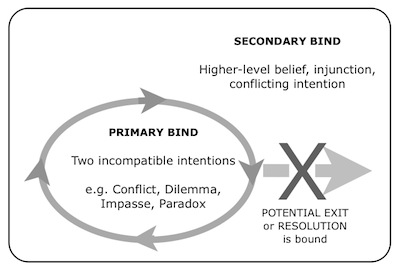
Looking backwards, we can find this same effort at work in Anti-Oedipus as well. As the title of the work implies, the target of attack here is Oedipus, understood as what Lacan would call the “symbolic order” – the rule of language and law, the ‘orderly conduct’ of civilizational affairs that becomes internalized within the subject and conflated with the state of nature. Elsewhere they remark that Oedipus is the operation of the double-bind, a theory of schizophrenia first identified by Gregory Bateson. As Deleuze and Guattari summarize:

Double bind is the term used by Gregory Bateson to describe the simultaneous transmission of two kinds of messages, one of which contradicts the other, for example the father who says to his son: go ahead, criticize me, but strongly hints that all effective criticism – at least a certain type of criticism – will be very unwelcome. Bateson sees in this phenomena a particularly schizophrenizing situation…[8]

what-are-double-binds

Deleuze and Guattari hold Bateson up as an example of deterritorialization, a flight of becoming from the enforced territories of being and thought. Indeed, Bateson not only finds a theory of schizophrenia in the double-bind, but also a remarkable congruence with the Zen koans given to the pupil by the master. If the double-bind in Western civilization leads to psychosis, in the East it leads to Enlightenment: “We feel that the schizophrenic finds himself continually in the same situation as the pupil but he achieves something like disorientation rather than enlightenment.”[9] Bateson would go to find a variety of overlaps between experiences of madness and schizophrenia with initiation rites in other societies; following in these footsteps, R.D. Laing would build a differing school of psychoanalysis that points away the confines of civilization, indicating the direction that schizoanalysis would eventually take.

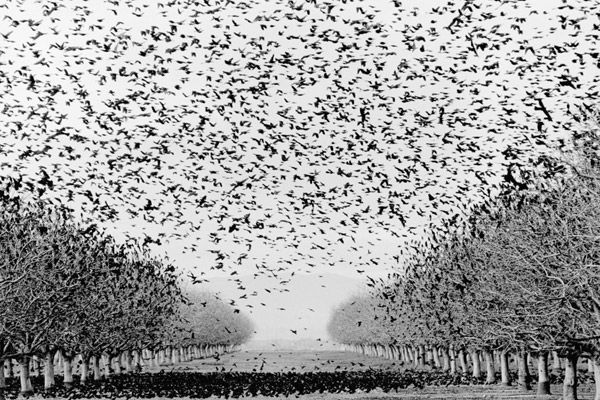
Through Deleuze and Guattari’s usage of Bateson we can discern in their text a reaction to a specific mode of machinic configuration or arrangement. The machine in question here is less a literal machine and more of a metaphor for systems: that of cybernetics, a sciences of feedback loops, first identified by Norbert Wiener but quickly applied throughout the military, industry, and governance. For Bateson, however, the realization that action derives from interacting agents in a system opened an ontological horizon that could only be described in cosmological terms: systems now could be understood as self-regulating, utilizing the dynamics of positive and negative feedback to reach homeostatic states, as well self-organizing, capable of shifting homeostatic states towards “new patterns” and complexity. An ecology, he reasons, acts as an aggregate of many subsystems bound up in interaction operating across a variety of scales. We shouldn’t think of this ecology strictly in terms of the environment, for the environment itself is one of these parts; it also includes culture, social bodies, and importantly for Bateson, the mind itself. The Cartesian foundation of Western thought, which posits the separation of the physical body from its essence – the mind or soul – becomes unglued in these systems. While the state sought to deploy systems thinking to reinforce its governmental apparatuses and capital looked to streamline its profit producing capabilities, Bateson was charting far-out territories where the boundaries between the human and the non-human dissolve, right down to the molecular level.

Bateson’s so-called “second-order cybernetics” foreshadowed a whole realm of scientific theorizing that would emerge across the 1970s and 80s, going by names such as chaos theory, complexity theory, and emergence. Returning to Deleuze and Guattari, we can draw a resemblance between his ecology of aggregates and the machinic ecologies of flows discussed in Anti-Oedipus: Oedipus, the symbolic order, is a force that blocks the flows, framing them in a way to produce the subject. As a double bind, it assumes the function of the homeostat and prevents or wards off attempts to organize to patterns different from this equilibrium. The openings towards complexity and emergence, however, provided schizoanalytic praxis will a new scientific vocabulary to draw upon, expressed most clearly in A Thousand Plateaus.

SWARM_138-139_low

This influence is found primarily in the chapters of the book focusing on the war machine, that is, minotorian or nomadic bands that can be defined by their degrees of separation from the state. This, incidentally, is also the point in which Deleuze and Guattari appear at their most anarchist. These two points convergence on the acknowledgement that absolute control is an impossibility; as long as there are states, there will be war machines that flee from it. The state here, that Oedipal function, seeks homeostasis but the war machine can disrupt equilibria, triggering processes of self-organization towards new states. “From turba to turbo: in other words, from bands or packs of atoms to the great vortical organizations. The model is a vortical one; it operates in an open space throughout which things-flows are distributed, rather than plotting out a closed space for linear and solid things.”[10]

To further draw out their point, Deleuze and Guattari plot out a dialectic of royal sciences and nomad sciences. We can see how the developments from cybernetics onward can easily reflect both paradigms: for the military looking to maximize its command and control over an environment, managing feedback between movements on the territory and weaponry became paramount. For the government, cybernetics allowed new means to articulate the organizations of power and the constituency, while in the market, feedback systems allowed rapid developments in everything from pricing stock market options and derivatives to the management of logistics for global production chains. These royal applications find their nomadic compliment in cybernetic’s application in all sorts of far-off territories: Stafford Beer’s holism and the Chilean CyberSyn experiment, “cybernetic guerrilla warfare”, R.D. Laing and Gregory Bateson… “What we have… are two formally different conceptions of science, and, ontologically, a single field of interaction in which royal science continually appropriates the contents of vague or nomad science while nomad science continually cuts the contents of royal science loose. At the limit, all that counts is the constantly shifting borderlands.”[11]

Cosmos against Civilization

I must confess a strong suspicion for political discourse that relies heavily on a rhetoric of self-organization. It appears, particularly in the wake of the developments in the economy from the 1990s onward,that such discourse closely to the spectacular logic of neoliberal capitalism itself, which in the technological evolution of integrated world capitalism strives to be an ontological horizon in its own right – a self-organizing system of human interaction that corresponds to the activities of nature. This trajectory can trace its origins back to the economic theories of F.A. Hayek (if not earlier) and his extensive borrowings from early systems thinking. In his methodological individualism, Hayek conflates the self-organizing principles with an atomist understanding of the individual, where agency emerges from not only as a radical force from within (as opposed agency emerging from relations within assemblages and aggregates), but from a Cartesian split between the human and non-human, civilization and nature.

Another problem from a differing perspective is that Guattari seems to take the possibilities inherent in information technology a little too strongly at their face value, seeing the inevitably of critical mutations of subjectivity riding the wave of their development. He guiding points in this techno-optimism were the experiences of Radio Alice in Italy, the usage of the French Minitel system by activist networks, and the growth of online community message boards spring up around groups and interests that appeared marginal against the greater cultural backdrop. Such things were evident, he argued, that minotorian groups could shape the future deployment of media technologies in a way free from statecraft, unleashing a thousand subaltern subjectivities.

This techno-optimism was, however, a cautious one, as he expressed only several times over the course of his later books: “The post-mediatic revolution to come will have to be guided to an unprecedented degree by those minority groups which are still the only ones to have realized the mortal risk for humanity of questions such as: the nuclear arms race; world famine; irreversible ecological degradation; mass-mediatic pollution of collective subjectivities.”[12] Part of this minotorian becoming, he insisted, could come from within movements of capitalism across the globe. In this regard Japan’s unique culture, a collision of the archaic and the hypermodern, was held up as an exemplar of mutant subjectivity that contrasted sharply the capitalist vision of the west. “Might Japanese capitalism,” he posed, “be a mutation resulting from the monstrous crossing of animist powers inherited from feudalism during the ‘Baku-han’ and the machinic powers of modernity to which it appears everything here must revert?”[13]

nyol53103020700.grid-6x2shinto

While there much to say on this idiosyncratic fascination with Japan, it is on this broader point of animism that I now wish to focus. Guattari’s late writings are peppered with references to the possibility of machinic subjectivities that have more in common with those of archaic societies than the contemporary postmodern malaise. He maintained a strong interest in the cosmological belief systems of the Australian Aborigines, which had developed at the time he was preparing the materials for Schizoanalytic Cartographies. To quote anthropologist Barbara Glowczewski at length,

The message that I brought back from Australia after my first field trips in 1979 and 1980 related to the ancestral connections with the land, which Aboriginal people experienced as a moving network: a real ontology in which humans, animals, plants, water and the whole of social life are thought of as the actualization of virtualities that are constantly in feedback with the space-time of Jukurrpa, the itineraries of ancestral travelers called Kangaroo, Plum or Digging-Stick Dreaming. These beings and the tracks of their voyages are effectively defined as being in becoming: sleeping in hundreds of places, springs, rocks, and interacting with humans in their own dreams and rituals, which aim to reinforce the links between all living things. Dreaming was practised as a means of regenerating life. My 1981 thesis Le rapport au temps et à l’espace des Aborigènes d’Australie (The Relation of Australian Aborigines to Time and Space) aimed to demonstrate that this dynamic process – mistakenly described by most anthropologists as ‘out of time’ – was intrinsic to the traditional vision of the world. I also demonstrated the active role of women – whose power had been denied (and continues to be denied) – in these societies. I utilized Guattari’s conception of the flux of desires to account for the mythic networks and to analyse numerous rituals: including the circulation among allies of hair strings as women’s non-alienable possessions, or a secret cult which, dreamed following the wrecking of a ship (Koombanah) deporting Aboriginal people in 1912, had journeyed among different languages groups as a symbolic form of economic transformation producing a double law, including that of the White men. Two years after I defended my thesis, I received a surprise phone call from Guattari, whom I hadn’t yet met. He invited me to his seminar to discuss my thesis, a copy of which he had received from his friend the video-maker François Pain and which he had just read in one sitting.[14]

Shortly thereafter Glowczewski arrived at the La Borde clinic to present her thesis before the patients, who, she recounted, had “a surprisingly intuitive understanding of the Aboriginal aims and workings of these social games and rituals.”[15] For the Aboriginals, all things radiate from the Dreamtime; all social structure, by extension, becomes articulated in terms of a singular family – extremely different from the nuclear family so savagely critiqued all the way back in Anti-Oedipus. This unique form of animism indicates as well that the binary division between the human and the nonhuman elements that compose the territory are largely inseparable, since they come from and will return to the same place.

SYDNEY OLYMPICS -- Sept. 15, 2000 -- Performers during the

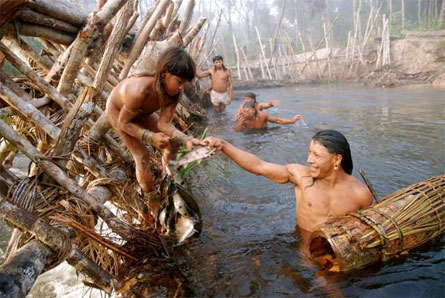
Glowczewski not only mentions that Guattari’s interest in the” Aborigines would foreshadow the politics of intertwining described in The Three Ecologies, but that his enthusiasm for the totemic paths and the use of dreams by the Warlpiri was stimulated, by, among other things, the fact that the kinship system – which extends to all the totems (Dreamings) and their associated places – seems to favour social strategies that prevent centralized structures of domination”[16] What Glowczewski is describing here is the influence of anthropologist Pierre Clastres, whose work on ‘primitive’ societies had greatly influenced Deleuze and Guattari. Focusing primarily on Amerindians and particularly those of Amazonia, Clastres illustrates that through kinship structures, the subpolitics of chieftanship, and war as social force the formal organization of the state is prevented at every point in which it could emerge. In his words these societies are, in fact, societies without states.

Using anthropological study to elucidate several key aspects in anarchist theory, Clastres argues that the state-form itself is indistinguishable, particularly where the Western state is involved, from ethnocidal practices of colonization: ethnocide, which is the elimination of the Other or difference to protection the interest of the same, “is clearly a part of the essence of the State…”[17] The state for Clastres is an extension of ethnocentric culture, formed with this culture becomes a property unto itself. It intrinsically forms itself against the Other, assembling itself higher on a hierarchical ladder and grants itself the enlightened goal of managing and correcting the Other’s perceived primitivism. In the case of Western civilization, the rapid expansion and deployment of both ethnocide and genocide under the colonialist banner is directly tied to the growth necessary for the reproduction of capitalist production, as so many Marxist theories of imperialism have waged. Clastres: “What differentiates the West is capitalism, as the impossibility of remaining within a frontier, as the passing beyond of all frontiers… Industrial society, the most formidable machines of production, is for that very reason the most terrifying machine of destruction. Races, societies, individuals; space, nature, forests, subsoils: everything is useful, everything must be used, everything must be productive, with productivity pushed to its maximum rate of intentsity.”[18]

In Anti-Oedipus (a book praised by Clastres), Deleuze and Guattari link this colonialist mentality to the relationship between capitalist production, the state, and Oedipus:

The colonizer… abolishes the chieftainship, or uses it to further his own ends (and he uses many other things besides: the chieftainship is only the beginning). The colonizer says: your father is your father and nothing else, or your maternal grandfather – don’t mistake them for chiefs; you can go have yourself triangulated in your corner, and place your house between those of your paternal and maternal kin; your family is your family and nothing else; sexual reproduction no longer passes through those points, although we rightly need your family to furnish a material that will be subjected to a new order of reproduction. Yes, then, an Oedipal framework is outlined for the dispossessed primitives: a shantytown Oedipus.[19]

Furthermore, they assert, the colonized continually resist Oedipus, fighting back at each turn, either in large, collective movements such as the anti-colonialist revolts of the 1960s, or the private moments of rebellion, as analyzed by Frantz Fanon in The Wretched of the Earth. Just as the schizo can retreat from the civilizing double-bind while the psychoanalyst attempts to ‘(re)colonize his or her mind, the resistance to the state on the part of the Others is “schizoanalysis in action.”[20]

5183aBPmKeL._SY344_BO1,204,203,200_ tumblr_mvpr7pwCjG1rbj6m8o1_1280 Free-all-political-prisoners1971

In A Thousand Plateaus, the two take up again the question of Clastres’ anthropology in their discussion of the war machine. This time, archaic societies ability to evade the state composes the actions of the war machines themselves, nomad movements that constantly overflow the limits but are also sought to be captured by the state. “War machines take shape against the apparatuses that appropriate the war machine and make war their affair and their object: the bring connections to bear against the great conjunction of the apparatuses of capture and domination.”[21] We can now grasp the unification of the archaic and the (post)modern machinic in Guattari’s later work – in A Thousand Plateaus we see two functions of the war machine. On one hand, it is their relationship to these anarchic functions of the anti-state social formations, constantly deterritorializing away from centralization. On the other hand, it is the relationship (which we must acknowledge is only partly a metaphor) between the war machine and nomad science – the sciences of self-organization and emergence, particularly in the contexts in which they break through the boundaries that the apparatuses of Western civilization seek to impose on them. In the era of media-information technologies, intricately bound to these sciences as they are, it is the minor groups that act of the war machine, becoming visible and communicable through the powers of the network. All too unfortunately, the apparatus of capture has appeared to be wildly successful.

The reader might ask, what then of animism? What is the relationship between animist subjectivity and the societies that reject the state, the war machine? Here the writings of Guattari, with or without Deleue, cease to be as instructive as they have to do this point. This is by no means the end of our constellation – the way forward is by looking now to the thinkers who probe these similar areas, pushing thought into new divergent directions by drawing in equal measures the ontological ecologies generated by the nomad sciences and the perspectives articulated by non-Western societies, who to this day exist in extreme danger of disappearance from both capitalism’s insatiable thirst for resources for growth and the ecological reactions to this megamachine.

It is Eduardo Vivieros de Castro, an expert on Amerindians, who insists that “animism is the ontology of societies without a state.”[22] does he mean by this? The state, he holds, can be defined by interiority. For capitalism, all things can be made to be interior to its complex assemblages, while the modern liberal stateform, which seeks to pluralistically manage differences, seeks to act as the universal mediator of social relations within its territories, while seeking to make its outside assimilate to its scripture – in other words, following the spatial expansion of capital, the state too wants to bring the outside into its interior. On the molecular, the self too is defined as interiority, interior to the body in accordance with the Cartesian rationalization that separates body and mind. This molecular rendering, in turn, is plugged into the state-capitalist machine: it is the source of the atomist thought, retained by Hayek, that transformed the subjectivity into a rational actor, primed for the permanent utopia of the market.

9kec7ow5tmyvj4ak1nzs80gzw

In animism, however, this interior exists nowhere – all things are outside, or more properly, in the relationship between things in the outside. In Amerindian belief bodies “are not thought as given but rather as made.”[23] The primordial stuff in which the body and its soul – of which there is zero division – is the stuff of the world itself, limited not only to the physicality of matter but also to the substance of the spiritual. Here too we find zero lines demarcating the division of matter from spirit, as all things are forever being made – the body, culture, nature, all are perfomative and unfolding in a process of worlding. Neither subject nor object, but entanglement and unfolding.

Phillipe Descola argues that this worldview emerges precisely because of these cultures emergence from spaces of complex ecosystems – “Might the apparent inability to objectivize nature of many Amazonian peoples be a consequence of the properties of their environment?”[24] What’s at stake in this observation is representationalism, which aims to separate all things, make them objects, quantifiable, and subject to control via discursive practices. The linguistic turn in critical theory, which took aim at the power of discursivity, managed only to muddy these waters by trapping discourse at the level of the signifier. This turn, however, connects the discursive to matter, making matter matter. Maurizio Lazzarrato: “we must move beyond both language and semiotics.”[25]

de Castro insists that “Not only would Amerindians put a wide birth between themselves and the Great Cartesian Divide which seperates humanity from animality, but their views anticipate the fundamental lessons of ecology which we are now only in a position to assimilate.”[26] Furthermore, their eco-cosmological perspective “reveals itself as the universal admixture of subject and objects, humans and non-humans against modern hubris, the primitive and postmodern ‘hybrids’, to borrow a term from Latour. Next to Latour we could make a list of thinkers that either anticipated or are fully engaged with this posthuman, perfomative turn: Deleuze and Guattari, Donna Haraway, Andrew Pickering, Karen Barad, Timothy Morton, so on and so forth – in short, a roster of the new ontologies that have informed and shaped much critical contemporary critical debate. The key becomes, however, not isolating this debate away into the halls of the academy, which will simply serve to ‘Oedipalize’ and regulate their function at the level of circulating signs. Instead, it becomes imperative not to simply think of these texts, and debate it. The purpose is think alongside action, to see where they meet the infrastructural systems forming in the era of late neoliberalism.

For de Castro, the translation of performativity into anthropology goes by the label “perspectivism”, which he describes as a “cosmology against the state”.[27] While perspectivism is a practice of knowing the subaltern or those operating on what appears to us to be an outside, it also performs a dual political role by bringing to us realizations of being and becoming utterly foreign to our perception. It provides, in its own way, a blueprint for living in a way that differs from capitalist realism. For this reason perspectivist anthropology, in de Castro’s own words, is a nomad science, as described in A Thousand Plateaus. And like schizoanalysis, the purpose is one of decolonization, of restarting the flows that have been blocked in the name of civilized progress.

For me, anthropology is in fact the theory—to sound a bit like Trotsky—the theory of a permanent decolonization. A permanent decolonization of thought. That is anthropology for me. It is not a question of decolonizing society, but of decolonizing thought. How to decolonize thought? And how to do it permanently? Because thinking is constantly recolonized and reterritorialized… What does it mean to live in a society without a state, against the state? We don’t have any idea. You have to live there to see how things happen in a world without a state. In a society that is not only lacking the state but, as Clastres thought, is against the state because it is constituted precisely on the absence of the state. Not because of the lack of a state, but upon the absence of the state, so that the state cannot come into existence. And animism has to do with that.[28]

[1] Felix Guattari The Three Ecologies Athlone Press, 2000, pg. 27

[2] Ibid

[3] Gilles Deleuze and Felix Guattari Anti-Oedipus: Capitalism and Schizophrenia Penguin Classics, 2009, pgs. 4-5

[4] Francois Dosse Gilles Deleuze and Felix Guattari: Intersecting Lives Columbia University Press, 2010, pg. 391

[5] See Brian Holmes “Guattari’s Schizoanalytic Cartographies (or, the Pathic Core at the Heart of Cybernetics)” Three Crises http://threecrises.org/guattaris-schizoanalytic-cartographies/; as well as my own “How Does Schizoanalysis Work? (or, “how do you make a class function like a work of art?”) Deterritorial Investigations Unit, https://deterritorialinvestigations.wordpress.com/2013/05/15/how-does-schizoanalysis-work-or-how-do-you-make-a-class-operate-like-a-work-of-art/

[6] Guattari The Three Ecologies pg. 47

[7] Gilles Deleuze and Felix Guattari A Thousand Plateaus: Capitalism and Schizophrenia University of Minnesota Press, 1989, pg. 6-7

[8] Deleuze and Guattari Anti-Oedipus pg. 76

[9] Gregory Bateson, Don D. Jackson, Jay Haley, and John Weakland “Toward a Theory of Schizophrenia” Behavioral Science, 1956, pg. 5 http://solutions-centre.org/pdf/TOWARD-A-THEORY-OF-SCHIZOPHRENIA-2.pdf

[10] A Thousand Plateaus pg. 361

[11] Ibid, pg. 367

[12] quoted in Gary Genosko “The Promise of Post-Media” in Clemens Apprich, Josephine Berry Slater, Anthony Iles and Oliver Lerone Schultz (eds.) Provocative Alloys: A Post-Media Anthology Mute, 2013, pg. 20

[13] quoted in “Japanese Singularity”, in Gary Genosko Felix Guattari: An Aberrant Introduction Continuum, 2002, pg. 142

[14] Barbara Glowczewski “Guattari and Anthropology: Existential Territories among Indigenous Australians” in Eric Alliez and Andrew Goffey (eds.) The Guattari Effect Bloomsbury, 2011, pg. 102

[15] Ibid, pg. 103

[16] Ibid, pg. 102

[17] Pierre Clastres “On Ethnocide” in Archeology of Violence Semiotext(e), 2010, pg. 111

[18] Ibid, pg. 112

[19] Deleuze and Guattari Anti-Oedipus pg. 169

[20] Ibid, pg. 167

[21] Deleuze and Guattari, A Thousand Plateaus

[22] Angela Melitopoulos and Maurizio Lazzarato “Assemblages: Felix Guattari and Machinic Animism” e-Flux July, 2012 http://www.e-flux.com/journal/assemblages-felix-guattari-and-machinic-animism/

[23] Eduardo Viveiros de Castro Cosmological Perspectivism in Amazonia and Elsewhere: Four lectures given in the Department of Social Anthropology, Cambridge University, February-March 1998 Hau-Net, 2012, pg. 123

[24] Phillipe Descola Beyond Nature and Culture University of Chicago Press, 2013, pg. 11

[25] Maurizio Lazzarato Signs and Machines: Capitalism and the Production of SubjectivitySemiotext(e), 2014, pg. 17

[26] Eduardo Viveiros de Castro “Cosmological Deixis and the Amerindian Perspectivism” The Journal of the Royal Anthropological Institute, Vol. 4, No. 3 (Sep., 1998), pg. 475

[27] Eduardo Viveiros de Castro “The Untimely, Again” introduction to Clastres Archeology of Violencepg. 48

[28] Melitopouos and Lazzarato “Assemblages”

Félix Guattari: Ecosophy and The Politics of Freedom

Avatar de S.C. HickmanThe Dark Forest: Literature, Philosophy, and Digital Arts

Guattari

Ecosophy: The Politics of Freedom

Gilles Deleuze would speak of his recently deceased friend and partner telling us that the work of Guattari remains to be discovered or rediscovered: “That is one of the best ways to keep Felix alive.”1 Maybe this is what we are doing in this reading group: discovering or rediscovering the work of Felix Guattari, and in this sense keeping his central insights alive within the matrix of possibilities we term speculative anarchism.

That The Three Ecologies was published in 1989 and seems as alive today in its critiques as the day it was penned is a testament to the truth of which his friend Deleuze speaks. That it deals with both his political and ethical vision is to be expected. Guattari was always the radical revolutionary seeking ways of emancipating others both in his medical practice and in the late cultural malaise of our capitalism…

Ver o post original 2.234 mais palavras

Hawaiian telescope fight prompts new rules for Mauna Kea (Nature)

Thirty Meter Telescope can proceed, but one-quarter of existing telescopes on mountain must be removed in the next decade.

Alexandra Witze

27 May 2015

Hawaii Governor David Ige says the Thirty Meter Telescope project can move forward.

The controversial Thirty Meter Telescope (TMT) should be built atop the sacred Hawaiian mountain of Mauna Kea as planned — but one-quarter of the 13 telescopes already there need to be taken down by the time the TMT starts operating in the mid-2020s, Hawaii’s governor David Ige said on 26 May.

Ige’s long-awaited statement aims to break the impasse between the TMT project, which halted construction in early April after protests broke out, and Native Hawaiians, who see the telescope — bigger than any on Mauna Kea so far — as the latest violation of an important cultural site.

The governor laid out sweeping changes to how Mauna Kea will be managed in the future. “We have in many ways failed the mountain,” he said. “We have not done right by a very special place.”

The shift could significantly affect astronomers who use the world-class facilities atop Mauna Kea, which include the twin 10-metre Keck telescopes as well as the 8-metre-class Gemini Northern and Subaru telescopes. The first astronomical observatories were built on Mauna Kea starting in the 1960s.

Perhaps most significantly, “the university must decommission as many telescopes as possible, with one to begin this year and at least 25% of all telescopes gone by the time the TMT is ready for operation,” Ige said. The first to go will be the Caltech Submillimeter Observatory, whose closure was announced in 2009; it will start to be dismantled later this year.

But none of the other 12 telescopes had immediate plans to shutter. The submillimetre-wavelength James Clerk Maxwell Telescope is just beginning a new life under the operation of the East Asian Observatory. The 3.8-metre United Kingdom Infrared Telescope was similarly transferred from the UK’s Science and Technology Facilities Council to the University of Hawaii in Manoa last year.

“This is all new to us,” says Peter Michaud, a spokesman for the Gemini Observatory based in Hilo, Hawaii. “Until we learn more about it, we’re not really able to say much of anything.”

A 2010 plan commissioned by the university lays out a framework for how various observatories could be taken down. The governor’s announcement is likely to accelerate those scenarios, says Günter Hasinger, director of the University of Hawaii’s Institute for Astronomy in Manoa. “In principle this is nothing new,” he says. “We have always made the point that the space on top of the mountain should only be populated by the best telescopes.”

A changing landscape

Ige’s changes all push toward reducing impact on the mountain’s 4,200-metre summit. The University of Hawaii leases more than 45 square kilometres as a science reserve. The current lease is good until the end of 2033, but Ige said that when that is up the university must return more than 40 square kilometres — all the land not needed for astronomy — to the state’s Department of Land and Natural Resources. The university must also agree that the TMT location, which is a few hundred metres below the actual summit, is the last area on the mountain where any telescopes will ever be built.

An artist’s conception of the Thirty Meter Telescope on Mauna Kea, with existing telescopes in the background.

Visitors to the mountain top will be limited, and be required to receive cultural training. A new cultural council will be created to provide input to the Office of Mauna Kea Management.

“It’s up to different organizations to decide their next step,” said Ige. “I intend to fully protect the right of TMT to proceed to construction, and respect and protect the right of protestors to peacefully protest.”

“We will work with the framework he has put forth,” said Henry Yang, chair of the TMT International Observatory board, in a statement. “We know we have a lot of work ahead of us. We appreciate that there are still people who are opposed to the project, and we will continue to respectfully listen and work with them to seek solutions.“

Ige said his office would work with the university to develop a timeline for the various actions. “To my point of view this is a very important step forward, and will hopefully solve the Gordian knot that we are in,” says Hasinger.

TMT construction ignited a firestorm of protest among Native Hawaiians and also by many astronomers who pushed to redress what they see as decades of scientists essentially colonizing a sacred space.

The $1.5-billion TMT project chose Mauna Kea over a mountain top in Chile, and had gone through a seven-year permissions process. Partners include the University of California, the California Institute of Technology, and the governments of China, Japan, India and Canada. Legal challenges are still wending their way through Hawaiian courts.

Two competing telescopes are both under construction in Chile.

Nature, doi:10.1038/nature.2015.17639

Related stories

Previsão do clima: terremotos intermitentes (Folha de S.Paulo)

Marcelo Leite, 03/05/2015  01h57

Depois de Katmandu, o terremoto no Nepal sacudiu também uma noção preconcebida comum entre jornalistas de ciência – esta coluna, por exemplo, foi abalada por um tuíte de Matthew Shirts, que levava para uma reportagem da revista “Newsweek”.

A leitura do texto, “Mais Terremotos Fatais Virão, Alertam Cientistas da Mudança do Clima”, trouxe à memória um momento constrangedor. Que o relato sirva para desencorajar nossa tendência a acreditar em verdades estabelecidas.

Certa vez um colega de redação perguntou se eu poderia escrever para explicar por que tsunamis estavam se tornando mais frequentes e qual era a relação disso com o aquecimento global. Segurei a vontade de rir e expliquei, condescendente, que processos climáticos não tinham o poder de desencadear eventos geológicos.

Não é bem assim. Há pesquisadores respeitáveis investigando a hipótese de que a mudança climática deflagrada pelo aquecimento global possa, sim, tornar terremotos e erupções vulcânicas mais frequentes.

Não seria nada inédito na história da Terra. Um exemplo recentíssimo na escala geológica (o planeta tem mais de 4 bilhões de anos) ocorreu entre 20 mil e 12 mil anos atrás, ao término do último período glacial.

A retração de geleiras continentais com quilômetros de espessura aliviou a pressão sobre a crosta terrestre o bastante para desencadear intensa atividade vulcânica. Há boas evidências disso em lugares como a Islândia.

O geólogo britânico Bill McGuire tem uma teoria ainda mais preocupante. Ele acha que a elevação dos mares em 100 m, causada pelo derretimento das calotas de gelo, teria deflagrado também terremotos e tsunamis (o que poderia repetir-se a partir de agora, com o aquecimento da atmosfera).

O imenso volume de água adicionado aos oceanos, ao pressionar suas bordas, teria desestabilizado as falhas geológicas próximas da costa, causando os tremores e colapsos submarinos que levantam ondas colossais. Mas a hipótese de McGuire, detalhada no livro “Acordando o Gigante”, ainda carece de medições e dados para ser aceita.

No caso do terremoto de Katmandu, o mecanismo pressuposto para pôr a culpa no clima é outro: chuva. Não uma pancada qualquer, mas as poderosas monções que castigam Índia e Nepal de junho a agosto.

Tamanho volume de água, que perde só para o movimentado na bacia Amazônica, seria capaz de alterar o balanço do estresse entre as placas Indo-Australiana e Asiática. O geólogo argelino Pierre Bettinelli, então no CalTech, mostrou que a atividade sísmica nos Himalaias é duas vezes mais intensa no inverno e atribuiu isso à gangorra de pressões entre os dois lados da falha tectônica.

Falta provar, claro. Mas que é instigante, isso é.

Quanto a terremotos causados pelo aquecimento global, ninguém precisa sair comprando kits de sobrevivência. O degelo da última glaciação demorou milhares de anos, e as piores previsões para a subida no nível dos oceanos indicam não muito mais que 1 m ou 2 m até o final deste século.

Ninguém está a salvo de tsunamis, porém. Há alguma chance – uma vez a cada 10 mil anos, talvez – de que o litoral brasileiro seja atingido por um deles, como pode ter ocorrido com São Vicente em 1541, após cataclisma nalgum ponto do Atlântico.

Clima marombado (Folha de S.Paulo)

Marcelo Leite, 31/05/2015  01h45

Como o jornal anda cheio de notícias boas, esta coluna retoma sua predileção desmesurada pelas más novas impopulares e anuncia: 2015 caminha para ser dos infernos também na esfera do clima.

É provável, por exemplo, que este ano bata o recorde de temperatura global. A marca estava antes, veja só, com 2014. Os dez anos mais escaldantes ocorreram todos depois de 1998.

Um dos que acreditam no novo recorde é o alemão Stefan Rahmstorf. O climatologista do Instituto Potsdam de Pesquisa sobre Impacto do Clima, que ficou famoso em 2007 por criticar as previsões do IPCC como muito conservadoras, lançou sua predição para 20 jornalistas de 17 países reunidos em Berlim há 20 dias.

O período janeiro-abril de 2015 brindou o planeta com o primeiro quadrimestre mais quente já registrado desde 1880. O período de 12 meses compreendido entre maio de 2014 e abril de 2015 também foi o pior em matéria de calor.

Isso tudo já acontecia enquanto o fenômeno El Niño ainda era considerado fraco. Esse aquecimento anormal das águas do Pacífico na costa oeste sul-americana, que costuma abrasar o clima mundial, ganhou impulso neste mês de maio e deve permanecer até o segundo semestre.

Notícia péssima para o Nordeste brasileiro. O semiárido tem bolsões que enfrentam o quarto ano seguido de seca. Entre os efeitos mais conhecidos de um El Niño está exatamente a diminuição das chuvas nessa região do Brasil (assim como o aumento da precipitação no Sul).

Pior é a situação na Índia. Até sexta-feira (29), uma onda de calor –a pior em duas décadas, com temperaturas de 47 graus Celsius– havia causado mais de 2.000 mortes. E o El Niño pode atrasar e enfraquecer as monções, chuvas torrenciais que começam em junho e poderiam refrescar o segundo país mais populoso do mundo.

Enquanto indianos torram, amazonenses estão debaixo d’água. A cheia do rio Negro, também ela perto de bater recordes, já atrapalhou a vida de 238 mil pessoas em 33 municípios do Estado do Amazonas.

O governo estadual se limita a medidas de remediação. Mais de 450 toneladas de alimentos não perecíveis foram distribuídas, assim como “kits dormitório” (colchões, redes e mosquiteiros) e “kits de higiene pessoal” para milhares de desabrigados.

Também foram destinados às cidades atingidas 68 metros cúbicos de madeira e 750 kits de tábuas, caibros e ripões para os moradores construírem passarelas elevadas conhecidas como “marombas”.

Essa enchente provavelmente nada tem a ver com o El Niño, e também seria difícil demonstrar um nexo causal entre a onda de calor indiana e a anomalia no Pacífico. Os dois eventos constituem bons exemplos, contudo, das situações extremas que a mudança do clima em curso deverá tornar mais frequentes nas próximas décadas.

Pelo andar da carruagem das negociações internacionais, parece cada vez mais difícil, se não impossível, que se consiga evitar um aquecimento global maior que 2 graus Celsius neste século. Esse é o limite de segurança indicado pelo IPCC.

A mudança do clima está contratada. Não resta muito mais que adaptar-se –e preparar a infraestrutura das cidades para ela exigirá muito mais do que marombas improvisadas.

Sabesp faz investimento milionário em questionada técnica para fazer chover (UOL)

Thamires Andrade*

Do UOL, em São Paulo

28/05/201512h09

Até o fim deste ano, a Sabesp terá repassado R$ 12,5 milhões sem ter feito uma licitação

Até o fim deste ano, a Sabesp terá repassado R$ 12,5 milhões sem ter feito uma licitação (Lucas Lacaz Ruiz/Estadão Conteúdo)

Enquanto alega necessidade de “garantir o equilíbrio econômico-financeiro” para justificar a alta na conta de água, a Sabesp (Companhia de Saneamento Básico do Estado de São Paulo) mantém um negócio de mais de R$ 8 milhões com a ModClima, uma empresa que oferece uma técnica de indução de chuvas artificiais. Especialistas ouvidos pelo UOL dizem, porém, que o método não é eficaz.

De acordo com documentos da Sabesp obtidos via Lei de Acesso à Informação, a companhia já fechou quatro contratos com a empresa. Nos dois mais recentes, assinados no ano passado, a Sabesp já pagou R$ 2,4 milhões de um total de R$ 8,1 milhões previstos para fazer chover nos sistemas Cantareira e Alto Tietê, os mais afetados pela crise da água na região metropolitana de São Paulo.

Nos dois anteriores, com vigência 2007/2008 e 2009/2013, respectivamente, foram repassados R$ 4,3 milhões — já somados os reajustes. Desde 2007, portanto, a ModClima recebeu quase R$ 7 milhões da Sabesp.

Até o fim deste ano, a Sabesp terá repassado R$ 12,5 milhões sem ter feito nenhum tipo de contrato de licitação. A empresa alega que não era necessário abrir esse processo, pois a ModClima possui “patente de tecnologia utilizada”. Ou seja, ela seria a única empresa detentora desse tipo de tecnologia e, consequentemente, a única capaz de prestar o serviço.

Para o professor livre-docente do IAG-USP (Instituto de Astronomia, Geofísica e Ciências Atmosféricas da Universidade de São Paulo) Augusto Jose Pereira Filho, a Sabesp contratou a empresa para não ser acusada de não fazer nada diante da crise de abastecimento de água.

“Foi dinheiro jogado fora. Era melhor utilizar essa verba para outros objetivos, como campanhas de conscientização e redução de perda de água, do que usar em técnicas que ainda não têm comprovação científica”, afirma.

A técnica

A tecnologia, utilizada pela ModClima, é chamada de semeadura e é realizada com um avião que lança gotículas de água dentro da nuvem para acelerar sua precipitação.

As gotas ganham volume e, quando estão pesadas o suficiente, a chuva localizada acontece. Segundo a empresa, chove de 5 a 40 milímetros. O tempo de semeadura dura entre 20 e 40 minutos.

“A semeadura consiste em imitar o processo de crescimento dos hidrometeoros [meteoros aquosos] que, quando atingem o tamanho correto dentro da nuvem, provocam a precipitação. Um avião lança dentro da nuvem gotículas de gelo, cristais ou outra partícula – de acordo com o tipo desta nuvem [quente ou fria] – para acelerar o início da chuva, mas para isso é necessário estar no lugar certo e na hora certa”, explica o professor Carlos Augusto Morales Rodriguez, do Departamento de Ciências Atmosféricas do IAG-USP.

A nuvem deve ter uma densidade adequada para que ocorra a precipitação, mas, segundo Rodriguez, a meteorologia tem dificuldades para identificar as nuvens em condições para a efetivação do processo.

“O radar meteorológico usado pela empresa contratada pela Sabesp não é capaz de identificar a nuvem que está em processo de precipitação, mas, sim, as nuvens que já estão chovendo. Portanto a técnica da empresa é ineficaz, já que, quando o avião entra na nuvem, ela já está chovendo”, explica Rodriguez.

Rodriguez afirma ainda que a empresa fez a semeadura no sistema Cantareira como se o local tivesse nuvens do tipo quente. “O Estado de São Paulo é composto por nuvens frias e, para acelerar a precipitação, era necessário uma técnica adequada para esta região, como o uso de iodeto de prata e gelo seco”, explica.

Tanto Rodriguez quanto Pereira Filho fizeram avaliações independentes do trabalho da empresa e concluíram que a técnica não tinha a eficácia desejada.

“Em uma avaliação de 2003/2004 constatamos que a técnica não funcionou, mas mesmo assim a Sabesp contratou a empresa novamente”, diz Filho. “Fui convidado pelo diretor da Sabesp para conversar com os representantes da ModClima e, durante a reunião, os relatos eram descabidos do ponto de vista científico.”

Ele também questiona os resultados da técnica no ano passado. De acordo com o documento da Sabesp obtido via Lei de Acesso à Informação, só no ano passado a técnica induziu precipitação de 25 hm³ (hectômetro cúbico, o equivalente a 25 bilhões de litros) no sistema Cantareira e 6 hm³ no sistema Alto Tietê (equivalente a 6 bilhões de litros).

“Relatos da Sabesp diziam que houve aumento de 30% de chuvas nos sistemas por causa da técnica, mas a porcentagem e os resultados são duvidosos, pois não é fácil medir de que maneira a semeadura contribuiu de fato para aumentar a precipitação local”, argumenta Filho.

Procurada, a empresa ModClima informou que sua comunicação atual está concentrada na Sabesp e que não responderia as perguntas da reportagem.

A Sabesp não indicou nenhum representante para explicar a contratação dos serviços para provocar chuvas artificiais nem respondeu questões complementares enviadas pelo UOL. *Com colaboração de Wellington Ramalhoso

Rejeitado pela Presidência, estudo sobre adaptação será entregue ao Meio Ambiente (Observatório do Clima)

Conclusões serão “subsídio importante” a plano nacional, diz secretário, mas não deverão ser incorporadas diretamente a ele

29/05/2015

CLAUDIO ANGELO (OC)

O maior estudo sobre adaptação à mudança climática já feito no Brasil tem uma perspectiva de final feliz. O Brasil 2040, criado na Secretaria de Assuntos Estratégicos da Presidência da República e por ela rejeitado, deverá ser entregue ao Ministério do Meio Ambiente nas próximas semanas.

O plano foi concebido na SAE pela equipe do economista Sérgio Margulis, então subsecretário de Desenvolvimento Sustentável da pasta. Após a mudança de ministro, o clima deixou a lista de prioridades estratégicas da pasta. Margulis e seu time foram demitidos em março, como revelou o Observatório do Clima. Havia temor de que o estudo fosse ser descontinuado ou de que seus resultados fossem ser classificados (colocados sob sigilo).

Nesta quinta-feira (28/05), o secretário nacional de Mudanças Climáticas do Ministério do Meio Ambiente, Carlos Klink, afirmou ao OC que o estudo será entregue pela SAE ao GEX (Grupo Executivo sobre Mudança do Clima), coordenado pelo Ministério do Meio Ambiente. “O secretário da SAE nos procurou para dizer que o estudo está prestes a ser concluído e haveria uma devolutiva”, disse Klink. “Vai passar para o GEX.”

Segundo o secretário, a ideia é que todos os ministérios possam ser informados do estudo e que usem seus resultados – por exemplo, para orientar o planejamento. Ainda de acordo com Klink, “há uma convergência muito forte” entre o Brasil 2040 e o Plano Nacional de Adaptação à Mudança Climática, o PNA, coordenado pelo Ministério do Meio Ambiente e também em fase de conclusão. Ambos deverão ser apresentados na próxima reunião do GEX, em junho ou julho.

Trata-se, no entanto, de dois animais diferentes. O Brasil 2040 focou em vulnerabilidades específicas do país e buscou traçar cenários para consumo imediato, por assim dizer, em políticas públicas. Dez grupos de pesquisa espalhados pelo país cruzaram modelos climáticos do IPCC (o painel do clima da ONU) regionalizados pelo Inpe (Instituto Nacional de Pesquisas Espaciais) com informações sobre infraestrutura, recursos hídricos, agricultura, energia e zonas costeiras, por exemplo. E procuraram saber como cada setor poderia ser afetado pela mudança do clima já no médio prazo, em 25 anos.

Entre as conclusões já conhecidas do estudo está que a temperatura no país poderá subir até 6oC na maior parte do Brasil no fim o século; de que grandes hidrelétricas, como Belo Monte e São Luiz do Tapajós, poderão ter reduções de vazão de pelo menos 30% até 2040, o que compromete sua viabilidade econômica; e de que a área cultivável de soja poderá diminuir no país até 39% no mesmo período.

Já o Plano Nacional de Adaptação faz uma mistura entre contexto, ações já existentes e diretrizes muito gerais para a formulação de políticas de adaptação no país. A ministra Izabella Teixeira disse em abril que “é claro” que o plano terá metas numéricas objetivas, o que foi confirmado por Klink. “Será uma mistura das duas coisas”, afirmou.

O Brasil 2040, porém, não deverá ser incorporado diretamente ao plano nacional. E não está claro se suas conclusões serão inseridas no capítulo de adaptação do compromisso do Brasil para o acordo de Paris – que só deverá ser entregue depois de agosto. Para Klink, mesmo assim o estudo será um subsídio importante. “Vários autores do ‘2040’ participam também do PNA, e devem trazer contribuições de um para o outro.”

“Esperamos que o Ministério do Meio Ambiente, de posse dos estudos do Brasil 2040, entregue-os à sociedade, que precisa saber como as mudanças climáticas afetarão o país”, disse Carlos Rittl, secretário-executivo do Observatório do Clima. “Cobraremos a secretaria no final do prazo para que o estudo seja de fato entregue e amplamente divulgado.”

– See more at: http://www.observatoriodoclima.eco.br/rejeitado-pela-presidencia-estudo-sobre-adaptacao-sera-entregue-ao-meio-ambiente#sthash.G4em00BO.4XYoaLXk.dpuf

*   *   *

Presidência demite líderes de estudo sobre clima, a nove meses da COP de Paris (Observatório do Clima)

Demissões na Secretaria de Assuntos Estratégicos sinalizam diminuição da importância da questão climática dentro do órgão ligado à Presidência da República

13/03/2015

Claudio Angelo (OC)

O ministro da Secretaria de Assuntos Estratégicos da Presidência da República, Mangabeira Unger, demitiu nesta semana os membros do quadro técnico da Secretaria de Desenvolvimento Sustentável da pasta. O secretário, Sérgio Margulis, de férias, deverá ser substituído nos próximos dias. A diretora de Programa Natalie Unterstell foi exonerada nesta sexta-feira.

null null
Sérgio Margulis e Natalie Unterstell, que trabalhavam na Secretaria de Assuntos Estratégicos da Presidência da República (Fotos: SAE/PR)

Margulis e Unterstell coordenavam o maior estudo já feito no país sobre adaptação às mudanças climáticas. Batizado “Brasil 2040”, o trabalho tem o objetivo de embasar políticas públicas de adaptação nos setores de energia, infraestrutura, agricultura e recursos hídricos. Quase uma dezena de grupos de pesquisa do país trabalha nele neste momento. A análise deveria ficar pronta em abril, e trazia más notícias sobre os impactos da mudança do clima na expansão do parque hidrelétrico brasileiro.

A troca no comando da secretaria sinaliza uma queda de importância da mudança climática no governo federal, justamente num momento em que essa agenda sobe na escala de prioridades de lideranças políticas no mundo todo. Em dezembro, um novo acordo global contra emissões deverá ser assinado numa conferência das Nações Unidas em Paris, a COP-21. Líderes de EUA, Europa, Índia e China têm dado declarações e feito acordos bilaterais para ampliar a possibilidade de sucesso em Paris. No Reino Unido, os líderes do governo e da oposição se juntaram para prometer esforços ampliados contra as mudanças do clima. Um grupo de megaempresários pediu em fevereiro que o planeta zere as emissões de CO2 em 2050, e o Banco da Inglaterra alertou na semana passada contra o risco de investir em combustíveis fósseis. Até o papa Francisco deve lançar nos próximos meses uma encíclica sobre a mudança climática.

Ao longo deste ano, todos os países devem submeter à ONU seus planos de enfrentamento das mudanças do clima, que incluem metas de redução de emissões e medidas de adaptação.

O estudo conduzido por Margulis traria subsídios ao Plano Nacional de Adaptação à Mudança do Clima, que está sendo produzido pelo MMA (Ministério do Meio Ambiente) e deve entrar em consulta pública no meio do ano, segundo informou ao Observatório do Clima o secretário nacional de Mudança Climática e Qualidade Ambiental do MMA, Carlos Klink.

Segundo apurou o OC, o novo ministro, que chefiou a SAE quando ela foi criada, no governo Lula, está promovendo um rearranjo das prioridades da pasta. Educação e desenvolvimento regional passam a ser os carros-chefes da secretaria, em linha com o slogan definido por Dilma Rousseff para ser segundo mandato, “Pátria Educadora”. O ex-ministro Marcelo Néri havia priorizado temas ambientais – Margulis era um dos três únicos secretários do ministério.

O economista carioca, de 58 anos, serviu por 22 na sede do Banco Mundial, em Washington. Em 2003, publicou um estudo seminal sobre o desmatamento na Amazônia, apontando a expansão da pecuária como principal causa da devastação. Seus dados ajudaram a orientar políticas públicas implantadas a partir de 2007 de restrição ao crédito para a pecuária e de apreensão de “bois piratas” que tiveram sucesso em reduzir a taxa de devastação na floresta. Em 2010, coordenou um outro estudo sobre a economia da mudança do clima, mostrando pela primeira vez que a economia brasileira cresceria mais num cenário de desenvolvimento mais limpo, com redução de emissões de carbono.

* Nota atualizada às 11h53, de 13/03/2015, para corrigir informação de que o secretário Sérgio Margulis já teria sido exonerado. Até esta sexta-feira, a portaria de exoneração ainda não havia sido publicada.

Presidente de CPI defende que prefeitura de SP aplique multas à Sabesp (Estadão)

Em São Paulo

13/05/201515h19

11.mai.2015 - Carroceria de veículo fica visível na margem da represa Jaguari-Jacareí, no interior de São Paulo, devido ao baixo nível das águas

11.mai.2015 – Carroceria de veículo fica visível na margem da represa Jaguari-Jacareí, no interior de São Paulo, devido ao baixo nível das águas. Pablo Schettini/Futura Press/Futura Press/Estadão Conteúdo

O presidente da Comissão Parlamentar de Inquérito (CPI) da Sabesp na Câmara Municipal de São Paulo, vereador Laércio Benko (PHS), afirmou nesta quarta (13) que a comissão defenderá uma posição mais efetiva da prefeitura de São Paulo em relação à aplicação de multas contra a Sabesp. A companhia de saneamento comandada pelo governo paulista cortou o fornecimento sem aviso prévio, enfrenta dificuldades na atividade de recapeamento de ruas após obras realizadas e ainda despeja esgoto em mananciais, segundo ele.

“Temos que fazer com que Sabesp devolva à Prefeitura, através de multas, aquilo que ela não praticou. Temos que propor penalidades ao prefeito, e também cobrar dele que a prefeitura realize a regularização dos nossos mananciais onde há ocupação indevida”, afirmou Benko, após o encerramento da sessão de hoje da CPI da Sabesp.

O relatório que está sendo elaborado pelo vereador Nelo Rodolfo (PMDB) também cita outra medida importante que deve ser levada à avaliação dos vereadores que compõem a CPI. Ele defende a criação de uma agência reguladora municipal, nos mesmos moldes da Agência Reguladora de Saneamento e Energia do Estado de São Paulo (Arsesp), esta estadual. “Mas ainda quero pensar mais sobre essa questão, para não estarmos apenas criando mais uma autarquia”, disse.

Benko reforçou, após a sessão da CPI, a contrariedade em relação ao fato de a Sabesp ser uma empresa listada em Bolsa. Durante a sessão, que contou com a presença do presidente da Sabesp, Jerson Kelman, o vereador criticou a distribuição de dividendos em um momento no qual a companhia precisa fazer investimentos para garantir o abastecimento de água.

Kelman rebateu a afirmação alegando que a Sabesp, por ser uma empresa aberta, deve respeitar a legislação e distribuir o equivalente a 25% do lucro líquido anual, o que foi proposto para 2015. Benko classificou com um “tapa na cara do cidadão paulistano” a distribuição de dividendos em um momento como o atual.

O vereador chegou a propor que a Sabesp fizesse provisões para recursos a serem destinados a obras, mas a possibilidade foi descartada pelo presidente da companhia de saneamento. “A provisão é um detalhe contábil. Para garantirmos investimentos em nosso planejamento plurianual, é preciso que tenhamos lucro para poder investir”, disse Kelman após a sessão.

O relatório do vereador Rodolfo também deve levantar a possibilidade de o contrato entre Sabesp e a prefeitura de São Paulo ser reavaliado. Nesse caso, pondera Benko, a grande dúvida estaria em quem assumiria o trabalho de saneamento feito pela Sabesp. O presidente da CPI afirmou que ainda não há convergência em relação ao pré-relatório elaborado pelo colega do PMDB. As atividades da CPI serão encerradas no próximo dia 29 de maio e o relator tem um prazo de até 15 dias, após essa data, para a conclusão do documento.

Responsabilidade

Questionado sobre a não convocação do governador de São Paulo, Geraldo Alckmin, à CPI da Sabesp, Benko ressaltou que a comissão convocou aqueles que eram considerados os principais envolvidos no processo: Kelman e a ex-presidente da Sabesp, Dilma Pena. “Acredito que o governador estava muito mal assessorado pela antiga presidência da Sabesp, e que agora chegou uma pessoa que abriu os olhos de todos”, disse Benko, que disputou a eleição a governador de São Paulo em 2014 contra o governador reeleito Alckmin. O governo de São Paulo é controlador da Sabesp e, como tal, indica o maior número de membros do conselho de administração da companhia de saneamento.

“Após o início do trabalho da CPI, em que nós desmascaramos a Dilma Pena, mostramos que ela estava administrando a Sabesp de uma forma péssima e foi trocada a presidência da Sabesp, as coisas começaram a funcionar”, disse. “Mas não estou dizendo que o governador não tenha responsabilidade, nem que ele tenha”, complementou. Benko disse que os vereadores podem entrar com ação popular, medida que pode ser feita por qualquer cidadão, e criticou a ausência do procurador geral do Estado às sessões da CPI.

Em relação à situação de abastecimento da cidade neste momento, o presidente da CPI destacou que não há um rodízio, mas sim a redução da pressão, o que afeta o abastecimento principalmente na região Norte do município, atendida pelo sistema Cantareira. “Precisamos torcer para a chuva. Rodízio eu acredito que não vai haver, mas a falta de água vai se agravar”, previu Benko.

Torneiras secam em São Paulo. Nível baixo do reservatório Atibainha, do sistema Cantareira, é percebido pela marca de água na ponte; desmatamento do Rio Amazonas, a centenas de quilômetros de São Paulo, pode estar contribuindo para a seca. Ao se cortar a floresta, sua capacidade de liberar umidade no ar é reduzida, diminuindo as chuvas no Sudeste Mauricio Lima/The New York Times

Os saberes indígenas, muito além do romantismo (Outras Palavras)

POR  RICARDO CAVALCANTI-SCHIEL

150513-Reciprocidade

Não se trata de opor um fantasioso “espiritualismo” a um materialismo ocidental. Mas de desafiar nosso regime de sociabilidade com outras ideias, disposições e possibilidades

Por Ricardo Cavalcanti-Schiel

Houve um tempo em que falar de índios no Brasil era um exercício romântico. Tão romântico quanto fantasioso.

No começo do século XX, alguns doutos paulistas saíram pelo seu estado batizando os lugares com nomes tupi, do Anhangabaú a Araçatuba, movidos por ímpetos eruditos, não necessariamente por remissões mais escrupulosas à realidade. Quando a região de Guaianases, na cidade de São Paulo, foi batizada com esse nome, havia centenas de anos que os Guainá, que ali teriam sido aldeados à força no século XVI, já não mais existiam para contar qualquer coisa a respeito da sua história. Os índios daqueles eruditos paulistas, cultores do “tupi antigo”, eram algo bastante postiço. Realizando com perversa ironia os ideais antropofágicos dos mesmos tupi, que séculos antes iam à guerra, entre outras coisas, para caçar, para seus futuros filhos, os nomes daqueles que comeriam, acabaram eles agora transformados em não mais que nomes, desta feita como que nomes em conserva, para serem usados nessa curiosa salada toponímica.

Enquanto isso, no oeste paulista, a partir de Bauru, travava-se uma guerra pela expansão da fronteira agrária, empurrada pela ferrovia. Era um legítimo cenário de bang-bang, e as principais vítimas do extermínio, operado por “bugreiros” e outros agentes, eram os Kaingang e os Xavante, genericamente chamados de Coroados, gente da família linguística jê (muito diferente da família tupi, portanto); extermínio que a história oficial paulista fez questão de sepultar sob a tampa de concreto do silêncio, escrevendo, em seu lugar, o relato fantasioso de uma simples saga de imigrantes. Assim, Araçatuba, por exemplo, terra kaingang, hoje capital do boi gordo, no extremo-oeste paulista, pôde, também ela, ganhar seu bucólico nome tupi: bosque de araçás.

Note-se: não estamos nos confins selváticos e geograficamente obscuros de uma imensa Amazônia; uma Amazônia quase que alheia e que nem parece ter fim (e que daí, pela “lei” da oferta e da procura, se presuma como tão… barata). Estamos no hoje pujante e urbanizado oeste paulista, há não mais que cem anos atrás, apenas vinte anos antes de São Paulo embarcar em uma aventura militar contra um incipiente governo nacional antioligárquico.

De romantismo em romantismo, chegamos aos anos 80, em que os índios, eternos candidatos a nobres selvagens, passam a ser agora heróis ecológicos. Esses, pelo menos, ainda estavam vivos. É bem verdade que a relação dos índios com aquilo que chamamos “natureza” é muito diferente da que a nossa sociedade tem, a começar pelo fato de que, como nos ensina a antropologia amazonista hoje, eles não a reconhecem como “natureza” ― como objeto exterior e à parte, feito para ser usado, apropriado e apenas eventualmente “preservado” como coisa patrimonializada ―, mas como “gente”, como uma multiplicidade de sujeitos imprescindíveis de uma relação sem a qual o mundo habitado não é compreensível nem poderia existir. No entanto, transformar os índios em heróis da “nossa” natureza, incorporados como parte daquele objeto à parte, e igualmente alheio a nós, pode não ser mais que uma dessas nossas projeções, tão românticas quanto utilitárias, de ver Peri beijar Ceci… e morrer em seguida. Parará tim bum bum bum.

Se o novo romantismo ecológico ao menos chamou os índios para a agenda enquanto eles ainda estão vivos, sua tônica acanhadamente preservacionista os fez equivaler, mais uma vez, ao passado; a um passado de aparente pureza florística e faunística que precisaria ser sempre revivido ― ou “resgatado”, como gosta de usar a terminologia patrimonializadora em voga ― de forma idealmente imutável. Mais uma vez, os índios parecem entrar na (nossa) dança sob a clave do embalsamamento, mesmo que, agora, sob a agenda de uma patrimonialização talvez tão fetichista quanto a toponímia mítica dos velhos eruditos paulistas.

No entanto, nos últimos tempos, os últimos lastros românticos que ainda pareciam nos avalizar a existência dos índios parecem estar ruindo, o que não nos augura necessariamente algo virtuoso, porque ficamos mal-acostumados a depender dos romantismos para assegurar uma (traiçoeira e manhosa) legitimidade simbólica desses Outros Nacionais (como os chamou a antropóloga Alcida Ramos) e, por consequência, garantir as bases institucionais da sua existência enquanto povos acolhidos e protegidos ― não falemos sequer ainda de “respeitados”, porque o respeito à diferença não é algo que se aprenda por meio de projeções românticas.

Não é preciso lembrar, para as pessoas razoavelmente informadas, o estado de coisas em que andam as políticas de governo… e os horizontes obscuros das políticas de Estado… com relação aos povos indígenas. Também já é quase ocioso lembrar o quanto um e outro (políticas de governo e projetos de política de Estado) têm se estimulado mutuamente, para promover o etnocídio indígena por meio do solapamento dos direitos. Seja para quem for, qualquer solapamento de direitos é sempre um sequestro da cidadania. Daria até para lembrar, parafrasticamente, aquele poema de Brecht: “primeiro levaram os índios…”.

O que alenta e justifica essa marcha implacável nós também já sabemos o que é: a velha ideologia desenvolvimentista repaginada pelo avatar inquestionável do consumo como critério, seja de teórica “inclusão” seja de teórico “bem-estar”. Assim, no coração dessa nova ideologia desenvolvimentista encontra-se uma operação utilitarista singela: trocar a cidadania pelo consumo. E, nela, o único lugar para os índios ― uma vez corroídas, por esse realismo neoclássico rasteiro, as amarras românticas que os sustentavam ― é o de se tornarem, eles também, modestíssimos consumidores, apoiados por programas assistenciais do governo, depois de entregarem seus “meios de produção” a quem realmente interessa, como aqueles que, vencidos, entregaram outrora o que são hoje terras de boi gordo.

Claro que os que já se renderam inteiramente à coisificação utilitarista do consumo (e provavelmente se esqueceram até de ser gente) vão dizer: melhor boi gordo do que índio ― e no estado em que chegamos, isso é exatamente o que muitos pensam, sem que tenham a necessidade de pronunciá-lo. No entanto, a troca utilitarista, na sua racionalidade de meios e no seu afã predatório, quer apenas ganhar hoje, para a aventura de uns quantos, o que o bem comum poderia, de outra forma, ganhar multiplicado amanhã, se sobreviver até lá. E é aí que a equação que move as curvas de utilidade se alarga para variáveis e horizontes impensados pelos mecano-economistas.

No atual estado de coisas, entretanto, parece haver apenas duas alternativas para salvar a (potencialmente subversiva) diversidade existencial dos Outros Nacionais da sanha desenvolvimentista de moê-la e transformá-la em salsicha: ou reciclamos as projeções românticas em algum novo (e duvidoso) feitiço encantatório das nossas narrativas nacionais, ou tiramos os índios do alheamento passadista a que sempre foram condenados e os reconhecemos como uma aposta sincera no futuro; num futuro não apenas deles, como também não apenas nosso, mas num futuro de diálogo, para além do alheamento, no qual eles também são, necessariamente, sujeitos de fala ― não “eles” a pessoa x ou y, ou a “representação” w ou z, mas, ainda mais radicalmente, as suas visões de mundo. A primeira alternativa, a da reciclagem das projeções românticas, sempre foi aquela imediatamente sedutora, e, com ela, chega-se até mesmo a lançar mão de alegados exotéricos. A segunda, por sua vez, é a que reclama uma reflexão antiutilitária, mas estratégica, que talvez seja exatamente aquilo pelo qual muitos de nós, antropólogos, trabalhamos.

Em 1952, num texto escrito para a Unesco, Lévi-Strauss defendia que as sociedades só sobrevivem porque aprendem umas com as outras. Uma sociedade que se isola na certeza das suas verdades fenece diante dos problemas para os quais sua visão de mundo não alcança soluções. As “soluções” de grande alcance, portanto, não são meramente tecnológicas, mas conceituais. São as ideias que dimensionam a técnica e que dão uso às ferramentas, ou, segundo a fórmula famosa do epistemólogo Georges Canguilhem: o microscópio não é a extensão da vista, mas a extensão da inteligência. Sem o conceito de micro-organismo, o que se veria pelas lentes de um microscópio seria apenas um conto de fadas.

Evidentemente que as tecnologias ajudam, mas o que está sempre por detrás delas são as ideias. De pouco adiantaria, para a expansão europeia dos séculos XV e XVI, o astrolábio que os europeus aprenderam dos árabes, se alguns deles não dispusessem do novo e herético conceito de uma Terra redonda. Descobrir a América, nesse sentido, foi a consagração de uma grande heresia, frente a uma doxa tão potente à sua época quanto os mitos econômicos atuais e suas leis inquestionáveis. E as coisas não pararam por aí, evidentemente, porque, como também nos lembrava Lévi-Strauss, isso é a história, e os europeus, casualmente, não se encontravam na situação dos Mayas em torno do ano 1.000, quando, orgulhosos e isolados, viram suas opulentas cidades colapsarem por conta de uma crise ecológica, por eles mesmo provocada, e para a qual nem o refinamento do conhecimento dos seus astrônomos e sacerdotes tinha uma solução a dar.
150507_Palacio Nacional 09b

Ainda assim, um milênio após o fim do período Maya Clássico, o muralista Diego Rivera pintaria em uma das paredes do Palácio Nacional do México a lista do que a tradição ameríndia mexicana havia legado ao mundo: uma lista de cultivos alimentares que, além de cacau, tomate e feijão, é encabeçada, evidentemente, pelo milho, cuja notável diversidade genética dos cultivares meso-americanos a Monsanto está tratando hoje de eliminar, por meio de seu milho transgênico com patente “made in USA”. Não apenas o milho, mas sobretudo a batata, levada dos Andes pelos europeus, produzem muito mais calorias por hectare plantado que o trigo, nascido na Mesopotâmia e levado para a Europa. O cultivo desse tubérculo, rapidamente estimulado e expandido no Velho Continente, foi responsável por eliminar a fome endêmica e medieval da Europa, e constituir a base demográfica sem a qual a Revolução Industrial não teria sido possível e, com ela, a nossa arrogante modernidade.Por trás da domesticação dos tubérculos nos Andes há um enorme conjunto de ideias sobre como a mãe-terra gera seus frutos, como o trabalho comum os recolhe, como eles podem ser acumulados e conservados, e como devem ser distribuídos. À época da Conquista, os indígenas dos Andes eram muitíssimo mais bem nutridos e saudáveis que os europeus. Diante dessa diferença evidente, estes últimos aproveitaram apenas um produto específico, o que, para eles, já foi muito. Há quem acredite que o socialismo e o Estado do bem-estar social teriam sido inventados alguns séculos antes se os europeus, além das batatas, tivessem levado as ideias.

Apostar nos índios, e portanto na diversidade cultural, como nosso futuro comum de não-alheamento, não significa meramente apostar que a erva de algum pajé possa trazer a cura para o câncer. Expor nossas ideias ao contato com outras visões de mundo pode nos curar de coisas muito piores: nossos próprios e mesquinhos limites.

Quando comentávamos antes que o militantismo ecologista, ao trazer intuitivamente os índios à baila, acabou descuidando do que eles poderiam pensar a respeito da “nossa” natureza ― apenas para servirem ao que nós continuamos a pensar dela e da sua “preservação” enquanto objeto ―, sugeríamos também que a recusa, por parte dos índios, à sumária objetificação dessa “natureza” corresponde ao reconhecimento dela, por eles, como sujeito de uma relação. Conceitos como animismo, perspectivismo e multinaturalismo (por oposição a multiculturalismo) vêm sendo testados pelos antropólogos para descrever o sentido da socialidade indígena na Amazônia e a sua maneira de reconhecer os agentes das relações. Esse fenômeno, no entanto ― como tentamos demonstrar em nossas pesquisas nos Andes ―, pode, na realidade, se constituir como um traço ameríndio generalizado, continental. E o que ele desafia não é apenas a nossa forma de relação com uma “natureza” dada, mas sim a forma como nós a conceituamos, para, em seguida, nos sentirmos à vontade para subjugá-la, a partir de uma relação sujeito-objeto em que a extensão do uso e da posse (a simples destruição incluída) se define pelos casuísmos de uma racionalidade instrumental.

Se aquele tipo de perspectiva sobre a socialidade tem uma incidência efetivamente ameríndia, continental, e se a dimensão do seu desafio pode e deve ser posta em larga escala, então quem nos manda o recado político é o movimento indígena equatoriano, que inspirou em boa medida a elaboração da última Constituição do país, referendada em 2008. Nela, pela primeira vez no mundo, a Natureza foi reconhecida como sujeito jurídico de direito, para que em seu nome e da sua integridade, seja defendida como parte interessada em qualquer ação judicial visando garantir sua “existência, manutenção e regeneração de seus ciclos vitais, estrutura, funções e processos evolutivos” (Art. 71). Talvez seja ocioso se prender a emblemas ou ressentimentos étnicos: se essa Natureza corresponde tão somente, ou não, à Pachamama, a mãe-terra dos andinos, tal como explicitamente a nomeia o mesmo artigo 71… Estamos, antes, em um terreno de fecundas heterogeneidades discursivas, no terreno do desafio das ideias. E é aí que se fazem as grandes apostas no futuro, porque é isso que, para o bem ou para o mal, com a lista de Diego Rivera e muitas outras, e também com toda a precariedade das experiências, constituiu o Novo Mundo.

O desafio posto pelo pensamento ameríndio de reconhecer a socialidade como espaço de interação necessária de muitos sujeitos, que faz o mundo girar não por conta de alguma hierarquia natural ou do imperativo de marcas de origem que definem privilégios, mas por conta das diferentes maneiras de vê-lo e de tecer acordos, nos sugere que viver em não-alheamento significa reconhecer que o Outro é, inescapavelmente, parte de qualquer consideração que se faça sobre si mesmo. Como já o enunciava, bela e sinteticamente, o professor Eduardo Viveiros de Castro, “para os ameríndios, o Outro não é apenas pensável, ele é indispensável”. Talvez não tenhamos lição melhor, para começarmos a repensar seriamente o que possamos entender por cidadania, em um contexto flagrado por iniquidades; um contexto que não será reformado se se insistir apenas no polo da objetificação alheadora, no fetiche da mercadoria e, em último termo, na dispensabilidade dos outros.

Não se trata de opor um fantasioso “espiritualismo” indígena a um materialismo ocidental “realista”. Trata-se de desafiar um certo regime de socialidade (o nosso, ocidental e moderno) com outras ideias, disposições e possibilidades. Algumas delas é bem provável que até já tenhamos aprendido inconscientemente, ao longo de nossa história cultural, afinal o território mais largo da cultura, a parte submersa desse iceberg, é, como também dizia Lévi-Strauss, esse inconsciente. Os índios que os portugueses aqui encontraram, com quem conviveram e que permanecem no (apenas aparente) subterrâneo das nossas mestiçagens, não legaram aos brasileiros de hoje simplesmente tapioca, rede de dormir e outras coisas. Legaram-nos também um modo de nos relacionarmos quotidianamente, que, muito diferente dos europeus, não parte do princípio do reconhecimento do lugar social e pertencimento de alguém sempre e necessariamente pelas suas marcas de origem ― algo que tanto prezam nossas elites senhoriais, que se querem mais “europeias”. Se os brasileiros aprenderam a se abrir cordialmente aos outros, digeri-los e abrasileirá-los como parte de um nós possível (ainda que muitas vezes perverso e hierárquico ― mas a hierarquia não é, com certeza, um legado indígena), isso seguramente não foi aprendido dos europeus.

E se se trata ainda de desafiar um certo regime de socialidade com outras ideias, disposições e possibilidades, então, levar a sério o não-alheamento diante da diversidade significa garantir aos muitos da cidadania um lugar ativo, ouvi-los mais detidamente e deixar-se desafiar pela possibilidade da invenção, pela potencial complicação do que parece já estar dado pelas nossas formas institucionais, recusando a simples tentação de domesticá-los às formas prévias, a uns quantos programas assistenciais, quotas e representações de fachada. Afinal de contas, o que é, por exemplo, o ideal político do “Buen Vivir” (ou, em quéchua, “Sumaq Kausay”), alentado pelas novas disposições constitucionais do Equador e da Bolívia, senão uma enorme complicação para a planura desenvolvimentista; uma complicação ainda a reclamar um ou vários Amartya Sen para lhe inventar indicadores por agora imponderáveis? Mas, e o que é também o ideal político do “Buen Vivir” senão um desafio em nome da “imanência da suficiência”, dos índios, contra a voraz e predatória “transcendência da necessidade”, do Ocidente capitalista, de que nos falava Eduardo Viveiros de Castro [1]?

Talvez seja também preciso dizer que encarar seriamente a opção do não-alheamento significa, com bastante probabilidade, molestar alguns lugares comuns tidos hoje como “politicamente corretos”, e que são aqueles tributários do multiculturalismo neoliberal, quais sejam, suas obsessões com fronteiras bem acabadas, identidades amuralhadas e os contratos de patrimonialização. Os verdadeiros diálogos não se realizam sobre a prévia domesticação dos seus termos por gramáticas unilaterais ― ou uma pretensa universalidade habermasiana. Eles não são uma mera exibição de emblemas, para marcar posição dentro de um mercado contratualista ― ou uma economia contratualista da alteridade. Os verdadeiros diálogos são aqueles em que nos “contaminamos” e nos arriscamos com as razões de ser dos outros. Os pós-estruturalistas talvez tenham nisso razão ao usarem o termo “devir”.

A Constituição brasileira de 88 consagrou os direitos coletivos indígenas como base positiva do direito à reprodução cultural. Sequestrar os primeiros é também sequestrar este último. O que perdemos todos com isso é mais do que uma diversidade meramente nominal, a diversidade passiva do multiculturalismo objetificador. Estaremos perdendo possibilidades de cidadania. E estaremos perdendo possibilidades de futuro. Pois é aí, e não num passado romântico ou instrumentalmente ecológico, que os índios deveriam sobretudo ser vistos.

[1] http://www.socioambiental.org/pt-br/blog/blog-do-isa/o-brasil-e-grande-mas-o-mundo-e-pequeno

Chimpanzés caçadores dão pistas sobre os primeiros humanos (El País)

Primatas que usam lanças podem fornecer indícios sobre origem das sociedades humanas

 12 MAY 2015 – 18:14 BRT

Um velho chimpanzé bebe água em um lago, em Fongoli, no Senegal. / FRANS LANTING

Na quente savana senegalesa se encontra o único grupo de chimpanzés que usa lanças para caçar animais com os quais se alimenta. Um ou outro grupo de chimpanzés foi visto portando ferramentas para a captura de pequenos mamíferos, mas esses, na comunidade de Fongoli, caçam regularmente usando ramos afiados. Esse modo de conseguir alimento é um uso cultural consolidado para esse grupo de chimpanzés.

Além dessa inovação tecnológica, em Fongoli ocorre também uma novidade social que os distingue dos demais chimpanzés estudados na África: há mais tolerância, maior paridade dos sexos na caça e os machos mais corpulentos não passam com tanta frequência por cima dos interesses dos demais, valendo-se de sua força. Para os pesquisadores que vêm observando esse comportamento há uma década esses usos poderiam, além disso, oferecer pistas sobre a evolução dos ancestrais humanos.

“São a única população não humana conhecida que caça vertebrados com ferramentas de forma sistemática, por isso constituem uma fonte importante para a hipótese sobre o comportamento dos primeiros hominídeos, com base na analogia”, explicam os pesquisadores do estudo no qual formularam suas conclusões depois de dez anos observando as caçadas de Fongoli. Esse grupo, liderado pela antropóloga Jill Pruetz, considera que esses animais são um bom exemplo do que pode ser a origem dos primeiros primatas eretos sobre duas patas.

Os machos mais fortes dessa comunidade respeitam as fêmeas na caça

Na sociedade Fongoli as fêmeas realizam exatamente a metade das caçadas com lança. Graças à inovação tecnológica que representa a conversão de galhos em pequenas lanças com as quais se ajudam para caçar galagos – pequenos macacos muito comuns nesse entorno –, as fêmeas conseguem certa independência alimentar. Na comunidade de Gombe, que durante muitos anos foi estudada por Jane Goodall, os machos arcam com cerca de 90% do total das presas; em Fongoli, somente 70%. Além disso, em outros grupos de chimpanzés os machos mais fortes roubam uma de cada quatro presas caçadas pelas fêmeas (sem ferramentas): em Fongoli, apenas 5%.

Uma fêmea de chimpanzé apanha e examina um galho que usará para capturar sua presa. / J. PRUETZ

“Em Fongoli, quando uma fêmea ou um macho de baixo escalão captura uma presa, permitem que ele fique com ela e a coma. Em outros lugares, o macho alfa ou outro macho dominante costuma tomar-lhe a presa. Assim, as fêmeas obtêm pouco benefício da caça, se outro chimpanzé lhe tira sua presa”, afirma Pruetz. Ou seja, o respeito dos machos de Fongoli pelas presas obtidas por suas companheiras serviria de incentivo para que elas se decidam a ir à caça com mais frequência do que as de outras comunidades. Durante esses anos de observação, praticamente todos os chimpanzés do grupo – cerca de 30 indivíduos – caçaram com ferramentas,

O clima seco faz com que os macacos mais acessíveis em Fongoli sejam os pequenos galagos, e não os colobos vermelhos – os preferidos dos chimpanzés em outros lugares da África –, que são maiores e difíceis de capturar por outros que não sejam os machos mais rápidos e corpulentos. Quase todos os episódios de caça com lanças observados (três centenas) se deram nos meses úmidos, nos quais outras fontes de alimento são escassas.

A savana senegalesa, com poucas árvores, é um ecossistema que tem uma importante semelhança com o cenário em que evoluíram os ancestrais humanos. Ao contrário de outras comunidades africanas, os chimpanzés de Fongoli passam a maior parte do tempo no chão, e não entre os galhos. A excepcional forma de caça de Fongoli leva os pesquisadores a sugerir em seu estudo que os primeiros hominídeos provavelmente intensificaram o uso de ferramentas tecnológicas para superar as pressões ambientais, e que eram até mesmo “suficientemente sofisticados a ponto de aperfeiçoar ferramentas de caça”.

“Sabemos que o entorno tem um impacto importante no comportamento dos chimpanzés”, afirma o primatólogo Joseph Call, do Instituto Max Planck. “A distribuição das árvores determina o tipo de caça: onde a vegetação é mais frondosa, a caçada é mais cooperativa em relação a outros entornos nos quais é mais fácil seguir a presa, e eles são mais individualistas”, assinala Call.

No entanto, Call põe em dúvida que essas práticas de Fongoli possam ser consideradas caçadas com lança propriamente ditas, já que para ele lembram mais a captura de formigas e cupins usando palitos, algo mais comum entre os primatas. “A definição de caça que os pesquisadores estabelecem em seu estudo não se distingue muito do que fazem colocando um raminho em um orifício para conseguir insetos para comer”, diz Call. Os chimpanzés de Fongoli cutucam com paus os galagos quando eles se escondem em cavidades das árvores para forçá-los a sair e, uma vez fora, lhes arrancam a cabeça com uma mordida. “É algo que fica entre uma coisa e a outra”, argumenta.

Esses antropólogos acreditam que o achado permite pensar que os primeiros hominídeos eretos também usavam lanças

Pruetz responde a esse tipo de crítica dizendo que se trata de uma estratégia para evitar que o macaco os morda ou escape, uma situação muito diferente daquela de colocar um galho em um orifício para capturar bichos. Se for o mesmo, argumentam Pruetz e seus colegas, a pergunta é “por que os chimpanzés de outros grupos não caçam mais”.

Além do caso particular, nem sequer está encerrado o debate sobre se os chimpanzés devem ser considerados modelos do que foram os ancestrais humanos. “Temos de levar em conta que o bonobo não faz nada disso e é tão próximo de nós como o chimpanzé”, defende Call. “Pegamos o chimpanzé por que nos cai bem para assinalar determinadas influências comuns. É preciso ter muito cuidado e não pesquisar a espécie dependendo do que queiramos encontrar”, propõe.

B.C. First Nations group rejects $1-billion offer for LNG venture (Globe and Mail)

The proposed Pacific NorthWest LNG project would be built on Lelu Island, near eelgrass beds that nurture young Skeena salmon. (www.lonniewishart.com/Pacific Northwest LNG)

BRENT JANG
VANCOUVER — The Globe and Mail

Published Wednesday, May. 13 2015, 1:15 AM EDT

Last updated Wednesday, May. 13 2015, 12:40 PM EDT

Lax Kw’alaams members voting in the final of three meetings have unanimously rejected a $1-billion cash offer from Pacific NorthWest LNG, declining to give aboriginal consent sought by the project while creating uncertainty for plans to export liquefied natural gas from British Columbia’s north coast.

Globe and Mail Update May. 12 2015, 7:30 PM EDT

Video: Can Petronas overcome the opposition to its LNG project?

The lure of the money, which would be spread over 40 years, is being overshadowed by what the native group views as excessive environmental risks. The Lax Kw’alaams fear the Pacific NorthWest LNG project led by Malaysia’s Petronas will harm juvenile salmon habitat in Flora Bank, located next to the proposed export terminal site on Lelu Island.

“The terminal is planned to be located in the traditional territory of the Lax Kw’alaams,” the aboriginal group’s band council said in a statement Wednesday. “Only Lax Kw’alaams have a valid claim to aboriginal title in the relevant area – their consent is required for this project to proceed. There are suggestions governments and the proponent may try to proceed with the project without consent of the Lax Kw’alaams. That would be unfortunate.”

In the first vote in Lax Kw’alaams, 181 eligible voters unanimously stood up to indicate their opposition to the LNG proposal. In the second vote in Prince Rupert, the pattern continued as 257 eligible voters declined to provide aboriginal consent. Tuesday night’s vote at a downtown Vancouver hotel made it three unanimous rejections in a row, said Lax Kw’alaams Mayor Garry Reece.

In Vancouver, 112 Lax Kw’alaams members stood up to convey their no votes, two sources close to the native group said. Dozens of others phoned and e-mailed band officials to signal their opposition.

The voting tally “sends an unequivocal message this is not a money issue,” the Lax Kw’alaams band council said. “This is environmental and cultural.”

Mr. Reece and 12 elected councillors will make the final decision on behalf of the 3,600-member band. They left the door open for good-faith negotiations, as long as those discussions don’t involve being too close to Flora Bank.

“Lax Kw’alaams is open to business, to development and to LNG,” including talks with Pacific NorthWest LNG, according to the statement.

An estimated 800 people live in the community of Lax Kw’alaams, while roughly 1,800 are based in Prince Rupert and another 1,000 in Vancouver and elsewhere.

Besides the cash offer from Pacific NorthWest LNG, the B.C. government is willing to transfer 2,200 hectares of Crown land, valued at $108-million and spread over the Prince Rupert harbour area and other property near Lax Kw’alaams. TransCanada Corp.’s Prince Rupert Gas Transmission pipeline plan is also under scrutiny by the First Nations group.

The band council said there needs to be better co-ordination among the provincial and federal governments, with the latter represented by the Prince Rupert Port Authority (PRPA). Lelu Island and nearby waters are under jurisdiction of the port authority.

“To date, it is the considered opinion of the Lax Kw’alaams that there has been indifference to the point of negligence or willful blindness, or both, by PRPA in respect” of the Pacific NorthWest LNG project, according to the band council’s statement.

Pacific NorthWest LNG filed its environmental impact statement in February, 2014. The Canadian Environmental Assessment Agency expressed concerns to the joint venture in May, 2014. Catherine Ponsford, the agency’s project manager for the Pacific and Yukon region, emphasized the need for Pacific NorthWest LNG to take heed of what is currently the picturesque setting of Lelu Island. “The project would convert large parts of Lelu Island, an undeveloped area of 192 hectares, into an industrial site,” she wrote in a five-page letter to Michael Lambert, Pacific NorthWest LNG’s head of environmental and regulatory affairs.

Ms. Ponsford sent another letter to Mr. Lambert in February, noting that Pacific NorthWest LNG agreed to conduct “3-D sediment dispersion modelling” to study the complex system that effectively holds Flora Bank in place. Ten weeks after that letter, Pacific NorthWest LNG submitted a new study by engineering firm Stantec Inc., dated May 5, that argued the construction of a suspension bridge and trestle from Lelu Island to Chatham Sound would not have an adverse effect on salmon habitat in Flora Bank.

The Canadian Environmental Assessment Agency, which began its review of Pacific NorthWest LNG in April, 2013, is expected to rule on the project by October.

“The significance of the Skeena River estuary to area First Nations cannot be overstated,” the band council said. “Lax Kw’alaams has on staff a team of scientists directed to assess the environmental challenges posed by the existing design for movement of LNG from the terminal.”

So far, most atolls winning the sea level rise battle (Pacific Institute of Public Policy)

So far, most atolls winning the sea level rise battle

An increasing number of atoll studies are not supporting claims of Pacific island leaders that “islands are sinking.” Scientific studies published this year show, for example, that land area in Tuvalu’s capital atoll of Funafuti grew seven percent over the past century despite significant sea level rise. Another study reported that 23 of 27 atoll islands across Kiribati, Tuvalu and the Federated States of Micronesia either increased in area or remained stable over recent decades.

Speaking about Kiribati, Canadian climatologist Simon Donner commented in the Scientific American: ‘Right now it is clear that no one needs to immediately wall in the islands or evacuate all the inhabitants. What the people of Kiribati and other low-lying countries need instead are well-thought-out, customized adaption plans and consistent international aid — not a breathless rush for a quick fix that makes the rest of the world feel good but obliges the island residents to play the part of helpless victim.’

These same climate scientists who are conducting ongoing research in Tuvalu, Kiribati and the Marshall Islands acknowledge the documented fact of sea level rise in the Pacific, and the potential threat this poses. But they are making the point, as articulated by Donner, that ‘the politicized public discourse on climate change is less nuanced than the science of reef islands.’

A recent report carried in Geology, the publication of the Geological Society of America, says Tuvalu has experienced ‘some of the highest rates of sea level rise over the past 60 years.’ At the same time, ‘no islands have been lost, the majority have enlarged, and there has been a 7.3 percent increase in net island area over the past century.’

To gain international attention to climate concerns and motivate funding to respond to what is described as climate damage, political leaders from the Pacific are predicting dire consequences.

The future viability of the Marshall Islands — and all island nations — is at stake,’ Marshall Islands Foreign Minister Tony deBrum told the global climate meeting in Peru last December.

‘It keeps me awake at night,’ said Tuvalu Prime Minister Enele Sopoaga in a recent interview. ‘Will we survive? Or will we disappear under the sea?’

Obviously, statements of island leaders at international meetings and the observations of recent scientific reports are at odds. Does it matter?

Comments Donner: ‘Exaggeration, whatever its impetus, inevitably invites backlash, which is bad because it can prevent the nation from getting the right kind of help.’

If we want to grab headlines, the ‘disappearing island’ theme is good. But to find solutions to, for example, the increasing number of ocean inundations that are occurring requires well-thought out plans.

Scientists studying these low-lying islands should be seen as allies, whose information can be used to focus attention on key areas of need. For example, the New Zealand and Australian scientists working in Tuvalu said their results “show that islands can persist on reefs under rates of sea level rise on the order of five millimeters per year.” With sea level rates projected to double in the coming years, ‘it is unclear whether islands will continue to maintain their dynamic adjustment at these higher rates of change,’ they said. ‘The challenge for low-lying atoll nations is to develop flexible adaptation strategies that recognize the likely persistence of islands over the next century, recognize the different modes of island change, and accommodate the ongoing dynamism of island margins.’

Developing precise information on atoll nations as these scientists are doing is needed to inform policy makers and local residents as people are inundated with discussion about — and, possibly, outside donor funding for — ‘adaptation’ and ‘mitigation’ in these islands.

In the 1990s and early 2000s, the Nuclear Claims Tribunal in the Marshall Islands hired internationally recognized scientists and medical doctors to advise it on such things as radiation exposure standards for nuclear test clean up programs and medical conditions deserving of compensation, while evaluating U.S. government scientific studies on the Marshall Islands. These scientists and doctors provided knowledge and advice that helped inform the compensation and claims process.

It seems this nuclear test-related model would be of significant benefit to islands in the region, by linking independent climate scientists with island governments so there is a connection between science and climate policies and actions of governments.

If we want to grab headlines, the ‘disappearing island’ theme is good. But to find solutions to, for example, the increasing number of ocean inundations that are occurring requires well-thought out plans.

‘The reality is that the next few decades for low-lying reef islands will be defined by an unsexy, expensive slog to adapt,’ wrote Donner in the Scientific American. ‘Success will not come from single land purchase or limited-term aid projects. It will come from years of trial and error and a long-term investment by the international community in implementing solutions tailored to specific locales.’ He comments that a World Bank-supported adaptation program in Kiribati took eight years of consultation, training, policy development and identifying priorities to finally produce a plan of action. And even then, when they rolled out sea walls for several locations, there were design faults that need to be fixed. Donner’s observation about Kiribati could equally apply to the rest of the Pacific: “Responding to climate change in a place like Kiribati requires a sustained commitment to building local scientific and engineering capacity and learning from mistakes.”

It is excellent advice.

Image: Low-lying islands, such as Majuro Atoll pictured here, are changing due to storms, erosion, high tides, seawalls and causeways, and sea level rise. But few are disappearing. Photo credit: Isaac Marty

Recorde histórico de CO2 (Observatório do Clima)

11/05/2015

Por Claudio Angelo, do OC –

A notícia correu o mundo nesta semana: a concentração de dióxido de carbono na atmosfera ultrapassou em março a marca simbólica de 400 partes por milhão, segundo anunciou a Noaa (Agência Nacional de Oceanos e Atmosfera dos EUA). É a primeira vez que isso acontece desde que a agência começou a medir esse gás em 40 pontos diferentes do planeta, na década de 1980.

Da última vez que houve tanto CO2 na atmosfera, provavelmente 3,5 milhões de anos atrás, não existiam seres humanos, nem gelo no polo Norte. A temperatura média global era de cerca de 3oC mais alta do que no período pré-industrial. O nível do mar era 4 a 5 metros mais alto do que hoje.

O anúncio foi tratado pela imprensa internacional como um “alerta vermelho” no ano da conferência do clima de Paris, que deveria (mas tem gente que acha que não vai) apontar o início da solução do problema do aquecimento global. Embora o recorde seja em si importante, o problema real é a tendência que ele indica.

Quatrocentas partes por milhão, ou ppm, é um número pequeno. Significa que, em cada milhão de moléculas de ar, há 400 de gás carbônico (lembre-se de que a atmosfera é composta quase totalmente de nitrogênio e oxigênio; o CO2 é um dos “gases-traço”, daqueles que juntos formam 1% da composição do ar).

Acontece que o gás carbônico faz o melhor estilo “chiquitito, pero cumplidor”: ele é extremamente eficiente em reter na atmosfera o calor que a Terra irradia em forma de radiação infravermelha. Não satisfeito, ele ajuda a elevar, por evaporação, os níveis atmosféricos de outro gás-estufa muito potente: o vapor d’água. Isso mesmo: como sua mãe já deve ter dito, até água em excesso faz mal.

As medições da concentração de CO2 na atmosfera começaram a ser feitas em 1958 pelo americano Charles Keeling no alto do vulcão Mauna Loa, no Havaí. O local foi escolhido por estar bem longe de fontes de poluição que pudessem enviesar as amostras de ar. O Mauna Loa, a 4.000 metros de altitude e no meio do Oceano Pacífico, representa bem como o CO2 está misturado à atmosfera global.

Quando as medições de Keeling começaram, a concentração de CO2 no ar estava em 315 ppm. Em 2013 elas ultrapassaram 400 ppm no Mauna Loa pela primeira vez, para caírem em seguida e fecharem o ano em 393 ppm. Os dados da Noaa mostram que o mesmo sinal foi detectado não apenas em um ponto, mas em dezenas de lugares diferentes mundo afora.

Assim como aconteceu em 2013, o valor vai cair nos próximos meses e fechar o ano abaixo de 400 ppm. A oscilação acontece porque no final do inverno no hemisfério Norte, onde está a maior parte das terras (portanto, da vegetação) do mundo, há muito carbono no ar. Ele vem da da decomposição das folhas que caíram no outono. Na primavera, a rebrota sequestra esse CO2 e a concentração cai novamente.

O problema, claro, é que essa concentração vem subindo de forma acelerada ano após ano. Em todo o período pré-industrial, a concentração de CO2 na atmosfera jamais ultrapassou 280 ppm. Do surgimento da espécie humana até o ano em que Keeling começou a fazer suas medições, o aumento foi de 12,5%, no máximo. Da primeira vitória do Brasil numa Copa do Mundo até hoje, o aumento já foi de outros 27%. A velocidade anual de crescimento dobrou entre 2000 e 2010 em relação a 1960-1970. Metade do aumento verificado desde a aurora da humanidade aconteceu depois de 1980.

A chamada "curva de Keeling", com o crescimento das concentrações de CO2 desde a década de 1950


Nesse ritmo, o CO2 terá dobrado em relação à era pré-industrial antes do final do século. Os modelos climáticos apontam que, com duas vezes mais CO2 no ar, o aumento da temperatura da Terra seria de cerca de 3oC, valor muito superior ao limite considerado “seguro” (e, para alguns, já inatingível) de 2oC acima da média pré-industrial. Segundo o IPCC, o painel do clima da ONU, para ter uma chance de 50% de atingir os 2oC, os níveis de CO2 precisariam estacionar em 450 ppm e depois cair.

Os 400 ppm são um número bizantino, mas importante por isso: apenas 50 ppm separam a humanidade de entrar em um território climático nunca antes explorado – e, ao que tudo indica, de forma alguma agradável. (Observatório do Clima/ #Envolverde)

* Publicado originalmente no site Observatório do Clima.

Sea level rise accelerating faster than thought (Science)

High tides swamp a playground in coastal Wales.

DIMITRIS LEGAKIS/SPLASH NEWS/NEWSCOM. High tides swamp a playground in coastal Wales.

If you’re still thinking about buying that beach house, think again. A new study suggests that sea levels aren’t just rising; they’re gaining ground faster than ever. That’s contrary to earlier work that suggested rising seas had slowed in recent years.

The result won’t come as a shock to most climate scientists. Long-term records from coastal tide gauges have shown that sea level rise accelerated throughout the 20th century. Models predict the trend will continue. However, previous studies based on satellite measurements—which began in 1993 and provide the most robust estimates of sea level—revealed that the rate of rise had slowed in the past decade compared with the one before.

That recent slowdown puzzled researchers, because sea level contributions from melting ice in Antarctica and Greenland are actually increasing, says Christopher Watson, a geodesist at the University of Tasmania in Australia. So he and colleagues took a closer look at the available satellite and tide gauge data, and tried to correct for other factors that might skew sea level measurements, like small changes in coastal elevation.

The results, published today in Nature Climate Change, show that global mean sea level rose slightly slower than previously thought between 1993 and 2014, but that sea level rise is indeed accelerating. The new findings agree more closely with other records of changing sea levels, like those produced by tide gauges and bottom-up accounting of the contributions from ocean warming and melting ice.

In the past, researchers have used tide gauges to keep tabs on the performance of satellite altimeters, which use radar to measure the height of the sea surface. The comparison allowed them to sniff out and cope with any issues that cropped up with the satellite sensors. Tide gauges themselves are not immune to problems, however; the land on which they rest can shift during earthquakes, or subside because of groundwater withdrawal or sediment settling. These processes can produce apparent changes in sea level that have nothing to do with the oceans.

So Watson’s team tried to correct for the rise and fall of tide gauge sites by using nearby GPS stations, which measure land motions. If no GPS stations were present, they used computer models to estimate known changes, such as how some regions continue to rebound from the last glaciation, when heavy ice sheets caused land to sink.

The newly recalibrated numbers show that the earliest part of the satellite record, collected between 1993 and 1999 by the first altimetry mission, known as TOPEX/Poseidon, appears to have overstated sea level rise. That’s probably because a sensor deteriorated, ultimately forcing engineers to turn on a backup instrument. When combined with data from subsequent satellite missions, those inflated TOPEX/Poseidon numbers gave the appearance that sea level rise was decelerating, even as the global climate warmed.

Also contributing to the apparent slowdown was a hiccup caused by natural climate variation, says John Church, a climate scientist at the Commonwealth Scientific and Industrial Research Organisation in Hobart, Australia, and a co-author of the new study. Around 2011, “there was a major dip in sea level associated with major flooding events in Australia and elsewhere,” he says. Intense rainfall transferred water from the oceans to the continents, temporarily overriding the long-term sea level trend.

The corrected record now shows that sea level rose 2.6 millimeters to 2.9 millimeters per year since 1993, compared with prior estimates of 3.2 millimeters per year. Despite the slower rates, the study found that sea level rise accelerated by an additional 0.04 millimeters per year, although the acceleration is not statistically significant. Watson says he expects that trend to grow stronger as researchers collect more data.

The acceleration falls in line with predictions from the Intergovernmental Panel on Climate Change (IPCC), Watson notes. “We’re tracking at that upper bound” of the IPCC’s business-as-usual scenario for greenhouse gas emissions, he says, which could bring up to one meter of sea level rise by 2100.

Others say it’s too early to tell. “The IPCC is looking way out in time,” says geodesist Steve Nerem of the University of Colorado, Boulder, who was not involved in the study. “This is only 20 years of data.”

In the meantime, Nerem says, the altimetry community needs to focus on continuing to improve the satellite data. He thinks Watson’s team “addressed it in the best way we can right now,” but it would be even better “to have a GPS receiver at every tide gauge, and right now that’s not the case.”

Regardless, the underlying message is clear, Church says: Sea levels are rising at ever increasing rates, and society needs to take notice.

Reunião Magna da ABC ressalta que o prazer de fazer ciência pela ciência está acima de qualquer premiação (Jornal da Ciência)

terça-feira, 12 de maio de 2015

    12.05 - Suzana

    Evento atraiu parcela de leigos interessados em comprovar que o desenvolvimento científico pode ser uma solução para os problemas socioeconômicos do Brasil

    Para participantes e organizadores da Reunião Magna 2015 da Academia Brasileira de Ciências, realizada de 4 a 6 de maio, no Rio de Janeiro, é, sem dúvida, difícil elencar os momentos que mais capturaram a atenção. A excelência dos temas escolhidos para as sessões, assim como o alto nível dos palestrantes, atraiu um público variado, que reuniu desde jovens talentos da Ciência no Brasil aos renomados integrantes da Academia e que há anos trabalham, dentro e fora de laboratórios, para que o Brasil ganhe destaque no cenário de produção científica internacional.

    Sob o tema “O Valor da Ciência”, na acepção de Poincaré, matemático, físico e filósofo francês que conferiu uma nova abordagem à Ciência entre os séculos XIX e XX, a Reunião Magna 2015 estimulou a discussão em torno do valor intrínseco de atividade científica _ ciência pela ciência_, ressaltando a importância da Ciência para o desenvolvimento socioeconômico brasileiro. Entre as palestras, um denominador comum ficou claro, é preciso estimular a ousadia dos jovens cientistas para que as pesquisas se transformem em inovação. Outro ponto em comum das apresentações dos cientistas foi a importância do trabalho de equipe e valorização de cada colaborador em uma pesquisa.

    Ganhadora do Prêmio Nobel de Química e primeira mulher israelense a obter a premiação, a cientista Ada Yonath mostrou que o bom humor é um traço dos pesquisadores, que têm o brilho no olhar ao comprovar o fundamento de suas pesquisas. Após sua palestra no último dia da Reunião Magna, Ada conheceu o Instituto de Ciências Biomédicas da UFRJ. Recebida pelo vice-diretor do Instituto, prof. José Garcia Abreu, e pela coordenadora do Programa de Pós-Graduação em Ciências Morfológicas da UFRJ, profa. Flávia Alcantara Gomes, Membro Afiliado da ABC, Ada afirmou, com relação às perguntas dos alunos de pós-graduação, sobre o que representou ganhar o prêmio Nobel, que “ganhar o prêmio foi bom…. mas entender a estrutura dos ribossomos foi o que me deu de fato a maior satisfação”. Ela deixou claro que o prazer da descoberta científica deve estar acima do prazer do reconhecimento.

    O prazer de concluir uma pesquisa e ver o trabalho de anos refletindo em um bem maior para sociedade também foi a mensagem do biólogo francês Jules Hoffmann, vencedor do Prêmio Nobel de Fisiologia/ Medicina de 2011, por um trabalho feito com Bruce Beutler que descobriu a ativação da imunidade inata. Ele capturou atenção máxima de todo o público do segundo dia da Reunião Magna de 2015. Atualmente à frente da direção da área de pesquisa e membro do Conselho de Administração do Centro Nacional de Pesquisa Científica da França (CNRS), ele enalteceu a contribuição de todos os demais integrantes de sua equipe, que, segundo ele, foram fundamentais para o resultado.

    Respostas às inquietudes

    Ao final do evento, o coordenador da Reunião Magna 2015, professor Vivaldo Moura Neto, disse ao Jornal da Ciência que a escolha do tema teve a intenção de destacar o prazer humano de fazer ciência, de buscar respostas às inquietudes do homem diante da natureza. Segundo ele, é preciso valorizar a Ciência no que ela pode trazer como implicações no desenvolvimento tecnológico, inovador e assim certamente contribuir para o desenvolvimento do país.

    “Nós, hoje como ontem e ainda amanhã, precisaremos estar atentos a isto. Será preciso que os governantes reconheçam a contribuição da Ciência brasileira ao desenvolvimento, uma ciência madura, produtiva, rica de possibilidades para atender ao desenvolvimento nacional. Repetimos isto durante os três dias, demonstramos esta verdade com projetos em curso e resultados testados”, disse. “Vejam exemplos do que se faz no CENPES, na COPPE, nos Institutos do Centro de Ciências da saúde da UFRJ, na USP, na Universidade de Campinas, na Bioquímica da UFRGS, no Instituto do Cérebro da PUC-do Rio Grande do Sul, ou o trabalho dos virologistas no Pará, além de tantos mais. De fato, o encontro permitiu mostrar o quanto estamos prontos para oferecer, a partir da ciência fundamental, os produtos que ela sabe gerar. Os engenheiros foram contundentes nos seus exemplos. É incrível a miopia de tantos que, lá do alto, não veem o que se passa aqui na terra brasilis”, completou o coordenador da Reunião Magna 2015.

    Atrair os jovens

    Nesta edição, a Reunião Magna atraiu, além de cientistas experientes e jovens talentos da produção científica, um grupo expressivo de “leigos”, segundo o professor Moura Neto. “Nos três dias da Reunião, houve relatos das experiências dos mais vividos, mas todos nós sabemos que não se faz um pesquisador, não se faz um cientista, de repente. É preciso atrair os jovens, entusiasmá-los, orientá-los. No entanto, não havia apenas jovens de centros universitários, ou os mais experientes da ciência, havia uma parcela de leigos, que certamente encontrou na Reunião Magna uma fonte de conhecimento, uma esperança de que se poderá melhorar o país. Seria interessante, naturalmente, que os governantes também vissem isto”, completou Moura Neto.

    Sobre a participação dos convidados estrangeiros e da sua percepção sobre o desenvolvimento da produção científica no Brasil, o coordenador da Reunião Magna 2015 disse que eles já têm colaboração com equipes brasileiras. “Se eles mantêm estas colaborações, é porque sabem da qualidade excelente do que fazemos aqui. Eles mesmo disseram isto, como por exemplo o matemático francês Etiennen Ghys, que aliás fez parte de sua formação no Rio de Janeiro, no IMPA”, comentou.

    Segundo Moura Neto, o prêmio Nobel Jules Hoffmann enalteceu, nas suas conversas de corredor na ABC, durante o evento, a satisfação de suas colaborações com esquipes paulistas. O coordenador da Reunião Magna também comentou que a cientista Ada Yonath, que, segundo ele, encantou a todos com uma conferência espetacular, manifestou possibilidades de colaborar com grupos brasileiros. “Se eles querem estas colaborações é porque nos reconhecem ombro a ombro”, finalizou.

    Suzana Liskauskas/ Jornal da Ciência

    How Facebook’s Algorithm Suppresses Content Diversity (Modestly) and How the Newsfeed Rules Your Clicks (The Message)

    Zeynep Tufekci on May 7, 2015

    Today, three researchers at Facebook published an article in Science on how Facebook’s newsfeed algorithm suppresses the amount of “cross-cutting” (i.e. likely to cause disagreement) news articles a person sees. I read a lot of academic research, and usually, the researchers are at a pains to highlight their findings. This one buries them as deep as it could, using a mix of convoluted language and irrelevant comparisons. So, first order of business is spelling out what they found. Also, for another important evaluation — with some overlap to this one — go read this post by University of Michigan professor Christian Sandvig.

    The most important finding, if you ask me, is buried in an appendix. Here’s the chart showing that the higher an item is in the newsfeed, the more likely it is clicked on.

    Notice how steep the curve is. The higher the link, more (a lot more) likely it will be clicked on. You live and die by placement, determined by the newsfeed algorithm. (The effect, as Sean J. Taylor correctly notes, is a combination of placement, and the fact that the algorithm is guessing what you would like). This was already known, mostly, but it’s great to have it confirmed by Facebook researchers (the study was solely authored by Facebook employees).

    The most important caveat that is buried is that this study is not about all of Facebook users, despite language at the end that’s quite misleading. The researchers end their paper with: “Finally, we conclusively establish that on average in the context of Facebook…” No. The research was conducted on a small, skewed subset of Facebook users who chose to self-identify their political affiliation on Facebook and regularly log on to Facebook, about ~4% of the population available for the study. This is super important because this sampling confounds the dependent variable.

    The gold standard of sampling is random, where every unit has equal chance of selection, which allows us to do amazing things like predict elections with tiny samples of thousands. Sometimes, researchers use convenience samples — whomever they can find easily — and those can be okay, or not, depending on how typical the sample ends up being compared to the universe. Sometimes, in cases like this, the sampling affects behavior: people who self-identify their politics are almost certainly going to behave quite differently, on average, than people who do not, when it comes to the behavior in question which is sharing and clicking through ideologically challenging content. So, everything in this study applies only to that small subsample of unusual people. (Here’s a post by the always excellent Eszter Hargittai unpacking the sampling issue further.) The study is still interesting, and important, but it is not a study that can generalize to Facebook users. Hopefully that can be a future study.

    What does the study actually say?

    • Here’s the key finding: Facebook researchers conclusively show that Facebook’s newsfeed algorithm decreases ideologically diverse, cross-cutting content people see from their social networks on Facebook by a measurable amount. The researchers report that exposure to diverse content is suppressed by Facebook’s algorithm by 8% for self-identified liberals and by 5% for self-identified conservatives. Or, as Christian Sandvig puts it, “the algorithm filters out 1 in 20 cross-cutting hard news stories that a self-identified conservative sees (or 5%) and 1 in 13cross-cutting hard news stories that a self-identified liberal sees (8%).” You are seeing fewer news items that you’d disagree with which are shared by your friends because the algorithm is not showing them to you.
    • Now, here’s the part which will likely confuse everyone, but it should not. The researchers also report a separate finding that individual choice to limit exposure through clicking behavior results in exposure to 6% less diverse content for liberals and 17% less diverse content for conservatives.

    Are you with me? One novel finding is that the newsfeed algorithm (modestly) suppresses diverse content, and another crucial and also novel finding is that placement in the feed is (strongly) influential of click-through rates.

    Researchers then replicate and confirm a well-known, uncontested and long-established finding which is that people have a tendency to avoid content that challenges their beliefs. Then, confusingly, the researchers compare whether algorithm suppression effect size is stronger than people choosing what to click, and have a lot of language that leads Christian Sandvig to call this the “it’s not our fault” study. I cannot remember a worse apples to oranges comparison I’ve seen recently, especially since these two dynamics, algorithmic suppression and individual choice, have cumulative effects.

    Comparing the individual choice to algorithmic suppression is like asking about the amount of trans fatty acids in french fries, a newly-added ingredient to the menu, and being told that hamburgers, which have long been on the menu, also have trans-fatty acids — an undisputed, scientifically uncontested and non-controversial fact. Individual self-selection in news sources long predates the Internet, and is a well-known, long-identified and well-studied phenomenon. Its scientific standing has never been in question. However, the role of Facebook’s algorithm in this process is a new — and important — issue. Just as the medical profession would be concerned about the amount of trans-fatty acids in the new item, french fries, as well as in the existing hamburgers, researchers should obviously be interested in algorithmic effects in suppressing diversity, in addition to long-standing research on individual choice, since the effects are cumulative. An addition, not a comparison, is warranted.

    Imagine this (imperfect) analogy where many people were complaining, say, a washing machine has a faulty mechanism that sometimes destroys clothes. Now imagine washing machine company research paper which finds this claim is correct for a small subsample of these washing machines, and quantifies that effect, but also looks into how many people throw out their clothes before they are totally worn out, a well-established, undisputed fact in the scientific literature. The correct headline would not be “people throwing out used clothes damages more dresses than the the faulty washing machine mechanism.” And if this subsample was drawn from one small factory located everywhere else than all the other factories that manufacture the same brand, and produced only 4% of the devices, the headline would not refer to all washing machines, and the paper would not (should not) conclude with a claim about the average washing machine.

    Also, in passing the paper’s conclusion appears misstated. Even though the comparison between personal choice and algorithmic effects is not very relevant, the result is mixed, rather than “conclusively establish[ing] that on average in the context of Facebook individual choices more than algorithms limit exposure to attitude-challenging content”. For self-identified liberals, the algorithm was a stronger suppressor of diversity (8% vs. 6%) while for self-identified conservatives, it was a weaker one (5% vs 17%).)

    Also, as Christian Sandvig states in this post, and Nathan Jurgenson in this important post here, and David Lazer in the introduction to the piece in Science explore deeply, the Facebook researchers are not studying some neutral phenomenon that exists outside of Facebook’s control. The algorithm is designed by Facebook, and is occasionally re-arranged, sometimes to the devastation of groups who cannot pay-to-play for that all important positioning. I’m glad that Facebook is choosing to publish such findings, but I cannot but shake my head about how the real findings are buried, and irrelevant comparisons take up the conclusion. Overall, from all aspects, this study confirms that for this slice of politically-engaged sub-population, Facebook’s algorithm is a modest suppressor of diversity of content people see on Facebook, and that newsfeed placement is a profoundly powerful gatekeeper for click-through rates. This, not all the roundabout conversation about people’s choices, is the news.

    Late Addition: Contrary to some people’s impressions, I am not arguing against all uses of algorithms in making choices in what we see online. The questions that concern me are how these algorithms work, what their effects are, who controls them, and what are the values that go into the design choices. At a personal level, I’d love to have the choice to set my newsfeed algorithm to “please show me more content I’d likely disagree with” — something the researchers prove that Facebook is able to do.

    New Territories in Acre and Why They Matter (E-flux)

    Journal #59, 11/2014

    Marjetica Potrč

    The Croa River community consists of approximately four hundred families spread out across eighty thousand hectares of Amazonian forest. They aspire to see the land they inhabit become an extraction reserve, and in fact, it is in the process of becoming precisely this: one of the new territories in Acre. As such, it is a good example of the current trend toward territorialization in the Brazilian state. It is also a good example of what territories stand for: self-organization, sustainable growth, and local knowledge.


    Territorialization of Acre State (1988, 1999, 2006), Courtesy the artist

    The Croa community’s land is located a few hours’ drive and a short boat ride from Cruzeiro do Sul. A small city, Cruzeiro do Sul is a major center for the western part of Acre and the region around the Jurua River. There are daily flights from Rio Branco, and the town is accessible by road from Rio Branco six months of the year and by the Jurua River throughout the year. From Cruzeiro do Sul it takes two to three weeks to travel by boat to Manaus. In short, the Croa community is nestled in the western corner of Brazil’s Amazonian forest and, from the perspective of São Paulo, seems a remote and isolated place—something that, in our world of excessive connectivity, is considered a negative. But from the perspective of the people who live there, relative isolation can be a bonus. The communities I saw, including the Croa community, draw strength from their cultural identity and a sustainable economy. Not all these communities are strong, but they understand clearly that both these conditions are necessary if they are to thrive. The communities are well connected among themselves and, beyond Acre, with the world—strangely enough, many of the things that concern them are, in fact, more closely related to world issues than to specifically Brazilian ones.


    Left: Ashanika Indian, Acre. Photo by Mauro Almeida. Right: Marjetica Potrč, Drawing No.1/7: Pattern Protects, 2007, 7 drawings. Courtesy the artist and Galerie Nordenhake, Berlin.

    When such communities reach out to others, they want to do it on their own terms. They want to interact in a positive way with others and at the same time remain separate. By reaffirming their own territories, they are actively participating in the creation of twenty-first-century models of coexistence, where the melting pot of global cities is balanced by centers where people voluntarily segregate themselves. After all, one of the most successful and sought-after models of living together today is the gated community—the small-scale residential entity. But unlike gated communities, which represent static strategies of retreat and self-enclosure, the new territories in Acre are dynamic and proactive: they reach out to others.


    Isolation and Connectivity, Left: Marjetica Potrč, drawing for project The Struggle for Spatial Justice (A luta por justiça espacial) for 27a. Bienal de São Paulo. Right: Marjetica Potrč, Drawing No.5/12, Florestania, 2006, 12 drawings. Courtesy the artist and Max Protetch Gallery, New York.

    Statement #1: The world must be pixelized! Democracy is particles!

    Over the past two decades, Acre has been pixelizing itself into new territories, such as extraction reserves and Indian territories, along with sustainable urban territories. The government supports the territorialization of the state. These new territories are the result of collaboration between the government and local communities. The communities are self-organized entities and, basically, bottom-up initiatives. Their focus is on empowering their own people (education is a primary concern); practicing the sustainable extraction of forest-based resources; and developing a small-scale economy as both a tool for their communities’ survival (several communities have been successfully selling their goods on the global market) and as a counter-model to the globalized economy created by multinational companies and organizations. The Acrean communities have a particular approach to land ownership. In the new territories, the emphasis is not on the individual owning land and extracting resources from it solely for his own benefit, but on the collective ownership and sustainable management of natural resources for the benefit of the whole community. Here, the existence of an individual is understood essentially as coexistence. Being always means “being with,” and “I” does not take precedence over “we.”1 In short, the new territories suggest forms of living together that go beyond neoliberalism and its understanding of individualism, liberal democracy, and market capitalism.

    Notice that the new territories of Acre represent a social and economic alternative to China’s new territories, which are characterized by fast-growing, large-scale economies and an ideology of progress. The territories of Acre, by contrast, are grounded in a small-scale economy; the people who live there feel a personal responsibility both toward their own communities and toward the world community.

    In fact, in their dynamics of deregulation and strategies of transition, Acre’s new territories suggest a different comparison: with the European Union as it is today. As a geopolitical entity, Europe is constantly expanding. It is a body in flux. Within its shifting boundaries, the consequences of the gradual dissolution of the social state and the ideology of multiculturalism can be seen in territories consolidated around ethnic groups and other kinds of communities. As last year’s rejection of the EU constitution by French and Dutch voters indicates, people want to live in a more localized European Union; similarly, the EU explores a paradigm in which regional entities serve as a counterbalance to the nation-state. An emphasis on the local means that more decisions are taken at the local level and bottom-up initiatives are on the increase. The state of “transition” is accepted as a working model, and there is a civil society in the making that is quite different not only from the society of twentieth-century modernism, which feared any threat to unity, but also from the present-day ideology of globalization. As regionalism and localism gain ground, new models of coexistence emerge, such as urban villages and urban villas, new typologies of residential architecture. In the heyday of the modernist national state, a residential community could mean some ten thousand people. Today, an urban village means two thousand people—a dramatic shrinkage from the earlier model. Another important distinction is that today’s urban villages are, again, bottom-up initiatives, while the modernist residential community was organized from the top down. The question is: just how far is it possible to “downscale” the world community?

    The territories in Acre are the result of “degrowth,” the process by which society fragments and pixelizes itself down to the level of the local community, and sometimes even further, to the level of the individual.2 Age-old wisdom tells us that when individuals take responsibility for building their own lives, they also build their communities, and beyond that, the world community: “When I build my life, I build the world.” As the Acrean territories show, communities see the consequences of such practices very clearly: they see “upscaling”—the scaling down of the economy and the pixelation of territories produce a new kind of connectedness: “upgrowth.” In Acre, particles and group identities are forces of democracy.

    Statement #2: We must grow up strong together!

    A precondition for communities in the new territories to thrive is that they draw strength from a sustainable economy, local experience—a loose notion that embraces the importance of cultural identity—and education. The communities believe that territories which are strong in these areas have the best chance to prosper. Although the emphasis is clearly on the local (they see rural communities as guaranteeing greater dignity, in contrast to the kind of life migrants to urban centers experience), they do not romanticize localness. They see themselves as players in the contemporary world: they had to overcome both the colonial past and the dominant globalizing pressures of the present. Theirs is a post-colonial, post-neoliberal practice. From where they stand, they see the future as their present.

    Universidade da Floresta (University of the Forest), Acre. Left: video still by Garret Linn, in Marjetica Potrč, Florestania: A New Citizenship, video, 2006. Courtesy the artist and Max Protetch Gallery, New York. Right: Marjetica Potrč, drawing for project The Struggle for Spatial Justice (A luta por justiça espacial) for 27a. Bienal de São Paulo.

    Practice #1: We are growing up together strong; we are connected! But first, let’s isolate ourselves. Only then we will be able to connect on our own terms.

    The new territories of Acre are, indeed, strong and well aware of the benefits that come from being connected. Clearly, local emphasis, self-esteem, and connectedness make a perfect match, not a contradiction. I am thinking in particular of an ongoing initiative by Indian tribes to connect their remote areas via satellite through solar-powered communication centers. Representatives from the tribes are traveling all the time—at least this was the impression I received from encountering them on the streets of Rio Branco and at airports, or, for that matter, not seeing them because they were in São Paulo while I was in Rio Branco, or in Rio Branco when I was in Cruzeiro do Sul. Indeed, I had the feeling that they traveled more than Paulistas. An Acrean can with justice say to a Paulista: “I know you, but you don’t know me.” The general feeling one gets in São Paulo is that Acre is very far away, an unknown, isolated region, not well connected at all. This perspective of the center toward the periphery is overturned in Acre, where territories are understood as centers that want to connect on their own terms. Acreans don’t see themselves as being too isolated. They like their degree of isolation. They draw on the wisdom of the forest: the “center” is a place in the forest where the “game”—the chance to make a good life for oneself thanks to the proximity of natural resources and community infrastructure—is strong and multiple connections to the outside world are not necessarily a bonus; the “periphery,” meanwhile, is along the river, where a person may be more connected to the world outside but the “game” is not so strong. As always—and as common wisdom tells us—the center is what’s most important.


    School Bus, Croa Community, Acre. Left: video still by Garret Linn, in Marjetica Potrč, Florestania: A New Citizenship, video, 2006. Courtesy the artist and Max Protetch Gallery, New York. Right: Marjetica Potrč, drawing for project The Struggle for Spatial Justice (A luta por justiça espacial) for 27a. Bienal de São Paulo.

    Practice #2: We marry local experience with hi-tech knowledge!

    The new territories of Acre are strong “centers” with rich local experience; they balance connectedness and isolation well. In a way, these territories are perfect islands: you can reach anyone from here but not everyone can reach you. The next most important thing is their practice of self-sustainable management—the result of blending local experience and hi-tech knowledge. Hi-tech sustainable solutions help them upgrade their living conditions, and allow them to communicate and trade from remote locations with little or no energy infrastructure. Advanced technology (such as solar-powered satellite dishes) means that at last, in the twenty-first century, the remote territories of Acre can themselves become centers, no less than other places, by using self-generated energy, which in turn gives them greater freedom in communicating. Without a doubt, the combination of local experience (from the territories) with hi-tech knowledge (from Brazil) is potentially a geopolitical advantage. But can it really work without the support of the state?

    Practice #3: Happiness is: growing in small steps! Ours is a dignified life! We are accountable for ourselves and to others!

    Those who manage the sustainable extraction of forest-based resources see the small-scale economy both as a tool for their own survival as well as a new economic model that is necessary for the survival of the planet and society at large. In Acre, clichés acquire real meaning: “The survival of the rain forest is the survival of the earth; the rain forest is the final frontier; the world is one community.” It feels as if Acre’s government and its people are on a mission. Does the future of the world depend on locally managed territories and small-scale economies providing a balance to the globalizing forces of multinational companies and organizations? The people I spoke with in Acre are convinced of this. But there’s a Catch-22, an obvious contradiction that resides in the very notion of sustainability. While any nonsustainable extraction of forest resources would have dire consequences not only to these communities but also to the entire world, efforts to achieve self-sustainable management of the forest through a small-scale economy present important challenges. Can the territories really survive and even thrive on this? Apart from natural resources, how well does local knowledge trade on the global market?

    Practice #4: We protect what belongs to us! Cupuaçu is ours!

    The new territories of Acre are strong centers and well connected; they practice self-sustainability and self-protection. The protection of the new territories is a must, not only because of the long history of their cultures being abused—which means self-protection comes naturally to those who live here—but also because of the ongoing threat of bio-piracy. The unlawful theft of natural resources in a region whose greatest wealth is biodiversity ranges from famous incidents involving the theft of rubber tree seeds (which led to the collapse of the region’s rubber extraction economy), to recent cases of a Japanese company, among others, attempting to patent the indigenous fruit known as cupuaçu (the Japanese patent has recently been revoked). So it’s no surprise, really, that Acre’s efforts to protect the territories from outsiders may seem excessive. The remoteness of their location does not guarantee sufficient protection for the Indian territories. If visitors to an extraction reserve are viewed with healthy suspicion because of fears that they might be involved with bio-piracy, a visit to an Indian tribe is extremely difficult to arrange. The main reason for this is to shield indigenous cultures. In theory, all would-be visitors to an Indian tribe must state their reasons for wanting to travel there, and visits must then be approved by the community. In this way, the territories remind us of the fortified city-states of Renaissance Italy or today’s contested territories in the West Bank. Indeed, the Acrean practice of planting trees as border protection in defense of one’s territory mirrors practices by Palestinians and Jewish settlers before the erection of the Israeli Barrier Wall halted negotiations between the two communities. A major difference, however, is that, while the Acrean territories may recall walled cities, they are not closed off. Today, the borders of these fragile and contested territories are porous. They permit and even welcome negotiations. And as for any precise demarcation of these territories’ borders, this remains in flux for the simple reason that rivers change their course and villages relocate themselves in the search for natural resources. And here is a contradiction: these strong territories are in fact fragile territories. To be able to exist and prosper, they need to be constantly communicating with the world and negotiating with their neighbors.

    Practice #5: We are not objects of study! We want to share our knowledge on equal terms! In a horizontal world, education must be horizontal! To each group, their own education! We are unique!

    Education—learning and sharing knowledge—is a crucial issue for the new territories, but the same may be said for the whole of Brazil and beyond. We have learned that the riches of education, though seemingly immaterial, are what guarantee the material wealth of nations. Today, the richest countries are those with the strongest educational systems. This awareness is even more important in the context of Brazil, ranked first in the world in the gap between rich and poor—which also means there is an immense gap where education is concerned. The new territories of Acre, although wealthy in both natural and intellectual resources, cannot hope to provide the kind of high-quality education the rich world demands. But being so inventive, the people of Acre organize things differently. The goal is to customize education for particular groups in the community. Established hierarchies are put in question, and education is organized in a way that makes sense for the community. Schools and local knowledge are cherished and protected—just as the territories themselves are. It struck me that the demands that shape education are, in a way, similar to those that shape the territories. Both exist for their people and both are necessary for people’s prosperity and aspirations, framing the life of the community.

    Two collaborations are under way in Acre that I find especially inspiring. One involves the building of schools in remote areas for primary education; this is a collaboration between the local communities and the government. A typical school of this sort is equipped with extensive solar paneling and a satellite dish—in other words, an energy supply and a means of communication with the world. The second collaboration concerns higher education. This is the University of the Forest, whose goal is to bring together the knowledge of rubber-tappers, Indians, academics, and scientists so as to marry local experience with Western science. This makes sense. Brazil, after all, is a hi-tech country where the knowledge of those who live in the forest is not taught in the classroom but experienced directly. Indians and rubber-tappers, the caretakers of the forest, don’t want to be objects of research. They want to contribute to our shared knowledge on an equal basis. They want to trade their knowledge as they see fit. I see the University of the Forest as a new and important model for higher education.

    Statement #3: The people of the ’60s were thinkers; we are doers!

    My aim in writing this was to make sense of what I experienced during my stay in Acre in March and April 2006. I know that my assessment of the situation is far from thorough, but so be it. For me, it all comes down to the question: “What does it mean to live a dignified and responsible life today?” I realize that the community structures in Acre are not intended as models for other communities. The things I have mentioned here are simply their practice—the practice of sustainable existence. For me, their strategies recall other twenty-first-century experiences, such as the new states of the Western Balkans, which were formed when the region collapsed in the wars in the 1990s; like Acre, this region, too, has become pixelized into small territories—territories that are rejuvenating themselves by implementing practices and pursuing aspirations similar to those of the people of Acre. In both cases, downscaling is producing a scaling up: these particles and group identities are not static and self-enclosed, but dynamic and open to the world. I believe that faster and slower worlds can exist simultaneously in parallel realities, and the Western Balkans and Acre seem to me to be fast worlds, in some ways ahead of the rest. So it’s possible for us to learn from their practices.

    I loved what I saw in Acre. It would be nice to think that the proposals of Constant and Yona Friedman, as well as other thinkers of the 1960s, such as Hélio Oiticica and Lygia Clark, who dreamed of a world community, provided inspiration for the people who are today forging Acre’s new territories, but I know that the Acreans have very likely never heard of them. Still, it’s beautiful to see that the doers of today are materializing the ideas of the thinkers of the ’60s. I thought it was fantastic how everyone we talked with in Acre saw clearly the benefits of their practices, for both themselves and the world community, and understood how to implement them. The new Acrean territories make me hopeful for our future coexistence. Their success is evidence that humanity can function as an intelligent organism. As it reaches critical mass, the world community, combined with a free-market economy, is generating alternative approaches to today’s neoliberalism, whether this means an emphasis on small-scale economies or a society based on local communities. Most importantly, those who live in the Acrean territories understand themselves as particles in, and contributors to, the world community.


    Rural School “Luiz Placido Fernandes,” Acre. Left: Courtesy of Seplands and Prodeem, the State of Acre, Brazil. Right: Marjetica Potrč, drawing for project The Struggle for Spatial Justice (A luta por justiça espacial) for 27a. Bienal de São Paulo.

    For sharing their vision and experience, I am particularly grateful to Camila Sposati, who provided me with a superb introduction to Acre and its people, to Sergio de Carvalho e Souza, who was an incredible guide for understanding the new territories, to members of the Croa community (Gean Carlos de Oliveira and Silvana Rossi), to representatives of the Indians (Luiz Waldenir Silva de Souza and Mutsa Katukina), the extraction reserves, and the government (Chico Genu and Marcus Vinicius), as well as to Manuela Carneiro da Cunha, co-author of the Enciclopédia da Floresta and a key figure in the University of the Forest, and many others besides.

    Em favor da florestania (Trópico)

    entrevista: Mauro Almeida

    Por Renato Sztutman

    A Universidade da Floresta, no Acre, luta para combinar o conhecimento científico com os saberes dos povos da região

    A função de uma universidade pública é, ao menos em teoria, garantir o acesso de todos os cidadãos ao conhecimento. Nisso reside o seu ideal de igualdade. Sabe-se, no entanto, que esse acesso “universal” acaba restrito a uma fatia da população que pôde contar com uma educação de alto nível e que partilha determinados valores culturais. O desafio passa a ser, então, como incluir no ensino superior a população menos favorecida, por vezes pertencente a diferentes segmentos étnicos e culturais, vetores minoritários da sociedade.

    A esse desafio soma-se outro, igualmente urgente: conceber um plano de ensino e pesquisa que reconheça nessas pessoas não receptáculos de um conjunto de saberes assegurados como universais, mas sobretudo sujeitos do conhecimento, capazes de realizar sínteses próprias e, ainda, transformar os conhecimentos produzidos pelo Ocidente moderno. Nesse sentido, incluir pode deixar de significar o enquadramento necessário em uma realidade estabelecida para designar um diálogo simétrico e transformador.

    Esses desafios têm sido bastante discutidos por Mauro Almeida, professor de antropologia da Unicamp (Universidade Estadual de Campinas), mais precisamente no que diz respeito à sua experiência com a concepção da Universidade da Floresta, inaugurada no início de 2006 na cidade de Cruzeiro do Sul.

    Localizada no extremo ocidente do Brasil, no Estado do Acre, num ponto quase eqüidistante entre Rio Branco e o oceano Pacífico, a região de Cruzeiro do Sul caracteriza-se pela sua riquíssima biodiversidade. Para Mauro Almeida, como para os demais idealizadores desse novo centro de ensino, o importante é promover a convivência, no interior e nos interstícios do ambiente acadêmico, de saberes tradicionais e científicos, de modo que sejam produzidas reflexões sobre o futuro da região em questão, o que exige investigações sobre manejo ambiental, biodiversidade, saúde e diversidade lingüística e cultural.

    Nota-se que o Acre revela uma luta já antiga em favor da “florestania”, neologismo bem-sucedido ali empregado para fazer referência a essa percepção de que a cidadania deve estender-se aos habitantes e seres da floresta, não podendo estar dissociada da questão ambiental.

    O campus expandido da Universidade Federal do Acre (Ufac), em Cruzeiro do Sul, que já conta com cursos de biologia, enfermagem, engenharia florestal, pedagogia e letras, todos eles constituídos por pesquisadores formados em importantes centros acadêmicos, é apenas uma das pontas do que se chama Universidade da Floresta. O campus está associado em rede ao Instituto da Biodiversidade e Manejo dos Recursos Naturais, órgão voltado à pesquisa admitindo a presença de pesquisadores indígenas e seringueiros, e ao Centro de Formação e Tecnologia da Floresta (Ceflora), responsável pelo oferecimento de cursos profissionalizantes e oficinas técnicas.

    Essa estrutura em rede permite articular o ensino com uma atividade de pesquisa de ponta e, ao mesmo tempo, integrar a população local. Assim, o conhecimento científico sobre o ambiente, bem como as condições para o uso de recursos naturais de maneira sustentável, são produzidos dentro de uma relação de respeito e diálogo com as populações indígenas, seringueiras e ribeirinhas. Estas se tornam agentes fundamentais nos processos de pesquisa e fazem valer suas demandas, como a comercialização de determinados produtos e a proteção de seus conhecimentos, freqüentemente ameaçados por interesses comerciais privados e predatórios.

    Como aposta Almeida na entrevista abaixo, um novo conceito de universidade está sendo gestado, permitindo que o conhecimento acadêmico seja produzido em mão-dupla. Alunos da cidade são levados à floresta e impulsionados a conduzir suas pesquisas e rever seus pressupostos por meio da valorização dos conhecimentos dos povos da região, transmitidos sobretudo por determinados “mestres” -como os pajés- que detêm saberes específicos sobre o ambiente.

    De modo reverso, índios e seringueiros são aos poucos trazidos às cidades, às salas de aula e aos laboratórios, tornando-se colaboradores e pesquisadores. (Num futuro não muito longínquo, quem sabe, eles poderão ser também incorporados como docentes.) Se esse intercâmbio der certo, resultando em sínteses criativas entre saberes científicos e locais, um ideal mais concreto de inclusão terá sido alcançado. As populações locais terão sido reconhecidas como sujeitos do conhecimento, e não apenas como sujeitos carentes de conhecimento. A universidade terá se tornado, enfim, espaço da pluralidade, uma “pluriversidade” aberta a todos.

    *

    Como nasceu a idéia da Universidade da Floresta? A que tipo de demandas ela vem atendendo no Acre?

    Mauro Almeida: A idéia surgiu há vários anos e, em 2003, ela estourou em uma reunião pública que contou com a participação de 500 pessoas, incluindo 80 organizações de todos os tipos. Essa reunião discutiu o ensino superior em Cruzeiro do Sul, segunda cidade do Acre e que fica a 600 km da capital, Rio Branco. Atualmente, ela possui 60 mil habitantes, está em crescimento. Ela está sendo conectada ao Brasil por uma estrada asfaltada, a BR-364, que passa por Rondônia e provavelmente continuará até o Ucaiali, de onde já há ligação com o Pacífico, passando pelos Andes.

    A expectativa é que, num período próximo, haja um fluxo muito grande nessa região. E isso exige um planejamento adequado para o uso da floresta e dos recursos, e também para a proteção das populações indígenas e tradicionais que lá se encontram. A região de Cruzeiro do Sul abriga a maior parte das áreas indígenas e das unidades de conservação do Estado do Acre. Praticamente metade dessa microrregião é ocupada por parques nacionais, terras indígenas e reservas extrativistas. Trata-se de uma área que conta com uma altíssima biodiversidade.

    O desafio que se apresenta é, portanto, compatibilizar a conservação da riqueza natural com o respeito aos direitos intelectuais e culturais das populações indígenas, seringueiros e agricultores locais e, além disso, encontrar meios para melhorar a qualidade de vida das pessoas que ali habitam. É preciso, então, fazer face às pressões que vão chegar quando a BR-364 estiver concluída. Uma das maneiras de fazer isso é pela educação.

    O deputado federal Henrique Afonso (PT) transformou a demanda da população local pelo ensino superior na bandeira de seu mandato e foi buscar apoio entre cientistas e pesquisadores que já estavam trabalhando nessa região e entre indígenas e seringueiros. Não se tratava simplesmente de fazer uma campanha para criar novos cursos -cursos tradicionais, como o de direito.

    A idéia era mais ousada, era articular a universidade com a criação de cursos que fossem voltados para a busca de soluções apropriadas para o uso dos recursos naturais da região e de uma forma de gerar renda que respeitasse o meio ambiente e as populações indígenas e tradicionais.
    Como se deu a participação do governo do Acre no processo de implantação da universidade?

    Almeida: O grupo de trabalho articulado em 2003 foi se encaminhando para criar um projeto que, em 2005, depois de muitos trâmites, finalmente teve um sinal verde do Ministério da Educação para se viabilizar. O ministro Tarso Genro prometeu liberar a contratação de 90 professores, dos quais 50 seriam para a Universidade Federal do Acre. Quarenta desses professores seriam destinados imediatamente para uma unidade autônoma, o campus Cruzeiro do Sul, e seriam seguidos por outros tantos num futuro próximo.

    O então governador do Estado, Jorge Viana, se comprometia com investimentos na infraestrutura, na conclusão de estradas e na via telefônica. E o Ministério da Ciência e Tecnologia, com investimentos para recursos em pesquisa e equipamento de laboratório. A Universidade da Floresta começou, então, a ser implantada em 2005, contratando por concurso público um pessoal científico do mais alto nível e de várias universidades do Brasil: ecólogos, biólogos moleculares, enfermeiros, engenheiros florestais etc.

    Um dos objetivos do governo era garantir que a universidade agisse junto com a população que não estava matriculada nos cursos acadêmicos, mas que manifestava demanda pela formação profissional nas mais diversas áreas. Essa formação seria dada, então, através das chamadas escolas da floresta, pólos de formação, espalhando-se ao mesmo tempo na cidade de Cruzeiro do Sul e dentro da floresta, por meio, por exemplo, de unidades fluviais itinerantes, os chamados “barcos-escola”.
    Quais as expectativas das populações indígenas da região diante da proposta da Universidade da Floresta? Em que medida essa proposta se vê articulada às demandas já existentes de um curso superior diferenciado?

    Almeida: Há indígenas ingressando na Universidade da Floresta, pois muitos deles possuem o curso médio completo. Mas os índios da região têm uma antiga reivindicação, que é a criação de um terceiro grau indígena, voltado para a formação em nível superior dos professores indígenas. Esses professores estão atuando há muitos anos em escolas organizadas por várias entidades indígenas, indigenistas e do governo; a principal delas é a ONG Comissão Pró-Índio do Acre (CPI). Uma estratégia possível seria que as escolas bilíngües e o treinamento de professores nativos adquirissem status de curso superior.

    Outra idéia é a criação de um curso superior indígena para formar não apenas professores, mas também especialistas em manejo florestal, em línguas indígenas etc., dentro da universidade. E o setor de línguas e pedagogia da Universidade da Floresta já apresentou uma proposta nesse sentido. Então, há o caminho de cursos específicos para índios, com uma direção principal de formação de professores indígenas com especializações em manejo florestal e em línguas indígenas.

    O modelo são os cursos para índios que funcionam atualmente no Mato Grosso e em Rondônia. Mas o conceito da Universidade da Floresta é, de fato, mais amplo, podendo combinar-se ao anterior: trata-se de produzir um estímulo para a entrada dos índios que passariam a fazer os mesmos cursos que os demais. Uma das questões que devem ser enfrentadas é, portanto, como propiciar essa entrada.
    Há algum sistema que favoreça a inclusão de alunos indígenas, como um sistema de cotas, por exemplo?

    Almeida: Não tem. Isso é um assunto em discussão. Eu pessoalmente sou favorável a algum sistema que permita a inclusão. Haveria um conjunto de vagas para indígenas, e esse curso superior indígena poderia ser articulado com os outros. E só pensar que há um conjunto de vagas, à parte, reservadas para uma certa demanda social. No futuro, poderia haver um grande número de alunos indígenas entrando nesse sistema com bolsas de estudos, sendo estimulados com a inclusão e fazendo os mesmos cursos que os não-indígenas, e não cursos especiais separados para os índios.

    Eu acho que seria o que eles próprios gostariam. Por exemplo, aqueles que vão ser professores especializados em línguas estariam fazendo o curso de línguas da Universidade da Floresta. O curso de letras já existe, só que agora está recebendo uma injeção de novos professores, com lingüistas competentes contratados recentemente e que trabalham com as línguas indígenas da região.

    Seria importante fortalecer a idéia de que a formação dos indígenas deve incluir no currículo as línguas e os conhecimentos locais. É preciso evitar que os professores indígenas, que se formaram numa trajetória educacional ligada ao povo deles, caiam num tipo de formação que os reduza a pessoas desgarradas, como se elas fossem carentes de conhecimentos relacionados, por exemplo, à tecnologia florestal.
    Como se dá a inclusão da população local na figura de pesquisadores? Qual é a concepção de pesquisa implicada na proposta da Universidade da Floresta e em seu trabalho conjunto com outros órgãos, como o Instituto da Biodiversidade?

    Almeida: O projeto da Universidade da Floresta não pode ser dissociado da criação do Instituto da Biodiversidade. Através dele, o Ministério da Ciência e Tecnologia canaliza recursos para pesquisas de caráter aplicado, tendo em vista os desafios da região e a participação de pessoas da população local como pesquisadores, muitas vezes bolsistas. Na verdade, o Instituto da Biodiversidade está funcionando de maneira ainda virtual. Ele conta com uma espécie de portfólio de projetos, financiados atualmente pelo Programa de Pesquisa em Biodiversidade.

    Dentre esses projetos, há uma certa liberdade para especificar qual será a participação dos professores, dos pesquisadores, indígenas e seringueiros. Há alguns projetos, em que a maior parte de seus recursos é investida em bolsas para seringueiros. São bolsas muito baixas.

    Na verdade, são estímulos para uma dedicação parcial em uma pesquisa colaborativa. A atividade principal dos seringueiros é escrever diários com temas variados, por exemplo, a fauna e o uso dela na forma de caça. Muitas vezes, esses seringueiros, que podem ser adultos ou adolescentes, estão em processo de alfabetização, entrando em contato com a técnica da escrita. O status dos seringueiros no Instituto da Biodiversidade é o de “pesquisadores da floresta”.

    Nos cursos que a escola da floresta vai realizar na área, eles vão participar como alunos e, alguns, talvez, como professores. Por exemplo, um curso que já ocorreu em 2005, antes da instalação da Universidade da Floresta, tratava da tecnologia do processamento da mandioca para fazer a famosa farinha.

    O Instituto da Biodiversidade tem como objetivo gerar conhecimento científico, oferecendo uma visão ampla sobre a floresta. Ele deverá fomentar oficinas, seminários e debates sobre os resultados da pesquisa, assim como publicações dos resultados, tanto em livros e manuais, mais acessíveis para as populações de lá, quanto em revistas científicas. Isso, aliás, já tem acontecido. Alguns desses pesquisadores locais já são co-autores em publicações científicas. O objetivo é tratar índios e seringueiros em pé de igualdade. É um objetivo difícil de atingir, pois tem muita resistência nesse sentido.
    Como superar essas resistências? Em que medida essa simetria de saberes está sendo reconhecida e instituída?

    Almeida: Nas instituições nacionais financiadoras de pesquisa não há uma maneira de incluir o indígena como pesquisador. É possível incluí-lo apenas como mão-de-obra de pesquisa, como auxiliar de campo, como guia. É possível remunerá-lo como técnico. Mas não existe uma categoria de pesquisador de notório saber ou de pesquisador tradicional como nós gostaríamos. Agora, é lutar para que a atividade de produção de conhecimento seja reconhecida como uma atividade de pesquisa, análoga à dos cientistas.

    É muito freqüente que pesquisadores das áreas de biologia, antropologia ou outras sejam acompanhados em seu trabalho de campo por um guia local. Mas este aparece no mais das vezes como um trabalhador braçal, quando, em muitos casos, é um profundo conhecedor da floresta. Conhece as propriedades daquelas plantas, os hábitos daqueles animais, dá pistas, dicas e indicações. Atua como um verdadeiro colaborador. Ele é dono de um largo conhecimento, que vem sendo filtrado, utilizado e processado, mas que perde a autoria original.

    Então, a nossa idéia é que seja possível produzir um trabalho com autoria, fazendo com que eles passem a escrever os seus próprios trabalhos em formatos que sejam melhores para eles. Pode não ser um formato tradicional, pode ser divulgado numa página da internet, pode ser um desenho, uma narrativa gravada.
    A divulgação dos resultados de pesquisas como essas exige providências relativas à proteção dos conhecimentos tradicionais. Afinal, eles se tornam mais expostos para o uso comercial e privado. Como equacionar, então, a atividade de pesquisa e as políticas de proteção?

    Almeida: Não se trata, é claro, de colocar em domínio público uma série de conhecimentos, embora a forma tradicional de transmissão desses conhecimentos corresponda a um uso bastante livre. A idéia é combinar pesquisa e políticas de proteção desses conhecimentos, que possuem um forte potencial econômico. O que não podemos fazer é entregar o ouro aos bandidos…

    Há um projeto, incentivado por Manuela Carneiro da Cunha, de montar na Universidade da Floresta uma “extratoteca”, um repositório de extratos vegetais e animais, produtos com valor econômico potencial muito alto, juntamente com um laboratório para análise desse material. Ali, os índios trabalhariam em cooperação com os cientistas. Trata-se de um laboratório capaz de realizar análises biotecnológicas, e um dos focos possíveis seria criar uma “biblioteca” de moléculas identificadas nas secreções de animais e vegetais.

    Seria possível, em princípio, identificar, registrar e, em alguns casos, gerar uma patente sobre processos biotecnológicos em benéfico das populações locais, impedindo, por exemplo, que o valor associado a isso seja apropriado. Vou citar o exemplo dos sapos, que representam um dos maiores índices de biodiversidade na região. Só em duas áreas, o Parque Nacional da Serra do Divisor e a Reserva Extrativista do Alto Juruá, foram detectadas 140 espécies de sapos. Cada uma delas é um armazém de substâncias distintas dotadas de propriedades específicas, e um dos exemplos são os sapos da espécie Philomedusa bicolor, mais conhecidos como sapos kampo, cuja secreção tem inúmeras propriedades relevantes para a saúde humana.

    Um projeto, atualmente conduzido pelo Ministério do Meio Ambiente, por iniciativa da ministra Marina Silva, pretende atender a reivindicações de proteção do uso tradicional da chamada vacina do sapo kampo e também dos direitos e potenciais sobre aplicações médicas dessa substância. Esse projeto surgiu em resposta à demanda dos índios Katukina. A discussão está sendo conduzida pelos próprios índios, junto com as entidades externas que estão colaborando no projeto, ou seja, as universidades e o próprio governo.
    Você pensa que a proposta de inclusão de pajés e mestres da floresta no ambiente da Universidade da Floresta criou ou pode criar certa resistência ou mesmo “ciúmes” por parte dos pesquisadores e cientistas? Como você avalia o diálogo estabelecido entre esses diferentes agentes?

    Almeida: Houve mesmo esse medo. Mas acho que o susto de certos cientistas com a idéia de que os pajés entrariam na Universidade da Floresta para dar aula se deve a um mal-entendido. O ideal dessa universidade é a criação de um espaço que tem como meta tratar simetricamente -com equivalência e com o respeito mútuo- os conhecimentos tradicionais e os conhecimentos científicos e acadêmicos.

    Devem ser considerados ao mesmo tempo a atividade de produção de saber pelos moradores da floresta e o próprio espaço acadêmico como outro espaço de produção do conhecimento. Tanto os índios como os moradores tradicionais da floresta precisam de um tempo para estabelecer um relacionamento entre os conhecimentos que eles acumularam e a visão do mundo que eles encontram na cidade ou entre os cientistas.

    Os cientistas, por sua vez, precisam de um tempo para entender e respeitar o ponto de vista dos moradores da floresta. Esse tipo de diálogo entre pesquisadores científicos e detentores de conhecimentos tradicionais é complicado. Mas, gradualmente, pode surgir uma convivência pacífica entre essas duas tradições. Isso não significa um se colocar no lugar do outro, ou misturar as duas formas de gerar e usar conhecimento. Não, os conhecimentos possuem teores diferentes, finalidades distintas e procedimentos também diferenciados.

    É preciso entender, por outro lado, que há espaço para cada um deles e pode se estabelecer, sim, um diálogo. É possível, para cada um dos lados, vislumbrar uma maneira diferente de abordar o significado da vida humana, da natureza, das técnicas corporais, da saúde. Em países como a China, por exemplo, nos cursos universitários-acadêmicos de formação de médicos, a tradição ocidental e a medicina chinesa convivem de uma maneira bastante produtiva. Para chegar a um ponto em que o pajé indígena seja aceito como professor convidado ou como um sábio da floresta que tem um status reconhecido é preciso de muito tempo.

    Uma impressão inicial foi a de que essa Universidade da Floresta talvez fosse misturar tudo, provocando uma inversão, uma espécie de anulação de todas as certezas do saber científico. Em vez disso, penso que é preciso um esforço para permitir que, dentro da universidade, possa se estabelecer um bom convívio com alunos e mesmo professores que saíram de outras tradições e possuem conhecimentos diversos daquele produzido pela nossa ciência. Isso não significa anular a especialização já existente.

    Uma maneira de fazer essa aproximação importante entre os diferentes tipos de conhecimento é exatamente através da pesquisa. E aí o Instituto da Biodiversidade entra com seus projetos autônomos. Porque lá o pesquisador e os alunos -que estão na universidade- vão a campo fazer atividade de pesquisa e passarão a conviver com aqueles que eu tenho chamado de “mestres da floresta”. A idéia é que os alunos aprendam, na prática, a respeitar os conhecimentos adquiridos em outras fontes. Há uma série de curadores tradicionais que exercem uma atividade terapêutica reconhecida regionalmente como válida. Em suma, a idéia é de pluralismo epistemológico -reconhecer a diversidade de modos de gerar conhecimentos relevantes para a humanidade.
    Quais as expectativas desses mestres da floresta em relação à universidade?

    Almeida: Uma das demandas é que a universidade seja uma ponte para que os conhecimentos e os produtos produzidos na floresta -por exemplo, substâncias atualmente classificadas como “fitoterápicas”- possam chegar às prateleiras dos brancos e serem enfim reconhecidas e comercializadas como remédios. Atualmente essa transição é muito trabalhosa e fora do alcance de moradores locais. Os índios fazem pressão também para que a Universidade da Floresta seja respeitosa com seu saber e suas formas de vida, e assim leve a sociedade a respeitá-las. Mas os indígenas e seringueiros também querem aprender coisas que não sabem.

    O desafio da Universidade da Floresta está, então, em articular cientistas e moradores da floresta, a fim de conhecer e utilizar sensatamente a biodiversidade, impedir o seu uso predatório, o seu saque. Trata-se de fazer face a uma pressão, como a do mercado biotecnológico, por substâncias da floresta. Mas como fazer? Quem vai pesquisar os conhecimentos da floresta? Quem vai articular essas ricas tradições de conhecimento com a realidade do mundo moderno?

    É preciso formar pessoas lá mesmo para refletir sobre essas questões e encontrar respostas. E é preciso colocar os próprios índios e moradores da mata dentro dessa formação para que eles, juntos, encontrem essa solução. Eu não tenho essa solução e nem pretendo ter. A idéia dos cientistas se instalarem naquele “fim do mundo” funcionou, e a equipe que foi contratada lá é muito competente. Para ir para lá, é preciso agir movido por um ideal. Eu estou muito entusiasmado com esse grupo. Eu tenho certeza que eles irão interagir com o povo da região. Já estão interagindo.
    Como trazer para uma universidade a idéia de diferença, de pluralidade? Em que medida o igualitarismo e o universalismo buscados nesses espaços podem abrigar o reconhecimento e a valorização das diferenças?

    Almeida: Não podemos ficar de salto alto e dizer: “A universidade, quem quiser que entre, faça o vestibular, pois não existe diferença”. Existe diferença, sim, e as pessoas têm de ser reconhecidas, inclusive, na diferença em relação à sua competência, como sábios que geram conhecimento importante sobre a vida e, portanto, podem oferecer uma importante contribuição para a nossa sociedade.

    As pessoas mantêm as suas identidades próprias, adquirem auto-respeito, passam por cima do que fizeram com elas no passado. E nós temos de tratá-las também com respeito. Isso tem de ser incluído na academia. A igualdade é, na verdade, o reconhecimento das diferenças. Se queremos garantir a igualdade de todos no acesso à universidade, uma das primeiras coisas que temos de fazer é tratar diferentemente as pessoas.

    Um deficiente físico que precisa de uma cadeira de rodas não pode ser tratado da mesma maneira que aquela pessoa que não necessita de uma cadeira de rodas. Ele está sendo tratado desigualmente para garantir um acesso igual ao saber. O cego que entrar na universidade vai precisar de um livro especial. Os exemplos podem ser multiplicados. Não há novidade alguma nisso. O ideal de igualdade deve ser o reconhecimento da diversidade. Eu penso que isso é algo muito importante num país como o Brasil.
    (Publicado em 7/4/2007)

    .

    Renato Sztutman
    É professor de antropologia da Unifesp (Universidade Federal de São Paulo), doutor em antropologia pela USP e co-editor da revista “Sexta-Feira”.