Arquivo da tag: Previsão

Dahr Jamail | The “Mega-Drought Future,” the Disappearance of Coral Reefs and the Unwillingness to Listen (Truthout)

Monday, 02 March 2015 00:00

By Dahr Jamail, Truthout | Report 

Since 2011, destruction of the oceans has not only continued, but it has increased dramatically. A World Resources report states that all coral reefs will be gone by 2050 "if no actions are taken," a study published in BioScience states that oysters are already "functionally extinct" since their populations are decimated by overharvesting and disease, and the "dead zone" in the Gulf of Mexico, and others around the globe, continue to break size records. (Photo via Shutterstock)

Since 2011, destruction of the oceans has not only continued, but it has increased dramatically. (Photo: Dead Coral Reef via Shutterstock)

Scientists are now mapping a world that is changing rapidly in often-terrifying ways. Climate disruption and world leaders’ unwillingness to act have put us at risk of experiencing mega-droughts, the disappearance of coral reefs and other ecological impacts of an anthropogenically warming planet.

The UN World Meteorological Organization recently announced that 14 of the 15 hottest years ever recorded have occurred since 2000. Ponder that for a moment before reading further.

In what is perhaps eerily prophetic timing, this February marked the 50th anniversary of US President Lyndon B. Johnson’s warning about carbon dioxide. In a 1965 special message to Congress, he warned about the buildup of carbon dioxide and said, in what would become the harbinger warning of anthropogenic climate disruption (ACD):

Air pollution is no longer confined to isolated places. This generation has altered the composition of the atmosphere on a global scale through radioactive materials and a steady increase in carbon dioxide from the burning of fossil fuels.

The potential consequences of this warming are also multiplying, as witnessed by a recent NASA study that shows that the United States is “at risk of [a] mega-drought future.” The research shows that the Southwest and Central Plains are both on course for super-droughts, which have not been witnessed in over 1,000 years.

To see more stories like this, visit “Planet or Profit?”

In this month’s climate dispatch, we document a wide range of research along similar lines: Scientists are now mapping a world that is changing rapidly in often terrifying ways.

Earth

After the single worst mountaineering accident in history took place last summer on Mount Everest, the standard climbing route for that mountain has become off limits. Many mountaineers, including this writer, credit ACD with making the section of the route where the deadly accident occurred more dangerous than ever before.

Climate Disruption DispatchesAn increasing number of reports now demonstrate that ACD is leading to new disease outbreaks around the world. In fact, many scientists fear that ACD is already creating the ecological basis for infectious deadly diseases to spread to both new places and new hosts as the planet’s atmosphere changes.

Other scientists are warning of a coming “climate plague,” and say that exotic diseases like Ebola, SARS and West Nile virus will become “increasingly common” as ACD progresses. Less dramatically but equally pertinent, recent studies are already linking ACD to longer and more intense hay fever seasons in the United States.

Wildlife is reflecting the changes to the climate as well. Grizzlies in Yellowstone National Park emerged several weeks early from their winter hibernation due to the arrival of spring-like weather, with warmer temperatures and rain falling instead of the usual snow, according to a park spokesperson.

Dramatic acceleration of ACD and its impacts on agriculture mean that “profound” societal changes are needed in order to feed the world’s ever-growing population.

Madagascar’s lemur species, most of them already imperiled, are now being severely impacted by the effects of ACD, which will cause an average of half of their current habitats to be removed over the next 70 years.

Although it’s not as though we needed any further evidence that ACD is real and progressing rapidly, a study recently published in Nature, drawn from evidence taken from ancient plankton fossils drilled from the ocean floor, supports current predictions about ACD, as it verifies what we are seeing today, and where it will lead, since it has happened in the past.

On the human front, a recent report shows how disasters resulting from ACD are pushing India’s poorest children further into poverty and sometimes human trafficking, as parents are displaced.

Lastly, researchers at an annual American Association for the Advancement of Science conference in the United States reported that the dramatic acceleration of ACD and its impacts on agriculture mean that “profound” societal changes are needed in order to feed the world’s ever-growing population. One example of these changes is the fact that, according to one of the scientists at the conference, in order to feed the planet between 2000 and 2050, agricultural output would have to produce the same amount of food as was produced in the last 500 years.

Water

As usual, the impact of ACD is extremely clear when it comes to water and water-related issues around the globe.

In Alaska, the annual Iditarod sled dog race is in increasing jeopardy, as warmer temperatures and dwindling snow cover are making it more challenging to run the race. Mushers are having to skirt open-water sections of previously frozen rivers, run their teams and sleds over long sections of bare ground, and run their dogs at night because daytime temperatures are sometimes too warm.

In the Pacific Northwest, a possibly record-setting bad snow year is in full swing, as mountain snowfalls remain at record low levels, and forecasts for the rest of the season are calling for more of the same. By way of example, the snowpack in the Olympic Mountains is at only 8 percent of its usual level.

The planet is experiencing “unabated planetary warming” when one includes the vast amounts of greenhouse-trapped heat in the oceans.

recent report revealed that anthropogenic air pollution in the northern hemisphere is reducing rainfall over Central America. Scientists explained that sun-masking pollution cools the northern hemisphere where most global industry is based. This then pushes the intertropical convergence zone (a rain band that encircles the globe) south because it moves toward the warmer hemisphere.

Researchers from the University of Arizona have shown that melting ice is causing the land to rise up in Iceland, and possibly elsewhere. The result of this could be a dramatic increase in the number of volcanic eruptions around the globe – yet another unintended consequence of ACD.

While it’s no secret that glaciers are melting in Antarctica and Greenland, a recently published study provided new evidence that the carbon from melting glaciers is impacting the downstream food chains and having a significant impact on those ecosystems. This means substantial changes to the base of the food web, changes that will have clear ramifications for global fisheries and ultimately, humans’ ability to feed themselves.

A recent study published in the journal PLOS ONE, titled “Smothered Oceans: Extreme Oxygen Loss in Oceans Accompanied Past Global Climate Change,” revealed that abrupt, extensive loss of oxygen occurred in the oceans when the global ice sheets melted approximately 10,000 to 17,000 years ago. These findings explain similar changes that are already occurring in the oceans right now.

New analysis of thousands of temperature measurements taken during deep ocean probes confirmed that the planet is experiencing “unabated planetary warming” when one includes the vast amounts of greenhouse-trapped heat in the oceans.

Life in the oceans is being impacted in what are increasingly obvious ways. Rutgers University professor Malin Pinsky, who studies the effects of ACD on fisheries, recently announced a study showing species redistribution (having to move to new areas due to temperature changes) of fluke, which are being pushed north toward cooler waters. Pinsky has already studied a similar phenomenon happening with flounder.

In California, nearly 1,000 sea lions have been washed ashore this year in what rehabilitation centers state is a growing crisis for the animals. National Oceanic and Atmospheric Administration officials are blaming warming ocean temperatures for the problem.

ACD-fueled drought continues to plague the planet, as the major vacillations between extreme dryness and floods grow increasingly common.

It’s important to place this distressing news for the planet’s oceans in a larger – and even more distressing – context. Now is a good time to recall an alarming 2011 report, in which the International Program on the State of the Ocean warned of mass extinction, based on the then-current rate of marine distress. The expert panel of scientists warned that a mass extinction event “unlike anything human history has ever seen” was coming, if the multifaceted degradation of the world’s oceans continues.

Since 2011, destruction of the oceans has not only continued, but it has increased dramatically. A World Resources report states that all coral reefs will be gone by 2050 “if no actions are taken,” a study published in BioScience states that oysters are already “functionally extinct” since their populations are decimated by overharvesting and disease, and the “dead zone” in the Gulf of Mexico, and others around the globe, continue to break size records.

Other water-related effects of climate disruption abound.

The massive snowfall in Boston this winter set all-time records for snow within 14, 20, and 30-day periods, and has been tied to ACD.

ACD-fueled drought continues to plague the planet, as the major vacillations between extreme dryness and floods grow increasingly common.

Sao Paulo, Brazil’s largest and wealthiest city that typically has access to one-eighth of the fresh water on the planet, is now seeing its taps run dry as the region struggles to cope with “an unprecedented water crisis.” And in the United States, California’s drought continues to make front-page news, as usual. The state suffered one of its driest Januarys on record, indicating that, without a doubt, the state is headed into a fourth straight year of drought.

Also in California, scientists are seeing that state’s shrinking snowpack as a harbinger of things to come. They are expecting the snowpack to shrink by at least one-third as the climate continues to warm in the coming decades, and expect that by the end of this century, more than half of what now functions as a massive natural freshwater reservoir could be gone.

Indeed, a recent NASA study warns us of an “unprecedented” North American drought, and shows that California is currently in the midst of its worst drought in more than 1,200 years. The study also shows how things are only going to get worse.

Meanwhile, the distress signals from the Arctic continue to make themselves known, in the form of melting ice.

A study recently published in the Journal of Climate shows that the amount of ice already lost in the Arctic dwarfs any of the ice gains that have occurred around Antarctica. ACD deniers had pointed toward increasing ice buildup in parts of the Antarctic as a sign that ACD was not happening, but this study blows that “argument” out of the water. “I hope that these results will make it clear that, globally, the Earth has lost sea ice over the past several decades, despite the Antarctic gains,” wrote study author Claire Parkinson, a sea ice researcher at NASA’s Goddard Space Flight Center in Maryland.

Seattle-based urban planner Jeffrey Linn produced a series of maps that show what is going to occur as sea levels continue to rise and major cities are submerged in hundreds of feet of water. They are worth looking at closely.

A study just published in the journal Nature Communications shows that sea levels north of New York City “jumped by 128mm (5 inches)” in just two years. This is an unprecedented rate in the history of tide gauge records. The US scientists who authored the study warned that coastal areas now need to prepare for “short term and extreme sea level events.”

Lastly, on the subject of rising sea levels, researchers recently reported that rising sea levels are already impacting Kennedy Space Center in Florida, where the historic and iconic launch pads 39A and 39B are under threat as nearby beachfront is washing away at an alarming rate.

Fire

A recent state-commissioned study in the US projects between a 2.5 to 5.5-degree Fahrenheit temperature increase by 2050, which would bring more disease, crop damage and wildfires to the state of Colorado, along with other states in the center of the country.

To make matters worse, another recent report makes it clear that wildfire season in the United States, which used to be confined to the months of July and August, has grown two and a half months longer in the last 40 years – and continues to expand.

Beyond the US, a recent study in the New Scientist revealed that ACD-augmented wildfires could begin releasing radioactive material locked in contaminated forest soils around Chernobyl, allowing them to spread all over Europe.

Air

A recent study published in Scientific Reports reveals that the forests’ ability to suck carbon from the atmosphere is likely slowing down. The ramifications for this are obvious: With forests’ ability to remove carbon dioxide from the atmosphere compromised, the impacts of ACD speed up dramatically.

Climate Central recently published an interactive tool called Winter Loses Its Cool, which allows you to see how daily low temperature projections for US cities are being impacted by ACD.

A modeling study published in LiveScience in February shows how ACD is spawning even more tornadoes in the US Southeast.

Another report – which shouldn’t surprise anyone living in the frigid northeastern US – shows how ACD is clearly shifting the jet stream that drives the weather for that region. This has been evident throughout most of February, where record-breakingbitterly cold air from Siberia wracked the region, along with the eastern half of Canada, with incredibly low temperatures and record snowfalls. It is obvious that something is amiss with the planet’s atmosphere when the US Northeast is getting weather, regularly now, that used to be found only within the Arctic Circle. As global temperatures slowly equalize as a result of ACD, the jet stream is no longer contained to its previous patterns.

January 2015 showed that worldwide temperatures are showing little sign of relenting from 2014’s record high levels, as January matched the warmest records for the month in 125 years of data records, according to Japan’s Meteorological Agency.

Lastly, the giant craters in Siberia that are believed to have been caused by methane gas eruptions in melting permafrost are now sparking fears of the unfolding of an Arctic natural disaster. That disaster would look like increasingly escalating temperatures that cause self-reinforcing feedback loops to kick in, and cause the permafrost in the Arctic to continue melting, hence releasing the rest of the trapped methane.

Denial and Reality

There is some big news on the ACD-denial front this month, as it was recently revealed how the deniers’ favorite scientist, Harvard-Smithsonian Center for Astrophysics’ Wei-Hock Soon, has been taking cash from corporate interests – and the documents are there to prove it. He has accepted more than a cool $1.2 million in money from the fossil fuel industry, and opted not to disclose that minor conflict of interest in the vast majority of his so-called scientific papers.

Nevertheless, others who are taking massive amounts of cash from the fossil fuel industry, like the infamous Sen. Jim Inhofe (R-Oklahoma), continue to spout onabout how only God can cause climate change.

A recently published op-ed in LiveScience asks the question, “Is it safe to be a climate scientist?” given how aggressive and even dangerous the pushback has been against scientists for simply doing their jobs.

It’s a legitimate question because given the fact that 2014 was the hottest year on record and all the other overwhelming evidence that ACD is in full swing and accelerating by the day, the denial movement has began to reach new heights of lying and propagandizing. By way of example, Australian Prime Minister Tony Abbott’s top business advisor Maurice Newman says that he believes ACD is a “myth.”

“We are conditioning ourselves to ignore the information coming into our ears.”

Meanwhile, talk of “geoengineering” as a “solution” for ACD continues to grow in frequency and volume, to the extent that the National Academy of Sciences (NAS) recently issued two firmly pessimistic reports on the subject. The NAS refused to call it “geoengineering,” however, instead calling it “climate intervention.” The NAS panel rejects the use of the term “geoengineering” because, “We felt ‘engineering’ implied a level of control that is illusory,” according to Dr. Marcia McNutt, who led the report committee.

Another, little-noticed factor that may be driving denial: noise pollution. A senior US scientist recently expressed concerns about how human-created noise is making us oblivious to the sound of nature. Rising background noise in some areas threatens to make people deaf to the sounds of birds, flowing water and wind blowing through trees, and the problem is exacerbated by people opting to use iPods during their hikes. “We are conditioning ourselves to ignore the information coming into our ears,” the scientist said. Along with the fact that the majority of the global population now lacks regular access to wilderness, it is becoming ever easier for people to avoid thinking about ACD, since they are out of touch with the planet.

There have been important recent developments on the reality front for this section.

As a mitigation option, a recent Reuters story reminds us, “Giving more women who want it access to birth control to limit their family size, in both rich and poor countries, could be a hugely effective way to curb climate change, according to experts.”

Truthout also recently published an analytical piece on this topic, noting that there are 225,000 people at the dinner table tonight who weren’t there last night – and that the vast majority of carbon emissions are coming from so-called developed countries, rather than poorer “developing” countries.

In an action geared toward raising global awareness, Catholics in 45 countries aim to send an ACD message through their Lenten chain of fasting this year. In addition, Pope Francis’ scheduled address to a joint session of Congress this fall is aiming to put Republican lawmakers who are ACD deniers square on the hot seat.

Given recent reports and events, let us remember the shockwaves caused in the global scientific community when, in 2010, Australian emeritus professor of microbiology Frank Fenner, who helped eradicate smallpox from the planet, predicted the human race would be extinct within the next 100 years. Believing humans will be unable to survive the ongoing twin-headed dragon of unbridled population explosion and overconsumption, Fenner stated unequivocally, “It’s an irreversible situation. I think it’s too late. I try not to express that because people are trying to do something, but they keep putting it off.”

On that note, researchers at Oxford University recently compiled a “scientific assessment about the possibility of oblivion” that predicts various scenarios of how human civilization will most likely end.

With ACD listed as the No. 1 most likely way we perish, the list goes on to include other possibilities like global thermonuclear war, a global pandemic, ecological catastrophe and global system catastrophe. Only two of the 12 scenarios – major asteroid impact and a super volcano – were not anthropogenic.

Regarding ACD, the researchers believe the possibility of global coordination to mitigate the impacts to be the largest controllable factor in whether or not catastrophe can be prevented. However, they also warned that the impact of ACD would be strongest in poorer countries, and that large human die-offs stemming from migrations and famines would cause major global instability.

Copyright, Truthout. May not be reprinted without permission.

How Silicon Valley controls our future (Fear and the Technopanic)

Translated: THE WORLD GOVERNMENT
How Silicon Valley controls our future

Jeff Jarvis

Oh, My!

Just 12 hours ago, I posted a brief piece about the continuing Europtechnopanic in Germany and the effort of publishers there to blame their every trouble on Google—even the so-called sin of free content and the price of metaphoric wurst.

Now Germany one-ups even itself with the most amazing specimen of Europtechnopanic I have yet seen. The cover of Der Spiegel, the country’s most important news outlet, makes the titans of Silicon Valley look dark, wicked, and, well—I just don’t know how else to say it—all too much like this.

This must be Spiegel’s Dystopian Special Issue. Note the additional cover billing: “Michel Houellebecq: ‘Humanism and enlightenment are dead.’”

I bought the issue online—you’re welcome—so you can read along with me (and correct my translations, please).

The cover story gets right to the point. Inside, the opening headline warns: “Tomorrowland: In Silicon Valley, a new elite doesn’t just want to determine what we consume but how we live. They want to change the world and accept no regulation. Must we stop them?”

Ah, yes, German publishers want to regulate Google—and now, watch out, Facebook, Apple, Uber, and Yahoo! (Yahoo?), they’re gunning for you next.

Turn the page and the first thing you read is this: “By all accounts, Travis Kalanick, founder and head of Uber, is an asshole.”

Oh, my.

It continues: “Uber is not the only company with plans for such world conquest. That’s how they all think: Google and Facebook, Apple and Airbnb, all those digital giants and thousands of smaller firms in their neighborhood. Their goal is never the niche but always the whole world. They don’t follow delusional fantasies but have thoroughly realistic goals in sight. It’s all made possible by a Dynamic Duo almost unique in economic history: globalization coupled with digitilization.”

Digitalization, you see, is not just a spectre haunting Europe but a dark force overcoming the world. Must it be stopped? We’re merely asking.

Spiegel’s editors next fret that “progress will be faster and bigger, like an avalanche:” iPhone, self-driving cars, the world’s knowledge now digital and retrievable, 70% of stock trading controlled by algorithms, commercial drones, artificial intelligence, robots. “Madness but everyday madness,” Spiegel cries. “No longer science fiction.”

What all this means is misunderstood, Spiegel says, “above all by politicians,” who must decide whether to stand by as spectators while “others organize a global revolution. Because what is happening is much more than the triumph of new technology, much more than an economic phenomenon. It’s not just about ‘the internet’ or ‘social networks,’ not about intelligence and Edward Snowden and the question of what Google does with data.” It’s not just about newspapers shutting down and jobs lost to software. We are in the path of social change, “which in the end no one can escape.” Distinct from the industrial revolution, this time “digitization doesn’t just change industries but how we think and how we live. Only this time the change is controlled centrally by a few hundred people…. They aren’t stumbling into the future, they are ideologues with a clear agenda…. a high-tech doctrine of salvation.”

Nerdnazis.

Oh, fuck!

The article then takes us on a tour of our new world capital, home to our “new Masters of the Universe,” who—perversely, apparently—are not concerned primarily about money. “Power through money isn’t enough for them.” It examines the roots of their philosophy from the “tradition of radical thinkers such as Noam Chomsky, Ayn Rand, and Friedrich Hayek,” leading to a “strange mixture of esoteric hippie-thinking and bare-knuckled capitalism.” Spiegel calls it their Menschheitsbeglückungswerks. I had to ask Twitter WTF that means.

Aha. So must we just go along with having this damned happiness shoved down our throats? “Is now the time for regulation before the world is finally dominated by digital monopolies?” Spiegel demands — I mean, merely asks? “Is this the time for democratic societies to defend themselves?”

Spiegel then visits four Silicon Valley geniuses: singularity man Ray Kurzweil; the conveniently German Sebastian Thrun, he of the self-driving car and online university; the always-good-for-a-WTF Peter Thiel (who was born in Germany but moved away after a year); and Airbnb’s Joe Gebbia. It recounts German President Joachim Gauck telling Thrun, “you scare me.” And it allows Thrun to respond that it’s the optimists, not the naysayers, who change the world.

I feared that these hapless four would be presented as ugly caricatures of the frightening, alien tribe of dark-bearded technopeople. You know what I’m getting at. But I’m relieved to say that’s not the case. What follows all the fear-mongering bluster of the cover story’s start is actual reporting. That is to say, a newsmagazine did what a newsmagazine does: It tops off its journalism with its agenda: frosting on the cupcake. And the agenda here is that of German publishers—some of them, which I explored last night and earlier. They attack Google and enlist politicians to do their bidding with new regulations to disadvantage their big, new, American, technological competitors.

And you know what? The German publishers’ strategy is working. German lawmakers passed a new ancillary copyright (nevermind that Google won that round when publishers gave it permission to quote their snippets) and EU politicians are talking not just about creating new copyright and privacy law but even about breaking up Google. The publishers are bringing Google to heel. The company waited far too long to empathize with publishers’ plight—albeit self-induced—and to recognize their political clout (a dangerous combination: desperation and power, as Google now knows). Now see how Matt Brittin, the head of EMEA for Google, drops birds at Europe’s feet like a willing hund, showing all the good that Google does indeed bring them.

I have also noted that Google is working on initiatives with European publishers to find mutual benefit and I celebrate that. That is why—ever helpful as I am—I wrote this post about what Google could do for news and this one about what news could do for Google. I see real opportunity for enlightened self-interest to take hold both inside Google and among publishers and for innovation and investment to come to news. But I’m one of those silly and apparently dangerous American optimists.

As I’ve often said, the publishers—led by Mathias Döpfner of Axel Springer and Paul-Bernhard Kallen of Burda—are smart. I admire them both. They know what they’re doing, using the power of their presses and thus their political clout to box in even big, powerful Google. It’s a game to them. It’s negotiation. It’s just business. I don’t agree with or much like their message or the tactic. But I get it.

Then comes this Scheißebombe from Der Spiegel. It goes far beyond the publishers’ game. It is nothing less than prewar propaganda, trying to stir up a populace against a boogeyman enemy in hopes of goading politicians to action to stop these people. If anyone would know better, you’d think they would. Schade.

A luta pela água em SP (Conta d’Água)

25 fev 2015

Quem é quem nos diferentes movimentos e coletivos que se organizam diante da ineficácia do governo e da Sabesp perante a crise hídrica.

Por Ivan Longo da Revista Fórum

O racionamento de água no estado de São Paulo já está consolidado e não é novidade para ninguém. Independente da região, não é difícil encontrar casas ou estabelecimentos que fiquem um ou mais dias sem água, todas as semanas. Os que não ficam só conseguem se segurar graças aos caminhões pipa. Ainda que essa situação seja um consenso, o governador Geraldo Alckmin e a Sabesp seguem negando o rodízio, negligenciando informação e adiando medidas para conter, de fato, a crise pela qual eles mesmos são os responsáveis.

Diante da inércia do poder público, a população vem se organizando para encontrar maneiras de adiar o pior ou mesmo pressionar os governantes para que se mude a lógica de como a água é administrada no estado. Do final do ano passado para o início deste ano, uma série de atos, atividades e aulas públicas relacionadas à crise hídrica vêm acontecendo independentemente da ação do poder público.

Para esta quinta-feira (26), por exemplo, o Movimento dos Trabalhadores Sem-Teto (MTST) convocou um grande ato — a Marcha pela Água — com o intuito de cobrar do governo transparência na gestão da crise e o direito universal à água.

Outros coletivos, entidades e movimentos pautados pela crise da água vêm nascendo e alguns deles, inclusive, atuando já há algum tempo. Com o objetivo em comum — o de garantir o acesso à água para todos — cada um desses grupos propõe diferentes métodos, caminhos e soluções.

Saiba quem é quem nessa nova configuração de lutas nascida no solo seco do estado de São Paulo.

Coletivo de Luta pela Água

O Coletivo de Luta pela Água publicou seu manifesto em janeiro deste ano diante do acirramento da crise no abastecimento no estado de São Paulo. Trata-se de um coletivo composto por movimentos sociais, sindicatos, gestores municipais e ONG’s que busca articular a sociedade civil na luta pelo direito à água. Como solução para a crise, a entidade propõe que o governo apresente imediatamente um Plano de Emergência que explicite de forma clara os próximos passos que serão tomados a partir de um amplo diálogo com a sociedade e representantes dos municípios.

Aliança pela Água

Aliança pela Água reúne uma série de entidades com diferentes áreas de atuação, mas principalmente as ligadas à questão ambiental. A ideia é construir, junto à sociedade — diante da inércia do governo estadual para com a crise no abastecimento — soluções para a segurança hídrica através de várias iniciativas.

Para isso, o coletivo tem realizado uma série de mapeamentos, aulas públicas, atos e consultas com especialistas para traçar caminhos, o que já levou à divulgação de uma Agenda Mínima, com 10 ações urgentes e 10 ações a médio e a longo prazo. Entre as propostas, estão a criação de um comitê de gestão da crise, a divulgação aberta de informações para a população, ação diferenciada das agências reguladoras para grandes consumidores (indústrias e agronegócio), incentivo às novas tecnologias, implantação de políticas de reuso, recuperação e proteção dos mananciais, transcrição de um novo modelo para a gestão da água, entre outras.

Assembleia Estadual da Água

Assembleia Estadual da Água surgiu a partir de entidades, como o coletivo Juntos!, do PSOL, que desde o ano passado vem realizando mobilizações contra a crise no abastecimento. No final do ano, a entidade teve contato com o movimento Itu Vai Parar, que lutava contra a calamidade ocorrida em Itu, uma das primeiras cidades a sentir mais intensamente os efeitos da crise. A partir do diálogo, diversas outras entidades decidiram se reunir para, em dezembro, realizar oficialmente a Assembleia Estadual da Água, em Itu, que contou com a participação de mais de 70 coletivos, entidades e movimentos. A Assembleia vem realizando uma série de atividades para mobilizar a população em torno do tema, inclusive em parceria com outros movimentos, como a Aliança pela Água.

MTST

O Movimento dos Trabalhadores Sem-Teto (MTST) também resolveu abraçar a causa da água. O movimento, que conta com milhares de militantes e com o apoio de dezenas de entidades, vai realizar o ato Marcha pela Água, no próximo dia 26. Eles exigem transparência do governo estadual para com a situação, a elaboração urgente de um plano de emergência e o fim da sobre taxa em relação ao consumo.

Lute pela água

O coletivo Lute pela Água busca fazer reuniões de bairro para articular a população na luta pelo direito à água e já realizou, desde o ano passado, três protestos contra a crise no abastecimento. Formado por membros do coletivo Território Livre e da Frente Independente Popular (FIP), o movimento defende a estatização da Sabesp e a gestão popular da companhia.

Conta D’água

O Conta D’água é um coletivo de comunicação, que reúne diversos veículos de mídia independente, bem como movimentos e entidades, com o intuito de fazer um contraponto à narrativa da mídia tradicional, que insiste em blindar o governo estadual e a Sabesp pela crise no abastecimento. Com matérias, reportagens, informes, entrevistas e eventos, o Conta D’água vem, desde o ano passado, participando das principais mobilizações em torno do tema e pautando o assunto com o viés e as demandas da população.


Agenda das mobilizações

26/2 (quinta-feira) — Marcha pela Água em São Paulo
Local: Largo da Batata, Pinheiros
Horário: 17h

20/03 (sexta-feira) — Dia de Luta pela Água
Realização: Coletivo de Luta pela Água
Local: Vão livre do MASP
Horário: 14h30

27/03 (sexta-feira) — 4º Ato Sem Água São Paulo vai Parar
Realização: Lute pela Água
Local: Largo da Batata, Pinheiros
Horário: 18h00

Após forte chuva, sistema Cantareira sobe de novo e chega a 11,1% (Folha de S.Paulo)

DE SÃO PAULO

26/02/2015  09h44

A forte chuva que atingiu a Grande SP na tarde de quarta-feira (25) fez com que o nível do Cantareira aumentasse 0,3 ponto percentual em comparação com o dia anterior. O manancial opera agora com 11,1%, índice ainda considerado crítico.

Apesar de ter subido mais do que nos dias anteriores, o aumento não foi tão alto porque, segundo meteorologistas, a chuva forte que atingiu São Paulo não passou pela região do manancial. Lá, a chuva foi mais moderada.

Representantes da Sabesp, no entanto, reiteraram na quarta-feira em sessão na Câmara Municipal de São Paulo que não está previsto um rodízio de água para a Grande SP. mesmo com as chuvas abaixo do previsto para março.

Fevereiro, segundo dados divulgados pela Sabesp, vai fechar com chuvas bem acima da média histórica. Até agora, no Cantareira registrou 293 mm de chuva quando a média para o mês é de 199,1 mm.

O Cantareira abastece 6,2 milhões de pessoas na zona norte e partes das zonas leste, oeste, central e sul da capital paulista -eram cerca de 9 milhões antes da crise. Essa diferença passou a ser atendida por outros sistemas.

Desde julho de 2014, em meio à grave crise hídrica, o governo paulista utilizou duas reservas do fundo da represa, conhecidas como volume morto. Esse volume, no Cantareira espalhado em três diferentes represas, é a porção que fica abaixo das tubulações que captam água. E, para ser utilizada, precisa ser bombeada.

A segunda cota do volume morto, de 105 bilhões de litros, começou a ser usada em novembro. Nesta terça, quando o sistema atingiu 10,7% de sua capacidade, o equivalente a ela foi recuperado. Já a primeira cota do volume morto, de 182,5 bilhões, talvez somente possa ser recuperada em um ou dois anos. Isso ocorrerá quando o nível do manancial atingir 29,2%.

A utilização do volume morto, segundo especialistas, pode ser comparada ao uso do cheque especial. Ambientalistas também apontam alguns riscos, como o de extinção de uma reserva técnica do manancial, por exemplo.

Rubens Fernando Alencar e Pilker/Folhapress

OUTROS RESERVATÓRIOS

Já o nível do reservatório Alto Tietê, que também sofre as consequências da seca, opera com 18,3% de sua capacidade, o mesmo índice registrado há quatro dias.

O sistema abastece 4,5 milhões de pessoas na região leste da capital paulista e Grande São Paulo. No dia 14 de dezembro, o Alto Tietê passou a contar com a adição do volume morto , que gerou um volume adicional de 39,5 milhões de metros cúbicos de água da represa Ponte Nova, em Salesópolis (a 97 km de São Paulo).

O nível da represa de Guarapiranga, que fornece água para 5,2 milhões de pessoas nas zonas sul e sudeste da capital paulista, avançou 1,1 ponto percentual e opera com 59,8% de sua capacidade.

O reservatório Rio Grande, que atendem a 1,5 milhão de pessoas, caiu 0,1 ponto percentual e opera agora com 83,3%. Já o reservatório Rio Claro, que também atende 1,5 milhão de pessoas, avançou 0,2 percentual. O sistema opera com 35,7%

O sistema Alto Cotia também teve melhora passando de 36,4% para 37,7%. O reservatório fornece água para 400 mil pessoas.

A medição da Sabesp é feita diariamente e compreende um período de 24 horas: das 7h às 7h.

Seca no sistema Cantareira

Nacho Doce – 4.dez.14/Reuters

Vídeo mostra como o Brasil monitora os riscos de desastres naturais (MCTI/INPE)

JC 5125, 26 de fevereiro de 2015

Os sistemas de monitoramento e prevenção de seus impactos no Brasil também integram o vídeo educacional lançado pelo INCT-MC

Os desastres naturais e os sistemas de monitoramento e prevenção de seus impactos no Brasil são tema do vídeo educacional lançado pelo Instituto Nacional de Ciência e Tecnologia para Mudanças Climáticas (INCT-MC).

material integra o projeto de difusão do conhecimento gerado pelas pesquisas realizadas durante os seis anos de vigência do INCT-MC (2008-2014), sediado no Instituto Nacional de Pesquisas Espaciais (Inpe/MCTI).

Dirigido a educadores, estudantes de ensino médio e graduação, e formuladores de políticas públicas, o vídeo traz informações sobre as causas do aumento do número de desastres naturais nos últimos anos e como o País está se preparando para prevenir e reduzir os prejuízos nos diversos setores da sociedade. Pesquisadores e tecnologistas do Centro Nacional de Monitoramento e Alertas de Desastres Naturais (Cemaden/MCTI) mostram como é feito o monitoramento de áreas de risco 24 horas por dia. Também são apresentadas as dimensões humanas, ou seja, como os desastres interferem e prejudicam a vida das pessoas e como o surgimento de novos cenários de risco pode e deve ser evitados.

Até junho, serão concluídos outros cinco vídeos educacionais, abordando temas relacionados às pesquisas do INCT para Mudanças Climáticas: segurança alimentar, segurança energética, segurança hídrica, saúde e biodiversidade.

Portal

O conhecimento produzido durante seis anos de pesquisas realizadas no âmbito do INCT para Mudanças Climáticas está sendo reunido em um portal na internet, a ser lançado neste semestre. O ambiente virtual oferecerá conteúdos com linguagem adequada para os diversos públicos de interesse: pesquisadores, educadores, estudantes (divididos por faixas etárias) e formuladores de políticas públicas. O material estará organizado em seis grandes áreas temáticas: segurança alimentar, segurança energética, segurança hídrica, saúde humana, biodiversidade e desastres naturais.

Leia mais.

(MCTI, via Inpe)

http://www.mcti.gov.br/noticias/-/asset_publisher/IqV53KMvD5rY/content/video-mostra-como-o-brasil-monitora-os-riscos-de-desastres-naturais

Em 10 anos, falta d’água atingirá 2,9 bilhões (Estadão)

Os países mais deficitários serão os com menos recursos e populações jovens e em crescimento

Um relatório internacional divulgado ontem adverte que, em 15 anos, a demanda mundial por água doce será 40% superior à oferta. Os países mais deficitários serão os com menos recursos e populações jovens e em crescimento. O documento do Instituto de Água, Meio Ambiente e Saúde (INWEH) da Universidade das Nações Unidas com sede no Canadá, prevê que em 10 anos 48 países – e uma população de 2,9 bilhões de pessoas – estarão classifica dos como “com escassez ou com estresse de água”.

O conteúdo na íntegra está disponível em: http://digital.estadao.com.br/download/pdf/2015/02/25/A15.pdf

(O Estado de S.Paulo)

Cantareira recupera 2º volume morto (Estadão)

Sistema Cantareira atingiu ontem 10,7% da capacidade

Após a 19.ª alta consecutiva, o nível do Sistema Cantareira atingiu ontem 10,7% da capacidade, índice que marca a “recuperação” da segunda cota do volume morto, de acordo com a Companhia de Saneamento Básico do Estado de São Paulo (Sabesp) e a Agência Nacional de Águas (ANA).

O conteúdo na íntegra está disponível em: http://digital.estadao.com.br/download/pdf/2015/02/25/A15.pdf

(O Estado de S.Paulo)

Mais informações sobre o assunto na Folha de S.Paulo – http://www1.folha.uol.com.br/fsp/cotidiano/209589-cantareira-recupera-2-parte-do-volume-morto.shtml

Como plantar água (Folha de S.Paulo)

JC, 5124, 25 de fevereiro de 2015

Governo reage à crise hídrica sobretudo com obras, mas deveria também mudar mentalidade em relação à preservação ambiental, diz o editorial da Folha de S.Paulo

O governo do Estado de São Paulo deixa escapar uma boa oportunidade de trocar a moldura com que enquadra a questão do abastecimento de água na região metropolitana da capital paulista. Mergulhado na crise e no curto prazo, perde de vista as providências de longo alcance que deveria tomar.

O conteúdo na íntegra está disponível em: http://www1.folha.uol.com.br/fsp/opiniao/209505-como-plantar-agua.shtml

(Folha de S.Paulo)

Nada cai do céu (Folha de S.Paulo)

JC, 5124, 25 de fevereiro de 2015

Carlos Magno

Com ou sem chuva à vista, a população precisa entender que a água pode –e vai– acabar se não forem tomadas medidas preventivas

O racionamento a que pode ser submetida boa parte da população paulistana –e de outras cidades e Estados brasileiros– poderia ser evitado? A questão é muito mais complexa do que possa parecer e jamais deveria ser levada ao campo do flá-flu político. Afinal, todos que vivemos nessas áreas já somos e seremos ainda mais afetados.

O calor bate recordes no mundo. Dados recentes da Nasa e da Administração Oceânica e Atmosférica dos Estados Unidos (Noaa, sigla para o nome em inglês do órgão) apontam 2014 como o ano mais quente da história. A temperatura média no solo e nos oceanos aumentou 0,69 graus, superando recordes anteriores. Parece pouco, mas não é.

A cada 20 ou 30 anos, em média, o oceano Pacífico, a maior massa de água do planeta, sofre variações de temperatura, ficando mais quente ou mais frio do que o normal. Essas oscilações de longo período interferem nos ventos, na chuva e na temperatura em muitas regiões do globo. No Brasil, diversos Estados já sentem os impactos dessa alteração climática.

O verão passado foi um dos mais secos e quentes da história, não apenas na região da capital paulista e seu entorno mas também em grande parte do Sudeste, especialmente em Minas Gerais e no vale do Piracicaba, de onde vem a maior parte da água que abastece a região metropolitana de São Paulo, por meio do sistema Cantareira. Áreas dessa região chegaram a registrar anomalias de até 5 graus nas temperaturas máximas em janeiro de 2014.

Com pouca água e maior consumo, devido ao calor, os rios e represas que abastecem o sistema caíram aos menores níveis já registrados. Em São Paulo, por exemplo, desde 2012 o Cantareira vem sofrendo com chuva abaixo do normal. Nem mesmo as chuvas de fevereiro, que elevaram o nível dos reservatórios, são ainda suficientes para mudar o quadro de seca.

E as previsões não são as melhores. Segundo estudo da Climatempo, somente no verão de 2017 é que se poderá esperar por uma chuva normal ou acima da média, que vá colaborar para uma consistente recuperação do sistema.

Reverter a situação é um desafio. Trata-se de algo muito mais educativo do que meteorológico ou de obras faraônicas –que, se agora são necessárias, deveriam ter sido planejadas há pelo menos dez anos.

Desde o final de 2013, meteorologistas têm alertado sobre esse cenário crítico. Já se sabe que o quadro não é favorável, e há poucas chances de mudança em curto prazo.

Porém, em um planeta onde 1,4 bilhão de quilômetros cúbicos é ocupado por água, o ser humano ainda parece acreditar que ela nunca irá acabar.

Com ou sem chuva à vista, a população precisa entender que a água pode –e vai– acabar se não forem tomadas medidas preventivas. A conscientização sobre o consumo deve ser permanente.

Optar pelo reúso pode ser uma das soluções. Aliás, a ideia de cobrar uma sobretaxa para aqueles que consumirem mais água do que o normal nesse período está entre as boas medidas já tomadas –tão boa quanto os descontos anunciados desde o ano passado para quem economiza água.

Em São Paulo, a despoluição dos rios Tietê e Pinheiros também é um caminho. Mas esse parece ser um cenário utópico, sobretudo se lembrarmos que a ideia é citada há décadas pelo poder público.

O que nossas autoridades precisam entender é que não dá para passar uma vida acreditando na ajuda divina. É preciso arregaçar as mangas e se preparar. Há ainda muito a fazer e a investir. Porque nada cai do céu –nem mesmo a água tem caído ultimamente.

CARLOS MAGNO, 53, é meteorologista e presidente da Climatempo Meteorologia

Os artigos publicados com assinatura não traduzem a opinião do jornal. Sua publicação obedece ao propósito de estimular o debate dos problemas brasileiros e mundiais e de refletir as diversas tendências do pensamento contemporâneo. debates@uol.com.br

When Exponential Progress Becomes Reality (Medium)

Niv Dror

“I used to say that this is the most important graph in all the technology business. I’m now of the opinion that this is the most important graph ever graphed.”

Steve Jurvetson

Moore’s Law

The expectation that your iPhone keeps getting thinner and faster every two years. Happy 50th anniversary.

Components get cheapercomputers get smallera lot of comparisontweets.

In 1965 Intel co-founder Gordon Moore made his original observation, noticing that over the history of computing hardware, the number of transistors in a dense integrated circuit doubles approximately every two years. The prediction was specific to semiconductors and stretched out for a decade. Its demise has long been predicted, and eventually will come to an end, but continues to be valid to this day.

Expanding beyond semiconductors, and reshaping all kinds of businesses, including those not traditionally thought of as tech.

Yes, Box co-founder Aaron Levie is the official spokesperson for Moore’s Law, and we’re all perfectly okay with that. His cloud computing company would not be around without it. He’s grateful. We’re all grateful. In conversations Moore’s Law constantly gets referenced.

It has become both a prediction and an abstraction.

Expanding far beyond its origin as a transistor-centric metric.

But Moore’s Law of integrated circuits is only the most recent paradigm in a much longer and even more profound technological trend.

Humanity’s capacity to compute has been compounding for as long as we could measure it.

5 Computing Paradigms: Electromechanical computer build by IBM for the 1890 U.S. Census → Alan Turing’s relay based computer that cracked the Nazi Enigma → Vacuum-tube computer predicted Eisenhower’s win in 1952 → Transistor-based machines used in the first space launches → Integrated-circuit-based personal computer

The Law of Accelerating Returns

In his 1999 book The Age of Spiritual Machines Google’s Director of Engineering, futurist, and author Ray Kurzweil proposed “The Law of Accelerating Returns”, according to which the rate of change in a wide variety of evolutionary systems tends to increase exponentially. A specific paradigm, a method or approach to solving a problem (e.g., shrinking transistors on an integrated circuit as an approach to making more powerful computers) provides exponential growth until the paradigm exhausts its potential. When this happens, a paradigm shift, a fundamental change in the technological approach occurs, enabling the exponential growth to continue.

Kurzweil explains:

It is important to note that Moore’s Law of Integrated Circuits was not the first, but the fifth paradigm to provide accelerating price-performance. Computing devices have been consistently multiplying in power (per unit of time) from the mechanical calculating devices used in the 1890 U.S. Census, to Turing’s relay-based machine that cracked the Nazi enigma code, to the vacuum tube computer that predicted Eisenhower’s win in 1952, to the transistor-based machines used in the first space launches, to the integrated-circuit-based personal computer.

This graph, which venture capitalist Steve Jurvetson describes as the most important concept ever to be graphed, is Kurzweil’s 110 year version of Moore’s Law. It spans across five paradigm shifts that have contributed to the exponential growth in computing.

Each dot represents the best computational price-performance device of the day, and when plotted on a logarithmic scale, they fit on the same double exponential curve that spans over a century. This is a very long lasting and predictable trend. It enables us to plan for a time beyond Moore’s Law, without knowing the specifics of the paradigm shift that’s ahead. The next paradigm will advance our ability to compute to such a massive scale, it will be beyond our current ability to comprehend.

The Power of Exponential Growth

Human perception is linear, technological progress is exponential. Our brains are hardwired to have linear expectations because that has always been the case. Technology today progresses so fast that the past no longer looks like the present, and the present is nowhere near the future ahead. Then seemingly out of nowhere, we find ourselves in a reality quite different than what we would expect.

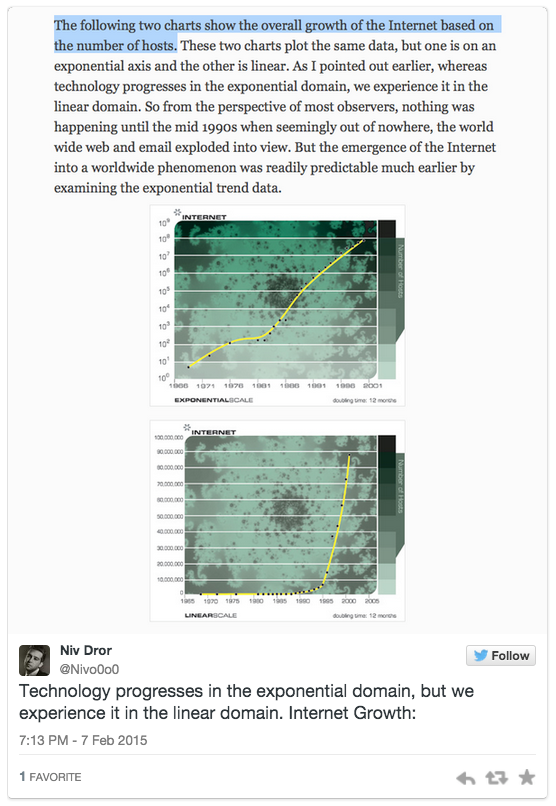
Kurzweil uses the overall growth of the internet as an example. The bottom chart being linear, which makes the internet growth seem sudden and unexpected, whereas the the top chart with the same data graphed on a logarithmic scale tell a very predictable story. On the exponential graph internet growth doesn’t come out of nowhere; it’s just presented in a way that is more intuitive for us to comprehend.

We are still prone to underestimate the progress that is coming because it’s difficult to internalize this reality that we’re living in a world of exponential technological change. It is a fairly recent development. And it’s important to get an understanding for the massive scale of advancements that the technologies of the future will enable. Particularly now, as we’ve reachedwhat Kurzweil calls the “Second Half of the Chessboard.”

(In the end the emperor realizes that he’s been tricked, by exponents, and has the inventor beheaded. In another version of the story the inventor becomes the new emperor).

It’s important to note that as the emperor and inventor went through the first half of the chessboard things were fairly uneventful. The inventor was first given spoonfuls of rice, then bowls of rice, then barrels, and by the end of the first half of the chess board the inventor had accumulated one large field’s worth — 4 billion grains — which is when the emperor started to take notice. It was only as they progressed through the second half of the chessboard that the situation quickly deteriorated.

# of Grains on 1st half: 4,294,967,295

# of Grains on 2nd half: 18,446,744,069,414,600,000

Mind-bending nonlinear gains in computing are about to get a lot more realistic in our lifetime, as there have been slightly more than 32 doublings of performance since the first programmable computers were invented.

Kurzweil’s Predictions

Kurzweil is known for making mind-boggling predictions about the future. And his track record is pretty good.

“…Ray is the best person I know at predicting the future of artificial intelligence.” —Bill Gates

Ray’s prediction for the future may sound crazy (they do sound crazy), but it’s important to note that it’s not about the specific prediction or the exact year. What’s important to focus on is what the they represent. These predictions are based on an understanding of Moore’s Law and Ray’s Law of Accelerating Returns, an awareness for the power of exponential growth, and an appreciation that information technology follows an exponential trend. They may sound crazy, but they are not based out of thin air.

And with that being said…

Second Half of the Chessboard Predictions

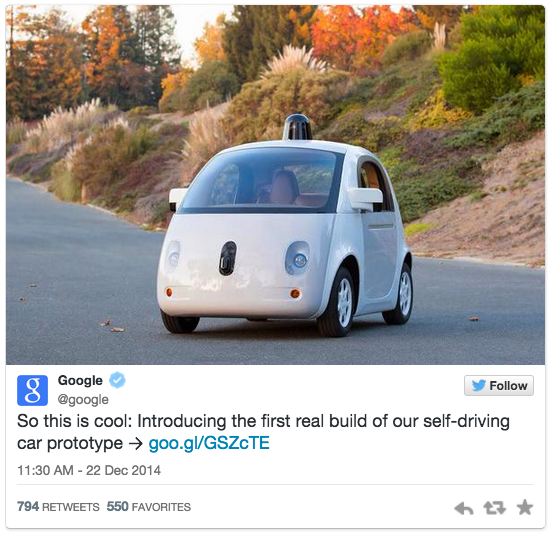
“By the 2020s, most diseases will go away as nanobots become smarter than current medical technology. Normal human eating can be replaced by nanosystems. The Turing test begins to be passable. Self-driving cars begin to take over the roads, and people won’t be allowed to drive on highways.”

“By the 2030s, virtual reality will begin to feel 100% real. We will be able to upload our mind/consciousness by the end of the decade.”

To expand image → https://twitter.com/nivo0o0/status/564309273480409088

Not quite there yet…

“By the 2040s, non-biological intelligence will be a billion times more capable than biological intelligence (a.k.a. us). Nanotech foglets will be able to make food out of thin air and create any object in physical world at a whim.”

These clones are cute.

“By 2045, we will multiply our intelligence a billionfold by linking wirelessly from our neocortex to a synthetic neocortex in the cloud.”

Multiplying our intelligence a billionfold by linking our neocortex to a synthetic neocortex in the cloud — what does that actually mean?

In March 2014 Kurzweil gave an excellent talk at the TED Conference. It was appropriately called: Get ready for hybrid thinking.

Here is a summary:

To expand image → https://twitter.com/nivo0o0/status/568686671983570944

These are the highlights:

Nanobots will connect our neocortex to a synthetic neocortex in the cloud, providing an extension of our neocortex.

Our thinking then will be a hybrid of biological and non-biological thinking(the non-biological portion is subject to the Law of Accelerating Returns and it will grow exponentially).

The frontal cortex and neocortex are not really qualitatively different, so it’s a quantitative expansion of the neocortex (like adding processing power).

The last time we expanded our neocortex was about two million years ago. That additional quantity of thinking was the enabling factor for us to take aqualitative leap and advance language, science, art, technology, etc.

We’re going to again expand our neocortex, only this time it won’t be limited by a fixed architecture of inclosure. It will be expanded without limits, by connecting our brain directly to the cloud.

We already carry a supercomputer in our pocket. We have unlimited access to all the world’s knowledge at our fingertips. Keeping in mind that we are prone to underestimate technological advancements (and that 2045 is not a hard deadline) is it really that far of a stretch to imagine a future where we’re always connected directly from our brain?

Progress is underway. We’ll be able to reverse engineering the neural cortex within five years. Kurzweil predicts that by 2030 we’ll be able to reverse engineer the entire brain. His latest book is called How to Create a Mind… This is the reason Google hired Kurzweil.

Hybrid Human Machines

To expand image → https://twitter.com/nivo0o0/status/568686671983570944

“We’re going to become increasingly non-biological…”

“We’ll also have non-biological bodies…”

“If the biological part went away it wouldn’t make any difference…”

They* will be as realistic as real reality.”

Impact on Society

technological singularity —“the hypothesis that accelerating progress in technologies will cause a runaway effect wherein artificial intelligence will exceed human intellectual capacity and control, thus radically changing civilization” — is beyond the scope of this article, but these advancements will absolutely have an impact on society. Which way is yet to be determined.

There may be some regret

Politicians will not know who/what to regulate.

Evolution may take an unexpected twist.

The rich-poor gap will expand.

The unimaginable will become reality and society will change.

Previsão do tempo no Sudeste é uma dor de cabeça para cientistas (Folha de S.Paulo)

15/02/2015

Peculiaridades do clima regional tornam difícil saber como ficará o nível do Cantareira mesmo no curto prazo

Área está sujeita à influência de vários fatores complexos, como umidade da Amazônia e frentes frias da Antártida

REINALDO JOSÉ LOPES

COLABORAÇÃO PARA A FOLHA

LUCAS VETTORAZZO

DO RIO

Se a sucessão de boas e más notícias sobre a chuva que abastece os reservatórios de São Paulo parece uma confusão só, não se preocupe: previsões climáticas sobre o Sudeste brasileiro podem confundir até especialistas.

Isso acontece porque a região mais populosa do Brasil ocupa uma área do globo terrestre que recebe todo tipo de influência complexa, desde a umidade oriunda da Amazônia até as frentes frias “sopradas” da Antártida.

Resultado: um nível de incerteza acima do normal numa seara que, por natureza, já é bastante incerta.

“Isso vale principalmente para prever o clima, ou seja, as variações de médio e longo prazo, mas também é verdade, ainda que em grau bem menor, para as previsões de tempo, ou seja, na escala de dias”, diz Tercio Ambrizzi, climatologista da USP.

Portanto, não é que o tempo seja mais instável na área do sistema Cantareira, o mais castigado pela atual crise e agora em ligeira recuperação. O que ocorre é que a região que abastece o Cantareira às vezes pode ficar mais sujeita a variações aleatórias de um sistema climático naturalmente complicado.

TEORIA DO CAOS

“Em escalas maiores do que 15 dias, faz décadas que está comprovado que o clima é caótico”, diz Gilvan Sampaio de Oliveira, meteorologista do Inpe (Instituto Nacional de Pesquisas Espaciais).

“Aliás, foi a partir daí que surgiu a teoria do caos”, afirma ele, referindo-se à ideia de que, em certos fenômenos complexos, pequenas mudanças no começo podem levar a alterações muito maiores e imprevisíveis no fim.

Em regiões tropicais, como é o caso de quase todo o território do Brasil, isso é ainda mais verdadeiro, porque o calor injeta mais energia na atmosfera, fazendo com que alterações do tempo aconteçam com mais velocidade e imprevisibilidade.

Além do calor, porém, o Sudeste também tem a desvantagem de que as variações climáticas por aqui dependem de fatores não oceânicos.

“Quando o clima de uma região depende do oceano, é bem mais fácil prevê-lo porque as variações oceânicas acontecem de forma bem mais lenta do que as da atmosfera”, explica Oliveira. “É o caso do semiárido nordestino, ligado basicamente às condições do oceano Pacífico e do Atlântico tropical. Se é ano de El Niño, com o Pacífico mais aquecido, a tendência é seca no Nordeste.”

Já as chuvas do Sudeste, em especial as de verão, estão ligadas principalmente à ZCAS (Zona de Convergência do Atlântico Sul), formada pela umidade da Amazônia, que se espalha numa grande faixa que atravessa o Brasil Central, e pelas frentes frias antárticas (veja infográfico).

“Quando essa zona se fortalece você pode ter chuva constante por três, quatro, cinco dias, e é bem comum isso acontecer no Carnaval, como inclusive deve acontecer neste ano”, diz Oliveira.

Em 2014 e, em menor grau, também neste ano, contudo, a ZCAS não atuou como deveria, com um bloqueio atmosférico impedindo que as chuvas de verão atingissem o Sudeste (e o Cantareira) em cheio. As chuvas constantes e bem distribuídas voltaram apenas nas últimas semanas, porque a ZCAS parece ter se “ajeitado” de novo.

Mesmo nesse cenário, isso não significa que as chuvas de verão cessem totalmente. Com o calor típico da estação, há um ciclo rápido de evaporação e chuva –mas é um padrão local, o que explica tempestades localizadas e inundações na Grande São Paulo, sem que essas precipitações façam cócegas no Cantareira.

Há ainda outro agravante, que talvez ajude a entender a fama de imprevisível da área. Até pouco tempo atrás, não havia estações pluviométricas confiáveis para medir o volume de chuva na região do Cantareira, conta José Marengo, climatologista do Cemaden (Centro Nacional de Monitoramento e Alertas de Desastres Naturais).

“Os pluviômetros mais próximos eram os de Campos do Jordão. Faltam registros históricos. Não podemos intercalar com os dados de Campos do Jordão porque é outro regime chuva.”

Panel Urges Research on Geoengineering as a Tool Against Climate Change (New York Times)

Piles at a CCI Energy Solutions coal handling plant in Shelbiana, Ky. Geoengineering proposals might counteract the effects of climate change that are the result of burning fossils fuels, such as coal. Credit: Luke Sharrett/Getty Images 

With the planet facing potentially severe impacts from global warming in coming decades, a government-sponsored scientific panel on Tuesday called for more research on geoengineering — technologies to deliberately intervene in nature to counter climate change.

The panel said the research could include small-scale outdoor experiments, which many scientists say are necessary to better understand whether and how geoengineering would work.

Some environmental groups and others say that such projects could have unintended damaging effects, and could set society on an unstoppable path to full-scale deployment of the technologies.

But the National Academy of Sciences panel said that with proper governance, which it said needed to be developed, and other safeguards, such experiments should pose no significant risk.

In two widely anticipated reports, the panel — which was supported by NASA and other federal agencies, including what the reports described as the “U.S. intelligence community” — noted that drastically reducing emissions of carbon dioxide and other greenhouse gases was by far the best way to mitigate the effects of a warming planet.

A device being developed by a company called Global Thermostat, is made to capture carbon dioxide from the air. This may be one solution to counteract climate change.CreditHenry Fountain/The New York Times 

But the panel, in making the case for more research into geoengineering, said, “It may be prudent to examine additional options for limiting the risks from climate change.”

“The committee felt that the need for information at this point outweighs the need for shoving this topic under the rug,” Marcia K. McNutt, chairwoman of the panel and the editor in chief of the journal Science, said at a news conference in Washington.

Geoengineering options generally fall into two categories: capturing and storing some of the carbon dioxide that has already been emitted so that the atmosphere traps less heat, or reflecting more sunlight away from the earth so there is less heat to start with. The panel issued separate reports on each.

The panel said that while the first option, called carbon dioxide removal, was relatively low risk, it was expensive, and that even if it was pursued on a planetwide scale, it would take many decades to have a significant impact on the climate. But the group said research was needed to develop efficient and effective methods to both remove the gas and store it so it remains out of the atmosphere indefinitely.

The second option, called solar radiation management, is far more controversial. Most discussions of the concept focus on the idea of dispersing sulfates or other chemicals high in the atmosphere, where they would reflect sunlight, in some ways mimicking the effect of a large volcanic eruption.

The process would be relatively inexpensive and should quickly lower temperatures, but it would have to be repeated indefinitely and would do nothing about another carbon dioxide-related problem: the acidification of oceans.

This approach might also have unintended effects on weather patterns around the world — bringing drought to once-fertile regions, for example. Or it might be used unilaterally as a weapon by governments or even extremely wealthy individuals.

Opponents of geoengineering have long argued that even conducting research on the subject presents a moral hazard that could distract society from the necessary task of reducing the emissions that are causing warming in the first place.

“A geoengineering ‘technofix’ would take us in the wrong direction,” Lisa Archer, food and technology program director of the environmental group Friends of the Earth, said in a statement. “Real climate justice requires dealing with root causes of climate change, not launching risky, unproven and unjust schemes.”

But the panel said that society had “reached a point where the severity of the potential risks from climate change appears to outweigh the potential risks from the moral hazard” of conducting research.

Ken Caldeira, a geoengineering researcher at the Carnegie Institution for Science and a member of the committee, said that while the panel felt that it was premature to deploy any sunlight-reflecting technologies today, “it’s worth knowing more about them,” including any problems that might make them unworkable.

“If there’s a real showstopper, we should know about it now,” Dr. Caldeira said, rather than discovering it later when society might be facing a climate emergency and desperate for a solution.

Dr. Caldeira is part of a small community of scientists who have researched solar radiation management concepts. Almost all of the research has been done on computers, simulating the effects of the technique on the climate. One attempt in Britain in 2011 to conduct an outdoor test of some of the engineering concepts provoked a public outcry. The experiment was eventually canceled.

David Keith, a researcher at Harvard University who reviewed the reports before they were released, said in an interview, “I think it’s terrific that they made a stronger call than I expected for research, including field research.” Along with other researchers, Dr. Keith has proposed a field experiment to test the effect of sulfate chemicals on atmospheric ozone.

Unlike some European countries, the United States has never had a separate geoengineering research program. Dr. Caldeira said establishing a separate program was unlikely, especially given the dysfunction in Congress. But he said that because many geoengineering research proposals might also help in general understanding of the climate, agencies that fund climate research might start to look favorably upon them.

Dr. Keith agreed, adding that he hoped the new reports would “break the logjam” and “give program managers the confidence they need to begin funding.”

At the news conference, Waleed Abdalati, a member of the panel and a professor at the University of Colorado, said that geoengineering research would have to be subject to governance that took into account not just the science, “but the human ramifications, as well.”

Dr. Abdalati said that, in general, the governance needed to precede the research. “A framework that addresses what kinds of activities would require governance is a necessary first step,” he said.

Raymond Pierrehumbert, a geophysicist at the University of Chicago and a member of the panel, said in an interview that while he thought that a research program that allowed outdoor experiments was potentially dangerous, “the report allows for enough flexibility in the process to follow that it could be decided that we shouldn’t have a program that goes beyond modeling.”

Above all, he said, “it’s really necessary to have some kind of discussion among broader stakeholders, including the public, to set guidelines for an allowable zone for experimentation.”

The Risks of Climate Engineering (New York Times)

Credit: Sarah Jacoby 

THE Republican Party has long resisted action on climate change, but now that much of the electorate wants something done, it needs to find a way out of the hole it has dug for itself. A committee appointed by the National Research Council may just have handed the party a ladder.

In a two-volume report, the council is recommending that the federal government fund a research program into geoengineering as a response to a warming globe. The study could be a watershed moment because reports from the council, an arm of the National Academies that provides advice on science and technology, are often an impetus for new scientific research programs.

Sometimes known as “Plan B,” geoengineering covers a variety of technologies aimed at deliberate, large-scale intervention in the climate system to counter global warming.

Despairing at global foot-dragging, some climate scientists now believe that a turn to Plan B is inevitable. They see it as inscribed in the logic of the situation. The council’s study begins with the assertion that the “likelihood of eventually considering last-ditch efforts” to address climate destabilization grows every year.

The report is balanced in its assessment of the science. Yet by bringing geoengineering from the fringes of the climate debate into the mainstream, it legitimizes a dangerous approach.

Beneath the identifiable risks is not only a gut reaction to the hubris of it all — the idea that humans could set out to regulate the Earth system, perhaps in perpetuity — but also to what it says about where we are today. As the committee’s chairwoman, Marcia McNutt, told The Associated Press: The public should read this report “and say, ‘This is downright scary.’ And they should say, ‘If this is our Hail Mary, what a scary, scary place we are in.’ ”

Even scarier is the fact that, while most geoengineering boosters see these technologies as a means of buying time for the world to get its act together, others promote them as a substitute for cutting emissions. In 2008, Newt Gingrich, the former House speaker, later Republican presidential candidate and an early backer of geoengineering, said: “Instead of penalizing ordinary Americans, we would have an option to address global warming by rewarding scientific invention,” adding: “Bring on the American ingenuity.”

The report, considerably more cautious, describes geoengineering as one element of a “portfolio of responses” to climate change and examines the prospects of two approaches — removing carbon dioxide from the atmosphere, and enveloping the planet in a layer of sulfate particles to reduce the amount of solar radiation reaching the Earth’s surface.

At the same time, the council makes clear that there is “no substitute for dramatic reductions in the emissions” of greenhouse gases to slow global warming and acidifying oceans.

The lowest-risk strategies for removing carbon dioxide are “currently limited by cost and at present cannot achieve the desired result of removing climatically important amounts,” the report said. On the second approach, the council said that at present it was “opposed to climate-altering deployment” of technologies to reflect radiation back into space.

Still, the council called for research programs to fill the gaps in our knowledge on both approaches, evoking a belief that we can understand enough about how the Earth system operates in order to take control of it.

Expressing interest in geoengineering has been taboo for politicians worried about climate change for fear they would be accused of shirking their responsibility to cut carbon emissions. Yet in some congressional offices, interest in geoengineering is strong. And Congress isn’t the only place where there is interest. Russia in 2013 unsuccessfully sought to insert a pro-geoengineering statement into the latest report of the Intergovernmental Panel on Climate Change.

Early work on geoengineering has given rise to one of the strangest paradoxes in American politics: enthusiasm for geoengineering from some who have attacked the idea of human-caused global warming. The Heartland Institute, infamous for its billboard comparing those who support climate science to the Unabomber, Theodore J. Kaczynski, featured an article in one of its newsletters from 2007 describing geoengineering as a “practical, cost-effective global warming strategy.”

Some scholars associated with conservative think tanks like the Hoover Institution and the Hudson Institute have written optimistically about geoengineering.

Oil companies, too, have dipped their toes into the geoengineering waters with Shell, for instance, having funded research into a scheme to put lime into seawater so it absorbs more carbon dioxide.

With half of Republican voters favoring government action to tackle global warming, any Republican administration would be tempted by the technofix to beat all technofixes.

For some, instead of global warming’s being proof of human failure, engineering the climate would represent the triumph of human ingenuity. While climate change threatens to destabilize the system, geoengineering promises to protect it. If there is such a thing as a right-wing technology, geoengineering is it.

President Obama has been working assiduously to persuade the world that the United States is at last serious about Plan A — winding back its greenhouse gas emissions. The suspicions of much of the world would be reignited if the United States were the first major power to invest heavily in Plan B.

Aconselhado por espírito indígena, Pezão garante que choverá no Rio (Época)

Relatório do Cacique Cobra Coral, enviado ao governador do Rio, garante normalização dos reservatórios do Rio até maio; presidente Dilma já foi informada

CRISTINA GRILLO
13/02/2015 19h11 – Atualizado em 13/02/2015 20h35

Governador do Rio de Janeiro Luiz Fernando Pezão (Foto: Pedro Farina)

Governador do Rio de Janeiro Luiz Fernando Pezão (Foto: Pedro Farina)

Celebrai, povo fluminense: vem água por aí. Abram as torneiras, durmam no chuveiro e caprichem no banho do carro. Está liberado até encher a piscina de plástico azul das crianças. Basta comungar da mesma confiança que o governador do Rio, Luiz Fernando Pezão. Ele assegura à ÉPOCA, com tranquilidade budista, que racionamento e rodízio são palavras do passado. Cálculos de volume morto e obras na rede de águas são coisas de políticos sem fé. A convicção de Pezão é transcendental: vem dos céus – embora não de São Pedro. Choverá, ora, porque a médium Adelaide Scritori, a pedido de Pezão, consultou o espírito do Cacique Cobra Coral – e o Cacique mandou dizer que a água não tarda e chegará abundante. Quem é Pezão para discutir com o espírito do Cacique?

O último relato do Cacique veio por email – não do além, mas por meio de Adelaide. No documento, enviado no dia 28 de janeiro, garante-se  que “tudo o que faltou em dezembro e janeiro virá em fevereiro, março e abril”. O email, que afastou da cabeça do governador qualquer ideia de racionamento, foi repassado em seguida, como de costume, a Dilma Rousseff. “A presidente se diverte com os emails do cacique. Riu muito de um que afirmava que o culpado da crise hídrica e energética era o Lobão [Edison Lobão, ex-ministro de Minas e Energia]”, disse Pezão à ÉPOCA em seu gabinete, no Palácio Guanabara. Dilma riu, mas Pezão leva os conselhos do Cacique a sério.

Fundação Cacique Cobra Coral (Foto: reprodução)

Imagem do site da Fundação Cacique Cobra Coral (Foto: reprodução)

A médium Adelaide lidera a Fundação Cacique Cobra Coral. Ela afirma incorporar o espírito do Cacique – um meteorologista sobrenatural, com capacidade para segurar uma tempestade aqui, mandar uma chuvinha lá e, graças a esse dom, fazer com que prefeituras e governos contratem a instituição para garantir seus serviços. No relatório que Pezão encaminhou a Dilma há, no entanto, um alerta para a possibilidade de temporais no Rio. Até junho, diz o Cacique, há o risco de chover, em apenas um dia, a quantidade esperada para um mês inteiro. “É preciso ficar alerta para o excesso de precipitação numa mesma localidade, como a zona norte”, avisa a entidade. Preparem a arca de Noé.

Pezão recebe com regularidade os informes que o espírito do Cacique envia à Prefeitura do Rio – o governo do Estado, afirma, não tem contrato com a fundação; a prefeitura, sim. Mas a relação de Pezão com o Cacique é antiga. Vem desde 1997, quando Pezão era prefeito de Piraí, município a 90 quilômetros da capital. “Eu sempre gostei de fazer festas na rua e conversava com eles para ter tempo bom. Chegava o dia da festa, chovia em todos os municípios vizinhos, e Piraí ficava sequinha, sequinha”, contou o governador. Com a prefeitura do Rio, os acordos da entidade mediúnica vêm dos tempos em que Cesar Maia era prefeito, no início de 2001. Eduardo Paes ameaçou romper com a fundação quando tomou posse em seu primeiro mandato, em 2009. Mas as previsões de temporais na noite do réveillon o fizeram rever a decisão. Não choveu e, desde então, além de satélites e outros instrumentos de alta tecnologia, o Rio conta com a expertise do cacique para ajudar nas previsões meteorológicas.

Mesmo sem contrato com o governo do Estado, a Fundação Cacique Cobra Coral parece estar se esforçando para garantir a normalização dos reservatórios. No domingo, dia 8, a médium Adelaide sofreu um acidente de carro na cidade de Paraibuna, em São Paulo. Ela vinha de Minas para o Rio de Janeiro, acompanhando o curso do rio Paraíba do Sul para avaliar, in loco, o nível dos reservatórios. O carro onde estava capotou três vezes e caiu no rio. Adelaide só teve escoriações leves. “Ela estava vendo tudo para informar ao cacique”, disse Pezão, que conecta seu celular para mostrar algumas fotos do acidente. Cair no rio não seria um mau sinal? “Não! Já está tudo certo, vai voltar a chover”, afirmou o confiante governador.

Das amplas janelas do gabinete de Pezão vê-se o jardim, espetacular, reformulado pelo paisagista francês Paul Villon no início do século XX. No meio do jardim, o chafariz de Netuno jorra, voluptuoso, litros e mais litros de água. “Mas é água de reuso”, apressa-se o governador a explicar, ao ouvir a pergunta sobre o desperdício –mesmo com toda a garantia dada pelo cacique de que o Rio está livre de problemas. Mas, pelo sim, pelo não, no dia seguinte o chafariz estava desligado.

Com chuva, Alckmin adia decisão sobre rodízio de água na Grande SP (Folha de S.Paulo)

FABRÍCIO LOBEL e GUSTAVO URIBE

DE SÃO PAULO

11/02/2015  02h00

O volume de chuvas no início de fevereiro, que já se aproxima da média para o mês, levou o governo Geraldo Alckmin (PSDB) a adiar a decisão sobre a implantação de um rodízio de água na Grande SP.

Nas palavras de um assessor do governo, “a Sabesp não jogou a toalha” e, diante de um cenário com chuvas até o final de março e o avanço simultâneo de algumas obras, será até mesmo possível atravessar o período de seca, de maio a setembro, sem rodízio.

Folha teve acesso a esse “plano antirrodízio”, o mais atualizado da Sabesp, a estatal da água. Ele envolve três pontos-chaves, todos interdependentes, sendo que o primeiro nada mais é do que uma ‘torcida meteorológica’:

1) O ritmo de chuvas de fevereiro, que já superou a metade do esperado para o mês e fez aumentar a entrada de água no sistema Cantareira, tem de ao menos permanecer como está até o fim de março;

2) A ligação da represa Billings com o sistema Alto Tietê precisa ser concluída; a obra prevê 11 km de dutos entre os dois mananciais e, segundo o governo de SP, deverá ficar pronta até maio;

3) A capacidade de interligação entre sistemas terá de ser ampliada. Dessa forma, águas do Guarapiranga e do Alto Tietê, por exemplo, poderão atender moradores hoje abastecidos pelo Cantareira em áreas de Guarulhos, na Vila Maria (zona norte), Mooca (zona leste) e Brás (centro).

Editoria de arte/Folhapress

Com tudo isso, aliado principalmente à política de racionamento por meio da redução da pressão na rede de abastecimento, a Sabesp acredita que poderá manter uma vazão de no mínimo 10 mil litros de água por segundo no Cantareira ao longo de 2015, o suficiente, segundo a estatal, para evitar o início do rodízio –a vazão atual é de 14 mil l/seg.

Qualquer falha em um desses três pontos, porém, provocará a reavaliação desse planejamento. O final de fevereiro, por ora, é o prazo tratado internamente como limite para definir o rodízio.

Questionado ontem (10/02) sobre o tema, Alckmin afirmou que não existe nada definido. “É uma decisão técnica, da Sabesp, que faz o monitoramento diário”.

NOVO ÂNIMO

Até o final de janeiro, quando o volume de chuvas seguia bem abaixo da média histórica e o Cantareira caminhava para um colapso completo, o governo paulista tratava o rodízio apenas como uma questão de tempo.

Foi nesse contexto, por exemplo, que um dirigente da Sabesp falou na possibilidade de um rodízio “pesado”, com cinco dias sem água e apenas dois com na semana.

As chuvas de fevereiro não tiraram o Cantareira de uma situação crítica, mas deram uma leve trégua ao governo.

O sistema operou nesta terça (10) com 6,1% de sua capacidade, após mais uma alta. Esse percentual já inclui duas cotas do volume morto, que são as reservas de água abaixo do nível original de captação.

Para evitar um rodízio em 2015, o governo espera que o sistema chegue ao final de março entre 10% e 12% –com o solo úmido após as recentes chuvas, foram reduzidos os danos do chamado “efeito esponja”, que impede o armazenamento da água da chuva.

Estiagem leva 16,8% dos municípios brasileiros a decretar desastre (UOL)

Leandro Prazeres

Do UOL, em Brasília

11/02/201506h00

No Brasil, 16,8% dos municípios estão, oficialmente, em situação de desastre, que inclui os estágios de calamidade pública e emergência, por conta da estiagem. Os dados são do Ministério da Integração Nacional, que centraliza e reconhece decretos do gênero registrados por municípios e Estados em todo o país. O Nordeste lidera a lista dos municípios afetados pela estiagem. No Ceará, por exemplo, 95% dos municípios estão oficialmente em situação de desastre por conta da seca.

De acordo com dados do ministério, dos 5.570 municípios brasileiros, 936 tinham decretos de situação de emergência ou calamidade pública em vigência. Os dados são de 2 de fevereiro, data em que o órgão fez a última atualização das informações. A partir do reconhecimento federal, municípios e Estados em situação de desastre ficam autorizados a contratar serviços e comprar mantimentos em regime emergencial sem precisar fazer licitação.

Segundo o ministério, não é possível fazer uma comparação entre os dados atuais e os da mesma época do ano passado porque as informações não são compiladas diariamente. Ainda de acordo com o ministério, em 2014, 1.265 municípios tiveram seus decretos de situação de emergência ou calamidade pública reconhecidos pelo governo federal. Em 2013, foram 1.514.

A assessoria de imprensa do ministério informa, no entanto, que não é possível afirmar que a estiagem neste início de ano é mais amena que as dos anos anteriores, pois os dados referentes a 2013 e 2014 só foram contabilizados ao final de cada ano.

Situação no Nordeste

Dos 936 municípios brasileiros oficialmente em situação de desastre, 843 estão no Nordeste, o equivalente a 90%. A região Sudeste é a segunda mais afetada, com 94 municípios em situação de desastre. As demais regiões (Norte, Centro-Oeste e Sul) não têm nenhum município com decreto de desastre reconhecido pelo governo federal.

Todos os nove Estados do Nordeste têm municípios com situação de desastre reconhecida pelo governo federal. A Paraíba lidera o “ranking” da estiagem com 197 decretos. Logo depois vem o Ceará, com 176. Em termos percentuais, no entanto, o Estado mais afetado foi o Ceará, onde 95% dos municípios estão, oficialmente, em situação de desastre.

De acordo com a Defesa Civil do Estado do Rio Grande do Norte, onde 91% dos municípios têm decretos de desastre reconhecidos pelo governo federal, algumas cidades estão em “colapso” — sem condições de atender à população.

Segundo o órgão, o governo tenta colocar em atividade 1.700 poços artesianos para minimizar os efeitos da estiagem. Pelo menos três cidades já enfrentam rodízio de água em regime 24/48 (um dia com água para cada dois sem).

Situação no Sudeste

Apesar de a crise hídrica estar afetando o abastecimento de água em municípios da região Sudeste, especialmente no Estado de São Paulo, apenas três municípios paulistas estão na lista do Ministério da Integração Nacional: Cristais Paulistas, Santa Rita do Passa Quatro e Tambaú.

Segundo o Ministério da Integração Nacional, “não há pedidos de reconhecimento federal dos Estados do Rio de Janeiro e São Paulo” esperando por análise dos técnicos do governo federal.

No Sudeste, o Estado mais afetado é Minas Gerais, com 90 municípios em situação de emergência ou calamidade pública. Segundo o ministério, Minas Gerais ainda tem 25 pedidos em análise.

Entenda a diferença entre situação de emergência e calamidade pública:

Situação de emergência

Situação anormal provocada por desastres (chuvas, estiagem, incêndio etc) que causam danos e prejuízos que comprometam apenas parcialmente a capacidade do Estado ou do município afetado de responder à situação

Calamidade pública

Situação anormal provocada por desastres (chuvas, estiagem, incêndio etc) que comprometem substancialmente a capacidade do Estado ou do município afetado responder à situação. Normalmente, quando um Estado ou Município decreta calamidade pública, o governo federal intercede com ações de socorro e transferência de recursos

Estiagem: imagens aéreas exibem seca nas represas brasileiras

3.fev.2015 – Vista aérea da represa de Jaguari, em Jacareí, no interior de São Paulo. Após fortes chuvas que caíram no Estado de São Paulo, o nível do reservatório registrou aumento e passou de 1,61% para 1,72% da capacidade Lucas Lacaz Ruiz/Estadão Conteúdo

Veja também

Médium da Fundação Cacique Cobra Coral sofre acidente de carro (O Globo)

Adelaide Scritori estava em Paraibuna quando o seu veículo capotou três vezes e caiu dentro do Rio Paraíba do Sul; com escoriações, ela foi transferida para hospital de São Paulo

POR LUIZ ERNESTO MAGALHÃES

RIO – A médium Adelaide Scritori, responsável pela Fundação Cacique Cobra Coral, sofreu um acidente na tarde deste domingo na cidade de Paraibuna, em São Paulo. Adelaide seguia de Minas Gerais para o Rio acompanhando o leito do Rio Paraíba do Sul para monitorar o nível dos reservatórios. O veículo em que estava perdeu o controle, capotou três vezes e caiu dentro d’água.

De acordo com o porta-voz da fundação, Osmar Santos, ela não corre risco de morte, mas sofreu escoriações por todo o corpo e foi levada para um hospital de São Paulo.

– Alguém intercedeu e protegeu a Adelaide – frisou.

A médium diz incorporar o espírito do cacique Cobra Coral, capaz de controlar o clima. Sobre as previsões, Santos disse que a tendência é de que os níveis dos reservatórios voltem a subir com chuvas frequentes até maio.

– As águas vão rolar. O bloqueio foi rompido, mas o cacique não quer conversa com o ministro de Minas e Energia, Eduardo Braga. Nós advertimos em outubro que, se o governador Geraldo Alckmin prosseguisse com o plano de transposição das águas do Rio Paraíba do Sul, a seca iria voltar – disse.

Leia mais sobre esse assunto em  http://oglobo.globo.com/rio/medium-da-fundacao-cacique-cobra-coral-sofre-acidente-de-carro-15281173#ixzz3RHSpz68o 
© 1996 – 2015. Todos direitos reservados a Infoglobo Comunicação e Participações S.A. Este material não pode ser publicado, transmitido por broadcast, reescrito ou redistribuído sem autorização. 

Memes ironizam previsão de temporal no Rio nesta quinta-feira (G1)

05/02/2015 17h15 – Atualizado em 05/02/2015 21h53

‘Ciclone In Rio’ e ‘Chuva no Rio #VemGente’ foram criados no Facebook.
Prefeitura montou esquema especial para enfrentar chuva que estava prevista.

Do G1 Rio

Memes da chuva no Rio (Foto: Reprodução de internet)

No Facebook, um evento simulanto o Rock In Rio, com o tema ‘Ciclone in Rio, Eu Fui’ também foi criado (Foto: Reprodução de internet)

A forte chuva que foi prevista por meteorologistas para cair na tarde desta quinta-feira (5) deixou muitos cariocas em alerta. A ausência de um grande temporal até as 20h, no entanto, inspirou os internautas que, desde a manhã, encheram as redes sociais de memes relacionados aos transtornos que seriam causados pela chuva.

No Facebook, pelo menos dois eventos foram criados. O “Ciclone In Rio” e o “Chuva no Rio #VemGente”. Na internet, também circulam fotos com a modelo Nana Gouveia posando perto de pessoas que, em outras situações, se refugiaram da chuva.

No Twitter, o personagem fictício Dilma Bolada, uma sátira da presidente, disse que decidiu mandar a chuva para Brasília. “Mandei desviar o ciclone do Rio de Janeiro para o Congresso Nacional. A cidade maravilhosa não merece uma coisa dessas!”. Na mesma rede social, internautas fazem diversas ironias como: “O governador Pezão acabou de anunciar que a chuva no Rio foi cancelada por questões de falta de água”.

No Twitter, internautas ironizam a chuva (Foto: Reprodução/Twitter)

No Twitter, internautas ironizam a chuva (Foto: Reprodução/Twitter)

Alerta pela manhã
Pela manhã, a Prefeitura do Rio apresentou um esquema especial elaborado por diversos órgãos do município para enfrentar a chuva. Cerca de 3,2 mil agentes foram mobilizados no esquema.

A cidade entrou em estágio de atenção às 6h50, afirmou o prefeito Eduardo Paes durante uma coletiva de imprensa no Centro de Operações Rio, no Centro. O estágio de atenção é o segundo nível em uma escala de três e significa a possibilidade de chuva moderada, ocasionalmente forte.

Chuva no Rio 3 (Foto: Reprodução/Twitter)

Chuva no Rio 6 (Foto: Reprodução/Twitter)


Chuva no Rio 8 (Foto: Reprodução/Twitter)

Chuva no Rio (Foto: Reprodução/Twitter)

Chuva no Rio 15 (Foto: Reprodução/Twitter)

Chuva no Rio 7 (Foto: Reprodução/Twitter)

Memes da chuva no Rio (Foto: Reprodução de internet)

Meme brinca com o Cristo Redentor (Foto: Reprodução / Twitter)

Meme brinca com o Cristo Redentor (Foto: Reprodução / Twitter)

Brincadeiras como ator Tony Tornado (Foto: Reprodução/Facebook)

Brincadeiras como ator Tony Tornado (Foto: Reprodução/Facebook)

Diversos memes se espalharam pela web por conta da chuva (Foto: Reprodução/Facebook)

Diversos memes se espalharam pela web por conta da chuva (Foto: Reprodução/Facebook)

Memes da chuva no Rio (Foto: Reprodução de internet)

A modelo Nana Gouveia não escapou das piadas na internet em memes sobre a chuva no Rio (Foto: Reprodução de internet)

Prefeito do Rio diz que foi zombado até pelos filhos após previsão falhar (G1)

06/02/2015 10h22 – Atualizado em 06/02/2015 17h34

Eduardo Paes diz que procedimento para chuva forte será padrão. Piscinões para conter alagamento na Praça da Bandeira serão inaugurados.

Henrique Coelho Do G1 Rio

Prefeito Eduardo Paes garantiu que procedimento contra chuvas fortes se tornará padrão na cidade. (Foto: Henrique Coelho / G1)

Prefeito Eduardo Paes garantiu que procedimento contra chuvas fortes se tornará padrão na cidade. (Foto: Henrique Coelho / G1)

Mesmo após uma chuva menos intensa que o previsto nesta quinta-feira (5), a Prefeitura do Rio  afirmou que vai continuar adotando os mesmos procedimentos com a previsão de uma chuva e ventos fortes.

“As pessoas sempre pedem planejamento, e ainda bem que não aconteceu nada. Mas vamos continuar fazendo isso porque não podemos deixar de dividir as informações que temos com a população”, disse o prefeito Eduardo Paes, que levou na esportiva as brincadeiras publicadas em redes sociais após as chuvas. “Até meus filhos zombaram de mim hoje de manhã, mas eu entendo. Não tenho vocação para Cacique Cobra Coral”, brincou.

Nesta quinta-feira, a Prefeitura do Rio apresentou um esquema especial elaborado por diversos órgãos do município para enfrentar a situação. Cerca de 3,2 mil agentes foram mobilizados no esquema.

“Vamos continuar com o mesmo esquema, com homens da Comlurb, da Guarda municipal, Cet-Rio”, afirmou, acrescentando que quatro novos piscinões na área da Praça da Bandeira, um dos principais pontos de alagamento da cidade, serão inaugurados neste sábado (7).  “Não levamos a sério algumas coisas no passado, e agora vamos ficar sempre atentos”.

Paes criticou ainda o fato de algumas empresas liberarem seus funcionários mais cedo devido à ameaça de chuva forte. “O dia que for para sair mais cedo, nós vamos avisar”, disparou.

Em sua página pessoal no Facebook, Eduardo Paes reiterou que a prefeitura irá manter os alertas quando houver previsão de temporal. No texto, além de comentar o deboche dos próprios filhos, ele falou da seriedade ao tratar da possibilidade de chuva forte na capital.

“A gente já viu muito drama nesta cidade em razão das chuvas, muita gente morrendo e perdendo o seu patrimônio. O que tenho que afirmar é que isso deve passar a ser algo costumeiro na vida da gente. Toda vez que a gente der um alerta desse, as pessoas devem ficar atentas, como pedi ontem”, registrou o prefeito.

saiba mais

Chemists Confirm the Existence of New Type of Bond (Scientific American)

A “vibrational” chemical bond predicted in the 1980s is demonstrated experimentally

Jan 20, 2015 By Amy Nordrum


Credit: Allevinatis/Flickr

Chemistry has many laws, one of which is that the rate of a reaction speeds up as temperature rises. So, in 1989, when chemists experimenting at a nuclear accelerator in Vancouver observed that a reaction between bromine and muonium—a hydrogen isotope—slowed down when they increased the temperature, they were flummoxed.

Donald Fleming, a University of British Columbia chemist involved with the experiment, thought that perhaps as bromine and muonium co-mingled, they formed an intermediate structure held together by a “vibrational” bond—a bond that other chemists had posed as a theoretical possibility earlier that decade. In this scenario, the lightweight muonium atom would move rapidly between two heavy bromine atoms, “like a Ping Pong ball bouncing between two bowling balls,” Fleming says. The oscillating atom would briefly hold the two bromine atoms together and reduce the overall energy, and therefore speed, of the reaction. (With a Fleming working on a bond, you could say the atomic interaction is shaken, not stirred.)

At the time of the experiment, the necessary equipment was not available to examine the milliseconds-long reaction closely enough to determine whether such vibrational bonding existed. Over the past 25 years, however, chemists’ ability to track subtle changes in energy levels within reactions has greatly improved, so Fleming and his colleagues ran their reaction again three years ago in the nuclear accelerator at Rutherford Appleton Laboratory in England. Based on calculations from both experiments and the work of collaborating theoretical chemists at Free University of Berlin and Saitama University in Japan, they concluded that muonium and bromine were indeed forming a new type of temporary bond. Its vibrational nature lowered the total energy of the intermediate bromine-muonium structure—thereby explaining why the reaction slowed even though the temperature was rising.

The team reported its results last December in Angewandte Chemie International Edition, a publication of the German Chemical Society. The work confirms that vibrational bonds—fleeting though they may be—should be added to the list of known chemical bonds. And although the bromine-muonium reaction was an “ideal” system to verify vibrational bonding, Fleming predicts the phenomenon also occurs in other reactions between heavy and light atoms.

This article was originally published with the title “New Vibrations.”

From the Concorde to Sci-Fi Climate Solutions (Truthout)

Thursday, 29 January 2015 00:00 By Almuth Ernsting, Truthout

The interior of the Concorde aircraft at the Scotland Museum of Flight. (Photo: Magnus Hagdorn)

The interior of the Concorde aircraft at the Scotland Museum of Flight. (Photo: Magnus Hagdorn)

Touting “sci-fi climate solutions” – untested technologies not really scalable to the dimensions of our climate change crisis – dangerously delays the day when we actually reduce greenhouse gas emissions.

Last week, I took my son to Scotland’s Museum of Flight. Its proudest exhibit: a Concorde. To me, it looked stunningly futuristic. “How old,” remarked my son, looking at the confusing array of pre-digital controls in the cockpit. Watching the accompanying video – “Past Dreams of the Future” – it occurred to me that the story of the Concorde stands as a symbol for two of the biggest obstacles to addressing climate change.

The Concorde must rank among the most wasteful ways of guzzling fossil fuels ever invented. No other form of transport is as destructive to the climate as aviation – yet the Concorde burned almost five times as much fuel per person per mile as a standard aircraft. Moreover, by emitting pollutants straight into the lower stratosphere, the Concorde contributed to ozone depletion. At the time of the Concorde’s first test flight in 1969, little was known about climate change and the ozone hole had not yet been discovered. Yet by the time the Concorde was grounded – for purely economic reasons – in 2003, concerns about its impact on the ozone layer had been voiced for 32 years and the Intergovernmental Panel on Climate Change’s (IPCC) first report had been published for 13 years.

The Concorde’s history illustrates how the elites will stop at nothing when pursuing their interests or desires. No damage to the atmosphere and no level of noise-induced misery to those living under Concorde flight paths were treated as bad enough to warrant depriving the richest of a glamorous toy.

If this first “climate change lesson” from the Concorde seems depressing, the second will be even less comfortable for many.

Back in 1969, the UK’s technology minister marveled at Concorde’s promises: “It’ll change the shape of the world; it’ll shrink the globe by half . . . It replaces in one step the entire progress made in aviation since the Wright Brothers in 1903.”

Few would have believed at that time that, from 2003, no commercial flight would reach even half the speed that had been achieved back in the 1970s.

The Concorde remained as fast – yet as inefficient and uneconomical – as it had been from its commercial inauguration in 1976 – despite vast amounts of public and industry investment. The term “Concorde fallacy” entered British dictionaries: “The idea that you should continue to spend money on a project, product, etc. in order not to waste the money or effort you have already put into it, which may lead to bad decisions.”

The lessons for those who believe in overcoming climate change through technological progress are sobering: It’s not written in the stars that every technology dreamed up can be realized, nor that, with enough time and money, every technical problem will be overcome and that, over time, every new technology will become better, more efficient and more affordable.

Yet precisely such faith in technological progress informs mainstream responses to climate change, including the response by the IPCC. At a conference last autumn, I listened to a lead author of the IPCC’s latest assessment report. His presentation began with a depressing summary of the escalating climate crisis and the massive rise in energy use and carbon emissions, clearly correlated with economic growth. His conclusion was highly optimistic: Provided we make the right choices, technological progress offers a future with zero-carbon energy for all, with ever greater prosperity and no need for economic growth to end. This, he illustrated with some drawings of what we might expect by 2050: super-grids connecting abundant nuclear and renewable energy sources across continents, new forms of mass transport (perhaps modeled on Japan’s magnetic levitation trains), new forms of aircraft (curiously reminiscent of the Concorde) and completely sustainable cars (which looked like robots on wheels). The last and most obscure drawing in his presentation was unfinished, to remind us that future technological progress is beyond our capacity to imagine; the speaker suggested it might be a printer printing itself in a new era of self-replicating machines.

These may represent the fantasies of just one of many lead authors of the IPCC’s recent report. But the IPCC’s 2014 mitigation report itself relies on a large range of techno-fixes, many of which are a long way from being technically, let alone commercially, viable. Climate justice campaigners have condemned the IPCC’s support for “false solutions” to climate change. But the term “false solutions” does not distinguish between techno-fixes that are real and scalable, albeit harmful and counterproductive on the one hand, and those that remain in the realm of science fiction, or threaten to turn into another “Concorde fallacy,” i.e. to keep guzzling public funds with no credible prospect of ever becoming truly viable. Let’s call the latter “sci-fi solutions.”

The most prominent, though by no means only, sci-fi solution espoused by the IPCC is BECCS – bioenergy with carbon capture and storage. According to their recent report, the vast majority of “pathways” or models for keeping temperature rise below 2 degrees Celsius rely on “negative emissions.” Although the report included words of caution, pointing out that such technologies are “uncertain” and “associated with challenges and risks,” the conclusion is quite clear: Either carbon capture and storage, including BECCS, is introduced on a very large scale, or the chances of keeping global warming within 2 degrees Celsius are minimal. In the meantime, the IPCC’s chair, Rajendra Pachauri, and the co-chair of the panel’s Working Group on Climate Change Mitigation, Ottmar Edenhofer, publicly advocate BECCS without any notes of caution about uncertainties – referring to it as a proven way of reducing carbon dioxide levels and thus global warming. Not surprisingly therefore, BECCS has even entered the UN climate change negotiations. The recent text, agreed at the Lima climate conference in December 2014 (“Lima Call for Action”), introduces the terms “net zero emissions” and “negative emissions,” i.e. the idea that we can reliably suck large amounts of carbon (those already emitted from burning fossil fuels) out of the atmosphere. Although BECCS is not explicitly mentioned in the Lima Call for Action, the wording implies support for it because it is treated as the key “negative emissions” technology by the IPCC.

If BECCS were to be applied at a large scale in the future, then we would have every reason to be alarmed. According to a scientific review, attempting to capture 1 billion tons of carbon through BECCS (far less than many of the “pathways” considered by the IPCC presume) would require 218 to 990 million hectares of switchgrass plantations (or similar scale plantations of other feedstocks, including trees), 1.6 to 7.4 trillion cubic meters of water a year, and 75 percent more than all the nitrogen fertilizers used worldwide (which currently stands at 1 billion tons according to the “conservative” estimates in many studies). By comparison, just 30 million hectares of land worldwide have been converted to grow feedstock for liquid biofuels so far. Yet biofuels have already become the main cause of accelerated growth in demand for vegetable oils and cereals, triggering huge volatility and rises in the price of wood worldwide. And by pushing up palm oil prices, biofuels have driven faster deforestation across Southeast Asia and increasingly in Africa. As a result of the ethanol boom, more than 6 million hectares of US land has been planted with corn, causing prairies and wetlands to be plowed up. This destruction of ecosystems, coupled with the greenhouse gas intensive use of fertilizers, means that biofuels overall are almost certainly worse for the climate than the fossil fuels they are meant to replace. There are no reasons to believe that the impacts of BECCS would be any more benign. And they would be on a much larger scale.

Capturing carbon takes a lot of energy, hence CCS requires around one-third more fuel to be burned to generate the same amount of energy. And sequestering captured carbon is a highly uncertain business. So far, there have been three large-scale carbon sequestration experiments. The longest-standing of these, the Sleipner field carbon sequestration trial in the North Sea, has been cited as proof that carbon dioxide can be sequestered reliably under the seabed. Yet in 2013, unexpected scars and fractures were found in the reservoir and a lead researcher concluded: “We are saying it is very likely something will come out in the end.” Another one of the supposedly “successful,” if much shorter, trials also raised “interesting questions,” according to the researchers: Carbon dioxide migrated further upward in the reservoir than predicted, most likely because injecting the carbon dioxide caused fractures in the cap rock.

There are thus good reasons to be alarmed about the prospect of large-scale bioenergy with CCS. Yet BECCS isn’t for real.

While the IPCC and world leaders conclude that we really need to use carbon capture and storage, including biomass, here’s what is actually happening: The Norwegian government, once proud of being a global pioneer of CCS, has pulled the plug on the country’s first full-scale CCS project after a scathing report from a public auditor. The Swedish state-owned energy company Vattenfall has shut down its CCS demonstration plant in Germany, the only plant worldwide testing a particular and supposedly promising carbon capture technology. The government of Alberta has dropped its previously enthusiastic support for CCS because it no longer sees it as economically viable.

True, 2014 has seen the opening of the world’s largest CCS power station, after SaskPower retrofitted one unit of their Boundary Dam coal power station in Saskatchewan to capture carbon dioxide. But Boundary Dam hardly confirms the techno-optimist’s hopes. The 100-megawatt unit costs approximately $1.4 billion to build – more than twice the cost of a much larger (non-CCS) 400-megawatt gas power station built by SaskPower in 2009. It became viable thanks only to public subsidies and to a contract with the oil company Cenovus, which agreed to buy the carbon dioxide for the next decade in order to inject it into an oil well to facilitate extraction of more hard to reach oil – a process called enhanced oil recovery (EOR). The supposed “carbon dioxide savings” predictably ignore all of the carbon dioxide emissions from burning that oil. But even with such a nearby oil field suitable for EOR, SaskPower had to make the plant far smaller than originally planned so as to avoid capturing more carbon dioxide than they could sell.

If CCS with fossil fuels is reminiscent of the Concorde fallacy, large-scale BECCS is entirely in the realm of science fiction. The supposedly most “promising technology”has never been tested in a biomass power plant and that has so far proven uneconomical with coal. Add to that the fact that biomass power plants need more feedstock and are less efficient and more expensive to run than coal power plants, and a massive-scale BECCS program becomes even more implausible. And then add to that the question of scale: Sequestering 1 billion tons of carbon a year would produce a volume of highly pressurized liquid carbon dioxide larger than the global volume of oil extracted annually. It would require governments and/or companies stumping up the money to build an infrastructure larger than that of the entire global oil industry – without any proven benefit.

This doesn’t mean that we won’t see any little BECCS projects in niche circumstances. One of these already exists: ADM is capturing carbon dioxide from ethanol fermentation in one of its refineries for use in CCS research. Capturing carbon dioxide from ethanol fermentation is relatively simple and cheap. If there happens to be some half-depleted nearby oil field suitable for enhanced oil recovery, some ethanol “CCS” projects could pop up here and there. But this has little to do with a “billion ton negative emissions” vision.

BECCS thus appears as one, albeit a particularly prominent, example of baseless techno-optimism leading to dangerous policy choices. Dangerous, that is, because hype about sci-fi solutions becomes a cover for the failure to curb fossil fuel burning and ecosystem destruction today.

É difícil atribuir seca em SP ao aquecimento global (Folha de S.Paulo)

Entrevista da 2ª – Carlos Nobre

26 de janeiro de 2015

São necessários mais estudos, diz climatologista, para quem o sudeste tem regime de chuvas especialmente imprevisível

MARCELO LEITE DE SÃO PAULO

O renomado climatologista Carlos Afonso Nobre está muito preocupado com a crise hídrica. No Sudeste, para que a estação chuvosa janeiro-março fique na média histórica, seria preciso chover 60% a 80% mais que o usual nos dois meses que faltam.

O problema é que não há como prever se isso vai ocorrer. No ano passado, o bloqueio atmosférico (massa de ar que impede a entrada de umidade) durou até meados de fevereiro. A boa notícia é que, neste janeiro de 2015, ele foi rompido pela frente fria dos últimos dias –mas nada impede a sua volta.

As condições do Sudeste, afirma, fazem dele uma região de baixa previsibilidade para secas e chuvas, mesmo na escala de semanas.

Secretário de Políticas e Programas de Pesquisa e Desenvolvimento do Ministério da Ciência, Tecnologia e Inovação, Nobre se encontra na posição desconfortável de ser um destacado estudioso da mudança do clima com funções executivas num ministério em que o titular (Aldo Rebelo) já pôs o fenômeno em dúvida. Evita tratar do assunto, porém, por ter convivido pouco com o novo ministro.

De todo modo, Nobre não abandona a prudência científica. “É difícil atribuir ao aquecimento global um extremo climático como as secas do Sudeste”, afirma nesta entrevista, concedida por escrito.

A impossibilidade de se relacionar diretamente a mudança climática a episódios específicos não significa, porém, que governos não devam se preparar para o aumento de eventos extremos causado por ela, diz Nobre.

Folha – O verão 2013/14 foi o mais seco em 62 anos no Sudeste, em especial na bacia que alimenta o Cantareira. Já é possível avaliar se o de 2014/15 irá superá-lo ou igualá-lo?

Carlos Nobre – Ainda não, pois fevereiro e março são meses da estação chuvosa. De qualquer maneira, para que a estação chuvosa no Sudeste se encerrasse dentro da média histórica, as chuvas em fevereiro e março deveriam ficar de 60% a 80% acima da média.

Até novembro e dezembro de 2013, as previsões sazonais não haviam sido capazes de indicar a estiagem que viria em janeiro de 2014.

De fato, não há quase nenhuma previsibilidade para a região Sudeste e Centro-Oeste quando se trabalha com uma escala de meses.

Tal região não está entre os locais do planeta com previsibilidade climática sazonal, como o norte do Nordeste, partes da Amazônia e Sudeste da América do Sul (centro-leste da Argentina, Uruguai e Paraguai, e sul do Brasil).

A variabilidade climática no Sudeste é fortemente influenciada por frentes frias e por fenômenos atmosféricos de grande escala, como os bloqueios, que geram os veranicos [com estiagem] no meio da estação chuvosa, que são difíceis da prever. Isso aumenta o nível de incerteza na gestão dos recursos hídricos.

Isso vale para a maior parte do Brasil?

No semiárido do Nordeste, as previsões de secas com antecedência de alguns meses têm alto índice de acerto, quase 80%, e são forma importante para políticas de mitigação dos impactos das secas.

Para a estação chuvosa principal do semiárido, de fevereiro a maio deste ano, as previsões indicam risco de chuvas abaixo da média, um quadro de continuidade do deficit hídrico de vários anos.

No caso da Amazônia, é significativo o risco de grandes incêndios florestais, como em 1998 em Roraima?

Para o norte da Amazônia, especialmente Roraima, as chuvas dos últimos meses têm estado um pouco abaixo da média histórica, e fevereiro e março são meses do período mais seco do ano.

A principal explicação para chuvas abaixo da média no norte da Amazônia é o El Niño [superaquecimento das águas do Pacífico que aquece a atmosfera], ainda que o episódio atual seja considerado fraco e deva se enfraquecer-se nos próximos meses. Não se espera uma seca tão intensa em Roraima como foi aquela de 1997-98, reflexo do mega-El Niño ocorrido então.

Em janeiro de 2014, o bloqueio atmosférico permaneceu até meados de fevereiro. Com a frente fria que chegou a SP nesta quinta-feira (22), pode-se dizer que o pior já passou?

Como disse, prever bloqueios atmosféricos com semanas de antecedência não é factível. Mas, de fato, a situação a partir da chegada de uma fraca frente fria ao Sudeste nos últimos dias é diferente daquela de janeiro e fevereiro de 2014.

A repetição em 2014 e 2015 de condições de estiagem grave, ao menos no Sudeste, pode ter relação com o aquecimento global? Afinal, 2014 foi declarado pela Nasa e pela Noaa o mais quente já registrado. Qual é a chance de que seja apenas uma coincidência?

O fato de que as observações globais indicam a continuidade da tendência de aquecimento global, com 2014 sendo o ano com a mais alta temperatura à superfície desde 1860, é algo bem esperado, em razão da crescente quantidade de gases do efeito estufa na atmosfera.

Por outro lado, é bem mais difícil atribuir ao aquecimento global um extremo climático como as secas do Sudeste. São necessários estudos com modelos climáticos globais complexos, nos quais se simula o clima com e sem os aumentos dos gases-estufa.

Além disso, sempre é necessário estabelecer quais são os mecanismos físicos para a mudança. No caso de bloqueios atmosféricos, envolveria entender mecanismos complexos. Como a propagação de ondas atmosféricas de milhares de quilômetros está respondendo ao aquecimento global? Trata-se de uma tarefa cientificamente bastante desafiadora.

Como se explica que reservatórios relativamente próximos, como Guarapiranga/Billings e Cantareira tenham comportamento tão díspares?

Em anos de bloqueios atmosféricos grandes sobre o Sudeste, toda a região apresenta chuvas abaixo da média. O efeito de ilha urbana de calor [afetadas pela temperatura mais elevada da cidade, massas úmidas de passagem viram tempestades], porém, atua para fazer com que os deficits sobre a região metropolitana de São Paulo sejam menores do que em regiões vizinhas, como o Cantareira.

Por outro lado, mesmo excetuando fenômenos de grande escala como os bloqueios, observa-se uma diminuição relativa das chuvas sobre o Cantareira nas últimas décadas e um aumento das chuvas sobre a cidade. Hipoteticamente, esse efeito de longo prazo pode estar relacionado com a ilha urbana de calor, mas estudos em andamento precisarão comprovar, ou não, essa hipótese.

O governo federal já trabalha com a hipótese de que a Grande São Paulo chegue a um estado de calamidade pública, com esgotamento completo do sistema Cantareira, por exemplo?

O Cemaden (Centro Nacional de Monitoramento e Alertas de Desastres Naturais) desenvolveu um modelo hidrológico para o sistema Cantareira e instalou, em abril e maio de 2014, 33 pluviômetros automáticos para melhorar o monitoramento das chuvas sobre as bacias de captação. Como não é factível prever hoje as chuvas em fevereiro e março, pode-se apenas traçar cenários.

No caso de continuidade de chuvas abaixo da média nesses meses, de fato há risco de o reservatório não ter condições de manter o abastecimento nos níveis atuais.

O que o poder público deve fazer no médio e no longo prazos para prevenir a repetição dessa situação limítrofe? Diria que se trata do principal problema no campo da adaptação à mudança do clima?

Adaptação às mudanças climáticas deve ser uma prioridade de política pública. Hidrólogos devem incorporar o fato de que os extremos climáticos estão se tornando mais frequentes e, em muitos casos, mais intensos.

Em outras palavras, as séries históricas de observações hidrológicas não podem mais ser consideradas estacionárias. O planejamento da utilização dos recursos hídricos deve levar em conta isso. A atual crise hídrica já está tendo um impacto em demonstrar que o Brasil precisa urgentemente buscar desenvolver sistemas e infraestruturas resistentes ao aumentos dos extremos climáticos.

Qual é a sua avaliação da Conferência de Lima e sua expectativa com relação a Paris, em dezembro?

Lima trouxe progressos incrementais. Embora exista a expectativa de algo maior em Paris, creio que seja realista não esperar uma revolução. Além disso, é preocupante a relativa diminuição recente dos preços dos petróleo e gás: se persistir, irá causar um inevitável aumento das emissões de gases do efeito-estufa.

“Há tecnologia para redução de emissões”, diz pesquisador Paulo Artaxo (Zero Hora)

Considerado uma das principais autoridades em mudanças climáticas, físico afirma que o Protocolo de Kyoto “já é letra morta”

por Bruno Felin

24/01/2015 | 11h23

"Há tecnologia para redução de emissões", diz pesquisador Paulo Artaxo Anxo Lamela/Anxo Lamela

Camadas de gelo da Groelândia perdem aproximadamente 258 bilhões de toneladas ao anoFoto: Anxo Lamela / Anxo Lamela

Paulo Artaxo é uma das principais autoridades em mudanças climáticas a representar o Brasil nas conferências da ONU. O físico da Universidade de São Paulo tem mais de 300 trabalhos publicados, parte deles nas grandes revistas científicas do mundo. É uma das pessoas a colocar o país como referência em estudos sobre o clima.

Como o mundo saiu da conferência em Lima, no Peru? Há um rascunho de acordo?
Paulo Artaxo: 
Não há um rascunho. Há, no máximo, uma tentativa de se fazer um acordo para redução de emissões, mas não há nenhum compromisso concreto com uma possivel verificação (de quem cumpre ou não). Isso, infelizmente, ainda não existe. O Protocolo de Kyoto foi uma ferramenta importante, mas já é letra morta, não foi cumprido pela falta de penalidade para quem não cumpre.

Evidências comprovam a urgência da luta contra o aquecimento global
Mudanças climáticas se tornam debate urgente em 2014
As técnicas mirabolantes da geoengenharia para conter o aquecimento global

O que emperrou para que esse encontro tivesse mais resultados concretos?
Paulo Artaxo: 
Obviamente, o que emperra são as velhas questões de sempre: quem paga a conta e como é que são divididas as responsabilidades do ponto de vista das reduções de emissões. Alguns países, como os Estados Unidos, não aceitam fazer nenhum tipo de redução se a China, por exemplo, que é o seu grande competidor, também não fizer uma redução. Essa é a questão.

Quanto ao proximo acordo, temos de ficar otimistas ou pessimistas?
Paulo Artaxo: Não é questão de ficar otimista, ou jogo de sim ou não. É fundamental que se façam políticas de redução de emissão de gases do efeito estufa, principalmente no setor de energia. Isso é fundamental, a estabilidade do clima no planeta no futuro depende disso. Agora, isso não é a única coisa relevante no nosso planeta, você tem questões econômicas, tecnológicas e políticas para tratar com isso. Então, não podemos simplesmente imaginar que vamos chegar em Paris, vamos sentar e redigir o novo acordo, e todo mundo vai ficar feliz. Não funciona desse jeito. É um longo processo, que esperamos que tenha sucesso, mas não se espera que saia um acordo para reduzir 80% das emissões. Talvez fique em 20% até 2050.

O que esperar da Cúpula do Clima
Relatório da Onu conclui que emissões de gases têm de zerar até 2100
“O Brasil é um dos exemplos mais importantes”

Temos tecnologia para reduzir a dependência dos combustíveis fósseis. O desafio é barateá-la?
Paulo Artaxo: Na verdade não é uma questão tecnológica. Há tecnologia para redução de emissões em todos os setores. Por exemplo, o setor mais óbvio é a indústria automotiva. Existe tecnologia para reduzir as emissões dos automóveis em pelo menos 50%. A questão é ter políticas públicas que ponham essas tecnologias em uso. Tem que obrigar as fábricas a fazer carros mais eficientes no menor prazo possível. Se isso não acontece, as fábricas vão continuar colocando no mercado carros extremamente ineficientes e totalmente inapropriados para a questão climática como a gente tem hoje.

Nos gráficos abaixo, as evidências demonstram a urgência por ações:

Níveis de CO2Os níveis de CO2 sempre variaram durante a história da Terra. Ao respirar, as plantas retiram o CO2 da atmosfera, ficam com o carbono e soltam oxigênio. Os animais puxam o oxigênio e soltam CO2. Um balanço perfeito. Durante centenas de milhares de anos, os seres vivos foram morrendo e esse material indo cada vez mais para o fundo da Terra. Ao ser exposto a calor e pressão, se transformou nos combustíveis fósseis: petróleo, gás e carvão. E aí mora o nosso problema: todo esse carbono que demorou centenas de milhares de anos para se formar está voltando para a atmosfera em apenas algumas centenas de anos.

Veja animação com o aumento do CO2 ao longo dos anos:

http://www.clicrbs.com.br/sites/swf/zh_grafico_aquecimentoglobal/co2.html

Aumento da temperatura

A temperatura oscilou durante toda a história do planeta acompanhando os níveis de CO2 na atmosfera. Cientistas estimam que os gases do efeito estufa emitidos pelo homem demorem 50 anos para começar a alterar os níveis de CO2 medidos. Por isso é perceptível que, após a revolução industrial, a temperatura tenha aumentado tanto.

http://www.clicrbs.com.br/sites/swf/zh_arte_infograficos_imagem_estatica/index.html?img=http://zerohora.clicrbs.com.br/rbs/image/17179158.jpg


Em animação, veja onde a temperatura aumentou nos últimos anos:

http://www.clicrbs.com.br/sites/swf/zh_grafico_aquecimentoglobal/temperature.html

Aumento do nível dos oceanos

O aumento do nível do mar se dá por dois fatores relacionados ao aquecimento global: a água que vem do derretimento do gelo da terra e a expansão natural da água quando esquenta. Em média, o nível do mar está subindo 3.17 milímetros por ano. No último século, foram 17 centímetros.

Em gráfico, acompanhe o aumento do nível do mar:

http://www.clicrbs.com.br/sites/swf/zh_arte_infograficos_imagem_estatica/index.html?img=http://zerohora.clicrbs.com.br/rbs/image/17179157.jpg

Desmatamento

Manter as florestas de pé é fundamental para combater o aquecimento, pois as plantas absorvem o CO2 e liberam oxigênio. O Brasil tem a segunda maior área de florestas do mundo, atrás apenas da Rússia, e já desmatou muito a Amazônia. Porém, os números vêm reduzindo, somos exemplo para outros países.

Em gráfico, veja o desmatamento da Amazônia nos últimos anos:

http://www.clicrbs.com.br/sites/swf/zh_arte_infograficos_imagem_estatica/index.html?img=http://zerohora.clicrbs.com.br/rbs/image/17179343.jpg

Massa de gelo

As camadas de gelo da Antartica reduziram cerca de 147 bilhões de toneladas por ano enquanto as da Groelândia perderam aproximadamente 258 bilhões de toneladas ao ano. No Ártico, a média de declínio da camada de gelo é de 13,3% por década (relativo às médias de 1981 a 2010).

Veja como ficaram alguns pontos do globo antes e depois dos efeitos das mudanças climáticas:

http://www.clicrbs.com.br/sites/swf/zh_grafico_aquecimentoglobal/antesdepois/index.html

Dahr Jamail | Mourning Our Planet: Climate Scientists Share Their Grieving Process (Truthout)

Sunday, 25 January 2015 00:00 By Dahr JamailTruthout | News Analysis 

Scientists write their feelings about climate change

(Image: Jared Rodriguez / Truthout)

I have been researching and writing about anthropogenic climate disruption (ACD) for Truthout for the past year, because I have long been deeply troubled by how fast the planet has been emitting its obvious distress signals.

On a nearly daily basis, I’ve sought out the most recent scientific studies, interviewed the top researchers and scientists penning those studies, and connected the dots to give readers as clear a picture as possible about the magnitude of the emergency we are in.

This work has emotional consequences: I’ve struggled with depression, anger, and fear. I’ve watched myself shift through some of the five stages of grief proposed by Elisabeth Kübler-Ross: Denial, anger, bargaining, depression, acceptance I’ve grieved for the planet and all the species who live here, and continue to do so as I work today.

I have been vacillating between depression and acceptance of where we are, both as victims – fragile human beings – and as perpetrators: We are the species responsible for altering the climate system of the planet we inhabit to the point of possibly driving ourselves extinct, in addition to the 150-200 species we are already driving extinct.

Can you relate to this grieving process?

If so, you might find solace in the fact that you are not alone: Climate science researchers, scientists, journalists and activists have all been struggling with grief around what we are witnessing.

To see more stories like this, visit “Planet or Profit?”

Take Professor Camille Parmesan, a climate researcher who says that ACD is the driving cause of her depression.

“I don’t know of a single scientist that’s not having an emotional reaction to what is being lost,” Parmesan said in the National Wildlife Federation’s 2012 report. “It’s gotten to be so depressing that I’m not sure I’m going to go back to this particular site again,” she said in reference to an ocean reef she had studied since 2002, “because I just know I’m going to see more and more of the coral dead, and bleached, and covered with brown algae.”

Last year I wrote about the work of Joanna Macy, a scholar of Buddhism, eco-philosophy, general systems theory and deep ecology, and author of more than a dozen books. Her initiative, The Work That Reconnects, helps people essentially do nothing more mysterious than telling the truth about what we see, know and feel is happening to our world.

In order to remain able to continue in our work, we first must feel the full pain of what is being done to the world, according to Macy.” Refusing to feel pain, and becoming incapable of feeling the pain, which is actually the root meaning of apathy, refusal to suffer – that makes us stupid, and half alive,” she told me. “It causes us to become blind to see what is really out there.”

I recently came across a blog titled, Is This How You Feel? It is an extraordinary compilation of handwritten letters from highly credentialed climate scientists and researchers sharing their myriad feelings about what they are seeing.

The blog is run and operated by Joe Duggan, a science communicator, who described his project like this: “All the scientists that have penned letters for this site have a sound understanding of climate change. Some have spent years designing models to predict changing climate, others, years investigating the implications for animal life. More still have been exploring a range of other topics concerning the causes and implications of a changing climate. As a minimum, they’ve all achieved a PhD in their area of expertise.”

With Joe’s permission, I am happy to share the passages below. In the spirit of opening the door to a continuing dialog among readers about our collective situation, what follows are the – often very personal – thoughts and feelings of several leading climate scientists.

Frustration

“Like many others I feel frustrated with the current state of public discourse and I’m dismayed by those who, seemingly motivated by their own short-term self interest, have chosen to hijack that discussion,” wrote Dr. John Fasullo, a project scientist in the climate analysis section of the National Centre for Atmospheric Research, on the Is This How You Feel? blog. “The climate is changing and WE are the primary cause.”

Professor Peter B. deMenocal with Columbia University’s Lamont-Doherty Earth Observatory shared an analogy to the climate scientist’s predicament, comparing it to how a medical doctor would feel while having to inform their patient, who is an old, lifelong friend, of a dire but treatable diagnosis. The friend goes on to angrily disregard what you have to say, for a variety of very human reasons, as you watch helplessly as their pain and illness unfold over the rest of their now-shortened life. “Returning to our patient, I feel frustrated that my friend won’t listen,” he concluded.

Dr. Helen McGregor, a research fellow at the Australian National University’s Research School of Earth Sciences, shared a very emotionally honest letter about her experience as a climate scientist. Here is what she wrote in full:

I feel like nobody’s listening. Ok Sure, some people are listening but not enough of our leaders are listening – those that make decisions that influence all our lives. And climate change is affecting and will continue to affect all our lives.

I feel perplexed at why many of our politicians, business leaders, and members of the public don’t get that increased CO2 in the Earths atmosphere is a problem. The very premise that CO2 traps heat is based on fundamental physics – the very same physics that underpins so much of modern society. The very same physics that has seen higher C02 linked with warmer periods in the geological past. And sure, there have been warm periods in the past and the Earth weathered the storm (excuse the pun) but back then there weren’t millions of people, immovable infrastructure, or entire communities in harms way.

I feel astonished that some would accuse me of being part of some global conspiracy to get more money – if I was in it for the money I would have stayed working as a geologist in the mining industry. No, I do climate research because I find climate so very interesting, global warming or not.

I feel both exasperation and despair in equal measure, that perhaps there really is nothing I can do. I feel vulnerable, that perhaps by writing this letter I expose myself to trolling and vitriol – perhaps I’m better off just keeping quiet.

Hope

Dr. Jennie Mallela with the Research Schools of Biology and Earth Sciences at the Australian National University shared a range of emotions, including optimism.

“I believe people are capable of amazing things and I do believe that climate change can be halted and even reversed,” she wrote. “I just hope it happens in my lifetime. I don’t want to become the generation that future children talk of as having destroyed the planet. I’d like to be the generation that fought back (and won) against human induced climate change. The generation that worked out how to live in harmony with the planet – that generation!”

She wasn’t alone.

“So whilst there is enough good and committed people we can change our path of warming,” wrote Dr. Jim Salinger, an honorary research associate in climate science with the University of Auckland’s School of Environment. However, he went on to add, “I am always hopeful – but 4 to 5 degrees Celsius of change will be a challenge to survive.”

I asked Dr. Ira Lefier, an Atmospheric/Oceanic Scientist whose research has focused on methane how he felt about our current situation. He expressed his concerns and frustration, but also optimism.

“I find the current situation is highly distressing, in that the facts regarding global warming have been known for many decades, because like an aircraft carrier avoiding a collision, course changes can easily be managed well in advance, but become impossible at the last minute – inertia seals the future destiny,” he said. “And I ask myself, what did we (scientists and activists and concerned citizens of the planet), how did we get here, so close to the midnight? And I think that there was a tragic underestimate based on the successful campaign to save the Ozone Layer through the fight against CFCs – a gas with almost no political lobby, that the global society could easily accept the widespread changes needed to address global climate change through reducing CO2 emissions – which affects almost everyone on the planet. And that political change could be engendered simply by scientists presenting their facts and observations.

“So yes, I find it highly distressing that we are having a societal discussion on whether to take climate change seriously, half a century late. Still, I refuse not to be an optimist, – it is not yet too late. I continue to do whatever I can both scientifically and by communicating with the public, firstly, because it is the right thing to do, and secondly, in the hope and belief that even now, positive action will reduce the damage from ma warming climate to the ecosystem. I refuse to accept ‘apres moi le deluge’ [after me comes the flood].”

Concern

“As a human-being, and especially as a parent, I feel concerned that we are doing damage to the planet,” wrote Professor Peter Cox, of the University of Exeter, on the blog. “I don’t want to leave a mess for my children, or anyone else’s children, to clear-up. We are currently creating a problem for them at an alarming rate – that is worrying.”

Professor Gabi Hegerl, a professor of climate system science with the University of Edinburgh, wrote, “I look at my children and think about what I know is coming their way and I worry how it will affect them.”

Dr. Sarah Perkins, a climate scientist and extreme events specialist with the University of New South Wales, shared both her concern and hope about our Earth.

For sometime now I’ve been terribly worried. I wish I didn’t have to acknowledge it, but everything I have feared is happening. I used to think I was paranoid, but it’s true. She’s slipping away from us. She’s been showing signs of acute illness for quite a while, but no one has really done anything. Her increased erratic behavior is something I’ve especially noticed. Certain behaviors that were only rare occurrences are starting to occur more often, and with heightened anger. I’ve tried to highlight these changes time and time again, as well as their speed of increase, but no one has paid attention.

It almost seems everyone has been ignoring me completely, and I’m not sure why. Is it easier to pretend there’s no illness, hoping it will go away? Or because they’ve never had to live without her, so the thought of death is impossible? Perhaps they cannot see they’ve done this to her. We all have.

To me this is all false logic. How can you ignore the severe sickness of someone you are so intricately connected to and dependent upon. How can you let your selfishness and greed take control, and not protect and nurture those who need it most? How can anyone not feel an overwhelming sense of care and responsibility when those so dear to us are so desperately ill? How can you push all this to the back of your mind? This is something I will never understand. Perhaps I’m the odd one out, the anomaly of the human race. The one who cares enough, who has the compassion, to want to help make her better.

The thing is we can make her better!! If we work together, we can cure this terrible illness and restore her to her old self before we exploited her. But we must act quickly, we must act together. Time is ticking, and we need to act now.

Sharing both his frustration and concern, Dr. Alex Sen Gupta with the Climate Change Research Center at the University of New South Wales wrote:

I feel frustrated. The scientific evidence is overwhelming. We know what’s going on, we know why it’s happening, we know how serious things are going to get and still after so many years, we are still doing practically nothing to stop it. I feel concerned that unmitigated our inaction will cause terrible suffering to those least able to cope with change and that within my lifetime many of the places that make this planet so special – the snows on Kilimanjaro, the Great Barrier Reef, even the ice covered Arctic will be degraded beyond recognition – our legacy to the next generation.

Anger

“My overwhelming emotion is anger; anger that is fuelled not so much by ignorance, but by greed and profiteering at the expense of future generations,” wrote Professor Corety Bradshaw, the director of ecological modeling at the University of Adelaide. “I am not referring to some vague, existential bonding to the future human race; rather, I am speaking as a father of a seven year-old girl who loves animals and nature in general. As a biologist, I see irrefutable evidence every day that human-driven climate disruption will turn out to be one of the main drivers of the Anthropocene mass extinction event now well under way.”

The rest of his letter is worth reading in full:

Public indifference and individual short-sightedness aside, I am furious that politicians like Abbott and his anti-environment henchman are stealing the future from my daughter, and laughing about it while they line their pockets with the figurative gold proffered by the fossil-fuel industry. Whether it is sheer stupidity, greed, deliberate dishonesty or all three, the outcome is the same – destruction of the environmental life-support system that keeps us all alive and prosperous. Climates change, but the rapidity with which we are disrupting the current climate on top of the already heavily compromised environmental health of the planet makes the situation dire.

My frustration with these greedy, lying bastards is personal. Human-caused climate disruption is not a belief – it is one of the best-studied phenomena on Earth. Even a half-wit can understand this. As any father would, anyone threatening my family will by on the receiving end of my ire and vengeance. This anger is the manifestation of my deep love for my daughter, and the sadness I feel in my core about how others are treating her future.

Mark my words, you plutocrats, denialists, fossil-fuel hacks and science charlatans – your time will come when you will be backed against the wall by the full wrath of billions who have suffered from your greed and stupidity, and I’ll be first in line to put you there.

“The Pivotal Psychological Reality of Our Time”

Joe told me the response to his project has been, in general, positive.

“I have received emails from all over the world from people of all walks of life thanking me for establishing the website – from retired grandmothers through to undergraduate university students,” he said. “The letters have been picked up by various social media sites like Science Alert…and have subsequently reached massive audiences.”

He was happy to add that the responses from scientists have been positive, and said his question of “How does climate change make you feel?” is “something they have not been asked before.”

“Of course there have been some very vocal opponents to my work,” Joe added. “This is to be expected. As I have said in the past, there is a small but very vocal group of people out there whose sole goal is to misinform and mislead the general public about climate change. These people don’t have to use the facts, they don’t have to even use the real data. They can cherry-pick from graphs, or even tell flat-out lies in an attempt to mislead the greater public. To what end, who knows? ITHYF [Is This How You Feel] does not exist to change the minds of deniers. It exists to provide an avenue through which every day people can relate to climate change.”

The term “climate change deniers,” then, has an entirely new – and ever more relevant – meaning when viewed through the lenses of the Kübler-Ross five stages of grief, given that “denial” is literally one of the five stages.

Joe is now asking laypeople to send in their letters about how they feel, and plans to publish those as well.

“This approach is not the only way to communicate on climate change, but it is one way, and I certainly feel that it is effective,” he concluded.

The practice of scientists sharing their feelings runs contrary to the dominant consumer capitalist culture of the West, which guards against – and attempts to divert attention from – the prospect of people getting in touch with feelings provoked by witnessing the wholesale destruction of the planet.

In fact, Joanna Macy believes it is not in the self-perceived interest of multinational corporations, or the government and the media that serve them “for us to stop and become aware of our profound anguish with the way things are.”

Nevertheless, these disturbing trends of widespread denial, disinformation by the corporate media, and the worsening impacts of runaway ACD, which are all increasing, are something she is very mindful of. As she wrote in World as Lover, World as Self, “The loss of certainty that there will be a future is, I believe, the pivotal psychological reality of our time.”

We don’t know how long we have left on earth. Five years? 15 years? 30? Beyond the year 2100? But when we allow our hearts to be shattered – broken completely open – by these stark, cold realities, we allow our perspectives to be opened up to vistas we’ve never known. When we allow ourselves to fully experience the crisis in this way, we are then able to truly see it through new eyes.

Like reaching new heights on a mountain, we can see things we’ve never seen before. Our thinking, attitudes, and outlook on life changes dramatically. It is a new consciousness, one in which we realize the pivotal stage in history we find ourselves in.

Perhaps, within this new consciousness, we can live in this time with grace, dignity, and caring. Perhaps, here, we can find ways to save habitat for a few more species, while we share this precious lives and this precious time with loved ones, in the wild places we love so much, on this rare and precious world.