Arquivo da tag: Previsão

Are We Bothered? (Monbiot)

May 16, 2014

The more we consume, the less we care about the living planet.

By George Monbiot, published on the Guardian’s website, 9th May 2014

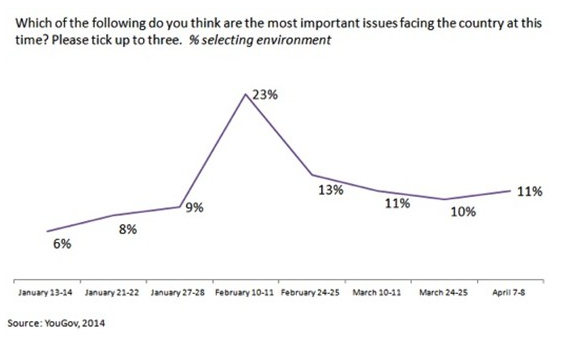
That didn’t take long. The public interest in the state of the natural world stimulated by the winter floods receded almost as quickly as the waters did. A YouGov poll showed that the number of respondents placing the environment among their top three issues of concern rose from 6% in mid-January to 23% in mid-February. By early April – though the Intergovernmental Panel on Climate Change had just published two massive and horrifying reports – the proportion had fallen back to 11%.

CarbonBrief has plotted the results on this graph:

public response to floods

Sustaining interest in this great but slow-burning crisis is a challenge no one seems to have mastered. Only when the crisis causes or exacerbates an acute disaster – such as the floods – is there a flicker of anxiety, but that quickly dies away.

Why is it so difficult to persuade people to care about our wonderful planet, the world that gave rise to us and upon which we wholly depend? And why do you encounter a barrage of hostility and denial whenever you attempt it (and not only from the professional liars who are paid by coal and oil and timber companies to sow confusion and channel hatred)?

The first thing to note, in trying to answer this question, is that the rich anglophone countries are anomalous. In this bar chart (copied from the website of the New York Times) you can see how atypical the attitudes of people in the US and the UK are. Because almost everything we read in this country is published in rich, English-speaking nations, we might get the false impression that the world doesn’t care very much.

bar chart from New York Times

This belief is likely to be reinforced by the cherished notion that we lead the world in knowledge, sophistication and compassion. The bar chart puts me in mind of the famous quote perhaps mistakenly attributed to Gandhi. When asked by a journalist during a visit to Britain, “What do you think of Western civilization?”, he’s reputed to have replied, “I think it would be a good idea.”

Our erroneous belief that we are more concerned about manmade climate change than the people of other nations informs the sentiment, often voiced by the press and politicians, that there’s no point in acting if the rest of the world won’t play its part. For example, last year the Chancellor, George Osborne, remarked:

“I don’t want us to be the only people out there in front of the rest of the world. I certainly think we shouldn’t be further ahead of our partners in Europe.”

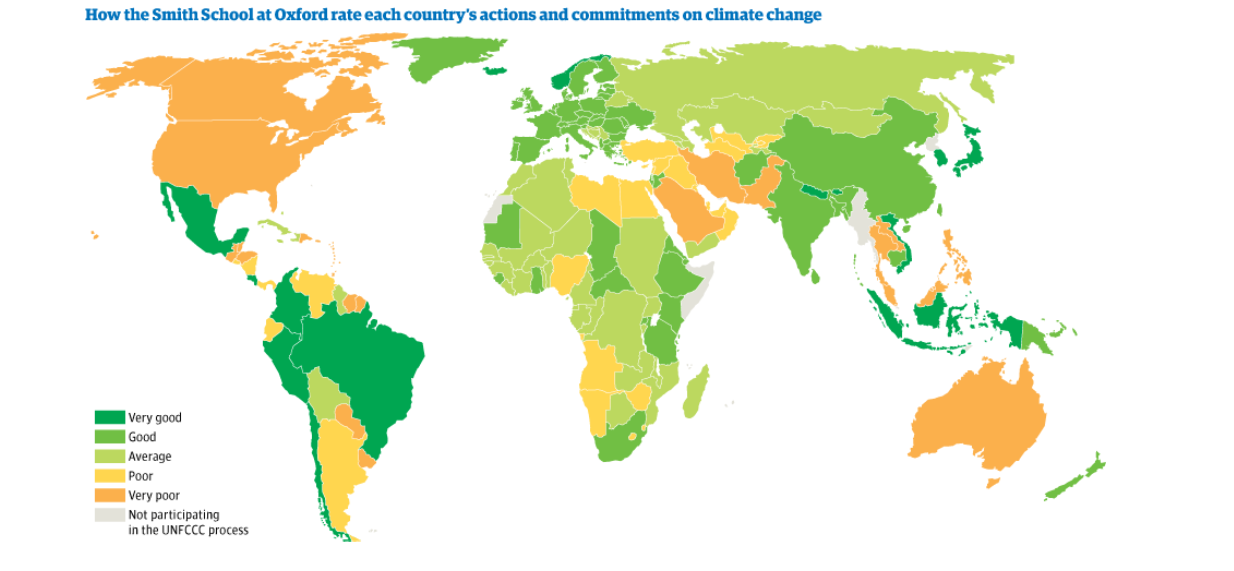
But we’re not “the only people out there in front of the rest of the world.” In fact we’re not in front at all. As this map produced by Oxford University’s Smith School suggests, we are some way behind not only some other rich nations but also a number of countries much poorer than ours.

mapping climate change commitments

As for the US, Australia and Canada, they are ranked among the worst of all: comprehensively failing to limit their massive contribution to a global problem. We justify our foot-dragging with a mistaken premise. Our refusal to stop pumping so much carbon dioxide into the atmosphere is pure selfishness.

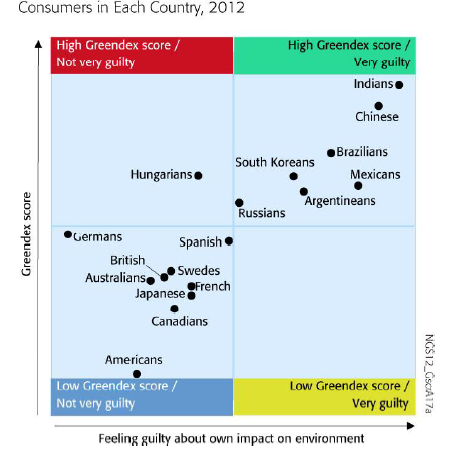
Both the map and the bar chart overlap to some degree with the fascinating results of the Greendex survey of consumer attitudes.

For years we’ve been told that people cannot afford to care about the natural world until they become rich; that only economic growth can save the biosphere, that civilisation marches towards enlightenment about our impacts on the living planet. The results suggest the opposite.

As you can see from the following graph, the people consulted in poorer countries feel, on average, much guiltier about their impacts on the natural world than people in rich countries, even though those impacts tend to be smaller. Of the nations surveyed, the people of Germany, the US, Australia and Britain feel the least consumer guilt; the people of India, China, Mexico and Brazil the most.

Greendex graph

The more we consume, the less we feel. And maybe that doesn’t just apply to guilt.

Perhaps that’s the point of our otherwise-pointless hyperconsumption: it smothers feeling. It might also be the effect of the constant bombardment of advertising and marketing. They seek to replace our attachments to people and place with attachments to objects: attachments which the next round of advertising then breaks in the hope of attaching us to a different set of objects.

The richer we are and the more we consume, the more self-centred and careless of the lives of others we appear to become. Even if you somehow put aside the direct, physical impacts of rising consumption, it’s hard to understand how anyone could imagine that economic growth is a formula for protecting the planet.

So what we seem to see here is the turning of a vicious circle. The more harm we do, the less concerned about it we become. And the more hyperconsumerism destroys relationships, communities and the physical fabric of the Earth, the more we try to fill the void in our lives by buying more stuff.

All this is accompanied in the rich anglophone nations with the extreme neoliberalism promoted by both press and politicians, and a great concentration of power in the hands of the financial and fossil fuel sectors, which lobby hard, in the public sphere and in private, to prevent change.

So the perennially low level of concern, which flickers upwards momentarily when disaster strikes, then slumps back into the customary stupor, is an almost inevitable result of a society that has become restructured around shopping, fashion, celebrity and an obsession with money. How we break the circle and wake people out of this dreamworld is the question that all those who love the living planet should address. There will be no easy answers.

Crazy Climate Economics (New York Times)

MAY 11, 2014

Paul Krugman

Everywhere you look these days, you see Marxism on the rise. Well, O.K., maybe you don’t — but conservatives do. If you so much as mention income inequality, you’ll be denounced as the second coming of Joseph Stalin; Rick Santorum has declared that any use of the word “class” is “Marxism talk.” In the right’s eyes, sinister motives lurk everywhere — for example, George Will says the only reason progressives favor trains is their goal of “diminishing Americans’ individualism in order to make them more amenable to collectivism.”

So it goes without saying that Obamacare, based on ideas originally developed at the Heritage Foundation, is a Marxist scheme — why, requiring that people purchase insurance is practically the same as sending them to gulags.

And just wait until the Environmental Protection Agency announces rules intended to slow the pace of climate change.

Until now, the right’s climate craziness has mainly been focused on attacking the science. And it has been quite a spectacle: At this point almost all card-carrying conservatives endorse the view that climate change is a gigantic hoax, that thousands of research papers showing a warming planet — 97 percent of the literature — are the product of a vast international conspiracy. But as the Obama administration moves toward actually doing something based on that science, crazy climate economics will come into its own.

You can already get a taste of what’s coming in the dissenting opinions from a recent Supreme Court ruling on power-plant pollution. A majority of the justices agreed that the E.P.A. has the right to regulate smog from coal-fired power plants, which drifts across state lines. But Justice Scalia didn’t just dissent; he suggested that the E.P.A.’s proposed rule — which would tie the size of required smog reductions to cost — reflected the Marxist concept of “from each according to his ability.” Taking cost into consideration is Marxist? Who knew?

And you can just imagine what will happen when the E.P.A., buoyed by the smog ruling, moves on to regulation of greenhouse gas emissions.

What do I mean by crazy climate economics?

First, we’ll see any effort to limit pollution denounced as a tyrannical act. Pollution wasn’t always a deeply partisan issue: Economists in the George W. Bush administration wrote paeans to “market based” pollution controls, and in 2008 John McCain made proposals for cap-and-trade limits on greenhouse gases part of his presidential campaign. But when House Democrats actually passed a cap-and-trade bill in 2009, it was attacked as, you guessed it, Marxist. And these days Republicans come out in force to oppose even the most obviously needed regulations, like the plan to reduce the pollution that’s killing Chesapeake Bay.

Second, we’ll see claims that any effort to limit emissions will have what Senator Marco Rubio is already calling “a devastating impact on our economy.”

Why is this crazy? Normally, conservatives extol the magic of markets and the adaptability of the private sector, which is supposedly able to transcend with ease any constraints posed by, say, limited supplies of natural resources. But as soon as anyone proposes adding a few limits to reflect environmental issues — such as a cap on carbon emissions — those all-capable corporations supposedly lose any ability to cope with change.

Now, the rules the E.P.A. is likely to impose won’t give the private sector as much flexibility as it would have had in dealing with an economywide carbon cap or emissions tax. But Republicans have only themselves to blame: Their scorched-earth opposition to any kind of climate policy has left executive action by the White House as the only route forward.

Furthermore, it turns out that focusing climate policy on coal-fired power plants isn’t bad as a first step. Such plants aren’t the only source of greenhouse gas emissions, but they’re a large part of the problem — and the best estimates we have of the path forward suggest that reducing power-plant emissions will be a large part of any solution.

What about the argument that unilateral U.S. action won’t work, because China is the real problem? It’s true that we’re no longer No. 1 in greenhouse gases — but we’re still a strong No. 2. Furthermore, U.S. action on climate is a necessary first step toward a broader international agreement, which will surely include sanctions on countries that don’t participate.

So the coming firestorm over new power-plant regulations won’t be a genuine debate — just as there isn’t a genuine debate about climate science. Instead, the airwaves will be filled with conspiracy theories and wild claims about costs, all of which should be ignored. Climate policy may finally be getting somewhere; let’s not let crazy climate economics get in the way.

Tornadoes, Dust Storms and Floods: What the Hell Happened This Week? (Mashable)

Tornado-april-2014

John Smith reacts after seeing what’s left of his auto repair shop in Mayflower, Ark., Monday, April 28, 2014, after a tornado struck the town late Sunday. IMAGE: KAREN E. SEGRAVE/ASSOCIATED PRESS

The United States had its most unusual weather week of the year to date, with a massive, slow-moving storm system spawning dozens of killer tornadoes, generating widespread flooding and even whipping up hurricane force winds amid blinding dust in the Great Plains.Here are just some of the statistics from this storm system:

    • In Mississippi, the storm spawned at least 14 tornadoes on April 28, including one EF-4 tornado that damaged the city of Louisville in Winston County. At least 10 tornado-related fatalities occurred in Mississippi.
    • In Arkansas, an EF-4 tornado with winds approaching 200 mph touched down on April 27, remaining on the ground for 42 miles, causing heavy damage to the small towns of Mayflower and Vilonia.
    • Along the Alabama and Florida Gulf Coast, including the city of Pensacola, Fla., a staggering 15 to 25 inches of rain fell in just 24 hours, including an hourly rainfall rate of nearly six inches per hour. The National Weather Service said such rainfall rates made this a 1-in-200 to 1-in-500 year rainfall event, meaning there is between a 0.2 to 0.5% likelihood of such a deluge occurring in any given year. These rainfall totals were higher than records set during landfalling hurricanes.
    • The heavy rain spread up the East Coast, where New York City had its 10th-wettest calendar day on record, with 4.97 inches of rain. The wettest day on record was Sept. 23, 1882, when 8.28 inches of rain fell.
    • In the Plains, which is enduring a severe droughtmultiple days of strong winds gusting above 60 mph created blinding dust storms. In Garden City, Kan., for example, wind gusts reached 65 mph on Tuesday, making it the fourth day in a row that wind speeds exceeded 45 mph.

Below, we answered some key questions about this wild weather week.

What the heck kind of storm was this, anyway?

The storm system that helped cause the tornadoes and the flooding is known as a “closed low,” or a low pressure area in the upper levels of the atmosphere that has been cut off from the atmosphere’s steering currents and left to meander on its own. Think of it as a storm that the jet stream cast aside, for unknown reasons.

In any event, the closed low meandered above the High Plains, as the jet stream took on a bizarre, sinuous S-like shape across the U.S. and Canada.

Jet Stream IMAGE: MASHABLE

The jet stream barely changed throughout the week, keeping the closed low locked in place. The firehose-like feed of Gulf of Mexico moisture blasted northward on its eastern flank, resulting from the counterclockwise flow of air around the low pressure area.

This moist air was one of the main ingredients that helped spark the tornado outbreak on April 27 and 28, as well as the flash flooding on April 30.

BmVou9tIAAAFB98

Tweet by Andrew FreedmanThe weather pattern in the US is stuck, one swirl in Plains, another offshore. Tornado outbreak in b/w. 6:14 PM – 28 Apr 2014


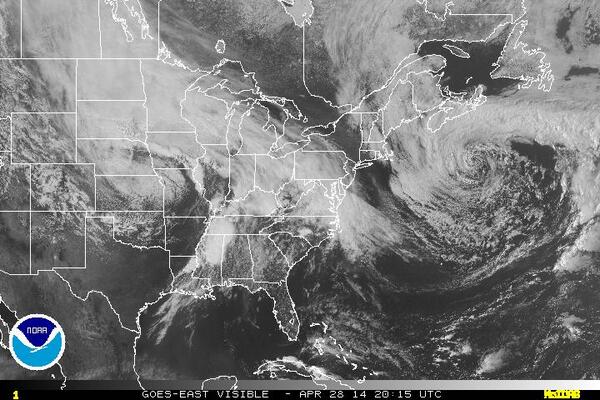
Interestingly, the closed low that spun its way around the High Plains was mirrored by another closed low off the East Coast, in a weather pattern that seemed to have been engineered for the sole purpose of producing extreme outcomes across the U.S.

Why did the storm move so slowly?

As happens from time to time — although some suspect it is happening more frequently now — the weather pattern got stuck in place this week. An unusually large and intense area of high pressure across southeastern Canada helped ensure that the closed low above the Plains had nowhere to escape, as the S-shaped jet stream slowly slithered its way eastward toward the East Coast, like a snake slowly digesting its prey.

The S-shaped jet stream slowly slithered its way eastward toward the East Coast, like a snake slowly digesting its prey.

Blocking patterns such as this one often lead to extreme weather events, especially temperature and precipitation extremes.

For example, a blocking pattern across Europe and Russia in 2010 led to the deadly Russian heat wave that killed thousands and contributed to massive wildfires, as well as the disastrous Pakistan floods that occurred around the same time. Another blocking pattern resulted in the deadly 2003 European heat wave, which killed an estimated 40,000 people.

In the U.S., meteorologists generally view closed, meandering, almost drunk weather patterns like the one from this past week with a sense of foreboding, since they can instigate and prolong severe weather outbreaks. In other words, closed lows usually mean trouble.

How might global warming have contributed to this storm?

Given the sharp increase in greenhouse gases such as carbon dioxide, the atmosphere now contains more moisture, on average, and is warmer, on average, than it used to be. Therefore, any weather system that occurs does so in an altered setting. However, that doesn’t really tell us much, so we have to pick this event apart into its many components.

First, let’s take the blocking pattern itself. Some meteorologists and climate scientists suspect that global warming is leading to more amplified, or wavy, jet stream patterns like the one we saw this week. This can prolong weather events and lead to more extreme events. One such scientist, Jennifer Francis of Rutgers University, has published several studies arguing that rapid climate change in the Arctic, where temperatures are increasing twice as fast as the rest of the world, is behind the jet stream changes in the northern midlatitudes.

However, many atmospheric scientists are not yet sold on this hypothesis, and see little evidence of detectable jet stream changes at all. Nevertheless, this remains a subject of intense ongoing research.

Severe Weather Florida

Workers repair Euclid Street near 12th Ave. in Pensacola, Fla. that was washed out due to recent flooding, Thursday, May 1, 2014. IMAGE: JOHN RAOUX/ASSOCIATED PRESS

Next, let’s look at the tornado outbreaks. This is another subject of ongoing research, with evidence from computer modeling studies so far pointing to projected increase in the number of severe thunderstorm days in a warmer world, but a possible decrease in the number of tornado days as one of the key ingredients for tornadoes, wind shear, becomes more scarce across parts of the U.S.

Wind shear occurs when winds vary in speed or direction with height, or both. When the tornadoes struck Arkansas, Mississippi and Alabama this week, wind shear was extremely high, with low-level winds blowing from the southeast, and winds a few thousand feet off the ground coming out of the southwest. This helped create the spinning motion that eventually resulted in the tornadoes.

According to the AP, data shows that the number of days with at least one significant tornado in the U.S. has been declining since the 1970s. Yet at the same time, the number of tornado outbreak days, with 30 tornadoes or more, has increased.

Rainfall Chart

Chart showing storm total rainfall amounts (in most cases these are two-day totals) along with average monthly precipitation for April. Data comes from Climate Central and NOAA. IMAGE: MASHABLE

“Something has been happening and we’re not sure yet why,” tornado expert Harold Brooks of the National Severe Storms Laboratory told the AP.

This transition to a “boom or bust” tornado regime is consistent with some climate studies showing that even if wind shear declines, it will still be present on some days, leading to potentially larger, but less frequent, outbreaks.

Lastly, there’s the heavy rainfall and flooding to consider. Here, at least, the scientific evidence is clearer — global warming is already leading to an increase in heavy rainfall events in the U.S. and elsewhere, and this is expected to continue. The reason for this is that warmer air holds more water vapor, which provides added fuel for storms.

According to the National Climate Assessment report, which is to be released on May 6, every region in the country (except Hawaii) has seen an increase in heavy precipitation events since 1991.

This means that we better get used to events like the one that occurred in Pensacola, where total 24-hour rainfall amounts approached two feet in some spots.

SEE ALSO: America Underwater: 20 Images From a Week of Record Rains

Taking On Adam Smith (and Karl Marx) (New York Times)

By STEVEN ERLANGER

APRIL 19, 2014

PARIS — Thomas Piketty turned 18 in 1989, when the Berlin Wall fell, so he was spared the tortured, decades-long French intellectual debate about the virtues and vices of communism. Even more telling, he remembers, was a trip he took with a close friend to Romania in early 1990, after the collapse of the Soviet empire.

“This sort of vaccinated me for life against lazy, anticapitalist rhetoric, because when you see these empty shops, you see these people queuing for nothing in the street,” he said, “it became clear to me that we need private property and market institutions, not just for economic efficiency but for personal freedom.”

But his disenchantment with communism doesn’t mean that Mr. Piketty has turned his back on the intellectual heritage of Karl Marx, who sought to explain the “iron laws” of capitalism. Like Marx, he is fiercely critical of the economic and social inequalities that untrammeled capitalism produces — and, he concludes, will continue to worsen. “I belong to a generation that never had any temptation with the Communist Party; I was too young for that,” Mr. Piketty said, in a long interview in his small, airless office here at the Paris School of Economics. “So it’s easier in a way to reopen these big issues about capitalism and inequality with a fresh eye, because I was too young for that fight. I don’t have to justify myself as being pro-communist or pro-capitalist.”

In his new book “Capital in the Twenty-First Century” (Harvard University Press), Mr. Piketty, 42, has written a blockbuster, at least in the world of economics. His book punctures earlier assumptions about the benevolence of advanced capitalism and forecasts sharply increasing inequality of wealth in industrialized countries, with deep and deleterious impact on democratic values of justice and fairness.

Branko Milanovic, a former economist at the World Bank, called it “one of the watershed books in economic thinking.” Paul Krugman, winner of the Nobel in economic science and a columnist for The New York Times, wrote that it “will be the most important economics book of the year — and maybe of the decade.” Remarkably for a book on such a weighty topic, it has already entered The New York Times’s best-seller list.

“Capital in the Twenty-First Century,” with its title echoing Marx’s “Das Kapital,” is meant to be a return to the kind of economic history, of political economy, written by predecessors like Marx and Adam Smith. It is nothing less than a broad effort to understand Western societies and the economic rules that underpin them. And in the process, by debunking the idea that “wealth raises all boats,” Mr. Piketty has thrown down a challenge to democratic governments to deal with an increasing gap between the rich and the poor — the very theme of inequality that recently moved both Pope Francis and President Obama to warn of its consequences.

Mr. Piketty — pronounced pee-ket-ee — grew up in a political home, with left-wing parents who were part of the 1968 demonstrations that turned traditional France upside down. Later, they went off to the Aude, deep in southern France, to raise goats. His parents are not a topic he wants to discuss. More relevant and important, he said, are his generation’s “founding experiences”: the collapse of Communism, the economic degradation of Eastern Europe and the first Gulf War, in 1991.

Those events motivated him to try to understand a world where economic ideas had such bad consequences. As for the Gulf War, it showed him that “governments can do a lot in terms of redistribution of wealth when they want.” The rapid intervention to force Saddam Hussein to unhand Kuwait and its oil was a remarkable show of concerted political will, Mr. Piketty said. “If we are able to send one million troops to Kuwait in a few months to return the oil, presumably we can do something about tax havens.”

Would he want to send troops to Guernsey, the lightly populated tax haven in the English Channel? Mr. Piketty, soft-spoken, barely laughed. “We don’t even have to do that — just simple basic trade policy, trade sanctions, would do the trick right away,” he said.

A top student, Mr. Piketty took a conventional path toward the French elite, being admitted to the rarefied École Normale Supérieure at 18. His doctoral dissertation on the theory of redistribution of wealth, completed at 22, won prizes. He then decamped to teach economics at the Massachusetts Institute of Technology before returning two years later to France, disappointed with the study of economics in America.

“My Ph.D. is mostly about pure economic theory because that was the easiest thing to do, and I was hired at M.I.T. as a young assistant professor doing economic theory,” he said. “I was young and successful at doing this, so it was an easy way. But very quickly I realized that there was little serious effort at collecting historical data on income and wealth, so that’s what I started doing.”

Academic economics is so focused on getting the econometrics and the statistical interpolation technique correct, he said, “you don’t really think, you don’t dare to ask the big questions.” American economists too often narrow the questions they examine to those they can answer, “but sometimes the questions are not that interesting,” he said. “Trying to write a real book that could speak to everyone meant I could not choose my questions. I had to take the important issues in a frontal manner — I could not escape.”

He hated the insularity of the economics department. So he decided to write large, a book he considers as much history as economics, and one that is constructed to lead the general reader by the hand.

He is also not afraid of literature, finding inspiration in the descriptions of society in the realist novels of Jane Austen and Balzac. Wealth was best achieved in these stories through a clever marriage; everyone knew that inherited land and capital was the only way to live well, since labor alone would not produce sufficient income. He wondered how that assumption had changed.

As he extended his work on France to the United States in collaboration with Emmanuel Saez, a professor of economics at the University of California, Berkeley, he saw that the patterns of the early 20th century — “the top 10 percent of the distribution was full of rental income, dividend income, interest income” — seemed less prevalent from the 1970s through the early 1990s.

“It took me a long time to realize that in effect we were returning slowly in the direction of the previous equilibrium, and that we were part of a long transitory process,” he said. When he started working on the issue in the late 1990s, “there was no way this could be understood so clearly — having 20 additional years of data makes a big difference to understanding the postwar period.”

His findings, aided by the power of modern computers, are based on centuries of statistics on wealth accumulation and economic growth in advanced industrial countries. They are also rather simply stated: The rate of growth of income from capital is several times larger than the rate of economic growth, meaning a comparatively shrinking share going to income earned from wages, which rarely increase faster than overall economic activity. Inequality surges when population and the economy grow slowly.

Mr. Piketty’s work is a challenge both to Marxism and laissez-faire economics. The book’s core finding, based on centuries of data, is that the rate of growth of income from capital is several times larger than the rate of economic growth, meaning a shrinking share going to income earned from wages. CreditEd Alcock for The New York Times

The reason that postwar economies looked different — that inequality fell — was historical catastrophe. World War I, the Depression and World War II destroyed huge accumulations of private capital, especially in Europe. What the French call “les trentes glorieuses” — the roughly 30 postwar years of rapid economic growth and shrinking inequality — were a rebound. The American curve, of course, is less sharp, given that the fighting was elsewhere.

A higher than normal rate of population and economic growth helped reduce inequality, along with higher taxes on the wealthy. But the professional and political assumption of the 1950s and 1960s, that inequality would stabilize and diminish on its own, proved to be an illusion. We are now back to a traditional pattern of returns on capital of 4 percent to 5 percent a year and rates of economic growth of around 1.5 percent a year.

So inequality has been quickly gathering pace, aided to some degree by the Reagan and Thatcher doctrines of tax cuts for the wealthy. “Trickle-down economics could have been true,” Mr. Piketty said simply. “It just happened to be wrong.”

His work is a challenge both to Marxism and laissez-faire economics, which “both count on pure economic forces for harmony or justice to prevail,” he said. While Marx presumed that the rate of return on capital, because of the system’s contradictions, would fall close to zero, bringing collapse and revolution, Mr. Piketty is saying the opposite. “The rate of return to capital can be bigger than the growth rate forever — this is actually what we’ve had for most of human history, and there are good reasons to believe we will have it in the future.”

In 2012 the top 1 percent of American households collected 22.5 percent of the nation’s income, the highest total since 1928. The richest 10 percent of Americans now take a larger slice of the pie than in 1913, at the close of the Gilded Age, owning more than 70 percent of the nation’s wealth. And half of that is owned by the top 1 percent.

Mr. Piketty, father of three daughters — 11, 13 and 16 — is no revolutionary. He is a member of no political party, and says he never served as an economic adviser to any politician. He calls himself a pragmatist, who simply follows the data.

But he accepts that his work is essentially political, and he is highly critical of the huge management salaries now in vogue, saying that “the idea that you need people making 10 million in compensation to work is pure ideology.”

Inequality by itself is acceptable, he says, to the extent it spurs individual initiative and wealth-generation that, with the aid of progressive taxation and other measures, helps makes everyone in society better off. “I have no problem with inequality as long as it is in the common interest,” he said.

But like the Columbia University economist Joseph E. Stiglitz, he argues that extreme inequality “threatens our democratic institutions.” Democracy is not just one citizen, one vote, but a promise of equal opportunity.

“It’s very difficult to make a democratic system work when you have such extreme inequality” in income, he said, “and such extreme inequality in terms of political influence and the production of knowledge and information. One of the big lessons of the 20th century is that we don’t need 19th-century inequality to grow.” But that’s just where the capitalist world is heading again, he concludes.

Mr. Saez, his collaborator, said that “Thomas combines great perfectionism with great impatience — he both wants to do things well and do things fast.” He added that Mr. Piketty has “incredible intuition for economics.”

The last part of the book presents Mr. Piketty’s policy ideas. He favors a progressive global tax on real wealth (minus debt), with the proceeds not handed to inefficient governments but redistributed to those with less capital. “We just want a way to share the tax burden that is fair and practical,” he said.

Net wealth is a better indicator of ability to pay than income alone, he said. “All I’m proposing is to reduce the property tax on half or three-quarters of the population who have very little wealth,” he said.

Published a year ago in French, the book is not without critics, especially of Mr. Piketty’s policy prescriptions, which have been called politically naïve. Others point out that some of the increase in capital is because of aging populations and postwar pension plans, which are not necessarily inherited.

More criticism is sure to come, and Mr. Piketty says he welcomes it. “I’m certainly looking forward to the debate.”

Mosquito transgênico para controle da dengue aprovado pela CTNBio (Portal do Meio Ambiente)

17 ABRIL 2014

Brasília – A CTNbio aprovou o pedido de liberação comercial de uma variedade transgênica de Aedes aegypti (o mosquito transmissor do vírus da dengue e de um novo virus, Chikungunya), desenvolvido pela empresa britânica Oxitec. O A. aegypti OX513a carrega um gene de letalidade condicional, que é ativado na ausência de tetraciclina. Os machos, separados das fêmeas ainda em estado de pupa, podem ser produzidos em biofábrica em enormes quantidades, sendo em seguida liberados no ambiente. Para detalhes verhttp://br.oxitec.com .

A votação nominal na Plenária teve como resultado 16 votos favoráveis (sendo um condicional) e um contra.

Antes da votação o parecer de vistas do processo foi lido. O membro relator argumentou pela diligência do processo por várias falhas que, ao seu ver, impediam uma conclusão segura do parecer. O argumento principal foi de que a eliminação do A. aegypti, de forma rápida e extensa, abriria espaço para a recolonização do espaço por outro mosquito, como o Aedes albopictus. Seu parecer foi amplamente rechaçado pela Comissão.

Também antes da votação alguns membros sugeriram uma audiência pública de instrução, que foi rechaçada por 11 votos contra 4.

A discussão imediatamente antes da votação versou menos sobre os riscos diretos do mosquito à saúde humana e animal e ao meio ambiente e derivou para aspectos de benefícios à tecnologia. Esta divergência refletiu o consenso da CTNBio quanto à segurança do produto e à premência de novas técnicas para o controle do vetor da dengue. A discussão também refletiu a segurança da CTNBio sobre o potencial da tecnologia na redução de populações de A. aegypti, sem riscos de recrudescimento de outras doenças, parecimento de novas endemias ou substituição do mosquito vetor, em completa oposição ao ponto de vista isolado do membro relator do pedido de vistas. Uma discussão detalhada do ponto de vista do relator está disponível em http://goo.gl/7aJZuI.

Com estes resultados,a CTNBio abre ao país a possibilidade de empregar um mosquito transgênico para o controle da dengue. A liberação comercial deste mosquito é, também, a primeira liberação comercial de um inseto transgênico no Mundo. O Brasil, usando uma legislação eficiência e séria na avaliação de risco de organismos geneticamente modificados, dá um exemplo de seriedade e maturidade tanto aos países que já fazem avaliação de risco de OGMs, como àqueles que ainda vacilam em ingressar no uso desta tecnologia.

Fonte: GenPeace.

*   *   *

17/4/2014 – 12h13

Mosquitos transgênicos são aprovados, mas pesquisadores temem riscos (Adital)

por Mateus Ramos, do Adital

mosquitos1 300x150 Mosquitos transgênicos são aprovados, mas pesquisadores temem riscos

Um importante, e perigoso, passo foi dado na última semana pela Comissão Técnica Nacional de Biossegurança (CTNBio), que aprovou o projeto de liberação de mosquitos geneticamente modificados no Brasil. Os mosquitos transgênicos serão usados para pesquisa e combate a dengue no país. O projeto, que permite a comercialização dos mosquitos pela empresa britânica Oxitec, foi considerado tecnicamente seguro pela CTNBio e, agora, só necessita de um registro da Agência Nacional de Vigilância Sanitária (Anvisa) para ser, de fato, liberado.

Para o professor da Universidade Federal de São Carlos (SP) e ex- membro da CTNBio, José Maria Ferraz, em entrevista à Adital, a resposta positiva dada ao projeto, pela Comissão, é um forte indicativo de que o mesmo será feito pela Anvisa. “Com certeza será aprovado, o próprio representante do Ministério da Saúde estava lá e disse que, frente às epidemias de dengue, era favorável à aprovação do projeto.”

Ferraz faz duras críticas à aprovação concedida pela CTNBio e ao projeto. “Não existe uma só política de enfrentamento à dengue, mas sim um conjunto de ações, além disso, não há garantias de que os mosquitos liberados também não carreguem a doença, ou seja, vão liberar milhões de mosquitos em todo o país, sem antes haver um estudo sério sobre o projeto. É uma coisa extremamente absurda o que foi feito. É uma insanidade, eu nunca vi tanta coisa errada em um só projeto.”

Outro grande problema apontado por Ferraz é o risco de se alterar, drasticamente, o número de mosquitos Aedes Aegypti. Uma possível redução pode aumentar a proliferação de outro mosquito, ainda mais nocivo, o Aedes Albopictus, que transmite não só a Dengue como outras doenças, a Malária por exemplo. Além disso, ele denuncia que falhas no projeto podem desencadear ainda a liberação de machos não estéreis e fêmeas, dificultando o controle das espécies. “O país está sendo cobaia de um experimento nunca feito antes no mundo. Aprovamos esse projeto muito rápido, de forma irresponsável.”

Os resultados prometidos pelo projeto podem ser afetados, por exemplo, caso haja o contato do mosquito com o antibiótico tetraciclina, que é encontrado em muitas rações para gatos e cachorros. “Basta que os mosquitos entrem em contato com as fezes dos animais alimentados com a ração que contenham esse antibiótico para que todo o experimento falhe.”, revela Ferraz.

Entenda o projeto

De acordo com a Oxitec, a técnica do projeto consiste em introduzir dois novos genes em mosquitos machos, que, ao copularem com as fêmeas do ambiente natural, gerariam larvas incapazes de chegar à fase adulta, ou seja, estas não chegariam à fase em que podem transmitir a doença aos seres humanos. Além disso, as crias também herdariam um marcador que as torna visíveis sob uma luz específica, facilitando o seu controle.

* Publicado originalmente no site Adital.

Krugman: Salvation Gets Cheap (New York Times)

APRIL 17, 2014

Paul Krugman

The Intergovernmental Panel on Climate Change, which pools the efforts of scientists around the globe, has begun releasing draft chapters from its latest assessment, and, for the most part, the reading is as grim as you might expect. We are still on the road to catastrophe without major policy changes.

But there is one piece of the assessment that is surprisingly, if conditionally, upbeat: Its take on the economics of mitigation. Even as the report calls for drastic action to limit emissions of greenhouse gases, it asserts that the economic impact of such drastic action would be surprisingly small. In fact, even under the most ambitious goals the assessment considers, the estimated reduction in economic growth would basically amount to a rounding error, around 0.06 percent per year.

What’s behind this economic optimism? To a large extent, it reflects a technological revolution many people don’t know about, the incredible recent decline in the cost of renewable energy, solar power in particular.

Before I get to that revolution, however, let’s talk for a minute about the overall relationship between economic growth and the environment.

Other things equal, more G.D.P. tends to mean more pollution. What transformed China into the world’s largest emitter of greenhouse gases? Explosive economic growth. But other things don’t have to be equal. There’s no necessary one-to-one relationship between growth and pollution.

People on both the left and the right often fail to understand this point. (I hate it when pundits try to make every issue into a case of “both sides are wrong,” but, in this case, it happens to be true.) On the left, you sometimes find environmentalists asserting that to save the planet we must give up on the idea of an ever-growing economy; on the right, you often find assertions that any attempt to limit pollution will have devastating impacts on growth. But there’s no reason we can’t become richer while reducing our impact on the environment.

Let me add that free-market advocates seem to experience a peculiar loss of faith whenever the subject of the environment comes up. They normally trumpet their belief that the magic of the market can surmount all obstacles — that the private sector’s flexibility and talent for innovation can easily cope with limiting factors like scarcity of land or minerals. But suggest the possibility of market-friendly environmental measures, like a carbon tax or a cap-and-trade system for carbon emissions, and they suddenly assert that the private sector would be unable to cope, that the costs would be immense. Funny how that works.

The sensible position on the economics of climate change has always been that it’s like the economics of everything else — that if we give corporations and individuals an incentive to reduce greenhouse gas emissions, they will respond. What form would that response take? Until a few years ago, the best guess was that it would proceed on many fronts, involving everything from better insulation and more fuel-efficient cars to increased use of nuclear power.

One front many people didn’t take too seriously, however, was renewable energy. Sure, cap-and-trade might make more room for wind and the sun, but how important could such sources really end up being? And I have to admit that I shared that skepticism. If truth be told, I thought of the idea that wind and sun could be major players as hippie-dippy wishful thinking.

The climate change panel, in its usual deadpan prose, notes that “many RE [renewable energy] technologies have demonstrated substantial performance improvements and cost reductions” since it released its last assessment, back in 2007. The Department of Energy is willing to display a bit more open enthusiasm; it titled a report on clean energy released last year “Revolution Now.” That sounds like hyperbole, but you realize that it isn’t when you learn that the price of solar panels has fallen more than 75 percent just since 2008.

Thanks to this technological leap forward, the climate panel can talk about “decarbonizing” electricity generation as a realistic goal — and since coal-fired power plants are a very large part of the climate problem, that’s a big part of the solution right there.

It’s even possible that decarbonizing will take place without special encouragement, but we can’t and shouldn’t count on that. The point, instead, is that drastic cuts in greenhouse gas emissions are now within fairly easy reach.

So is the climate threat solved? Well, it should be. The science is solid; the technology is there; the economics look far more favorable than anyone expected. All that stands in the way of saving the planet is a combination of ignorance, prejudice and vested interests. What could go wrong? Oh, wait.

Global Warming Scare Tactics (New York Times)

 OAKLAND, Calif. — IF you were looking for ways to increase public skepticism about global warming, you could hardly do better than the forthcoming nine-part series on climate change and natural disasters, starting this Sunday on Showtime. A trailer for “Years of Living Dangerously” is terrifying, replete with images of melting glaciers, raging wildfires and rampaging floods. “I don’t think scary is the right word,” intones one voice. “Dangerous, definitely.”

Showtime’s producers undoubtedly have the best of intentions. There are serious long-term risks associated with rising greenhouse gas emissions, ranging from ocean acidification to sea-level rise to decreasing agricultural output.

But there is every reason to believe that efforts to raise public concern about climate change by linking it to natural disasters will backfire. More than a decade’s worth of research suggests that fear-based appeals about climate change inspire denial, fatalism and polarization.

For instance, Al Gore’s 2006 documentary, “An Inconvenient Truth,” popularized the idea that today’s natural disasters are increasing in severity and frequency because of human-caused global warming. It also contributed to public backlash and division. Since 2006, the number of Americans telling Gallup that the media was exaggerating global warming grew to 42 percent today from about 34 percent. Meanwhile, the gap between Democrats and Republicans on whether global warming is caused by humans rose to 42 percent last year from 26 percent in 2006, according to the Pew Research Center.

Other factors contributed. Some conservatives and fossil-fuel interests questioned the link between carbon emissions and global warming. And beginning in 2007, as the country was falling into recession, public support for environmental protection declined.

Still, environmental groups have known since 2000 that efforts to link climate change to natural disasters could backfire, after researchers at the Frameworks Institute studied public attitudes for its report “How to Talk About Global Warming.” Messages focused on extreme weather events, they found, made many Americans more likely to view climate change as an act of God — something to be weathered, not prevented.

Some people, the report noted, “are likely to buy an SUV to help them through the erratic weather to come” for example, rather than support fuel-efficiency standards.

Since then, evidence that a fear-based approach backfires has grown stronger. A frequently cited 2009 study in the journal Science Communication summed up the scholarly consensus. “Although shocking, catastrophic, and large-scale representations of the impacts of climate change may well act as an initial hook for people’s attention and concern,” the researchers wrote, “they clearly do not motivate a sense of personal engagement with the issue and indeed may act to trigger barriers to engagement such as denial.” In a controlled laboratory experiment published in Psychological Science in 2010, researchers were able to use “dire messages” about global warming to increase skepticism about the problem.

Many climate advocates ignore these findings, arguing that they have an obligation to convey the alarming facts.

But claims linking the latest blizzard, drought or hurricane to global warming simply can’t be supported by the science. Our warming world is, according to the United Nations Intergovernmental Panel on Climate Change, increasing heat waves and intense precipitation in some places, and is likely to bring more extreme weather in the future. But the panel also said there is little evidence that this warming is increasing the loss of life or the economic costs of natural disasters. “Economic growth, including greater concentrations of people and wealth in periled areas and rising insurance penetration,” the climate panel noted, “is the most important driver of increasing losses.”

What works, say environmental pollsters and researchers, is focusing on popular solutions. Climate advocates often do this, arguing that solar and wind can reduce emissions while strengthening the economy. But when renewable energy technologies are offered as solutions to the exclusion of other low-carbon alternatives, they polarize rather than unite.

One recent study, published by Yale Law School’s Cultural Cognition Project, found that conservatives become less skeptical about global warming if they first read articles suggesting nuclear energy or geoengineering as solutions. Another study, in the journal Nature Climate Change in 2012, concluded that “communication should focus on how mitigation efforts can promote a better society” rather than “on the reality of climate change and averting its risks.”

Nonetheless, virtually every major national environmental organization continues to reject nuclear energy, even after four leading climate scientists wrote them an open letter last fall, imploring them to embrace the technology as a key climate solution. Together with catastrophic rhetoric, the rejection of technologies like nuclear and natural gas by environmental groups is most likely feeding the perception among many that climate change is being exaggerated. After all, if climate change is a planetary emergency, why take nuclear and natural gas off the table?

While the urgency that motivates exaggerated claims is understandable, turning down the rhetoric and embracing solutions like nuclear energy will better serve efforts to slow global warming.

Brasil e Suécia se aliam para pesquisar mudanças climáticas (Ascom do MCTI)

JC e-mail 4929, de 08 de abril de 2014

Workshop bilateral discutirá desafios, adaptação e iniciativas estratégicas

Novas frentes de diálogo e colaboração devem sair do Workshop Bilateral Brasil-Suécia sobre os Desafios das Mudanças Climáticas – Adaptação e Iniciativas Estratégicas, promovido por três dias, até quarta-feira (9), pela Coordenação de Aperfeiçoamento de Pessoal de Nível Superior (Capes/MEC) em parceria com o Conselho de Pesquisa da Suécia (VR, na sigla original).

Observador do encontro, o secretário de Políticas e Programas de Pesquisa e Desenvolvimento do Ministério da Ciência, Tecnologia e Inovação (MCTI), Carlos Nobre, ressaltou durante a cerimônia de abertura, nesta segunda-feira (7), o caráter singular da parceria: “Chamou minha atenção, inicialmente, a oportunidade de colocar em contato cientistas suecos e brasileiros que trabalham em mudanças climáticas, uma visão de grandes contrastes”.

Nobre comentou diferenças ambientais entre as duas nações. “Nas altas latitudes, especialmente no Ártico, existe certamente uma preocupação muito grande dos países escandinavos, em paralelo aos ecossistemas tropicais, também, de certo modo, ameaçados em médio e longo prazo pelas mudanças ambientais globais”, comparou. “Olhar a questão por esse ângulo dos contrastes vai permitir um avanço muito grande do planejamento de pesquisas conjuntas. Nós sempre aprendemos muito comparando coisas extremas.”

Para o presidente da Capes, Jorge Almeida Guimarães, as experiências internacionais das duas agências governamentais facilitam a criação de laços transversais entre grupos científicos brasileiros e suecos. “Seguramente, sairemos daqui com uma proposta completa de montagem de um programa para aprofundar as pesquisas e a formação de recursos humanos nesse importante tema, que nos afeta a todos hoje, as mudanças climáticas.”

Representante do VR, a professora KerstinSahlin destacou o objetivo fundamental do evento – “pensar como podemos estabelecer um caminho para futuras colaborações” – e adiantou que os debates precisam buscar projetos de pesquisa conjunta com potencial de serem desenvolvidos. “Eu espero que possamos ter uma discussão aberta, informal e bastante construtiva”, disse.

Desafios climáticos
O diretor de Programas e Bolsas no País da Capes, Marcio de Castro, informou que o workshop deve gerar um edital de financiamento de pesquisa e colaboração binacional. “O tema proposto é mais do que atual, envolvendo mudanças climáticas e o impacto nas diferentes áreas do conhecimento”, afirmou. “E o que torna mais ainda oportuna a discussão é o relatório recente do IPCC, o Painel Intergovernamental sobre Mudanças Climáticas.”

Ministra da Embaixada da Suécia em Brasília, a conselheira PernillaJosefssonLazo classificou os desafios das mudanças no clima como “um dos mais importantes tópicos dos nossos tempos”. Ela recordou que um acordo entre os ministérios da Educação possibilitou a aproximação do VR com a Capes, por meio do programa Ciência sem Fronteiras, que, até o momento, ao todo, concedeu 172 bolsas para brasileiros estudarem no país nórdico.

O secretário do MCTI apresentou a liderança da pasta no financiamento de trabalhos nacionais na área, como a Rede Brasileira de Pesquisas sobre Mudanças Climáticas Globais (Rede Clima) – aperfeiçoada recentemente – e investimentos em tecnologias, a exemplo de sistemas de observação da Terra, incluindo sua capacidade de modelagem, e infraestrutura de supercomputação.

“Finalmente, o Brasil chegou a esse ponto importante, que é o fato de desenvolvermos uma capacidade autônoma de gerar cenários climáticos globais”, apontou Nobre. “Hoje, somos um dos poucos países do mundo que têm seus próprios grupos de modelagem e que geram cenários que podem vir a acontecer no nosso planeta na escala de décadas ou séculos.”

Na opinião do secretário, apesar dos avanços recentes na redução de emissões de gases de efeito estufa, o Brasil tem muito trabalho pela frente em adaptação a mudanças climáticas. Segundo ele, já existem iniciativas nos setores de agricultura e desastres naturais, mas o país também precisa desenvolver conhecimento avançado e implementar políticas públicas que contemplem água, biodiversidade e zonas costeiras, por exemplo.

(Rodrigo PdGuerra – Ascom do MCTI)
http://www.mcti.gov.br/index.php/content/view/353787/Brasil_e_Suecia_se_aliam_para_pesquisar_mudancas_climaticas.html

A Rough Ride to the Future by James Lovelock, review (The Telegraph)

James Lovelock argues that climate change may not be the fault of rapacious humanity but the constructive chaos that attends a new infrastructure

James Lovelock, the author of A Rough Ride to the Future

James Lovelock, the author of A Rough Ride to the Future. Photo: EPA

As the inventor of Gaia theory, James Lovelock is used to thinking big. Ever since he came up with the idea that the planet and its inhabitants form one vast, self-regulating system – initially scoffed at, but now taken seriously across a variety of disciplines – his focus has been wider than that of his more hidebound colleagues.

In A Rough Ride to the Future, Lovelock outlines a new theory. He argues that since 1712, the year in which the Newcomen steam engine was created, we have moved into a new age, the Anthropocene, in which humanity’s ability to liberate energy and information from the Earth has rapidly outpaced both Darwinian evolution and the planet’s ability to cope.

What is refreshing about Lovelock’s approach to these issues is that it is blessedly free of dogma. He does not blame humanity for doing what comes naturally: exploiting the wonders available to it. And he is happy to outline the gaps in our understanding of climate science, not least the role of living beings in helping to regulate the system.

This clarity extends to his conclusions. Ultimately, he suggests, climate change is down to ignorance, not negligence – but while we do not yet know its exact contours, the process is both extremely serious and probably unfixable. Unlike the situation with CFCs, or chlorofluorocarbons, a generation ago, there are too many actors – countries, companies and individual humans – that would need to be cudgelled into self-denial if the status quo were to be retained.

Where he differs from the consensus, however, is in suggesting that this might not be such a bad thing. What we are seeing around us, Lovelock argues, may be the large-scale destruction of the planet’s ecosystem by rapacious humanity. But it may also be “no more than the constructive chaos that always attends the installation of a new infrastructure”.

Humanity is already concentrating itself in bigger and bigger cities, so rather than trying to “save the Earth”, or restore some artificial version of a normal climate, why not live comfortable lives in clustered, air-conditioned mega-cities? This serves ants and termites perfectly well, he argues – as well as the inhabitants of Singapore.

The problem is that while many of Lovelock’s ideas are fascinating, the book as a whole fails to match their clarity. There are disconnected sections on the virtues of the lone scientist; on why invention is better than pure research; on the reaction to Gaia theory; and so on. It is clear throughout that Lovelock, now in his nineties, has led a fascinating life, with frequent offhand mentions of consulting for Nasa or devising instruments that proved the contamination of the environment by CFCs. In a typically Lovelockian sentence, the author claims – probably accurately – to have developed the world’s first working microwave, using it in the lab “to reanimate chilled small animals and to cook my lunch”. One finds oneself longing for a full autobiography, rather than these bits and pieces.

The reader certainly gets the sense that Lovelock doesn’t suffer fools – or much of modernity – gladly. “A Faraday or a Darwin,” he laments, “would [today] be buried in paperwork, and obliged to spend their time solving problems concerning health and safety and political correctness, today’s equivalent of the theocratic oppression of Galileo.” Elsewhere, he insists that “the internet has made the human world a monstrous village with an ever-growing population of nags, scolds and officious fools”. Well, up to a point, m’lud.

Whether you enjoy this book, then, will depend on your tolerance for big ideas and awkward constructions. Perhaps the most refreshing aspect of it is that Lovelock extends his lack of cant to the role of humanity as a whole. Just as it is ludicrous to think that the world was precision-engineered for our benefit, so it is arrogant and short-sighted to imagine that the coming centuries must be devoted to the preservation of humanity in its current form.

Perhaps, he suggests, we are not the end point of civilisation but its John the Baptists – the species that either gave birth to, or merged with, a species of electronic life that can supervise and preserve Gaia for centuries to come. That, Lovelock believes, would truly be an achievement. And if it sounds far-fetched – well, they laughed at the Gaia hypothesis, too.

A Rough Ride to the Future by James Lovelock

208pp, Allen Lane, Telegraph offer price £18 (PLUS £1.35 p&p). Call 0844 871 1515 or see books.telegraph.co.uk

Repercussões do novo relatório do Painel Intergovernamental sobre Mudanças Climáticas (IPCC)

Brasil já se prepara para adaptações às mudanças climáticas, diz especialista (Agência Brasil)

JC e-mail 4925, de 02 de abril de 2014

Com base no relatório do IPCC,dirigente do INPE disse que o Brasil já revela um passo adiante em termos de adaptação às mudanças climáticas

Com o título Mudanças Climáticas 2014: Impactos, Adaptação e Vulnerabilidade, o relatório divulgado ontem (31) pelo Painel Intergovernamental sobre Mudanças Climáticas (IPCC) sinaliza que os efeitos das mudanças do clima já estão sendo sentidos em todo o mundo. O relatório aponta que para se alcançar um aquecimento de apenas 2 graus centígrados, que seria o mínimo tolerável para que os impactos não sejam muito fortes, é preciso ter emissões zero de gases do efeito estufa, a partir de 2050.

“O compromisso é ter emissões zero a partir de 2040 /2050, e isso significa uma mudança de todo o sistema de desenvolvimento, que envolve mudança dos combustíveis”, disse hoje (1º) o chefe do Centro de Ciência do Sistema Terrestr,e do Instituto Nacional de Pesquisas Espaciais (Inpe), José Marengo, um dos autores do novo relatório do IPCC. Marengo apresentou o relatório na Academia Brasileira de Ciências (ABC), no Rio de Janeiro, e destacou que alguns países interpretam isso como uma tentativa de frear o crescimento econômico. Na verdade, ele assegurou que a intenção é chegar a um valor para que o aquecimento não seja tão intenso e grave.

Com base no relatório do IPCC, Marengo comentou que o Brasil já revela um passo adiante em termos de adaptação às mudanças climáticas. “Eu acho que o Brasil já escutou a mensagem. Já está começando a preparar o plano nacional de adaptação, por meio dos ministérios do Meio Ambiente e da Ciência, Tecnologia e Inovação”. Essa adaptação, acrescentou, é acompanhada de avaliações de vulnerabilidades, “e o Brasil é vulnerável às mudanças de clima”, lembrou.

A adaptação, segundo ele, atenderá a políticas governamentais, mas a comunidade científica ajudará a elaborar o plano para identificar regiões e setores considerados chave. “Porque a adaptação é uma coisa que muda de região e de setor. Você pode ter uma adaptação no setor saúde, no Nordeste, totalmente diferente do Sul. Então, essa é uma política que o governo já está começando a traçar seriamente”.

O plano prevê análises de risco em setores como agricultura, saúde, recursos hídricos, regiões costeiras, grandes cidades. Ele está começando a ser traçado como uma estratégia de governo. Como as vulnerabilidades são diferentes, o plano não pode criar uma política única para o país. Na parte da segurança alimentar, em especial, José Marengo ressaltou a importância do conhecimento indígena, principalmente para os países mais pobres.

Marengo afiançou, entretanto, que esse plano não deverá ser concluído no curto prazo. “É uma coisa que leva tempo. Esse tipo de estudo não pode ser feito em um ou dois anos. É uma coisa de longo prazo, porque vai mudando continuamente. Ou seja, é um plano dinâmico, que a cada cinco anos tem que ser reavaliado e refeito. Poucos países têm feito isso, e o Brasil está começando a elaborar esse plano agora”, manifestou.

Marengo admitiu que a adaptação às mudanças climáticas tem que ter também um viés econômico, por meio da regulação. “Quando eu falo em adaptação, é uma mistura de conhecimento científico para identificar que área é vulnerável. Mas tudo isso vem acompanhado de coisas que não são climáticas, mas sim, econômicas, como custos e investimento. Porque adaptação custa dinheiro. Quem vai pagar pela adaptação? “, indagou.

O IPCC não tem uma posição a respeito, embora Marengo mencione que os países pobres querem que os ricos paguem pela sua adaptação às mudanças do clima. O tema deverá ser abordado na próxima reunião da 20ª Convenção-Quadro sobre Mudança do Clima COP-20, da Organização das Nações Unidas (ONU), que ocorrerá em Lima, no Peru, no final deste ano.

Entretanto, o IPCC aponta situações sobre o que está ocorrendo nas diversas partes do mundo, e o que poderia ser feito. As soluções, salientou, serão indicadas no próximo relatório do IPCC, cuja divulgação é aguardada para este mês. O relatório, segundo ele, apontará que “a solução está na mitigação”. Caso, por exemplo, da redução das emissões de gases de efeito estufa, o uso menor de combustíveis fósseis e maior uso de fontes de energia renováveis, novas opções de combustíveis, novas soluções de tecnologia, estabilização da população. “Tudo isso são coisas que podem ser consideradas”. Admitiu, porém, que são difíceis de serem alcançadas, porque alguns países estão dispostos a isso, outros não. “É uma coisa que depende de acordo mundial”.

De acordo com o relatório do IPCC, as tendências são de aumento da temperatura global, aumento e diminuição de precipitações (chuvas), degradação ambiental, risco para as áreas costeiras e a fauna marinha, mudança na produtividade agrícola, entre outras. A adaptação a essas mudanças depende do lugar e do contexto. A adaptação para um setor pode não ser aplicável a outro. As medidas visando a adaptação às mudanças climáticas devem ser tomadas pelos governos, mas também pela sociedade como um todo e pelos indivíduos, recomendam os cientistas que elaboraram o relatório.

Para o Nordeste brasileiro, por exemplo, a construção de cisternas pode ser um começo no sentido de adaptação à seca. Mas isso tem de ser uma busca permanente, destacou José Marengo. Observou que programas de reflorestamento são formas de mitigação e, em consequência, de adaptação, na medida em que reduzem as emissões e absorvem as emissões excedentes.

No Brasil, três aspectos se distinguem: segurança hídrica, segurança energética e segurança alimentar. As secas no Nordeste e as recentes enchentes no Norte têm ajudado a entender o problema da vulnerabilidade do clima, acrescentou o cientista. Disse que, de certa forma, o Brasil tem reagido para enfrentar os extremos. “Mas tem que pensar que esses extremos podem ser mais frequentes. A experiência está mostrando que alguns desses extremos devem ser pensados no longo prazo, para décadas”, salientou.

O biólogo Marcos Buckeridge, pesquisador do Instituto de Biociências da Universidade de São Paulo (USP) e membro do IPCC, lembrou que as queimadas na Amazônia, apesar de mostrarem redução nos últimos anos, ainda ocorrem com intensidade. “O Brasil é o país que mais queima floresta no mundo”, e isso leva à perda de muitas espécies animais e vegetais, trazendo, como resultado, impactos no clima.

Para a pesquisadora sênior do Centro de Estudos Integrados sobre Meio Ambiente e Mudanças Climáticas – Centro Clima da Universidade Federal do Rio de Janeiro, Carolina Burle Schmidt Dubeux, a economia da adaptação deve pensar o gerenciamento também do lado da demanda. Isso quer dizer que tem que englobar não só investimentos, mas também regulação econômica em que os preços reflitam a redução da oferta de bens. “Regulação econômica é muito importante para que a gente possa se adaptar [às mudanças do clima]. As políticas têm que refletir a escassez da água e da energia elétrica e controlar a demanda”, apontou.

Segundo a pesquisadora, a internalização de custos ambientais nos preços é necessária para que a população tenha maior qualidade de vida. “A questão da adaptação é um constante gerenciamento do risco das mudanças climáticas, que é desconhecido e imprevisível”, acrescentou. Carolina defendeu que para ocorrer a adaptação, deve haver uma comunicação constante entre o governo e a sociedade. “A mídia tem um papel relevante nesse processo”, disse.

(Agência Brasil)

* * *

Mudanças climáticas ameaçam produtos da cesta básica brasileira (O Globo)

JC e-mail 4925, de 02 de abril de 2014

Dieta será prejudicada por queda das safras e da atividade pesqueira

Os impactos das mudanças climáticas no país comprometerão o rendimento das safras de trigo, arroz, milho e soja, produtos fundamentais da cesta básica do brasileiro. Outro problema desembarca no litoral. Segundo prognósticos divulgados esta semana pelo Painel Intergovernamental de Mudanças Climáticas (IPCC), grandes populações de peixes deixarão a zona tropical nas próximas décadas, buscando regiões de alta latitude. Desta forma, a pesca artesanal também é afetada.

A falta de segurança alimentar também vai acometer outros países. Estima-se que a atividade agrícola da União Europeia caia significativamente até o fim do século. Duas soluções já são estudadas. Uma seria aumentar as importações – o Brasil seria um importante mercado, se conseguir nutrir a sua população e, além disso, desenvolver uma produção excedente. A outra possibilidade é a pesquisa de variedades genéticas que deem resistência aos alimentos diante das novas condições climáticas.

– Os eventos extremos, mesmo quando têm curta duração, reduzem o tamanho da safra – contou Marcos Buckeridge, professor do Departamento de Botânica da USP e coautor do relatório do IPCC, em uma apresentação realizada ontem na Academia Brasileira de Ciências. – Além disso, somos o país que mais queima florestas no mundo, e a seca é maior justamente na Amazônia Oriental, levando a perdas na agricultura da região.

O aquecimento global também enfraquecerá a segurança hídrica do país.

– É preciso encontrar uma forma de garantir a disponibilidade de água no semiárido, assim como estruturas que a direcione para as áreas urbanas – recomenda José Marengo, climatologista do Instituto Nacional de Pesquisas Espaciais (Inpe) e também autor do relatório.

Marengo lembra que o Nordeste enfrenta a estiagem há três anos. Segundo ele, o uso de carros-pipa é uma solução pontual. Portanto, outras medidas devem ser pensadas. A transposição do Rio São Francisco também pode não ser suficiente, já que a região deve passar por um processo de desertificação até o fim do século.

De acordo com um estudo realizado em 2009 por diversas instituições brasileiras, e que é citado no novo relatório do IPCC, as chuvas no Nordeste podem diminuir até 2,5mm por dia até 2100, causando perdas agrícolas em todos os estados da região. O déficit hídrico reduziria em 25% a capacidade de pastoreiro dos bovinos de corte. O retrocesso da pecuária é outro ataque à dieta do brasileiro.

– O Brasil perderá entre R$ 719 bilhões e R$ 3,6 trilhões em 2050, se nada fizer . Enfrentaremos perda agrícola e precisaremos de mais recursos para o setor hidrelétrico – alerta Carolina Dubeux, pesquisadora do Centro Clima da Coppe/UFRJ, que assina o documento. – A adaptação é um constante gerenciamento de risco.

(Renato Grandelle / O Globo)
http://oglobo.globo.com/ciencia/mudancas-climaticas-ameacam-produtos-da-cesta-basica-brasileira-12061170#ixzz2xjSEUoVy

* * *

Impactos mais graves no clima do país virão de secas e de cheias (Folha de S.Paulo)

JC e-mail 4925, de 02 de abril de 2014

Brasileiros em painel da ONU dizem que país precisa se preparar para problemas opostos em diferentes regiões

As previsões regionais do novo relatório do IPCC (painel do clima da ONU) aponta como principais efeitos da mudança climática no país problemas na disponibilidade de água, com secas persistentes em alguns pontos e cheias recordes em outros. Lançado anteontem no Japão, o documento do grupo de trabalho 2 do IPCC dá ênfase a impactos e vulnerabilidades provocados pelo clima ao redor do mundo. Além de listar os principais riscos, o documento ressalta a necessidade de adaptação aos riscos projetados. No Brasil, pela extensão territorial, os efeitos serão diferentes em cada região.

Além de afetar a floresta e seus ecossistemas, a mudança climática deve prejudicar também a geração de energia, a agricultura e até a saúde da população. “Tudo remete à água. Onde nós tivermos problemas com a água, vamos ter problemas com outras coisas”, resumiu Marcos Buckeridge, professor da USP e um dos autores do relatório do IPCC, em entrevista coletiva com outros brasileiros que participaram do painel.

Na Amazônia, o padrão de chuvas já vem sendo afetado. Atualmente, a cheia no rio Madeira já passa dos 25 m –nível mais alto da história– e afeta 60 mil pessoas. No Nordeste, que nos últimos anos passou por secas sucessivas, as mudanças climáticas podem intensificar os períodos sem chuva, e há um risco de que o semiárido vire árido permanentemente.

Segundo José Marengo, do Inpe (Instituto Nacional de Pesquisas Espaciais) e um dos autores principais do documento, ainda é cedo para saber se a seca persistente em São Paulo irá se repetir no ano que vem ou nos outros, mas alertou que é preciso que o Brasil se prepare melhor.

MITIGAR E ADAPTAR
O IPCC fez previsões para diferentes cenários, mas, basicamente, indica que as consequências são mais graves quanto maiores os níveis de emissões de gases-estufa. “Se não dá para reduzir as ameaças, precisamos pelo menos reduzir os riscos”, disse Marengo, destacando que, no Brasil, nem sempre isso acontece. No caso das secas, a construção de cisternas e a mobilização de carros-pipa seriam alternativas de adaptação. Já nos locais onde deve haver aumento nas chuvas, a remoção de populações de áreas de risco, como as encostas, seria a alternativa.

Carolina Dubeux, da UFRJ, que também participa do IPCC, afirma que, para que haja equilíbrio entre oferta e demanda, é preciso que a economia reflita a escassez dos recursos naturais, sobretudo em áreas como agricultura e geração de energia. “É necessário que os preços reflitam a escassez de um bem. Se a água está escassa, o preço dela precisa refletir isso. Não podemos só expandir a oferta”, afirmou.

Neste relatório, caiu o grau de confiança sobre projeções para algumas regiões, sobretudo em países em desenvolvimento. Segundo Carlos Nobre, secretário do Ministério de Ciência, Tecnologia e Inovação, isso não significa que o documento tenha menos poder político ou científico.

Everton Lucero, chefe de clima no Itamaraty, diz que o documento será importante para subsidiar discussões do próximo acordo climático mundial. “Mas há um desequilíbrio entre os trabalhos científicos levados em consideração pelo IPCC, com muito mais ênfase no que é produzido nos países ricos. As nações em desenvolvimento também produzem muita ciência de qualidade, que deve ter mais espaço”, disse.

(Giuliana Miranda/Folha de S.Paulo)
http://www1.folha.uol.com.br/fsp/cienciasaude/159305-impactos-mais-graves-no-clima-do-pais-virao-de-secas-e-de-cheias.shtml

* * *

Relatório do IPCC aponta riscos e oportunidades para respostas (Ascom do MCTI)

JC e-mail 4925, de 02 de abril de 2014

Um total de 309 cientistas de 70 países, entre coordenadores, autores, editores e revisores, foram selecionados para produzir o relatório

O novo relatório do Painel Intergovernamental sobre Mudanças Climáticas (IPCC) diz que os efeitos das mudanças climáticas já estão ocorrendo em todos os continentes e oceanos e que o mundo, em muitos casos, está mal preparado para os riscos. O documento também conclui que há oportunidades de repostas, embora os riscos sejam difíceis de gerenciar com os níveis elevados de aquecimento.

O relatório, intitulado Mudanças Climáticas 2014: Impactos, Adaptação e Vulnerabilidade, foi elaborado pelo Grupo de Trabalho 2 (GT 2) do IPCC e detalha os impactos das mudanças climáticas até o momento, os riscos futuros e as oportunidades para uma ação eficaz para reduzir os riscos. Os resultados foram apresentados à imprensa brasileira em entrevista coletiva no Rio de Janeiro nesta terça-feira (1º).

Um total de 309 cientistas de 70 países, entre coordenadores, autores, editores e revisores, foram selecionados para produzir o relatório. Eles contaram com a ajuda de 436 autores contribuintes e 1.729 revisores especialistas.

Os autores concluem que a resposta às mudanças climáticas envolve fazer escolhas sobre os riscos em um mundo em transformação, assinalando que a natureza dos riscos das mudanças climáticas é cada vez mais evidente, embora essas alterações também continuem a produzir surpresas. O relatório identifica as populações, indústrias e ecossistemas vulneráveis ao redor do mundo.

Segundo o documento, o risco da mudança climática provém de vulnerabilidade (falta de preparo), exposição (pessoas ou bens em perigo) e sobreposição com os riscos (tendências ou eventos climáticos desencadeantes). Cada um desses três componentes pode ser alvo de ações inteligentes para diminuir o risco.

“Vivemos numa era de mudanças climáticas provocadas pelo homem”, afirma o copresidente do GT 2 Vicente Barros, da Universidade de Buenos Aires, Argentina. “Em muitos casos, não estamos preparados para os riscos relacionados com o clima que já enfrentamos. Investimentos num melhor preparo podem melhorar os resultados, tanto para o presente e para o futuro.”

Reação
A adaptação para reduzir os riscos das mudanças climáticas começa a ocorrer, mas com um foco mais forte na reação aos acontecimentos passados do que na preparação para um futuro diferente, de acordo com outro copresidente do GT, Chris Field, da Carnegie Institution for Science, dos Estados Unidos.

“A adaptação às mudanças climáticas não é uma agenda exótica nunca tentada. Governos, empresas e comunidades ao redor do mundo estão construindo experiência com a adaptação”, explica Field. “Esta experiência constitui um ponto de partida para adaptações mais ousadas e ambiciosas, que serão importantes à medida que o clima e a sociedade continuam a mudar”.

Riscos futuros decorrentes das mudanças no clima dependem fortemente da quantidade de futuras alterações climáticas. Magnitudes crescentes de aquecimento aumentam a probabilidade de impactos graves e generalizados que podem ser surpreendentes ou irreversíveis.

“Com níveis elevados de aquecimento, que resultam de um crescimento contínuo das emissões de gases de efeito estufa, será um desafio gerenciar os riscos e mesmo investimentos sérios e contínuos em adaptação enfrentarão limites”, afirma Field.

Problemas
Impactos observados da mudança climática já afetaram a agricultura, a saúde humana, os ecossistemas terrestres e marítimos, abastecimento de água e a vida de algumas pessoas. A característica marcante dos impactos observados é que eles estão ocorrendo a partir dos trópicos para os polos, a partir de pequenas ilhas para grandes continentes e dos países mais ricos para os mais pobres.

“O relatório conclui que as pessoas, sociedades e ecossistemas são vulneráveis em todo o mundo, mas com vulnerabilidade diferentes em lugares diferentes. As mudanças climáticas muitas vezes interagem com outras tensões para aumentar o risco”, diz Chris Field.

A adaptação pode desempenhar um papel-chave na redução destes riscos, observa Vicente Barros. “Parte da razão pela qual a adaptação é tão importante é que, devido à mudança climática, o mundo enfrenta uma série de riscos já inseridos no sistema climático, acentuados pelas emissões passadas e infraestrutura existente”.

Field acrescenta: “A compreensão de que a mudança climática é um desafio na gestão de risco abre um leque de oportunidades para integrar a adaptação com o desenvolvimento econômico e social e com as iniciativas para limitar o aquecimento futuro. Nós definitivamente enfrentamos desafios, mas compreender esses desafios e ultrapassá-los de forma criativa pode fazer da adaptação à mudança climática uma forma importante de ajudar a construir um mundo mais vibrante em curto prazo e além”.

Conteúdo
O relatório do GT 2 é composto por dois volumes. O primeiro contém Resumo para Formuladores de Políticas, Resumo Técnico e 20 capítulos que avaliam riscos por setor e oportunidades para resposta. Os setores incluem recursos de água doce, os ecossistemas terrestres e oceânicos, costas, alimentos, áreas urbanas e rurais, energia e indústria, a saúde humana e a segurança, além dos meios de vida e pobreza.

Em seus dez capítulos, o segundo volume avalia os riscos e oportunidades para a resposta por região. Essas regiões incluem África, Europa, Ásia, Australásia (Austrália, a Nova Zelândia, a Nova Guiné e algumas ilhas menores da parte oriental da Indonésia), América do Norte, América Central e América do Sul, regiões polares, pequenas ilhas e oceanos.

Acesse a contribuição do grupo de trabalho (em inglês) aqui ou no site da instituição.

A Unidade de Apoio Técnico do GT 2 é hospedada pela Carnegie Institution for Science e financiada pelo governo dos Estados Unidos.

Mapa
“O relatório do Grupo de Trabalho 2 é outro importante passo para a nossa compreensão sobre como reduzir e gerenciar os riscos das mudanças climáticas”, destaca o presidente do IPCC, RajendraPachauri. “Juntamente com os relatórios dos grupos 1 e 3, fornece um mapa conceitual não só dos aspectos essenciais do desafio climático, mas as soluções possíveis.”

O relatório do GT 1 foi lançado em setembro de 2013, e o do GT 3 será divulgado neste mês. O quinto relatório de avaliação (AR5) será concluído com a publicação de uma síntese em outubro.

O Painel Intergovernamental sobre Mudança do Clima é o organismo internacional para avaliar a ciência relacionada à mudança climática. Foi criado em 1988 pela Organização Meteorológica Mundial e pelo Programa das Nações Unidas para o Ambiente (Pnuma), para fornecer aos formuladores de políticas avaliações regulares da base científica das mudanças climáticas, seus impactos e riscos futuros, e opções para adaptação e mitigação.

Foi na 28ª Sessão do IPCC, realizada em abril de 2008, que os membros do painel decidiram preparar o AR5. O documento envolveu 837 autores e editores de revisão.

(Ascom do MCTI, com informações do IPCC)
http://www.mcti.gov.br/index.php/content/view/353700/Relatorio_do_IPCC_aponta_riscos_e_oportunidades_para_respostas.html

Relatório do IPCC sugere adaptação baseada em ecossistemas (Estado de S.Paulo)

JC e-mail 4923, de 31 de março de 2014

Modelo adotado no Brasil e região foi indicado como alternativa a infraestutura cara

Além das recomendações usuais para que os países invistam mais em infraestrutura para aumentar sua resiliência às mudanças climáticas, no novo relatório do Painel Intergovernamental sobre Mudanças Climáticas (IPCC), divulgado neste domingo, 30, ganhou espaço uma alternativa mais barata que pode, em alguns locais, conseguir efeitos parecidos: a adaptação baseada em ecossistemas.

O tema aparece em maior ou menor profundidade em cerca de metade dos capítulos e teve destaque especial no capítulo regional de América Central e do Sul, onde técnicas como criação de áreas protegidas, acordos para conservação e manejos comunitários de áreas naturais estão sendo testadas.

Mas o que isso tem a ver com adaptação? De acordo com o ecólogo Fabio Scarano, da Conservação Internacional, e um dos autores do capítulo, a ideia é fortalecer serviços ecossistêmicos que são fundamentais. Um ambiente bem preservado tem a capacidade de prover um clima estável, o fornecimento de água, a presença de polinizadores. “Como se fosse uma infraestrutura da própria natureza”, diz.

Como premissa, está a conservação da natureza aliada ao incentivo do seu uso sustentável – a fim também de evitar a pobreza, que é um dos principais motores da vulnerabilidade de populações.

“Normalmente quando se fala em adaptação se pensa na construção de grandes estruturas, como um dique, por exemplo, para evitar uma inundação. O que em geral é muito caro, mas em uma adaptação baseada em ecossistemas, conservar a natureza e usá-la bem é uma forma de diminuir a vulnerabilidade das pessoas às mudanças climáticas”, afirma.

Ele cita como exemplo uma região costeira em que o mangue tenha sido degradado. “Esse ecossistema funciona como uma barreira. Em um cenário de ressacas mais fortes, elevação do nível do mar, a costa vai ficar mais vulnerável, será necessário construir diques. Mas se mantém o mangue em pé e se oferece um auxílio para que as pessoas possam ter uma economia básica desse mangue, com técnicas mais sustentáveis, e elas recebam para mantê-lo assim, vai ser mais barato do que depois ter de fazer um dique.”

Segundo o pesquisador, para ser mais resiliente é importante acabar com a pobreza e preservar a natureza. “Se for possível ter os dois, a gente consegue o tão falado desenvolvimento sustentável”, opina.

(Giovana Girardi / Estado de S.Paulo)
http://www.estadao.com.br/noticias/vida,relatorio-do-ipcc-sugere-adaptacao-baseada-em-ecossistemas,1147134,0.htm

Outras matérias sobre o assunto:

O Globo
Painel da ONU apresenta medidas contra aquecimento global
http://oglobo.globo.com/ciencia/painel-da-onu-apresenta-medidas-contra-aquecimento-global-12038245#ixzz2xXy60bbZ

Valor Econômico
Mudança do clima afeta a todos e está acontecendo agora, alerta IPCC
http://www.valor.com.br/internacional/3500174/mudanca-do-clima-afeta-todos-e-esta-acontecendo-agora-alerta-ipcc#ixzz2xYAtWVsg

Chuvas no Sul e no Sudeste podem voltar ao normal só em 2016 (Agência Brasil)

JC e-mail 4923, de 31 de março de 2014

Para o Brasil, o fenômeno indica a possibilidade de as chuvas no centro-sul do país só voltaram ao normal no verão de 2016

A origem da crise energética provocada pela estiagem no Sul e no Sudeste no início do ano pode estar do outro lado do mundo. Segundo meteorologistas ouvidos pela Agência Brasil, o país está sendo afetado por um ciclo natural de resfriamento do Oceano Pacífico, que se reflete em alterações climáticas em grande parte do planeta. Para o Brasil, o fenômeno indica a possibilidade de as chuvas no centro-sul do país só voltaram ao normal no verão de 2016.

Chamado de oscilação interdecadal do Pacífico ou oscilação decadal do Pacífico (PDO, na sigla em inglês), o processo caracteriza-se pela sucessão entre fases quentes e frias na área tropical do Oceano Pacífico. Os ciclos duram de 20 a 30 anos e são mais amplos que os fenômenos El Niño e La Niña, que se alternam de dois a sete anos. Em 1999, o oceano entrou numa fase fria, que deve durar até 2025 e se reflete em El Niños brandos e La Niñas mais intensos.

Atualmente, o Pacífico está no auge do ciclo de resfriamento, o que, segundo os especialistas, historicamente provoca quatro anos seguidos de verões com chuvas abaixo do normal na região Centro-Sul do Brasil. “Desde 2012, tem chovido abaixo da média no Sul, no Sudeste e em parte do Centro-Oeste durante o verão. A princípio, o que está sendo desenhado é as chuvas só voltarem à média em 2016”, diz o meteorologista Alexandre Nascimento, especialista em análises climáticas da Climatempo.

A partir do segundo semestre, os modelos climáticos apontam a chegada de um novo El Niño, com chuvas no Sul e seca no Nordeste. No entanto, por causa do resfriamento do Oceano Pacífico, o El Niño deverá ser mais fraco que o normal e insuficiente para recompor os reservatórios. “O próximo verão deverá ter mais chuva que o anterior, mas as chuvas tendem a continuar irregulares no Sul e no Sudeste”, adverte Nascimento.

O El Niño é o aquecimento do Oceano Pacífico na região equatorial. Pesquisadora do Instituto Nacional de Pesquisas Espaciais (Inpe), Mary Kayano estudou a relação entre esse fenômeno e a oscilação decadal do Pacífico e constatou um padrão. “Em fases frias da PDO, os El Niños são mais brandos. Tanto que o último El Niño forte ocorreu em 1997, quando o Oceano Pacífico estava numa fase quente”, diz. Ela, no entanto, evita fazer prognósticos sobre o próximo verão. Segundo a pesquisadora, o Inpe emite previsões somente para os próximos três meses.

O comportamento histórico, no entanto, indica que o resfriamento do Pacífico está afetando o Brasil. Segundo o diretor-geral da MetSul Meteorologia, Eugenio Hackbart, o Brasil enfrentou uma sequência de verões com estiagem entre o fim dos anos 1950 e o início da década de 1960, quando o Pacífico atravessava um pico de temperaturas baixas. “Os padrões de circulação atmosférica hoje estão semelhantes aos daquela época”, compara.

Além das chuvas irregulares durante o verão, o resfriamento do Oceano Pacífico traz efeitos distintos conforme as regiões do país, com invernos mais rigorosos no Sul e no Sudeste. “Ano passado, chegou a nevar perto de Florianópolis”, lembra Hackbart. O fenômeno provoca ainda cheias acima da média no Amazonas e no Pará. No entanto, esclarece o diretor da MetSul, não está relacionado à cheia do Rio Madeira, decorrente de chuvas atípicas na Bolívia.

Apesar das chuvas acima da média na maior parte do país em março, Nascimento, da Climatempo, considera que os reservatórios não devem voltar a subir com rapidez por causa do tipo de chuva que tem atingido a região e da chegada da estação seca ao Centro-Sul nos próximos meses. “A verdade é que os reservatórios só enchem com chuvas generalizadas, que duram vários dias e são constantes. Até agora, temos registrado pancadas, que podem ser fortes, mas são eventos isolados”, explica.

Mesmo com a possibilidade de mais um verão com chuvas abaixo da média, os meteorologistas recomendam cuidado com os prognósticos. “A maioria dos estudos sobre os ciclos no Oceano Pacífico é recente. A gente precisa de séries históricas mais longas para compreender a extensão do fenômeno”, diz a pesquisadora do Inpe. Hackbart levanta dúvidas sobre a intensidade do próximo El Niño. “Alguns modelos e especialistas dizem que o próximo El Niño tem chances de ser forte. Nesse caso, as chuvas podem ser mais intensas e ajudar os reservatórios”, pondera.

Aquecimento global contribuiu pouco para estiagem no Centro-Sul (Agência Brasil)

JC e-mail 4923, de 31 de março de 2014

A combinação entre o resfriamento do Oceano Pacífico, que tem provocado chuvas abaixo da média nos últimos anos no Centro-Sul do país, e o aquecimento anormal da porção sul do Atlântico provocou a estiagem

Apontado como o vilão das mudanças climáticas, o aquecimento global tem o papel questionado na estiagem que atingiu o Sul e o Sudeste no início do ano. Para os meteorologistas ouvidos pela Agência Brasil, as emissões de gás carbônico, no máximo, pioraram o calor no Sul e no Sudeste, mas não foram a causa do verão mais seco no Centro-Sul desde o início das medições, em 1931.

A combinação entre o resfriamento do Oceano Pacífico, que tem provocado chuvas abaixo da média nos últimos anos no Centro-Sul do país, e o aquecimento anormal da porção sul do Atlântico provocou a estiagem. As águas aquecidas próximas à costa brasileira fortaleceram um sistema de alta pressão que impediu a entrada de frentes frias e aumentou o calor em janeiro e fevereiro. No entanto, a relação entre a alteração no Atlântico e o aquecimento global ainda não é clara.

“A estiagem foi mais grave que o previsto justamente por causa do sistema de alta pressão do Atlântico que bloqueou as frentes frias, mas não há comprovação de que o Atlântico ficou mais quente por causa do aquecimento global”, explica o diretor-geral da MetSul Meteorologia, Eugenio Hackbart.

Para o especialista em tendências climáticas da Climatempo, Alexandre Nascimento, o aquecimento global está mais relacionado a eventos isolados, como enchentes e furacões, do que a fenômenos de vários anos de duração, como o ciclo de temperaturas baixas no Oceano Pacífico. Ele também questiona se o calor foi consequência apenas das emissões de gás carbônico. “A seca foi tão quente por causa do aquecimento global ou por causa do desmatamento e do crescimento das cidades? As associações não são tão simples”, opina.

Global warming dials up our risks, UN report says (AP)

By SETH BORENSTEIN, 30 March 2014

FILE – In this Aug. 20, 2013 file photo, Syrian refugees cross into Iraq at the Peshkhabour border point in Dahuk, 260 miles (430 kilometers) northwest of Baghdad, Iraq. In an authoritative report due out Monday, March 31, 2014, a United Nations climate panel for the first time is connecting hotter global temperatures to hotter global tempers. Top scientists are saying that climate change will complicate and worsen existing global security problems, such as civil wars, strife between nations and refugees. (AP Photo/Hadi Mizban, File)
FILE – In this Dec. 17, 2011 file photo, an Egyptian protester throws a stone toward soldiers, unseen, as a building burns during clashes near Tahrir Square, in Cairo, Egypt. In an authoritative report due out Monday, March 31, 2014, a United Nations climate panel for the first time is connecting hotter global temperatures to hotter global tempers. Top scientists are saying that climate change will complicate and worsen existing global security problems, such as civil wars, strife between nations and refugees. (AP Photo/Ahmad Hammad, File).
FILE – In this Nov. 10, 2013 file photo, a survivor walks by a large ship after it was washed ashore by strong waves caused by powerful Typhoon Haiyan in Tacloban city, Leyte province, central Philippines. Freaky storms like 2013’s Typhoon Haiyan, 2012’s Superstorm Sandy and 2008’s ultra-deadly Cyclone Nargis may not have been caused by warming, but their fatal storm surges were augmented by climate change’s ever rising seas, Maarten van Aalst, a top official at the International Federation of Red Cross and Red Crescent Societies said. Global warming is driving humanity toward a whole new level of many risks, a United Nations scientific panel reports, warning that the wild climate ride has only just begun. (AP Photo/Aaron Favila, File).
FILE – This Nov. 9, 2013 file photo provided by NASA shows Typhoon Haiyan taken by astronaut Karen L. Nyberg aboard the International Space Station. Freaky storms like 2013’s Typhoon Haiyan, 2012’s Superstorm Sandy and 2008’s ultra-deadly Cyclone Nargis may not have been caused by warming, but their fatal storm surges were augmented by climate change’s ever rising seas, Maarten van Aalst, a top official at the International Federation of Red Cross and Red Crescent Societies said. Global warming is driving humanity toward a whole new level of many risks, a United Nations scientific panel reports, warning that the wild climate ride has only just begun. (AP Photo/NASA, Karen L. Nyberg, File).
FILE – This May 6, 2008 file photo, shows an aerial view of devastation caused by Cyclone Nargis, seen at an unknown location in Myanmar. Freaky storms like 2013’s Typhoon Haiyan, 2012’s Superstorm Sandy and 2008’s ultra-deadly Cyclone Nargis may not have been caused by warming, but their fatal storm surges were augmented by climate change’s ever rising seas, Maarten van Aalst, a top official at the International Federation of Red Cross and Red Crescent Societies said. Global warming is driving humanity toward a whole new level of many risks, a United Nations scientific panel reports, warning that the wild climate ride has only just begun. (AP Photo/File).
FILE – This Oct. 31, 2012 file photo, shows an aerial view of the damage to an amusement park left in the wake of Superstorm Sandy, in Seaside Heights, N.J. Freaky storms like 2013’s Typhoon Haiyan, 2012’s Superstorm Sandy and 2008’s ultra-deadly Cyclone Nargis may not have been caused by warming, but their fatal storm surges were augmented by climate change’s ever rising seas, Maarten van Aalst, a top official at the International Federation of Red Cross and Red Crescent Societies said. Global warming is driving humanity toward a whole new level of many risks, a United Nations scientific panel reports, warning that the wild climate ride has only just begun. (AP Photo/Mike Groll, File)
FILE – In this Oct. 22, 2005 file photo, a motorcyclist rides past a mountain of trash, sheet rock and domestic furniture, removed from homes damaged by Hurricane Katrina, at one of three dump areas setup for that purpose, in New Orleans, LA. In the cases of the big storms like Haiyan, Sandy and Hurricane Katrina in 2005, the poor were the most vulnerable, a United Nations scientific panel reports said. The report talks about climate change helping create new pockets of poverty and “hotspots of hunger” even in richer countries, increasing inequality between rich and poor. (AP Photo/Nati Harnik, File)
FILE – In this Aug. 7, 2010 file photo, a firefighter tries to stop a forest fire near the village of Verkhnyaya Vereya in Nizhny Novgorod region, some 410 km (255 miles) east of Moscow. Twenty-first century disasters such as killer heat waves in Europe, wildfires in the United States, droughts in Australia and deadly flooding in Mozambique, Thailand and Pakistan highlight how vulnerable humanity is to extreme weather, says a massive new report from a Nobel Prize-winning group of scientists released early Monday, March 31, 2014. (AP Photo/Alexander Zemlianichenko Jr., File)
FILE - This Nov. 13, 2013 file photo, shows typhoon damaged fuel tanks along the coast in Tanawan, central Philippines. A United Nations panel of scientists has drafted a list of eight ``key risks” about climate change that’s easy to understand and illustrates the issues that have the greatest potential to cause harm to the planet. The list is part of a massive report on how global warming is affecting humans and the planet and how the future will be worse unless something is done about it. The report is being finalized at a meeting on the weekend of March 29, 2014 by the Intergovernmental Panel on Climate Change. (AP Photo/Wally Santana, File)
FILE – This Nov. 13, 2013 file photo, shows typhoon damaged fuel tanks along the coast in Tanawan, central Philippines. A United Nations panel of scientists has drafted a list of eight “key risks” about climate change that’s easy to understand and illustrates the issues that have the greatest potential to cause harm to the planet. The list is part of a massive report on how global warming is affecting humans and the planet and how the future will be worse unless something is done about it. The report is being finalized at a meeting on the weekend of March 29, 2014 by the Intergovernmental Panel on Climate Change. (AP Photo/Wally Santana, File)
CJ. Yokohama (Japan), 31/03/2014.- Renate Christ, Secretary of the IPCC attends a press conference during the 10th Plenary of Intergovernmental Panel on Climate Change (IPCC) Working Group II and 38th Session of the IPCC in Yokohama, south of Tokyo, Japan, 31 March 2014. The IPCC announced that the effects of climate change are already taking place globally on all continents and across ocean waters. Although the world today is not prepared for risks resulting from a climate change, there are opportunities to act on such risks. EFE/EPA/CHRISTOPHER JUE
CJ. Yokohama (Japan), 31/03/2014.- Rajendra Pachauri (L) Chairman of the Intergovernmental Panel on Climate Change (IPCC) and Christopher Field (R), IPCC Working Group II Co-Chair attend a press conference during the tenth Plenary IPCC Working Group II and 38th Session of the IPCC in Yokohama, south of Tokyo, Japan, 31 March 2014. The IPCC announced that the effects of climate change are already taking place globally on all continents and across ocean waters. Although the world today is not prepared for risks resulting from a climate change, there are opportunities to act on such risks. EFE/EPA/CHRISTOPHER JUE
CJ. Yokohama (Japan), 31/03/2014.- Christopher Field, IPCC Working Group II Co-Chair, speaks at a press conference during the tenth Plenary of the Intergovernmental Panel on Climate Change (IPCC) Working Group II and 38th Session of the IPCC in Yokohama, south of Tokyo, Japan, 31 March 2014. The IPCC announced that the effects of climate change are already taking place globally on all continents and across ocean waters. Although the world today is not prepared for risks resulting from a climate change, there are opportunities to act on such risks. EFE/EPA/CHRISTOPHER JUE
Smoke is discharged from chimneys at a plant in Tokyo, Tuesday, March 25, 2014. Along with the enormous risks global warming poses for humanity are opportunities to improve public health and build a better world, scientists gathered in Yokohama for a climate change conference said Tuesday. (AP Photo/Eugene Hoshiko)
Demonstrators participate in a silence protest in front of a conference hall where the Intergovernmental Panel on Climate Change is meeting in Yokohama, near Tokyo, Monday, March 31, 2014. (AP Photo/Shizuo Kambayashi)
Chairman of the Intergovernmental Panel on Climate Change (IPCC) Rajendra K. Pachauri, center, speaks during a press conference in Yokohama, near Tokyo, Monday, March 31, 2014. (AP Photo/Shizuo Kambayashi)
A guard speaks on a mobile phone in front of demonstrators participating in a silence protest in front of a conference hall where the Intergovernmental Panel on Climate Change is meeting in Yokohama, near Tokyo, Monday, March 31, 2014. (AP Photo/Shizuo Kambayashi)

YOKOHAMA, Japan (AP) — If the world doesn’t cut pollution of heat-trapping gases, the already noticeable harms of global warming could spiral “out of control,” the head of a United Nations scientific panel warned Monday.

And he’s not alone. The Obama White House says it is taking this new report as a call for action, with Secretary of State John Kerry saying “the costs of inaction are catastrophic.”

Rajendra Pachauri, chairman of the Intergovernmental Panel on Climate Change that issued the 32-volume, 2,610-page report here early Monday, told The Associated Press: “it is a call for action.” Without reductions in emissions, he said, impacts from warming “could get out of control.”

One of the study’s authors, Maarten van Aalst, a top official at the International Federation of the Red Cross and Red Crescent Societies, said, “If we don’t reduce greenhouse gases soon, risks will get out of hand. And the risks have already risen.”

Twenty-first century disasters such as killer heat waves in Europe, wildfires in the United States, droughts in Australia and deadly flooding in Mozambique, Thailand and Pakistan highlight how vulnerable humanity is to extreme weather, according to the report from the Nobel Prize-winning group of scientists. The dangers are going to worsen as the climate changes even more, the report’s authors said.

“We’re now in an era where climate change isn’t some kind of future hypothetical,” said the overall lead author of the report, Chris Field of the Carnegie Institution for Science in California. “We live in an area where impacts from climate change are already widespread and consequential.”

Nobody is immune, Pachauri and other scientists said.

“We’re all sitting ducks,” Princeton University professor Michael Oppenheimer, one of the main authors of the report, said in an interview.

After several days of late-night wrangling, more than 100 governments unanimously approved the scientist-written 49-page summary — which is aimed at world political leaders. The summary mentions the word “risk” an average of about 5 1/2 times per page.

“Changes are occurring rapidly and they are sort of building up that risk,” Field said.

These risks are both big and small, according to the report. They are now and in the future. They hit farmers and big cities. Some places will have too much water, some not enough, including drinking water. Other risks mentioned in the report involve the price and availability of food, and to a lesser and more qualified extent some diseases, financial costs and even world peace.

“Things are worse than we had predicted” in 2007, when the group of scientists last issued this type of report, said report co-author Saleemul Huq, director of the International Centre for Climate Change and Development at the Independent University in Bangladesh. “We are going to see more and more impacts, faster and sooner than we had anticipated.”

The problems have gotten so bad that the panel had to add a new and dangerous level of risks. In 2007, the biggest risk level in one key summary graphic was “high” and colored blazing red. The latest report adds a new level, “very high,” and colors it deep purple.

You might as well call it a “horrible” risk level, said van Aalst: “The horrible is something quite likely, and we won’t be able to do anything about it.”

The report predicts that the highest level of risk would first hit plants and animals, both on land and the acidifying oceans.

Climate change will worsen problems that society already has, such as poverty, sickness, violence and refugees, according to the report. And on the other end, it will act as a brake slowing down the benefits of a modernizing society, such as regular economic growth and more efficient crop production, it says.

“In recent decades, changes in climate have caused impacts on natural and human systems on all continents and across the oceans,” the report says.

And if society doesn’t change, the future looks even worse, it says: “Increasing magnitudes of warming increase the likelihood of severe, pervasive, and irreversible impacts.”

While the problems from global warming will hit everyone in some way, the magnitude of the harm won’t be equal, coming down harder on people who can least afford it, the report says. It will increase the gaps between the rich and poor, healthy and sick, young and old, and men and women, van Aalst said.

But the report’s authors say this is not a modern day version of the Four Horsemen of the Apocalypse. Much of what they warn of are more nuanced troubles that grow by degrees and worsen other societal ills. The report also concedes that there are uncertainties in understanding and predicting future climate risks.

The report, the fifth on warming’s impacts, includes risks to the ecosystems of the Earth, including a thawing Arctic, but it is far more oriented to what it means to people than past versions.

The report also notes that one major area of risk is that with increased warming, incredibly dramatic but ultra-rare single major climate events, sometimes called tipping points, become more possible with huge consequences for the globe. These are events like the melting of the Greenland ice sheet, which would take more than 1,000 years.

“I can’t think of a better word for what it means to society than the word ‘risk,'” said Virginia Burkett of the U.S. Geological Survey, one of the study’s main authors. She calls global warming “maybe one of the greatest known risks we face.”

Global warming is triggered by heat-trapping gases, such as carbon dioxide, that stay in the atmosphere for a century. Much of the gases still in the air and trapping heat came from the United States and other industrial nations. China is now by far the No. 1 carbon dioxide polluter, followed by the United States and India.

Unlike in past reports, where the scientists tried to limit examples of extremes to disasters that computer simulations can attribute partly to man-made warming, this version broadens what it looks at because it includes the larger issues of risk and vulnerability, van Aalst said.

Freaky storms like 2013’s Typhoon Haiyan, 2012’s Superstorm Sandy and 2008’s ultra-deadly Cyclone Nargis may not have been caused by warming, but their fatal storm surges were augmented by climate change’s ever rising seas, he said.

And in the cases of the big storms like Haiyan, Sandy and Hurricane Katrina in 2005, the poor were the most vulnerable, Oppenheimer and van Aalst said. The report talks about climate change helping create new pockets of poverty and “hotspots of hunger” even in richer countries, increasing inequality between rich and poor.

Report co-author Maggie Opondo of the University of Nairobi said that especially in places like Africa, climate change and extreme events mean “people are going to become more vulnerable to sinking deeper into poverty.” And other study authors talked about the fairness issue with climate change.

“Rich people benefit from using all these fossil fuels,” University of Sussex economist Richard Tol said. “Poorer people lose out.”

Huq said he had hope because richer nations and people are being hit more, and “when it hits the rich, then it’s a problem” and people start acting on it.

Part of the report talks about what can be done: reducing carbon pollution and adapting to and preparing for changing climates with smarter development.

The report echoes an earlier U.N. climate science panel that said if greenhouse gases continue to rise, the world is looking at another about 6 or 7 degrees Fahrenheit (3.5 or 4 degrees Celsius) of warming by 2100 instead of the international goal of not allowing temperatures to rise more than 2 degrees Fahrenheit (1.2 degrees Celsius). The difference between those two outcomes, Princeton’s Oppenheimer said, “is the difference between driving on an icy road at 30 mph versus 90 mph. It’s risky at 30, but deadly at 90.”

Tol, who is in the minority of experts here, had his name removed from the summary because he found it “too alarmist,” harping too much on risk.

But the panel vice chairman, Jean-Pascal van Ypersele, said that’s not quite right: “We are pointing for reasons for alarm … It’s because the facts and the science and the data show that there are reasons to be alarmed. It’s not because we’re alarmist.”

The report is based on more than 12,000 peer reviewed scientific studies. Michel Jarraud, secretary general of the World Meteorological Organization, a co-sponsor of the climate panel, said this report was “the most solid evidence you can get in any scientific discipline.”

Michael Mann, a climate scientist at Pennsylvania State University who wasn’t part of this report, said he found the report “very conservative” because it is based on only peer reviewed studies and has to be approved unanimously.

There is still time to adapt to some of the coming changes and reduce heat-trapping emissions, so it’s not all bad, said study co-author Patricia Romero-Lankao of the National Center for Atmospheric Research in Colorado.

“We have a closing window of opportunity,” she said. “We do have choices. We need to act now.”

___

Online:

The Intergovernmental Panel on Climate Change: http://www.ipcc.ch

___


Seth Borenstein can be followed at http://twitter.com/borenbears

Um oceano nos ares (Fapesp)

Radares e sobrevoos detalham os mecanismos de formação de chuva e o efeito da poluição urbana sobre o clima da Amazônia

CARLOS FIORAVANTI | Edição 217 – Março de 2014

O mundo das águas: nuvens escuras cobrem o rio Negro e Manaus no dia 18 de fevereiro de 2014, antecipando mais uma chuva amazônica

De Manaus

Aqui em Manaus e por esta vasta região Norte chove muito o ano todo, mas as chuvas são diferentes. No início do ano – fevereiro e março – chove quase todo dia, com poucos relâmpagos, e o aguaceiro lava a floresta e as cidades durante horas seguidas. Já no final do ano – de setembro a novembro – as tempestades são mais intensas, com muitos relâmpagos, acordando medos atávicos, e as chuvas são localizadas e mais breves. Para confirmar e detalhar os mecanismos de formação da chuva – diferente em cada região do país e mesmo dentro de uma mesma região – e o efeito da poluição de Manaus sobre o clima da Amazônia, um grupo de 100 pesquisadores do Brasil, dos Estados Unidos e da Alemanha começou a escrutinar o céu da região de Manaus com radares e aviões, por meio do programa Green OceanAmazon (GOAmazon). Lançado oficialmente no dia 18 de fevereiro em Manaus, o GOAmazon conta com orçamento de R$ 24 milhões e apoio financeiro da FAPESP, Fundação de Amparo à Pesquisa do Estado do Amazonas (Fapeam) e Departamento de Energia e Fundação Nacional de Ciência (NSF) dos Estados Unidos.

A expressão green ocean nasceu em 1999, na primeira grande campanha do programa Experimento de Grande Escala da Biosfera-Atmosfera na Amazônia (LBA). Sobrevoando a floresta de Ji-Paraná, em Rondônia, os pesquisadores – muitos deles integrantes deste novo programa – notaram que as nuvens não se comportavam como o esperado. Nessa região da Amazônia já próxima à Bolívia, imaginava-se que as nuvens tivessem até 20 quilômetros (km) de altura e apresentassem alta concentração de material particulado e de gotas pequenas de chuva, características das chamadas nuvens continentais. Em vez disso, elas tinham características das nuvens oceânicas, com pouco material particulado, de formação mais rápida e topos relativamente baixos, como em áreas oceânicas – era um oceano, não azul, mas verde, por estar sobre a floresta. Antonio Manzi, pesquisador do Instituto Nacional de Pesquisas da Amazônia (Inpa), que participou daquela e de outras expedições do LBA e agora integra o GOAmazon, lembra-se de que foi também em 1999 que verificaram que as chamadas nuvens quentes, que não formam cristais de gelo, eram as predominantes na região – um fato inesperado em áreas continentais.


016-021_CAPA_Chuva_217-extraO volume de chuva que cai sobre a bacia amazônica equivale a um oceano. Segundo Manzi, são em média 27 trilhões de toneladas de água por ano. Em termos mais concretos, a chuva, se se acumulasse em vez de escoar no solo, formaria uma lâmina d’água com uma espessura de 2,3 metros ao longo dos 6,1 milhões de quilômetros quadrados da bacia amazônica, que se espalha pelo Brasil e por vários países vizinhos. Luiz Augusto Machado, pesquisador do Instituto Nacional de Pesquisas Espaciais (Inpe), calculou o volume médio da água de chuva em todo o país: são 14 trilhões de toneladas por ano. Caso se acumulasse, essa água da chuva formaria uma camada de 1,7 metro de altura cobrindo todo o país. Machado é também o coordenador do Projeto Chuva, que integra o GOAmazon e fará agora em Manaus a última etapa de um levantamento sobre os tipos e distribuição de nuvens de chuva no Brasil. 

Ainda não está claro como esse oceano aéreo se forma. “As nuvens podem ou não gerar chuva”, diz Gilberto Fisch, do Instituto de Aeronáutica e Espaço (IAE), de São José dos Campos, e pesquisador do Projeto Chuva. “Costuma-se dizer que, quando há vapor-d’água, a chuva se forma e cai, mas não é bem assim.” A maioria das gotículas que formam as nuvens, com dezenas de micrômetros de diâmetro, se dispersa na forma de vapor. Só uma minoria consegue ganhar volume e se transformar em gotas com diâmetro de 1 a 5 milímetros e cair, por ação da gravidade. Entender como as nuvens se formam e crescem e em quais a chuva efetivamente se forma é uma das metas da equipe do GOAmazon.

Em um dos locais de coleta de informações, no município de Manacapuru, 80 km a oeste de Manaus, 120 equipamentos estão funcionando dia e noite – alguns expostos, outros no interior de 15 contêineres – para levantar informações sobre o clima na região, com o reforço dos balões meteorológicos, soltados a cada seis horas. Sobre um dos contêineres está um radar com alcance de 100 km que examina o formato e a constituição de nuvens formadoras de chuva e, desde 2010, fez o mesmo serviço em outras cidades brasileiras. As informações apuradas sobre as nuvens serão confrontadas com as do satélite GPM, que deve ser lançado em 27 de fevereiro do Japão e permanecer em uma órbita de 400 km de altura, enviando informações sobre as nuvens de chuva em quase todo o planeta. “O GPM vai passar duas vezes por dia sobre Manaus, complementando nossas informações”, diz Machado.

Um avião de pesquisa vindo dos Estados Unidos chegou a Manaus no dia 16 de fevereiro com a previsão de começar a voar nos dias seguintes para examinar diretamente os tipos de cristais de gelo do interior das nuvens e os teores de gás carbônico (CO2) e material particulado. O avião norte-americano e outro da Alemanha devem sobrevoar a cidade e a floresta em setembro para medir as eventuais alterações do clima na estação seca.

Os experimentos, previstos para terminarem em dezembro de 2015, devem resultar em previsões meteorológicas de curto prazo (duas horas) e modelos computacionais de circulação atmosférica mais apurados. Em algumas regiões do país o monitoramento do volume de chuvas, dependente de satélites meteorológicos, ainda é muito impreciso, adiando as medidas de alerta que poderiam salvar vidas antes de as chuvas fortes chegarem.

Varrendo o céu: o radar de nuvem (esquerda) e o de chuva, instalados em Manacapuru, a 80 km de Manaus

Uma metrópole na floresta
Com forte base industrial,  uma frota de 700 mil veículos e quase 2 milhões de habitantes, Manaus, capital do estado do Amazonas, é a maior metrópole tropical do mundo cercada por centenas de quilômetros de floresta. Como a pluma de poluentes produzida por essa megacidade no centro da Amazônia altera o ciclo de vida dos aerossóis e das nuvens em áreas de mata preservada e como esses elementos interagem na atmosfera e provocam mais ou menos chuvas na região?

Essas são as questões centrais que o experimento internacional GOAmazon tentará responder nos próximos anos. Um conjunto detalhado de medidas sobre aerossóis, gases traço (gás carbônico, metano e outros) e nuvens será realizado em seis diferentes sítios. Três se encontram a leste, antes de o vento passar por Manaus, e, portanto, sua atmosfera ainda não foi contaminada pela pluma de poluição da capital. Um quarto posto de medição será na própria metrópole e os dois últimos se situam em Iranduba e Manacapuru, a oeste, onde a atmosfera já carrega a influência dos poluentes emitidos em Manaus.

“Não há outra cidade com uma situação similar à da capital do Amazonas”, afirma Paulo Artaxo, coordenador de projeto temático ligado ao GOAmazon. “Sabemos que a poluição altera a precipitação, mas em que tipo de nuvem e em que circunstância?” Os estudos de Scott Martin, pesquisador da Universidade Harvard e integrante do GOAmazon, indicaram que o efeito dos aerossóis sobre o clima da Amazônia varia de acordo com a época do ano. Já se viu também que as nuvens que passam sobre a cidade recebem poluição e apresentam uma refletividade maior que as sem poluição. As nuvens da floresta têm uma carga de material particulado equivalente à da era pré-industrial.

Maria Assunção da Silva Dias, pesquisadora do Instituto de Astronomia, Geofísica e Ciências Atmosféricas da Universidade de São Paulo (IAG-USP) que coordenou a campanha do LBA em 1999, vai modelar a influência da brisa fluvial originada pelos rios Negro, Solimões e Amazonas sobre o vento que carrega a pluma de poluentes da capital amazonense. A brisa sopra do rio para a terra durante o dia. À noite, ela inverte o sentido.  “Em rios com margens largas, como o Negro, a brisa pode ser um fator capaz de alterar a direção e a intensidade dos ventos, modificando o regime de chuvas em áreas próximas”, diz Maria Assunção, que em 2004 realizou um estudo semelhante sobre a brisa do rio Tapajós, em Santarém, no Pará.

Neve no nordeste
Dispostos a entender melhor a formação de chuva pelo país e a evitar tragédias climáticas, a equipe do Inpe coletou nos últimos quatro anos dados em cinco pontos de amostragem: Alcântara, no Maranhão; Fortaleza, no Ceará; Belém, no Pará; São José dos Campos, em São Paulo; e Santa Maria, no Rio Grande do Sul. Um radar e outros equipamentos agora instalados em Manaus medem o tamanho das gotas nas nuvens e os tipos de cristais que as formam. As formas das gotas, a propósito, são bem diferentes: podem ser horizontais, elípticas ou oblongas, mas todas longe do formato abaulado com que normalmente se representam as gotas de chuva.

Preparando balão meteorológico para soltura

“Esse é o primeiro recenseamento da distribuição de gotas de chuvas e cristais de gelo no território nacional”, diz Machado. O que se notou, em linhas gerais, é que diferentes tipos de nuvens (mais altas ou mais baixas), com diferentes tipos de cristais de gelo (em forma de estrela, coluna ou cone), se formam e se desfazem continuamente em todas as regiões do país. Também se viu que há particularidades regionais, que indicam processos distintos de formação de chuvas e fenômenos surpreendentes. As formas e os humores da chuva pelo país ao longo do ano são diversificados a ponto de lembrarem o poema Caso pluvioso, no qual o poeta Carlos Drummond de Andrade descobre que Maria é que chovia (ele não conta quem era Maria) e a chama de chuvadeira, chuvadonha, chuvinhenta, chuvil e pluvimedonha. E em seguida: “Choveu tanto Maria em minha casa / que a correnteza forte criou asa / e um rio se formou, ou mar, não sei, / sei apenas que nele me afundei”.

A realidade também exibiu um pouco de poesia. “Detectamos neve nas nuvens mais altas sobre a cidade de Fortaleza”, diz Machado. Para decepção dos moradores locais, porém, a neve derrete e cai como chuva comum. No Nordeste predominam as nuvens quentes, assim chamadas porque o topo está abaixo do limite de temperatura de 0oCelsius (ºC) e, por essa razão, nelas não se formam cristais de gelo, como nas regiões mais altas dos outros tipos de nuvens. Por não abrigarem gelo, essas nuvens passam despercebidas pelos satélites meteorológicos e pelos equipamentos de micro-ondas usados para prever a formação de chuvas, resultando em medições imprecisas. As medições de nuvens quentes feitas por radar em Alcântara indicaram que os valores de volume de água, comparados com as medições feitas por satélite, estavam subestimados em mais de 50%, como descrito por Carlos Morales, pesquisador da USP que integra o Projeto Chuva.

O limite – ou isoterma – de 0ºC separa cristais de gelo (acima) e água líquida (abaixo): é uma espécie de porta invisível da chuva, onde o gelo derrete e forma água. Não é lá muito rigorosa, porque no Sudeste, por causa das fortes correntes ascendentes, a água permanece líquida a temperaturas de até 20 graus negativos, acima da camada de derretimento do gelo. “A combinação entre água e gelo em altitudes mais elevadas é a principal razão da maior incidência das descargas elétricas na região Sudeste”, diz Machado.

Manaus sob chuva

Por meio do radar, pode-se examinar a proporção de água e de gelo no interior das nuvens, desse modo obtendo informações que escapam dos satélites usados na previsão do tempo. “Os satélites não detectam as gotas grandes de água e de baixa concentração que vêm do Atlântico e formam as nuvens das regiões Nordeste e Sudeste”, Machado exemplifica. No Nordeste as nuvens, que se concentram na zona costeira, são alimentadas pelas massas de ar vindas de regiões próximas ao equador, que se movem do oceano para o continente. Já no Sul e no Sudeste as chuvas se devem principalmente às massas de ar frio (frentes frias) que vêm da Argentina. Os especialistas dizem que os satélites também não detectam fenômenos que não escapariam ao radar, como a transformação de um vento quente que veio do oceano, esfriou rapidamente ao encontrar as regiões mais frias do alto das serras no Sul do Brasil e desabou como uma chuva impiedosa sobre Blumenau e toda a região leste de Santa Catarina em 2008.

O radar de dupla polarização, em conjunto com outros instrumentos, envia ondas horizontais e verticais que, por reflexão, indicam o formato dos cristais de gelo e das gotas de chuva, desse modo elucidando a composição das nuvens e os mecanismos de formação e intensificação das descargas elétricas (raios) durante as tempestades. Os pesquisadores verificaram que as nuvens com muitos raios são mais altas e abrigam uma diversidade maior de cristais de gelo e mais granizo (pedras de gelo) do que aquelas que produzem menos raios. Além disso, de acordo com esse levantamento, as cargas elétricas negativas permanecem na mesma altura, logo acima do limite de 0oC, e as positivas podem ficar mais altas, acompanhando o topo das nuvens e o aumento da intensidade da descarga elétrica (ver detalhes no infográfico).

“Quem não quer saber onde vai chover antes de sair de casa?”, indaga Machado. Os especialistas acreditam que os dados coletados, combinados com a modelagem computacional já utilizada para a previsão do clima, podem criar uma base sólida de conhecimento teórico e aplicado sobre a chuva continental. Em uma das ramificações do Projeto Chuva – o SOS, Sistema de Observação de Tempo Severo –, o grupo do Inpe trabalhou com equipes da Defesa Civil e de universidades em cada uma das cidades em que se instalaram com os equipamentos para prever a chegada de chuvas com duas horas de antecedência e uma resolução espacial que define possíveis pontos de alagamentos nos bairros, complementando as previsões fornecidas por supercomputadores como o Tupã, instalado no Inpe. Com base nessas experiências, Machado acredita que o radar, acoplado a um sistema de informação geográfica (SIG) e às tecnologias já em uso de previsão de chuva em alta resolução, da ordem de centenas de metros, viabiliza a previsão imediata de tempestades e desastres climáticos, para que o morador de um bairro possa saber, antes de sair de casa, se está chovendo no bairro vizinho, para onde está indo. “Para isso”, ele diz, “precisamos conhecer o tamanho das gotas de chuva e dos fenômenos que se passam no interior das nuvens, como já estamos fazendo”. Eles continuam trabalhando, enquanto agora, como na canção de Tom Jobim, chegam as águas de março, fechando o verão.

Com colaboração de Marcos Pivetta

Projetos
1. Processos de nuvens associados aos principais sistemas precipitantes no Brasil: uma contribuição a modelagem da escala de nuvens e ao GPM (medida global de precipitação) (nº 2009/15235-8); Modalidade Projeto Temático; Pesquisador responsável Luiz Augusto Toledo Machado – Inpe; Investimento R$ 2.188.914,06 (FAPESP).
2. GoAmazon: interação da pluma urbana de Manaus com emissões biogênicas da floresta amazônica (nº 2013/05014-0); Modalidade Projeto temático; Pesquisador responsável Paulo Eduardo Artaxo Netto – IF-USP; Investimento R$ 3.236.501,79 (FAPESP).

Horizonte árido (OESP)

‘Questão de natureza política, a água deve ter agenda própria com leis, infraestrutura e campanhas para consumo consciente’, diz engenheiro

22 de março de 2014 | 16h 00

Juliana Sayuri

Secou. Desta vez, faltaram as águas de março fechando o verão. O Cantareira, principal reservatório a hidratar a Grande São Paulo, marcou 14,5% de volume armazenado na sexta-feira, cravando novo recorde negativo desde 1974. São Pedro não colaborou desde dezembro, o cidadão abusou, o político tergiversou e, no fim, São Paulo poderá amargar dias mais secos neste outono.

Na véspera do Dia Mundial da Água, 22 de março, indiana caminha numa tempestade de areia - Anupam Nath/AP

Na véspera do Dia Mundial da Água, 22 de março, indiana caminha numa tempestade de areia. Anupam Nath/AP

“Política é a arte de firmar compromissos. Nesse campos ambientais, isso é muito difícil – Kyoto está aí pra não desmentir ninguém”, afirma Benedito Braga, engenheiro civil, Ph.D. por Stanford e professor da Escola Politécnica da Universidade de São Paulo. “No limite, é competência da cidade. Está na Constituição: prover água é prerrogativa constitucional das prefeituras. Seria do governo do Estado se estivéssemos discutindo obras. Mas agora, para resgatar o Cantareira, nem adianta correr atrás de obras, que ficariam prontas em talvez três anos – e até lá já teríamos morrido de sede”, critica. Que fazer? “Racionar. É a única saída. Não me refiro ao rodízio, que fique claro: racionar é consumir menos que o usual.”

Ex-diretor da Agência Nacional de Águas, Braga preside desde 2012 o World Water Council, um think tank que reúne Nações Unidas, scholars, técnicos, políticos, executivos e ativistas. “Precisamos compreender que água é uma questão de ordem política. Para mudar e melhorar essa situação, é preciso discutir alternativas, ideias inovadoras, soluções inteligentes”, diz. Que essa fonte não seque.

A questão da água está sendo muito discutida nos últimos dias, com a situação do Cantareira. Água é uma pauta política?

Fiz uma palestra nessa semana e, num dos últimos slides, mostrei três caracteres chineses. O primeiro simboliza “rio”. O segundo, “dique”. E o terceiro, que seria a soma dos dois? Logo se imagina que seria “reservatório” ou algo assim, mas não. É “ordem política”. Nossos governantes já notaram isso. No Nordeste, todo político considera a questão da água. No Sudeste, até estes tempos, só discutíamos as inundações. Agora, diante desse quadro do Cantareira… Os políticos precisam compreender que a água deve estar na pauta, com orçamento e tudo mais, pois isso pode lhes custar as eleições. Política é a arte de firmar compromissos, formar consensos, resolver problemas. É muito difícil formar consensos nesses campos – Kyoto está aí pra não desmentir ninguém. A água permeia diferentes setores, como agricultura e energia, mas precisa de uma agenda própria – senão, cada setor faz o que bem entende, desperdiça recursos hídricos cá e lá, falta água… E aí? É uma questão de natureza política. O cidadão pode ajudar? Certamente. Elegendo políticos que tenham uma plataforma coerente. E, francamente, o único sinal que políticos realmente entendem é o voto. Se o cidadão compreender que a água é um tema tão importante quanto a saúde e a educação, o político também deverá compreender.

Cantareira é um bom sistema?

Sim. Foi idealizado por Eduardo Yassuda, professor brilhante da Poli. No início da década de 1970, ele disse: “São Paulo não pode resolver o problema da água com soluções pequeninas. Precisa de soluções de gente grande”. Aí começou a procurar mananciais, Guarapiranga, Tietê, Taiaçupeba, Paraitinga, Ponte Nova. E viu que precisaríamos trazer água do outro lado da serra. Construíram esse sistema, que tem 800 milhões de metros cúbicos de armazenamento, uma vazão que, à época, supria toda a água de São Paulo. Foi uma boa ideia. Mas agora a situação é grave. Não interessa a quem culpar – a variabilidade do clima, o político, a Lua e o planeta Saturno. É tudo junto. Há uma falha na oferta – São Pedro não foi generoso neste verão. E uma falha na demanda – as pessoas não notaram a gravidade da situação e continuaram consumindo como sempre. E a infraestrutura não acompanhou o crescimento da demanda. Agora estão considerando usar o tal volume morto. O que é isso? Se você construir uma obstrução para armazenar água, esse volume contém sedimentos em suspensão. Reservamos um espaço no fundo do reservatório para depositar esse sedimento – e o sistema continua funcionando. O que a Sabesp tem? Tomadas de água, em diferentes alturas. Quando o nível do reservatório está alto, as duas tomadas funcionam. Vem a seca, uma das tomadas não funciona mais. No limite do volume morto, não há mais nada. O nível baixa e baixa, até que uma hora só há sedimentos e não dá para tirar mais nada. É uma alternativa viável do ponto de vista técnico. Mas não é a solução. A solução é parar de usar tanta água.

Racionar.

Racionar, mas não como a maioria imagina. Racionar é consumir menos que o usual. Há duas formas para isso. Primeiro, um rodízio, fechando e abrindo registros em diferentes setores das cidades. Segundo, um racionamento com medidas não estruturais, com bônus para quem economizar, multas para quem extrapolar. Isso deve ser feito por uma lei municipal.

Isso não é responsabilidade do governo do Estado?

Não. A competência legal é do município, nas esferas do Executivo e do Legislativo. Está na Constituição: prover água potável e saneamento é uma prerrogativa constitucional das prefeituras. Se estivéssemos discutindo obras, seria o governo do Estado. Neste momento, nem adianta correr atrás de obras. Eles estimam 18 meses, mas na verdade só ficariam prontas em dois, talvez três anos – e até lá já teríamos morrido de sede. O Estado dá concessão à Sabesp. Mas São Carlos, no interior, não usa Sabesp – e sim o Serviço Autônomo de Água e Esgoto São Carlos (SAAE); Limeira, também no interior, não usa Sabesp, mas a Foz do Brasil/Odebrecht. Diante de qualquer problema, a responsabilidade primeiro é da companhia, mas, no fim, é do prefeito. Que poderia passar uma lei municipal dizendo o seguinte: estamos vivendo uma situação muito grave e, por isso, cada domicílio terá um limite de consumo de 20 metros cúbicos por mês, com tarifa de R$ 10. Se ultrapassar, a tarifa passa a R$ 100. É uma forma de regular o uso, pois o cidadão que estava acostumado a pagar R$ 90 e vê a conta saltar para R$ 500 certamente freará o consumo. No mês seguinte, pode apostar que todas as torneiras vão estar fechadas, o cara não vai mais lavar calçada e não vai demorar no banho. Esse é o racionamento que deveria ser feito, obviamente acompanhado por uma campanha de conscientização para dizer: “Meu amigo, você não será pego de surpresa. Preste atenção, economize água”. É melhor que o rodízio.

Por quê?

Imagine uma tubulação, com juntas para outras tubulações. Quando os tubos estão cheios, ainda há perda de água na linha – eram 35%, agora são 25%. Quer dizer que há vazamentos no sistema. Quando o sistema está pressurizado, a água corre. Quando despressuriza, a água para e entra no solo, misturando-se e voltando às tubulações uma água de qualidade desconhecida. Por isso, o rodízio não é bom. Ainda dá tempo de racionar, mas nossos governantes precisam agir. Na seca, acontecerá o racionamento por rodízio, pois não haverá mais tempo hábil para o outro tipo. A Austrália também passou por uma situação grave. Ali foram dez anos de seca, só agora voltou a chover forte. Os australianos fizeram várias usinas de dessalinização e cortaram a água antes usada para irrigação. No nosso caso, o que poderia ser feito? O governo – alçada estadual no caso dos rios Jaguari e Jacareí, com o Departamento de Águas e Energia Elétrica (DAEE); e federal no rio Piracicaba, com a Agência Nacional de Águas – deveria visitar os lugares de irrigação e dizer: “Meu caro, o que você cultiva aí? Tomate? Pago sua safra, mas você não vai tirar nem um litro a mais de água do rio”. Assim, a água deixa de ser destinada a um uso “menos nobre”, e fica disponível para o consumo dos cidadãos.

Há um modelo de gestão hídrica no mundo?

Não há um país nota 10 em todos os quesitos. Em termos de uso de água no ambiente urbano, diria Cingapura, que reaproveita quase a totalidade de seus esgotos para consumo doméstico. Cingapura dependia da Malásia e, num esforço para se tornar mais autônoma, investiu num programa de reúso de água fantástico, mas muito caro, da ordem de bilhões de dólares. A Namíbia também tem um sistema de reúso de água potável há 40 anos. Talvez, no futuro, tenhamos que fazer isso em São Paulo: reaproveitar e beber o que era nosso esgoto. Em termos de gestão no ambiente agrícola, Espanha e Israel se destacam. Em termos de gestão de recursos hídricos, a França é um bom exemplo. É só lembrar o Sena, muito sujo há 50 anos, limpo agora. Muito dinheiro já foi investido para despoluir o Tietê – mas sinceramente, nem eu nem meus netos nem meus bisnetos veremos esse rio 100% limpo.

Do ponto de vista cultural, o que precisaria mudar para valorizar esse recurso?

A situação que vivemos agora é exemplar. Pense: quando o brasileiro começou a se preocupar em economizar energia? Em 2001, no tal apagão elétrico. Na ocasião, usamos um método de racionamento melhor, com multa. Na época, eu morava em Brasília. Gastava 1.200 quilowatts/hora por mês, passei para 400. E continuei vivendo da mesma forma, só com mais precauções: lembrar de apagar a luz, tirar a tomada, tomar banhos mais breves. Foi uma situação extrema, mas hoje aprendi: sei meus gastos de energia todo mês. Quem sabe agora o paulistano aprenderá o consumo consciente de água?

Qual é a maior agressão à água?

Poluição, sem dúvida. As metas do milênio estabelecidas pelas Nações Unidas em 2000, para serem cumpridas até 2015, previam reduzir à metade o número de pessoas sem acesso à água potável e ao saneamento improved, quer dizer, “melhorado”. Essa expressão foi escolhida propositalmente, pois à época não tínhamos elementos para avaliar os custos para oferecer saneamento para todos. Além da coleta e da disposição de resíduos, precisamos discutir o tratamento do esgoto. Aí realmente a água é agredida. Por exemplo, não podemos viver num ambiente urbano, como nesta região paulistana com um dos metros quadrados mais caros do Brasil, onde o sujeito abre a janela e se depara com o cheiro fétido do Pinheiros. É inadmissível.

Um dia a água valerá mais que o petróleo?

Já vale em certos lugares, como na Arábia Saudita. Ali eles dessalinizam a água do mar – e gastam uma nota, queimando petróleo para poder cultivar trigo no meio do deserto. Há substituto para o petróleo (fontes como a energia hidroelétrica e a nuclear), mas absolutamente nada substitui a água. É um valor capital. A água é muito generosa, pois nos ajuda a crescer: é elemento essencial para sermos cidadãos mais igualitários, pois aumenta nosso desenvolvimento, nossa produção de energia e de grãos. É fundamental para as necessidades essenciais humanas, para o desenvolvimento econômico, para a sustentabilidade ambiental e, certamente, para melhorar a qualidade de vida dos cidadãos.

O sr. se considera otimista ou pessimista?

Um otimista inveterado. Um dia, haverá água para todos, desde que sejamos suficientemente inteligentes para gerenciá-la. Há água na região metropolitana de São Paulo, mas contaminada e poluída. Logo, precisamos de gestão e tecnologia adequadas. Muitos ambientalistas criticam os engenheiros, vistos como “destruidores” da natureza. É a falsa ideia de que a tecnologia é má. Graças à tecnologia, nossa expectativa de vida saltou de 50 para 70, 80 anos. Quem, como Malthus, previu cataclismos, até agora deu com os burros n’água. Há, sim, diversas questões a resolver. E, para resolvê-las, acredito na tecnologia e, principalmente, no ser humano.

Return of the oppressed (Aeon)

From the Roman Empire to our own Gilded Age, inequality moves in cycles. The future looks like a rough ride

by 

Jack Whinery and family, homesteaders photographed in Pie Town, New Mexico, October 1940. Photo courtesy the Library of CongressJack Whinery and family, homesteaders photographed in Pie Town, New Mexico, October 1940. Photo courtesy the Library of Congress

Peter Turchin is professor of ecology and mathematics at the University of Connecticut and vice president of the Evolution Institute. He co-authored Secular Cycles (2009).

Today, the top one per cent of incomes in the United States accounts for one fifth of US earnings. The top one per cent of fortunes holds two-fifths of the total wealth. Just one rich family, the six heirs of the brothers Sam and James Walton, founders of Walmart, are worth more than the bottom 40 per cent of the American population combined ($115 billion in 2012).

After thousands of scholarly and popular articles on the topic, one might think we would have a pretty good idea why the richest people in the US are pulling away from the rest. But it seems we don’t. As the Congressional Budget Office concluded in 2011: ‘the precise reasons for the rapid growth in income at the top are not well understood’. Some commentators point to economic factors, some to politics, and others again to culture. Yet obviously enough, all these factors must interact in complex ways. What is slightly less obvious is how a very long historical perspective can help us to see the whole mechanism.

In his book Wealth and Democracy (2002), Kevin Phillips came up with a useful way of thinking about the changing patterns of wealth inequality in the US. He looked at the net wealth of the nation’s median household and compared it with the size of the largest fortune in the US. The ratio of the two figures provided a rough measure of wealth inequality, and that’s what he tracked, touching down every decade or so from the turn of the 19th century all the way to the present. In doing so, he found a striking pattern.

We found repeated back-and-forth swings in demographic, economic, social, and political structures

From 1800 to the 1920s, inequality increased more than a hundredfold. Then came the reversal: from the 1920s to 1980, it shrank back to levels not seen since the mid-19th century. Over that time, the top fortunes hardly grew (from one to two billion dollars; a decline in real terms). Yet the wealth of a typical family increased by a multiple of 40. From 1980 to the present, the wealth gap has been on another steep, if erratic, rise. Commentators have called the period from 1920s to 1970s the ‘great compression’. The past 30 years are known as the ‘great divergence’. Bring the 19th century into the picture, however, and one sees not isolated movements so much as a rhythm. In other words, when looked at over a long period, the development of wealth inequality in the US appears to be cyclical. And if it’s cyclical, we can predict what happens next.

An obvious objection presents itself at this point. Does observing just one and a half cycles really show that there is a regular pattern in the dynamics of inequality? No, by itself it doesn’t. But this is where looking at other historical societies becomes interesting. In our bookSecular Cycles (2009), Sergey Nefedov and I applied the Phillips approach to England, France and Russia throughout both the medieval and early modern periods, and also to ancient Rome. All of these societies (and others for which information was patchier) went through recurring ‘secular’ cycles, which is to say, very long ones. Over periods of two to three centuries, we found repeated back-and-forth swings in demographic, economic, social, and political structures. And the cycles of inequality were an integral part of the overall motion.

Incidentally, when students of dynamical systems (or, more colourfully, ‘chaoticians’ such as Jeff Goldblum’s character in the filmJurassic Park) talk about ‘cycles’, we do not mean rigid, mechanical, clock-like movements. Cycles in the real world are chaotic, because complex systems such as human societies have many parts that are constantly moving and influencing each other. Despite this complexity, our historical research on Rome, England, France, Russia and now the US shows that these complex interactions add up to a general rhythm. Upward trends in variables (for example, economic inequality) alternate with downward trends. And most importantly, the ways in which other parts of the system move can tell us why certain trends periodically reverse themselves. Understanding (and perhaps even forecasting) such trend-reversals is at the core of the new discipline of cliodynamics, which looks at history through the lens of mathematical modelling.

So it looks like the pattern that we see in the US is real. Ours is, of course, a very different society from ancient Rome or medieval England. It is cut off from them by the Industrial Revolution and by innumerable advances in technology since then. Even so, a historically based model might shed light on what has been happening in the US over the past three decades.

First, we need to think about jobs. Unless other forces intervene, an overabundance of labour will tend to drive down its price, which naturally means that workers and their families have less to live on. One of the most important forces affecting the labour supply in the US has been immigration, and it turns out that immigration, as measured by the proportion of the population who were born abroad, has changed in a cyclical manner just like inequality. In fact, the periods of high immigration coincided with the periods of stagnating wages. The Great Compression, meanwhile, unfolded under a low-immigration regime. This tallies with work by the Harvard economist George Borjas, who argues that immigration plays an important role in depressing wages, especially for those unskilled workers who compete most directly with new arrivals.

Immigration is only one part of a complex story. Another reason why the labour supply in the US went up in the 19th century is, not to put too fine a point on it, sex. The native-born population was growing at what were, at the time, unprecedented rates: a 2.9 per cent growth per year in the 1800s, only gradually declining after that. By 1850 there was no available farmland in Eastern Seaboard states. Many from that ‘population surplus’ moved west, but others ended up in eastern cities where, of course, they competed for jobs with new immigrants.

This connection between the oversupply of labour and plummeting living standards for the poor is one of the more robust generalisations in history. Consider the case of medieval England. The population of England doubled between 1150 and 1300. There was little possibility of overseas emigration, so the ‘surplus’ peasants flocked to the cities, causing the population of London to balloon from 20,000 to 80,000. Too many hungry mouths and too many idle hands resulted in a fourfold increase in food prices and a halving of real wages. Then, when a series of horrible epidemics, starting with the Black Death of 1348, carried away more than half of the population, the same dynamic ran in reverse. The catastrophe, paradoxically, introduced a Golden Age for common people. Real wages tripled and living standards went up, both quantitatively and qualitatively. Common people relied less on bread, gorging themselves instead on meat, fish, and dairy products.

The tug of war between the top and typical incomes doesn’t have to be a zero-sum game, but in practice it often is

Much the same pattern can be seen during the secular cycle of the Roman Principate. The population of the Roman Empire grew rapidly during the first two centuries up to 165AD. Then came a series of deadly epidemics, known as the Antonine Plague. In Roman Egypt, for which we have contemporary data thanks to preserved papyri, real wages first fell (when the population increased) and then regained ground (when the population collapsed). We also know that many grain fields were converted to orchards and vineyards following the plagues. The implication is that the standard of life for common people improved — they ate less bread, more fruit, and drank wine. The gap between common people and the elites shrank.

Naturally, the conditions affecting the labour supply were different in the second half of the 20th century in the US. An important new element was globalisation, which allows corporations to move jobs to poorer countries (with that ‘giant sucking sound’, as Ross Perot put it during his 1992 presidential campaign). But none of this alters the fact that an oversupply of labour tends to depress wages for the poorer section of the population. And just as in Roman Egypt, the poor in the US today eat more energy-dense foods — bread, pasta, and potatoes — while the wealthy eat more fruit and drink wine.

Falling wages isn’t the only reason why labour oversupply leads to inequality. As the slice of the economic pie going to employees diminishes, the share going to employers goes up. Periods of rapid growth for top fortunes are commonly associated with stagnating incomes for the majority. Equally, when worker incomes grew in the Great Compression, top fortunes actually declined in real terms. The tug of war between the top and typical incomes doesn’t have to be a zero-sum game, but in practice it often is. And so in 13th-century England, as the overall population doubles, we find landowners charging peasants higher rents and paying less in wages: the immiseration of the general populace translates into a Golden Age for the aristocrats.

As the historian Christopher Dyer wrote, life was good for the upper-crust English around 1300. They drank more wine and spent their spare cash building or refurbishing castles, cathedrals, and monasteries. They didn’t just enjoy a better living standard; they also grew in number. For example, the number of knights and esquires tripled between 1200 and 1300. But disaster struck in 1348, when the Black Death removed the population surplus (and then some). By the 15th century, while the common people were enjoying their own Golden Age, the aristocracy had fallen on hard times. We can infer the severity of their financial straits from the amount of claret imported from France. Only the gentry drank wine, and around 1300, England imported 20,000 tuns or casks of it from France per year. By 1460, this declined to only 5,000. In the mid-15th century, there were simply fewer aristocrats and they were much poorer.

In the US between around 1870 and 1900, there was another Golden Age for the elites, appropriately called the Gilded Age. While living standards for the majority declined (seen vividly in dwindling average heights and life expectancies), the moneyed classes were enjoying ever more luxurious lifestyles. And just like in 13th-century England, the total number of the wealthy was shooting up. Between 1825 and 1900, the number of millionaires (in constant 1900 dollars) went from 2.5 per million of the population to 19 per million. In our current cycle, the proportion of decamillionaires (those whose net worth exceeds 10 million in 1995 dollars) grew tenfold between 1992 and 2007 — from 0.04 to 0.4 per cent of the US population.

This seems like a peculiar development. The reason for it — cheeringly enough, you might say — is that cheap labour allows many enterprising, hard-working or simply lucky members of the poorer classes to climb into the ranks of the wealthy. In the 19th century, a skilled artisan in the US could expand his workshop by hiring other workers, eventually becoming the owner of a large business; Sven Beckert’s The Monied Metropolis (2003) describes many instances of this story playing out. In America today, enterprising and hard-working individuals start dotcom companies or claw their way into jobs as the CEOs of large corporations.

On the face of it, this is a wonderful testament to merit-based upward mobility. But there are side effects. Don’t forget that most people are stuck with stagnant or falling real wages. Upward mobility for a few hollows out the middle class and causes the social pyramid to become top-heavy. Too many elites relative to the general population (a condition I call ‘elite overproduction’) leads to ever-stiffer rivalry in the upper echelons. And then you get trouble.

In the US, there is famously a close connection between wealth and power. Many well-off individuals — typically not the founders of great fortunes but their children and grandchildren — choose to enter politics (Mitt Romney is a convenient example, though the Kennedy clan also comes to mind). Yet the number of political offices is fixed: there are only so many senators and representatives at the federal and state levels, and only one US president. As the ranks of the wealthy swell, so too do the numbers of wealthy aspirants for the finite supply of political positions.

When watching political battles in today’s Senate, it is hard not to think about their parallels in Republican Rome. The population of Italy roughly doubled during the second century BC, while the number of aristocrats increased even more. Again, the supply of political offices was fixed — there were 300 places in the senate and membership was for life. By the end of the century, competition for influence had turned ugly. During the Gracchan period (139—110BC), political feuding led to the slaughter of the tribunes Tiberius and Gaius on the streets of Rome. During the next century, intra-elite conflict spilt out of Rome into Italy and then into the broader Mediterranean. The civil wars of the first century BC, fuelled by a surplus of politically ambitious aristocrats, ultimately caused the fall of the Republic and the establishment of the Empire.

Beside sheer numbers, there is a further, subtler factor that aggravates internal class rivalry. So far I have been talking about the elites as if they are all the same. But they aren’t: the differences within the wealthiest one per cent are almost as stark as the difference between the top one per cent and the remaining 99. The millionaires want to reach the level of decamillionaires, who strive to match the centimillionaires, who are trying to keep up with billionaires. The result is very intense status rivalry, expressed through conspicuous consumption. Towards the end of the Republic, Roman aristocrats competed by exhibiting works of art and massive silver decorations in their homes. They threw extravagant banquets with peacocks from Samos, oysters from Lake Lucrino and snails from Africa, all imported at great expense. Archaeology confirms a genuine and dramatic shift towards luxury.

The US political system is much more attuned to the wishes of the rich than to the aspirations of the poor

Intra-elite competition also seems to affect the social mood. Norms of competition and extreme individualism become prevalent and norms of co-operation and collective action recede. Social Darwinism took off during the original Gilded Age, and Ayn Rand (who argued that altruism is evil) has grown astonishingly popular during what we might call our Second Gilded Age. The glorification of competition and individual success in itself becomes a driver of economic inequality. As Christopher Hayes wrote in Twilight of the Elites (2012): ‘defenders of the status quo invoke a kind of neo-Calvinist logic by saying that those at the top, by virtue of their placement there, must be the most deserving’. By the same reasoning, those at the bottom are not deserving. As such social norms spread, it becomes increasingly easy for CEOs to justify giving themselves huge bonuses while cutting the wages of workers.

Such cultural attitudes work with economic forces to widen inequality. Economists know very well that few markets are ‘efficient’ in the sense that their prices are set entirely by the forces of supply and demand. Labour markets are especially sensitive to cultural norms about what is fair compensation, so prevailing theories about inequality have practical consequences. And labour markets are also strongly affected by government regulation, as the economist and Nobel laureate Joseph Stiglitz has argued. So let’s consider how politics enters the equation here.

The US, as we saw, breeds strong links between wealth and politics. Some wealthy individuals run for office themselves. Others use their money to support their favoured politicians and policies. As a result, the US political system is much more attuned to the wishes of the rich than to the aspirations of the poor. Kevin Phillips has been one of the most influential voices raised in alarm at the dangers for democracy of growing wealth disparity.

Inverse relationship between well-being and inequality in American history. The peaks and valleys of inequality (in purple) represent the ratio of the largest fortunes to the median wealth of households (the Phillips curve). The blue-shaded curve combines four measures of well-being: economic (the fraction of economic growth that is paid to workers as wages), health (life expectancy and the average height of native-born population), and social optimism (the average age of first marriage, with early marriages indicating social optimism and delayed marriages indicating social pessimism).Inverse relationship between well-being and inequality in American history. The peaks and valleys of inequality (in purple) represent the ratio of the largest fortunes to the median wealth of households (the Phillips curve). The blue-shaded curve combines four measures of well-being: economic (the fraction of economic growth that is paid to workers as wages), health (life expectancy and the average height of native-born population), and social optimism (the average age of first marriage, with early marriages indicating social optimism and delayed marriages indicating social pessimism).

Yet the US political system has been under the influence of wealthy elites ever since the American Revolution. In some historical periods it worked primarily for the benefit of the wealthy. In others, it pursued policies that benefited the society as a whole. Take the minimum wage, which grew during the Great Compression era and declined (in real terms) after 1980. The proportion of American workers who were unionised changed in a similarly cyclical fashion, as the legislative field tilted first one way then the other. The top marginal tax rate was 68 per cent or higher before 1980; by 1988 it declined to 28 per cent. In one era, government policy systematically favoured the majority, while in another it favoured the narrow interests of the wealthy elites. This inconsistency calls for explanation.

It is relatively easy to understand the periods when the wealthy bent the agenda to suit their interests (though of course, not all rich people care exclusively about their own wealth). How, though, can we account for the much more broadly inclusive policies of the Great Compression era? And what caused the reversal that ended the Gilded Age and ushered in the Great Compression? Or the second switch, which took place around 1980?

History provides another clue. Unequal societies generally turn a corner once they have passed through a long spell of political instability. Governing elites tire of incessant violence and disorder. They realise that they need to suppress their internal rivalries, and switch to a more co-operative way of governing, if they are to have any hope of preserving the social order. We see this shift in the social mood repeatedly throughout history — towards the end of the Roman civil wars (first century BC), following the English Wars of the Roses (1455-85), and after the Fronde (1648-53), the final great outbreak of violence that had been convulsing France since the Wars of Religion began in the late 16th century. Put simply, it is fear of revolution that restores equality. And my analysis of US history in a forthcoming book suggests that this is precisely what happened in the US around 1920.

Reforms that ensured an equitable distribution of the fruits of economic growth turned out to be a highly effective counter to the lure of Bolshevism

These were the years of extreme insecurity. There were race riots (the ‘Red Summer of 1919’), worker insurrections, and an Italian anarchist terrorist campaign aimed directly at the elites. The worst incident in US labour history was the West Virginia Mine War of 1920—21, culminating in the Battle of Blair Mountain. Although it started as a workers’ dispute, the Mine War eventually turned into the largest armed insurrection that the US has ever seen, the Civil War excepted. Between 10,000 and 15,000 miners armed with rifles battled against thousands of strikebreakers and sheriff deputies. The federal government eventually called in the Air Force, the only time it has ever done so against its own people. Add to all this the rise of the Soviet Union and the wave of socialist revolutions that swept Europe after the First World War, triggering the Red Scare of 1921, and you get a sense of the atmosphere. Quantitative data indicate that this period was the most violent in US history, second only to the Civil War. It was much, much worse than the 1960s.

The US, in short, was in a revolutionary situation, and many among the political and business elites realised it. They began to push through a remarkable series of reforms. In 1921 and 1924, Congress passed legislation that effectively shut down immigration into the US. Although much of the motivation behind these laws was to exclude ‘dangerous aliens’ such as Italian anarchists and Eastern European socialists, the broader effect was to reduce the labour surplus. Worker wages grew rapidly. At around the same time, federal income tax came in and the rate at which top incomes were taxed began to increase. Somewhat later, provoked by the Great Depression, other laws legalised collective bargaining through unions, introduced a minimum wage, and established Social Security.

The US elites entered into an unwritten compact with the working classes. This implicit contract included the promise that the fruits of economic growth would be distributed more equitably among both workers and owners. In return, the fundamentals of the political-economic system would not be challenged (no revolution). The deal allowed the lower and upper classes to co-operate in solving the challenges facing the American Republic — overcoming the Great Depression, winning the Second World War, and countering the Soviet threat during the Cold War.

It almost goes without saying that there was a racist and xenophobic underside to all this. The co-operating group was mainly native-born white Protestants. African-Americans, Jews, Catholics and foreigners were excluded or heavily discriminated against. Nevertheless, while making such ‘categorical inequalities’ worse, the compact led to a dramatic reduction in overall economic inequality.

The ‘New Deal Coalition’ which ruled the US from 1932 to the late 1960s did so well that the business community, opposed to its policies at first, came to accept them in the post-war years. As the historian Kim Phillips-Fein wrote in Invisible Hands (2010):
Many managers and stockholders [made] peace with the liberal order that had emerged. They began to bargain regularly with the labour unions at their companies. They advocated the use of fiscal policy and government action to help the nation to cope with economic downturns. They accepted the idea that the state might have some role to play in guiding economic life.

When Barry Goldwater campaigned on a pro-business, anti-union and anti-big government platform in the 1964 presidential elections, he couldn’t win any lasting support from the corporate community. The conservatives had to wait another 16 years for their triumph.

But by the late 1970s, a new generation of political and business leaders had come to power. To them the revolutionary situation of 1919-21 was just history. In this they were similar to the French aristocrats on the eve of the French Revolution, who did not see that their actions could bring down the Ancien Régime — the last great social breakdown, the Fronde, being so far in the past.

The US elites, similarly, took the smooth functioning of the political-economic system for granted. The only problem, as they saw it, was that they weren’t being adequately compensated for their efforts. Feelings of dissatisfaction ran high during the Bear Market of 1973—82, when capital returns took a particular beating. The high inflation of that decade ate into inherited wealth. A fortune of $2 billion in 1982 was a third smaller, when expressed in inflation-adjusted dollars, than $1 billion in 1962, and only a sixth of $1 billion in 1912. All these factors contributed to the reversal of the late 1970s.

It is no coincidence that the life of Communism (from the October Revolution in Russia in 1917 to the fall of the Berlin Wall in 1989) coincides almost perfectly with the Great Compression era. The Red Scares of, firstly, 1919—21 and then 1947—57 suggest that US elites took the Soviet threat quite seriously. More generally, the Soviet Union, especially in its early years, aggressively promoted an ideology that was highly threatening to the political-economic system favoured by the US elites. Reforms that ensured an equitable distribution of the fruits of economic growth turned out to be a highly effective counter to the lure of Bolshevism.

Nevertheless, when Communism collapsed, its significance was seriously misread. It’s true that the Soviet economy could not compete with a system based on free markets plus policies and norms that promoted equity. Yet the fall of the Soviet Union was interpreted as a vindication of free markets, period. The triumphalist, heady atmosphere of the 1990s was highly conducive to the spread of Ayn Randism and other individualist ideologies. The unwritten social contract that had emerged during the New Deal and braved the challenges of the Second World War had faded from memory.

What, then, explains the rapid growth of top fortunes in the US over the past 30 years? Why did the wages of unskilled workers stagnate or decline? What accounts for the bitterness of election rhetoric in the US, the growing legislative gridlock, the rampant political polarisation? My answer is that all of these trends are part of a complex and interlocking system. I don’t just mean that everything affects everything else; that would be vacuous. Rather, that cliodynamic theory can tell us specifically how demographic, economic and cultural variables relate to one another, and how their interactions generate social change. Cliodynamics also explains why historical reversals in such diverse areas as economics and culture happen at roughly similar times. The theory of secular cycles was developed using data from historical societies, but it looks like it can provide answers to questions about our own society.

Our society, like all previous complex societies, is on a rollercoaster. Impersonal social forces bring us to the top; then comes the inevitable plunge. But the descent is not inevitable. Ours is the first society that can perceive how those forces operate, even if dimly. This means that we can avoid the worst — perhaps by switching to a less harrowing track, perhaps by redesigning the rollercoaster altogether.

Three years ago I published a short article in the science journalNature. I pointed out that several leading indicators of political instability look set to peak around 2020. In other words, we are rapidly approaching a historical cusp, at which the US will be particularly vulnerable to violent upheaval. This prediction is not a ‘prophecy’. I don’t believe that disaster is pre-ordained, no matter what we do. On the contrary, if we understand the causes, we have a chance to prevent it from happening. But the first thing we will have to do is reverse the trend of ever-growing inequality.

Correction, Feb 13, 2013: When first published, this article misidentified Michael Bloomberg, the mayor of New York City, as an inheritor of a large fortune. In fact he amassed most of his wealth himself.

7 February 2013

Elegy for a Country’s Seasons (New York Review of Books)

Zadie SmithAPRIL 3, 2014 ISSUE

smith_1-040314.jpg

Wyatt Gallery: Displaced Home in Marsh, Midland Beach, Staten Island, ­November 2012; from the book #Sandy: Seen Through the iPhones of Acclaimed Photographers, to be published by Daylight in September. ­Gallery’s photograph also appears in the exhibition ‘Rising Waters,’ on view at the ­Museum of the City of New York until April 6, 2014. For more on the exhibition, see Michael Greenberg’s review on the NYRgallery blog,www.nybooks.com/gallery.

There is the scientific and ideological language for what is happening to the weather, but there are hardly any intimate words. Is that surprising? People in mourning tend to use euphemism; likewise the guilty and ashamed. The most melancholy of all the euphemisms: “The new normal.” “It’s the new normal,” I think, as a beloved pear tree, half-drowned, loses its grip on the earth and falls over. The train line to Cornwall washes away—the new normal. We can’t even say the word “abnormal” to each other out loud: it reminds us of what came before. Better to forget what once was normal, the way season followed season, with a temperate charm only the poets appreciated.

What “used to be” is painful to remember. Forcing the spike of an unlit firework into the cold, dry ground. Admiring the frost on the holly berries, en route to school. Taking a long, restorative walk on Boxing Day in the winter glare. Whole football pitches crunching underfoot. A bit of sun on Pancake Day; a little more for the Grand National. Chilly April showers, Wimbledon warmth. July weddings that could trust in fine weather. The distinct possibility of a Glastonbury sunburn. At least, we say to each other, at least August is still reliably ablaze—in Cornwall if not at carnival. And it’s nice that the Scots can take a little more heat with them when they pack up and leave.

Maybe we will get used to this new England, and—like the very young and recently migrated—take it for granted that April is the time for shorts and sandals, or that the New Year traditionally announces itself with a biblical flood. They say there will be butterflies appearing in new areas, and birds visiting earlier and leaving later—perhaps that will be interesting, and new, and not, necessarily, worse. Maybe we are misremembering the past! The Thames hasn’t frozen over for generations, and the dream of a White Christmas is only a collective Dickensian delusion. Besides, wasn’t it always a wet country?

It’s amazing the side roads you can will yourself down to avoid the four-lane motorway ahead. England was never as wet as either its famous novels suggest or our American cousins presume. The weather has changed, is changing, and with it so many seemingly small things—quite apart from train tracks and houses, livelihoods and actual lives—are being lost. It was easy to assume, for example, that we would always be able to easily find a hedgehog in some corner of a London garden, pick it up in cupped hands, and unfurl it for our children—or go on a picnic and watch fat bumblebees crawling over the mouth of an open jam jar. Every country has its own version of this local sadness. (And every country has its version of our arguments, when it comes to causation. Climate change or cars? Climate change or cell phone sites?) You’re not meant to mention the minor losses, they don’t seem worth mentioning—not when compared to the visions of apocalypse conjured by climate scientists and movie directors. And then there are all those people who believe that nothing much is happening at all.

Although many harsh words are said about the childlike response of the public to the coming emergency, the response doesn’t seem to me very surprising, either. It’s hard to keep apocalypse consistently in mind, especially if you want to get out of bed in the morning. What’s missing from the account is how much of our reaction is emotional. If it weren’t, the whole landscape of debate would be different. We can easily imagine, for example, a world in which the deniers were not deniers at all, but simple ruthless pragmatists, the kind of people who say: “I understand very well what’s coming, but I am not concerned with my grandchildren; I am concerned with myself, my shareholders, and the Chinese competition.” And there are indeed a few who say this, but not as many as it might be reasonable to expect.

Another response that would seem natural aligns a deep religious feeling with environmental concern, for those who consider the land a beauteous gift of the Lord should, surely, rationally, be among the most keen to protect it. There are a few of these knocking around, too, but again, not half as many as I would have assumed. Instead the evidence is to be “believed” or “denied” as if the scientific papers are so many Lutheran creeds pinned to a door. In America, a curious loophole has even been discovered in God’s creation, concerning hierarchy. It’s argued that because He placed humans above “things”—above animals and plants and the ocean—we can, with a clean conscience, let all those things go to hell. (In England, traditional Christian love of the land has been more easily converted into environmental consciousness, notably among the country aristocrats who own so much of it.)

But I don’t think we have made matters of science into questions of belief out of sheer stupidity. Belief usually has an emotional component; it’s desire, disguised. Of course, on the part of our leaders much of the politicization is cynical bad faith, and economically motivated, but down here on the ground, the desire for innocence is what’s driving us. For both “sides” are full of guilt, full of self-disgust—what Martin Amis once called “species shame”—and we project it outward. This is what fuels the petty fury of our debates, even in the midst of crisis.

During Superstorm Sandy, I climbed down fifteen floors, several months pregnant, in the darkness, just so I could get a Wi-Fi signal and e-mail a climate-change-denying acquaintance with this fresh evidence of his idiocy. And it only takes a polar vortex—a pocket of cold air that may lower temperatures—for one’s inbox to fill up with gleeful counternarratives from right-leaning relatives—as if this were all a game, and the only thing hanging in the balance is whether or not you or your crazy uncle in Florida are “alarmists” or “realists.” Meanwhile, in Jamaica, where Sandy first made landfall, the ever more frequent tropical depressions, storms, hurricanes, droughts, and landslides do not fall, for Jamaicans, in the category of ontological argument.

Sing an elegy for the washed away! For the cycles of life, for the saltwater marshes, the houses, the humans—whole islands of humans. Going, going, gone! But not quite yet. The apocalypse is always usefully cast into the future—unless you happen to live in Mauritius, or Jamaica, or the many other perilous spots. According to recent reports, “if emissions of global greenhouse gases remain unchanged,” things could begin to get truly serious around 2050, just in time for the seventh birthday party of my granddaughter. (The grandchildren of the future are frequently evoked in elegies of this kind.) Sometimes the global, repetitive nature of this elegy is so exhaustively sad—and so divorced from any attempts at meaningful action—that you can’t fail to detect in the elegists a fatalist liberal consciousness that has, when you get right down to it, as much of a perverse desire for the apocalypse as the evangelicals we supposedly scorn.

Recently it’s been possible to see both sides leaning in a little closer to hear the optimistic arguments of the technocrats. Some sleight of hand has occurred by which we begin to move from talk of combating and reversing to discussion of carbon capture and storage, and higher sea walls, and generators on the roof, and battening down the hatches. Both sides meet in failure. They say to each other: “Yes, perhaps we should have had the argument differently, some time ago, but now it is too late, now we must work with what we have.”

This will no doubt look very peculiar to my seven-year-old granddaughter. I don’t expect she will forgive me, but it might be useful for her to get a glimpse into the mindset, if only for the purposes of comprehension. What shall I tell her? Her teachers will already have explained that what was happening to the weather, in 2014, was an inconvenient truth, financially, politically—but that’s perfectly obvious, even now. A global movement of the people might have forced it onto the political agenda, no matter the cost. What she will want to know is why this movement took so long to materialize. So I might say to her, look: the thing you have to appreciate is that we’d just been through a century of relativism and deconstruction, in which we were informed that most of our fondest-held principles were either uncertain or simple wishful thinking, and in many areas of our lives we had already been asked to accept that nothing is essential and everything changes—and this had taken the fight out of us somewhat.

And then also it’s important to remember that the necessary conditions of our lives—those things that seem to us unavoidably to be the case—are not only debated by physicists and philosophers but exist, irrationally, in the minds of the rest of us, beneath contempt intellectually, perhaps, but we still experience them as permanent facts. The climate was one of those facts. We did not think it could change. That is, we always knew we could do a great deal of damage to this planet, but even the most hubristic among us had not imagined we would ever be able to fundamentally change its rhythms and character, just as a child who has screamed all day at her father still does not expect to see him lie down on the kitchen floor and weep. Now, do you think that’ll get me off the hook with my (slightly tiresome and judgmental) future granddaughter? I worry.

Oh, what have we done! It’s a biblical question, and we do not seem able to pull ourselves out of its familiar—essentially religious—cycle of shame, denial, and self-flagellation. This is why (I shall tell my granddaughter) the apocalyptic scenarios did not help—the terrible truth is that we had a profound, historical attraction to apocalypse. In the end, the only thing that could create the necessary traction in our minds was the intimate loss of the things we loved. Like when the seasons changed in our beloved little island, or when the lights went out on the fifteenth floor, or the day I went into an Italian garden in early July, with its owner, a woman in her eighties, and upon seeing the scorched yellow earth and withered roses, and hearing what only the really old people will confess—in all my years I’ve never seen anything like it—I found my mind finally beginning to turn from the elegiac what have we done to the practical what can we do?

Welcome to the Thirsty West (Slate)

MARCH 6 2014 11:31 PMA monthlong series about the devastating drought facing a corner of the country.

By 

140306_FUT_BridgeCanalAny examination of the Southwest’s drought must start in Arizona. Photo courtesy Eric Holthaus

Driving through the Arizona desert between Tucson and Phoenix, it’s easy to see the remnants of agricultural boom times. Irrigated agriculture in the Arizona desert peaked in the 1950s and has steadily declined as urbanization’s water demand has exploded. The road is flanked with abandoned cotton fields that have since turned into dust-storm factories. It’s not uncommon for the road to close and for day to turn into the night during the worst storms, which happen during the early summer months as the monsoon thunderstorms move north from the Sea of Cortez.

In some ways, it feels post-apocalyptic: Evidence suggests that human activity has moved somewhere else.

Improving technology has offset some of the more ridiculous uses of desert water. In the early days, farmers literally flooded fields of orange trees with water diverted from newly constructed dams. Wells have pumped at least two rivers dry in southern Arizona, where groundwater levels have dropped by hundreds of feet over the last century.

It took decades, but Arizona finally learned that it had to adapt to survive. Still, many obvious questions have no easy answer: How to balance economic growth and environment? Does fairness mean cities get first dibs over farmers, even though they were here first? Is climate change a game changer? The issue of water in the Southwest is a preview of 21st-century politics worldwide.

Everywhere there are signs of adaptation to this new reality, or at least attempts at it. A billboard just north of Tucson pitches FiberMax, a variety of genetically modified cotton seed originally developed by Bayer in Australia. It promises to increase production in semiarid climates like this one and has become one of the top-selling cotton brands in the nation.

The shift away from irrigated agriculture in Arizona hasn’t come without a fight. By some measures, farmers are still winning. According to the Arizona Department of Water Resources, more than two-thirds of Arizona’s water is still used to irrigate fields, down from a peak of 90 percent last century.

Decades ago, state officials in Arizona begin to plan for a future without water—and that meant sacrificing agriculture for future urban growth. A massive civil engineering project in the 1960s diverted part of the Colorado River to feed Phoenix and Tucson. Those cities could not exist in their current state without this unnatural influx of Rocky Mountain snowmelt. Now there’s tension across the region, as the realities of climate change and extreme weather catch up with the business-as-usual agricultural bedrock that laid the foundation for the economy here.

In some ways, what’s happened in Arizona could be a preview of California’s future.

This year in California, fields are being fallowed as the state battles a drought as intense as anything it has faced in centuries. Federal water allocation for many farms has been cut to zero for the first time. California’s vast energy-intensive infrastructure for moving water around the state has been choked off by lack of snowpack and low reservoir levels. In some places, there’s simply nothing left to do but wait for rain.

By all accounts, March is the make or break month for the California drought. That’s because snowpack peaks on or about April 1. A big storm last week boosted levels to their highest point so far this winter, but that’s not saying much. Snowpack is still 70 percent below normal, near record lows. California’s Sierra range is nearly devoid of snow, supplemental water from the Colorado River has been reduced for the first time, and groundwater levels are “falling at an alarming rate.” Whatever is up in the Sierras at the end of this month will form the basis for the reserve water that will get California through the summer—and what promises to be an epic fire season.

The present-day Southwest was born from a pendulum swing in climatic fortunes that has no equal in U.S. history. Research at the University of California, Berkeley shows that the 20th century was an abnormally wet era in the West and that a new mega-drought may be starting. With the added pressure of climate change, there’s simply no way to count on continued supplies of water at current usage rates.

Looking ahead, the U.S. Global Change Research Program projects 20 percent to 50 percent less water by the end of this century, with temperatures 5 to 10 degrees warmer (Fahrenheit). The newly released National Climate Assessment confirms the trend: The theme of the 21st century in the Southwest will be more people with less water.

140306_FUT_CentralAZProjectCanalCentral Arizona Project Canal. Photo courtesy Eric Holthaus

Don’t get me wrong: This has always been an extreme environment. But over the thousands of years of human civilization in this corner of the world, people have adapted to little water. Problem is: The water supply/demand calculus has never changed this quickly before. About 100 years ago, the balance started to tip. Groundwater was invested for agricultural purposes. Massive civil engineering projects pulled more water from rivers. The human presence in the desert blossomed.

Now, the West is thirsty and getting thirstier.

All this month, I’ll be sending dispatches from the desert, discussing the water crisis that has been with the modern Southwest for decades, but seems to be coming to a head this year. I’ll be visiting produce warehouses on the Mexican border, talking to farmers in California’s drought-stricken Central Valley, examining which technologies could buy cities time if the taps are cut off, and asking questions about what people and governments are doing to prepare for a future with less water, with lots of stops along the way. It’s my attempt to trace the impacts of the current drought from plow to plate and beyond.

This week, on a hike through the saguaro cactus forest near Tucson, my wife and I were caught in the first rainstorm in two and a half months. For a brief few hours, the desert came alive: Birds were singing, and the mesquite trees became noticeably greener. But as quickly as it came, the rain was gone. Hours later, only a few puddles remained alongside city streets. The next day, the sun was back, baking the desert once again.

The Ocean Is Coming (Truthout)

Thursday, 27 February 2014 09:06By William Rivers Pitt, Truthout | Op-Ed

Storms.(Photo: Lance Page / Truthout )

It occurs to me that I spend an inordinate amount of time in this space pointing out the ludicrous, the extreme and the absurd in America. Doing so is just slightly less fun than emergency root canal during a national novocaine shortage. To be fair, however, there’s a hell of a lot to talk about in that particular vein, the fodder for these stories are the people running the country, and not nearly enough people in a position to inform the public are talking about it, so I do it.

When a Virginia GOP senator labels all women as incubators – “some refer to them as mothers,” he said – someone needs to shine a light.

When 65 miles of the Mississippi River gets shut down due to a massive oil spill, including the port of New Orleans, when that causes public drinking water intakes to be shuttered, and no bit of it makes the national news, someone needs to say it happened.

When the Tokyo Electric Power Company, a.k.a. Tepco, announces that radiation levels at the disaster zone formerly known as the Fukushima nuclear power plant are being “significantly undercounted,” and nary a word is said about it in the “mainstream” news, someone needs to put the word out.

These serial astonishments make for easy copy, and pointing them out is important for no other reason than they actually and truly fa-chrissakes happened, and people need to know…but merely pointing at absurdity for the sake of exposure changes nothing to the good, and turns politics into just another broadcast of a car chase that ends in a messy wreck.

So.

I believe the minimum wage should be somewhere between $15 and $20 an hour, and that all the so-called business “leaders” crowing against any raise to that wage are self-destructive idiots. Commerce needs funds in the hands of consumers to survive and thrive, and consumers today are barely handling rent. Put more money in the worker’s pocket, and he will spend some of it at your store, because he can. The minimum wage has been stagnant for 30 years, and is due for a right and proper boost. If people don’t have money, your store won’t sell any goods. Get out of your own way and pay your people, so they can have money to spend on what you’re selling. This strikes me as simple arithmetic.

I believe the weather is going crazy because there is an enormous amount of moisture in the atmosphere due to the ongoing collapse of the Arctic ecosystem. More water in the atmosphere leads to fiercer storms and higher tides, and every major city on the coast is under dire threat. The ocean is coming, higher and higher each year, so we can either run for high ground, or we can adjust our behavior. The ocean is coming, and it brooks no argument. It is stronger than all of us, and will take what it pleases.

I believe the Keystone XL pipeline, the drought-causing national practice of fracking, the coal-oriented water disasters in West Virginia and North Carolina, the serial poison spills nationwide, the oil train derailments, and the entire practice of allowing the fossil fuels industry to write its own regulations so as to do as it pleases, are collectively a suicide pact that I did not sign up for. The ocean is coming, unless we find a better way.

I believe President Obama, who talks about the environment while pushing the Keystone pipeline, who talks about economic inequality while demanding fast-track authority for the Trans Pacific Partnership trade deal, is a Hall-of-Fame worthy bullshit artist. I believe the sooner people see this truth for what it is, the better. He is not your friend. He is selling you out.

I believe the 50% of eligible American voters who can’t be bothered to turn out one Tuesday every two years should be ashamed of themselves, because this is a good country, but if that goodness doesn’t show up at the polls, we wind up in this ditch with a bunch of self-satisfied non-voters complaining about the mess we’re in. Decisions are made by those who show up, and lately, the small minority of hateful nutbags showing up become a large majority because they’re the only ones pulling the lever.

And that’s for openers.

These things are happening nationally, but they are also happening locally, right in your back yard. These are your fights, in your communities, involving your air and drinking water and basic rights. The ocean is coming, boys and girls, and it will sweep us all away with a flick of its finger – rich and poor, powerful and powerless alike – unless we figure out a few home truths at speed and make serial changes to the way we operate on this small planet.

Stand up.

The March of Anthropogenic Climate Disruption (Truthout)

Monday, 24 February 2014 09:11

By Dahr JamailTruthout | News Analysis

The March of Anthropogenic Climate Disruption

(Image: Jared Rodriguez / Truthout)

Last year marked the 37th consecutive year of above-average global temperature, according to data from NASA.

The signs of advanced Anthropogenic Climate Disruption (ACD) are all around us, becoming ever more visible by the day.

At least for those choosing to pay attention.

An Abundance of Signs

While the causes of most of these signs cannot be solely attributed to ACD, the correlation of the increasing intensity and frequency of events to ACD is unmistakable.

Let’s take a closer look at a random sampling of some of the more recent signs.

Sao Paulo, South America’s largest city (over 12 million people), will see its biggest water-supply system run dry soon if there is no rain. Concurry, a town in Australia’s outback, is so dry after two rainless years that their mayor is now looking at permanent evacuation as a final possibility. Record temperatures in Australia have been so intense that in January, around 100,000 bats literally fell from the sky during an extreme heat wave.

A now-chronic drought in California, which is also one of the most important agricultural regions in the United States, has reached a new level of severity never before recorded on the US drought monitor in the state. In an effort to preserve what little water remained, state officials there recently announced they would cut off water that the state provides to local public water agencies that serve 25 million residents and about 750,000 acres of farmland. Another impact of the drought there has 17 communities about to run out of water. Leading scientists have discussed how California’s historic drought has been worsened by ACD, and a recent NASA report on the drought, by some measures the deepest in over a century, adds:

“The entire west coast of the United States is changing color as the deepest drought in more than a century unfolds. According to the US Dept. of Agriculture and NOAA, dry conditions have become extreme across more than 62% of California’s land area – and there is little relief in sight.

“Up and down California, from Oregon to Mexico, it’s dry as a bone,” comments JPL climatologst Bill Patzert. “To make matters worse, the snowpack in the water-storing Sierras is less than 20% of normal for this time of the year.”

“The drought is so bad, NASA satellites can see it from space. On Jan. 18, 2014 – just one day after California governor Jerry Brown declared a state of emergency – NASA’s Terra satellite snapped a sobering picture of the Sierra Nevada mountain range. Where thousands of square miles of white snowpack should have been, there was just bare dirt and rock.”

During a recent interview, a climate change scientist, while discussing ACD-induced drought plaguing the US Southwest, said that he had now become hesitant to use the word drought, because “the word drought implies that there is an ending.”

Meanwhile, New Mexico’s chronic drought is so severe the state’s two largest rivers are now regularly drying up. Summer 2013 saw the Rio Grande drying up only 18 miles south of Albuquerque, with the drying now likely to spread north and into the city itself. By September 2013, nearly half of the entire US was in moderate to extreme drought.

During a recent interview, a climate change scientist, while discussing ACD-induced drought plaguing the US Southwest, said that he had now become hesitant to use the word drought, because “the word drought implies that there is an ending.”

As if things aren’t already severe enough, the new report Hydraulic Fracturing and Water Stress: Water Demand by the Numbers shows that much of the oil and gas fracking activity in both the United States and Canada is happening in “arid, water stressed regions, creating significant long-term water sourcing risks” that will strongly and negatively impact the local ecosystem, communities and people living nearby.

The president of the organization that produced this report said, “Hydraulic fracturing is increasing competitive pressures for water in some of the country’s most water-stressed and drought-ridden regions. Barring stiffer water-use regulations and improved on-the-ground practices, the industry’s water needs in many regions are on a collision course with other water users, especially agriculture and municipal water use.”

Recent data from NASA shows that one billion people around the world now lack access to safe drinking water.  Last year at an international water conference in Abu Dhabi, the UAE’s Crown Prince Sheikh Mohammed bin Zayed al-Nahyan said: “For us, water is [now] more important than oil.” Experts now warn that the world is “standing on a precipice” when it comes to growing water scarcity.

Looking northward, Alaska, given its Arctic geo-proximity, regularly sees the signs of advanced ACD. According to a recent NASA report on the northernmost US state:

“The last half of January was one of the warmest winter periods in Alaska’s history, with temperatures as much as 40°F (22°C) above normal on some days in the central and western portions of the state, according to Weather Underground’s Christopher Bart. The all-time warmest January temperature ever observed in Alaska was tied on January 27 when the temperature peaked at 62°F (16.7°C) at Port Alsworth. Numerous other locations – including Nome, Denali Park Headquarters, Palmer, Homer, Alyseka, Seward, Talkeetna, and Kotzebue – all set January records. The combination of heat and rain has caused Alaska’s rivers to swell and brighten with sediment, creating satellite views reminiscent of spring and summer runoff.”

Another recent study published in The Cryosphere shows that Alaska’s Arctic icy lakes are losing their thickness and fewer are freezing all the way through to the bottom during winter. This should not come as a surprise, given that the reflective capacity of Arctic sea ice has is disappearing at twice the rate previously shown.

(Photo: Subhankar Banerjee)

Polar bear on Bernard Harbor, along the Beaufort Sea coast, Arctic Alaska, June 2001. (Photo: Subhankar Banerjee)

As aforementioned, science now shows that global temperatures are rising every year. In addition to this overall trend, we are now in the midst of a 28-year streak of summer records above the 20th century average.

In another indicator from the north, a new study by the UC Boulder Institute of Arctic and Alpine Research showed that average summer temperatures in the Eastern Canadian Arctic during the last 100 years are higher now than during any century in the past 44,000 years, and indications are that Canadian Arctic temperatures today have not been matched or exceeded for roughly 120,000 years. Research leader Gifford Miller added, “The key piece here is just how unprecedented the warming of Arctic Canada is. This study really says the warming we are seeing is outside any kind of known natural variability, and it has to be due to increased greenhouse gases in the atmosphere.”

As ACD progresses, weather patterns come to resemble a heart-rate chart for a heart in defibrillation. Hence, rather than uniform increases in drought or temperatures, we are experiencing haphazard chaotic extreme weather events all over the planet, and the only pattern we might safely assume to continue is an intensification of these events, in both strength and frequency.

Iran’s Lake Urmia, once the largest lake in the country, has shrunk to less than half its normal size, causing Iran to face a crisis of water supply. The situation is so dire, government officials are making contingency plans to ration water in Tehran, a city of 22 million. Iran’s President Hassan Rouhani has even named water as a “national security issue,” and when he gives public speeches in areas impacted by water shortages he is now promising residents he will “bring the water back.”

In other parts of the world, while water scarcity is heightening already strained caste tensions in India, the UK is experiencing the opposite problems with water. January rains brought parts of England their wettest January since records began more than 100 years ago. The UK’s Met Office reported before the end of that month that much of southern England and parts of the Midlands had already seen twice the average rainfall for January, and there were still three days left in the month. January flooding across the UK went on to surpass all 247 years of data on the books, spurring the chief scientist at Britain’s Met Office to say that “all the evidence” suggests that the extreme weather in the UK is linked to ACD.

Another part of the world facing a crisis from too much water is Fiji, where residents from a village facing rising sea levels that are flooding their farmlands and seeping into their homes are having to flee. The village is the first to have its people relocated under Fiji’s “climate change refugee” program.

More bad news comes from a recently published study showing that Earth’s vegetation could be saturated with carbon by the end of this century, and would thus cease acting as a break on ACD.

More bad news comes from a recently published study showing that Earth’s vegetation could be saturated with carbon by the end of this century, and would thus cease acting as a break on ACD. However, this study could be an under-estimate of the phenomenon, as it is based on a predicted 4C rise in global temperature by 2100, and other studies and modeling predict a 4C temperature increase far sooner. (The Hadley Centre for Meteorological Researchsuggests a 4C temperature increase by 2060. The Global Carbon Project, which monitors the global carbon cycle, and the Copenhagen Diagnosis, a climate science report, predict 6C and 7C temperature increases, respectively, by 2100. The UN Environment Program predicts up to a 5C increase by 2050.)

Whenever we reach the 4C increase, whether it is by 2050, or sooner, this shall mark the threshold at which terrestrial trees and plants are no longer able to soak up any more carbon from the atmosphere, and we will see an abrupt increase in atmospheric carbon, and an even further acceleration of ACD.

And it’s not just global weather events providing the signs. Other first-time phenomena abound as well.

For the first time, scientists have discovered species of Atlantic Ocean zooplankton reproducing in Arctic waters. German researchers say the discovery indicates a possible shift in the Arctic zooplankton community as the region warms, one that could be detrimental to Arctic birds, fish, and marine mammals.

Another study shows an increase in both the range and risk for malaria due to ACD, and cat parasites have even been found in Beluga whales in the Arctic, in addition to recently published research showing other diseases in seals and other Arctic life.

Distressing signs of ACD’s increasing decimation of life continue unabated. In addition to between 150-200 species going extinct daily, Monarch butterflies are now in danger of disappearing as well. Experts recently reported that the numbers of Monarch butterflies have dropped to their lowest levels since record-keeping began. At their peak, the butterflies covered an area of Mexican pine and fir forests of 44.5 acres. Now, after steep and persistent declines in the last three years, they only cover 1.65 acres. Extreme weather trends, illegal logging, and a dramatic reduction of the butterflies’ habitat are all to blame.

recently published study that spanned 27-years showed that ACD is “killing Argentina’s Magellanic penguin chicks.” Torrential rainstorms and extreme heat are killing the young birds in significant numbers.

Distressingly, the vast majority of these citations and studies are only from the last six weeks.

More Pollution, More Denial

Meanwhile, the polluting continues as global carbon emissions only continue to increase.

Another recent study shows that black carbon emissions in India and China could be two to three times more concentrated than previously estimated. Black carbon is a major element of soot, and comes from the incomplete combustion of fossil fuels. The study showed that parts of India and China could have as much as 130 percent higher black carbon concentrations than shown in standard country models.

India is now rated as having some of the worst air quality in the world, and is tied with China for exposing its population to hazardous air pollution.

Meanwhile, Australian government authorities recently approved a project that will dump dredged sediment near the Great Barrier Reef, a so-called World Heritage Site, to create one of the world’s largest coal ports.

Also on the front lines of the coal industry, miners now want to ignite deep coal seams to capture the gases created from the fires to use them for power generation. It’s called underground coal gasification, it is on deck for what comes next after the fracking blitz, and it is a good idea for those wishing to turn Earth into Venus.

Then we have BP’s “Energy Outlook” for the future, an annual report where the oil giant plots trends in global energy production and consumption. With this, we can expect nothing less than full steam ahead when it comes to vomiting as much carbon into the atmosphere in as short a time as possible.

BP CEO Bob Dudley announced at a January press conference that his company’s Outlook sees carbon emissions projected to rise “29% by 2035.”

Speaking of BP, the corporate-driven government of the United States continues to serve its masters well.

The US State Department recently released its environmental impact statement that found “no major climate impact” from a continuation in the construction of the Keystone XL pipeline, a pipeline that will transport tar sands oil – the dirtiest fossil fuel on Earth, produced by the most environmentally destructive fossil fuel extraction process ever known.

US President Barack Obama claims he has yet to make a decision on the pipeline, but we can guess what his decision shall be.

In late January, the US House Energy and Commerce Committee voted down an amendment that would have stated conclusively that ACD is occurring, despite recent evidence that ACD has literally shifted the jet stream, the main system that helps determine all of the weather in North America and Northern Europe. The 24 members of the committee who voted down the amendment, all of them Republicans and more overtly honest about who they are working for than is Obama, have accepted approximately $9.3 million in career contributions from the oil, gas, and coal industries.

Systemic problems require systemic solutions, and thinking the radical change necessary to preserve what life remains on the planet is possible without the complete removal of the system that is killing us, is futile.

The fact that the planet is most likely long past having gone over the cliff when it comes to passing the point of no returnregarding ACD is a fact most people prefer not to contemplate.

And who can blame them? The relentless onslaught of distress signals from the planet, coupled with the fact that the governments of the countries generating the most emissions are those marching lock-step with the fossil fuel industries are daunting, to say the least.

Oil, gas, and coal are the fuels the capitalist system uses to generate the all-important next quarterly profit on the road toward infinite growth, as required by the capitalist system.

Systemic problems require systemic solutions, and thinking the radical change necessary to preserve what life remains on the planet is possible without the complete removal of the system that is killing us, is futile.

Half measures, as we have seen all too often, avail us nothing.

Copyright, Truthout. May not be reprinted without permission.

Hurricane prediction: Real time forecast of Hurricane Sandy had track and intensity accuracy (Science Daily)

Date:

February 25, 2014

Source: Penn State

Summary: A real-time hurricane analysis and prediction system that effectively incorporates airborne Doppler radar information may accurately track the path, intensity and wind force in a hurricane, according to meteorologists. This system can also identify the sources of forecast uncertainty.

Zhang stated that the model predicted storm paths 50 mile accuracy four to five days ahead of landfall for Hurricane Sandy. “We also had accurate predictions of Sandy’s intensity.” Credit: NOAA/NASA

A real-time hurricane analysis and prediction system that effectively incorporates airborne Doppler radar information may accurately track the path, intensity and wind force in a hurricane, according to Penn State meteorologists. This system can also identify the sources of forecast uncertainty.

“For this particular study aircraft-based Doppler radar information was ingested into the system,” said Fuqing Zhang, professor of meteorology, Penn State. “Our predictions were comparable to or better than those made by operational global models.”

Zhang and Erin B. Munsell, graduate student in meteorology, used The Pennsylvania State University real-time convection-permitting hurricane analysis and forecasting system (WRF-EnKF) to analyze Hurricane Sandy. While Sandy made landfall on the New Jersey coast on the evening of Oct. 29, 2012, the analysis and forecast system began tracking on Oct. 21 and the Doppler radar data analyzed covers Oct. 26 through 28.

The researchers compared The WRF-EnKF predictions to the National Oceanic and Atmospheric Administration’s Global Forecast System (GFS) and the European Centre for Medium-Range Weather Forecasts (ECMWF). Besides the ability to effectively assimilate real-time Doppler radar information, the WRF-EnKF model also includes high-resolution cloud-permitting grids, which allow for the existence of individual clouds in the model.

“Our model predicted storm paths with 100 km — 50 mile — accuracy four to five days ahead of landfall for Hurricane Sandy,” said Zhang. “We also had accurate predictions of Sandy’s intensity.”

The WRF-EnKF model also runs 60 storm predictions simultaneously as an ensemble, each with slightly differing initial conditions. The program runs on NOAA’s dedicated computer, and the analysis was done on the Texas Advanced Computing Center computer because of the enormity of data collected.

To analyze the Hurricane Sandy forecast data, the researchers divided the 60 runs into groups — good, fair and poor. This approach was able to isolate uncertainties in the model initial conditions, which are most prevalent on Oct. 26, when 10 of the predictions suggested that Sandy would not make landfall at all. By looking at this portion of the model, Zhang suggests that the errors occur because of differences in the initial steering level winds in the tropics that Sandy was embedded in, instead of a mid-latitude trough — an area of relatively low atmospheric pressure — ahead of Sandy’s path.

“Though the mid-latitude system does not strongly influence the final position of Sandy, differences in the timing and location of its interactions with Sandy lead to considerable differences in rainfall forecasts, especially with respect to heavy precipitation over land,” the researchers report in a recent issue of the Journal of Advances in Modeling Earth Systems.

By two days before landfall, the WRF-EnKF model was accurately predicting the hurricane’s path with landfall in southern New Jersey, while the GFS model predicted a more northern landfall in New York and Connecticut, and the ECMWF model forecast landfall in northern New Jersey.

Hurricane Sandy is a good storm to analyze because its path was unusual among Atlantic tropical storms, which do not usually turn northwest into the mid-Atlantic or New England. While all three models did a fairly good job at predicting aspects of this hurricane, the WRF-EnKF model was very promising in predicting path, intensity and rainfall.

NOAA is currently evaluating the use of the WRF-EnKF system in storm prediction, and other researchers are using it to predict storm surge and risk analysis.

Journal Reference:

  1. Erin B. Munsell, Fuqing Zhang. Prediction and uncertainty of Hurricane Sandy (2012) explored through a real-time cloud-permitting ensemble analysis and forecast system assimilating airborne Doppler radar observationsJournal of Advances in Modeling Earth Systems, 2014; DOI: 10.1002/2013MS000297

People tend to blame fate when faced with a hard decision (Science Daily)

Date: February 19, 2014

Source: Association for Psychological Science

Summary: We tend to deal with difficult decisions by shifting responsibility for the decision to fate, according to new research. Life is full of decisions. Some, like what to eat for breakfast, are relatively easy. Others, like whether to move cities for a new job, are quite a bit more difficult. Difficult decisions tend to make us feel stressed and uncomfortable — we don’t want to feel responsible if the outcome is less than desirable. New research suggests that we deal with such difficult decisions by shifting responsibility for the decision to fate.

Life is full of decisions. Some, like what to eat for breakfast, are relatively easy. Others, like whether to move cities for a new job, are quite a bit more difficult. Difficult decisions tend to make us feel stressed and uncomfortable — we don’t want to feel responsible if the outcome is less than desirable. New research suggests that we deal with such difficult decisions by shifting responsibility for the decision to fate.

The findings are published in Psychological Science, a journal of the Association for Psychological Science.

“Fate is a ubiquitous supernatural belief, spanning time and place,” write researchers Aaron Kay, Simone Tang, and Steven Shepherd of Duke University. “It exerts a range of positive and negative effects on health, coping, and both action and inaction.”

Kay, Tang, and Shepherd hypothesized that people may invoke fate as a way of assuaging their own stress and fears — a way of saying “It’s out of my hands now, there’s nothing I can do.”

“Belief in fate, defined as the belief that whatever happens was supposed to happen and that outcomes are ultimately predetermined, may be especially useful when one is facing these types of difficult decisions,” they explain.

To test their hypothesis, the researchers capitalized on a current event of considerable significance: the 2012 U.S. presidential election.

They conducted an online survey with 189 participants and found that the greater difficulty participants reported in choosing between Obama and Romney (e.g., “both candidates seem equally good,” “I am not sure how to compare the candidates’ plans”), the more likely they were to believe in fate (e.g., “Fate will make sure that the candidate that eventually gets elected is the right one”).

In a second online survey, the researchers actually manipulated participants’ decision difficulty by making it harder to distinguish between the candidates.

Participants read real policy statements from the two presidential candidates — some read quotes from the candidates that emphasized the similarities in their policy positions, others read quotes that emphasized the differences.

As predicted, participants who read statements that highlighted similarities viewed the decision between the candidates as more difficult and reported greater belief in fate than the participants that read statements focused on differences.

“The two studies presented here provide consistent and converging evidence that decision difficulty can motivate increased belief in fate,” write Kay and colleagues.

The researchers note that these findings raise additional questions that still need to be answered.

For example, do people invoke fate when they have to make decisions that are personally but not societally significant, such as where to invest money? And are we just as likely to invoke luck or other supernatural worldviews when faced with a difficult decision?

“Belief in fate may ease the psychological burden of a difficult decision, but whether that comes at the cost of short-circuiting an effective decision-making process is an important question for future research,” the researchers conclude.

Journal Reference:

  1. S. Tang, S. Shepherd, A. C. Kay. Do Difficult Decisions Motivate Belief in Fate? A Test in the Context of the 2012 U.S. Presidential Election.Psychological Science, 2014; DOI: 10.1177/0956797613519448