Arquivo da tag: Incerteza

Grupo de especialistas divulga previsão do clima para o próximo trimestre (MCTI)

Na primeira reunião de 2015 do Grupo de Trabalho em Previsão Climática Sazonal do Ministério da Ciência, Tecnologia e Inovação, pesquisadores alertam que haverá chuvas abaixo da média no Norte e Nordeste e acima da média no Sul do País

Chuvas abaixo da média na região Semiárida do Nordeste e na região Norte do Brasil, com possibilidade de queimadas e incêndios em Roraima, e continuidade de precipitação acima da média na região Sul. Essas são as tendências climáticas para os próximos três meses (fevereiro, março e abril). Elas foram apresentadas nesta sexta-feira (16) na primeira reunião de 2015 do Grupo de Trabalho em Previsão Climática Sazonal (GTPCS) do Ministério da Ciência, Tecnologia e Inovação (MCTI).

Paulo Nobre, pesquisador do Instituto Nacional de Pesquisas Espaciais (Inpe/MCTI), atribuiu os resultados da avaliação do grupo à continuidade do fenômeno El Niño. “Temos uma condição sazonal dessas três regiões onde é possível hoje cientificamente e tecnologicamente fazer essas previsões”, afirmou o especialista que conduziu as atividades do primeiro encontro do GTPCS.

Participam do grupo de trabalho, instituído pelo MCTI em novembro de 2013, as principais lideranças na área de previsão climática no País. A cada mês os especialistas se reúnem para traçar prognósticos para o trimestre seguinte. O objetivo é dar subsídios aos tomadores de decisões sobre o cenário climático que se aproxima.

O secretário de Políticas e Programas de Pesquisa e Desenvolvimento do MCTI, Carlos Nobre, alertou que a previsão climática para o próximo trimestre inspira atenção. “O Brasil está vivendo um momento de diferentes extremos climáticos em diferentes partes do país com impactos na economia e na sociedade”, destacou o secretário que também coordena do GTPCS. “As informações geradas pelo grupo de trabalho alimentam imediatamente ministérios e a presidência da República para que sejam tomadas as medidas necessárias.”

Na abertura do encontro, que aconteceu pela primeira vez em Brasília, o ministro da Ciência, Tecnologia e Inovação, Aldo Rebelo, enfatizou a importância de haver previsão climática de curto prazo. “O trabalho dos pesquisadores do GTPCS já contribuiu no ano passado para reduzir os danos da seca no Nordeste e das enchentes em Rondônia”, exemplificou.

Participam do grupo pesquisadores do Centro de Previsão de Tempo e Estudos Climáticos (CPTEC) do Inpe; do Centro de Ciência do Sistema Terrestre (CCST); do Centro Nacional de Monitoramento e Alertas de Desastres Naturais (Cemaden/MCTI); e do Instituto Nacional de Pesquisas da Amazônia (Inpa/MCTI). A cada reunião um dos membros conduzirá as atividades. Nesta sexta, o meteorologista Paulo Nobre, pesquisador do Inpe, coordenou os trabalhos.

Para outras regiões do país não há previsibilidade climática, a exemplo do Sudeste. “O Nordeste, por exemplo, é a região com maior previsibilidade sazonal porque tem a dependência do Oceano e um tempo de variação bem lento. Na região Sudeste, o que causa chuva são as frentes frias que tem um tempo de previsibilidade de uma semana, no máximo duas”, explica Paulo Nobre, pesquisador do Inpe. No limite do conhecimento científico o que se pode afirmar é que as chuvas continuarão abaixo da média neste período.

Acesse aqui o relatório completo emitido pelo GTPCS.

(MCTI)

http://www.mcti.gov.br/visualizar/-/asset_publisher/jIPU0I5RgRmq/content/grupo-de-especialistas-divulga-previsao-do-clima-para-o-proximo-trimestre?redirect=/&

Crise hídrica: Alarme! (Rede Nossa São Paulo)

19/1/2015 – 03h10

por Oded Grajew*

suspensao racionamento nh Crise hídrica: Alarme!

Diante da crise da água em São Paulo, o coordenador geral da Rede Nossa São Paulo e do Programa Cidades Sustentáveis faz um apelo às autoridades e aos cidadãos para que assumam as devidas responsabilidades. Confira:

A cidade de São Paulo está diante de uma catástrofe social, econômica e ambiental sem precedentes. O nível do sistema Cantareira está em cerca de 6% e segue baixando por volta de 0,1% ao dia. O que significa que, em aproximadamente 60 dias, o sistema pode secar COMPLETAMENTE!

O presidente da Sabesp declarou que o sistema pode ZERAR em março ou, na melhor das hipóteses, em junho deste ano. E NÃO HÁ UM PLANO B em curto prazo. Isto significa que seis milhões de pessoas ficarão praticamente SEM UMA GOTA DE ÁGUA ou com enorme escassez. Não é que haverá apenas racionamento ou restrição. Poderá haver ZERO de água, NEM UMA GOTA.

Você já se deu conta do que isto significa em termos sociais, econômicos (milhares de estabelecimentos inviabilizados e enorme desemprego) e ambientais? Você já se deu conta de que no primeiro momento a catástrofe atingirá os mais vulneráveis (pobres, crianças e idosos) e depois todos nós?

O que nos espanta é a passividade da sociedade e das autoridades diante da iminência desta monumental catástrofe. Todas as medidas tomadas pelas autoridades e o comportamento da sociedade são absolutamente insuficientes para enfrentar este verdadeiro cataclismo.

Parece que estamos todos anestesiados e impotentes para agir, para reagir, para pressionar, para alertar, para se mobilizar em torno de propostas e, principalmente, em ações e planos de emergência de curto prazo e políticas e comportamentos que levem a uma drástica transformação da nossa relação com o meio ambiente e os recursos hídricos.

Há uma unanimidade de que esta é uma crise de LONGUÍSSIMA DURAÇÃO por termos deixado, permitido, que se chegasse a esta dramática situação. Agora, o que mais parece é que estamos acomodados e tranquilos num Titanic sem nos dar conta do iceberg que está se aproximando.

Nosso intuito, nosso apelo, nosso objetivo com este alarme é conclamar as autoridades, os formadores de opinião, as lideranças e os cidadãos a se conscientizarem urgentemente da gravíssima situação que vive a cidade, da dimensão da catástrofe que se aproxima a passos largos.

Precisamos parar de nos enganar. É fundamental que haja uma grande mobilização de todos para que se tomem ações e medidas à altura da dramática situação que vivemos. Deixar de lado rivalidades e interesses políticos, eleitorais, desavenças ideológicas. Não faltam conhecimentos, não faltam ideias, não faltam propostas (o Conselho da Cidade de São Paulo aprovou um grande conjunto delas). Mas faltam mobilização e liderança para enfrentar este imenso desafio.

Todos precisamos assumir nossa responsabilidade à altura do nosso poder, de nossa competência e de nossa consciência. O tempo está se esgotando a cada dia.

* Oded Grajew é empresário, coordenador da secretaria executiva da Rede Nossa São Paulo, presidente emérito do Instituto Ethos e idealizador do Fórum Social Mundial.

** Publicado originalmente no site Rede Nossa São Paulo.

(Rede Nossa São Paulo)

Can Humanity’s ‘Great Acceleration’ Be Managed and, If So, How? (Dot Earth, New York Times)

By January 15, 2015 5:00 pm

Updated below | Through three-plus decades of reporting, I’ve been seeking ways to better mesh humanity’s infinite aspirations with life on a finite planet. (Do this Google search — “infinite aspirations” “finite planet” Revkin – to get the idea. Also read the 2002 special issue of Science Times titled “Managing Planet Earth.”)

So I was naturally drawn to a research effort that surfaced in 2009 defining a “safe operating space for humanity” by estimating a set of nine “planetary boundaries” for vital-sign-style parameters like levels of greenhouse gases, flows of nitrogen and phosphorus and loss of biodiversity.

Photo

A diagram from a 2009 analysis of "planetary boundaries" showed humans were already hitting limits (red denotes danger zones).
A diagram from a 2009 analysis of “planetary boundaries” showed humans were already hitting limits (red denotes danger zones).Credit Stockholm Resilience Center

The same was true for a related “Great Acceleration” dashboard showing humanity’s growth spurt (the graphs below), created by the International Geosphere-Biosphere Program.

Photo

A graphic illustrating how human social and economic trends, resource appetites and environmental impacts have surged since 1950.
A graphic illustrating how human social and economic trends, resource appetites and environmental impacts have surged since 1950.Credit International Geosphere-Biosphere Program

Who would want to drive a car without gauges tracking engine heat, speed and fuel levels? I use that artwork in all my talks.

Now, both the dashboard of human impacts and planetary boundaries have been updated. For more detail on the dashboard, explore the website of the geosphere-biosphere organization.

In a prepared statement, a co-author of the acceleration analysis, Lisa Deutsch, a senior lecturer at the Stockholm Resilience Center, saw little that was encouraging:

Of all the socio-economic trends only construction of new large dams seems to show any sign of the bending of the curves – or a slowing of the Great Acceleration. Only one Earth System trend indicates a curve that may be the result of intentional human intervention – the success story of ozone depletion. The leveling off of marine fisheries capture since the 1980s is unfortunately not due to marine stewardship, but to overfishing.

And all that acceleration (mostly since 1950, as I wrote yesterday) has pushed us out of four safe zones, according to the 18 authors of the updated assessment of environmental boundaries, published online today by the journal Science here: “Planetary Boundaries: Guiding human development on a changing planet.”

The paper is behind a paywall, but the Stockholm Resilience Center, which has led this work, has summarized the results, including the authors’ conclusion that we’re in the danger zone on four of the nine boundaries: climate change, loss of biosphere integrity, land-system change and alteration of biogeochemical cycles (for the nutrients phosphorus and nitrogen).

Their work has been a valuable prod to the community of scientists and policy analysts aiming to smooth the human journey, resulting in strings of additional studies. Some followup work has supported the concept, and even broadened it, as with a 2011 proposal by Kate Raworth of the aid group Oxfam to add social-justice boundaries, as well: “A Safe and Just Space for Humanity – Can We Live Within the Doughnut?”

Photo

In 2011, <a href="http://www.oxfam.org/en/research/safe-and-just-space-humanity">Kate Raworth</a> at the aid group Oxfam proposed a framework for safe and just human advancement illustrated as a doughnut-shaped zone.
In 2011, Kate Raworth at the aid group Oxfam proposed a framework for safe and just human advancement illustrated as a doughnut-shaped zone.Credit Oxfam

But others have convincingly challenged many of the boundaries and also questioned their usefulness, given how both impacts of, and decisions about, human activities like fertilizing fields or tapping aquifers are inherently local — not planetary in scale. (You’ll hear from some critics below.)

In 2012, the boundaries work helped produce a compelling alternative framework for navigating the Anthropocene — “Planetary Opportunities: A Social Contract for Global Change Science to Contribute to a Sustainable Future.”

I hope the public (and policy makers) will realize this is not a right-wrong, win-lose science debate. A complex planet dominated by a complicated young species will never be managed neatly. All of us, including environmental scientists, will continue to learn and adjust.

I was encouraged, for instance, to see the new iteration of the boundaries analysis take a much more refined view of danger zones, including more of an emphasis on the deep level of uncertainty in many areas:

Photo

A diagram from a paper defining "planetary boundaries" for human activities shows areas of greatest risk in red.
A diagram from a paper defining “planetary boundaries” for human activities shows areas of greatest risk in red.Credit Science

The authors, led by Will Steffen of Australian National University and Johan Rockström of the Stockholm Resilience Center, have tried to refine how they approach risks related to disrupting ecosystems – not simply pointing to lost biological diversity but instead devising a measure of general “biosphere integrity.”

That measure, and the growing human influence on the climate through the buildup of long-lived greenhouse gases are the main source of concern, they wrote:

Two core boundaries – climate change and biosphere integrity – have been identified, each of which has the potential on its own to drive the Earth System into a new state should they be substantially and persistently transgressed.

But the bottom line has a very retro feel, adding up to the kind of ominous, but generalized warnings that many environmental scientists and other scholars began giving with the “Limits to Growth” analysis in 1972. Here’s a cornerstone passage from the paper, reprising a longstanding view that the environmental conditions of the Holocene – the equable span since the end of the last ice age – is ideal:

The precautionary principle suggests that human societies would be unwise to drive the Earth System substantially away from a Holocene-like condition. A continuing trajectory away from the Holocene could lead, with an uncomfortably high probability, to a very different state of the Earth System, one that is likely to be much less hospitable to the development of human societies.

I sent the Science paper to a batch of environmental researchers who have been constructive critics of the Boundaries work. Four of them wrote a group response, posted below, which includes this total rejection of the idea that the Holocene is somehow special:

[M]ost species evolved before the Holocene and the contemporary ecosystems that sustain humanity are agroecosystems, urban ecosystems and other human-altered ecosystems….

Here’s their full response:

The Limits of Planetary Boundaries
Erle Ellis, Barry Brook, Linus Blomqvist, Ruth DeFries

Steffen et al (2015) revise the “planetary boundaries framework” initially proposed in 2009 as the “safe limits” for human alteration of Earth processes (Rockstrom et al 2009). Limiting human harm to environments is a major challenge and we applaud all efforts to increase the public utility of global-change science. Yet the planetary boundaries (PB) framework – in its original form and as revised by Steffen et al – obscures rather than clarifies the environmental and sustainability challenges faced by humanity this century.

Steffen et al concede that “not all Earth system processes included in the PB have singular thresholds at the global/continental/ocean basin level.” Such processes include biosphere integrity (see Brook et al 2013), biogeochemical flows, freshwater use, and land-system change. “Nevertheless,” they continue, “it is important that boundaries be established for these processes.” Why? Where a global threshold is unknown or lacking, there is no scientifically robust way of specifying such a boundary – determining a limit along a continuum of environmental change becomes a matter of guesswork or speculation (see e.g. Bass 2009; Nordhaus et al 2012). For instance, the land-system boundary for temperate forest is set at 50% of forest cover remaining. There is no robust justification for why this boundary should not be 40%, or 70%, or some other level.

While the stated objective of the PB framework is to “guide human societies” away from a state of the Earth system that is “less hospitable to the development of human societies”, it offers little scientific evidence to support the connection between the global state of specific Earth system processes and human well-being. Instead, the Holocene environment (the most recent 10,000 years) is assumed to be ideal. Yet most species evolved before the Holocene and the contemporary ecosystems that sustain humanity are agroecosystems, urban ecosystems and other human-altered ecosystems that in themselves represent some of the most important global and local environmental changes that characterize the Anthropocene. Contrary to the authors’ claim that the Holocene is the “only state of the planet that we know for certain can support contemporary human societies,” the human-altered ecosystems of the Anthropocene represent the only state of the planet that we know for certain can support contemporary civilization.

Human alteration of environments produces multiple effects, some advantageous to societies, such as enhanced food production, and some detrimental, like environmental pollution with toxic chemicals, excess nutrients and carbon emissions from fossil fuels, and the loss of wildlife and their habitats. The key to better environmental outcomes is not in ending human alteration of environments but in anticipating and mitigating their negative consequences. These decisions and trade-offs should be guided by robust evidence, with global-change science investigating the connections and tradeoffs between the state of the environment and human well-being in the context of the local setting, rather than by framing and reframing environmental challenges in terms of untestable assumptions about the virtues of past environments.

Even without specifying exact global boundaries, global metrics can be highly misleading for policy. For example, with nitrogen, where the majority of human emissions come from synthetic fertilizers, the real-world challenge is to apply just the right amount of nitrogen to optimize crop yields while minimizing nitrogen losses that harm aquatic ecosystems. Reducing fertilizer application in Africa might seem beneficial globally, yet the result in this region would be even poorer crop yields without any notable reduction in nitrogen pollution; Africa’s fertilizer use is already suboptimal for crop yields. What can look like a good or a bad thing globally can prove exactly the opposite when viewed regionally and locally. What use is a global indicator for a local issue? As in real estate, location is everything.

Finally, and most importantly, the planetary boundaries are burdened not only with major uncertainties and weak scientific theory – they are also politically problematic. Real world environmental challenges like nitrogen pollution, freshwater consumption and land-use change are ultimately a matter of politics, in the sense that there are losers and winners, and solutions have to be negotiated among many stakeholders. The idea of a scientific expert group determining top-down global limits on these activities and processes ignores these inevitable trade-offs and seems to preclude democratic resolution of these questions. It has been argued that (Steffen et al 2011):

Ultimately, there will need to be an institution (or institutions) operating, with authority, above the level of individual countries to ensure that the planetary boundaries are respected. In effect, such an institution, acting on behalf of humanity as a whole, would be the ultimate arbiter of the myriad trade-offs that need to be managed as nations and groups of people jockey for economic and social advantage. It would, in essence, become the global referee on the planetary playing field.

Here the planetary boundaries framework reaches its logical conclusion with a political scenario that is as unlikely as it is unpalatable. There is no ultimate global authority to rule over humanity or the environment. Science has a tremendously important role to play in guiding environmental management, not as a decider, but as a resource for deliberative, evidence-based decision making by the public, policy makers, and interest groups on the challenges, trade-offs and possible courses of action in negotiating the environmental challenges of societal development (DeFries et al 2012). Proposing that science itself can define the global environmental limits of human development is simultaneously unrealistic, hubristic, and a strategy doomed to fail.

I’ve posted the response online as a standalone document for easier downloading; there you can view the authors’ references, as well.

Update, 9:40 p.m.| Will Steffen, the lead author of the updated Planetary Boundaries analysis, sent this reply to Ellis and co-authors tonight:

Response to Ellis et al. on planetary boundaries

Of course we welcome constructive debate on and criticism of the planetary boundaries (PB) update paper. However, the comments of Ellis et al. appear to be more of a knee-jerk reaction to the original 2009 paper than a careful analysis of the present paper. In fact, one wonders if they have even read the paper, including the Supplementary Online Material (SOM) where much methodological detail is provided.

One criticism seems to be based on a rather bizarre conflation of a state of the Earth System with (i) the time when individual biological species evolved, and (ii) the nature and distribution of human-altered terrestrial ecosystems. This makes no sense from an Earth System science perspective. The state of the Earth System (a single system at the planetary level) also involves the oceans, the atmosphere, the cryosphere and very important processes like the surface energy balance and the flows and transformation of elements. It is the state of this single complex system, which provides the planetary life support system for humanity, that the PB framework is concerned with, not with fragmentary bits of it in isolation.

In particular, the PB framework is based on the fact – and I emphasise the word “fact” – that the relatively stable Holocene state of the Earth System (the past approximately 11,700 years) is the only state of the System that has allowed the development of agriculture, urban settlements and complex human societies. Some argue that humanity can now survive, and even thrive, in a rapidly destabilizing planetary environment, but that is a belief system based on supreme technological optimism, and is not a reasoned scientifically informed judgment. Also, Ellis et al. seem to conflate human alteration of terrestrial environments with human alteration of the fundamental state of the Earth System as a whole. These are two vastly different things.

The criticisms show further misunderstanding of the nature of complex systems like the Earth System and how they operate. For example, Ellis et al. claim that a process is not important unless it has a threshold. Even a cursory understanding of the carbon cycle, for example, shows that this is nonsense. Neither the terrestrial nor the marine carbon sinks have known large-scale thesholds yet they are exceedingly important for the functioning of the climate system, which does indeed have known large-scale thresholds such as the melting of the Greenland ice sheet. Sure, it is more challenging to define boundaries for processes that are very important for the resilience of the Earth System but don’t have large-scale thresholds, but it is not impossible. The zone of uncertainty tends to be larger for these boundaries, but as scientific understanding improves, this zone will narrow.

An important misrepresentation of our paper is the assertion that we are somehow suggesting that fertilizer application in Africa be reduced. Nothing could be further from the truth. In fact, if Ellis et al had taken the time to read the SOM, the excellent paper by Carpenter and Bennett (2011) on the P boundary, the equally excellent paper by de Vries et al. (2013) on the N boundary, and the paper by Steffen and Stafford Smith (2013) on the distribution and equity issues for many of the PBs, including N and P, they wouldn’t have made such a misrepresentation.

Finally, the Steffen et al. (2011) paper seems to have triggered yet another misrepresentation. The paragraph of the paper quoted by Ellis et al. is based on contributions from two of the authors who are experts in institutions and governance issues, and does not come from the natural science community. Nowhere in the paragraph quoted, nor in the Steffen et al. (2011) paper as a whole, is there the proposal for a “a scientific expert group determining top-down global limits…”. The paragraph reprinted by Ellis et al. doesn’t mention scientists at all. That is a complete misrepresentation of our work.

We reiterate that we very much welcome careful and constructive critiques of the PB update paper, preferably in the peer-reviewed literature. In fact, such critiques of the 2009 PB paper were very helpful in developing the 2015 paper. Knee-jerk reactions in the blogosphere make for interesting reading, but they are far less useful in advancing the science.

Update, Jan. 16, 2:09 p.m. | Johan Rockström and Katherine Richardson, authors of the boundaries analysis, sent these additional reactions to the Ellis et al. critique:

We are honored that Erle Ellis, Barry Brook, Linus Blomqvist and Ruth DeFries (Ellis et al.) show such strong interest in our Planetary Boundaries research. The 2015 science update draws upon the over 60 scientific articles that have been published specifically scrutinizing different aspects of the Planetary Boundaries framework (amongst them the contributions by all these four researchers), and the most recent advancements in Earth System science. This new paper scientifically addresses and clarifies all of the natural science related aspects of Ellis et al.’s critique. It can also be noted that Ellis et al.’s critique simply echoes the standpoints regarding Planetary Boundaries research that the same group (Blomqvist et al., 2012) brought forward in 2012. Now, as then, their criticisms seem largely to be based on misunderstandings and their own viewpoints:

(1) We have never argued that there are planetary scale tipping points for all Planetary Boundary processes. Furthermore, there does not need to be a tipping point for these processes and systems in order for them to function as key regulators of the stability of the Earth system. A good example here is the carbon sink in the biosphere (approximately 4.5 Gt/year) which has doubled over the past 50 years in response to human emissions of CO2 and, thus, provides a good example of Earth resilience at play;

(2) Establishing the Planetary Boundaries, i.e. identifying Earth System scale boundaries for environmental processes that regulate the stability of the planet, does not (of course) contradict or replace the need for local action, transparency and democratic processes. Our society has long accepted the need for local – and to some extent regional- environmental management. Scientific evidence has now accumulated that indicates a further need for management of some environmental challenges at the global level. Many years of multi-lateral climate negotiation indicate a recognized need for global management of the CO2 emissions that occur locally. Our Planetary Boundaries research identifies that there are also other processes critical to the functioning of the Earth System that are so impacted by human activities that they, too, demand management at the global level. Ours is a positive – not a doomsday – message. It will come as no surprise to any reader that there are environmental challenges associated with all of the 9 Earth System functions we examine. Through our research, we offer a framework that can be useful in developing management at a global level.

It is important to emphasize that Ellis et al. associate socio-political attributes to our work that do not exist. The Science paper published today (16th January 2015), is a natural science update and advancement of the planetary boundaries framework. It makes no attempt to enter the (very important) social science realm of equity, institutions or global governance. The implications attributed to the PB framework must, then, reflect Ellis et al.’s own normative values. Furthermore, Ellis et al. argue that the “key to better environmental outcomes is not ending human alteration” but “anticipating and mitigating the negative consequences” of human environmental perturbation. While Planetary Boundaries research does not dictate how societies should use the insights it provides, “anticipating negative consequences” is at the absolute core of our approach!

Regarding Earth system tipping points. As Will Steffen points out in his earlier response, it would have been scientifically more correct for Ellis et al. to refer not only to their own assessment of uncertainties regarding a potential biosphere tipping point but also to the response to their article by Terry Hughes et al. (2014). These researchers presented the current state of empirical evidence concerning changes in interactions and feedbacks and how they can (in several cases do!) trigger tipping points at ecosystem and biome scale, and that such non-linear dynamics at local to regional scale can add up to impacts at the Earth system scale.

A different worldview. The Ellis et al. critique appears not to be a scientific criticism per se but rather is based on their own interpretation of differences in worldview. They do not substantively put in question the stability of the Earth system as a basis for human development– see Will Steffen’s response. Thus, it appears that we and Ellis et al. are in agreement here. Of course species and ecosystems have evolved prior to the Holocene but only in the stable environment of the Holocene have humans been able to exploit the Earth system at scale (e.g., by inventing agriculture as a response to a stable hydro-climate in the Holocene).

Ellis et al. argue that the only constructive avenue is to “investigate the connections and trade-offs between the state of the environment and human well-being in the context of the local setting..:”. This is clearly not aligned with current scientific evidence. In the Anthropocene, there is robust evidence showing that we need to address global environmental change at the global level, as well as at the regional, national and local contexts, and in particular understanding cross-scale interactions between them.

On global governance. It seems hardly surprising, given the Ellis et al.’s misunderstanding of the Planetary Boundaries framework that their interpretation of the implications of operationalizing the framework rests also on misunderstandings. They claim the Planetary Boundaries framework translates to an “ultimate global authority to rule over humanity”. No one would argue that the current multi-lateral climate negotiations are an attempt to establish “ultimate global authority over humanity” and this is certainly never been suggested by the Planetary Boundaries research. In essence, the Planetary Boundary analysis simply identifies Earth System processes that – in the same manner as climate – regulate the stability of the Earth System, and if impacted too far by human activities potentially can disrupt the functioning of the Earth System. The Planetary Boundaries is, then, nothing more than a natural sciences contribution to an important societal discussion and which presents evidence which can support the definition of Planetary Boundaries to safeguard a stable and resilient Earth system. How this then translates to governance is another issue entirely and important social science contributions have addressed these (Galaz et al 2012). As our research shows, there is natural science evidence that global management of some environmental challenges is necessary. From the social science literature (Biermann et al., 2012) as well as from real world policy making, we see that such global scale regulation is possible to construct in a democratic manner and does establish a safe operating space, e.g. the Montreal protocol, a global agreement to address one of the identified planetary boundaries and which, to our knowledge, is never referred to as a “global authority ruling over humanity”. As noted above, the UNFCCC process is also fundamentally concerned with establishing the global “rules of the game” by which society can continue to develop within a climate planetary boundary. The Aichi targets (within the UN Convention on Biological Diversity) of setting aside marine and terrestrial areas for conservation are also good examples of the political translation of a science based concern over global loss of biodiversity. The coming SDG (Sustainable Development Goals) framework includes a proposed set of four goals (oceans, climate, biodiversity and freshwater), which is a de-facto example of applying planetary boundary thinking to create a global framework for safeguarding a stable environment on the planet for societies and communities across the world. We find it interesting – and encouraging – that societies and the world community are already developing management tools within several “planetary boundary domains”. In all cases, this is happening in good democratic order and building upon bottom-up processes and informed by science. This ought to be reassuring for Ellis et al. who portray implementation of Planetary Boundary thinking as a dark force of planetary rule.

*   *   *

[Reaction]

The Limits of Planetary Boundaries 2.0 (Brave New Climate)

Back in 2013, I led some research that critiqued the ‘Planetary Boundaries‘ concept (my refereed paper, Does the terrestrial biosphere have planetary tipping points?, appeared in Trends in Ecology & Evolution). I also blogged about this here: Worrying about global tipping points distracts from real planetary threats.

Today a new paper appeared in the journal Science, called “Planetary boundaries: Guiding human development on a changing planet“, which attempts to refine and clarify the concept. It states that four of nine planetary boundaries have been crossed, re-imagines the biodiversity boundary as one of ‘biodiversity integrity’, and introduces the concept of ‘novel entities’. A popular summary in the Washington Post can be read here. On the invitation of New York Times “Dot Earth” reporter Andy Revkin, my colleagues and I have written a short response, which I reproduce below. The full Dot Earth article can be read here.

The Limits of Planetary Boundaries
Erle Ellis, Barry Brook, Linus Blomqvist, Ruth DeFries

Steffen et al (2015) revise the “planetary boundaries framework” initially proposed in 2009 as the “safe limits” for human alteration of Earth processes(Rockstrom et al 2009). Limiting human harm to environments is a major challenge and we applaud all efforts to increase the public utility of global-change science. Yet the planetary boundaries (PB) framework – in its original form and as revised by Steffen et al – obscures rather than clarifies the environmental and sustainability challenges faced by humanity this century.

Steffen et al concede that “not all Earth system processes included in the PB have singular thresholds at the global/continental/ocean basin level.” Such processes include biosphere integrity (see Brook et al 2013), biogeochemical flows, freshwater use, and land-system change. “Nevertheless,” they continue, “it is important that boundaries be established for these processes.” Why? Where a global threshold is unknown or lacking, there is no scientifically robust way of specifying such a boundary – determining a limit along a continuum of environmental change becomes a matter of guesswork or speculation (see e.g. Bass 2009;Nordhaus et al 2012). For instance, the land-system boundary for temperate forest is set at 50% of forest cover remaining. There is no robust justification for why this boundary should not be 40%, or 70%, or some other level.

While the stated objective of the PB framework is to “guide human societies” away from a state of the Earth system that is “less hospitable to the development of human societies”, it offers little scientific evidence to support the connection between the global state of specific Earth system processes and human well-being. Instead, the Holocene environment (the most recent 10,000 years) is assumed to be ideal. Yet most species evolved before the Holocene and the contemporary ecosystems that sustain humanity are agroecosystems, urban ecosystems and other human-altered ecosystems that in themselves represent some of the most important global and local environmental changes that characterize the Anthropocene. Contrary to the authors’ claim that the Holocene is the “only state of the planet that we know for certain can support contemporary human societies,” the human-altered ecosystems of the Anthropocene represent the only state of the planet that we know for certain can support contemporary civilization.

Human alteration of environments produces multiple effects, some advantageous to societies, such as enhanced food production, and some detrimental, like environmental pollution with toxic chemicals, excess nutrients and carbon emissions from fossil fuels, and the loss of wildlife and their habitats. The key to better environmental outcomes is not in ending human alteration of environments but in anticipating and mitigating their negative consequences. These decisions and trade-offs should be guided by robust evidence, with global-change science investigating the connections and tradeoffs between the state of the environment and human well-being in the context of the local setting, rather than by framing and reframing environmental challenges in terms of untestable assumptions about the virtues of past environments.

Even without specifying exact global boundaries, global metrics can be highly misleading for policy. For example, with nitrogen, where the majority of human emissions come from synthetic fertilizers, the real-world challenge is to apply just the right amount of nitrogen to optimize crop yields while minimizing nitrogen losses that harm aquatic ecosystems. Reducing fertilizer application in Africa might seem beneficial globally, yet the result in this region would be even poorer crop yields without any notable reduction in nitrogen pollution; Africa’s fertilizer use is already suboptimal for crop yields. What can look like a good or a bad thing globally can prove exactly the opposite when viewed regionally and locally. What use is a global indicator for a local issue? As in real estate, location is everything.

Finally, and most importantly, the planetary boundaries are burdened not only with major uncertainties and weak scientific theory – they are also politically problematic. Real world environmental challenges like nitrogen pollution, freshwater consumption and land-use change are ultimately a matter of politics, in the sense that there are losers and winners, and solutions have to be negotiated among many stakeholders. The idea of a scientific expert group determining top-down global limits on these activities and processes ignores these inevitable trade-offs and seems to preclude democratic resolution of these questions. It has been argued that (Steffen et al 2011):

Ultimately, there will need to be an institution (or institutions) operating, with authority, above the level of individual countries to ensure that the planetary boundaries are respected. In effect, such an institution, acting on behalf of humanity as a whole, would be the ultimate arbiter of the myriad trade-offs that need to be managed as nations and groups of people jockey for economic and social advantage. It would, in essence, become the global referee on the planetary playing field.

Here the planetary boundaries framework reaches its logical conclusion with a political scenario that is as unlikely as it is unpalatable. There is no ultimate global authority to rule over humanity or the environment. Science has a tremendously important role to play in guiding environmental management, not as a decider, but as a resource for deliberative, evidence-based decision making by the public, policy makers, and interest groups on the challenges, trade-offs and possible courses of action in negotiating the environmental challenges of societal development (DeFries et al 2012). Proposing that science itself can define the global environmental limits of human development is simultaneously unrealistic, hubristic, and a strategy doomed to fail.

Cientistas tentam responder: cadê as chuvas do Cantareira? (Folha de S.Paulo)

RAFAEL GARCIA

DE SÃO PAULO

18/01/2015 01h45

As tempestades que têm desabado sobre a cidade de São Paulo desde o fim de dezembro derrubaram árvores e postes, mas não serviram para abastecer as represas do Cantareira, prolongando a crise da água. Cientistas, porém, afirmam que isso é compreensível e era até esperado.

O problema que leva à essa situação paradoxal passa por uma espécie de pane que acontece pelo segundo verão consecutivo no sistema que os meteorologistas chamam de ZCAS (Zona de Convergência do Atlântico Sul). Trata-se de uma banda de nuvens que se estende desde o oeste da Amazônia até Mato Grosso, Minas Gerais, São Paulo e segue até alto mar.

“O sistema, que favoreceria as chuvas na região central do Brasil como um todo, não está atuando como deveria”, diz Anna Bárbara de Melo, do CPTEC (Centro de Previsão de Tempo e Estudos Climáticos), ligado ao Instituto Nacional de Pesquisas Espaciais.

Em dezembro, a ZCAS entrou em ação, mas no lugar “errado”. “O sistema ocorreu, só que favorecendo a região sul da Bahia e o Tocantins”, diz a pesquisadora. “Todo o estado de Minas, em dezembro, teve menos precipitação que o normal, com exceção de algumas áreas no norte.”
Segundo o climatologista Tércio Ambrizzi, da USP, o fenômeno pode estar relacionado à mudança climática.

“O fato de a atmosfera estar mais aquecida tem gerado uma variabilidade climática maior, enfatizando os eventos extremos”, diz o climatologista. “Em 2010 e 2011, nós estávamos enfrentando as inundações e mortes ocorridas nos deslizamentos do Rio de Janeiro”, conta Ambrizzi.
“Naquele ano o Cantareira estava com mais de 100% da capacidade, vertendo água e prejudicando algumas cidades. Três anos depois, passamos para um extremo seco com chuvas abaixo da média.”

CAPITAL

Mas, se falta chuva na Cantareira, por que tanta água na capital?

Isso se explica por um outro fenômeno, tipicamente relacionado às chuvas de verão: as ilhas de calor.

Em grandes concentrações urbanas, sem vegetação, o pouco de umidade que existe sobre essas áreas tende a subir em função do calor, até atingir temperaturas mais baixas e se condensar. Isso cria nuvens com uma extensão horizontal relativamente pequena, mas uma extensão vertical grande, com bastante água. A chuva então cai numa região específica, com muita violência, explica Ambrizzi. Em geral, tais tempestades ocorrem no início da noite.

Essas fortes descargas, concentradas em horários limitados, não chegaram nem a trazer um volume médio histórico de água nem mesmo para a capital.

Na primeira metade de janeiro, a estação meteorológica do Mirante de Santana, na zona norte de São Paulo, registrou 71 mm de chuva acumulada, quando a média histórica era de 130 mm. No Cantareira, mais ao norte, a situação é pior, com apenas 60 mm de chuva tendo ocorrido até agora, menos da metade do que se esperava. O nível do reservatório caiu de 7,2% para 6,2%, numa época do ano em que costuma subir.

Algumas das chuvas de verão estimuladas pela mancha urbana de São Paulo poderiam até ter contribuído para elevar o nível de algumas represas do sistema Cantareira, mas aí surge o terceiro problema. Segundo hidrólogos, o solo da maior parte das represas já estava tão seco, castigado pelo sol, que boa parte da água foi simplesmente absorvida pela terra, sem causar nenhuma elevação no nível dos reservatórios.

Esse “efeito esponja”, diz Ambrizzi, pode ter anulado qualquer benefício que chuvas de verão tenham trazido para as represas do Cantareira mais próximas da capital.

Study Reveals Scary New Facts About Sea Level Rise (Climate Progress)

POSTED ON JANUARY 15, 2015 AT 11:05 AM UPDATED: JANUARY 15, 2015 AT 1:50 PM

A Sri Lankan man throws his bait as he fishes in Colombo, Sri Lanka, Monday, July 1, 2013.

A Sri Lankan man throws his bait as he fishes in Colombo, Sri Lanka, Monday, July 1, 2013.

CREDIT: AP PHOTO/ERANGA JAYAWARDENA

A new study from scientists at Harvard and Rutgers Universities has been sweeping theinternet, and for good reason: it shows, quite alarmingly, that the planet’s seas have been rising much faster than we thought.

The research can be confusing on its face. At first glance, it shows that scientists have actually been overstating the rate of sea level rise for the first 90 years of the 20th century. Instead of rising about six inches over that period of time, the Harvard and Rutgers scientists discovered that the sea actually only rose by about five inches. That’s a big overstatement — a two quadrillion gallon overstatement, in fact — enough to fill three billion Olympic-size swimming pools, the New York Times reported.

But here’s the thing. If the sea wasn’t rising as steadily as we believed from 1900 to 1990, that means that it has been rising much more quickly than we thought from 1990 to the present day. In other words, we used to think the rate of acceleration of sea level rise in the last 25 years was only a little worse compared to the past — now that we know the rate used to be much slower, we know that it’s much worse.

This chart shows as estimate of global sea level side from four different analyses, shown in red, blue, purple, and black. Shaded regions show uncertainty.

This chart shows as estimate of global sea level side from four different analyses, shown in red, blue, purple, and black. Shaded regions show uncertainty.

CREDIT: NATURE

“What this paper shows is that the sea-level acceleration over the past century has been greater than had been estimated by others,” lead writer Eric Morrow said in a statement. “It’s a larger problem than we initially thought.”

Specifically, previous research had stated the seas rose about two-thirds of an inch per decade between 1900 and 1990. But with the new study, that rate was recalculated to less than half an inch a decade. Both old and new research say that since 1990, the ocean has been rising at about 1.2 inches a decade, meaning the gap is much wider than previously thought.

Most scientists believe that the main driver of sea level rise is the thermal expansion of warming oceans and the melting of the world’s ice sheets and mountain glaciers, two phenomena driven by global warming. Antarctica, for example, is losing land ice at an accelerating rate. In December, scientists discovered that a West Antarctic ice sheet roughly the size of Texas is losing the amount of ice equivalent to Mount Everest every two years, representing a melt rate that has tripled over the last decade.

The common skeptic argument is that while Antarctica is losing land ice, it is actually gaining sea ice. While that’s true, sea ice melt does not affect sea level rise. It’s like an ice cube in a glass — if it melts, nothing happens. Up north in the Arctic, however, the loss of sea ice is just as important to look at, because when it melts, more sunlight is absorbed by the oceans. In Antarctica, sea ice melt is less of a problem for ocean warmth.

In addition, tropical glaciers in the Andes Mountains are melting, threatening freshwater supplies in South America. Some scientists have also predicted that the Greenland Ice Sheet — which covers about 80 percent of the massive country — is approaching a “tipping point” that could also have “huge implications” for global sea levels and ocean carbon dioxide absorption.

“We know the sea level is changing for a variety of reasons,” study co-author Carling Hay said. “There are ongoing effects due to the last ice age, heating and expansion of the ocean due to global warming, changes in ocean circulation, and present-day melting of land-ice, all of which result in unique patterns of sea-level change.”

All that may seem pretty grim, but there is a least one good thing to come out of the research — a new and hopefully more accurate method for measuring sea level rise. Before this study, scientists estimated global sea level by essentially dropping long yard sticks into different points of the ocean, and then averaging out the measurements to see if the ocean rose or fell.

For this study, Morrow and Hay attempted to use the data from how individual ice sheets contribute to global sea-level rise, and how ocean circulation is changing to inform their measurements. If the method proves to be better, it could serve to, as the New York Times put it, “increase scientists’ confidence that they understand precisely why the ocean is rising — and therefore shore up their ability to project future increases.”

NASA, NOAA find 2014 warmest year in modern record (Science Daily)

Date: January 16, 2015

Source: NASA

Summary: The year 2014 ranks as Earth’s warmest since 1880, according to two separate analyses by NASA and National Oceanic and Atmospheric Administration (NOAA) scientists. The 10 warmest years in the instrumental record, with the exception of 1998, have now occurred since 2000. This trend continues a long-term warming of the planet, according to an analysis of surface temperature measurements.

This color-coded map displays global temperature anomaly data from 2014. Credit: NASA’s Goddard Space Flight Center

The year 2014 ranks as Earth’s warmest since 1880, according to two separate analyses by NASA and National Oceanic and Atmospheric Administration (NOAA) scientists.

The 10 warmest years in the instrumental record, with the exception of 1998, have now occurred since 2000. This trend continues a long-term warming of the planet, according to an analysis of surface temperature measurements by scientists at NASA’s Goddard Institute of Space Studies (GISS) in New York.

In an independent analysis of the raw data, also released Friday, NOAA scientists also found 2014 to be the warmest on record.

“NASA is at the forefront of the scientific investigation of the dynamics of the Earth’s climate on a global scale,” said John Grunsfeld, associate administrator for the Science Mission Directorate at NASA Headquarters in Washington. “The observed long-term warming trend and the ranking of 2014 as the warmest year on record reinforces the importance for NASA to study Earth as a complete system, and particularly to understand the role and impacts of human activity.”

Since 1880, Earth’s average surface temperature has warmed by about 1.4 degrees Fahrenheit (0.8 degrees Celsius), a trend that is largely driven by the increase in carbon dioxide and other human emissions into the planet’s atmosphere. The majority of that warming has occurred in the past three decades.

“This is the latest in a series of warm years, in a series of warm decades. While the ranking of individual years can be affected by chaotic weather patterns, the long-term trends are attributable to drivers of climate change that right now are dominated by human emissions of greenhouse gases,” said GISS Director Gavin Schmidt.

While 2014 temperatures continue the planet’s long-term warming trend, scientists still expect to see year-to-year fluctuations in average global temperature caused by phenomena such as El Niño or La Niña. These phenomena warm or cool the tropical Pacific and are thought to have played a role in the flattening of the long-term warming trend over the past 15 years. However, 2014’s record warmth occurred during an El Niño-neutral year.

“NOAA provides decision makers with timely and trusted science-based information about our changing world,” said Richard Spinrad, NOAA chief scientist. “As we monitor changes in our climate, demand for the environmental intelligence NOAA provides is only growing. It’s critical that we continue to work with our partners, like NASA, to observe these changes and to provide the information communities need to build resiliency.”

Regional differences in temperature are more strongly affected by weather dynamics than the global mean. For example, in the U.S. in 2014, parts of the Midwest and East Coast were unusually cool, while Alaska and three western states — California, Arizona and Nevada — experienced their warmest year on record, according to NOAA.

The GISS analysis incorporates surface temperature measurements from 6,300 weather stations, ship- and buoy-based observations of sea surface temperatures, and temperature measurements from Antarctic research stations. This raw data is analyzed using an algorithm that takes into account the varied spacing of temperature stations around the globe and urban heating effects that could skew the calculation. The result is an estimate of the global average temperature difference from a baseline period of 1951 to 1980.

NOAA scientists used much of the same raw temperature data, but a different baseline period. They also employ their own methods to estimate global temperatures.

GISS is a NASA laboratory managed by the Earth Sciences Division of the agency’s Goddard Space Flight Center, in Greenbelt, Maryland. The laboratory is affiliated with Columbia University’s Earth Institute and School of Engineering and Applied Science in New York.

NASA monitors Earth’s vital signs from land, air and space with a fleet of satellites, as well as airborne and ground-based observation campaigns. NASA develops new ways to observe and study Earth’s interconnected natural systems with long-term data records and computer analysis tools to better see how our planet is changing. The agency shares this unique knowledge with the global community and works with institutions in the United States and around the world that contribute to understanding and protecting our home planet.

The data set of 2014 surface temperature measurements is available at:

http://data.giss.nasa.gov/gistemp/

The methodology used to make the temperature calculation is available at:

http://data.giss.nasa.gov/gistemp/sources_v3/

For more information about NASA’s Earth science activities, visit:

http://www.nasa.gov/earthrightnow

2014: Putting The Hottest Year Ever in Perspective (Climate Nexus)

Last updated: January 16, 2015

Climate Change Connections and Why It Matters

Introduction

2014 was 0.69°C (1.24°F) above the 20th century average of 14.1°C, making it the hottest year on record since NOAA’s National Climatic Data Center began taking measurements in 1880. The record surpassed the previous hottest year record, shared by 2005 and 2010, by 0.04°C (0.07°F). As the Earth heats up, new temperature records are increasingly common, but 2014’s record-breaking global temperature—which represents the average of land and ocean surface temperatures—is especially remarkable given that 2014 saw little influence from El Niño warming and was an ENSO-neutral year. Here is some important context on how the 2014 temperature record reaffirms long-term, human-caused global warming trends; how recent warming is tied to extreme weather patterns; and how analysts use global temperature datasets to assess the state of the climate. Top points to note include:

Table of Contents

U.S. 2014 Temperature Trends

ENSO

Record Ocean Heat

U.S. Extreme Weather

Global Extreme Weather

Temperature Datasets

  • In 2014, the U.S. saw unprecedented levels of simultaneous extreme heat in the West and cooler than average temperatures in the East, with both trends linked to global warming.
  • 2014’s heat record is alarming in the absence of a full El Niño-Southern Oscillation (ENSO) and provides yet more evidence that that human-caused warming is now the dominant force driving changes in global temperature trends.
  • Global warming is not only on the rise but is fueling extreme weather and unprecedented patterns of extreme temperature anomalies.
  • Sea surface temperatures in particular are reaching record highs, driving extreme atmospheric patterns that cause heavy rainfall and floods in some countries and droughts in others.
  • Three of the four major groups that track combined ocean and land surface global temperatures—NOAA, NASA, and the JMA— have confirmed that 2014 was the hottest year on record, even with biases that underestimate warming in the ocean and Arctic.

Record Heat Supports Long-Term Warming Trend

Climate change linked to unusual temperature trends in the U.S.

2014 saw five new monthly heat records in the U.S. and was the 18th year in a row where the nationwide annual temperature average was hotter than usual. Though parts of the U.S. experienced cooler than average temperatures (a trend linked to global climate change), Alaska, Arizona, California, and Nevada each had their warmest year on record. Alarmingly, California’s annual average temperature was 2.3°C (4.1°F) above the 20th century average, shattering the old record of 1.3°C (2.3°F) by 1°C.

Average annual temperature in California and the U.S.

Source: NOAA, SFGate

Human-caused warming in 2014 trumped the ENSO signal.

February 1985 was the last month where global temperature fell below the 20th century monthly average, making December 2014 the 358th consecutive month where global land and ocean surface temperature was above average. Each of the last three decades has been much warmer than the decade before. In the 1990s, every year was warmer than the average of the previous decade, and the 2000s were warmer still. Now, according to NOAA, thirteen out of fifteen of the hottest years on record occurred since 2000, and the two exceptions (1997 and 1998) were strong El Niño years. In 2014, six out of 12 months tied or topped previous monthly global temperature records.

The combination of human-caused warming and year-to-year natural variation has generally determined which years set new temperature records. Prior to 2014, 2010 and 2005 tied for the hottest year on record, both of which were El Niño years. This makes sense because, in addition to long-term warming due to an increase in atmospheric greenhouse gases, the ENSO can bump global temperatures up or down for one to several years at a time. During El Niño events, some of the heat that gets stored in the oceans spreads out and gets released back into the atmosphere, causing large-scale atmospheric circulation changes and an increase in global temperature. La Niña periods, on the other hand, are characterized by cooler than average temperatures.

What makes 2014 especially remarkable is that it set a new global temperature record during an ENSO-neutral year. From January-February 2014, sea surface temperatures were mostly below average across the eastern equatorial Pacific. By the fall, temperatures were above average, leading to speculation about the onset of an El Niño event. Scientists in the U.S. have three criteria, each of which must be met to officially declare the start of an El Niño. Conditions in the fall of 2014 met the first two criteria (that monthly sea surface temperature anomalies exceed 0.5°C and last across several seasons), but not the final criterion (observance of an atmospheric response associated with more rain over the central Pacific and less rain over Indonesia).

Global annual average temperature anomalies (relative to the 1961-1990 average) for 1950-2013 based on an average of the three data sets from NASA, NOAA and the UK Met Office. Coloring indicates whether a year was classified as an El Niño year (red), an ENSO neutral year (grey) or a La Niña year (blue).

Source: Climate Central, WMO

This means 2014 was the hottest year on record without the added boost from a full-fledged El Niño event, and it will have been even warmer than recent years with moderate ENSO contributions (2010 and 2005). Moreover, this implies that the amount of warming due to human activity is enough to trump the natural year-to-year variation associated with the ENSO cycle. With NOAA holding there is a 50-60 percent chance of a noteworthy El Niño event developing in early 2015, there’s a good chance 2015 will be even hotter, making for two record-setting years in a row. What’s more, as more heat is pumped into the ocean, climate models project a doubling in the frequency of extreme El Niño events in the future.

Record ocean surface temperatures driving 2014’s heat demonstrate the ocean’s role as an important heat sink and are linked to unusual atmospheric patterns.

Global average sea surface temperature (which is a conservative and incomplete cross-section of the ocean) has shown an alarming trend in 2014. From May through November, each month set a new record for global sea surface temperature anomaly (or departure from average), with June also setting a new record for the highest departure from average for any month. The record was short-lived, however, as June’s temperatures were quickly surpassed first in August and then again in September. A study analyzing the record ocean surface warming in 2014 finds that unusually warm surface temperatures in the North Pacific were largely responsible. While it is still too soon to know for sure, this could indicate the start of a new trend where the massive amount of heat being absorbed by the ocean is making its way to the surface, and getting reflected in surface temperatures.

Oceanic warming is especially worrisome because it has broad and complex impacts on the global climate system. Most immediately, the ocean is connected to the atmosphere—the two systems work together to move heat and freshwater across latitudes to maintain a balanced climate. This is known as ocean-atmospheric coupling. Climate scientists are actively researching how changes in ocean and atmospheric heat content impact circulation patterns, in particular how changes in circulation affect the weather patterns that steer storms. For example, one recent analysis found that ocean warming might cause atmospheric precipitation bands to shift toward the poles, causing an increase in the intensity and frequency of extreme precipitation events at middle and high latitudes as well as a reduction in the same near the equator. Already, we are starting to experience patterns consistent with this kind of analysis.

The amount of heat accumulating in the ocean is vital for diagnosing the Earth’s energy imbalance. Studies estimate that over 90 percent of the heat reaching the Earth is absorbed by the ocean and that over the past several decades, global warming has caused an increase in the heat content of both the upper and deep oceans.

Recent observational data has indicated a slowing in the rate of ocean surface warming relative to other climate variables, which scientists have pinned to cool-surface La Niña episodes in the equatorial Pacific. However, it is important to remember that different regions of the ocean heat up differently, and global observational data often underreports changes in regions that are difficult to measure (such as around the poles or in the deep oceans). The deep oceans in particular are responsible for absorbing much of the excess heat. Deep ocean circulation patterns carry sun-warmed tropical waters into the higher latitudes where they sink and flow back towards the Equator, acting as a kind of buffer to climate change by slowing the rate of surface warming. In addition, research shows that three major ocean basins—the Equatorial Pacific, North Atlantic, and Southern Ocean—are important areas of ocean heat uptake and that observational data often fails to capture the full extent of actual warming in these regions. Despite the limitations associated with measuring changes in ocean heat content, however, we are still seeing record-breaking heat in the oceans.


Warmer World Linked To More Extreme Weather

Unusual jet stream patterns, linked to warming in the Arctic and warmer sea surface temperatures in the Pacific, drove extreme drought in the western U.S. and chills in the East.

Temperatures in the U.S. throughout 2014 were exceptional, marked by simultaneous record heat in the West and cooler than average temperatures in the East. While it may seem strange for global warming to sometimes be accompanied by colder winters, recent studies hold that warming in the Arctic and in the western Pacific Ocean has led to changes in the jet stream, which can result in volatile weather patterns and unusually persistent periods of extreme weather in the mid-northern latitudes. The avenues through which warming influences the jet stream represent a new and still emerging facet of climate science.

Throughout 2013 and 2014, the jet stream frequently dipped from the Arctic to the south, creating a persistent dipole—or two opposed atmospheric pressure systems—with the Western U.S. receiving warm, high-pressure air from the Pacific, and the Eastern U.S. receiving Arctic air carried by the sunken jet stream.

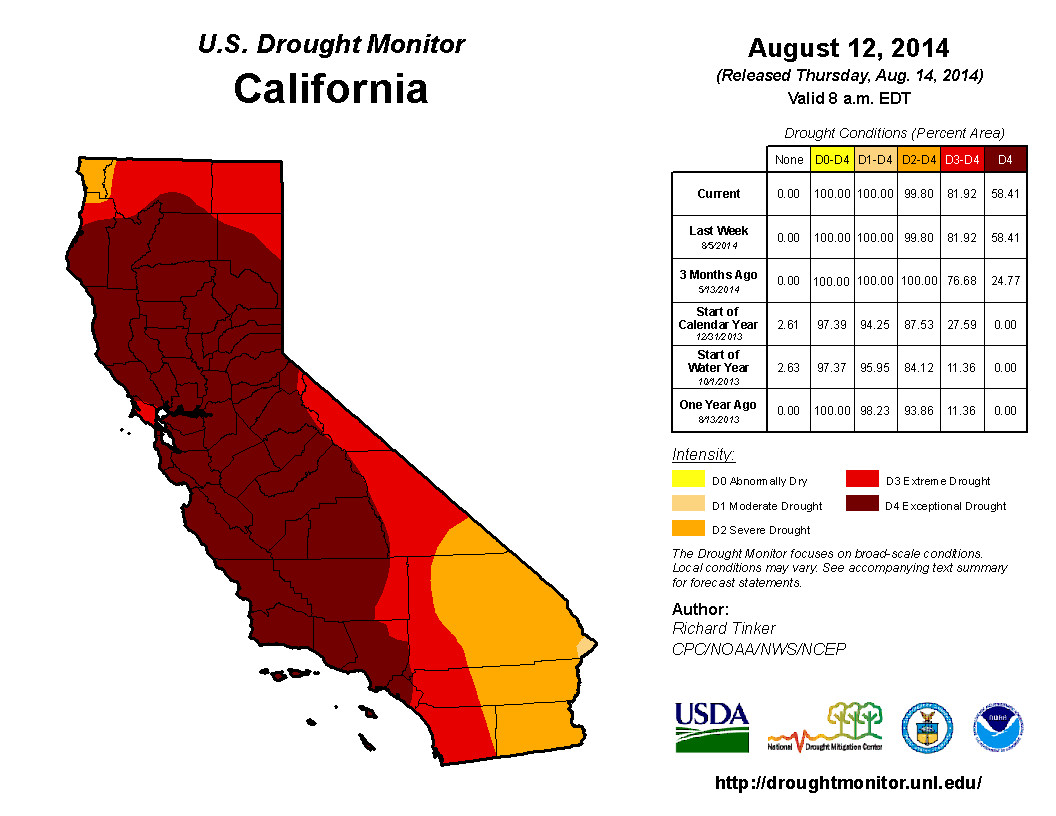
Arguably the most severe outgrowth of this recent trend in the U.S. has been the historic 2012-2014 California drought (which forecasters predict will continue into 2015). The state began 2014 with its lowest Sierra snowpack recording—12 percent—in more than 50 years of record keeping. In August, California set a new U.S. Drought Monitor record with 58.4 percent of the state in the worst drought category, known as “exceptional drought.” The dry conditions along the West Coast also fueled a severe wildfire season. On August 2, California Governor Jerry Brown declared a state of emergency due to the ongoing drought, fires and deteriorating air quality throughout the state. Meanwhile, Oregon and Washington topped the nation in total number of acres burned, with Washington experiencing its largest wildfire ever recorded.

The horizontal line marks the precipitation level of the 2000 – 2004 drought, the worst of the past 800 years up to 2012. Droughts of this intensity are predicted to be the new normal by 2030, and will be considered an outlier of extreme wetness by 2100

Source: Schwalm et al. 2012

By contrast, the Central and Eastern U.S. experienced unusually persistent cold temperatures throughout 2014. The winter of 2013-2014 was among the coldest on record for the Great Lakes, and Minnesota, Wisconsin, Michigan, Illinois, and Indiana each had winter temperatures that ranked among the ten coldest on record. Ice coverage over the Great Lakes peaked at 92.2 percent on March 6, the second highest measurement on record. The summer was also cooler than average for the region, which led into an unseasonably frigid fall.

Several U.S. locations experienced their coldest Novembers on record due to a procession of cold fronts tapping air from the Arctic. At the start, the Arctic outbreak was largely the product of the extra-tropical remnant of Typhoon Nuri from the Pacific. The system was the most powerful storm to ever move over the Bering Sea, gaining strength from warmer than average ocean and atmospheric conditions. Due to its strength, the storm caused the jet stream to sink southward bringing Arctic conditions to the United States. As a result, North America snow cover reached a record extent for mid-November—15.35 million square kilometers—crushing the old record from 1985 by over two million square kilometers. On November 16, temperatures were warmer in Alaska (significantly in some cases) than in many Central and Eastern U.S. states. Arctic temperatures ran up to 40 degrees above average (with Fairbanks, Alaska blowing away old temperature records by almost two degrees), while the Central and Eastern U.S. experienced record snowfall and temperatures up to 40 degrees below average.

The weather forecast across the United States from November 16 through November 20

Source: Thinkprogress; National Weather Service

Taken together, 2014 has witnessed a record-setting split in the U.S. between regions of simultaneous hot and cold temperatures. According to Scott Robeson, a climate scientist at Indiana University Bloomington, these hot and cold extremes are important. Robeson recently authored a studyon warm and cold anomalies in the northern hemisphere and found, “Average temperatures don’t tell us everything we need to know about climate change. Arguably, these cold extremes and warm extremes are the most important factors for human society.” Robeson notes that temperatures in the Northern Hemisphere are considerably more volatile than in the South, where there is less land mass to add complexity to weather systems. The extreme weather observed in 2014 in the U.S. has many layers of complexity, with ocean and Arctic temperatures influencing circulation patterns, and a growing body of scientificevidence suggests global warming may be the common denominator.

Internationally, 2014 saw record heat and drought in some countries, but cold spells and flooding in others. As in the U.S., many of these trends are associated with unusual ocean-atmospheric circulation patterns with likely connections to climate change.

Perturbations in the jet stream have wide ranging climate impacts that vary depending on geographical region. One recent analysis finds a connection between a wavy jet stream pattern—with greater dips from north to south—and increases in the probabilities of heat waves in western North America and central Asia; cold outbreaks in eastern North America; droughts in central North America, Europe and central Asia; and wet spells in western Asia.

Just as most of the weather in the western U.S. is below the jet stream and connected to the Pacific, most of the weather in Europe rides in under the jet stream from the Atlantic. While the jet stream has been unusually far north in the Pacific, bringing high temperatures and drought to the western U.S., the jet stream has been unusually far south across the Atlantic. As a result, the UK was hit by an exceptional run of winter storms and an intense polar vortex at the start of 2014, with rainfall amounts, storm intensities, wave heights, and other extreme weather trends at or near record levels. Related damages from December 23, 2013 – March 1, 2014 added up to $1.5 billion. Global warming has doubled the risk of extreme conditions, as warmer temperatures and melting ice in the Arctic cause the jet stream to push cold air southwards.

In January and February, an exceptional dry spell hit Southeast Asia, with the worst impacts—including water shortages, wildfires, crop failure, and increased incidence of infectious disease—felt in Singapore, Malaysia, Indonesia, and Thailand. Singapore suffered its longest dry spell on record between January 13 and February 8, which caused extensive damage to rice crops and fish stocks at several offshore farms. Dengue hotspots in Malaysia experienced a four-fold increase in infections to about 14,000 compared with the same period last year.

Continuous, heavy rainfall in May resulted in some of the worst flooding ever recorded in Southeast Europe, mainly Serbia, Bosnia and Herzegovina (BiH), and Croatia. Three months’ worth of rain fell in only three days, making it the heaviest rainfall in BiH since records began in 1894. On May 15, the Serbian Government declared a state of emergency for its entire territory. The storm caused $4.5 billion in damage.

May also saw the Eastern Pacific’s strongest May hurricane on record, Hurricane Amanda, which peaked as a top-end Category 4 hurricane with 155 mph winds. The impressive hurricane was linked to record sea surface temperatures, which measured 0.59°C above the 20th century average of 16.3°C, the highest temperature anomaly on record for May. In July in the Western Pacific, Typhoon Rammasun became the strongest typhoon to hit China’s Hainan Province in 21 years, surprising forecasters as it gained more strength than anticipated. Like Amanda, wind speeds topped out around 155 mph. The typhoon remained very strong as it made landfall, leading to extreme rainfall and flooding in China that caused $7.2 billion in damage. Global warming is expected to increase the rainfall from tropical cyclones.

In Australia, 2014 was the third hottest year on record (with 2013 being the hottest) and was characterized by frequent periods of abnormally warm weather that contributed to huge bushfires in Victoria and South Australia. According to Dr. Karl Braganza, manager of the Bureau of Meteorology’s climate monitoring section, Australia is seeing “reoccurring heat waves, long durations of heat but very little cold weather.” A report by Australia’s Climate Council finds that the frequency and severity of bushfires is getting worse in the southern state of New South Wales each year due to “record-breaking heat and hotter weather over the long term.”

Following the wettest January to August on record, the UK experienced its driest September since records began in 1910, receiving 19.4mm of rain, or 20 percent of the expected average. Monthly temperatures in the UK were also significantly above average. One recent study finds that human-caused global warming has increased the chances of extremely hot summers in parts of Europe tenfold. The UK Met Office is currently researching how jet stream variations and changes to atmospheric circulation may be increasing the risk of patterns that slow the movement of weather systems, allowing heat waves to develop and intensify.


Understanding the Global Surface Temperature Datasets

Three of the major global temperature datasets that combine both ocean and atmospheric temperatures have declared 2014 the hottest year on record.

The 10 warmest years on record according to the NOAA and NASA datasets.

Source: NOAA; NASA

The four most highly cited combined SST and land temperature datasets are NOAA’s MLOST, NASA’s GISTEMP, the UK’s HadCRUT, and the JMA’s CLIMAT. While HadCRUT has yet to confirm, NOAA, NASA and the JMA—using independent data and analysis—have decalred 2014 the hottest year on record. The Japanese Meteorological Agency (JMA) was one of the first agencies to report 2014’s heat record in a preliminary analysis and found that 2014’s global temperature was 0.63°C above average. NOAA’s data holds that 2014’s temperature was 0.69°C above average, and NASA that it was 0.68°C above average.

Satellites that measure temperatures in the lower atmosphere, or troposphere, did not rank 2014 as a record year, but the troposphere is only one region where excess heat gets stored.

Because satellite datasets measure the atmosphere, and not the climate system as a whole, it is inaccurate to compare satellite temperature averages with combined land and SST averages. Combined land and SST datasets are based on instrumental readings taken on site in the ocean and atmosphere, while satellite records focus on the troposphere and infer temperatures at various levels using measurements of radiance (the intensity of radiation passing through a point in a given direction). Both types of datasets improve our understanding of the rate at which the Earth is warming and how the climate system as a whole distributes heat. But because the two types of datasets vary in terms of their scope, it is perfectly possible for the atmospheric temperature average, as measured by satellites, not to set a new record, while the global combined land and SST average does.

This was the case in 2014. The two most widely cited satellite records are the University of Alabama in Huntsville (UAH) and the privately owned Remote Sensing Systems (RSS) datasets. According to the RSS data, 2014’s annual average temperature in the lower troposphere was the sixth warmest on record, or 0.26°C above the long-term average. The UAH data has not yet been confirmed, but will likely reaffirm the RSS finding. This is to be expected, however, in a year where record ocean heat was the dominant driver of observed warming.

Temperature analyses provide an important health gauge for the planet.

The instrumental temperature record—based on readings from ships and buoys that measure sea-surface temperature (SST) as well as land-based weather stations—has provided vital information about the Earth’s climate over the last century and beyond. To reconstruct global temperatures, each agency divides the Earth’s surface into latitude-longitude grid boxes that are used to integrate in situ (“on site”) temperature measurements from around the globe.

The three most highly cited combined SST and land temperature datasets are NOAA’s MLOST, NASA’s GISTEMP, and the UK’s HadCRUT. All three datasets report global average temperature as an anomaly, or departure from average, relative to a reference period. This is because absolute temperatures can vary (depending on factors like elevation), whereas anomalies allow for more meaningful comparisons between locations and accurate calculations of temperature trends. HadCRUT uses the most recent reference period to calculate anomalies, 1961-1990, followed by GISTEMP’s 1951-1980 period. MLOST, on the other hand, uses the 20th century, 1901-2000, as its reference period to establish a longer-term average.

Global Land and Ocean Temperature Anomalies, January-December

Source: NOAA

While the concept of these datasets is fairly simple, their construction is challenging due to difficulties in obtaining data; documenting and accounting for changes in instrumentation and observing practices; addressing changes in station location and local land use; understanding random measurement errors; and deciding where and how to fill in missing data in space and time. Each group has approached the above challenges somewhat differently. The final datasets differ in their spatial coverage, spatial resolution, starting year, and degree of interpolation (a method of constructing missing data points based on surrounding, discrete points). For this reason, NOAA, NASA, and UK Met Office global temperature anomalies vary subtly.

Global temperature data often underestimates the amount of warming due to coverage bias.

Analyzing temperature observations at a global scale often comes at the cost of not including important spatial detail. This challenge—known as coverage bias—is something all three of the major global temperature datasets struggle with and attempt to reconcile.

NOAA’s Merged Land-Ocean Surface Temperature Analysis (MLOST) uses land surface air temperatures taken from the Global Historical Climatology Network (GHCN) dataset and ocean temperatures from the Extended Reconstructed Sea Surface Temperature (ERSST) dataset, and combines these into a comprehensive global surface temperature dataset. The comprehensive dataset spans from 1880 to the present at monthly resolution on a 5×5 degree latitude-longitude grid. MLOST uses interpolation, but areas without enough data—mainly at the poles, over Africa, and at the center of the Atlantic and Pacific Oceans—are masked in the data analysis to prevent any overreliance on reconstructions that are based on too little data.

NASA Goddard’s Global Surface Temperature Analysis (GISTEMP) also uses GHCN data from 1880 to the present, but GISTEMP has some important differences from NOAA’s MLOST. While GISTEMP has a more focused spatial resolution, with a 2×2 grid, and better coverage at the poles due to the inclusion of data from Antarctic “READER” stations, it only provides data in terms of temperature anomalies. All three of the major global datasets report global temperatures as anomalies to make comparison and computation easier, but GISTEMP is unique in that it works solely with anomaly data from the outset. NOAA and HadCRUT have absolute temperature data from which they derive regional anomalies. As for HadCRUT, it is unique in that it incorporates many additional sources beyond GHCN and is the only global analysis that does not use interpolation. It also has more spatial coverage gaps than MLOST and GISTEMP and a tendency to significantly underreport warming, primarily due to a lack of temperature data at the Arctic, which is warming much fasterthan other regions.

“The Shining Sun,” DeviantArt user edsousa

Seca em São Paulo – 16 de janeiro de 2015

Chuvas devem continuar abaixo da média em 2015, diz Cemaden (G1)

Ano deve ser influenciado por eventos extremos de 2014, diz especialista

Se o ano passado foi um período de condições climáticas extremas no Brasil, entre elas a seca em diversas regiões, a situação em 2015 pode piorar. Esta é a avaliação feita pelo Centro Nacional de Monitoramento e Alertas de Desastres Naturais (Cemaden) em Cachoeira Paulista (SP), que já prevê chuvas abaixo da média novamente.

De acordo com o meteorologista do Cemaden, Marcelo Seluchi, neste verão choveu pouco mais da metade do normal para o período. O órgão é uma das extensões do Instituto Nacional de Pesquisas Espaciais (Inpe) para estudos e alertas de desastres naturais. “Comparado com o ano passado, a situação de 2015 pode piorar nas metrópoles em várias regiões do Brasil e no Vale do Paraíba”, afirma.

Leia mais: http://g1.globo.com/sp/vale-do-paraiba-regiao/noticia/2015/01/chuvas-devem-continuar-abaixo-da-media-em-2015-diz-cemaden.html

(Portal G1)

*   *   *

Cantareira pode secar em julho, prevê centro de monitoramento (O Globo)

Governador Alckmin diz que foi mal interpretado ao falar sobre racionamento

O Sistema Cantareira, responsável por abastecer 6,5 milhões de pessoas na Grande São Paulo, pode secar em julho, caso o consumo de água na Região Metropolitana continue o mesmo e a chuva mantenha o ritmo observado nos últimos meses. A projeção foi feita pelo Centro Nacional de Monitoramento e Alertas de Desastres Naturais (Cemaden), ligado ao Ministério da Ciência e Tecnologia.

Leia mais: http://oglobo.globo.com/brasil/cantareira-pode-secar-em-julho-preve-centro-de-monitoramento-15066400

(O Globo)

Mais informações sobre o assunto: Presidente da Cedae prevê uso inédito do volume morto de Paraibuna ainda este semestre – http://oglobo.globo.com/rio/presidente-da-cedae-preve-uso-inedito-do-volume-morto-de-paraibuna-ainda-este-semestre-15066522

(O Globo)

*   *   *

Combinação de seca e calor extremo agrava crise do Cantareira (Estadão)

Dados oficiais mostram que nos primeiros 15 dias do ano o sistema recebeu 35% menos água do que a média de janeiro passado, enquanto as temperaturas máximas na capital batem recordes

Apontada pelo governo Geraldo Alckmin (PSDB) como a causa da crise hídrica paulista no início de 2014, a combinação de seca severa nos mananciais e calor extremo na capital está ainda mais crítica em 2015. Dados oficiais mostram que nos primeiros 15 dias do ano o Sistema Cantareira recebeu 35% menos água do que a média de janeiro passado, enquanto as temperaturas máximas na cidade estão batendo o recorde registrado no mesmo período do ano anterior.

O conteúdo na íntegra está disponível em: http://sao-paulo.estadao.com.br/noticias/geral,combinacao-de-seca-e-calor-extremo-agrava-crise-do-cantareira,1620492

(Fabio Leite/O Estado de S. Paulo)

Mais informações sobre o assunto: Na Folha de S.Paulo – Cantareira tem ainda menos chuva em 2015 (http://www1.folha.uol.com.br/fsp/cotidiano/204210-cantareira-tem-ainda-menos-chuva-em-2015.shtml)

*   *   *

Nível de oceanos subiu em ritmo 30% maior do que se previa (Folha de S.Paulo)

Novo estudo indica que nível do mar subiu apenas 1,2 mm entre 1900 e 1990; avaliações antigas diziam que elevação foi de 1,8mm

Do início do século 20 até a década passada, o nível dos oceanos subiu em ritmo 30% maior do que se imaginava, de acordo com um estudo realizado por pesquisadores da Universidade de Harvard (Estados Unidos).

O conteúdo na íntegra está disponível em: http://ciencia.estadao.com.br/noticias/geral,nivel-de-oceanos-subiu-em-ritmo-30-maior-do-que-se-previa,1620001

(Fábio de Castro – O Estado de S. Paulo)

Mais informações sobre o assunto: 

O Globo – Nível dos mares tem aumentado mais rápido (http://oglobo.globo.com/sociedade/ciencia/nivel-dos-mares-tem-aumentado-mais-rapido-15054794)

Early warning signals of abrupt climate change (Science Daily)

Date: December 8, 2014

Source: University of Exeter

Summary: A new study has found early warning signals of a reorganization of the Atlantic ocean’s circulation which could have a profound impact on the global climate system.


Drought (stock image). Credit: © carloscastilla / Fotolia

A new study by researchers at the University of Exeter has found early warning signals of a reorganisation of the Atlantic ocean’s circulation which could have a profound impact on the global climate system.

The research, published today in the journal Nature Communications, used a simulation from a highly complex model to analyse the Atlantic Meridional Overturning Circulation (AMOC), an important component of the Earth’s climate system.

It showed that early warning signals are present up to 250 years before it collapses, suggesting that scientists could monitor the real world overturning circulation for the same signals.

The AMOC is like a conveyor belt in the ocean, driven by the salinity and temperature of the water. The system transports heat energy from the tropics and Southern Hemisphere to the North Atlantic, where it is transferred to the atmosphere.

Experiments suggest that if the AMOC is ‘switched off’ by extra freshwater entering the North Atlantic, surface air temperature in the North Atlantic region would cool by around 1-3°C, with enhanced cooling of up to 8°C in the worst affected regions.

The collapse would also encourage drought in the Sahel — the area just south of the Sahara desert — and dynamic changes in sea level of up to 80cm along the coasts of Europe and North America.

“We found that natural fluctuations in the circulation were getting longer-lived as the collapse was approached, a phenomenon known as critical slowing down,” said lead author Chris Boulton.

“We don’t know how close we are to a collapse of the circulation, but a real world early warning could help us prevent it, or at least prepare for the consequences” adds co-author Professor Tim Lenton.

The study is the most realistic simulation of the climate system in which this type of early warning signal has been tested.

“The best early warning signals in the model world are in places where major efforts are going into monitoring the circulation in the real world — so these efforts could have unexpected added value’ adds Professor Lenton.


Journal Reference:

  1. Chris A. Boulton, Lesley C. Allison, Timothy M. Lenton. Early warning signals of Atlantic Meridional Overturning Circulation collapse in a fully coupled climate model. Nature Communications, 2014; 5: 5752 DOI: 10.1038/ncomms6752

January-October 2014 temperatures highest on record (Science Daily)

Date: November 29, 2014

Source: World Meteorological Organization

Summary: The global average temperature over land and ocean surfaces for January to October 2014 was the highest on record, according to the U.S. National Oceanic and Atmospheric Administration. It said October was the hottest since records began in 1880.

The global average temperature over land and ocean surfaces for January to October 2014 was the highest on record, according to NOAA. October was the hottest since records began in 1880. Credit: NOAA

The global average temperature over land and ocean surfaces for January to October 2014 was the highest on record, according to the U.S. National Oceanic and Atmospheric Administration (NOAA). It said October was the hottest since records began in 1880.

NOAA said the combined global land and ocean average surface temperature for the January-October period was 0.68°C (1.22°F) above the 20th century average of 14.1°C (57.4°F). For October, it was 0.74°C (1.33°F) above the 20th century average of 14.0°C (57.1°F).

The high October temperature was driven by warmth across the globe over both the land and ocean surfaces and was fairly evenly distributed between the Northern and Southern Hemispheres. The Southern Hemisphere had its hottest October on record and the Northern Hemisphere its third warmest.

October marked the third consecutive month and fifth of the past six with a record high global temperature for its respective month (July was fourth highest).

The Tokyo Climate Center, which is a WMO Regional Climate Centre, also reported that October was the hottest on record. The record was also confirmed by data from NASA’s Goddard Institute for Space Studies.

WMO uses a combination of datasets to compile its annual Statement on the Status of the Global Climate. Additional information is drawn from the ERA-Interim reanalysis-based data set maintained by the European Centre for Medium-Range Weather Forecasts.

Further information: http://www.ncdc.noaa.gov/sotc/global/2014/10

As previsões de Isaac Asimov para 2014, 50 anos atrás (Pragmatismo Político)

03/JAN/2014 ÀS 18:42

Escritor e professor Isaac Asimov fez, há 50 anos, surpreendentes previsões de como seria o mundo em 2014

isaac asimov previsões 2014

Professor Isaac Asimov fez impressionantes previsões para 2014… há 50 anos (Reprodução)

Em 1964, durante a Feira Mundial de Nova York, o New York Times convidou o escritor de ficção científica e professor de bioquímica Isaac Asimov a fazer previsões de como seria o mundo 50 anos depois, ou seja, este ano. Asimov escreveu mais de 500 trabalhos, entre romances, contos, teses e artigos e sempre se caracterizou por fazer projeções acuradas sobre o futuro. As previsões do escritor, que morreu em 1991, são surpreendentes.

Cozinha

Asimov prevê que os equipamentos de culinária pouparão a humanidade de fazer trabalhos tediosos. “As cozinhas estão equipadas para fazer “auto-refeições”. “Almoços e jantares serão feitos com comidas semi-preparadas, que poderão ser conservadas em freezer. Em 2014, as cozinhas terão equipamentos capazes de preparar uma refeição individual em alguns poucos segundos”. Só faltou mesmo ele usar a palavra “microondas”.

Computadores

O escritor previu um mundo repleto de computadores capazes de fazer as mais complexas tarefas. “Em 2014, haverá mini computadores instalados em robôs”, escreve ele, no que parece ser uma alusão aos chips. E garantiu que será possível fazer traduções com uma dessas máquinas, como se previsse a existência do Google Translator.

Comunicação

As ligações telefônicas terão imagem e voz, garantiu Asimov em seu texto. “As telas serão usadas não apenas para ver pessoas, mas também para estudar documentos e fotos e ler livros”. E prevê que satélites em órbita tornarão possível fazer conexões telefônicas para qualquer lugar da Terra e até mesmo “saber o clima na Antártica”. Mas em Terra haverá outras soluções. “A conexão terá que ser feita em tubos de plástico, para evitar a interferência atmosférica”, escreve ele, como se já conhecesse a fibra ótica.

Cinema

Asimov previu que em 2014 o cinema seria apresentando em 3-D, mas garantiu que algumas coisas nunca mudariam: “Continuarão a existir filas de três horas para ver o filme”.

Energia

Ele previu que já existiriam algumas usinas experimentais produzindo energia com a fusão nuclear. Errou. Mas acertou quando vaticinou a existência de baterias recarregáveis para alimentar muitos aparelhos elétricos de nossa vida cotidiana. Mais ainda: “Uma vez usadas, as baterias só poderão ser recolhidas por agentes autorizados pelos fabricantes” — o que deveria acontecer, mas nem sempre acontece.

Veículos

Asimov erra feio nas suas previsões relacionadas ao transporte.

Ele acreditou que carros e caminhões pudessem circular sem encostar no chão ou água, deslizando a uma altura de “um ou dois metros”. E que não haveria mais necessidade de construir pontes, “já que os carros seriam capazes de circular sobre as águas, mas serão desencorajados a fazer isso pelas autoridades”.

Marte

Para o escritor, em 2014 o homem já terá chegado a Marte com espaçonaves não tripuladas, embora “já estivesse sendo planejada uma expedição com pessoas e até a formação de uma colônia marciana”. O que nos faz lembrar da proposta pública de uma viagem a Marte só de ida, feita recentemente, para formar a primeira colônia no planeta.

Televisão

Asimov cita a provável existência de “televisões de parede”, como se pudesse prever as telas planas, mas acredita que os aparelhos serão substituídos por cubos capazes de fazer transmissões em 3-D, visíveis de qualquer ângulo.

População

O escritor previu que a população mundial seria de 6,5 bilhões em 2014 (já passou dos 7 bilhões) e que áreas desérticas e geladas seriam ocupadas por cidades — o que não é exatamente errado. Mas preconizou, também, a má divisão de renda: “Uma grande parte da humanidade não terá acesso à tecnologia existente e, embora melhor do que hoje, estará muito defasada em relação às populações mais privilegiados do mundo. Nesse sentido, andaremos para trás”, escreve ele.

Comida

“Em 2014 será comum a ‘carne falsa’, feita com vegetais, e que não será exatamente ruim, mas haverá muita resistência a essa inovação”, escreve Asimov, referindo-se provavelmente aos hambúrgueres de soja.

Expectativa de vida

O escritor preconizou problemas devido à super população do planeta, atribuindo-a aos avanços da medicina: “O uso de aparelhos capazes de substituir o coração e outros órgãos vai elevar a expectativa de vida, em algumas partes do planeta, a 85 anos de idade”. A média mundial subiu de 52 anos em 1964 para 70 anos em 2012. Em alguns países, como Japão, Suíça e Austrália, já está em 82 anos.

Escola

“As escolas do futuro”, escreve Asimov, “apresentarão aulas em circuitos fechados de TV e todos os alunos aprenderão os fundamentos da tecnologia dos computadores”. O que ele não previu foi a possibilidade de os alunos ensinarem os professores quando se trata de uso de computadores — como, aliás, ocorre em algumas escolas públicas brasileiras.

Trabalho

Asimov previu uma população entediada, como sinal de uma doença que “se alastra a cada ano, aumentando de intensidade, o que terá consequência mentais, emocionais e sociais”. Depressão? “Ouso dizer”, prossegue ele, “que a psiquiatria será a especialidade médica mais importante em 2014. Aqueles poucos que puderem se envolver em trabalhos mais criativos formarão a elite da humanidade”.

Brasil registra um grande terremoto a cada 50 anos (O Globo)

Cálculo é de novo centro de pesquisa, que vai detectar tremores em 80 pontos do país

Quatro instituições unem-se esta sexta-feira para formar o Serviço Sismológico Nacional. Os centros de pesquisa calculam que o país registra um terremoto de magnitude maior do que 6 graus na escala Richter a cada 50 anos, aproximadamente — o último foi em 1955, no noroeste de Mato Grosso, com índice de 6,2 graus. O tremor foi sentido em Cuiabá, a 370 km de distância.

As universidades de São Paulo (USP), de Brasília (UnB) e a Federal do Rio Grande do Norte (UFRN) trabalharão sob a coordenação do Observatório Nacional. O grupo mantém cerca de 80 estações sismológicas no país e registros iniciados em 1767. A mais recente foi inaugurada no mês passado, na Ilha de Trindade, a cerca de 1,2 mil quilômetros ao leste de Vitória, no Espírito Santo.

Leia mais sobre esse assunto em http://oglobo.globo.com/sociedade/ciencia/brasil-registra-um-grande-terremoto-cada-50-anos-14681727#ixzz3KMSImin8

(Renato Grandelle / O Globo)

Modeling the past to understand the future of a stronger El Niño (Science Daily)

Date:

November 26, 2014

Source:

University of Wisconsin-Madison

Summary:

El Nino is not a contemporary phenomenon; it’s long been the Earth’s dominant source of year-to-year climate fluctuation. But as the climate warms and the feedbacks that drive the cycle change, researchers want to know how El Nino will respond.

141126132628-large

Using state-of-the-art computer models maintained at the National Center for Atmospheric Research, researchers determined that El Niño has intensified over the last 6,000 years. This pier and cafe are in Ocean Beach, California. Credit: Jon Sullivan

It was fishermen off the coast of Peru who first recognized the anomaly, hundreds of years ago. Every so often, their usually cold, nutrient-rich water would turn warm and the fish they depended on would disappear. Then there was the ceaseless rain.

They called it “El Nino,” The Boy — or Christmas Boy — because of its timing near the holiday each time it returned, every three to seven years.

El Nino is not a contemporary phenomenon; it’s long been Earth’s dominant source of year-to-year climate fluctuation. But as the climate warms and the feedbacks that drive the cycle change, researchers want to know how El Nino will respond. A team of researchers led by the University of Wisconsin’s Zhengyu Liu published the latest findings in this quest Nov. 27, 2014 in Nature.

“We can’t see the future; the only thing we can do is examine the past,” says Liu, a professor in the Department of Atmospheric and Oceanic Sciences. “The question people are interested in now is whether it’s going to be stronger or weaker, and this requires us to first check if our model can simulate its past history.”

The study examines what has influenced El Nino over the last 21,000 years in order to understand its future and to prepare for the consequences. It is valuable knowledge for scientists, land managers, policymakers and many others, as people across the globe focus on adapting to a changing climate.

Using state-of-the-art computer models maintained at the National Center for Atmospheric Research in Colorado, the researchers — also from Peking University in China, the University of Hawaii at Manoa, and Georgia Institute of Technology — determined that El Nino has intensified over the last 6,000 years.

The findings corroborate data from previous studies, which relied on observations like historical sediments off the Central American coast and changes in fossilized coral. During warm, rainy El Nino years, the coastal sediments consist of larger mixed deposits of lighter color, and the coral provides a unique signature, akin to rings on a tree.

“There have been some observations that El Nino has been changing,” says Liu, also a professor in the Nelson Institute for Environmental Studies Center for Climatic Research. “Previous studies seem to indicate El Nino has increased over the last 5,000 to 7,000 years.”

But unlike previous studies, the new model provides a continuous look at the long history of El Nino, rather than a snapshot in time.

It examines the large-scale influences that have impacted the strength of El Nino over the last 21,000 years, such as atmospheric carbon dioxide, ice sheet melting and changes to Earth’s orbit.

El Nino is driven by an intricate tango between the ocean and Earth’s atmosphere. In non-El Nino years, trade winds over the tropical Pacific Ocean drive the seas westward, from the coast of Central America toward Indonesia, adding a thick, warm layer to the surface of the western part of the ocean while cooler water rises to the surface in the east. This brings rain to the west and dry conditions to the east.

During El Nino, the trade winds relax and the sea surface temperature differences between the Western and Eastern Pacific Ocean are diminished. This alters the heat distribution in both the water and the air in each region, forcing a cascade of global climate-related changes.

“It has an impact on Madison winter temperatures — when Peru is warm, it’s warm here,” says Liu. “It has global impact. If there are changes in the future, will it change the pattern?”

Before the start of the Holocene — which began roughly 12,000 years ago — pulses of melting water during deglaciation most strongly influenced El Nino, the study found. But since that time, changes in Earth’s orbit have played the greatest role in intensifying it.

Like an uptick in tempo, the feedbacks between ocean and atmosphere — such as how wind and seas interact — have grown stronger.

However, even with the best data available, some features of the simulated El Nino — especially prior to 6,000 years ago — can’t be tested unambiguously, Liu says. The current observational data feeding the model is sparse and the resolution too low to pick up subtle shifts in El Nino over the millennia.

The study findings indicate better observational data is needed to refine the science, like more coral samples and sediment measurements from different locations in the Central Pacific. Like all science, better understanding what drives El Nino and how it might change is a process, and one that will continue to evolve over time.

“It’s really an open door; we need more data to get a more significant model,” he says. “With this study, we are providing the first benchmark for the next five, 10, 20 years into the future.”

Story Source:

The above story is based on materials provided by University of Wisconsin-Madison. The original article was written by Kelly April Tyrrell. Note: Materials may be edited for content and length.

Journal Reference:

  1. Zhengyu Liu, Zhengyao Lu, Xinyu Wen, B. L. Otto-Bliesner, A. Timmermann, K. M. Cobb. Evolution and forcing mechanisms of El Niño over the past 21,000 years. Nature, 2014; 515 (7528): 550 DOI: 10.1038/nature13963

O possível colapso do Cantareira (Estadão)

O possível colapso do Cantareira

22.11.2014 | 03:00

O Estado de S. Paulo

A Companhia de Saneamento Básico do Estado de São Paulo (Sabesp) e o governo estadual estão se comportando como médicos do século passado. Sabendo que a doença é séria, se recusam a discutir o futuro com o paciente. Fazem o que podem para curar o doente, mas o poupam da angústia de enfrentar a realidade. Hoje, os médicos são educados para contar a verdade. Isso causa angústia, mas ao menos não priva o doente da liberdade de decidir como e onde quer viver enquanto espera o desfecho.

O Sistema Cantareira está se aproximando rapidamente do colapso. Quando não for possível retirar mais água das represas, 6 milhões de pessoas ficarão literalmente sem uma gota de água. É a parte da população de São Paulo que só pode ser abastecida pelo Cantareira. Esta é uma possibilidade real, cuja probabilidade é difícil de calcular. É por isso que vou tentar descrever de maneira objetiva a realidade hoje, deixando para os leitores as especulações sobre o futuro. Todos as informações foram extraídas de documentos oficiais da Agencia Nacional de Águas (ANA), do Departamento de Águas e Energia Elétrica (DAEE) e da Sabesp.

Gráficos

O Sistema Cantareira é composto por três represas. As duas maiores, Jaguari/Jacareí e Atibainha, representam 92% do sistema. Quando cheia até a borda, a Represa Jaguari/Jacareí (acompanhe pelo quadro nesta página) atinge a conta 844 (ou seja, 844 metros acima do nível do mar), armazena 1,047 bilhão de m3 de água (um m3 são 1.000 litros) e cobre uma área de 50 km2 (cada km2 corresponde a 100 quarteirões). No último dia 18, ela estava na cota 815,5, tendo baixado 28,5 metros, e continha somente 140 milhões de m3 de água (13,3% do máximo). Sua superfície cobria somente uma área de 16 km2, deixando 34 km2 de terra e lama expostos (é o que você pode ver nas fotografias publicadas diariamente).

Neste dia, foi iniciada a retirada da segunda fração da reserva técnica – também chamada de volume morto -, o que vai reduzir o volume para 42 milhões de m3 (4% do máximo) e reduzir a área coberta por água para 8 km2. O barro vai cobrir 84% da área da represa (o quadro mostra os mesmos números para a Represa do Atibainha).

É muito difícil acreditar que seja possível extrair dessas represas uma reserva técnica 3. Se ela existir, será muito pequena. A reserva técnica 1, de 182,5 milhões de m3, já foi consumida. A reserva técnica 2, de 106 milhões de m3, já começou a ser retirada da Represa de Jaguari/Jacareí e praticamente já foi toda retirada da Represa do Atibainha.

Os dados mostram que ainda restam 232 milhões de m3 nessas duas represas, sendo possível retirar 99 milhões de m3. Grande parte do restante não será possível utilizar.

Quando o nível da água baixou para 820, a água deixou de fluir por gravidade para o túnel. Para evitar a interrupção do fornecimento, foi construído um dique em volta do túnel. Grandes bombas flutuantes transportam a água para o interior do dique, de onde ela flui pelo túnel. Dessa maneira, foi possível retirar a chamada reserva técnica 1. Quando a água da parte de fora do dique acabou, um segundo dique foi construído, isolando um grande braço da represa para permitir a retirada da reserva técnica 2. Nesse segundo dique foi instalado um outro grupo de bombas. Hoje, as bombas do segundo dique transportam a água para esse braço isolado da represa e a água chega no primeiro dique, onde é bombeada novamente para poder alcançar a entrada do túnel. Como os locais em que a Sabesp decidiu instalar esses dois grupos de bombas não têm energia elétrica, grandes geradores movidos a diesel foram transportados até a proximidade das bombas. Caminhões-tanque levam o diesel por estradas precárias para manter os geradores ligados 24 horas. É desse esquema improvisado que agora dependem os 6 milhões de pessoas que recebem água do Sistema Cantareira.

O sistema de bombas é capaz de retirar até 20 m3 por segundo da represa (20 pequenas caixas de água por segundo). Mas o problema é que, atualmente, só chegam às represas, trazidos pelos rios, 6 m3 por segundo de água. Assim, a cada segundo, 14 m3 a mais do que chega são retirados da represa. A rápida velocidade de perda das reservas significa que a, cada dia, a represa perde 1,2 milhão de m3 de água.

Mantido esse ritmo de perdas, é fácil calcular que a duração das reservas atuais é de 79 dias até o término da reserva técnica 2 e de 6 meses até que toda a água existente na represa se esgote.

Para que esse prazo seja estendido é necessário que a entrada de água na represa aumente. Se os atuais 6 m3 por segundo aumentarem para um número menor do que 20 m3 por segundo, a represa vai continuar a ser delapidada, mais lentamente. Se ela chegar a 20 m3 por segundo (o mesmo que as bombas retiram hoje), a represa vai parar de esvaziar. Mas são necessários mais de 20 m3 por segundo, um aumento constante de 4 vezes no fluxo atual dos rios, para que a represa volte a encher.

O problema é que isso não está ocorrendo nestes dois primeiros meses de chuva deste final de ano (outubro e novembro) e não ocorreu nenhuma vez nos meses de chuva do início de 2014 (janeiro, fevereiro, março e abril).

É claro que pode chover, e espero que chova muito, mas se o futuro próximo se comportar como o passado próximo, 6 milhões de pessoas ficarão sem água. E, infelizmente, é impossível abastecer 6 milhões com caminhões-pipa. Como e onde essas pessoas vão viver até que o Cantareira se recupere ou outras represas tomem seu lugar? É isso que eu gostaria de saber.

MAIS INFORMAÇÕES: BOLETIM ANA/DAEE DE MONITORAMENTO DO SISTEMA CANTAREIRA (18/11/2014). PROJEÇÃO DE DEMANDA DO SISTEMA CANTAREIRA, SABESP, 2014, E DADOS DE REFERÊNCIA ACERCA DA OUTORGA DO SISTEMA CANTAREIRA ANA/DAEE, 2013

Of gods and men: Societies living in harsh environments are more likely to believe in moralizing gods (Science Daily)

Date: November 10, 2014

Source: National Evolutionary Synthesis Center (NESCent)

Summary: New research finds that cultures living in harsher ecosystems with limited resources are more prone to a belief in moralizing, high gods. The results indicate that other cross-disciplinary factors, including as political complexity, also influence this belief.


Just as physical adaptations help populations prosper in inhospitable habitats, belief in moralizing, high gods might be similarly advantageous for human cultures in poorer environments. A new study from the National Evolutionary Synthesis Center (NESCent) suggests that societies with less access to food and water are more likely to believe in these types of deities.

“When life is tough or when it’s uncertain, people believe in big gods,” says Russell Gray, a professor at the University of Auckland and a founding director of the Max Planck Institute for History and the Sciences in Jena, Germany. “Prosocial behavior maybe helps people do well in harsh or unpredictable environments.”

Gray and his coauthors found a strong correlation between belief in high gods who enforce a moral code and other societal characteristics. Political complexity–namely a social hierarchy beyond the local community– and the practice of animal husbandry were both strongly associated with a belief in moralizing gods.

The emergence of religion has long been explained as a result of either culture or environmental factors but not both. The new findings imply that complex practices and characteristics thought to be exclusive to humans arise from a medley of ecological, historical, and cultural variables.

“When researchers discuss the forces that shaped human history, there is considerable disagreement as to whether our behavior is primarily determined by culture or by the environment,” says primary author Carlos Botero, a researcher at the Initiative for Biological Complexity at North Carolina State University. “We wanted to throw away all preconceived notions regarding these processes and look at all the potential drivers together to see how different aspects of the human experience may have contributed to the behavioral patterns we see today.”

The paper, which is now available online, will be published in an upcoming issue of the Proceedings of the National Academies of Science. To study variables associated with the environment, history, and culture, the research team included experts in biology, ecology, linguistics, anthropology, and even religious studies. The senior author, Gray, studies the intersection of psychology and linguistics, while Botero, an evolutionary ecologist, has examined coordinated behaviors in birds.

This study began with a NESCent working group that explored the evolution of human cultures. On a whim, Botero plotted ethnographic data of societies that believe in moralizing, high gods and found that their global distribution is quite similar to a map of cooperative breeding in birds. The parallels between the two suggested that ecological factors must play a part. Furthermore, recent research has supported a connection between a belief in moralizing gods and group cooperation. However, prior to this study, evidence supporting a relationship between such beliefs and the environment was elusive.

“A lot of evolutionists have been busy trying to bang religion on the head. I think the challenge is to explain it,” Gray says.

“Although some aspects of religion appear maladaptive, the near universal prevalence of religion suggests that there’s got to be some adaptive value and by looking at how these things vary ecologically, we get some insight.”

Botero, Gray, and their coauthors used historical, social, and ecological data for 583 societies to illustrate the multifaceted relationship between belief in moralizing, high gods and external variables. Whereas previous research relied on rough estimates of ecological conditions, this study used high-resolution global datasets for variables like plant growth, precipitation, and temperature. The team also mined the Ethnographic Atlas– an electronic database of more than a thousand societies from the 20th century– for geographic coordinates and sociological data including the presence of religious beliefs, agriculture, and animal husbandry.

“The goal became not just to look at the ecological variables, but to look at the whole thing. Once we accounted for as many other factors as we could, we wanted to see if we could still detect an environmental effect,” Botero says. “The overall picture is that these beliefs are ultimately shaped by a combination of historical, ecological, and social factors.”

Botero believes that this study is just the tip of the iceberg in examining human behavior from a cross-disciplinary standpoint. The team plans to further this study by exploring the processes that have influenced the evolution of other human behaviors including taboos, circumcision, and the modification of natural habitats.

“We are at an unprecedented time in history,” Botero says. “Now we’re able to harness both data and a combination of multidisciplinary expertise to explore these kinds of questions in an empirical way.”


Journal Reference:

  1. C. A. Botero, B. Gardner, K. R. Kirby, J. Bulbulia, M. C. Gavin, R. D. Gray. The ecology of religious beliefs. Proceedings of the National Academy of Sciences, 2014; DOI: 10.1073/pnas.1408701111

The IPCC is stern on climate change – but it still underestimates the situation (The Guardian)

UN body’s warning on carbon emissions is hard to ignore, but breaking the power of the fossil fuel industry won’t be easy

The Guardian, Sunday 2 November 2014 10.59 GMT

Bangkok's skyline blanketed in a hazeBangkok’s skyline blanketed in a haze. The IPCC report says climate change has increased the risk of severe heatwaves and other extreme weather. Photograph: Adrees Latif/Reuters

At this point, the scientists who run the Intergovernmental Panel on Climate Change must feel like it’s time to trade their satellites, their carefully calibrated thermometers and spectrometers, their finely tuned computer models – all of them for a thesaurus. Surely, somewhere, there must be words that will prompt the world’s leaders to act.

This week, with the release of their new synthesis report, they are trying the words “severe, widespread, and irreversible” to describe the effects of climate change – which for scientists, conservative by nature, falls just short of announcing that climate change will produce a zombie apocalypse plus random beheadings plus Ebola. It’s hard to imagine how they will up the language in time for the next big global confab in Paris.

But even with all that, this new document – actually a synthesis of three big working group reports released over the last year – almost certainly underestimates the actual severity of the situation. As the Washington Post pointed out this week, past reports have always tried to err on the side of understatement; it’s a particular problem with sea level rise, since the current IPCC document does not even include the finding in May that the great Antarctic ice sheets have begun to melt. (The studies were published after the IPCC’s cutoff date.)

But when you get right down to it, who cares? The scientists have done their job; no sentient person, including Republican Senate candidates, can any longer believe in their heart of hearts that there’s not a problem here. The scientific method has triumphed: over a quarter of a century, researchers have reached astonishing consensus on a basic problem in chemistry and physics.

And the engineers have done just as well. The price of a solar panel has dropped by more than 90% over the last 25 years, and continues to plummet. In the few places they have actually been deployed at scale, the results are astonishing: there were days this summer when Germany generated 75% of its power from the wind and the sun.

That, of course, is not because Germany is so richly endowed with sunlight (it’s a rare person who books a North Sea beach holiday). It’s because the Germans have produced a remarkable quantity of political will, and put it to good use.

As opposed to the rest of the world, where the fossil fuel industry has produced an enormous amount of fear in the political class, and kept things from changing. Their vast piles of money have so far weighed more in the political balance than the vast piles of data accumulated by the scientists. In fact, the IPCC can calculate the size of the gap with great exactness. To get on the right track, they estimate, the world would have to cut fossil fuel investments annually between now and 2029, and use the money instead to push the pace of renewables.

That is a hard task, but not an impossible one. Indeed, the people’s movement symbolised by September’s mammoth climate march in New York, has begun to make an impact in dollars and cents. A new report this week shows that by delaying the Keystone pipeline in North America protesters have prevented at least $17bn (£10.6bn) in new investments in the tar sands of Canada – investments that would have produced carbon equivalent to 735 coal-fired power plants. That’s pretty good work.

Our political leaders could do much more, of course. If they put a serious price on carbon, we would move quickly out of the fossil fuel age and into the renewable future. But that won’t happen until we break the power of the fossil fuel industry. That’s why it’s very good news that divestment campaigners have been winning victories on one continent after another, as universities from Stanford to Sydney to Glasgow start selling their fossil fuel stocks in protest – hey, even the Rockefeller Brothers fund, heir to the greatest oil fortune ever, have joined in the fight.

Breaking the power of the fossil fuel industry won’t be easy, especially since it has to happen fast. It has to happen, in fact, before the carbon we’ve unleashed into the atmosphere breaks the planet. I’m not certain we’ll win this fight – but, thanks to the IPCC, no one will ever be able to say they weren’t warned.

What Happened On Easter Island — A New (Even Scarier) Scenario (NPR)

December 10, 2013 8:41 AM ET

We all know the story, or think we do.

Let me tell it the old way, then the new way. See which worries you most.

Island filled with trees

Robert Krulwich/NPR

First version: Easter Island is a small 63-square-mile patch of land — more than a thousand miles from the next inhabited spot in the Pacific Ocean. In A.D. 1200 (or thereabouts), a small group of Polynesians — it might have been a single family — made their way there, settled in and began to farm. When they arrived, the place was covered with trees — as many as 16 million of them, some towering 100 feet high.

These settlers were farmers, practicing slash-and-burn agriculture, so they burned down woods, opened spaces, and began to multiply. Pretty soon the island had too many people, too few trees, and then, in only a few generations, no trees at all.

Island without trees

Robert Krulwich/NPR

As Jared Diamond tells it in his best-selling book, Collapse, Easter Island is the “clearest example of a society that destroyed itself by overexploiting its own resources.” Once tree clearing started, it didn’t stop until the whole forest was gone. Diamond called this self-destructive behavior “ecocide” and warned that Easter Island’s fate could one day be our own.

When Captain James Cook visited there in 1774, his crew counted roughly 700 islanders (from an earlier population of thousands), living marginal lives, their canoes reduced to patched fragments of driftwood.

And that has become the lesson of Easter Island — that we don’t dare abuse the plants and animals around us, because if we do, we will, all of us, go down together.

Easter Island Statues

Robert Krulwich/NPR

And yet, puzzlingly, these same people had managed to carve enormous statues — almost a thousand of them, with giant, hollow-eyed, gaunt faces, some weighing 75 tons. The statues faced not outward, not to the sea, but inward, toward the now empty, denuded landscape. When Captain Cook saw them, many of these “moai” had been toppled and lay face down, in abject defeat.

OK, that’s the story we all know, the Collapse story. The new one is very different.

A Story Of Success?

It comes from two anthropologists, Terry Hunt and Carl Lipo, from the University of Hawaii. They say, “Rather than a case of abject failure,” what happened to the people on Easter Island “is an unlikely story of success.”

Success? How could anyone call what happened on Easter Island a “success?”

Well, I’ve taken a look at their book, The Statues That Walked, and oddly enough they’ve got a case, although I’ll say in advance what they call “success” strikes me as just as scary — maybe scarier.

Here’s their argument: Professors Hunt and Lipo say fossil hunters and paleobotanists have found no hard evidence that the first Polynesian settlers set fire to the forest to clear land — what’s called “large scale prehistoric farming.” The trees did die, no question. But instead of fire, Hunt and Lipo blame rats.

Rat next to fallen trees

Robert Krulwich/NPR

Polynesian rats (Rattus exulans) stowed away on those canoes, Hunt and Lipo say, and once they landed, with no enemies and lots of palm roots to eat, they went on a binge, eating and destroying tree after tree, and multiplying at a furious rate. As a reviewer in The Wall Street Journal reported,

In laboratory settings, Polynesian rat populations can double in 47 days. Throw a breeding pair into an island with no predators and abundant food and arithmetic suggests the result … If the animals multiplied as they did in Hawaii, the authors calculate, [Easter Island] would quickly have housed between two and three million. Among the favorite food sources of R. exulans are tree seeds and tree sprouts. Humans surely cleared some of the forest, but the real damage would have come from the rats that prevented new growth.

As the trees went, so did 20 other forest plants, six land birds and several sea birds. So there was definitely less choice in food, a much narrower diet, and yet people continued to live on Easter Island, and food, it seems, was not their big problem.

Rat Meat, Anybody?

For one thing, they could eat rats. As J.B. MacKinnon reports in his new book, The Once and Future World, archeologists examined ancient garbage heaps on Easter Island looking for discarded bones and found “that 60 percent of the bones came from introduced rats.”

So they’d found a meat substitute.

Man with rat on a plate

Robert Krulwich/NPR

What’s more, though the island hadn’t much water and its soil wasn’t rich, the islanders took stones, broke them into bits, and scattered them onto open fields creating an uneven surface. When wind blew in off the sea, the bumpy rocks produced more turbulent airflow, “releasing mineral nutrients in the rock,” J.B. MacKinnon says, which gave the soil just enough of a nutrient boost to support basic vegetables. One tenth of the island had these scattered rock “gardens,” and they produced enough food, “to sustain a population density similar to places like Oklahoma, Colorado, Sweden and New Zealand today.”

According to MacKinnon, scientists say that Easter Island skeletons from that time show “less malnutrition than people in Europe.” When a Dutch explorer, Jacob Roggevin, happened by in 1722, he wrote that islanders didn’t ask for food. They wanted European hats instead. And, of course, starving folks typically don’t have the time or energy to carve and shove 70-ton statues around their island.

A ‘Success’ Story?

Why is this a success story?

Because, say the Hawaiian anthropologists, clans and families on Easter Island didn’t fall apart. It’s true, the island became desolate, emptier. The ecosystem was severely compromised. And yet, say the anthropologists, Easter Islanders didn’t disappear. They adjusted. They had no lumber to build canoes to go deep-sea fishing. They had fewer birds to hunt. They didn’t have coconuts. But they kept going on rat meat and small helpings of vegetables. They made do.

Cooked rat meal

Robert Krulwich/NPR

One niggling question: If everybody was eating enough, why did the population decline? Probably, the professors say, from sexually transmitted diseases after Europeans came visiting.

OK, maybe there was no “ecocide.” But is this good news? Should we celebrate?

I wonder. What we have here are two scenarios ostensibly about Easter Island’s past, but really about what might be our planet’s future. The first scenario — an ecological collapse — nobody wants that. But let’s think about this new alternative — where humans degrade their environment but somehow “muddle through.” Is that better? In some ways, I think this “success” story is just as scary.

The Danger Of ‘Success’

What if the planet’s ecosystem, as J.B. MacKinnon puts it, “is reduced to a ruin, yet its people endure, worshipping their gods and coveting status objects while surviving on some futuristic equivalent of the Easter Islanders’ rat meat and rock gardens?”

Humans are a very adaptable species. We’ve seen people grow used to slums, adjust to concentration camps, learn to live with what fate hands them. If our future is to continuously degrade our planet, lose plant after plant, animal after animal, forgetting what we once enjoyed, adjusting to lesser circumstances, never shouting, “That’s It!” — always making do, I wouldn’t call that “success.”

The Lesson? Remember Tang, The Breakfast Drink

People can’t remember what their great-grandparents saw, ate and loved about the world. They only know what they know. To prevent an ecological crisis, we must become alarmed. That’s when we’ll act. The new Easter Island story suggests that humans may never hit the alarm.

It’s like the story people used to tell about Tang, a sad, flat synthetic orange juice popularized by NASA. If you know what real orange juice tastes like, Tang is no achievement. But if you are on a 50-year voyage, if you lose the memory of real orange juice, then gradually, you begin to think Tang is delicious.

On Easter Island, people learned to live with less and forgot what it was like to have more. Maybe that will happen to us. There’s a lesson here. It’s not a happy one.

As MacKinnon puts it: “If you’re waiting for an ecological crisis to persuade human beings to change their troubled relationship with nature — you could be waiting a long, long time.”

U.N. Panel Issues Its Starkest Warning Yet on Global Warming (New York Times)

Machines digging for brown coal in front of a power plant near Grevenbroich, Germany, in April.CreditMartin Meissner/Associated Press

COPENHAGEN — The gathering risks of climate change are so profound that they could stall or even reverse generations of progress against poverty and hunger if greenhouse emissions continue at a runaway pace, according to a major new United Nations report.

Despite growing efforts in many countries to tackle the problem, the global situation is becoming more acute as developing countries join the West in burning huge amounts of fossil fuels, the Intergovernmental Panel on Climate Change said here on Sunday.

Failure to reduce emissions, the group of scientists and other experts found, could threaten society with food shortages, refugee crises, the flooding of major cities and entire island nations, mass extinction of plants and animals, and a climate so drastically altered it might become dangerous for people to work or play outside during the hottest times of the year.

“Continued emission of greenhouse gases will cause further warming and long-lasting changes in all components of the climate system, increasing the likelihood of severe, pervasive and irreversible impacts for people and ecosystems,” the report found.

In the starkest language it has ever used, the expert panel made clear how far society remains from having any serious policy to limit global warming.

Doing so would require leaving the vast majority of the world’s reserves of fossil fuels in the ground or, alternatively, developing methods to capture and bury the emissions resulting from their use, the group said.

If governments are to meet their own stated goal of limiting the warming of the planet to no more than 3.6 degrees Fahrenheit, or 2 degrees Celsius, above the preindustrial level, they must restrict emissions from additional fossil-fuel burning to about 1 trillion tons of carbon dioxide, the panel said. At current growth rates, that budget is likely to be exhausted in something like 30 years, possibly less.

Yet energy companies have booked coal and petroleum reserves equal to several times that amount, and they are spending some $600 billion a year to find more. Utilities and oil companies continue to build coal-fired power plants and refineries, and governments are spending another $600 billion or so directly subsidizing the consumption of fossil fuels.

By contrast, the report found, less than $400 billion a year is being spent around the world to reduce emissions or otherwise cope with climate change. That is a small fraction of the revenue spent on fossil fuels — it is less, for example, than the revenue of a single American oil company, ExxonMobil.

The new report comes just a month before international delegates convene in Lima, Peru, to devise a new global agreement to limit emissions, and it makes clear the urgency of their task.

Appearing Sunday morning at a news conference in Copenhagen to unveil the report, the United Nations secretary general, Ban Ki-moon, appealed for strong action in Lima.

“Science has spoken. There is no ambiguity in their message,” Mr. Ban said. “Leaders must act. Time is not on our side.”

Yet there has been no sign that national leaders are willing to discuss allocating the trillion-ton emissions budget among countries, an approach that would confront the problem head-on, but also raise deep questions of fairness. To the contrary, they are moving toward a relatively weak agreement that would essentially let each country decide for itself how much effort to put into limiting global warming, and even that document would not take effect until 2020.

“If they choose not to talk about the carbon budget, they’re choosing not to address the problem of climate change,” said Myles R. Allen, a climate scientist at Oxford University in Britain who helped write the new report. “They might as well not bother to turn up for these meetings.”

The Intergovernmental Panel on Climate Change is a scientific body appointed by the world’s governments to advise them on the causes and effects of global warming, and potential solutions. The group, along with Al Gore, was awarded the Nobel Peace Prize in 2007 for its efforts to call attention to the climate crisis.

The new report is a 175-page synopsis of a much longer series of reports that the panel has issued over the past year. It is the final step in a five-year effort by the body to analyze a vast archive of published climate research.

It is the fifth such report from the group since 1990, each finding greater certainty that the climate is warming and that human activities are the primary cause.

“Human influence has been detected in warming of the atmosphere and the ocean, in changes in the global water cycle, in reductions in snow and ice, and in global mean sea-level rise; and it is extremely likely to have been the dominant cause of the observed warming since the mid-20th century,” the report said.

A core finding of the new report is that climate change is no longer a distant threat, but is being felt all over the world. “It’s here and now,” Rajendra K. Pachauri, the chairman of the panel, said in an interview. “It’s not something in the future.”

The group cited mass die-offs of forests, such as those killed by heat-loving beetles in the American West; the melting of land ice virtually everywhere in the world; an accelerating rise of the seas that is leading to increased coastal flooding; and heat waves that have devastated crops and killed tens of thousands of people.

The report contained the group’s most explicit warning yet about the food supply, saying that climate change had already become a small drag on overall global production, and could become a far larger one if emissions continued unchecked.

A related finding is that climate change poses serious risks to basic human progress, in areas such as alleviating poverty. Under the worst-case scenarios, factors like high food prices and intensified weather disasters would most likely leave poor people worse off. In fact, the report said, that has already happened to a degree.

In Washington, the Obama administration welcomed the report, with the president’s science adviser, John P. Holdren, calling it “yet another wake-up call to the global community that we must act together swiftly and aggressively in order to stem climate change and avoid its worst impacts.”

The administration is pushing for new limits on emissions from American power plants, but faces stiff resistance in Congress and some states.

Michael Oppenheimer, a climate scientist at Princeton University and a principal author of the new report, said that a continuation of the political paralysis on emissions would leave society depending largely on luck.

If the level of greenhouse gases were to continue rising at a rapid pace over the coming decades, severe effects would be avoided only if the climate turned out to be far less sensitive to those gases than most scientists think likely, he said.

“We’ve seen many governments delay and delay and delay on implementing comprehensive emissions cuts,” Dr. Oppenheimer said. “So the need for a lot of luck looms larger and larger. Personally, I think it’s a slim reed to lean on for the fate of the planet.”

Estudo investiga atraso da estação chuvosa na Amazônia (Agência Fapesp)

30/10/2014 – 12h26

por Redação da Agência Fapesp

Amazonia2 Estudo investiga atraso da estação chuvosa na Amazônia

Agência FAPESP – A transição da estação seca para a estação chuvosa no sul da Amazônia costuma ocorrer entre os meses de setembro e outubro. Atrasos nesse processo causam fortes impactos na agricultura local, na geração de energia e no funcionamento dos grandes rios da região, dos quais a população depende até mesmo para se locomover.

As fortes secas que afetaram a Amazônia nos anos de 2005 e 2010, bem como as enchentes de 2009 e 2014, indicam uma crescente variabilidade no início do período das chuvas que os modelos de previsão do clima ainda não são capazes de detectar com sensibilidade.

Compreender melhor os fatores que influenciam essa transição e, dessa forma, aperfeiçoar os modelos matemáticos existentes é o objetivo de um projeto apoiado pela FAPESP e coordenado pelo pesquisador José Antônio Marengo Orsini, do Centro Nacional de Monitoramento e Alertas de Desastres Naturais (Cemaden), em parceria com a cientista Rong Fu, da University of Texas, nos Estados Unidos.

“Observamos um aumento de quase um mês na duração do período de seca, quando comparado aos dados dos anos 1970. Os modelos matemáticos existentes indicam que esse atraso no início das chuvas tende a aumentar. Queremos investigar se há influência da pluma de poluição da região metropolitana de Manaus nesse processo”, contou Marengo.

A pesquisa está sendo realizada no âmbito da campanha científica Green Ocean Amazon (GOAmazon), que reúne pesquisadores de diversas universidades e institutos brasileiros e norte-americanos e conta com financiamento do Departamento de Energia dos Estados Unidos (DoE, na sigla em inglês), da FAPESP e da Fundação de Amparo à Pesquisa do Estado do Amazonas (Fapeam), entre outros parceiros.

Resultados preliminares foram apresentados na terça-feira (28/10), em Washington (Estados Unidos), durante o simpósio FAPESP-U.S. Collaborative Research on the Amazon.

“Evidências da literatura sugerem que a transição do período de seca para o de chuvas é influenciada por fatores externos, como anomalias na temperatura da superfície do oceano, transporte de umidade, entre outros. Mas o gatilho para essa transição está sem dúvida dentro da floresta”, disse Fu.

Os pesquisadores estão trabalhando com dois diferentes modelos, um americano, chamado Community Earth System Model (Cesm), e o Modelo Brasileiro do Sistema Terrestre (Besm, na sigla em inglês). Mas, segundo Marengo, eles ainda não são capazes de representar com precisão os impactos da extensão da seca no sul da Amazônia.

Existem parâmetros que precisam ser melhorados, como a inclusão de aerossóis e a representação das nuvens baixas. A ideia é usar toda a gama de dados gerada pelos diversos experimentos do GOAmazon para alimentar esses modelos e aperfeiçoá-los”, contou Marengo.

De acordo com o pesquisador, a região sul da Amazônia é a que sofre mais com o atraso do início das chuvas, pois no norte não há um período de seca definido. Além do impacto sobre as populações, os cientistas temem que o prolongamento do período de seca possa causar danos permanentes à floresta.

“O ser humano se adapta, mas a floresta pode começar a secar e ficar mais vulnerável a queimadas. Quando começar a chover pode ser tarde demais. Somente com o aperfeiçoamento dos modelos poderemos ter mais certeza sobre os possíveis impactos”, disse Marengo.

Modelando nuvens

Outro projeto realizado no âmbito do GOAmazon que tem como objetivo o aperfeiçoamento de modelos de previsão climática foi apresentado no simpósio em Washington por Tercio Ambrizzi, do Instituto de Astronomia, Geofísica e Ciências Atmosféricas (IAG) da USP e por seu colega Carlos Roberto Mechoso, da University of California em Los Angeles (Ucla).

“Nosso objetivo é investigar como os aerossóis produzidos pela região de Manaus influenciam o processo de formação de nuvens na Amazônia. Nós comparamos as simulações que os diversos modelos são capazes de fazer com dados reais que estão sendo produzidos nos diversos sítios de pesquisa do GOAmazon”, disse Ambrizzi.

Depois de aperfeiçoados, esses modelos poderão ser incorporados em programas que desenham cenários de mudança climática, aumentando o grau de confiabilidade das projeções, afirmou o pesquisador.

Ao todo, o grupo trabalha com cinco diferentes modelos matemáticos, entre eles um de previsão do clima global, um de previsão regional e um voltado especificamente à formação de nuvens. Há ainda um programa capaz de mapear a trajetória das nuvens, desde o desenvolvimento inicial, a maturação e o decaimento, na forma de chuva, com auxílio de imagens de satélite.

Por meio do chamado modelo lagrangiano de difusão de partículas, o grupo de Ambrizzi investiga detalhadamente de onde vem a umidade existente na região da Amazônia e para onde ela se dirige. Os primeiros resultados foram divulgados em artigo publicado na revista Hydrology and Earth System Sciences.

“É possível ver claramente pela trajetória das partículas que as regiões do Atlântico tropical norte e sul são fontes de umidade para a Amazônia. Essas partículas caminham até a região Sudeste, onde se transformam em chuva”, disse Ambrizzi.

Sítios de pesquisa

Desde o início de 2014, uma gama enorme de dados sobre composição química de aerossóis e gases atmosféricos, microfísica de nuvens e parâmetros meteorológicos está sendo coletada nos diversos sítios de pesquisa instalados na região amazônica para o projeto GOAmazon.

O chamado sítio T3, localizado em Manacapuru, a 100 km de Manaus, é onde está instalada a estrutura do Atmospheric Radiation Measurement (ARM) Facility – um conjunto móvel de equipamentos terrestres e aéreos desenvolvido para estudos climáticos e pertencente ao DoE. O local recebe a pluma de Manaus após percorrer um longo caminho e sofrer interações com partículas emitidas pela floresta e com a radiação solar.

O T2 está situado no município de Iranduba, situado na margem do Rio Negro oposta à cidade de Manaus, e recebe a pluma de poluição assim que ela é emitida. Lá foi instalado com apoio da FAPESP um contêiner com equipamentos semelhantes aos existentes em Manacapuru.

A infraestrutura para coleta de dados do GOAmazon conta ainda com duas torres instaladas dentro da cidade de Manaus, na sede do Instituto Nacional de Pesquisas da Amazônia (Inpa), batizada de sítio T1, e um conjunto de torres ao norte de Manaus – conhecido como T0 –, que inclui a Torre Alta de Observação da Amazônia (Atto), com 320 metros de altura. O T0 está situado no lado oposto ao percorrido pela pluma e representa, portanto, as condições da atmosfera amazônica sem a influência da poluição.

“Estamos analisando os dados das estações antes da pluma de Manaus e depois da pluma de Manaus. A primeira constatação é que, sem conhecer a situação da química atmosférica antes da pluma, no T0, fica quase impossível interpretar os dados coletados no T3, onde está a infraestrutura do ARM”, ressaltou Paulo Artaxo, professor do Instituto de Física (IF) da USP e idealizador do projeto GOAmazon ao lado de Scot Martin, da Harvard University, nos Estados Unidos.

A comparação entre os dados coletados nos diversos sítios, afirmou Artaxo, revela haver forte influência da pluma de Manaus na composição química dos aerossóis e dos gases traço observados em Manacapuru.

“Qual é o impacto e suas consequências ainda vamos analisar. Já vimos, em relação ao ozônio, que há um aumento de até quatro vezes na concentração quando se comparam o T0 e o T3. Passa de 10 partes por milhão (ppm) para 40 ppm após a pluma, chegando a níveis que podem ser danosos às plantas. Vimos também forte efeito no balanço de radiação atmosférica, alterando a quantidade de radiação disponível para as plantas realizarem fotossíntese”, disse.

* Publicado originalmente no site Agência Fapesp.

(Agência Fapesp)

A seca de SP na mídia 4 (31 de outubro de 2014)

1. Folha de S.Paulo – Poder – Não é à toa que Alckmin tem apelido de picolé de chuchu, diz Lula – 23/09/2014

governador a crise hídrica do Sistema Cantareira e disse que daqui a pouco a presidente Dilma Rousseff será culpada pelo problema de abastecimento de água no Estado. &quo …

http://www1.folha.uol.com.br/po…picole-de-chuchu-diz-lula.shtml

2. Folha de S.Paulo – Cotidiano – De licença médica, presidente da Sabesp não vai à CPI da falta de água – 23/09/2014

; do sistema Cantareira, que nesta quarta-feira registra 7,8% de sua capacidade. Há um ano, o manancial que é responsável pelo abastecimento de quase metade da região metrop …

http://www1.folha.uol.com.br/co…ai-a-cpi-da-falta-de-agua.shtml

3. Folha de S.Paulo – Cotidiano – Apesar de relatório da Sabesp, Alckmin nega cortes de água em SP – 23/09/2014

Paulo estão relacionados com a crise de desabastecimento do Sistema Cantareira. O tucano afirmou que, diferente do que informa relatório revelado pela Folha, não tem havi …

http://www1.folha.uol.com.br/co…nega-cortes-de-agua-em-sp.shtml

4. Folha de S.Paulo – Cotidiano – Prefeitura quer construir poços artesianos para suprir falta d´água – 23/09/2014

sistema Cantareira nesta terça opera com 7,8% de sua capacidade, o menor de sua história. Na segunda-feira (22), era de 8%. A Sabesp não fala oficialmente em racionamento …

http://www1.folha.uol.com.br/co…s-para-suprir-falta-dagua.shtml

5. Folha de S.Paulo – Cotidiano – Sabesp reconhece cortes de água em relatório enviado à Promotoria – 23/09/2014

Cantareira e contradiz o que a empresa tem informado desde que começaram a surgir queixas sobre cortes noturnos. No relatório “Operação Emergencial do Sistema Can …

http://www1.folha.uol.com.br/co…orio-enviado-a-promotoria.shtml

6. Folha de S.Paulo – Cotidiano – Obra deve aumentar em 10,7 pontos percentuais reserva do Cantareira – 22/09/2014

A Sabesp anunciou nesta segunda-feira (22) que uma obra deve aumentar em 10,7 pontos percentuais a capacidade de reserva do sistema Cantareira. No entanto, a captação da ág …

http://www1.folha.uol.com.br/co…ais-reserva-do-cantareira.shtml

7. Folha de S.Paulo – Cotidiano – Inverno termina nesta 2ª e primavera só terá chuva intensa após as eleições – 22/09/2014

. O índice do Cantareira chegou aos 8 % da capacidade nesta segunda. O “volume morto” (ou reserva técnica) já está sendo utilizado desde maio. Nesta segunda-fe …

http://www1.folha.uol.com.br/co…ra-chuva-apos-as-eleicoes.shtml

8. Folha de S.Paulo – Cotidiano – Mesmo com 1/4 de toda a chuva do mês, nível do Cantareira volta a cair – 22/09/2014

Mesmo após a chuva que atingiu a região da Grande São Paulo neste último final de semana, o nível do sistema Cantareira voltou a cair nesta segunda-feira (22). De acordo co …

http://www1.folha.uol.com.br/co…o-cantareira-volta-a-cair.shtml

9. Folha de S.Paulo – Cotidiano – Sol volta a aparecer e deve elevar as temperaturas amanhã em São Paulo – 21/09/2014

reservatório em situação crítica. O índice do Cantareira chegou aos 8,08% da capacidade nesta sexta -o menor patamar da história. O “volume morto” (ou reserva téc …

http://www1.folha.uol.com.br/co…turas-amanha-em-sao-paulo.shtml

10. Folha de S.Paulo – Cotidiano – Sistema Cantareira chega a 8,1% de armazenamento, menor já registrado – 21/09/2014

O índice de armazenamento de água no Sistema Cantareira caiu para 8,1% neste domingo (21), segundo informações da Sabesp. Trata-se do menor patamar registrado desde que o & …

http://www1.folha.uol.com.br/co…mento-menor-ja-registrado.shtml

11. Folha de S.Paulo – Mercado – Reservatórios de água chegam a pior nível desde 2000 – 21/09/2014

redução do nível no período, mesmo que pequena. Jorge Araujo/Folhapress Sistema Cantareira na barragem Jaguari com nível da água muito baixo Para especialistas …

http://www1.folha.uol.com.br/me…m-a-pior-nivel-desde-2005.shtml

12. Folha de S.Paulo – sãopaulo – Reservas ambientais salvam SP de reprovar no mínimo de área verde – 21/09/2014

. Na região da Serra da Cantareira, a temperatura média é de 18ºC. Na Sé, pode chegar a 33ºC. “São Paulo teve um aumento em torno de 1,2ºC desde os anos 1950. A cidad …

http://www1.folha.uol.com.br/sa…r-no-minimo-de-area-verde.shtml

13. Folha de S.Paulo – Cotidiano – Com água de reúso, Grande São Paulo teria mais dois sistemas Cantareira – 21/09/2014

Na Grande São Paulo, um estoque de água equivalente a dois sistemas Cantareira, capaz de sanar a crise de abastecimento, é ignorado. Essa é a visão do professor de engenh …

http://www1.folha.uol.com.br/co…-teria-mais-2-cantareiras.shtml

14. Folha de S.Paulo – Cotidiano – Tempo deve continuar nublado e chuvoso neste domingo em São Paulo – 20/09/2014

as temperaturas mais elevadas do que o normal. São Paulo tem tido escassez de chuva desde o início do ano, o que coloca seus reservatório em situação crítica. O índice do Can …

http://www1.folha.uol.com.br/co…este-domingo-em-sao-paulo.shtml

15. Folha de S.Paulo – Ciência – Maurício Tuffani: Um dia especial do gráfico desinformativo da Sabesp – 20/09/2014

armazenamento do sistema Cantareira. Desde maio, quando começou a ser usado… Leia post completo no blog …

http://www1.folha.uol.com.br/ci…-desinformativo-da-sabesp.shtml

16. Folha de S.Paulo – Cotidiano – SP diz ‘estranhar momento’ em que agência deixa grupo do Cantareira – 20/09/2014

sistema Cantareira, criado em fevereiro. “A Secretaria de Saneamento e Recursos Hídricos do Estado estranha o momento dessa decisão e o fato de ter sido tomada de um …

http://www1.folha.uol.com.br/co…deixa-grupo-do-cantareira.shtml

17. Folha de S.Paulo – Cotidiano – Primavera começa 2ª e terá chuvas mais intensas a partir de outubro – 19/09/2014

térmica. São Paulo tem tido escassez de chuva desde o início do ano, o que coloca seus reservatório em situação crítica. O índice doCantareira chegou aos 8,08% da capaci …

http://www1.folha.uol.com.br/co…ensas-a-partir-de-outubro.shtml

18. Folha de S.Paulo – Cotidiano – Agência federal decide abandonar grupo de crise do sistema Cantareira – 19/09/2014

A ANA (Agência Nacional de Águas) anunciou nesta sexta (19) sua retirada do comitê que assessora a gestão do sistemaCantareira –principal fornecedor de água para 9 m …

http://www1.folha.uol.com.br/co…ise-do-sistema-cantareira.shtml

19. Folha de S.Paulo – Cotidiano – Procurador quer anular resolução que libera maior vazão de água para SP – 19/09/2014

O Ministério Público Federal em Campos de Goytacazes, norte fluminense, entrou nesta sexta-feira (19) com uma ação civil pública pedindo a nulidade da resolução da ANA (Agência Na …

http://www1.folha.uol.com.br/co…ior-vazao-de-agua-para-sp.shtml

20. Folha de S.Paulo – Cotidiano – Cantareira libera mais água para o interior para evitar racionamento – 19/09/2014

O sistema Cantareira passou a liberar mais água para o interior do Estado de São Paulo nesta sexta-feira (19) devido à vazão crítica dos rios da bacia PCJ (Piracicaba, Capi …

http://www1.folha.uol.com.br/co…-para-evitar-racionamento.shtml

21. F5 – Factoides – HUMOR: Eike já pensou em comprar o SBT e hoje vende cosméticos Jequiti – 19/09/2014

de São Paulo, Geraldo Alckmin, também decidiu convocar artistas para apoiar sua reeleição. Mas parece que devido ao estado da Cantareira, só conseguiu a Deborah Secco… (t …

http://f5.folha.uol.com.br/fact…-vende-cosmeticos-jequiti.shtml

22. Folha de S.Paulo – Cotidiano – Agência diz que SP dificultará disponibilização de água do Cantareira – 18/09/2014

Cantareira e que isso “dificultará” a disponibilização de água. A agência diz que o governo paulista havia acordado reduzir vazões do sistema Cantareira …

http://www1.folha.uol.com.br/co…cao-de-agua-do-cantareira.shtml

23. Folha de S.Paulo – Cotidiano – Interior de SP pede mais água do Cantareira para evitar racionamento – 18/09/2014

Cidades e indústrias do interior de São Paulo querem usar mais água do sistema Cantareira devido à baixa vazão dos rios da região do PCJ (Piracicaba, Capivari e Jundiaí), c …

http://www1.folha.uol.com.br/co…-para-evitar-racionamento.shtml

24. Folha de S.Paulo – Cotidiano – Presidente da Sabesp é intimada a depor em CPI sobre falta de água – 17/09/2014

as obras e o início do uso do chamado “volume morto” do sistema Cantareira, que nesta quarta-feira registra 8,7% de sua capacidade. Há um ano, o manancial que é r …

http://www1.folha.uol.com.br/co…sobre-falta-de-agua-em-sp.shtml

25. Folha de S.Paulo – Ambiente – Crise da água em SP não é falta de planejamento, diz Secretário de Recursos Hídricos – 17/09/2014

;, e os reservatórios do sistema Cantareira só não entraram no verão de 2013 com mais água por necessidade de prevenção de enchentes. “Em 2009, eu era secretário de …

http://www1.folha.uol.com.br/am…ario-de-recursos-hidricos.shtml

26. Painel do Leitor – Painel do Leitor – Sabesp contesta reportagem sobre crise da água – 16/09/2014

Cantareira, o combate aos vazamentos e a gestão operacional, a companhia vem atravessando a pior seca da história sem racionamento. * PARTICIPAÇÃO Os leitores podem c …

http://www1.folha.uol.com.br/pa…tagem-sobre-crise-da-agua.shtml

27. Folha de S.Paulo – Videocasts – WWF vê falha de Alckmin na crise da água; veja entrevista – 15/09/2014

;volume morto” do sistema Cantareira e para interligá-lo com outros sistemas da região metropolitana, de maneira a reduzir a carga sobre ele. Por fim, está acelerando o …

http://www1.folha.uol.com.br/mu…crise-da-agua-veja-debate.shtml

28. Folha de S.Paulo – sãopaulo – ‘Bebo água da torneira, a qualidade da Sabesp é reconhecida’, diz Alckmin – 14/09/2014

, a Sabesp informava que o sistema Cantareira —pivô da crise de abastecimento de água que atinge parte do Estado desde o fim de 2013— chegou a 9,8% da capacidade …

http://www1.folha.uol.com.br/sa…e-reconhecida-diz-alckmin.shtml

29. Folha de S.Paulo – Poder – ‘Eleição demanda sangue frio, e eu tenho’, diz Padilha – 14/09/2014

e está explicito na opinião da própria população que registrou vento noturno encanado. A cada vez ele vai falando em volume morto e a gente está o vendo matar o Cantareira. …

http://www1.folha.uol.com.br/po…io-e-eu-tenho-diz-padilha.shtml

30. Folha de S.Paulo – Ambiente – Ocupação de mananciais prejudica oferta de água na Grande São Paulo – 14/09/2014

sistema Cantareira. Levantamento do Instituto de Pesquisas Ecológicas (IPÊ), ONG que há 30 anos estuda o ambiente de regiões como a do Cantareira, mostra que 49% d …

http://www1.folha.uol.com.br/am…-agua-na-grande-sao-paulo.shtml

31. Folha de S.Paulo – Ambiente – Brasil não está preparado para enfrentar desafios ligados à água – 14/09/2014

radiografia de corpo inteiro da estiagem na Região Metropolitana de São Paulo, para tentar entender uma doença que começou bem antes da queda nos níveis das represas do sistema

http://www1.folha.uol.com.br/am…r-desafios-ligados-a-agua.shtml

32. Folha de S.Paulo – Ambiente – Desperdício de água na Grande SP é quatro vezes o volume poupado – 14/09/2014

ficará pronto em 2018. Até lá, para enfrentar a estiagem e fugir do racionamento, a Sabesp recorreu à captação do volume morto no sistema Cantareira e ao bônus na conta d …

http://www1.folha.uol.com.br/am…ro-vezes-o-volume-poupado.shtml

33. Folha – Colunistas – Juca Kfouri – Morumbi à europeia – 14/09/2014

de como deve ser dura a vida de um jornalista paraguaio que cobre futebol. Tudo porque o nível do Campeonato Brasileiro andava tão baixo quanto o nível da represa da Cantarei …

http://www1.folha.uol.com.br/co…515623-morumbi-a-europeia.shtml

34. Folha de S.Paulo – Cotidiano – Nível do sistema Cantareira volta a cair e atinge marca de 9,4% – 13/09/2014

O nível do sistema Cantareira voltou a cair neste sábado (13). De acordo com o balanço divulgado pela Sabesp, o principal manancial de abastecimento da Grande São Paulo ope …

http://www1.folha.uol.com.br/co…cair-e-atinge-marca-de-94.shtml

35. Guia Folha – Bares – ‘Pinga ni mim’: 30 casas com doses, promoções e quitutes de cachaça – 12/09/2014

. * Terra Nova Aos pés da serra da Cantareira fica esse bar de ambiente rústico, com madeira e tijolos aparentes. A carta tem mais de 470 tipos de cachaça. Os proprietár …

http://guia.folha.uol.com.br/ba…oes-e-quitutes-de-cachaca.shtml

36. Folha de S.Paulo – Cotidiano – Sem chuva, nível do Cantareira volta a cair e atinge marca de 9,7% – 11/09/2014

O nível do sistema cantareira voltou a cair nesta quinta-feira (11). De acordo com o balanço diário divulgado pela Sabesp, o principal manancial de abastecimento da Grande …

http://www1.folha.uol.com.br/co…cair-e-atinge-marca-de-97.shtml

37. Folha de S.Paulo – Opinião – Alejandro López Castillo: O deserto volta ao Sudeste – 11/09/2014

Sul e Sudeste do Brasil. O antigo deserto foi revisitado em 2014. As cheias no rio Madeira e o baixo nível do sistema Cantareirapodem estar conectados, como afirmou o ci …

http://www1.folha.uol.com.br/op…-deserto-volta-ao-sudeste.shtml

38. Folha de S.Paulo – Cotidiano – Falta de água faz escola na zona leste de São Paulo suspender aulas – 11/09/2014

Os 1.200 estudantes da escola Isaac Newton, no bairro de Artur Alvim, zona leste de São Paulo, ficaram sem aula nesta quarta (10) por falta de água. Os quatro reservatórios do c …

http://www1.folha.uol.com.br/co…-sao-paulo-suspende-aulas.shtml

39. Folha de S.Paulo – Cotidiano – Aplicativo gratuito ajuda consumidor a economizar água – 10/09/2014

. Hoje, o nível do sistema Cantareira —que abastece a Grande São Paulo— atingiu 10%. É a primeira vez que isso ocorre desde maio, quando o volume morto começou …

http://www1.folha.uol.com.br/co…sumidor-a-economizar-agua.shtml

40. Folha de S.Paulo – Cotidiano – Pela 1ª vez após retirada do volume morto, Cantareira opera abaixo de 10% – 10/09/2014

O nível do sistema Cantareira está, pela primeira vez desde que o volume morto começou a ser usado, abaixo dos 10%. De acordo com a Sabesp, o principal manancial de abastec …

http://www1.folha.uol.com.br/co…areira-opera-abaixo-de-10.shtml

41. Folha de S.Paulo – Poder – No mercado municipal, Alckmin recebe reclamações sobre crise da água – 08/09/2014

Em corpo a corpo com eleitores, o governador de São Paulo, Geraldo Alckmin (PSDB), foi cobrado nesta segunda-feira (8) pela crise de desabastecimento do Sistema Cantareira. …

http://www1.folha.uol.com.br/po…acoes-sobre-crise-da-agua.shtml

42. Folha de S.Paulo – Cotidiano – Após 5 meses de bônus, parcela dos que poupam água permanece igual – 08/09/2014

Cantareira a consumidores em toda a área de atuação da companhia na região metropolitana. A proporção de poupadores também é a mesma de maio, quando o “volume morto& …

http://www1.folha.uol.com.br/co…grande-sp-permanece-igual.shtml

43. Folha de S.Paulo – Opinião – Osvaldo Ferreira Valente: SOS água – 08/09/2014

uma unidade de produção de água. Os volumes armazenados nas represas do sistema Cantareira, por exemplo, são produtos das bacias hidrográficas que estão sustentando as vazõ …

http://www1.folha.uol.com.br/op…ferreira-valente-sos-agua.shtml

44. Folha de S.Paulo – Cotidiano – Dessalinização é alternativa para abastecer 9 Estados – 07/09/2014

Desde que o açude secou há dois anos, não sai uma gota das torneiras da comunidade Columinjuba, em Maranguape (CE). A única água potável é a que vem dos poços, recolhida em baldes …

http://www1.folha.uol.com.br/co…-para-abastecer-9-estados.shtml

45. Folha de S.Paulo – Cotidiano – Dessalinização atenuou racionamento em Fernando de Noronha – 07/09/2014

Implantada há dez anos em Fernando de Noronha, a dessalinização atenuou, mas ainda não resolveu os problemas de abastecimento do arquipélago, situado a 545 km da costa pernambucan …

http://www1.folha.uol.com.br/co…cionamento-em-arquipelago.shtml

46. Folha de S.Paulo – Cotidiano – Temperaturas se elevam, mas não deve chover em São Paulo – 06/09/2014

O nível do sistema Cantareira, atualmente em 10,5%, não deve subir nesta semana. Segundo o Instituto Nacional de Meteorologia (Inmet), a probabilidade de chuva no Estado é …

http://www1.folha.uol.com.br/co…-deve-chover-em-sao-paulo.shtml

47. Folha de S.Paulo – Cotidiano – Seca já faz 1/5 das cidades do país decretar emergência ou calamidade – 06/09/2014

país, como a do rio São Francisco e as do PCJ (Piracicaba, Capivari e Jundiaí), que alimentam o sistema Cantareira. Para o professor Antonio Carlos Zuffo, da Unicamp, a e …

http://www1.folha.uol.com.br/co…-pais-decretar-emergencia.shtml

48. Folha de S.Paulo – Poder – Governador despacha com três ou quatro secretários, diz Benko – 06/09/2014

solucionar a crise hídrica, ele defende a transposição de água do Rio Paraíba do Sul, fruto de disputa entre os governos paulista e fluminense, para ajudar a abastecer o sistema < …

http://www1.folha.uol.com.br/po…tro-secretarios-diz-benko.shtml

49. Folha de S.Paulo – Cotidiano – Governo de SP tem gasto extra para bombear água do sistema Cantareira – 06/09/2014

O bombeamento do “volume morto” do sistema Cantareira, cujas obras consumiram cerca de R$ 80 milhões, tem representado um custo extra para os cofres públicos e pa …

http://www1.folha.uol.com.br/co…gua-do-sistema-cantareira.shtml

50. Folha de S.Paulo – Poder – Em agenda com Russomanno, Alckmin recebe críticas de militantes do PT – 05/09/2014

alvo de críticas e vaia de militantes do PT que o cobraram sobre a crise de desabastecimento do sistema Cantareira. Alckmin manteve semblante sorridente e evitou reagir às …

http://www1.folha.uol.com.br/po…ticas-de-militantes-do-pt.shtml

51. Folha de S.Paulo – Cotidiano – Chuva atinge Cantareira, mas não alivia o nível do reservatório – 03/09/2014

A chuva de terça-feira (2) atingiu o sistema Cantareira, mas não alterou em nada o nível de armazenamento do reservatório. De acordo com a Sabesp (Companhia de Saneamento …

http://www1.folha.uol.com.br/co…a-o-nivel-do-reservatorio.shtml

52. Folha de S.Paulo – Cotidiano – Batizada de Bebedouro por fartura de água, cidade implanta racionamento – 31/08/2014

A 381 km da capital paulista, a cidade de Bebedouro recebeu esse nome por causa do córrego que servia aos animais e tropeiros que seguiam de São Paulo a Minas Gerais e Goiás no sé …

http://www1.folha.uol.com.br/co…ade-implanta-racionamento.shtml

53. Folha de S.Paulo – Cotidiano – ‘Efeito José’ pode trazer longa seca ao Cantareira – 31/08/2014

Baseados em séries históricas de chuvas, especialistas em recursos hídricos consideram a possibilidade de a seca que afeta a região do sistema Cantareira se prolongar por a …

http://www1.folha.uol.com.br/co…-longa-seca-ao-cantareira.shtml

54. Folha de S.Paulo – Cotidiano – Falta de água é culpa do governo de SP, afirma relatora da ONU – 31/08/2014

obras como a transposição do rio São Francisco ou o sistema Cantareira? Por várias razões, há uma atração pelas megaobras nos investimentos feitos em água e esgoto, não só …

http://www1.folha.uol.com.br/co…sp-afirma-relatora-da-onu.shtml

55. Folha de S.Paulo – sãopaulo – Padilha critica ‘black blocs’ e diz que pretende levar a Bíblia para o gabinete – 31/08/2014

uma eventual escassez de água? Em 2004, quando teve a renovação da outorga da Cantareira, foi definido um conjunto de obras necessárias para reduzir a dependência que a reg …

http://www1.folha.uol.com.br/sa…-a-biblia-para-o-gabinete.shtml

56. Folha de S.Paulo – Cotidiano – Acordo reduz vazão do Cantareira para região metropolitana, diz agência – 29/08/2014

A ANA (Agência Nacional de Águas) informou nesta sexta-feira (29) que a Sabesp vai reduzir novamente a quantidade de água a ser retirada do sistema Cantareira para abastece …

http://www1.folha.uol.com.br/co…para-regiao-metropolitana.shtml

57. Folha de S.Paulo – Poder – Computador do governo federal inclui crítica a Alckmin na Wikipédia – 29/08/2014

nesta sexta-feira (29) pelo jornal “O Globo”. A mudança, feita na tarde de quarta-feira (27), foi realizada no verbete do sistemaCantareira a fim de incluir cr …

http://www1.folha.uol.com.br/po…ca-a-alckmin-na-wikipedia.shtml

58. Folha de S.Paulo – Poder – Alckmin faz inaugurações ‘fakes’ em ano eleitoral, diz Padilha – 29/08/2014

programa detecta, além da crise de desabastecimento do sistema Cantareira. “Essa é mais uma atitude do governador que governa esse Estado há 20 anos e em ano da elei …

http://www1.folha.uol.com.br/po…ano-eleitoral-diz-padilha.shtml

59. Folha de S.Paulo – Poder – Lula diz que Alckmin nunca responde por problemas de São Paulo – 28/08/2014

. Lula citou a crise de desabastecimento do sistema Cantareira e também o aumento do número de roubos no Estado. O ex-presidente cobrou que Padilha explore mais a corrupçã …

http://www1.folha.uol.com.br/po…or-problemas-de-sao-paulo.shtml

60. Folha de S.Paulo – Cotidiano – Bairros nobres da zona oeste reduzem menos o consumo de água em SP – 28/08/2014

; –que fica abaixo das comportas da represa e, precisa ser puxada com bombas– de duas represas do sistema Cantareira. Moacyr Lopes Junior – 1º.ago.14/Folhapr …

http://www1.folha.uol.com.br/co…sumo-de-agua-em-sao-paulo.shtml

61. Folha de S.Paulo – Cotidiano – Sabesp tem gasto extra de R$ 11 milhões com publicidade – 27/08/2014

Com o orçamento contido e assumindo custos de ações emergenciais contra a crise hídrica, a Sabesp elevou em quase R$ 11 milhões suas verbas de publicidade, hoje a cargo de três ag …

http://www1.folha.uol.com.br/co…em-gasto-extra-de-r-11-mi.shtml

62. Folha de S.Paulo – Cotidiano – SP terá queda de temperatura e melhor qualidade do ar nos próximos dias – 26/08/2014

desta terça chegou a atingir a região do sistema Cantareira, mas também de forma rápida e isolada. “Foi uma chuva muito parecida com a do dia 17, apenas para molhar o …

http://www1.folha.uol.com.br/co…e-do-ar-nos-proximos-dias.shtml

63. Folha de S.Paulo – Cotidiano – Depois de 9 dias de seca e baixa umidade do ar, volta a chover em SP – 26/08/2014

a população, ela não é considerada de grande intensidade pelos meteorologistas. A chuva também não vai atingir a região do sistema do Cantareira, segundo os meteorologistas …

http://www1.folha.uol.com.br/co…o-ar-volta-a-chover-em-sp.shtml

64. Folha de S.Paulo – Poder – Bastidores: Suplicy boceja 11 vezes em 30 minutos de debate – 26/08/2014

. Petistas brincaram que o líquido daria para encher o volume morto do Cantareira. * Enlatado O candidato do PT, Alexandre Padilha, ganhou ontem dois apelidos. Vice na …

http://www1.folha.uol.com.br/po…s-em-30-minutos-de-debate.shtml

65. Folha de S.Paulo – Opinião – Editorial: Águas de outubro – 26/08/2014

abastecidos pelo Cantareira e por outros cinco sistemas. Se a metáfora não fosse inconveniente, talvez a companhia paulista de saneamento básico buscasse caracterizar ess …

http://www1.folha.uol.com.br/op…ditorial-aguas-de-outubro.shtml

66. Folha de S.Paulo – Cotidiano – SP entra em estado de alerta; umidade relativa do ar chega a 14% – 25/08/2014

começa a atuar no sul do Estado. A previsão é de chuvas isoladas, mas não há qualquer previsão de chuva significativa na região do sistema Cantareira. A temperatura máxima …

http://www1.folha.uol.com.br/co…relativa-do-ar-chega-a-16.shtml

67. Folha de S.Paulo – Poder – Propaganda de Alckmin ataca segurança na gestão do ‘PMDB de Skaf’ – 25/08/2014

;, da banda Psirico, sucesso do Carnaval deste ano, com críticas à educação. A versão anterior fazia menção à crise hídrica do sistema Cantareira. A campanha de Alexandre …

http://www1.folha.uol.com.br/po…na-gestao-do-pmdb-de-skaf.shtml

68. Folha de S.Paulo – Cotidiano – Seca provoca corrida por poços artesianos no interior de São Paulo – 25/08/2014

no Estado, segundo o Daee, dos quais 2.701 estão na capital (8%). Nas regiões de São Paulo e Campinas, as mais afetadas pela falta de chuva e pela crise do sistema Cantareira …

http://www1.folha.uol.com.br/co…-no-interior-de-sao-paulo.shtml

70. Folha de S.Paulo – Cotidiano – Confira 8 medidas que podem evitar um colapso de abastecimento em SP – 24/08/2014

Com sua principal fonte de água –o sistema Cantareira– em crise desde o início do ano, a região metropolitana de São Paulo tem de repensar suas alternativas de …

http://www1.folha.uol.com.br/co…so-de-abastecimento-em-sp.shtml

71. Folha de S.Paulo – Cotidiano – Bônus por redução na conta de água deve continuar até fim de 2015 – 23/08/2014

divulgaram previsões de uma temporada seca, com poucas chuvas, no próximo verão. Em entrevista à Folha, Arce afirma que, para a recuperação do Cantareira, que abastece 9 …

http://www1.folha.uol.com.br/co…ntinuar-ate-o-fim-de-2015.shtml

72. Folha de S.Paulo – Cotidiano – Rio de Janeiro ignora falta de água, afirma secretário paulista – 23/08/2014

disse o seguinte: se chover a média histórica, que são 84 anos, não recuperava. Por quê? Ela supôs que na hora que chovesse eu iria voltar a tirar 32 m³/s do Cantareira. Nã …

http://www1.folha.uol.com.br/co…firma-secretario-paulista.shtml

73. Painel do Leitor – Painel do Leitor – Governo de SP contesta reportagem sobre reservatórios do sistemaCantareira – 23/08/2014

Estão errados o título e o primeiro parágrafo do texto “Cantareira tem água para mais 4 meses, diz Alckmin”. Como explicado pelo governador em entrevista e reiter …

http://www1.folha.uol.com.br/pa…ios-do-sistema-cantareira.shtml

74. Folha de S.Paulo – Cotidiano – Em uma semana nível do Cantareira cai 0,9 ponto percentual – 22/08/2014

O nível do sistema Cantareira caiu 0,9 ponto percentual em uma semana. É o que mostra o relatório diário divulgado pela Sabesp nesta sexta-feira. O nível do maior mananci …

http://www1.folha.uol.com.br/co…cai-09-pontos-percentuais.shtml

75. Folha de S.Paulo – Cotidiano – Sistema Cantareira tem água para mais quatro meses, afirma Alckmin – 22/08/2014

O governador Geraldo Alckmin (PSDB) disse nesta quinta-feira (21) que os reservatórios de Atibainha e Jaguari-Jacareí, que integram o sistema Cantareira, têm água para mais …

http://www1.folha.uol.com.br/co…-mais-4-meses-diz-alckmin.shtml

76. Folha de S.Paulo – BBC Brasil – Sudeste pode ‘aprender com Nordeste a lidar com seca’, diz especialista – 21/08/2014

que iria cobrar uma multa de 30% pelo aumento do consumo de água. A medida veio após quedas sucessivas do nível do SistemaCantareira (que abastece a Grande São Paulo) por …

http://www1.folha.uol.com.br/bb…com-seca-diz-especialista.shtml

77. Folha de S.Paulo – Cotidiano – Governo federal diz que crise da água em SP pode se prolongar até 2016 – 20/08/2014

há uma incerteza quanto à duração da crise. “Considerando que hoje a crise no Paraíba do Sul e no Cantareira ganha contornos que a gente nunca tinha visto, no caso d …

http://www1.folha.uol.com.br/co…ode-se-prolongar-ate-2016.shtml

78. Folha de S.Paulo – Cotidiano – Consumo de água na Grande SP cresce no primeiro semestre – 20/08/2014

cidades da Grande São Paulo (incluindo a capital) mais 12 cidades da região de Bragança (a 85 km de São Paulo) que são abastecidas pelo Cantareira e outros cinco sistemas. …

http://www1.folha.uol.com.br/co…esce-no-primeiro-semestre.shtml

79. Folha de S.Paulo – Poder – Em vistoria a metrô, Alckmin é vaiado e faz ‘selfie’ com eleitores – 19/08/2014

partiu de usuários do transporte público, que reclamaram da atual crise de desabastecimento do sistema Cantareira. A vaia teve inicio quando o candidato à reeleição deixa …

http://www1.folha.uol.com.br/po…-faz-selfie-com-eleitores.shtml

80. Folha – Colunistas – Carlos Heitor Cony – Sugestões cívicas – 19/08/2014

; Ou o lema daquela gafieira do inicio do século: “Talento e Formosura”. De minha parte, gostaria de ver na bandeira a tatuagem que vi no peito cabeludo de um marinheir …

http://www1.folha.uol.com.br/co…1502452-sugestoes-civicas.shtml

81. F5 – Televisão – SBT e Record exibem série de reportagens com o mesmo título – 18/08/2014

publicada na Folha desta segunda-feira (18). Luis Moura/Folhapress Sistema Cantareira registra nível de apenas 13,8% da capacidade total, em Bragança Paulista (no …

http://f5.folha.uol.com.br/tele…tagens-com-o-mesmo-titulo.shtml

82. Folha de S.Paulo – sãopaulo – Candidato do PHS quer fazer governo ‘Big Brother, 100% transparente’ – 17/08/2014

Cantareira. E defendo a briga pelo uso do rio Paraíba do Sul. São Paulo merece usar essa água. O sr. acha a qualidade da água boa? Bebe água da torneira? Depende. Se sei …

http://www1.folha.uol.com.br/sa…-brother-100-transparente.shtml

83. Folha de S.Paulo – Cotidiano – Aos 40, sistema Cantareira atende 7 milhões de pessoas a mais – 17/08/2014

Seria às 10h30 de um domingo, antevéspera do réveillon de 1974. O governador Laudo Natel acionou a operação do sistemaCantareira, que poria fim às torneiras secas de 1,2 m …

http://www1.folha.uol.com.br/co…de-7-mi-de-pessoas-a-mais.shtml

84. Folha de S.Paulo – Cotidiano – Sabesp pede a cliente caixa d’água capaz de abastecer imóvel por um dia – 16/08/2014

sistema Cantareira –o principal da Grande São Paulo, em crise desde o início do ano. A medida afeta em especial os moradores de áreas mais altas. Ao recomendar a …

http://www1.folha.uol.com.br/co…basteca-imovel-por-um-dia.shtml

85. Folha de S.Paulo – Cotidiano – Parcela dos paulistanos que relatam falta de água aumenta e vai a 46% – 16/08/2014

hídrica, com a redução drástica do volume armazenado no sistema Cantareira. De lá para cá, cresceram os relatos de falta de água, especialmente à noite. O governo estad …

http://www1.folha.uol.com.br/co…e-agua-aumenta-e-vai-a-46.shtml

86. Folha de S.Paulo – Cotidiano – Sabesp começa a bombear ‘volume morto’ de outra represa do Cantareira – 15/08/2014

A Sabesp (companhia de abastecimento do Estado de São Paulo) iniciou o bombeamento do “volume morto” de mais uma represa do sistema Cantareira nesta sexta-feira ( …

http://www1.folha.uol.com.br/co…tra-represa-do-cantareira.shtml

87. Folha de S.Paulo – Cotidiano – Água liberada por SP para o Rio também é usada para diluir esgoto – 15/08/2014

a geração de energia. Embora esteja com apenas 37,7% de sua capacidade, tem mais água armazenada do que quatro represas do sistema Cantareira juntas. “É um conflit …

http://www1.folha.uol.com.br/co…-usada-para-diluir-esgoto.shtml

88. Folha – Colunistas – Michel Laub – Autoficção e mamadeira – 15/08/2014

diz que literatura não muda o mundo, é interessante pensar no exemplo do parágrafo anterior. A Bovespa, a Cantareira e a Papuda não se abalarão pelo eventual sucesso do tal …

http://www1.folha.uol.com.br/co…13-autoficcao-e-mamadeira.shtml

89. Folha – Colunistas – Mônica Bergamo – Água do volume morto do Cantareira é própria para consumo, aponta teste – 14/08/2014

Teste na água do volume morto feito pela associação Proteste, que atua na defesa do consumidor, mostra que ela é própria para consumo. Foram analisadas amostras colhidas em cinco …

http://www1.folha.uol.com.br/co…para-consumo-aponta-teste.shtml

90. Folha de S.Paulo – Cotidiano – Nível dos reservatórios do rio Paraíba do Sul é o pior desde 2003 – 14/08/2014

sistema Cantareira, principal abastecedor da Grande São Paulo, hoje abalado pela seca. Para isso, no entanto, ainda serão necessários cerca de 14 meses de obras de interl …

http://www1.folha.uol.com.br/co…o-sul-e-o-pior-desde-2003.shtml

91. Folha de S.Paulo – Cotidiano – Ministério Público pede informações sobre redução da vazão do rio Jaguari – 13/08/2014

). Luis Moura – 21.jul.14/Folhapress Vista da represa Jaguari-Jacareí, a maior do sistema Cantareira, na cidade de Vargem (SP) Para o governador do Rio, Luiz F …

http://www1.folha.uol.com.br/co…o-da-vazao-do-rio-jaguari.shtml

92. Folha de S.Paulo – Cotidiano – Redução da vazão de água vai afetar cidade de Alckmin, afirma órgão – 13/08/2014

Vista da represa Jaguari-Jacareí, a maior do sistema Cantareira, na cidade de Vargem (SP) O governo paulista afirma que todo o Vale do Paraíba precisa de metade d …

http://www1.folha.uol.com.br/co…e-de-alckmin-afirma-orgao.shtml

93. Folha de S.Paulo – Cotidiano – Lei prioriza água para o consumo humano quando a estiagem é oficial – 13/08/2014

. Luis Moura – 21.jul.14/Folhapress Vista da represa Jaguari-Jacareí, a maior do sistema Cantareira, na cidade de Vargem (SP) Apesar da crise que atinge o Esta …

http://www1.folha.uol.com.br/co…ando-a-estiagem-e-oficial.shtml

94. Folha de S.Paulo – Cotidiano – SP não justificou redução de vazão de água no rio Jaguari, diz agência – 12/08/2014

de água do “volume morto” das represas de Jaguari e Jacareí, do sistema Cantareira A manifestação da agência acontece após afirmações de outros órgãos do setor …

http://www1.folha.uol.com.br/co…o-rio-jaguari-diz-agencia.shtml

95. Folha de S.Paulo – Cotidiano – Pezão diz que decisão de SP sobre a água é ‘unilateral’ e propõe diálogo – 12/08/2014

. Luis Moura – 15.abr.14/Folhapress Bombeamento de água do “volume morto” das represas de Jaguari e Jacareí, do sistemaCantareira Em nota divulgada n …

http://www1.folha.uol.com.br/co…ilateral-e-propoe-dialogo.shtml

96. Folha de S.Paulo – Cotidiano – Obra para uso da 2ª cota do ‘volume morto’ do Cantareira é autorizada – 12/08/2014

Cantareira. A data do início das obras e o custo ainda não foram informados pela empresa. O “volume morto” é uma reserva de água que fica abaixo das comportas d …

http://www1.folha.uol.com.br/co…o-cantareira-e-autorizada.shtml

97. Folha de S.Paulo – Cotidiano – Tempo deve continuar seco em São Paulo no verão, dizem meteorologistas – 12/08/2014

meteorologistas. Um estudo da Climatempo estima que, entre outubro deste ano e março de 2015, as precipitações no sistemaCantareira, que enfrenta uma estiagem inédita, p …

http://www1.folha.uol.com.br/co…ulo-dizem-meteorologistas.shtml

98. Folha de S.Paulo – Poder – Coordenador de Padilha chama Aécio, Alckmin e Serra de ‘turma do balde’ – 11/08/2014

Coordenador da campanha do PT ao governo de São Paulo, Emídio de Souza, ironizou nesta segunda-feira (11) a gestão da crise hídrica do sistema Cantareira pelo PSDB. Em se …

http://www1.folha.uol.com.br/po…e-serra-de-turma-do-balde.shtml

99. Folha de S.Paulo – Poder – Skaf parodia ‘Lepo Lepo’ e Padilha apropria-se de gritos de torcida na web – 11/08/2014

abastecimento do sistema Cantareira, o petista decidiu propagar nove jingles criados e cantados por sua militância nos atos de rua, que reformulam letras de música famosas …

http://www1.folha.uol.com.br/po…-gritos-de-torcida-na-web.shtml

100. Folha de S.Paulo – Cotidiano – Cidades multam em até R$ 5.000 quem desperdiça água e fazem sorteio para poupadores – 11/08/2014

Cantareira -principal abastecedor da região metropolitana e em crise desde o início do ano. Com 150 mil habitantes, São Caetano contornou a menor disponibilidade hídrica …

http://www1.folha.uol.com.br/co…a-e-dao-rifa-a-poupadores.shtml

101. Folha de S.Paulo – Cotidiano – São Paulo tem 2,1 milhões de pessoas sob racionamento – 11/08/2014

das primeiras impactadas pela crise do sistema Cantareira, principal fonte de água da região metropolitana, que no sábado (9) tinha apenas 14,1% de sua capacidade de armaze …

http://www1.folha.uol.com.br/co…-pessoas-sob-racionamento.shtml

102. Folha de S.Paulo – sãopaulo – Editor de fotografia da Folha dá cinco sugestões de passeios para a semana – 10/08/2014

, depois, almoçar em um dos restaurantes que ficam à sua margem. Informe-se sobre o local 3.O Velhão Em plena serra daCantareira, o complexo é uma viagem ao passado. Além …

http://www1.folha.uol.com.br/sa…de-passeios-para-a-semana.shtml

103. Folha de S.Paulo – Poder – Dilma experimenta ‘dogão’ de Osasco, e usa ato falho para alfinetar Alckmin – 09/08/2014

passeio, Dilma discursou por 15 minutos e usou um ato falho para atacar a crise hídrica do sistema Cantareira e alfinetar mais uma vez o governador Geraldo Alckmin (PSDB). …

http://www1.folha.uol.com.br/po…ho-para-alfinetar-alckmin.shtml

104. Folha de S.Paulo – Cotidiano – Estiagem gera crise entre SP e órgão nacional de energia – 09/08/2014

desgaste do governo paulista, especialmente devido à seca histórica do sistema Cantareira, que abastece 8,8 milhões de pessoas na região metropolitana de São Paulo. Mas a g …

http://www1.folha.uol.com.br/co…orgao-nacional-de-energia.shtml

105. Folha – Colunistas – José Simão – Seca! Proibido lavar calcinha! – 08/08/2014

;Alckmin, 50%, Skaf, 11%, Padilha, 5%, Cantareira, 0%”. A Cantareira é a lanterna da eleição! Roubou o lugar do Padilha! Avisa pro Lula que o Padilha não é p …

http://www1.folha.uol.com.br/co…a-proibido-lavar-calcinha.shtml

106. Guia Folha – Passeios – Dia dos Pais: kart e bungee-jump são opções que vão além das lembrancinhas – 08/08/2014

especializada realiza saltos uma vez por mês na Pedreira do Dib, na serra da Cantareira. O próximo será no domingo seguinte ao dos pais, dia 17. O pulo é de mais de 50 metr …

http://guia.folha.uol.com.br/pa…ao-alem-das-lembrancinhas.shtml

107. Folha de S.Paulo – Opinião – Gesner Oliveira: Por uma nova atitude em relação à água – 08/08/2014

Foi necessária uma das mais severas estiagens das últimas décadas na região do Cantareira para a sociedade se dar conta de que a água é um recurso escasso. Embora seja …

http://www1.folha.uol.com.br/op…atitude-em-relacao-a-agua.shtml

108. Folha de S.Paulo – Poder – Em evento da PM, Alckmin recebe críticas de deputado estadual – 07/08/2014

pedestre, que reconheceu o governador, o chamou de “ladrão”. Outra mulher que passava pelo local lembrou da crise de desabastecimento no Sistema Cantareira. ” …

http://www1.folha.uol.com.br/po…icas-de-deputado-estadual.shtml

109. Folha de S.Paulo – Cotidiano – Alckmin diz que não está preocupado com ‘CPI da Sabesp’ – 07/08/2014

; a iniciativa criada para apurar a responsabilidade da empresa na atual crise de desabastecimento do Sistema Cantareira. “Eu espero que não seja uma motivação eleito …

http://www1.folha.uol.com.br/co…ocupado-com-cpi-da-sabesp.shtml

110. Painel do Leitor – Painel do Leitor – Sabesp responde carta de leitor sobre crise hídrica – 07/08/2014

o consumo e o uso da reserva técnica do sistema Cantareira. Com base em todas as medidas já aplicadas, o abastecimento está garantido para a região até o início de 2015 …

http://www1.folha.uol.com.br/pa…eitor-sobre-crise-hidrica.shtml

111. Folha de S.Paulo – Cotidiano – Cantareira libera mais água para evitar racionamento em Campinas – 06/08/2014

Para evitar o racionamento de água em Campinas, terceira cidade mais populosa de São Paulo, o sistema Cantareira está liberando mais água para o interior do Estado pela qua …

http://www1.folha.uol.com.br/co…-racionamento-em-campinas.shtml

112. Folha de S.Paulo – Poder – Crise da água gera primeiro embate público entre Alckmin e Padilha – 06/08/2014

A crise de desabastecimento do Sistema Cantareira elevou o tom da campanha ao governo paulista e provocou nesta quarta-feira (6) o primeiro embate público entre o governado …

http://www1.folha.uol.com.br/po…o-entre-alckmin-e-padilha.shtml

113. Folha de S.Paulo – Poder – Em recado a Padilha, Alckmin diz que não se deve ‘subestimar a inteligência’ – 06/08/2014

;vive no mundo da propaganda” ao se referir à atual crise de desabastecimento do sistema Cantareira. Em agenda pública, o candidato à reeleição comentou a crítica fei …

http://www1.folha.uol.com.br/po…subestimar-a-inteligencia.shtml

114. Folha de S.Paulo – Poder – Em campanha com Lula, Padilha promete fazer o ‘Pronatec paulista’ – 05/08/2014

e atacou a gestão do PSDB pela crise hídrica do Sistema Cantareira. O ex-presidente defendeu a escolha de Padilha para concorrer ao comando do Estado e ironizou as avalia …

http://www1.folha.uol.com.br/po…fazer-o-pronatec-paulista.shtml

115. Painel do Leitor – Painel do Leitor – Secretaria de Saneamento contesta editorial sobre crise hídrica – 05/08/2014

O editorial da Folha sobre a crise hídrica cita pesquisa na qual não se sabe se os entrevistados são atendidos pelo Cantareira ou se os problemas são específicos das moradi …

http://www1.folha.uol.com.br/pa…orial-sobre-crise-hidrica.shtml

116. Folha de S.Paulo – Cotidiano – Tribunal de Contas julga irregular obra da Sabesp contra crise de água – 05/08/2014

que ele atenda mais moradores atualmente abastecidos pelo sistema Cantareira, conforme os planos divulgados pela gestão Geraldo Alckmin (PSDB). O conselheiro do tribunal …

http://www1.folha.uol.com.br/co…besp-contra-crise-de-agua.shtml

117. Folha de S.Paulo – Poder – Para Alckmin, tem havido ‘exploração política’ na crise da água em SP – 04/08/2014

fazer uso político da crise de desabastecimento do Sistema Cantareira. O tucano, que avaliou como um “equívoco” os recentes ataques, afirmou que tem havido ” …

http://www1.folha.uol.com.br/po…ca-na-crise-da-agua-em-sp.shtml

118. Folha de S.Paulo – Cotidiano – Grupo que gerencia crise hídrica em SP prorroga atuação até 2015 – 04/08/2014

O grupo que gerencia a crise hídrica do sistema Cantareira teve sua atuação prorrogada até outubro no ano que vem, segundo a ANA (Agência Nacional de Águas). O Gtag-Ca …

http://www1.folha.uol.com.br/co…prorroga-atuacao-ate-2015.shtml

119. Folha de S.Paulo – Cotidiano – Em SP, governo recuou de sobretaxa por alta no consumo – 03/08/2014

, o Ministério Público Federal recomendou que o governo e a Sabesp apresentem projetos para a adoção do racionamento em regiões atendidas pelo sistema Cantareira. Para o g …

http://www1.folha.uol.com.br/co…etaxa-por-alta-no-consumo.shtml

120. Folha de S.Paulo – Cotidiano – Adotar racionamento em SP seria ‘irresponsável’, diz Alckmin – 02/08/2014

Cantareira. Alckmin ainda disse que 90% da população reduziu o consumo de água, e que o governo está preparado para chegar até o período de chuvas. NA PRÁTICA Reporta …

http://www1.folha.uol.com.br/co…-agua-seria-irresponsavel.shtml

121. Folha de S.Paulo – Opinião – Editorial: Miopia líquida – 02/08/2014

fevereiro e junho no volume retirado do sistema Cantareira. Antes disso, a empresa estatal de saneamento básico havia aliviado 44% da demanda sobre o Cantareira re …

http://www1.folha.uol.com.br/op…-editorial-miopia-liquida.shtml

122. Folha de S.Paulo – Cotidiano – Sistema Cantareira recebe apenas 58% da chuva esperada em sete meses – 01/08/2014

O sistema Cantareira recebeu nos primeiros sete meses de 2014 apenas 58% do volume de chuva esperado para o período. Com 533 mm de chuva de janeiro a julho, o valor fica …

http://www1.folha.uol.com.br/co…-sete-meses-no-cantareira.shtml

123. Folha de S.Paulo – Poder – Padilha promete pacote de R$ 13 bilhões para crise de água em SP – 01/08/2014

Público Federal) recomendou que o governo estadual e a Sabesp apresentem projetos para a implementação imediata do racionamento de água nas regiões atendidas pelo sistema Canta …

http://www1.folha.uol.com.br/po…-para-crise-de-agua-em-sp.shtml

124. Folha de S.Paulo – Tec – #hashtag: Site colaborativo mostra onde já faltou água em São Paulo – 01/08/2014

Em meio à falta de dados fiáveis sobre os problemas de falta d’água em São Paulo, causado pela crise hídrica do SistemaCantareira, um site colaborativo criado em maio traz …

http://www1.folha.uol.com.br/te…-faltou-agua-em-sao-paulo.shtml

125. Folha de S.Paulo – Cotidiano – Queda na produção de água no Cantareira não deteve crise no sistema – 01/08/2014

Embora expressiva, a queda na produção de água no Cantareira não foi suficiente para recuperar o sistema e ainda pode estar relacionada às queixas de desabastecimento em Sã …

http://www1.folha.uol.com.br/co…o-deteve-crise-no-sistema.shtml

126. Folha de S.Paulo – Cotidiano – Medidas da Sabesp no Cantareira já são equivalentes a racionamento – 01/08/2014

A queda na produção de água do sistema Cantareira nos últimos cinco meses já é equivalente a uma situação de racionamento, com um rodízio de 3 dias sem água para cada 1,5 c …

http://www1.folha.uol.com.br/co…uivalem-a-um-racionamento.shtml

127. Folha de S.Paulo – Poder – Na CUT, Dilma diz que oposição quer ‘ambiente de quanto pior, melhor’ – 31/07/2014

a presença dos sindicalistas para atacar o governador Geraldo Alckmin (PSDB), que busca a reeleição, citando a crise de abastecimento do Sistema Cantareira. Ela disse que o …

http://www1.folha.uol.com.br/po…nte-de-quanto-pior-melhor.shtml

128. Folha de S.Paulo – Poder – Luiz Moura não será um problema para campanha em SP, diz Padilha – 31/07/2014

no Sistema Cantareira. Questionado sobre o fato do prefeito Fernando Haddad ter dito à Folha que Padilha ainda é desconhecido, o candidato evitou polemizar com o correlig …

http://www1.folha.uol.com.br/po…ampanha-em-sp-diz-padilha.shtml

129. Folha de S.Paulo – Cotidiano – Sabesp nega que diminuição de água à noite se trate de rodízio em SP – 31/07/2014

Saneamento, em São Paulo. Após cinco meses ajudando o sistema Cantareira, o volume do Alto Tietê caiu pela metade, chegando a 21,2%. RESTAURANTES FECHADOS Restaurantes …

http://www1.folha.uol.com.br/co…rto-do-sistema-alto-tiete.shtml

130. Folha de S.Paulo – Opinião – Alexandre Padilha: Soluções para a falta de água em São Paulo – 31/07/2014

anos. Não fosse a lentidão, já deveria estar abastecendo a região metropolitana com o correspondente a 15% do volume de água doCantareira. Isso agora só vai acontecer em 2 …

http://www1.folha.uol.com.br/op…alta-de-agua-em-sao-paulo.shtml

131. Folha de S.Paulo – Cotidiano – Após 5 meses ajudando Cantareira, volume do Alto Tietê cai à metade – 30/07/2014

Cinco meses após começar a atender usuários do Cantareira, o nível do sistema Alto Tietê, o segundo maior abastecedor da Grande São Paulo, caiu pela metade, chegando a 21,2 …

http://www1.folha.uol.com.br/co…o-alto-tiete-cai-a-metade.shtml

132. Folha de S.Paulo – Cotidiano – Restrição noturna poupa água equivalente à enviada a Campinas (SP) – 30/07/2014

A restrição ao fornecimento de água a São Paulo durante a noite resultou em uma economia equivalente a todo o volume que o sistema Cantareira fornece às regiões de Campinas …

http://www1.folha.uol.com.br/co…e-a-enviada-a-campinas-sp.shtml

134. Folha de S.Paulo – Cotidiano – Veja algumas perguntas e respostas sobre a crise da água em São Paulo – 30/07/2014

O baixo nível dos reservatórios paulistas têm preocupado o governo e a população desde o início do ano. O caso mais grave estava no sistema Cantareira, mas o uso de outras …

http://www1.folha.uol.com.br/co…rise-da-agua-em-sao-paulo.shtml

135. Folha de S.Paulo – Poder – ‘Quem sabe o racionamento vai sair do armário’, provoca Padilha – 29/07/2014

tire do armário o racionamento de água que o Estado enfrenta pela crise do abastecimento do Sistema Cantareira. “Nós fomos a candidatura que mostrou pela primeira ve …

http://www1.folha.uol.com.br/po…o-armario-provoca-padilha.shtml

136. Folha de S.Paulo – Cotidiano – Previsão aponta chuvas no sistema Cantareira só após o dia 20 de agosto – 29/07/2014

Meteorologistas apontam que a área que abastece os reservatórios do sistema Cantareira só deve receber chuvas após o dia 20 de agosto. O meteorologista da Somar Meteorolo …

http://www1.folha.uol.com.br/co…o-apos-o-dia-20-de-agosto.shtml

137. Folha de S.Paulo – Cotidiano – 26% dos consumidores gastaram mais água durante a Copa na Grande SP – 29/07/2014

, mas não conseguiram o desconto extra. arte Folhapress/arte Folhapress Está sem água? Envie seu relato e foto Na região abastecida pelo reservatório do sistema Canta …

http://www1.folha.uol.com.br/co…rante-a-copa-na-grande-sp.shtml

138. Folha de S.Paulo – Cotidiano – Sabesp vê ‘economia fabulosa’ em ação para reduzir envio de água – 29/07/2014

;, afirmou. Segundo Massato, a diminuição na pressão poupou de “2.500 a 2.800 litros por segundo” do sistema Cantareira –o equivalente a 11,4% ou 12,8% da …

http://www1.folha.uol.com.br/co…ara-reduzir-envio-de-agua.shtml

139. Folha de S.Paulo – Cotidiano – Procuradoria recomenda que governo inicie racionamento na Grande SP – 28/07/2014

pelo sistema Cantareira. O órgão afirmou, em nota, que não descarta a adoção de medidas judiciais caso o governo não atenda a recomendação. De acordo com o Ministério Púb …

http://www1.folha.uol.com.br/co…racionamento-na-grande-sp.shtml

140. Folha de S.Paulo – Cotidiano – Será preciso mais ‘volume morto’ se não chover até setembro, diz Alckmin – 28/07/2014

sistema Cantareira, caso a escassez de chuvas se estenda até setembro. O “volume morto” é uma reserva de água que fica abaixo das comportas das represas e que, …

http://www1.folha.uol.com.br/co…-ate-setembro-diz-alckmin.shtml

141. Folha de S.Paulo – Cotidiano – Falta de água faz bares vetarem copo de vidro na região da Vila Madalena – 26/07/2014

/Folhapress Represa do sistema Cantareira fica seco na região de Vargem, no interior de SP A falta d’água tem afetado a rotina dos estabelecimentos, que deixam a l …

http://www1.folha.uol.com.br/co…ao-da-vila-madalena-em-sp.shtml

142. Folha de S.Paulo – Cotidiano – Fim de semana será de temperatura baixa e possibilidade de chuva em SP – 25/07/2014

Estado, podendo atingir área do sistema Cantareira. O Cantareira é responsável pelo abastecimento de grande parte da região metropolitana de São Paulo, e está oper …

http://www1.folha.uol.com.br/co…sibilidade-de-chuva-em-sp.shtml

143. Guia Folha – Passeios – Conheça 44 feiras de rua de SP e saiba onde encontrar orgânicos e mercadões – 25/07/2014

Mercadão, na rua da Cantareira, e, por que não dizer, é a sua versão míni (e mais simples). As barracas oferecem o trivial: frutas, verduras e legumes frescos, a preços mai …

http://guia.folha.uol.com.br/pa…rar-organicos-e-mercadoes.shtml

144. Folha de S.Paulo – Cotidiano – Agência investiga se Sabesp faz racionamento de água à noite – 25/07/2014

saneamento básico), órgão do governo que fiscaliza o serviço de água no Estado. A decisão, em meio à crise hídrica do sistemaCantareira, foi tomada a partir de queixas d …

http://www1.folha.uol.com.br/co…ionamento-de-agua-a-noite.shtml

145. Folha de S.Paulo – Poder – Poder e Política – Leia a transcrição da entrevista de Paulo Maluf à Folha e ao UOL – 24/07/2014

, aparentemente nulo, dessa crise de abastecimento de água? Olha, esse é um assunto que eu posso te falar duas horas. Não, mas, por favor, contenha-se. Porque o Sistema Cantar …

http://www1.folha.uol.com.br/po…lo-maluf-a-folha-e-ao-uol.shtml

146. Folha de S.Paulo – Poder – Poder e Política – Ministro da Justiça atuou junto aos EUA para ajudar Maluf – 24/07/2014

. Como o sr. explica o efeito aparentemente nulo que a crise de abastecimento de água está tendo nesse processo eleitoral paulista? O Sistema Cantareira foi idealizado qua …

http://www1.folha.uol.com.br/po…ntrevista-com-paulo-maluf.shtml

147. Folha de S.Paulo – Opinião – Editorial: Cantareira no elevador – 24/07/2014

genuína com a situação do sistema Cantareira, responsável pelo abastecimento hídrico de 8,8 milhões de pessoas. Por causa da estiagem incomum, tornaram-se frequentes, e n …

http://www1.folha.uol.com.br/op…al-cantareira-no-elevador.shtml

148. Folha de S.Paulo – Poder – Após trocarem farpas, Lula e Alckmin são homenageados no mesmo evento – 23/07/2014

Uma semana depois de trocarem farpas sobre a crise de desabastecimento de água no Sistema Cantareira, um dos temas com potencial para pautar as eleições estaduais deste ano …

http://www1.folha.uol.com.br/po…enageados-no-mesmo-evento.shtml

149. Folha de S.Paulo – Cotidiano – Comitês farão plano contra perda de água em 14 cidades de SP e MG – 23/07/2014

No auge da crise hídrica que afeta a região Sudeste, 14 cidades de São Paulo e de Minas Gerais receberão um plano de combate à perda de água no abastecimento da população, encomen …

http://www1.folha.uol.com.br/co…-em-14-cidades-de-sp-e-mg.shtml

150. Folha – Colunistas – José Simão – Ueba! Dunga entra pra Globo! – 23/07/2014

vão levar chumbo de novo!”. Deve ser a placa da CBF! Rarará! E a predestinada da Cantareira; sabe quem é a engenheira responsável pela quantidade de água da Grande S …

http://www1.folha.uol.com.br/co…eba-dunga-entra-pra-globo.shtml

151. Folha de S.Paulo – Poder – Em defesa de Lula, Padilha também pede que Alckmin ‘dê exemplo’ – 22/07/2014

reduzir a dependência do sistema Cantareira”. Ele disse que a cidade ganhará faculdade de medicina com recursos do governo federal e prometeu “metrô até o centro …

http://www1.folha.uol.com.br/po…de-que-alckmin-de-exemplo.shtml

152. Folha de S.Paulo – Poder – Com crise no Cantareira, Alckmin escala secretário para campanha – 22/07/2014

Cantareira, que opera desde maio com o volume morto, é alvo de ataques tanto do PT como do PMDB, que acusam o governo paulista de não ter investido o suficiente na área par …

http://www1.folha.uol.com.br/po…-secretario-para-campanha.shtml

153. Folha de S.Paulo – Cotidiano – Governo federal diz que água do Cantareira não está garantida até 2015 – 22/07/2014

A ministra do Meio Ambiente, Izabella Teixeira, afirmou nesta terça-feira (22) que o abastecimento de água pelo sistemaCantareira não está garantido até março de 2015, com …

http://www1.folha.uol.com.br/co…o-esta-garantida-ate-2015.shtml

154. Folha de S.Paulo – Cotidiano – Sabesp pede para utilizar mais água do ‘volume morto’ do Cantareira – 22/07/2014

Dois meses após iniciar o bombeamento do “volume morto” no sistema Cantareira, a Sabesp pediu para bombear mais 100 bilhões de litros da reserva, situada abaixo d …

http://www1.folha.uol.com.br/co…olume-morto-do-cantareira.shtml

155. Folha de S.Paulo – Poder – Painel: Skaf e Padilha reavaliam campanhas após nova alta de Alckmin – 21/07/2014

A fonte secou A nova alta de Geraldo Alckmin (PSDB) no Datafolha jogou as campanhas de Paulo Skaf (PMDB) e Alexandre Padilha (PT) no divã. Os adversários do governador paulista se …

http://www1.folha.uol.com.br/po…apos-nova-alta-de-alckmin.shtml

156. Folha de S.Paulo – Cotidiano – Seca faz cidade cancelar rafting e boia-cross no interior paulista – 20/07/2014

Cachoeira em hotel na Serra da Mantiqueira em 2013 (em cima) e atualmente, atingida por seca CANTAREIRA E TIETÊ A falta d’água também abateu municípios às margen …

http://www1.folha.uol.com.br/co…ross-no-interior-paulista.shtml

157. Guia Folha – Passeios – Com clima hippie, Festival de Arte Serrinha oferece programação eclética – 18/07/2014

Sistema Cantareira, que passa por uma baixa histórica, ameaçando o abastecimento de água de região metropolitana de São Paulo. A proposta é trabalhar a situação de seca do …

http://guia.folha.uol.com.br/pa…rece-programacao-ecletica.shtml

159. Folha de S.Paulo – Cotidiano – Economia de água do Cantareira cresce, mas 14% elevam consumo – 16/07/2014

Embora a maioria da população esteja economizando água, a parcela de consumidores atendidos pelo sistema Cantareira e que aumentaram seu consumo subiu de 10% para 14% entre …

http://www1.folha.uol.com.br/co…sce-mas-14-elevam-consumo.shtml

160. Folha de S.Paulo – Ciência – Maurício Tuffani: O gráfico da Sabesp engana mais que mil palavras – 15/07/2014

Paulo) com o título “Gráfico de volume do Sistema Cantareira”. Se… Leia post completo no blog …

http://www1.folha.uol.com.br/ci…ana-mais-que-mil-palavras.shtml

161. Folha de S.Paulo – Ciência – Maurício Tuffani: A Cantareira, a figueira, ética e estética – 14/07/2014

O esgotamento do sistema Cantareira e o corte de uma enorme figueira para dar lugar à construção de um lançamento imobiliário em São Paulo, no bairro do Ipiranga, no doming …

http://www1.folha.uol.com.br/ci…figueira-etica-e-estetica.shtml

162. Folha – Colunistas – Cidadona – Dobra procura por poços domésticos em SP, que sofre com crise hídrica – 13/07/2014

burlar a crise de abastecimento da Sabesp. Doze empresas do setor dizem que o movimento residencial dobrou desde que começaram a minar notícias sobre a seca no sistema Cantar …

http://www1.folha.uol.com.br/co…e-sofre-com-crise-hidrica.shtml

163. Folha de S.Paulo – Cotidiano – Gestão Alckmin prevê transpor rio para abastecer Campinas – 12/07/2014

Cantareira”, afirma Arly de Lara Romêo, diretor-presidente da Sanasa (empresa de saneamento de Campinas). “É uma obra importante e rápida, e eles [o governo est …

http://www1.folha.uol.com.br/co…o-para-abastecer-campinas.shtml

164. Folha de S.Paulo – Cotidiano – Sabesp estuda usar ‘volume morto’ do sistema Alto Tietê – 12/07/2014

Depois do sistema Cantareira, a Sabesp poderá a começar usar o chamado “volume morto” do sistema Alto Tietê, que também passa por situação crítica, com falta de c …

http://www1.folha.uol.com.br/co…rto-do-sistema-alto-tiete.shtml

165. Folha de S.Paulo – Cotidiano – Mesmo com chuva no Cantareira, nível continua caindo – 12/07/2014

Em apenas quatro dias, a chuva acumulada na região do Cantareira foi mais da metade da média histórica do mês de julho. Mesmo assim, o nível do sistema voltou a cair nest …

http://www1.folha.uol.com.br/co…ira-nivel-continua-caindo.shtml

166. Folha de S.Paulo – Cotidiano – Moradores de Itu fazem procissão para pedir chuva – 11/07/2014

Moradores de Itu, que estão sob racionamento de água há cinco meses, resolveram apelar aos céus para que volte a chover na cidade. Na quarta-feira (9), eles saíram em caminhada …

http://www1.folha.uol.com.br/co…rocissao-para-pedir-chuva.shtml

167. Folha de S.Paulo – Cotidiano – Ribeirão Preto – Bônus para quem economizar água deverá ser prolongado, diz Alckmin – 10/07/2014

O governo de São Paulo deverá prolongar o bônus de 30% de desconto na conta de quem economizar água e é abastecido pelo sistema Cantareira, na Grande São Paulo. “Nós …

http://www1.folha.uol.com.br/co…er-prolongado-diz-alckmin.shtml

168. Folha de S.Paulo – Cotidiano – Com pouca chuva, nível do Cantareira atinge 18,7% – 10/07/2014

A crise no sistema Cantareira se agravou desde abril passado, quando o governo de São Paulo anunciou a cobrança -agora deixada de lado- da sobretaxa para quem elevasse seu …

http://www1.folha.uol.com.br/co…-do-cantareira-atinge-188.shtml

169. Folha de S.Paulo – Cotidiano – Três meses após anúncio, Alckmin diz que sobretaxa da água não é necessária – 09/07/2014

campanha, foi reavaliado por Alckmin. SECA O sistema Cantareira já opera com menos de 20% da capacidade desde sexta-feira (4). A medição considera o “volume morto& …

http://www1.folha.uol.com.br/co…-da-agua-nao-e-necessaria.shtml

170. Folha – Colunistas – Mônica Bergamo – É replay ou é outro gol? Leia piadas que circulam na web após derrota do Brasil na Copa – 08/07/2014

: To aqui trancado porque to com vergonha de sair no quintal e olhar pro meu cachorro que é um pastor alemão. Em vez de latir, ele vai rir – É replay ou é outro gol? – Alckmin: …

http://www1.folha.uol.com.br/co…derrota-do-brasil-na-copa.shtml

171. Folha – Colunistas – Leão Serva – Movimento dos sem água – 07/07/2014

abastecimento de São Paulo. A água que bebemos vem de conjuntos de rios e represas localizados ao norte (Cantareira) e ao sul (Guarapiranga). A água brota de fontes que d …

http://www1.folha.uol.com.br/co…36-movimento-dos-sem-agua.shtml

172. Folha de S.Paulo – Cotidiano – Com ‘volume morto’, nível do Cantareira chega a 19,4% – 07/07/2014

Sem chuva à vista, o sistema Cantareira já opera com menos de 20% da capacidade desde sexta-feira (4). A medição considera o “volume morto” –reserva do fund …

http://www1.folha.uol.com.br/co…do-cantareira-chega-a-194.shtml

173. Folha de S.Paulo – Opinião – Editorial: Pedir votos e pedir água – 07/07/2014

A utilização da água do sistema Cantareira reservada abaixo do nível anterior de captação –o famigerado volume morto– não foi capaz de afastar o espectro de um …

http://www1.folha.uol.com.br/op…-pedir-votos-e-pedir-agua.shtml

174. Folha de S.Paulo – Ilustríssima – O que esperar da chegada de El Niño, o menino travesso do clima – 06/07/2014

a pó (ou lama) os reservatórios do sistema Cantareira -fonte de abastecimento para 9 milhões de pessoas- pode esquecer El Niño. O nível continuará baixando, mas o Pacífico …

http://www1.folha.uol.com.br/il…-menino-travesso-do-clima.shtml

175. Folha – Colunistas – José Simão – Hoje! Seleção do Buááásil! – 04/07/2014

vai pedir pra eles chorarem em cima da Cantareira! E eles trocaram de ritmo: do pagode pro chorinho! Ou então chama a Supernanny! E o chargista Lute lançou um novo grito …

http://www1.folha.uol.com.br/co…-hoje-selecao-do-buaaasil.shtml

176. Folha de S.Paulo – Poder – Pra gringo ver: PM-SP, de novo – 03/07/2014

potencial desastre pós-Copa espreita São Paulo e o PSDB” Brian Winter correspondente-chefe da Reuters, sobre o agravamento dos problemas no Sistema Cantareira * PM …

http://www1.folha.uol.com.br/po…-gringo-ver-pm-sp-de-novo.shtml

177. Folha de S.Paulo – Cotidiano – Sabesp tem de tirar menos água do Cantareira – 03/07/2014

Com a seca cada vez mais crítica, o comitê que determina a quantidade de água a ser retirada do sistema Cantareira decidiu que a Sabesp reduza novamente a captação para aba …

http://www1.folha.uol.com.br/co…-menos-agua-do-cantareira.shtml

178. Folha de S.Paulo – Cotidiano – Sistema Cantareira esvazia em ritmo mais rápido – 02/07/2014

O esvaziamento do sistema Cantareira acelerou nos últimos dias e acendeu um alerta dentro da Sabesp, empresa de abastecimento de água do governo de São Paulo. O ritmo de …

http://www1.folha.uol.com.br/co…azia-em-ritmo-mais-rapido.shtml

179. Folha de S.Paulo – Cotidiano – Falta de chuva em São Paulo vai ao menos até setembro – 02/07/2014

A falta de chuva registrada durante o mês de junho no sistema Cantareira vai continuar até pelo menos setembro, indica a previsão do tempo para a região. Análise da Somar …

http://www1.folha.uol.com.br/co…vai-ao-menos-ate-setembro.shtml

180. Folha de S.Paulo – Cotidiano – Sabesp diz que haverá água no Cantareira até março de 2015 – 02/07/2014

A Sabesp, companhia do governo de São Paulo, afirmou em nota à Folha que o abastecimento dos consumidores do sistemaCantareira está garantido até março de 2015. Para alc …

http://www1.folha.uol.com.br/co…tareira-ate-marco-de-2015.shtml

181. Folha de S.Paulo – Cotidiano – Usuários do Cantareira serão abastecidos por outros sistemas, diz Alckmin – 01/07/2014

O governador de São Paulo, Geraldo Alckmin (PSDB), anunciou nesta terça-feira (1º) cronograma de medidas no período de seca para suprir os usuários do sistema Cantareira. S …

http://www1.folha.uol.com.br/co…tros-sistemas-diz-alckmin.shtml

182. Folha de S.Paulo – Cotidiano – Nível do Cantareira cai mesmo com 87% dos clientes poupando – 01/07/2014

Embora 87% dos moradores da Grande SP abastecidos pelo Cantareira tenham poupado água no mês passado, segundo a Sabesp, o nível do sistema não para de cair. Ontem (30/6), …

http://www1.folha.uol.com.br/co…-87-dos-clientes-poupando.shtml

183. Folha de S.Paulo – Poder – Após perder PP, Padilha entrega vice ao PC do B – 30/06/2014

. No Twitter, Padilha disse que escolha de Santana vai ajudar a atacar a crise de abastecimento do Cantareira, reservatório de água de São Paulo que está operando em nívei …

http://www1.folha.uol.com.br/po…a-entrega-vide-ao-pc-do-b.shtml

184. Folha de S.Paulo – Cotidiano – Em um mês, nível do sistema Cantareira cai 4,2 pontos percentuais – 29/06/2014

Em um mês, o nível de água do sistema Cantareira, principal reservatório que abastece a Grande São Paulo, caiu 4,2 pontos percentuais. Neste domingo (29), o sistema registr …

http://www1.folha.uol.com.br/co…cai-42-pontos-percentuais.shtml

185. Folha de S.Paulo – Cotidiano – Em crise de água, SP tem junho com chuva bem abaixo do normal – 28/06/2014

sistema Cantareira, que passa pela maior crise de falta de água em ao menos 80 anos. Quase 9 milhões de pessoas dependem do reservatório. De acordo com números da Sabesp, …

http://www1.folha.uol.com.br/co…huva-bem-abaixo-do-normal.shtml

186. Folha de S.Paulo – Folhinha – De futebol no Mercadão a piquenique, veja dicas de atrações infantis – 27/06/2014

gol entre duplas e ao som de música. A atividade é recomendada para maiores de 7 anos. QUANDO 27/6, das 11h às 14h ONDE Mercado Municipal de São Paulo – r. a Cantareira, …

http://www1.folha.uol.com.br/fo…icas-de-atracoes-infantis.shtml

187. Folha de S.Paulo – Poder – Ao lado de Alckmin, Dilma anuncia investimentos e alfineta tucanos – 26/06/2014

no nível mais profundo dos reservatórios) do sistema Cantareira para abastecer a região metropolitana da capital, e a violência são os principais temas usados por Padilha p …

http://www1.folha.uol.com.br/po…mentos-e-alfineta-tucanos.shtml

188. Folha de S.Paulo – Opinião – Mario Mantovani e Malu Ribeiro: O alerta da água para o zoneamento urbano em São Paulo – 24/06/2014

A crise da água em São Paulo traz um alerta aos governantes e à sociedade sobre a importância do planejamento e do zoneamento urbano. Enquanto o sistema Cantareira seca, au …

http://www1.folha.uol.com.br/op…mento-urbano-em-sao-paulo.shtml

189. Guia Folha – Restaurantes – Veja 30 restaurantes com refeições a partir de R$ 1 e pratos variados no bufê – 20/06/2014

a semana, come-se à vontade com sobremesa (fruta ou sorvete) inclusa. Informe-se sobre o local As Véia É o restaurante do complexo O Velhão, na serra da Cantareira, que r …

http://guia.folha.uol.com.br/re…e-pratos-variados-no-bufe.shtml

191. Folha de S.Paulo – Poder – Padilha minimiza falta de Dilma e diz que ela pôs ‘dedo na ferida’ de Alckmin – 16/06/2014

governador enfrenta desde o início do ano uma crise hídrica que o levou a usar o volume morto do Sistema Cantareira (que abastece 8,8 milhões de pessoas na região metropoli …

http://www1.folha.uol.com.br/po…dedo-na-ferida-de-alckmin.shtml

192. F5 – Factoides – HUMOR: Pastéis brigam com coxinhas por causa de ré no quibe – 16/06/2014

. Edson Aran No Orkut do Zuckerberg, o debate ficou mais baixo do que o nível da Cantareira. Eram pastéis ofendendo coxinhas por causa de ré no quibe. Risoles e e …

http://f5.folha.uol.com.br/fact…-por-causa-de-re-no-quibe.shtml

193. Folha de S.Paulo – Poder – Lula acusa a oposição de pregar ‘ódio contra o PT’ – 15/06/2014

. O ex-presidente ironizou a fala de Aécio sobre o “tsunami”. Disse que o tucano deveria ter “colocado o tsunami dele para abastecer o Cantareira” …

http://www1.folha.uol.com.br/po…e-pregar-odio-contra-o-pt.shtml

194. Folha de S.Paulo – Poder – Como Brasil não tem tsunami, eles não voltarão, diz Mercadante sobre PSDB – 15/06/2014

;, afirmou. O ex-presidente Lula ironizou o discurso do presidenciável tucano: “Por que eles não colocam o tsunami deles para abastecer o sistema Cantareira que seria …

http://www1.folha.uol.com.br/po…diz-mercadante-sobre-psdb.shtml

195. Folha de S.Paulo – Poder – PSDB deveria colocar tsunami deles para abastecer o Cantareira, diz Lula – 15/06/2014

Lula, PSDB deveria colocar o tsunami deles para abastecer o sistema Cantareira. “Por que eles não colocam o tsunami deles para abastecer o sistema cantareira …

http://www1.folha.uol.com.br/po…cer-o-cantareira-diz-lula.shtml

196. Folha de S.Paulo – Poder – Padilha ataca gestão tucana em SP e diz que Alckmin governa ‘encastelado’ – 15/06/2014

Confirmado candidato ao governo de São Paulo pelo PT, Alexandre Padilha aproveitou seu discurso neste domingo (15) para atacar a gestão do PSDB que já dura quase 20 anos no Estado …

http://www1.folha.uol.com.br/po…ckmin-governa-encastelado.shtml

197. Folha de S.Paulo – Poder – Em vídeo para Padilha, Dilma diz que SP ‘não pode mais confiar em volume morto’ – 15/06/2014

obrigou a acionar o volume morto do sistema Cantareira, que abastece 8,8 milhões de pessoas na região metropolitana. Em uma fala dura, Dilma afirmou que a gestão tucana d …

http://www1.folha.uol.com.br/po…s-confiar-em-volume-morto.shtml

198. Folha de S.Paulo – Cotidiano – Sabesp garante que água do ‘volume morto’ é adequada ao consumo – 15/06/2014

represa de Jacareí, uma das que formam o sistema Cantareira, mostraram que os índices de metais na água estavam em conformidade com os parâmetros internacionais de qualidad …

http://www1.folha.uol.com.br/co…rto-e-adequada-ao-consumo.shtml

199. Folha de S.Paulo – Cotidiano – Com medo da água do ‘volume morto’, paulistano troca torneira por galão – 15/06/2014

Cantareira para conter o risco de racionamento, é comum a desconfiança sobre a água que sai da torneira –apesar de a Sabesp garantir a qualidade. O ‘volume morto’ é …

http://www1.folha.uol.com.br/co…-troca-torneira-por-galao.shtml

200. Folha de S.Paulo – Mercado – Usina ‘desperdiça’ 10 milhões de litros de água do rio Paraná por segundo – 13/06/2014

Cantareira. A obra de Porto Primavera, de responsabilidade da Cesp, faz parte de um imbróglio jurídico que se estende por anos. Há problemas desde a década de 1970, quand …

http://www1.folha.uol.com.br/me…por-segundo-do-rio-parana.shtml

204. Folha de S.Paulo – Poder – Em crítica a Alckmin, Skaf defende racionamento e ‘atitude’ contra grevistas – 06/06/2014

O pré-candidato ao governo de São Paulo pelo PMDB, Paulo Skaf, defendeu racionamento de água do sistema Cantareira e “atitudes” contra a greve dos metroviários …

http://www1.folha.uol.com.br/po…-atitude-contra-grevistas.shtml

205. Folha de S.Paulo – Mercado – Alta de alimentos desacelera, e inflação recua para 0,46% em maio – 06/06/2014

economizarem por conta do baixo nível do reservatório de Cantareira. Por outro lado, puxaram a inflação de maio para cima os grupos vestuário (0,84%), sob efeito das nova …

http://www1.folha.uol.com.br/me…ao-recua-para-046-em-maio.shtml

206. F5 – Factoides – HUMOR: Seleção brasileira está tão morna quanto ‘Em Família’ – 05/06/2014

vão usar a mesma roupa em todos os capítulos. Alckminzaram a novela. Figurino versão Cantareira. Tudo bem que a história inteira se concentra em uma casa, dentro de uma f …

http://f5.folha.uol.com.br/fact…o-morna-quanto-em-familia.shtml

207. Folha de S.Paulo – Poder – ‘Lamentável’, diz Dilma sobre as depredações no metrô em São Paulo – 05/06/2014

abastecimento da história. A água do sistema Cantareira pode se esgotar em outubro, num cenário pessimista, segundo análise de grupo de crise formado por ANA (Agência Nac …

http://www1.folha.uol.com.br/po…de-protestos-em-sao-paulo.shtml

208. Folha de S.Paulo – Seminários Folha – Comunidade em São Paulo é síntese de problemas ambientais – 05/06/2014

cerca de 350 famílias sem-teto em 96, com apoio da União dos Movimentos de Moradia, nas franjas da Serra da Cantareira, zona norte da capital. Como tantas outras áreas de p …

http://www1.folha.uol.com.br/se…e-de-problemas-ambientais.shtml

210. Folha de S.Paulo – Seminários Folha – Veja todos os vídeos do Fórum de Sustentabilidade – 04/06/2014

abastecimento no reservatório da Cantareira, orientou a discussão do segundo painel do Fórum Sustentabilidade –terceiro seminário da série promovida pela Folha para d …

http://www1.folha.uol.com.br/se…forum-de-sustentabilidade.shtml

211. Folha de S.Paulo – Cotidiano – Sem chuvas em SP, Cantareira pode secar até outubro, diz grupo de risco – 04/06/2014

No pior cenário, a água do sistema Cantareira se esgotaria em outubro, segundo comunicado divulgado ontem (3/6) pelo grupo de crise formado por ANA (Agência Nacional de Águ …

http://www1.folha.uol.com.br/co…ra-pode-secar-ate-outubro.shtml

212. Folha – Colunistas – Antonio Prata – Infiltrados no bolo – 04/06/2014

do volume morto da Cantareira: só dava zagueiro da Costa do Marfim, goleiro da Suíça, reserva do Japão. Peguei algumas de que precisava e disse pra ele fazer o mesmo com as …

http://www1.folha.uol.com.br/co…64610-infiltrados-no-bolo.shtml

213. Folha de S.Paulo – Seminários Folha – Brasil deve se adaptar para evitar tragédias de mudanças climáticas, diz Carlos Nobre – 03/06/2014

de chuvas tenha aumentado na capital do Estado – pela ordem dos 30% – o mesmo não aconteceu no lugar onde fica o sistemaCantareira. “Há uma teoria que diz que o Ca …

http://www1.folha.uol.com.br/se…imaticas-diz-carlos-nobre.shtml

214. Folha de S.Paulo – Seminários Folha – Homem não controla o clima e mundo está esfriando, diz professor – 03/06/2014

Cantareira, foram reduzidas.” Os números, no entanto, não batem com outros dados mostrados por Molion nesta mesma apresentação, quando mostrou que, entre 1941 e 1950, …

http://www1.folha.uol.com.br/se…a-esfriando-diz-professor.shtml

215. Folha de S.Paulo – Cotidiano – Em pior cenário, água do Sistema Cantareira poderia acabar em outubro – 03/06/2014

Em uma previsão pessimista, levando em consideração afluências médias mensais iguais a 50% inferiores à mínima histórica, o volume do Sistema Cantareira se esgotaria em out …

http://www1.folha.uol.com.br/co…poderia-acabar-em-outubro.shtml

216. Folha de S.Paulo – Cotidiano – Comitê de crise diverge sobre uso de água do sistema Cantareira – 03/06/2014

O grupo de crise que administra o sistema Cantareira tem um grande conflito para resolver, nas palavras de Vicente Andreu Guillo, diretor-presidente da ANA (Agência Naciona …

http://www1.folha.uol.com.br/co…gua-do-sistema-cantareira.shtml

217. Folha de S.Paulo – Opinião – Malu Nunes: A última gota – 03/06/2014

A crise no sistema Cantareira, que abastece quase dez milhões de pessoas na Grande São Paulo e no interior, é um exemplo concreto de que o abastecimento de água pode ficar …

http://www1.folha.uol.com.br/op…-malu-nunes-a-ultima-gota.shtml

218. Folha de S.Paulo – Seminários Folha – Reservatórios baixos já afetam energia produzida no Brasil, diz Goldemberg – 02/06/2014

A falta de chuva não afetou apenas o abastecimento de água e o sistema Cantareira, mas também a produção de energia no Brasil. Encerrando o dia de palestras no Fórum de …

http://www1.folha.uol.com.br/se…-no-brasil-diz-goldemberg.shtml

219. Folha de S.Paulo – Seminários Folha – Especialistas defendem planejamento estratégico para solucionar crise de água – 02/06/2014

A necessidade de se criar uma gestão sustentável dos recursos hídricos no Brasil, à luz da atual crise de abastecimento no reservatório da Cantareira, orientou a discussão …

http://www1.folha.uol.com.br/se…-solucionar-crise-de-agua.shtml

220. Folha de S.Paulo – Cotidiano – Sem previsão de chuvas, nível do Cantareira volta a cair em São Paulo – 01/06/2014

O nível do reservatório Cantareira que abastece a maior parte da Grande São Paulo voltou a cair nos últimos dias. Na comparação entre sexta-feira (30) e domingo (1º), o nív …

http://www1.folha.uol.com.br/co…volta-a-cair-em-sao-paulo.shtml

221. Folha de S.Paulo – Opinião – Dilma Pena e João Paulo Tavares Papa: Corrida contra o Tempo – 01/06/2014

A situação enfrentada pelo sistema Cantareira, maior fonte de abastecimento da região metropolitana de São Paulo (RMSP), ocasionada pela severa estiagem do último verão, a …

http://www1.folha.uol.com.br/op…pa-corrida-contra-o-tempo.shtml

222. Folha de S.Paulo – Cotidiano – Sabesp não investiu 37% do previsto em obras pré-crise – 01/06/2014

dezembro do ano passado, antes da mais grave crise de fornecimento de água que a Grande São Paulo já enfrentou. O sistemaCantareira, responsável pelo abastecimento de 9 …

http://www1.folha.uol.com.br/co…evisto-em-obras-pre-crise.shtml

223. Folha de S.Paulo – Cotidiano – 35% dos paulistanos afirmam ter sofrido falta de água, diz Datafolha – 31/05/2014

pontuais ocorrem devido à redução de pressão na água distribuída. A capital e a região metropolitana enfrentam uma crise desde o fim de 2013 com os reservatórios do Cantareir …

http://www1.folha.uol.com.br/co…lta-de-agua-diz-datafolha.shtml

224. Folha de S.Paulo – Cotidiano – Crise hídrica será tema no Fórum de Sustentabilidade – 31/05/2014

A atual crise da água em São Paulo será um dos temas do Fórum de Sustentabilidade, que será realizado pela Folha na capital paulista, em 2 e 3 de junho. O seminário, gratuito, é …

http://www1.folha.uol.com.br/co…forum-de-sustentabilidade.shtml

225. Folha de S.Paulo – Cotidiano – Ribeirão Preto – Até setembro, 2,1 mi de consumidores serão transferidos doCantareira, diz Alckmin – 30/05/2014

Sistema Cantareira. Normalmente, o sistema abastece 8,8 milhões de pessoas, segundo a Sabesp. O motivo é a falta de chuvas que reduziu as reservas nas represas que formam …

http://www1.folha.uol.com.br/co…o-mais-agua-do-cantareira.shtml

226. Folha de S.Paulo – Cotidiano – Em 15 dias, sistema Cantareira soma queda de 1,7 ponto percentual – 30/05/2014

Quinze dias após o começo da retirada do volume morto –reserva de água armazenada abaixo dos pontos de captação– do sistemaCantareira, o reservatório opera 1,7 …

http://www1.folha.uol.com.br/co…da-de-17-ponto-percentual.shtml

227. Folha de S.Paulo – Cotidiano – Nível do sistema Cantareira cai mais 0,2 ponto percentual – 29/05/2014

O nível do reservatório Cantareira caiu mais 0,2 ponto percentual na comparação entre quarta e quinta-feira (29) atingindo 25,1% de sua capacidade. Nos últimos dias, a médi …

http://www1.folha.uol.com.br/co…ais-02-pontos-percentuais.shtml

228. Folha de S.Paulo – Cotidiano – ‘Sabesp vai usar canequinha, se chuva não voltar’, diz diretor – 29/05/2014

registrado nos mananciais do sistema Cantareira, entre o fim do ano passado e o início deste. A crise maior, na visão de Massato, que esteve ontem na Câmara, tem a ver co …

http://www1.folha.uol.com.br/co…va-nao-voltar-diz-diretor.shtml

229. Folha de S.Paulo – Cotidiano – MPF do Rio propõe multa diária de R$ 50 mil em caso de transposição do Rio Paraíba do Sul – 28/05/2014

, em Nazaré Paulista, parte do Sistema Cantareira, e a represa Jaguari, na cidade de Igaratá”, informou a empresa por e-mail. A companhia explicou que o reservatório …

http://www1.folha.uol.com.br/co…cao-do-rio-paraiba-do-sul.shtml

230. Folha de S.Paulo – Cotidiano – Ribeirão Preto – Padilha afirma que Sabesp não investe o necessário para evitar falta de água em SP – 28/05/2014

Sistema Cantareira. Vários bairros da cidade não têm água 24 horas por dia, desde dezembro. Guarulhos teve corte de 400 litros de água por segundo. A capital, de março a ab …

http://www1.folha.uol.com.br/co…para-evitar-falta-de-agua.shtml

231. Folha de S.Paulo – Cotidiano – Comitê anticrise recomenda que Sabesp reajuste vazão do Cantareira – 28/05/2014

O comitê anticrise que monitora a estiagem do sistema Cantareira recomendou que a Sabesp reajuste a vazão do reservatório. De acordo com documento divulgado pela ANA (Agênc …

http://www1.folha.uol.com.br/co…juste-vazao-do-cantareira.shtml

232. Folha de S.Paulo – Opinião – Raul Telles, André Lima e Luís Fernando Pinto: Muito dito e pouco feito nos dois anos do Código Florestal – 27/05/2014

São Paulo (Fapesp) sobre áreas prioritárias para a restauração florestal. Na região do Cantareira, região estratégica de abastecimento público para milhões de paulistas, so …

http://www1.folha.uol.com.br/op…-anos-do-codigo-florestal.shtml

233. Folha de S.Paulo – Opinião – Antonio Carlos Mendes Thame: Não se trata a água com oportunismo – 27/05/2014

Cantareira com a represa Billings e a mágica sugestão de que esta poderia suprir aquele. A Billings já está integrada a outros sistemas e fornece 7.000 litros por segundo, …

http://www1.folha.uol.com.br/op…ta-a-agua-com-oportunismo.shtml

234. Folha de S.Paulo – Cotidiano – Nível do Cantareira volta a cair mesmo com final de semana chuvoso em SP – 26/05/2014

Após um final de semana chuvoso, o nível das cinco represas do sistema Cantareira voltou a registrar queda nesta segunda-feira. A redução do volume armazenado no manancial …

http://www1.folha.uol.com.br/co…l-de-semana-chuvoso-em-sp.shtml

235. Folha de S.Paulo – Cotidiano – Mesmo com chuva, cai o nível de água do Cantareira – 26/05/2014

Mesmo com as chuvas do fim de semana, o nível das cinco represas do sistema Cantareira caiu. Entre sexta-feira (23) e ontem (25), as águas baixaram 0,1%, e o índice do volu …

http://www1.folha.uol.com.br/co…vel-de-agua-do-cantareira.shtml

236. Folha de S.Paulo – Cotidiano – Poços podem ajudar na crise da água, dizem especialistas – 25/05/2014

Um volume de água equivalente a metade da vazão atual do sistema Cantareira é retirado do subsolo da Grande São Paulo a cada segundo. Enquanto os cerca de 12 mil poços …

http://www1.folha.uol.com.br/co…-agua-dizem-especialistas.shtml

237. Folha de S.Paulo – sãopaulo – Confira 5 dicas para aproveitar SP durante a semana – 25/05/2014

mosteiros). R. Barra Funda, 611, Barra Funda, região oeste, tel. 4304-0611. 3. O Velhão / As Véia Vale tirar uma tarde para visitar o espaço na serra da Cantareira feit …

http://www1.folha.uol.com.br/sa…eitar-sp-durante-a-semana.shtml

238. Folha de S.Paulo – Cotidiano – Erramos: Mesmo com chuva, nível do Cantareira cai 0,1 ponto percentual – 23/05/2014

Diferentemente do informado no texto “Mesmo com chuva, nível do Cantareira cai 0,1 ponto percentual” (Cotidiano – 23/05/2014 – 10h32), o nível do reservatório cai …

http://www1.folha.uol.com.br/co…a-cai-01-ponto-percentual.shtml

239. Folha de S.Paulo – Cotidiano – Mesmo com chuva, nível do Cantareira cai 0,1 ponto percentual – 23/05/2014

Mesmo com as chuvas que começaram a atingir São Paulo na tarde de quinta-feira (22), o nível do reservatório Cantareira caiu 0,1 ponto percentual na comparação entre quinta …

http://www1.folha.uol.com.br/co…cantareira-cai-somente-01.shtml

240. Folha de S.Paulo – Ciência – Maurício Tuffani: O morto da discórdia do sistema Cantareira – 23/05/2014

Depois de divergirem sobre o percentual de água disponível para abastecimento no sistema Cantareira, como mostrou este blog, a Sabesp e o comitê anticrise criado em fevereir …

http://www1.folha.uol.com.br/ci…dia-do-sistema-cantareira.shtml

241. Folha de S.Paulo – Cotidiano – Em uma semana, nível do Cantareira cai quase 1 ponto percentual – 22/05/2014

Uma semana após o início da captação do volume morto do sistema Cantareira –reserva de água na zona mais funda das represas que, por ficar abaixo da tubulação que cap …

http://www1.folha.uol.com.br/co…do-cantareira-cai-quase-1.shtml

242. Folha de S.Paulo – Cotidiano – Ribeirão Preto – Sobretaxa para quem consumir mais água fica a critério da Arsesp, diz Alckmin – 21/05/2014

municípios abastecidos pelo sistema Cantareira, 76% dos consumidores reduziram seus gastos. Em abril, o índice foi de 81% e até o dia 15 deste mês, 84%, segundo o governa …

http://www1.folha.uol.com.br/co…rio-da-arsesp-diz-alckmin.shtml

243. Folha de S.Paulo – Ciência – Maurício Tuffani: Os três percentuais do sistema Cantareira – 21/05/2014

Aqui em São Paulo, enquanto diminuem as águas do sistema Cantareira, aumenta a quantidade de índices para medi-las. Desde segunda-feira, dia 19, as pessoas que vivem na regi …

http://www1.folha.uol.com.br/ci…ais-do-sistema-cantareira.shtml

244. Folha de S.Paulo – Cotidiano – Após granizo, semana será de frio intenso e chuva forte em São Paulo – 20/05/2014

sistema Cantareira, mas com menos intensidade do que na região metropolitana de São Paulo e no Sul e nada que vá resolver o problema da falta de água”. TEMPERATURA …

http://www1.folha.uol.com.br/co…-chuva-forte-em-sao-paulo.shtml

245. Folha de S.Paulo – Cotidiano – Sabesp e grupo técnico mostram índices diferentes no Cantareira – 19/05/2014

A Sabesp e o comitê anticrise apontam números diferentes para a água armazenada no sistema Cantareira. Enquanto a companhia do governo estadual mostra dados acima de 26% de …

http://www1.folha.uol.com.br/co…-diferentes-no-cantareira.shtml

246. Folha de S.Paulo – Cotidiano – Rua na Aclimação continua tomada por gelo 20 horas após a chuva – 19/05/2014

, na região de Cotia. Com nível de 26,4% no domingo, o sistema Cantareira foi atingido pela chuva, mas o novo percentual -que definirá se houve mudança- será divulgado hoje. …

http://www1.folha.uol.com.br/co…elo-20-horas-apos-a-chuva.shtml

247. Folha de S.Paulo – Cotidiano – Após chuva, Prefeitura de SP remove gelo de ruas na Aclimação – 19/05/2014

minutos no km 272, na altura de Taboão da Serra. A Raposo Tavares teve uma queda de barreira no km 30, na região de Cotia. Com nível de 26,4% no domingo, o sistema Cantareirahttp://www1.folha.uol.com.br/co…gelo-de-ruas-na-aclimacao.shtml

248. Painel do Leitor – Painel do Leitor – Leitores escrevem sobre falta de água em São Paulo – 19/05/2014

dessa água, no caso do sistema Cantareira, apenas demonstra a falácia da sua gestão por parte da Sabesp e do governo do Estado de São Paulo. JOÃO LUIZ BOCCIA BRANDÃO, pro …

http://www1.folha.uol.com.br/pa…alta-de-agua-em-sao-paulo.shtml

249. Folha – Colunistas – Ricardo Melo – O racionamento da verdade em SP – 19/05/2014

de opinião”, logo teremos providências. Dito e feito. Em tempo recorde convocaram-se mortos para aumentar o volume daCantareira. Estranho como praticamente sumiram …

http://www1.folha.uol.com.br/co…onamento-da-verdade-em-sp.shtml

250. Folha de S.Paulo – Cotidiano – Nível do sistema Cantareira neste sábado é de 26,5%, diz Sabesp – 17/05/2014

Dois dias após o início do bombeamento do chamado ‘volume morto’ –reserva emergencial de água nas represas–, o sistemaCantareira está com 26,5% de sua capacida …

http://www1.folha.uol.com.br/co…abado-e-de-265-diz-sabesp.shtml

251. Folha de S.Paulo – Ilustrada – Caio Reisewitz ganha exposição em centro de fotografia de NY – 17/05/2014

construção da imagem”, afirma. A mata atlântica acaba tendo um destaque maior na sua obra pela relação com ela na infância, quando visitava a serra da Cantareira ou …

http://www1.folha.uol.com.br/il…entro-de-fotografia-de-ny.shtml

252. Folha – Colunistas – Demétrio Magnoli – Rascunho achado no lixo – 17/05/2014

dias, iniciaremos um racionamento oficial no abastecimento de água. A medida prudencial destina-se a poupar a reserva do volume morto no sistema Cantareira, pois não se pod …

http://www1.folha.uol.com.br/co…3-rascunho-achado-no-lixo.shtml

253. Folha de S.Paulo – Cotidiano – Sem chuvas, sistema Cantareira pode sofrer corte no inverno – 17/05/2014

Se a estiagem for severa nos meses de inverno, o uso do chamado “volume morto” poderá ser limitado pelos órgãos responsáveis pela administração do sistema Cantareira< …

http://www1.folha.uol.com.br/co…e-sofrer-corte-no-inverno.shtml

254. Folha de S.Paulo – Cotidiano – Com ‘volume morto’, nível do Cantareira vai para 26,7% em SP – 16/05/2014

Com a captação da água do “volume morto” do sistema Cantareira, o nível do reservatório que abastece mais de 8 milhões de pessoas em São Paulo subiu para 26,7%. N …

http://www1.folha.uol.com.br/co…areira-vai-para-267-em-sp.shtml

255. F5 – Factoides – HUMOR: Somos todos Solange – 15/05/2014

A água do volume morto da Cantareira começou a ser captada. É o Pré-Sal da sede! Como o Alckmin vai dar as boas vindas para os gringos que estão chegando em São Paulo para …

http://f5.folha.uol.com.br/fact…humor-somos-todos-solange.shtml

256. Folha de S.Paulo – Cotidiano – Nível do Cantareira chega a 8,2%; retirada do volume morto começa hoje – 15/05/2014

O nível do sistema Cantareira continuou a cair e atingiu 8,2% de sua capacidade total nesta quinta-feira (15). A retirada do volume morto do local –reserva de água …

http://www1.folha.uol.com.br/co…rada-do-volume-morto-hoje.shtml

257. Folha de S.Paulo – Cotidiano – Nível do Cantareira chega a 8,4% um dia antes da retirada do volume morto – 14/05/2014

O nível do sistema Cantareira atingiu 8,4% de sua capacidade total nesta quarta-feira (14). A retirada do volume morto do local –reserva de água na zona mais funda …

http://www1.folha.uol.com.br/co…-retirada-do-volume-morto.shtml

258. Folha de S.Paulo – Cotidiano – Sabesp vai começar a usar reserva emergencial a partir de amanhã; veja – 14/05/2014

de Águas). De acordo com a agência, o volume morto do sistema Cantareira pode ser esgotado antes de novembro, caso se mantenham os atuais níveis de chuva e de retirada de …

http://www1.folha.uol.com.br/co…encial-a-partir-de-amanha.shtml

259. Folha de S.Paulo – Poder – Governo segura tarifas para conter a inflação, diz ministro – 14/05/2014

não tivemos os investimentos prudenciais indispensáveis, porque o sistema Cantareira vinha caindo fortemente nos últimos quatro anos e hoje estamos numa situação que o níve …

http://www1.folha.uol.com.br/po…-da-gasolina-e-da-energia.shtml

260. Folha de S.Paulo – Cotidiano – ‘Volume morto’ do Cantareira pode acabar antes de novembro, diz agência – 13/05/2014

terça-feira (13) que o “volume morto” do sistema Cantareira pode ser consumido antes de novembro, caso se mantenham os atuais níveis de chuva e retirada de água d …

http://www1.folha.uol.com.br/co…s-de-novembro-diz-agencia.shtml

261. Folha de S.Paulo – Ciência – Maurício Tuffani: Sites para acompanhar a situação das águas – 13/05/2014

Pode parecer provincianismo diante de um tema nacional, mas começo este post tratando sobre São Paulo porque moro na região abastecida pelo Sistema Cantareira e me baseio em …

http://www1.folha.uol.com.br/ci…nhar-a-situacao-das-aguas.shtml

262. Folha de S.Paulo – Poder – ‘Não teria problema em ser vice de Alckmin’, afirma Kassab – 13/05/2014

tempo, visando o equilíbrio público. O governo federal deve rediscutir sua distribuição”, afirmou. ÁGUA O nível do sistemaCantareira, que no domingo (11) ficou ab …

http://www1.folha.uol.com.br/po…-de-alckmin-afirma-kassab.shtml

263. Folha de S.Paulo – Poder – Em ataque indireto a Alckmin, Dilma critica ‘quem nunca fez’ – 13/05/2014

no Estado mais rico da Federação, São Paulo, que é a falta de água no reservatório da Cantareira”, disse a presidente. O nível do sistema Cantareira, que abas …

http://www1.folha.uol.com.br/po…ma-critica-quem-nunca-fez.shtml

264. Folha de S.Paulo – Cotidiano – Nível do Cantareira chega a 8,6% a dois dias da retirada do volume morto – 13/05/2014

O nível do sistema Cantareira, que no domingo (11) ficou abaixo de 9% pela primeira vez, atingiu 8,6% de sua capacidade nesta terça-feira (13). Em dois dias, o governo do …

http://www1.folha.uol.com.br/co…-retirada-do-volume-morto.shtml

265. Folha de S.Paulo – Cotidiano – Com seca, federação orienta lojas a ampliar caixas-d’água – 13/05/2014

, o nível do sistema Cantareira tinha 8,8% de sua capacidade. O governador Geraldo Alckmin (PSDB) tem negado que haverá rodízio, por causa do uso do volume morto (reserva de …

http://www1.folha.uol.com.br/co…as-a-ampliar-caixas-dagua.shtml

266. Folha de S.Paulo – Cotidiano – Nível do sistema Cantareira chega a 8,8% da capacidade total – 12/05/2014

O nível do sistema Cantareira, que no domingo (11) ficou abaixo de 9% pela primeira vez, atingiu 8,8% de sua capacidade nesta segunda-feira (12). Segundo o boletim técnic …

http://www1.folha.uol.com.br/co…ema-cantareira-chega-a-88.shtml

267. Folha de S.Paulo – Cotidiano – Nível de água do Cantareira, em SP, fica abaixo de 9% pela 1ª vez – 11/05/2014

O nível do sistema Cantareira voltou a cair neste domingo e agora o manancial opera com 8,9% da sua plena capacidade, informou um boletim técnico divulgado pela Sabesp. E …

http://www1.folha.uol.com.br/co…pode-secar-durante-a-copa.shtml

268. Folha de S.Paulo – Cotidiano – Obra emergencial interrompe distribuição de água em Moema – 10/05/2014

. O reservatório Cantareira, que abastece a capital e demais cidades da região metropolitana, atingiu 9,1% da sua capacidade neste sábado. O manancial passa pela pior esti …

http://www1.folha.uol.com.br/co…ribuicao-de-agua-em-moema.shtml

269. Folha de S.Paulo – Cotidiano – Sem chuva a quase um mês, nível do Cantareira volta a cair e chega a 9,1% – 10/05/2014

. Quem sofre com isso é o reservatório Cantareira que opera com 9,1% da sua capacidade. O manancial passa pela pior estiagem dos últimos 84 anos. Desde o início do mês cho …

http://www1.folha.uol.com.br/co…volta-a-cair-e-chega-a-91.shtml

270. Folha de S.Paulo – Cotidiano – Nível do reservatório do sistema Cantareira chega a 9,2% – 09/05/2014

O nível do reservatório do sistema Cantareira segue caindo e atingiu mais um recorde histórico na manhã desta sexta-feira. Segundo relatório da Sabesp, o reservatório está …

http://www1.folha.uol.com.br/co…ema-cantareira-chega-a-92.shtml

271. Folha – Colunistas – Mônica Bergamo – Promotor fala em ‘responsabilizar pessoalmente’ servidores da Sabesp – 09/05/2014

O promotor de Justiça que apura se houve má gestão da Sabesp no sistema Cantareira, José Ismael Lutti, fala em “responsabilizar pessoalmente” por improbidade …

http://www1.folha.uol.com.br/co…ente-servidores-da-sabesp.shtml

272. Folha – Colunistas – José Simão – Felipão! Convoca o pandeiro! – 09/05/2014

nas redes sociais se no Nordeste tinha privada. Resposta de um nordestino: “Temos privada, pior vocês que não têm água pra dar descarga”. Rarará. E a Cantareirahttp://www1.folha.uol.com.br/co…elipao-convoca-o-pandeiro.shtml

273. Folha de S.Paulo – Poder – Padilha vai propor bônus permanente para quem economizar água em SP – 08/05/2014

a economia em razão do nível crítico do sistema Cantareira, que hoje opera com menos de 10% de sua capacidade. Em abril, 31 municípios da região metropolitana eram benefici …

http://www1.folha.uol.com.br/po…uem-economizar-agua-em-sp.shtml

274. Folha de S.Paulo – Cotidiano – Pobres são os mais afetados por falta de água em SP, diz pesquisa – 07/05/2014

levantamento. O índice sobe para 35% na região metropolitana, contra 30% na capital e 14% no interior. NOVA QUEDA O nível do reservatório do sistema Cantareira voltou a …

http://www1.folha.uol.com.br/co…e-agua-em-sp-diz-pesquisa.shtml

275. Folha de S.Paulo – Cotidiano – Nível do reservatório do sistema Cantareira volta a cair e chega a 9,6% – 07/05/2014

O nível do reservatório do sistema Cantareira voltou a cair e atingiu mais um recorde histórico na manhã desta quarta-feira. Segundo relatório da Sabesp, o reservatório est …

http://www1.folha.uol.com.br/co…volta-a-cair-e-chega-a-96.shtml

276. Folha – Colunistas – Mercado Aberto – Mineradora australiana investe R$ 600 mi em MG – 07/05/2014

% foi a expansão no primeiro trimestre de 2014 * Com escassez, SP tem alta nas vendas de caixas-d’água A queda no nível do reservatório do sistema Cantareira e a possi …

http://www1.folha.uol.com.br/co…na-investe-r-600-mi-em-mg.shtml

277. Folha de S.Paulo – Poder – Padilha diz que, se eleito, aumentará subsídio ao transporte público – 06/05/2014

nenhuma obra saiu do papel para reduzir a dependência de Cantareira. Desde 2004, é um tema persistente. Aloizio Mercadante [candidato petista ao governo do Estado em 2010], …

http://www1.folha.uol.com.br/po…a-tarifa-de-trens-e-metro.shtml

278. Folha de S.Paulo – Cotidiano – Nível do Cantareira fica abaixo dos 10% pela primeira vez na história – 06/05/2014

Em queda constante desde o começo do ano, o sistema Cantareira atingiu pela primeira vez na história um nível abaixo dos 10% nesta terça-feira (06). De acordo com o relatór …

http://www1.folha.uol.com.br/co…l-do-cantareira-atinge-98.shtml

279. Folha de S.Paulo – Cotidiano – ‘Efeito esponja’ deve atrasar recuperação do sistema Cantareira – 06/05/2014

O uso do chamado “volume morto” das represas do sistema Cantareira vai atrasar a recuperação dos reservatórios quando a chuva voltar, dizem especialistas. O &qu …

http://www1.folha.uol.com.br/co…recuperacao-do-cantareira.shtml

280. Folha de S.Paulo – Opinião – Editorial: Racionamento afastado – 06/05/2014

sistema Cantareira, cadente há meses, atinge meros 10% de sua capacidade útil. Os dados e as ponderações do governo tucano, porém, ainda precisam passar pelo crivo de esp …

http://www1.folha.uol.com.br/op…ial-racionamento-afastado.shtml

281. Folha de S.Paulo – Cotidiano – SP chega a 23 dias sem chuva significativa; frente fria chega quinta – 05/05/2014

conta do tempo seco. ABASTECIMENTO A pouca chuva tem deixado os reservatórios paulistas em risco desde o início do ano. Nesta segunda-feira, o sistema Cantareira chegou …

http://www1.folha.uol.com.br/co…-frente-fria-chega-quinta.shtml

282. Folha de S.Paulo – Cotidiano – Ministra diz que ‘quem tem que falar de racionamento de água é SP’ – 05/05/2014

governo do Estado de São Paulo, que é responsável pela operação do Sistema Cantareira, também responsável por toda a segurança hídrica”, afirmou. Danilo Verpa/Folh …

http://www1.folha.uol.com.br/co…racionamento-de-agua-e-sp.shtml

283. Folha de S.Paulo – Cotidiano – Nível do sistema Cantareira chega a 10% – 05/05/2014

O nível do sistema Cantareira atingiu a marca de 10% de sua capacidade total nesta segunda-feira (05). Desde a última semana, o manancial opera abaixo de 11%, marca atingid …

http://www1.folha.uol.com.br/co…ema-cantareira-chega-a-10.shtml

284. Folha de S.Paulo – Cotidiano – Alckmin descarta racionamento em SP em 2014 – 04/05/2014

nível do Cantareira subirá 18,5% quando o “volume morto” (reserva de água na zona mais funda das represas) começar a ser utilizado. Até isso acontecer, a previs …

http://www1.folha.uol.com.br/co…acionamento-em-sp-em-2014.shtml

285. Folha de S.Paulo – Cotidiano – Cantareira opera com 10,1% de sua capacidade total – 04/05/2014

O nível do sistema Cantareira segue caindo e opera neste domingo (4) com 10,1% de sua capacidade total. Desde a última semana, o manancial opera abaixo de 11%, marca atingi …

http://www1.folha.uol.com.br/co…1-de-sua-capacidade-total.shtml

286. Folha de S.Paulo – Poder – Com Padilha em crise, PT sobe tom contra Alckmin – 04/05/2014

seminário comandado pelo ex-ministro já está marcado para o dia 17 de maio. Visitas a reservatório e a cidades que estão sendo prejudicadas com a baixa do sistema Cantareirahttp://www1.folha.uol.com.br/po…t-sobe-tom-contra-alckmin.shtml

287. Folha de S.Paulo – sãopaulo – Histórias e curiosidades da Radial Leste, via que ganha o mundo na Copa – 04/05/2014

urbanístico incentivou a ocupação da zona leste”, afirma a professora Ana Cláudia Castilho Barone, da FAU-USP. “Na zona norte, tinha a serra da Cantareira. Na s …

http://www1.folha.uol.com.br/sa…o-mundo-em-6-dias-da-copa.shtml

288. Folha de S.Paulo – Cotidiano – Chuva no inverno deve ser maior no Sudeste, mas chegará tarde – 03/05/2014

Após oito meses com chuvas abaixo da média sobre o sistema Cantareira, técnicos da Sabesp se animaram com relatório recente da Organização Meteorológica Mundial, ligada à O …

http://www1.folha.uol.com.br/co…sudeste-mas-chegara-tarde.shtml

289. Folha – Colunistas – Xico Sá – Somos todos Pelés – 03/05/2014

tudo desde que vendia amendoim na estação de trem de Bauru. Vai chover, Pelé, para melhorar o índice da Cantareira? E Pelé disse love, love, love, como na canção de Caeta …

http://www1.folha.uol.com.br/co…1448870-somos-todos-peles.shtml

290. Folha de S.Paulo – Cotidiano – Secretário de Alckmin afirma que água está garantida até março – 03/05/2014

Secretário de Alckmin afirma que água está garantida até março; imagem mostra sistema Cantareira Arce diz que a sobretaxa de 30% na conta de água vai valer a parti …

http://www1.folha.uol.com.br/co…-esta-garantida-ate-marco.shtml

291. Folha de S.Paulo – Cotidiano – Nível do sistema Cantareira atinge 10,4% – 02/05/2014

O nível do sistema Cantareira segue caindo e opera nesta sexta-feira (2) com 10,4% de sua capacidade total. Desde o começo da semana, o manancial opera com capacidade abaix …

http://www1.folha.uol.com.br/co…ema-cantareira-atinge-104.shtml

292. Folha – Colunistas – Barbara Gancia – Sorria, você está sendo filmado – 02/05/2014

a figurinha repetida. Nível do sistema Cantareira registra novo recorde negativo. Tome banho de jacuzzi. Tome banho de piscina. Laudo aponta que menino foi envenenado. To …

http://www1.folha.uol.com.br/co…a-voce-esta-sendo-filmado.shtml

293. Folha de S.Paulo – Cotidiano – Nível do sistema Cantareira não para de cair e atinge 10,5% – 01/05/2014

O nível do sistema Cantareira registrou um novo recorde negativo nesta quinta-feira (1º) operando com 10,5% de sua capacidade total. Desde o começo da semana, o manancial o …

http://www1.folha.uol.com.br/co…para-de-cair-e-atinge-105.shtml

294. Folha de S.Paulo – Cotidiano – Taxa é aprovada para quem aumentar consumo de água na Grande SP – 01/05/2014

abastecidos pelo sistema Cantareira reduziram o consumo, segundo a Secretaria Estadual de Saneamento e Recursos Hídricos. Uma parcela de 39% dos consumidores se habilitou …

http://www1.folha.uol.com.br/co…consumo-agua-na-grande-sp.shtml

295. Folha de S.Paulo – Cotidiano – Sabesp terá de reduzir em 10% retirada de água do Cantareira para Grande SP – 30/04/2014

Pela segunda vez neste ano, o órgão técnico que estabelece a quantidade de água que pode ser retirada do sistema Cantareiradeterminou que a Sabesp reduza em 10% a captação …

http://www1.folha.uol.com.br/co…cantareira-para-grande-sp.shtml

296. Folha de S.Paulo – Cotidiano – 81% reduzem consumo de água em SP; programa de bônus é estendido – 30/04/2014

O governo paulista afirmou nesta quarta-feira que 81% dos consumidores abastecidos pelo sistema Cantareira reduziram o consumo de água no mês de abril, além disso, 39 …

http://www1.folha.uol.com.br/co…rama-de-bonus-e-estendido.shtml

297. Folha de S.Paulo – Cotidiano – Falta de chuva reduz nível do sistema Cantareira para 10,7% em São Paulo – 30/04/2014

O nível do sistema Cantareira registrou um novo recorde negativo nesta quarta-feira. Desta vez, o nível do reservatório está operando com 10,7% de sua capacidade total. De …

http://www1.folha.uol.com.br/co…ira-para-107-em-sao-paulo.shtml

298. Folha de S.Paulo – Poder – ‘Quero Lulinha solto para ser meu cabo eleitoral’, diz Padilha – 29/04/2014

2004 –quando teve a renovação da outorga do Cantareira–, foi incapaz de fazer as obras que assumiu a responsabilidade de fazer”, afirmou o pré-candidato. & …

http://www1.folha.uol.com.br/po…abo-eleitoral-diz-padilha.shtml

299. Folha de S.Paulo – Cotidiano – Ribeirão Preto – Skaf diz que ‘falta de gestão’ provocou crise de abastecimento em SP – 29/04/2014

sistema Cantareira, que abastece 8 milhões de pessoas na capital e Grande São Paulo, registrou novo recorde negativo nesta terça-feira (29), operando com 10,9% de sua capac …

http://www1.folha.uol.com.br/co…se-de-abastecimento-em-sp.shtml

300. Folha de S.Paulo – Cotidiano – Nível do sistema Cantareira volta a cair e atinge 10,9% – 29/04/2014

O nível do sistema Cantareira registrou um novo recorde negativo nesta terça-feira (29) operando com 10,9% de sua capacidade total. De acordo com a Sabesp, esta é a primeir …

http://www1.folha.uol.com.br/co…volta-a-cair-e-atinge-109.shtml

301. Folha de S.Paulo – Cotidiano – Nível do Cantareira bate novo recorde negativo e atinge 11% em SP – 28/04/2014

O nível do sistema Cantareira registrou um novo recorde negativo nesta segunda-feira (28) operando com 11% de sua capacidade total. De acordo com a Sabesp, esta é a primeir …

http://www1.folha.uol.com.br/co…recorde-e-atinge-11-em-sp.shtml

302. Folha de S.Paulo – Cotidiano – Moradores reclamam de transtornos com obras do Rodoanel – 28/04/2014

usadas para abrir as rochas da serra da Cantareira, segundo ela, são detonadas sem nenhum tipo de aviso. “Como a casa treme, sempre existe o susto das pessoas”, …

http://www1.folha.uol.com.br/co…nos-com-obras-do-rodoanel.shtml

303. Folha de S.Paulo – sãopaulo – Prepare-se: segunda começa com nova faixa para ônibus e termina com festas – 27/04/2014

, o espaço para os coletivos é aberto na avenida Nova Cantareira, entre as avenidas Água Fria e Coronel Sezefredo Fagundes, na zona norte. Ela funciona das 6h às 9h no senti …

http://www1.folha.uol.com.br/sa…ibus-e-termina-com-festas.shtml

304. Folha de S.Paulo – sãopaulo – Veja 5 opções de passeios para curtir SP durante a semana – 27/04/2014

De trilha no parque Estadual da Cantareira à cópia restaurada do clássico “Os Pássaros”, de Hitchcock, veja cinco dicas de como aproveitar São Paulo dadas pela re …

http://www1.folha.uol.com.br/sa…urtir-sp-durante-a-semana.shtml

305. Folha de S.Paulo – sãopaulo – Confira três casas na árvore de pequenos Tarzans paulistanos – 27/04/2014

. Aventureiro e com o espírito de explorador, o menino passa as tardes em contato com a natureza no quintal de sua casa, na Serra da Cantareira, zona norte. A mãe, a publi …

http://www1.folha.uol.com.br/sa…uenos-tarzans-paulistanos.shtml

306. Folha de S.Paulo – Cotidiano – Água branca em torneiras de SP está boa para consumo, diz teste – 26/04/2014

, dosagem que teria sido reforçada com a transferência de água entre os sistemas Alto Tietê, Guarapiranga e Cantareira. A análise do laboratório Precision Labs com amostra …

http://www1.folha.uol.com.br/co…oa-para-consumo-diz-teste.shtml

307. Folha de S.Paulo – Cotidiano – Ativistas, estudantes e políticos dão ‘abraço’ no sistema Cantareira – 26/04/2014

Cerca de 400 pessoas se reuniram ontem ao redor da represa Jaguari-Jacareí, em Piracaia (a 99 km de São Paulo), para dar um “abraço” no sistema Cantareira. Ativ …

http://www1.folha.uol.com.br/co…aco-no-sistema-cantareira.shtml

308. Folha de S.Paulo – Opinião – Editorial: Depois de mim, a seca – 26/04/2014

Com menos de 12% da capacidade total nestes últimos dias, o sistema de abastecimento da Cantareira sofre o mais baixo nível nas reservas de água desde que estas passaram a …

http://www1.folha.uol.com.br/op…rial-depois-de-mim-a-seca.shtml

309. Folha de S.Paulo – Poder – PT ingressa com representação contra a Sabesp por crise na água – 24/04/2014

Saneamento Básico do Estado de São Paulo) tem responsabilidade na atual crise hídrica do Sistema Cantareira. No documento, os deputados petistas fazem críticas aos govern …

http://www1.folha.uol.com.br/po…-sabesp-por-crise-na-agua.shtml

310. Folha de S.Paulo – Turismo – Museu do Futebol e Vila Madalena estão entre as dicas de São Paulo – 24/04/2014

, frutos do mar e vinhos. É famoso o sanduíche de mortadela, servido no mezanino. R. da Cantareira, 306, Luz, tel. (11) 3313-3365. Seg. a sáb., das 6h às 18h. Dom., das 6h …

http://www1.folha.uol.com.br/tu…tre-as-dicas-de-sao-paulo.shtml

311. Folha de S.Paulo – Cotidiano – Para Alckmin, racionamento pode desperdiçar água ao invés de poupar – 22/04/2014

será candidato à reeleição em outubro, afastavam essa possibilidade. A mudança no discurso do governador ocorre em meio ao agravamento da crise no Cantareira –o pri …

http://www1.folha.uol.com.br/co…r-agua-ao-inves-de-poupar.shtml

312. Folha de S.Paulo – Cotidiano – Nível do sistema Cantareira bate novo recorde e fica abaixo dos 12% – 22/04/2014

O nível do sistema Cantareira registrou um novo recorde negativo nesta terça-feira (22) operando com 11,9% de sua capacidade total. De acordo com a Sabesp, o volume de água …

http://www1.folha.uol.com.br/co…orde-e-fica-abaixo-dos-12.shtml

313. Folha de S.Paulo – Cotidiano – Começa em maio cobrança de taxa de quem consumir mais água, diz Alckmin – 22/04/2014

de dezembro. A crise no abastecimento da Grande São Paulo tem sido explorada por adversários políticos do governador, que é pré-candidato à reeleição. O sistema Cantareirahttp://www1.folha.uol.com.br/co…mo-de-agua-comeca-em-maio.shtml

314. Folha de S.Paulo – Cotidiano – Ribeirão Preto – Alckmin nega caráter eleitoreiro em adiamento de reajuste de água pela Sabesp – 21/04/2014

, que é pré-candidato à reeleição. O sistema Cantareira, conjunto de represas que abastece 8 milhões de pessoas na região, está com 12% de sua capacidade –o mais baixo …

http://www1.folha.uol.com.br/co…juste-de-agua-pela-sabesp.shtml

315. Folha de S.Paulo – Cotidiano – Nível do Cantareira volta a cair e atinge 12% de sua capacidade em SP – 21/04/2014

O nível do sistema Cantareira voltou a cair nesta segunda-feira (21). De acordo com o relatório diário da Sabesp, o volume de água armazenada no manancial representava 12% …

http://www1.folha.uol.com.br/co…2-de-sua-capacidade-em-sp.shtml

316. Folha de S.Paulo – Poder – Padilha levará falta d’água em São Paulo a propaganda na TV – 20/04/2014

de Padilha na represa Billings, um dos maiores reservatórios de água da região metropolitana da capital, e também no Cantareira, que hoje opera com cerca de 12% de sua capa …

http://www1.folha.uol.com.br/po…-paulo-a-propaganda-na-tv.shtml

317. Folha – Colunistas – José Simão – Ueba! Tô com overdose de ovo! – 20/04/2014

“. Rarará! E o Alckmin vai mudar o nome da represa Cantareira pra Quantareia! Só tem areia! E eu vi uma foto que deve ser do comitê da campanha do Aécio: “O Rei …

http://www1.folha.uol.com.br/co…ba-to-com-overdose-de-ovo.shtml

318. Folha de S.Paulo – Cotidiano – Autorizada a subir em 5,4% a conta de água, Sabesp decide atrasar reajuste – 18/04/2014

Cantareira –que hoje está com 12,2% de sua capacidade, um dos piores níveis da história. A empresa de saneamento está absorvendo custos da ordem dos R$ 800 milhões …

http://www1.folha.uol.com.br/co…-54-a-conta-de-agua-em-sp.shtml

319. F5 – Factoides – HUMOR: Copa com um parafuso a menos – 17/04/2014

A coisa está feia! O mês mal passou da metade e minha conta no banco está mais rasa que o Sistema da Cantareira! Estou apelando para o volume morto do meu cheque especial …

http://f5.folha.uol.com.br/fact…a-com-um-parafuso-a-menos.shtml

320. Folha de S.Paulo – Cotidiano – Sabesp vai cobrar taxa de consumidor que gastar mais água, diz secretário – 17/04/2014

reflete principalmente na capacidade de armazenamento do sistema Cantareira que abastece mais de 8 milhões de pessoas na região metropolitana de São Paulo. Nesta quinta, o …

http://www1.folha.uol.com.br/co…ra-multado-diz-secretario.shtml

321. Folha de S.Paulo – Cotidiano – Alckmin diz que não vai transformar crise da água em ‘picuinha política’ – 17/04/2014

enfrentarmos a maior estiagem dos último 84 anos, sem nenhum racionamento, sem nenhum rodízio”, afirmou. Nesta quinta, o reservatório Cantareira voltou a registrar q …

http://www1.folha.uol.com.br/co…agua-em-picuinha-politica.shtml

322. Folha de S.Paulo – Cotidiano – Sabesp volta a negar que faça racionamento ou rodízio de água em SP – 16/04/2014

para atender manobras técnicas como o remanejamento dos sistemas Guarapiranga e Alto Tietê para o Cantareira”, diz a Sabesp. “Em relação à pressão, a Sabesp seg …

http://www1.folha.uol.com.br/co…-ou-rodizio-de-agua-em-sp.shtml

323. Folha de S.Paulo – Cotidiano – Secretário de Haddad diz que Sabesp faz rodízio noturno de água – 16/04/2014

Guarapiranga e Alto Tietê para o Cantareira”, diz nota enviada pela companhia de saneamento básico. “Em relação à pressão, a Sabesp segue a Norma Técnica NBR 12 …

http://www1.folha.uol.com.br/co…z-rodizio-noturno-de-agua.shtml

324. Folha de S.Paulo – Cotidiano – Chuva provoca pequena elevação no sistema Cantareira – 16/04/2014

As chuvas que atingiram ontem (15) São Paulo na divisa com o sul de Minas Gerais fizeram elevar um pouco o nível do reservatório do sistema Cantareira. De acordo com a Sabe …

http://www1.folha.uol.com.br/co…cao-no-sistema-cantareira.shtml

325. Folha de S.Paulo – Poder – Painel: Grupo anticrise recomenda que Sabesp considere vazão ainda menor que atual – 16/04/2014

Conta-gotas O grupo anticrise que monitora a situação do sistema Cantareira recomendou que a Sabesp comece a se planejar para operar com vazão ainda menor do que a que está …

http://www1.folha.uol.com.br/po…zao-ainda-menor-que-atual.shtml

Climate change in the media (DISCCRS)

DISCCRS News – October 28, 2014

NEWS

Researchers resolve the Karakoram glacier anomaly, a cold case of climate science – Princeton University Press Release – October 22, 2014 – http://www.princeton.edu/main/news/archive/S41/39/84Q12/

    Related: Snowfall less sensitive to warming in Karakoram than in Himalayas due to a unique seasonal cycle – Nature Geoscience – October 12, 2014 – http://www.nature.com/ngeo/journal/vaop/ncurrent/full/ngeo2269.html

    Collaboration on this paper with two of the authors is the result of discussions begun at the DISCCRS VII symposium. Lead author Sarah Kapnick, a DISCCRS VII Symposium alum, is a postdoctoral research fellow at Princeton University. Moet Ashfaq is also a DISCCRS VII symposium alum, and is currently a computational climate scientist at the Oak Ridge National Laboratory.

Events that mark Arctic warming – Guardian – October 26, 2014 – http://www.theguardian.com/news/2014/oct/26/weatherwatch-arctic-warming-northwest-passage-siberia

Arctic melt means more severe winters likely – for now – New Scientist – October 27, 2014 – http://www.newscientist.com/article/dn26457-arctic-melt-means-more-severe-winters-likely–for-now.html#.VE7PACiv1sQ

    Related: Cold Winters in Europe, Asia Linked to Sea Ice Decline – Climate Central – October 26, 2014 – http://www.climatecentral.org/news/cold-winters-in-europe-asia-linked-to-arctic-sea-ice-decline-18239

    Related: Global warming has doubled risk of harsh winters in Eurasia, research finds – Guardian – October 26, 2014 – http://www.theguardian.com/environment/2014/oct/26/global-warming-has-doubled-risk-harsh-winters-eurasia-research-finds

UN expert: Keep up hope amid climate change battle – Associated Press – October 27, 2014 – http://bigstory.ap.org/article/ea6b7bb91beb401a85fd8defbcb18826/un-envoy-keep-hope-amid-climate-change-battle

UN climate change draft sees risks of irreversible damage – Reuters – October 26, 2014 – http://www.reuters.com/article/2014/10/26/climatechange-report-idUSL6N0SK0LQ20141026

EU leaders agree to cut greenhouse gas emissions by 40% by 2030 – Guardian – October 24, 2014 – http://www.theguardian.com/world/2014/oct/24/eu-leaders-agree-to-cut-greenhouse-gas-emissions-by-40-by-2030

    Related: EU strikes compromise to set new climate target – Reuters – October 24, 2014 – http://www.reuters.com/article/2014/10/24/us-eu-summit-climatechange-idUSKCN0IB1PB20141024

    Related: EU emissions target isn’t as ambitious as it seems – New Scientist – October 24, 2014 – http://www.newscientist.com/article/dn26446-eu-emissions-target-isnt-as-ambitious-as-it-seems.html#.VE7PCCiv1sQ

    Related: Europe Reaches Climate Deal, Sends Message – Climate Central – October 24, 2014 – http://www.climatecentral.org/news/eu-climate-deal-2030-18228

    Related: EU climate change goal pits green business against industry – Reuters – October 24, 2014 – http://www.reuters.com/article/2014/10/24/eu-summit-climatechange-reaction-pix-tvu-idUSL6N0SJ3CE20141024

Innovations in Energy Storage Provide Boost for Renewables – Yale Environment 360 – October 27, 2014 – http://e360.yale.edu/feature/innovations_in_energy_storage_provide_boost_for_renewables/2820/

Great Barrier Reef protection plan ‘ignores the threat of climate change’ – Guardian – October 27, 2014 – http://www.theguardian.com/environment/2014/oct/27/great-barrier-reef-protection-plan-ignores-threat-climate-change

Recently discovered microbe is key player in climate change – University of Arizona Press Release (via AAAS EurekAlert) – October 22, 2014 – http://www.eurekalert.org/pub_releases/2014-10/uoa-rdm102014.php

FORUM

Rick Piltz Dies at 71; Quit Bush White House Over Climate Policy – New York Times – October 23, 2014 – By Douglas Martin – http://www.nytimes.com/2014/10/24/us/politics/rick-s-piltz-firebrand-on-climate-dies-at-71-.html?_r=0

    Related: Whistleblower Who Exposed White House Tampering with Climate Science Dies – Scientific American Blog – October 22, 2014 – By Paul Thacker – http://blogs.scientificamerican.com/guest-blog/2014/10/22/whistleblower-who-exposed-white-house-tampering-with-climate-science-dies/

U.S. needs to invest in Arctic ships, technology to prepare for climate change: envoy – Reuters – October 21, 2014 – By Andrea Shalal and Ayesha Rascoe – http://www.reuters.com/article/2014/10/21/us-usa-arctic-navy-climatechange-idUSKCN0IA2S520141021

Solving Energy Poverty Need Not Trash the Atmosphere – ClimateWire (via Scientific American) – October 24, 2014 – By Lisa Friedman – http://www.scientificamerican.com/article/solving-energy-poverty-need-not-trash-the-atmosphere/

2014 Arctic sea ice extent – 6th lowest in millennia – Climate Consensus – the 97% blog (Guardian) – October 21, 2014 – By Dana Nuccitelli – http://www.theguardian.com/environment/climate-consensus-97-per-cent/2014/oct/20/2014-arctic-sea-ice-extent-6th-lowest-in-millennia