>


>
Our Web survey of readers suggests that the scientifically literate public still trusts its experts—with some important caveats
By The Editors September 22, 2010 11
Scientists have had a rough year. The leaked “Climategate” e-mails painted researchers as censorious. The mild H1N1 flu outbreak led to charges that health officials exaggerated the danger to help Big Pharma sell more drugs. And Harvard University investigators found shocking holes in a star professor’s data. As policy decisions on climate, energy, health and technology loom large, it’s important to ask: How badly have recent events shaken people’s faith in science? Does the public still trust scientists?
To find out, Scientific American partnered with our sister publication, Nature, the international journal of science, to poll readers online. More than 21,000 people responded via the Web sites of Nature and of Scientific American and its international editions. As expected, it was a supportive and science-literate crowd—19 percent identified themselves as Ph.Ds. But attitudes differed widely depending on particular issues—climate, evolution, technology—and on whether respondents live in the U.S., Europe or Asia.
How Much Do People Trust What Scientists Say?

We asked respondents to rank how much they trusted various groups of people on a scale of 1 (strongly distrust) to 5 (strongly trust). Scientists came out on top by a healthy margin. When we asked how much people trust what scientists say on a topic-by-topic basis, only three topics (including, surprisingly, evolution) garnered a stronger vote of confidence than scientists did as a whole.
When Science Meets Politics: A Tale of Three Nations

Should scientists get involved in politics? Readers differ widely depending on where they are from. Germany, whose top politician has a doctorate in quantum chemistry, seems to approve of scientists playing a big role in politics. Not so in China. Even though most leaders are engineers, Chinese respondents were much less keen than their German or U.S. counterparts to see scientists in political life.
Build Labs, Not Guns
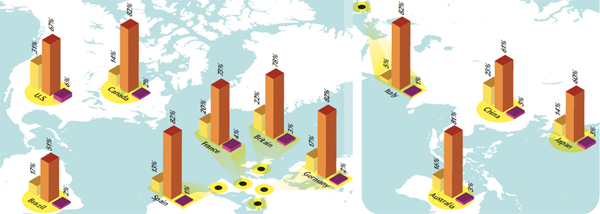
More than 70 percent of respondents agreed that in tough economic times, science funding should be spared. When asked what should be cut instead, defense spending was the overwhelming pick.

Techno Fears
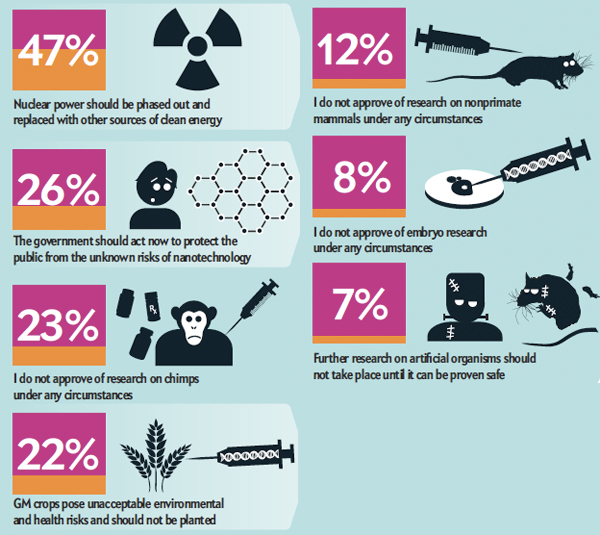
Technology can lead to unintended consequences. We asked readers what technological efforts need to be reined in—or at least closely monitored. Surprisingly, more respondents were concerned about nuclear power than artificial life, stem cells or genetically modified crops.
U.S. vs. Europe
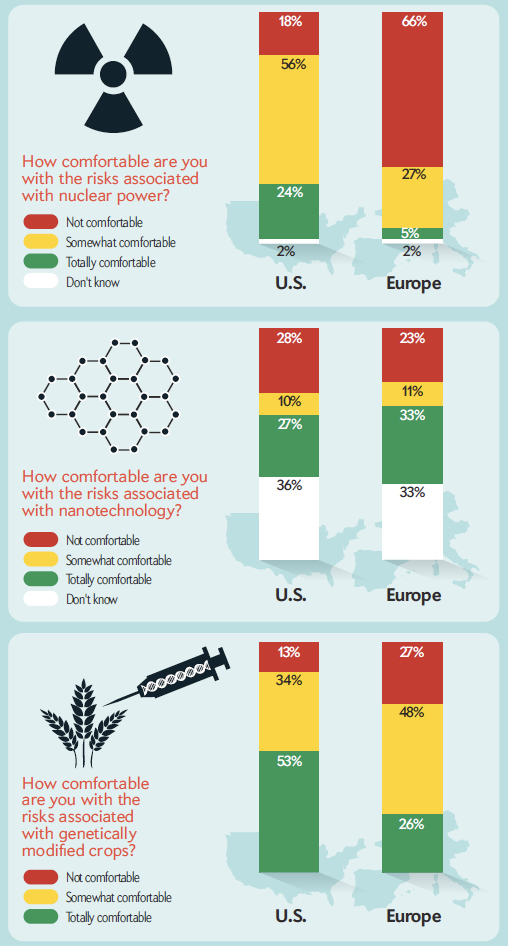
Europeans and Americans differ sharply in their attitudes toward technology. Higher proportions of respondents from Europe worry about nuclear power and genetically modified crops than those from the U.S. (In this grouping, Europe includes Belgium, France, Germany, Italy and Spain, but not Britain, where opinion is more closely aligned with that of the U.S.) In both Europe and the U.S., nanotechnology seems to be a great unknown. Europeans also expressed a mistrust of what scientists have to say about flu pandemics.
Suspicion Over the Flu

On June 11, 2009, the Geneva-based World Health Organization declared the H1N1 flu outbreak a pandemic, confirming what virologists already knew—that the flu virus had spread throughout the world. Governments called up billions of dollars’ worth of vaccines and antiretroviral drugs, a medical arsenal that stood ready to combat a virus that, thankfully, turned out to be mild.
A year later two European studies charged that the WHO’s decision-making process was tainted by conflicts of interest. In 2004 a WHO committee recommended that governments stockpile antiretroviral drugs in times of pandemic; the scientists on that committee were later found to have ties to drug companies. The WHO has refused to identify the scientists who sat on last year’s committee that recommended the pandemic declaration, leading to suspicions that they might have ties to industry as well.
The controversy got a lot of press in Europe—the Daily Mail, a British tabloid, declared: “The pandemic that never was: Drug firms ‘encouraged world health body to exaggerate swine flu threat’”; the controversy in the U.S. garnered little mention.
The brouhaha seems to have influenced opinion markedly in Europe. Nearly 70 percent of U.S. respondents in our survey trusted what scientists say about flu pandemics; in Europe, only 31 percent felt the same way. The figures represented the largest split between the U.S. and Europe on any issue in the poll.
Climate Denial on the Decline

Numerous polls show a decline in the percentage of Americans who believe humans affect climate, but our survey suggests the nation is not among the worst deniers. (Those are France, Japan and Australia.) Attitudes, however, may be shifting the other way. Among those respondents who have changed their opinions in the past year, three times more said they are more certain than less certain that humans are changing the climate.
>
Sondagem da Nature e Scientific American feita em 18 países, Brasil inclusive, indica que as pessoas acreditam na ciência e nos cientistas
Edição Online – 22/09/2010
Uma tomada de opinião feita pela internet com mais de 21 mil leitores de 18 países, inclusive o Brasil, das revistas Nature e das edições americana e internacionais da Scientific American indica que a credibilidade da ciência e dos cientistas é alta. Feita sem qualquer metodologia científica, como ressaltam seus próprios autores, a enquete divulgada hoje (22/09) mostra que os leitores acreditam mais na palavra dos cientistas do que na de qualquer outro grupo de pessoas.
Numa escala de confiança que variava de zero a cinco, os cientistas receberam a nota média de 3,98, praticamente 4. Em segundo lugar, empatados com a nota 3.09, vieram os grupos de amigos/familiares e as entidades não-governamentais. A seguir apareceram, por ordem decrescente de credibilidade, os grupos de defesa dos cidadãos (2.69), os jornalistas (2.57), as empresas (1.78), os políticos eleitos (1.76) e as autoridades religiosas (1.55). Para realçar a boa avaliação feita do trabalho dos cientistas, a Scientific American usou o título “In Science We Trust“ (“Na Ciência Nós Acreditamos’) em sua reportagem sobre a enquete.
A confiança dos leitores no que os cientistas dizem oscila significativamente de acordo com o tema em questão. Evolução foi o assunto em que a palavra dos pesquisadores recebeu a melhor avaliação no quesito confiabilidade. Obteve a nota 4.3, novamente numa escala que variava de zero a cinco. Também mereceram notas elevadas as opiniões dos cientistas sobre os seguintes temas: energias renováveis (4.08), origem do universo (4) e células-tronco (3.97). Os assuntos em que os leitores menos confiam nos cientistas foram: pandemia de gripe aviária (3.19), drogas para depressão (3.21) e pesticidas (3.33).
A sondagem também mostrou que 89% dos leitores dizem que investir em ciência básica pode não produzir efeitos econômicos imediatos, mas é uma forma de construir as bases para o crescimento futuro. Para 75% dos entrevistados pela enquete, em nome da preservação das verbas para ciência, os governos deveriam cortar os gastos com o setor de armamentos e defesa nacional.
O maior temor tecnológico dos leitores ainda são as usinas atômicas. Quase metade dos entrevistados acredita que formas mais limpas de energia deveriam substituir a nuclear. O segundo tema que mais preocupa as pessoas são possíveis riscos desconhecidos do emprego da nanotecnologia, uma questão citada por 26% dos entrevistados.
Brasil e diferenças regionais – As revistas Nature e Scientific American sabem que a sondagem online não reflete a visão de toda a população dos países em que ela foi realizada. “Muitos dos resultados batem com a opinião de um grupo de pessoas bem informada sobre ciência”, escreveu a Nature. Afinal, 19% das pessoas que participaram da enquete disseram ter o título de doutor. Foi uma elite, portanto, que respondeu a sondagem. Além disso, a amostra de leitores de cada país é desproporcional ao número de habitantes. Do Brasil, por exemplo, participaram 422 pessoas, cerca de 10% do número de norte-americanos.
Ainda assim, algumas diferenças regionais apareceram. Os europeus são os que mais temem os riscos associados ao uso da energia nuclear e possíveis problemas causados pelo cultivo de organismos geneticamente modificados. Já os americanos são os que menos se inquietam com essas questões. Os chineses são os que mais defendem a ideia de que os cientistas não devem se meter em política (os brasileiros foram a segunda nacionalidade que mais apoiou essa posição).
Refletindo a importância que o país ganhou recentemente no cenário internacional, Nature e Scientific American divulgaram alguns dados específicos sobre as respostas dadas pelos brasileiros. Em geral, os brasileiros ocuparam os lugares intermediários nas comparações entre os países. Não são os mais crentes nos cientistas e na ciência, mas também não são os mais descrentes.
No entanto, chamou atenção a quantidade de brasileiros (23.5%) que ainda têm dúvidas sobre as explicações dadas pela teoria evolutiva baseada no processo de seleção natural. Na China a descrença chega a quase metade dos entrevistados e no Japão a 35%. Mas na Alemanha e no Reino Unido o ceticismo sobre esse tema não alcança 10% e nos Estados Unidos está na casa dos 13%. No que diz respeito a admitir que as atividades humanas contribuem para mudar o clima global, os brasileiros foram tão assertivos quanto americanos, ingleses e britânicos: cerca de 80% concordaram com essa afirmação.
>
Política de C & T | Mudanças climáticas
Livro mostra como um trio de físicos se dedicou a combater a ideia do aquecimento global nos EUA
Marcos Pivetta, de San Diego*
Edição Impressa 175 – Setembro 2010
Nos tribunais, quando as evidências são enormes contra o réu e a condenação parece questão de tempo, os advogados de defesa sempre podem recorrer a uma derradeira tática: fomentar uma dúvida qualquer, às vezes sobre um aspecto secundário do delito, para turvar o raciocínio dos membros do júri e, assim, evitar ou ao menos postergar o quanto for possível a sentença. A partir do final dos anos 1980, uma versão desse clássico estratagema judicial – que, dentro e fora das cortes, fora usado eficazmente pela indústria do cigarro durante décadas para negar e minimizar os conhecidos malefícios do tabagismo – passou a ser empregada nos Estados Unidos para questionar a existência do aquecimento global e a contribuição das atividades humanas, em especial a queima de combustíveis fósseis emissores de gases de efeito estufa, no desencadeamento das mudanças climáticas.
Sempre que era divulgado um novo estudo de peso sobre a natureza do aquecimento global, três veteranos pesquisadores de enorme prestígio, abrigados numa entidade privada em Washington, o George C. Marshall Institute, saíam a campo para questionar os novos dados. “Primeiro, eles disseram que as mudanças climáticas não existiam, depois afirmaram que as variações de temperatura eram um fenômeno natural (tentaram atribuir a culpa a alterações na atividade solar) e então passaram a argumentar que, havendo as mudanças e mesmo sendo culpa nossa, isso não importava porque nós sempre poderíamos nos adaptar a elas”, afirmou a historiadora da ciência Naomi Oreskes, da Universidade da Califórnia em San Diego (UCSD), numa palestra realizada para jornalistas latino-americanos durante o 7o Taller Jack F. Ealy de Periodismo Científico, que ocorreu em julho nessa universidade. “Em todos os casos, eles negavam que havia um consenso científico sobre a questão, apesar de serem essencialmente eles mesmos os únicos que estavam contra.”
Ao lado do também historiador da ciência Erik Conway, que trabalha no Instituto de Tecnologia da Califórnia (Caltech), Naomi lançou em maio nos Estados Unidos o livro Merchants of doubt – How a handful of scientists obscured the thuth on issues from tobacco smoke to global warming (“Mercadores da dúvida – Como uns poucos cientistas ocultaram a verdade em temas que vão do cigarro ao aquecimento global”, numa tradução livre para o português). Na obra, muito bem documentada e que recebeu elogios na imprensa leiga e nas revistas científicas, Naomi e Conway, um especialista na história da exploração do espaço, mostram que já existe, e não é de hoje, um consenso científico sobre o aquecimento global, detalham a trajetória dos líderes do instituto e suas táticas de negação das mudanças climáticas.
Nos Estados Unidos, país que historicamente é o maior emissor de gases de efeito estufa e também o maior refratário a adotar políticas para mitigar as mudanças climáticas, a ação dos céticos do aquecimento global foi encabeçada nas duas últimas décadas por uma trinca de influentes físicos aposentados ou semiaposentados, todos hoje mortos: o especialista em física da matéria sólida Frederick Seitz (1911-2008), que participou do projeto da construção da bomba atômica durante a Segunda Guerra Mundial e foi presidente da Academia Nacional de Ciências dos Estados Unidos na década de 1960; o astrofísico Robert Jastrow (1925-2008), fundador e diretor do God-dard Institute for Space Studies da Nasa nos anos 1960 e uma figura importante na condução de vários projetos da agência espacial; e William Nierenberg (1919-2000), pesquisador apaixonado pelo mar que foi durante mais de 20 anos diretor do prestigioso Scripps Institution of Oceanography. Nenhum deles era um especialista em modelos climáticos, mas esse detalhe não diminuía sua influência na mídia e na administração norte-americana, sobretudo em governos republicanos.
Em 1984 os três fundaram o George C. Marshall Institute, cujo slogan era (e é) “ciência para uma política pública melhor”. O think tank, expressão em inglês usada para denominar esse tipo de instituto, tinha como objetivo original fazer lobby a favor do polêmico projeto de construção de um escudo espacial capaz de defender os Estados Unidos de um eventual ataque de mísseis balísticos disparados pela União Soviética. Apelidada de Guerra nas Estrelas, a iniciativa de defesa, concebida durante a administração de Ronald Reagan, nunca saiu do papel. Com a derrocada do império soviético entre o fim dos anos 1980 e o início dos 1990, o projeto do escudo espacial foi arquivado e Seitz, Jastrow e Nierenberg redirecionaram a atuação do instituto para um tema mais atual: o combate ao ambientalismo em geral e à negação do aquecimento global. “Eles tinham aquela ideia de que os ambientalistas eram como melancias: verdes por fora e vermelhos por dentro”, disse Naomi.
Ozônio e DDT – A dupla que escreveu o livro se conheceu numa conferência sobre história da meteorologia em 2004 na Alemanha e logo ambos perceberam que haviam chegado à mesma constatação: os cientistas que mais ativamente combatiam nos Estados Unidos a ideia de que a temperatura global do planeta estava aumentando eram os mesmos que, no passado recente, tinham negado ou ainda negavam a existência do buraco na camada de ozônio, os perigos da chuva ácida, os malefícios do pesticida DDT e os problemas de saúde causados pelo tabaco em fumantes passivos. “Em todos esses temas científicos, eles sempre estiveram do lado errado”, afirmou Naomi, que já deu aulas em Harvard, em Stanford, na New York University e hoje dirige o Sixth College da UCSD. “Quando descobrimos que Seitz tinha coordenado entre 1979 e 1985 o programa de pesquisa da R.J. Reynolds Tobacco Company, que investiu US$ 45 milhões em estudos científicos, vimos que tínhamos uma boa história.”
A atuação dos membros do instituto visava (e visa) mostrar que não havia consenso científico sobre a existência das mudanças climáticas e muito menos certeza sobre quais seriam as suas causas. Logo, diziam os cientistas do George C. Marshall Institute, o debate nesse campo da ciência estava totalmente aberto e não fazia sentido os Estados Unidos adotarem qualquer medida legal ou prática para diminuir o consumo de combustíveis fósseis. Exatamente a mesma tática foi empregada durante décadas por pesquisadores e médicos ligados ou patrocinados pela indústria do cigarro, que, a despeito das crescentes evidências dos malefícios do tabaco, negavam e minimizavam as conclusões dos estudos científicos.
Posta dessa maneira, a negação do aquecimento global parece ter sido alvo de uma conspiração encabeçada por um grupo de cientistas conservadores. Os autores do livro, no entanto, se apressam em descartar qualquer insinuação nessa linha. Eles dizem que não encontraram nada de ilegal na atuação de Seitz, Jastrow e Nierenberg e que tudo foi feito mais ou menos às claras. Entre os estratagemas do instituto, estava o de invocar um princípio clássico da imprensa norte-americana e ocidental: lembrar os jornalistas de que eles sempre têm de ouvir e dar espaço equivalente a visões contrárias às dominantes. Nas reportagens sobre mudanças climáticas, os dirigentes do George C. Marshall Institute e outros céticos do aquecimento global eram com frequência o outro lado.
Merchants of doubt apresenta Seitz, Jastrow e Nierenberg como fervorosos defensores da desregulamentação da economia, anticomunistas convictos, “falcões” a serviço da indústria dos combustíveis fósseis e de interesses conservadores. “O lobby deles foi muito eficiente porque a cultura americana da finada Guerra Fria era permeada pela crença no fundamentalismo dos mercados, na ideia de que os mercados eram, sempre e em todo o lugar, bons e que a regulamentação é sempre ruim”, diz Conway. “Essa ideia permitiu que a negação do aquecimento global funcionasse tão bem. A propaganda é mais eficiente quando se assenta em algo que as pessoas já acreditam.”
Reação ao livro – A publicação do livro levou a uma reação dos atuais comandantes do George C. Marshall Institute. Num artigo divulgado em junho no site do think tank, William O’Keefe e Jeff Kueter, respectivamente CEO e presidente do instituto, dizem que a obra carece de fundamentação científica e distorce a realidade. Eles defendem os bons serviços prestados à ciência pelos fundadores do instituto, dizem que Seitz, Jastrow e Nierenberg sempre foram anticomunistas e defensores do livre mercado – e que isso está longe de ser um defeito nos Estados Unidos.
De concreto, a resposta não desmente nenhum dos fatos centrais relatados no livro. Por exempo, O’ Keefe e Kueter admitem que Seitz realmente chefiou o programa de pesquisas da R.J. Reynolds depois de ter se aposentado do cargo de presidente da Universidade Rockefeller, algo que, segundo eles, não era segredo e estava na autobiografia do físico. Mas dizem que o intuito do programa não era gerar dados que questionassem os malefícios do cigarro. Pelo menos esse não era o objetivo de Seitz, ainda que pudesse ser o da indústria do tabaco.
Sobre a questão das mudanças climáticas, as respostas dos atuais dirigentes do instituto parecem dar mais razão a Naomi e Conway do que contradizê-los. “Na verdade, o único consenso (sobre o aquecimento global) que existe é entre aqueles que escrevem (o relatório do Painel Intergovernamental de Mudanças Climáticas, o IPCC, na sigla em inglês)”, afirmam O’Keefe, ex-vice presidente do Instituto Americano do Petróleo, e Kueter. Por isso, eles advogam mais pesquisas científicas sobre o tema e nenhuma ação imediata para diminuir as emissões de gases de efeito estufa: “Somos contra as políticas de reduções das emissões de poluentes e de mecanismos semelhantes ao Protocolo de Kyoto? Sim. Elas são caras e vão trazer pouco retorno ambiental”.
Para o climatologista Carlos Nobre, coordenador do Programa FAPESP de Pesquisa sobre Mudanças Climáticas Globais e do Centro de Ciência do Sistema Terrestre (CCST) do Instituto Nacional de Pesquisas Espaciais (Inpe), a atuação de lobbies conservadores ligados à indústria dos combustíveis fósseis, como o realizado pelo George C. Marshall Institute, atrasa a obtenção de um grande acordo mundial para a redução das emissões de gases de efeito estufa. “Eles sabem que estão numa batalha perdida, a exemplo do que ocorreu com o debate em torno dos malefícios do tabaco”, argumenta Nobre, que faz parte do time de 600 cientistas de mais de 40 países que compõem o IPCC. “O que eles querem é atrasar o máximo possível a adoção de medidas que forcem a indústria americana a reduzir suas emissões de poluentes.”
O físico Paulo Artaxo, professor da Universidade de São Paulo (USP), outro representante do Brasil no IPCC, pensa de forma semelhante. “Eles querem ganhar tempo”, afirma Artaxo. “Em ciência, nunca há 100% de certeza. Mas os dados compilados pelo IPCC representam a melhor ciência disponível sobre a questão do aquecimento global.” Em seu último relatório, o IPCC atribuiu, com um grau de 95% de confiabilidade, as mudanças climáticas ao aumento das atividades humanas no planeta. Criado em 1988, o IPPC não é perfeito e está corrigindo suas imprecisões e a forma de trabalhar. Mas seus dados, diz a maior parte dos pesquisadores, são uma razão para agir – e não para o imobilismo como defendem os céticos das mudanças climáticas.
A visão de Washington sobre o aquecimento global mudou com a chegada do democrata Barack Obama à Casa Branca? Para Conway, a atual administração parece aceitar a realidade de que as mudanças climáticas são reais e decorrem essencialmente das atividades humanas. “Mas os Estados Unidos não têm sido muito pró-ativos nessa questão”, reconhece Conway. “Somos os líderes mundiais em ciência do clima. No entanto, em termos práticos, de medidas mitigadoras do aquecimento, os países escandinavos estão muito na nossa frente.”
* O jornalista Marcos Pivetta participou do 7o Taller Jack F. Ealy de Periodismo Científico a convite do Institute of the Americas.
>
Published: Sept. 14, 2010 E-mail Editor ShareThis
Aaron M. McCright, associate professor of sociology
Michigan State University – News
EAST LANSING, Mich. — Women tend to believe the scientific consensus on global warming more than men, according to a study by a Michigan State University researcher.
The findings, published in the September issue of the journal Population and Environment, challenge common perceptions that men are more scientifically literate, said sociologist Aaron M. McCright.
“Men still claim they have a better understanding of global warming than women, even though women’s beliefs align much more closely with the scientific consensus,” said McCright, an associate professor with appointments in MSU’s Department of Sociology, Lyman Briggs College and Environmental Science and Policy Program.
The study is one of the first to focus in-depth on how the genders think about climate change. The findings also reinforce past research that suggests women lack confidence in their science comprehension.
“Here is yet another study finding that women underestimate their scientific knowledge – a troubling pattern that inhibits many young women from pursuing scientific careers,” McCright said.
Understanding how the genders think about the environment is important on several fronts, said McCright, who calls climate change “the most expansive environmental problem facing humanity.”
“Does this mean women are more likely to buy energy-efficient appliances and hybrid vehicles than men?” he said. “Do they vote for different political candidates? Do they talk to their children differently about global warming?”
McCright analyzed eight years of data from Gallup’s annual environment poll that asked fairly basic questions about climate change knowledge and concern. He said the gender divide on concern about climate change was not explained by the roles that men and women perform such as whether they were homemakers, parents or employed full time.
Instead, he said the gender divide likely is explained by “gender socialization.” According to this theory, boys in the United States learn that masculinity emphasizes detachment, control and mastery. A feminine identity, on the other hand, stresses attachment, empathy and care – traits that may make it easier to feel concern about the potential dire consequences of global warming, McCright said.
“Women and men think about climate change differently,” he said. “And when scientists or policymakers are communicating about climate change with the general public, they should consider this rather than treating the public as one big monolithic audience.”
What science writers are looking for and why it behooves you to answer their calls.
By Edyta Zielinska
There was a time when the public saw newspaper reporters as heroic figures. In those days, “Men wore hats and pounded away on the typewriter with two fingers,” says neuroscientist Richard Ransohoff, whose father was a beat reporter at the Cincinnati Enquirer and Post and Times-Star through the early 1960s. His father “knew every cop in town,” recalls Ransohoff, who works today at the Cleveland Clinic’s Mellen Center for Multiple Sclerosis. “I was enamored with that persona.”
Even with his fond memories of journalism’s glory days, as a clinical neurologist, Ransohoff understands the frustration common to many scientists when their work is covered by the media. The effect of news coverage is immediate. His patients will visit his office with clips in hand, full of hopes and questions. “I’ve had thousands of conversations with patients,” he says. “You have a disease for which the cause is unknown and the course is variable,” and you have to explain that even the most promising research is years away from being tested, much less proven as a treatment, he says.
The public understands that if they “go to their niece’s third grade recital and the kid plays chopsticks, and plays the hell out of it,” he says, “no one in the audience is fooled into thinking that the next stop is Carnegie Hall.” That same appreciation is missing in the public’s understanding of the scientific enterprise, he says. That there is a slim chance for big findings in basic research, trumpeted by news stories, to make it through the long vetting process of drug development and clinical trials is a concept that the public rarely grasps.
And basic researchers can get burned by media coverage, as well, such as when years of bench work are cast incorrectly by a reporter who makes a factual mistake or misinterprets complex findings.
But there are many reasons why scientists should speak to reporters, and why doing so can help their careers. “I don’t think scientists are hesitant to speak to the press. I just don’t think they’re good at it,” Ransohoff says. “But in fairness it is difficult to talk about cellular processes to people who [sometimes] don’t know their bodies are made out of cells.” Of course, most journalists who write primarily about science these days are well versed in basic biology, physics, or whatever field they cover—many are even former scientists themselves.
Here are tips from leading science reporters, producers and other communications experts on how researchers can get the most out of interactions with the press, and why taking a call from a reporter is worth your time.
Why you should make time for reporters
It’s your duty
“I don’t think it’s important [to talk to reporters], I think it’s essential,” says Brandeis University’s Gregory Petsko, who served as past president of the American Society for Biochemistry and Molecular Biology. “The public puts us in the lab. They spend their money to allow us to do what we love to do.” Since taxpayers fund the majority of research, it’s scientists’ responsibility to communicate the science on which the money is spent, says Petsko.
It raises your profile with journal editors and funders
Editors of high-impact journals don’t just look for the best research, they also look for research they think will catch the eyes of editors at the New York Times. If they see that your lab publishes the kinds of studies that appear on the radar screens of science journalists, they may be more prone to look favorably on your next submission. The same is true of some granting agencies.
Your bosses will love it
“Our institutions love publicity,” says Ransohoff. “We get local credibility and a type of celebrity within our institution.” Having your research covered by media outlets can translate to recognition and validation within your department that may ultimately help you win departmental resources.
You may pick up grant-writing tips
Journalists have an eye for distilling the details—a skill that increasingly shorter grant applications place at a premium. “We’re in a completely new era of grant preparation and review,” says Ransohoff. With applications for National Institutes of Health grants recently trimmed from 25 pages to 12, researchers and reviewers must briefly emphasize a project’s significance and innovation—concepts that science writers routinely think about. Scientists will benefit from seeing how a seasoned journalist distills years of work and a long manuscript into a readable, 500-word article.
It gets the public excited about science
Robert Langer, Massachusetts Institute of Technology biomedical engineer, has more than 760 patents pending or awarded, and runs the largest academic biomedical engineering lab in the world. He is also something of a press darling for being approachable, despite the demands on his time. (He called this reporter within 20 minutes of receiving an email request.) “The future of our country and science depends on getting outstanding young people interested in science,” says Langer, and helping reporters publish stories that describe the achievements and possibilities of science is one way to do that.
It’s better you than someone else
If you care about how the science in your field will be described, the best thing to do is to respond to reporters’ calls, especially with hot-button topics like stem cells or climate change. “If no [expert scientists] talked, [reporters will] end up going to people who are less and less expert,” which can result in stories that are less accurate, says Ed Sykes, a press officer at the Science Media Centre, an organization that provides press support for the UK national media.
The Medium Matters
TV is different from print
When Vincent Liota, a senior series producer at NOVA scienceNOW, was working as a news cameraman for a local television station in Norfolk, Va. in 1985, he covered the hostage takeover of Flight 847. When the hostages were released, both TV and newspaper reporters swarmed around one hostage who was willing to speak. The man said that he had gotten off the plane, sat down and lit a cigarette. “He was telling this story and getting really emotional,” says Liota. At that moment, a newspaper reporter interrupted and asked “what brand of cigarettes were you smoking?” to the frustration of all of the television reporters who wanted the uninterrupted, first-hand account. Print reporters will often grill you for specific details and numbers that will help the reader visualize the story.
If it’s live, do pre-interview mental pushups
Most people who are interviewed on radio or TV usually experience a pre-interview, in which someone—either the on-air reporter or a producer—asks questions similar to those they’ll hear on-air, says Christopher Intagliata, one of the producers of Science Friday, a live public radio talk show hosted by Ira Flatow. Mooney, who’s been interviewed on radio about his work, says he usually spends 5 minutes before going on the air, thinking about what the audience is interested in, and how to explain those ideas in the clearest way. “If it’s live radio, you’ve only got one shot,” Mooney says.
For the news— no personality, no problem
Not everyone can be dynamic, funny, witty, engaging, dramatic,” says Petsko. But you do have to be clear, he adds. “Nothing is more important than that.” Personality is not as crucial to a news story as it is in a feature article or live interview. When Tom Clarke—who covers breaking science stories for Channel 4 News in the United Kingdom—hits the road for a story, he isn’t looking to find the perfect source. News reporters like Angier and Clarke will digest the science for their audience, using quotes or sound bites from scientists to give a story context. “It doesn’t matter what the scientist is like,” says Clarke. “We’ll find a way to get something we can use.”
Getting the most out of a press call
Understand what the journalist/outlet is looking for
You should always get a sense of the kind of story the reporter aims to write. It’s perfectly acceptable to ask a reporter about his or her intentions for an article. But keep in mind that the reporter may not always know, says Faye Flam, a science journalist at the Philadelphia Inquirer. “Sometimes I’m just fishing,” for an idea, she says. But asking the journalist for more information, or for a list of sample questions, can help you decide if you’d like to participate, and provide clues for how to prepare and “be more helpful,” says Flam. Another way to decide whether to participate is to try to imagine the headline that will appear with the story that you’re interviewing for, says Brad Phillips, president of Phillips Media Relations, and author of the blog mrmediatraining.com.
K.I.S.S.—Keep It Simple, Scientist
Sometimes, the simplest answer is the best one. “When you’re learning to drive a car, you want someone who’s going to answer your questions in a way that’s going to be fruitful to you,” says Liota. “When someone asks ‘how do you make the car go, you don’t want someone to say, ‘Well, there’s this thing called the carburetor… and that supplies gasoline into the manifold, where it is combusted. The valves adjust the fuel injected into the cylinder, and pistons compress it, and then they fire.’” While the information is all correct, viewers want a scientist who can simply say “you step on the gas and it goes.”
It’s okay to give personal details
While personal questions may seem like dangerous territory or off topic, they can be crucial to conveying the human face of science. “I want the audience to know that scientists aren’t bronzed figures that, with very little homework, come up with great pronouncements,” says Krulwich. If you’re uncomfortable with giving a particular personal detail, feel free to ask why the reporter thinks it’s important.
Be a go-to source
“My job is to get good people,” says Science Friday’s Intagliata. Come Friday’s deadline, “I want to know I have a failsafe solution,” he adds. If reporters can’t get the clarity they’re looking for, they simply search for another source. “One wonders why we turn to the same sources again and again,” says Angier. Some sources are simply good at drawing a caricature that captures the essence of an idea. “People who master that will get called again and again,” says Angier.
It’s all about significance
Reporters will want to know, “Is this something the rest of the public should care about?” adds Sykes. He says that scientists should come to the interviews “armed” with “the bottom line” and numbers that demonstrate the impact the science could have on humanity or on the field. “Journalists love the numbers, but they have to be in context.”
Prepare a plate of metaphors
Scientists should come to the interviews “armed” with “the bottom line” and numbers that demonstrate the impact the science could have on humanity or on the field.
—Ed Sykes
The goal of the science writer, says Angier, is to “bring the senses to bear—what it would look like, what it would feel like, smell like.” The shortest path to achieving this goal is the use of metaphors, and you can aid reporters in crafting these turns of phrase. For example, to describe RNA interference to a lay audience, Liota once constructed several layers of metaphor: Using animation, his team drew RNA as a recipe that a “monkish scribe” copies from the grand cookbook of DNA, which was kept locked in a tower (the nucleus). Those recipes were then chucked out of the nuclear “window” (a pore) and caught by a chef (a ribosome) floating in the cytoplasm, who would whip up proteins based on the instructions. While such extensive metaphors may seem excessive and loose, they give uninitiated readers a fighting chance to understand complex biological concepts.
Want coverage? Be available
Make yourself accessible to the press, and be sure not to book travel plans during the week before your new research is published. If a reporter can’t reach you or someone in your lab, they may choose not to cover the story.
Common press pitfalls, and how to avoid them
To avoid oversimplification, connect the dots
Good science reporters do their best not to tell an overly simplified story. That isn’t satisfying to anyone, says Angier. When using metaphors, make sure to think about and convey the limits of the metaphor. A journalist will try to convey the full complexity, but in the end, a story is “just a taste,” he notes. “It’s not the master class.” If you’re worried that a reporter won’t get all the most important parts of your science, prepare three main points you want to get across, making sure to convey how you came to those statements, and field-test them on a layperson to ensure that the message is clear.
To avoid errors, avoid jargon
When science writer Carl Zimmer teaches a course on science communication to budding researchers at Yale University, he often returns the assignment with loads of jargon words circled in red. “A scientist has spent years learning how to talk like a scientist,” he says, and often have a hard time distinguishing jargon from genuinely descriptive language. But every time a scientist uses a word that is meaningful only to that particular field, it increases the likelihood that the reporter will misunderstand the intended message when he sits down to write and translate that term for a general scientific or lay audience.
To avoid misquotes, take a pause
“The big issue is pausing properly,” says Petsko. When talking to a reporter, he always takes breaks to let the reporter “digest and see what kinds of questions come back at me.” Some reporters try to take down all of the words you say—especially unfamiliar scientific terms (so they can look them up later). The faster you talk, the more likely it is that they’ll miss something.
To avoid sensational stories, research the reporter
The majority of science reporters are quite conscientious about getting their stories right. “Most of us are trying to make an honest effort to get at the truth, and we’re genuinely interested in what [scientists] do,” says Flam. But general assignment reporters, who don’t usually cover science, may not be as adept at capturing scientific stories. It’s always a good idea to research reporters or outlets before you agree to speak with them to see whether you trust how—and if—they cover science. If a reporter calls first (without sending an email request), feel free to say that you’ll call back, and do a few Internet searches.
if it’s wrong, ask for a correction
Even the best science reporters do get it wrong sometimes. Don’t hesitate to get in touch with reporters or their editors to set the record straight. Most will be happy to oblige. But remember that many outlets have a policy only to correct factual errors, not omissions or changes in tone.
Definitions
Disclaimer: While the following represent widely held definitions in the field, not every reporter will interpret the rules in the same way. Your best bet is to either not say anything you don’t want to see in print or have an explicit conversation with the reporter about how your words will be used before the interview begins.
Off the record:
This is an agreement you make with a journalist before you say things that you do not want published. Here, nothing you say will be published or attributed to you. If you only want parts of the conversation to be “off the record,” make sure to tell the reporter when you’d like those parts to begin and end.
Not for attribution:
You can agree to speak to a reporter about a sensitive topic under the condition that your name will not be used. This information will be published, but attributed to an unnamed source. The reporter will then negotiate an attribution for your comments that demonstrates your expertise without revealing your identity.
Background:
When a reporter asks to speak “on background,” this indicates that your guidance and opinion are needed. Talk to the reporter ahead of time if you don’t want what you say used in the story.
Outside comment:
This is the journalist’s method for peer review. Reporters invite researchers who were not involved in the issue or study at hand to weigh in on the science and its potential impact on the field.
Take home message:
This is the most important point about the science or issue at hand, stripped of the details. A succinct sentence in summary usually suffices.
News story:
More timely, more focused, and written on a tighter deadline than features, news stories generally highlight one finding or event. In general, reporters have much less time to grasp the content of the science and fact check—so you may have only one chance to be understood.
Feature article:
These longer pieces posit a particular concept—a thesis—and support that concept with quotes and anecdotes from a much larger number of sources than a news story.
Profile:
These stories tell the science of a single person (and more rarely a place) through the recollections of people who have worked with, mentored, or inspired that scientist.
Fact checking:
Reporters will ask to read back (or email) the facts stated in the article to make sure they are accurately portrayed. This is not, however, an opportunity to change quotes, or the focus of a story.
The rules of engagement
You’re always on the record
“It is the responsibility of the scientists to know what the rules are.” —Natalie Angier, New York Times science columnist
If scientists choose to speak to a reporter, everything they say can be published, and it’s the journalist’s prerogative to choose which portions of the interview to include in a story. The law of free speech gives reporters the right to publish what they hear. This concept could be unfamiliar to many scientists, says David Mooney, a bioengineer at Harvard University. “Scientists routinely talk to each other off the record to kind of exchange ideas in a very informal way, where there’s no sense that these ideas will ever become public,” he says. “It’s an integral part of the scientific process.” Printable information can even include data divulged in conference presentations, but each meeting typically has a unique confidentiality policy, if members of the press will be present. This can vary widely, so it’s best to know the ground rules for the conference at which you’re presenting.
No, seriously—you’re on the record
It’s possible to ensure that some portion of an interview is off the record (see definitions), but scientists have to go about this a specific way. Simply saying, “it’s off the record,” isn’t enough, says Carolyn Foley, a lawyer who specializes in media and communications law at Davis Wright Tremaine LLP in New York. “You need to get the reporter’s agreement,” preferably in writing, but verbal agreements are okay. You must first say you want to speak off the record and obtain the reporter’s agreement, before sharing sensitive information. “It is the responsibility of the scientists to know what the rules are,” says New York Times science columnist Natalie Angier. You can’t talk to a reporter and then “suddenly negate the whole conversation,” by saying that it was off the record. The reporter is still allowed to use that information. Don’t “talk to a reporter like you’re talking to a friend,” says Foley. “Even if you have a good rapport with them, the journalist is free to use the information.”
Don’t hype or overstate
Every journalist’s primary objective is to entice the reader to care and to continue reading. Part of that equation with science stories is spelling out the major finding and implication of the research—either for the general public or for a general scientific audience. Take extra care when talking about the relevance of a finding. Be aware that, to the reporter, these may be the most important two sentences you say, so take care to include all of the relevant caveats. According to MIT’s Langer, “it’s natural to get excited about your science,” but it’s important to be conservative about your predictions for the human implications. “You don’t want to give false hope,” he says.
It’s your science, but it’s their story
You can try to guide reporters to the parts of your science that are most important, you can emphasize your main points, but in the end, “once I walk away with these notes, that’s my work product and it’s my job to come up with an account of this conversation,” says Robert Krulwich, cohost of Radiolab, a public radio show about science and philosophy. Some outlets allow scientists to read a draft of the piece to check for errors, while others have strict policies that prevent a reporter from showing any part of the draft. Except in the most extenuating circumstances, these policies are typically non-negotiable.
Have a comment? E-mail us at mail@the-scientist.com
Read more: Why Trust A Reporter? – The Scientist
>
Exposição e livro trazem à luz imagens polêmicas feitas por rival de Darwin
Por Carlos Haag
Edição Impressa 175 – Setembro 2010

Mestiços do Amazonas. © divulgacão.
Aqueles que põem em dúvida os efeitos perniciosos da mistura de raça e são levados por falsa filantropia a romper todas as barreiras colocadas entre elas deveriam vir ao Brasil”, afirmou o zoó-logo suíço Louis Agassiz (1807-1873) em seu livro A journey to Brazil (1867), escrito a quatro mãos com a mulher, a americana Elizabeth Cary, resultado da visita ao país como líder da Expedição Thayer, entre 1865 e 1866, da qual fizeram parte, entre outros, o futuro filósofo William James (1842-1910) e o geólogo Charles Frederick Hartt, indo do Rio de Janeiro ao Amazonas. Professor da Lawrence School, ramo da Universidade Harvard, e fundador do Museu de Zoologia Comparada da mesma universidade, Agassiz era o mais notável e popular cientista da América do Norte, defensor do criacionismo, do poligenismo, adepto da teoria da degeneração das raças e um opositor feroz do evolucionismo. Após a publicação de A origem das espécies (1859), de Darwin, porém, seu prestígio passou a ser questionado por jovens naturalistas americanos que rejeitavam suas interpretações teológicas e racistas. Ele então abraçou com entusiasmo a chance de vir ao Brasil com o objetivo de pesquisar os peixes da bacia amazônica para provar a “falácia” das teses darwinistas.
Não menos importante, a viagem era a oportunidade de visitar um “paraíso racialista”. Agassiz aproveitou a sua estada para recolher provas materiais da “degeneração racial” provocada pelo “mulatismo”, comum na população brasileira, fortemente miscigenada. O resultado foi uma série de 200 imagens, conservadas no Museu Peabody de Harvard, em sua maioria inéditas devido ao seu conteúdo polêmico: retratos nus da população africana do Rio e dos tipos mestiços de Manaus. Um grupo de 40 dessas fotografias está sendo exibido pela primeira vez na exposição Rastros e raças de Louis Agassiz: fotografia, corpo e ciência, ontem e hoje, mostra que faz parte da 29ª Bienal de Artes de São Paulo e está em cartaz no Teatro de Arena até o final do mês. Ao mesmo tempo, acaba de ser lançado o catálogo homônimo da exibição, editado por sua curadora, Maria Helena Machado, professora do Departamento de História da Universidade de São Paulo (USP). A pesquisadora também é a organizadora do livro O Brasil no olhar de William James (pela Edusp, a ser lançado até o final do ano), que traz cartas, diários e desenhos do filósofo americano, irmão do escritor Henry James, como integrante da Expedição Thayer. Então um jovem de 23 anos, estudante de medicina em Harvard, James era admirador do suíço, mas a estada brasileira mudou sua visão sobre o “Professor” (como se refere a Agassiz), bem como, nota Maria Helena, foi um ponto decisivo na vida do filósofo do pragmatismo, pois teria sido aqui que ele decidira se dedicar à filosofia. “Indo contra a corrente do momento, seus registros do Brasil são peculiarmente empáticos, apesar de ter contraído varíola, que o deixou temporariamente cego, colidindo com a visão do mentor da viagem, Agassiz, cuja posição política e ideológica o vinculava aos defensores do racismo e das teorias da degeneração pelo hibridismo”, fala a professora.
“Passeando pelo éden amazônico, a Expedição Thayer, com apoio dos governos americano e brasileiro, devassaria a Amazônia, apropriando-se dos peixes, das rochas e capturando imagens dos mestiços e mestiças da região, fotografados nus em poses dúbias, congelados como exemplos da degeneração racial, em nome da construção de um inventário dos perigos da miscigenação”, continua Maria Helena. Agassiz havia se tornado o principal divulgador de uma ciência idealista e cristã, que reafirmava o criacionismo ao mesmo tempo que usava uma linguagem “vanguardista”, cheia de nomes técnicos e alusões a procedimentos científicos. “Se por um lado ele se alinhava no campo dos adeptos da ciência empírica como chave do conhecimento, ao mesmo tempo se reconciliava com as visões metafísicas e religiosas que buscavam interpretar, no livro da natureza, os desígnios divinos.” O zoólogo fora discípulo do naturalista francês Georges Cuvier, que negava a interconexão genética das diferentes espécies, cuja análise pressupunha uma descrição empírica minuciosa dos seres observados, já que cada espécie era única em si mesma. Além disso, Cuvier acreditava que o mundo havia sofrido inúmeras catástrofes que teriam dizimado as espécies que o povoavam, sendo em seguida outras criadas pela mão divina. Assim, os animais que conhecemos teriam sido originados por uma criação recente, hipótese que daria conta do grande problema para os não evolucionistas: a diferença entre os animais fósseis e os atuais.
“Agassiz também preconizava que todos os seres organizados foram criados para pertencer a uma determinada ‘pátria’, ou seja, existiria uma ligação entre os seres e seus hábitats. As diferenças de clima não bastavam para explicar a distribuição das espécies. A lógica do povoamento saíra diretamente de Deus”, explica a historiadora Lorelai Kury, pesquisadora da Fundação Oswaldo Cruz e professora da Universidade do Estado do Rio de Janeiro. Segundo o suíço, existiriam “províncias zoológicas”, já que Deus, depois de ter criado novas espécies em diferentes épocas, teria designado a cada uma a sua “pátria”.

As três poses típicas das fotos de Agassiz.
“O cientista, para Agassiz, era um ser privilegiado que saberia desvendar o plano divino por meio da observação científica da natureza, ocupando o lugar tradicionalmente reservado aos teólogos. Sua visão se ligava a uma perspectiva platônica e estática da vida e da ciência, cujas diretrizes se reportavam a certezas como a existência de tipos ideais e, sobretudo, a reafirmação da precedência do plano divino sobre a realidade do mundo natural”, diz Maria Helena. Ainda segundo o zoólogo, haveria uma hierarquia natural na escala dos seres, de animais para humanos, assim como entre as raças humanas, fruto da intenção divina de impor uma ordem ao mundo. “Cabia aos homens entender e respeitar isso. Os negros, que teriam sido criados por Deus expressamente para habitar os cinturões tropicais, provinham de uma espécie humana inferior, cuja virtude seria a força física e a capacidade de servir. Ante os brancos, superiores, eles abdicavam de sua autonomia em nome da segurança do comando e da proteção de seus mestres. Essas ideias eram comungadas por pró-escravistas e por abolicionistas como Agassiz.” Tal concepção de mundo tinha ampla aceitação, em especial pelo público leigo americano, acalmando suas angústias num mundo em rápida transformação. “Agassiz, durante esse período, estava mais interessado em se dirigir às preocupações do público do que à comunidade científica. Ele ignorava solenemente o número crescente de intelectuais que haviam perdido o interesse na ideia de criações separadas, continuando a dar palestras abertas em defesa do poligenismo e do pluralismo”, observa a antropóloga Gwyniera Isaac, curadora de etnologia americana do Smithsonian’s National Museum of Natural History e autora do artigo “Louis Agassiz’s Photographs in Brazil.”
A viagem ao Brasil era, então, uma necessidade, pois, com a publicidade da expedição, ele acreditava que conseguiria aliados para rebater o evolucionismo e defender a fixidez das espécies e as criações sucessivas. “Na região amazônica, Agassiz dedicou-se a buscar provas de uma recente glaciação que teria marcado uma ruptura entre as espécies atuais e as extintas (o que levou Hartt a se afastar dele), dentro do espírito das catástrofes naturais como responsáveis pela geração de novas espécies, isoladas e sem ligação com outras. Com relação aos peixes, ele acreditava que as espécies encontradas variavam ao longo do Amazonas e eram diferentes para cada afluente”, afirma Lorelai. Contrário a Darwin, Agassiz pensava que a variabilidade em cada espécie era nula e o que hoje se considera uma variedade o zoólogo tomava por uma espécie nova.
O suíço também tinha outros interesses, menos científicos. Desde a sua chegada aos Estados Unidos, em 1840, havia se envolvido no debate norte-americano sobre as raças, abraçando a teoria da degeneração, que afirmava ser a miscigenação ou hibridismo o caminho certo para a degenerescência social. Afinal, se Deus criara a flora, a fauna e o homem em nichos precisos, como o ser humano afrontava esses desígnios misturando climas e raças e, pior, fazendo-as interagir? “Para alguns dos abolicionistas e pensadores racialistas do século XIX, além do mal dos deslocamentos de negros, resultante do tráfico, outro erro, ainda pior, seria o ‘mulatismo’, a conspurcação do sangue ocasionada pela mestiçagem. A solução seria a emigração coletiva ou, pelo menos, a segregação dos afro-americanos em um cinturão de clima quente no Sul, no qual eles viveriam o mais apartado possível, sob a tutela dos brancos”, conta Maria Helena. “Com isso os defensores da incompatibilidade da convivência da raça negra com a civilização acreditavam que os negros seriam impedidos de cometer danos irreparáveis ao corpo da nação.” Em meio à Guerra de Secessão, circulavam, no Norte e no Sul dos Estados Unidos, propostas de “repatriação” dos ex-escravos, inclusive para o Brasil (ver “O dia em que o Brasil disse não aos Estados Unidos”, na edição 156 de Pesquisa FAPESP). Os argumentos de Agassiz sobre as províncias zoológicas, que destinavam as áreas tropicais para a raça negra, tingiam essas propostas com a aura de filantropia. Por isso, observa a pesquisadora, os interesses da Expedição Thayer iam além da ciência. “Por trás do discurso público do cientista-viajante havia outro que ligava Agassiz aos interesses norte-americanos na Amazônia, conectado a duas linhas de ação diplomática: a abertura do Amazonas à navegação internacional e aos projetos de assentamento de negros americanos como colonos ou aprendizes na várzea amazônica, vista como extensão natural do ‘Destino Manifesto’ dos EUA.” O governo norte-americano sabia da ligação entre Agassiz e Dom Pedro II, que trocavam correspondência desde 1863, e o suíço veio ao Brasil para pressionar o imperador a abrir a navegação da Amazônia, no que teve sucesso, e também para ajudar a promover a imigração de negros.
“Nesse sentido, o Brasil era visto como lugar ideal para recolher provas dos perigos da degeneração, que seriam veiculados em sua volta aos EUA. Para isso pensou em fazer uma expressiva coleção de fotografias que documentaria as mazelas da mistura de raças puras e híbridas, tudo com caráter abertamente racialista”, nota Maria Helena. “A consequência natural de alianças entre pessoas de sangue misturado é uma classe de indivíduos em que o tipo puro desaparece assim como todas as qualidades físicas e morais das raças primitivas, produzindo mestiços tão repulsivos como cachorros vira-latas”, anotou Agassiz. Daí a observação precisa de Darwin sobre o rival: “Ele coleta dados para provar uma teoria em vez de observar esses dados para desenvolver uma teoria”. Esse é o princípio que explica as fotografias brasileiras. “Para demonstrar sua tese, ele coletou imagens sobre a classe ‘híbrida’ das populações que, acreditava, eram aparentes no Brasil. Humanos, como qualquer outra espécie, requeriam análise por meio de métodos empíricos e ‘frios’ como a fotografia”, nota Gwyniera Isaac.
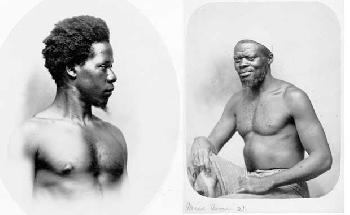
Imagens iriam servir de argumento racialista
Com o objetivo de ilustrar o perfil dos brasileiros, Agassiz encomendou ao fotógrafo profissional Augusto Stahl uma série de daguerreótipos de africanos, que classificou como “tipos raciais puros”, gerando duas séries de fotografias, uma em forma de portraits e outra de caráter científico e fisionômico de tipos étnicos de negros e negras do Rio de Janeiro, incluindo alguns chineses que viviam na cidade. Os retratados aparecem nus e em três posições fixas: de frente, de costas e de perfil. Em Manaus, foi ainda mais longe e criou um Bureau d’Antropologie para documentar as diferenças entre as raças puras e mistas, contando com a ajuda do fotógrafo improvisado Walter Hunnewell na feitura de retratos dos tipos híbridos amazônicos. Agassiz já fizera antes, em 1850, uma série semelhante, com escravos americanos da Carolina do Sul, experiência que, afirma, teria consolidado suas ideias racistas. “Usando novos recursos técnicos, como a fotografia, surgiram teorias sobre as novas formas de capturar o corpo humano, visto como veículo de traços raciais a serem revelados pela capacidade do naturalista de ‘ler corpos’. Ele inaugurou uma representação somatológica e frenológica do outro africano que iria se generalizar nas décadas seguintes e povoaria os nascentes museus antropológicos”, avalia Maria Helena.
“A antropologia havia se transformado, naquela época, na ciência do visível, do corpo físico com suas marcas de distinção racial e, assim, as representações visuais eram cruciais. Nos EUA, isso era obtido por meio da contraposição da cor da pele, o que fazia da raça um conceito baseado no contraste. Ver a imagem de um negro ao lado da de um branco imediatamente provocaria no público a ideia da suposta diferença ‘inerente’ entre as raças. Agassiz, para reforçar isso, interpolou na sua coleção de fotos de negros imagens de estátuas clássicas gregas, versão idealizada dos brancos”, explica a antropóloga Nancy Stepan, da Universidade Columbia, e autora do livro Picturing tropical nature. “A fotografia aparecia como a certeza de verdade para os cientistas, em vez dos antigos desenhos, que seriam limitadores. Foi assim usada na psiquiatria, na medicina, na categorização de criminosos e, no final do século XIX, era uma parte essencial da administração do Estado moderno.”
Agassiz, sem treino nas complicadas mensurações antropométricas, viu na fotografia uma saída, atribuindo à invenção uma “importância de época”. “Ele buscava, porém, o tipo estável que comprovasse a sua noção da fixidez das espécies. Essa procura de um tipo ao qual os indivíduos poderiam teoricamente ser reduzidos, contramão do fluxo contínuo dos seres, cegou Agassiz para a evidência que levou Darwin e Wallace a propor a teoria da evolução. A mesma falácia fez com que suas fotografias, ao final, fossem tão confusas e inesperadas para ele”, afirma a antropóloga. Eram também polêmicas. “Fui para o estabelecimento e lá cautelosamente admitido por Hunnewell com suas mãos negras. Na sala estava o Professor ocupado em persuadir três moças, às quais ele se referia como índias puras, mas, como se confirmou depois, tinham sangue branco. Estavam muito bem vestidas e eram aparentemente refinadas, de qualquer modo não libertinas. Elas consentiram que se tomassem com elas as maiores liberdades e foram induzidas a se despir e posar nuas. Então chegou o sr. Tavares Bastos e me perguntou ironicamente se eu estava vinculado ao Bureau d’Antropologie”, descreveu William James. “Na tradição europeia, da qual Agassiz fazia parte, estar vestido era sinal de civilização e as roupas eram um símbolo de status e gênero. Deixar pessoas nuas roubava delas a dignidade e a humanidade. Para ele, isso era possível porque muitas eram escravas”, observa Nancy.
“Muitas das mulheres fotografadas, porém, eram da boa sociedade de Manaus e o clima no Bureau não era dos mais respeitosos. As fotos se situam numa zona desconfortável entre o científico e o erótico, gêneros que se cruzavam com frequência no século XIX. As observações de James revelam o clima de segredo, o que contrasta com as afirmações de Agassiz sobre a natureza abertamente científica das fotos. Além disso, a menção de James sobre as ‘mãos negras’ de Hunnewell tem um duplo sentido que vai além da sujeira dos produtos químicos”, analisa o antropólogo John Monteiro, da Universidade Estadual de Campinas. Ao mesmo tempo as fotos se enquadravam na convenção etnográfica de introduzir o confortável espectador branco àquilo que é não apenas exótico, e está em distância segura, como também invisível. O resultado das imagens coletadas, porém, não era o esperado por Agassiz. “O livro do casal e os diários de James estão cheios de exemplos frustrados de encontrar tipos ‘puros’. O Brasil conseguiu confundir Agassiz, que acreditava estar num país com exemplos definidos das três raças ‘puras’. Ele se deparou, porém, com ‘híbridos’ que cruzaram com outros ‘híbridos’ e assim por diante, gerando uma realidade complexa que não poderia ser apreendida em suas fotografias”, diz Nancy. “Isso era impossível sem lançar mão de outros recursos, como legendas, o que ia de encontro ao seu método científico em que as ‘raças falavam por si mesmas’. Paradoxalmente, ao despir seus modelos, Agassiz removeu alguns dos poucos signos que poderia ter usado para assegurar as identidades raciais dos tipos.”
A coleção brasileira nunca foi divulgada e em A journey to Brazil aparecem apenas algumas delas como base para xilogravuras. “Para isso contribuiu uma série de razões políticas e acadêmicas que acabaram por inviabilizar o seu projeto de estudo das raças. Há que se considerar também o ambiente moral rígido da Nova Inglaterra e a perda da credibilidade científica de Agassiz. As fotos guardam, no entanto, uma atualidade, ao evocar os rostos e vidas de pessoas que foram anuladas não apenas pela ‘objetificação’ da ciência, mas pelas políticas de esquecimento”, diz Maria Helena. William James resume bem a questão: “Tenho me beneficiado em ouvir Agassiz falar, não tanto pelo que ele diz, pois nunca ouvi ninguém pôr para fora uma quantidade maior de bobagens, mas por aprender a forma de funcionar desta vasta e prática máquina que ele é”.
>
Controvérsia sobre o local da construção da Mesquita Park51/Cordoba House, a duas quadras do Marco Zero, e ameaça de queima de cópias do Alcorão pelo pastor Terry Jones, na Flórida.
http://www.redetv.com.br/player/jw/4.4/player.swf
>
De acordo com o coordenador da pesquisa, Eduardo López Moreno, a desigualdade entre ricos e pobres pode provocar uma série de problemas sociais, como a criminalidade.
Por João Carlos , Agência Brasil
21 de março de 2010, às 09h54min
As cidades de Goiânia, Fortaleza e Belo Horizonte figuram entre aquelas com maior desigualdade de renda do mundo. Segundo dados divulgados sexta (19) pela ONU-Habitat, a Agência das Nações Unidas para Habitação, esses municípios brasileiros só ficam atrás das cidades sul-africanas, e de Lagos, na Nigéria.
Segundo a ONU, as três cidades brasileiras apresentaram um índice de Gini (que mede a desigualdade) igual ou superior a 0,61, em uma escala de zero a 1,00, em que os números mais altos mostram maior desigualdade. As nove cidades sul-africanas pesquisadas apresentaram índices entre de 0,67 e 0,75. Já Lagos tem índice de 0,64.
Os dados constam no estudo “Estado das Cidades do Mundo”, da ONU. De acordo com o coordenador da pesquisa, Eduardo López Moreno, a desigualdade entre ricos e pobres pode provocar uma série de problemas sociais, como a criminalidade.
“Existe um vínculo muito direto entre as cidades mais desiguais do mundo e um certo nível de criminalidade. Ou seja, a cidade mais desigual vai gerar, mais facilmente, certos distúrbios sociais. E o problema é que as autoridades locais, provinciais e federais vão usar recursos que deveriam ser utilizados para investimentos, para conter esses fenômenos sociais”, disse Moreno.
Brasília também é destacada na pesquisa com um alto índice (0,60). Já na comparação entre países, o Brasil é classificado como um país de “desigualdade muito alta”, com um índice Gini médio de 0,58. Dentro de uma pesquisa com países da África, Ásia, América Latina e Leste Europeu, o Brasil só fica atrás de África do Sul (0,76), Zâmbia (0,66), Namíbia (0,63), Zimbábwe (0,60) e Colômbia (0,59).
O estudo também cita as diferenças de oportunidades entre moradores de favelas e aqueles que residem em outras áreas dentro das cidades brasileiras. De acordo com a ONU, a chance de uma pessoa ter desnutrição em uma favela brasileira é 2,5 vezes maior do que no resto da cidade, enquanto que a diferença média no mundo é de duas vezes.
>
By the CNN Wire Staff
September 9, 2010 — Updated 2140 GMT (0540 HKT)
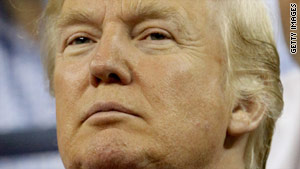
Donald Trump said he wants to buy the space “because it will end a … highly divisive situation.”
(CNN) — Real estate mogul Donald Trump has offered to buy the lower Manhattan site where a Muslim group plans to build an Islamic community center for 25 percent more than the current owners paid for it.
Trump made the offer Thursday in a letter to Hisham Elzanaty, an investor in the Islamic center site.
“I am making this offer as a resident of New York and citizen of the United States, not because I think the location is a spectacular one (because it is not), but because it will end a very serious, inflammatory, and highly divisive situation that is destined, in my opinion, to only get worse,” he wrote.
Trump further stipulated, as part of the offer, that if a mosque is to be built, “it would be located at least five blocks further from the World Trade Center site.”
Trump said he would pay cash for the site “with an immediate closing.”
“Hopefully, something good can happen!” he concluded.
There was no immediate response from Elzanaty.
>
JC e-mail 4088, de 02 de Setembro de 2010.
(Mariana Oliveira, G1, 2/9/2010)
Universidades devem ser orientadas para criação de cotas raciais. Eloi Araujo informou que documento será apresentado até 20 de outubro.
O ministro da Secretaria de Políticas de Promoção da Igualdade Racial, Eloi Ferreira de Araujo, informou ao G1 que um grupo de trabalho da secretaria trabalha atualmente em nota técnica que deve recomendar ao presidente Luiz Inácio Lula da Silva que crie cotas para negros em universidades federais por meio de decreto.
“Na nota técnica vamos tomar providências no sentido de buscar que pretos e pardos tenham direito de ingressar no ensino superior. A nota técnica poderá dizer que é necessário um decreto. Eu estou aguardando a finalização da nota técnica para marcar audiência com o presidente. Eu penso que um decreto é uma boa medida para adotar se não houver por parte de todo mundo a adoção da política de cotas”, afirmou o ministro.
“A nota técnica vai orientar inclusive como as cotas deverão ser observadas pelas instituições de ensino superior. Algumas organizações imaginam que haja uma autonomia universitária. A autonomia não é absoluta, é relativa”, completou o ministro.
De acordo com ele, a nota técnica será finalizada e entregue a Lula até o dia 20 de outubro, dia em que o estatuto entra em vigor. O texto foi sancionado pelo presidente no último dia 20 de julho e tem 90 dias para começar a vigorar.
Logo após a aprovação do estatuto no Senado, antes da sanção presidencial, Eloi Araujo falou ao G1 que o estatuto permitia a criação de cotas sem que uma lei sobre o tema fosse discutida e aprovada por deputados e senadores. Na ocasião, o senador Demóstenes Torres (DEM-GO) disse que isso era uma tentativa de “golpe”. “Isso é o que se chama de tentativa de fazer com que o Congresso brasileiro seja fechado ainda que esteja aberto. Essa matéria tão polêmica deve ser regulamentada evidentemente através de uma lei. (…) É o que se chama de falsa polêmica. O ministro se viu derrotado em uma posição e tenta dar um golpe”.
De acordo com Eloi Araujo, não se trata de golpe porque a lei é clara. “A lei é soberana. É dura, mas é a lei. E prevê a adoção de ações afirmativas. O Congresso aprovou essa lei.” Ele afirmou crer que uma definição sobre um eventual decreto para estabelecer cotas saia ainda neste governo.
Eloi explicou que o grupo de trabalho é formado por técnicos da secretária, como professores e advogados. Esse grupo será responsável pela nota técnica que vai dar uma diretriz sobre o que deve ser regulamentado no estatuto. Cinco temas devem ser priorizados: educação, trabalho, moradia, cultura e saúde.
“Nossa preocupação diz respeito ao propósito de contribuir com os amigos da Corte, aqueles que têm defesa de nossas ações. No Supremo Tribunal Federal (STF) temos ações muito perversas contra a população negra, contra cotas, contra o Prouni e contra as comunidades quilombolas. (…) Esse grupo está debruçado em oferecer subsídios nesses casos com base no estatuto.”
Cotas sociais
O ministro afirmou ser contra universidades que privilegiam cotas sociais a cotas raciais. Estudo do Instituto de Estudos Sociais e Políticos (Iesp) divulgado no começo desta semana mostrou que 71% das universidades federais e estaduais já têm cotas com base em seus conselhos ou leis estaduais. A maioria das instituições, porém, favorece as cotas sociais, para quem vem de escola pública.
Segundo ele, ações afirmativas que só privilegiam o lado social, sem analisar a questão racial, devem ser revistas. “Essas medidas precisam ser revistas porque deveriam ser observados dados técnicos oferecidos pelo Instituto Brasileiro de Geografia e Estatística (IBGE). Se a população é composta por 80% de pessoas que ganham até cinco salários, então vamos fazer isso. Se for qualquer outro número, é só para dizer que está fazendo. É coisa para inglês ver. É como se não tivesse havido a grande ofensa da escravidão e houve. Qualquer informação que não leve em consideração a gravidade que foi a escravidão, não é sequer educativa. Deveria observar os dois aspectos, sociais e raciais.”
Para Eloi Araujo, no entanto, pode-se discutir por quanto tempo as cotas raciais seriam válidas. “Isso é justiça social e não precisa ser para sempre. Podemos estabelecer por um período, duas décadas, e depois analisar a evolução.”
>
Pastor fala em repensar planos a pedido da Casa Branca, Pentágono ou departamento de Estado
09 de setembro de 2010 | 14h 48

Pastor Jones idealizou o ‘Dia Internacional da Queima do Corão’.
WASHINGTON – O governo americano discute fazer um pedido formal ao pastor Terry Jones para que ele desista de promover queima de exemplares do Alcorão – o livro sagrado do Islã – no aniversário dos atentados de 11 de setembro, no próximo sábado.
“Esta possibilidade está sendo discutida no governo, mas ainda não há uma decisão”, disse o porta-voz do Pentágono Geoffrey Morrell nesta quinta-feira, 9.
Em uma entrevista publicada pelo jornal USA Today, o reverendo disse que se recebesse um pedido da Casa Branca, do Departamento de Estado ou do Pentágono, repensaria seus planos.
“Por enquanto não estamos convencidos que recuar seja o certo a fazer. Se fôssemos contactados pela Casa Branca, pelo Departamento de Estado ou pelo Pentágono isto nos faria repensar. Não acho que um pedido deles seja algo que ignoraríamos”, disse.
Obama intervém
Pela manhã, em uma entrevista à rede de TV ABC, o presidente Barack Obama defendeu que o pastor desista do protesto. Segundo o democrata, a atitude pode colocar em risco tropas americanas no Afeganistão e incentivar radicais islâmicos da Al-Qaeda.
“Se ele estiver escutando, espero que ele entenda que o que ele propõe é completamente contrário ao valores dos americanos. Nosso país foi construído sobre as noções da tolerância e da liberdade religiosa”, disse Obama. “Quero que ele entenda que seu golpe publicitário pode colocar em grave perigo todos aqueles que servem o país fora daqui”.
Obama ainda disse que a queima do Alcorão , vai impulsionar a Al-Qaeda e aumentar os níveis de violência contra os soldados americanos no Afeganistão e no Paquistão. “Espero que ele ouça sua consciência e entenda que seus planos levarão a atos de destruição”, concluiu o presidente.
Viajantes em alerta
Também nesta tarde, o departamento de Estado emitiu um alerta para americanos fora do país sobre o risco de manifestações antiamericanas no sábado, caso o reverendo leve sua proposta adiante.
“O potencial para protestos que podem se tornar violentos continua alta”, diz o alerta.
Com Reuters
* * *
Da Flórida a Meca – A história do extremista cristão que quer queimar 200 cópias do Alcorão
por Gustavo Chacra
09.setembro.2010 05:17:11
Antes de começar o texto, preciso deixar claro que ninguém nos EUA está apoiando a iniciativa de queimar o Alcorão, a não ser os seguidores do pastor da Flórida. Até mesmo oportunistas supostamente conservadores, como o apresentador Glenn Beck, da Fox News, criticaram a iniciativa.
Terry Jones era um pastor completamente desconhecido e irrelevante nos Estados Unidos até dois meses atrás. Apenas 30 pessoas frequentam semanalmente seus sermões em sua igreja em Gainesville, na Flórida. Mesmo na pequena cidade, este líder evangélico é considerado uma figura marginal, sem importância, quase uma piada. Ele era considerado um fracasso nas relações públicas.
A não ser pelo seu longo bigode grisalho, Jones não conseguia chamar a atenção, apesar de tentar com o seu programa “The Braveheart Show”, no YouTube, e com o livro “The Islam is of the Devil”. Porém somente 200 pessoas costumavam assisti-lo. Um número similar comprou o seu livro na internet.
Tudo mudou em 25 de julho deste ano, quando o pastor decidiu, no seu programa do YouTube, lançar uma campanha “internacional” para queimar o Alcorão. “O Islã é do demônio. O 11 de Setembro nunca será esquecido. Foi o dia que Islã nos atacou, o nosso modo de vida, a nossa Constituição. É uma religião demoníaca. Neste 11 de Setembro, teremos um dia internacional para queimar o Alcorão”, afirmou o pastor, que se autodenomina doutor, no vídeo de 1 minuto e 36 segundos.
Inicialmente, poucos prestaram atenção na sua campanha. Nos últimos dias, com a aproximação do 11 de Setembro, as autoridades passaram a levar a sério a campanha deste pastor que lidera uma igreja chamada Dove World Outreach Center.
Aproveitando a sua popularidade, Jones tem dado seguidas entrevistas a redes de TV. Críticos, como o general David Petreaus, comparam o seu radicalismo ao do Taleban. No seu site, ao apresentar os ideais de sua igreja, ele afirma que “os cristãos precisam retornar para a verdade e parar de se esconderem. O Aborto é um assassinato. A homossexualidade é um pecado. Temos que chamar estas coisas pelo que elas realmente são. Jesus é o único caminho, a verdade e a vida. Qualquer religião que vá contra isso é demônio”.
Repúdio internacional
A decisão de queimar cerca de 200 cópias do Alcorão no dia 11 de Setembro provocou repúdio internacional e elevou os temores de reações violentas de muçulmanos ao redor do mundo. Autoridades americanas e lideranças islâmicas moderadas tentam mostrar que esta manifestação é um caso isolado, não representando o pensamento americano.
Até agora, estas condenações a Jones foram insuficientes para conter os protestos que já começaram na Indonésia e no Paquistão e devem se espalhar por outros países. Um porta-voz do Ministério das Relações Exteriores do Irã advertiu os EUA para não “profanarem objetos islâmicos” e para “não criarem situações sensíveis envolvendo a opinião pública e os muçulmanos”.
O tom também foi duro nas declarações de um ex-ministro de assuntos religiosos da Síria. “Estamos acostumados a ver as administrações arrogantes dos EUA e da Europa ofendendo o islamismo e a figura do profeta Maomé”, disse Abd al Razzaq Munis para uma rede de TV iraniana. No Afeganistão, manifestantes queimaram bandeiras americanas e um boneco que representaria Terry Jones.
Há cinco anos, depois de um cartunista dinamarquês publicar um cartoon satirizando o profeta Maomé, dezenas de milhares de muçulmanos protestaram violentamente ao redor do mundo e mais de cem pessoas morreram. Queimar o Alcorão seria uma blasfêmia ainda maior para os muçulmanos. “Se a igreja da Flórida levar adiante seus planos de queimar o Alcorão no 11 de Setembro, aquela data infame vai ganhar um irmão gêmeo que será o estopim de uma onda de ira que consumirá partes do mundo”, escreveu em editorial o jornal libanês Daily Star, alertando sobre os riscos da atitude do pastor americano.
Ao publicarem as informações sobre o assunto ontem, a imprensa da região foi cautelosa. Até mesmo a rede de TV Al Manar, do Hezbollah, evitou declarações incendiárias ao colocar logo no primeiro parágrafo de seu texto que autoridades americanas condenaram a atitude do pastor. A Al Jazeera também tomou o mesmo cuidado.
Em declarações no Council on Foreign Relations, a secretária de Estado, Hillary Clinton, disse que os planos de “uma pequena igreja da Flórida de queimar cópias do Alcorão no 11 de Setembro é revoltante e infeliz, não representando quem somos como americanos”. O comandante das forças americanas no Afeganistão, general David Petraeus, também condenou o pastor, afirmando que a atitude dele pode colocar em risco as tropas americanas.
O Vaticano criticou Jones ao afirmar que todas as religiões “devem ser respeitadas e protegidas”. A chanceler (premiê) alemã, Angela Merkel, e o presidente do Líbano, Michel Suleiman, que é cristão, também lamentaram a decisão do pastor da Flórida e alertaram para os riscos de violência em reação à atitude dele. O secretário-geral da ONU, Ban Ki-Moon, disse que a ação do pastor pode colocar em risco “iniciativas das Nações Unidas ao redor do mundo para defender a tolerância religiosa”.
Apesar de todas estas iniciativas, a Justiça americana não pode impedir que o pastor siga adiante com seus planos. A Constituição dos EUA garante o direito à liberdade de expressão, ainda que uma religião seja ofendida.
Islamofobia
Grupos muçulmanos dos Estados Unidos pretendem realizar um protesto pacífico diante da igreja do pastor Terry Jones, no dia 11 de Setembro, quando ele promete queimar cerca de 200 cópias do Alcorão. A data, neste ano, coincide com o último dia do Ramadã, mês sagrado para os islâmicos.
“Nós estaremos lá. A idéia é encará-lo de frente e mostrar que existe uma alternativa. Também tentaremos mostrar ao resto do mundo islâmico que este pastor é uma figura marginal, não representando o pensamento americano”, me disse Corey Saylor, porta-voz do Council on American-Islamic Relations (CAIR), considerado o grupo mais representativo da população muçulmana dos EUA.
Segundo ele, muitas vezes a imprensa ocidental mostra líderes marginais do islamismo atacando o judaísmo e o cristianismo como se fossem autoridades religiosas importantes. “Não podemos fazer o mesmo. Estamos trabalhando para que os muçulmanos ao redor do mundo entendam que este é um caso isolado”, disse Saylor, advertindo, porém, que existe uma “bolha islamofóbica” nos EUA.
Citando o prefeito de Nova York, Michael Bloomberg, episódios como o do pastor Jones e a oposição à construção do centro comunitário islâmico a dois quarteirões do Ground Zero “possuem motivações políticas e devem se reduzir depois das eleições (parlamentares) de novembro”. Ele também elogiou as manifestações de Hillary e Petraeus.
Na avaliação do CAIR, o presidente Barack Obama não deveria intervir. “Isso seria usado politicamente contra ele”, disse Saylor. O líder americano é classificado como muçulmano por mais de um quinto da população dos EUA, apesar de ele publicamente se declarar cristão.
Um grupo de líderes religiosos, incluindo autoridades cristãs, judaicas e islâmicas, divulgaram ontem um comunicado lamentando a atitude do pastor do Texas e advertindo para o risco do crescimento da islamofobia nos EUA. A revista Time, que é a de maior circulação no país, publicou uma capa no mês passado questionando se os americanos são islamofóbicos. O New York Times, em editoriais, também já advertiu para os riscos dos sentimentos anti-islã.
>
A viciously anti-Muslim blogger, the New York Post and the right-wing media machine: How it all went down
By Justin Elliott
Monday, Aug 16, 2010 07:01 ET

Blogger Pamela Geller and Imam Feisal Abdul Rauf (AP)
A group of progressive Muslim-Americans plans to build an Islamic community center two and a half blocks from ground zero in lower Manhattan. They have had a mosque in the same neighborhood for many years. There’s another mosque two blocks away from the site. City officials support the project. Muslims have been praying at the Pentagon, the other building hit on Sept. 11, for many years.
In short, there is no good reason that the Cordoba House project should have been a major national news story, let alone controversy. And yet it has become just that, dominating the political conversation for weeks and prompting such a backlash that, according to a new poll, nearly 7 in 10 Americans now say they oppose the project. How did the Cordoba House become so toxic, so fast?
In a story last week, the New York Times, which framed the project in a largely positive, noncontroversial light last December, argued that it was cursed from the start by “public relations missteps.” But this isn’t accurate. To a remarkable extent, a Salon review of the origins of the story found, the controversy was kicked up and driven by Pamela Geller, a right-wing, viciously anti-Muslim, conspiracy-mongering blogger, whose sinister portrayal of the project was embraced by Rupert Murdoch’s New York Post.
Here’s a timeline of how it all happened:
* Dec. 8, 2009: The Times publishes a lengthy front-page look at the Cordoba project. “We want to push back against the extremists,” Imam Feisal Abdul Rauf, the lead organizer, is quoted as saying. Two Jewish leaders and two city officials, including the mayor’s office, say they support the idea, as does the mother of a man killed on 9/11. An FBI spokesman says the imam has worked with the bureau. Besides a few third-tier right-wing blogs, including Pamela Geller’s Atlas Shrugs site, no one much notices the Times story.
* Dec. 21, 2009: Conservative media personality Laura Ingraham interviews Abdul Rauf’s wife, Daisy Khan, while guest-hosting “The O’Reilly Factor” on Fox. In hindsight, the segment is remarkable for its cordiality. “I can’t find many people who really have a problem with it,” Ingraham says of the Cordoba project, adding at the end of the interview, “I like what you’re trying to do.”
* (This segment [above] also includes onscreen the first use that we’ve seen of the misnomer “ground zero mosque.”) After the segment — and despite the front-page Times story — there were no news articles on the mosque for five and a half months, according to a search of the Nexis newspaper archive.
* May 6, 2010: After a unanimous vote by a New York City community board committee to approve the project, the AP runs a story. It quotes relatives of 9/11 victims (called by the reporter), who offer differing opinions. The New York Post, meanwhile, runs a story under the inaccurate headline, “Panel Approves ‘WTC’ Mosque.” Geller is less subtle, titling her post that day, “Monster Mosque Pushes Ahead in Shadow of World Trade Center Islamic Death and Destruction.” She writes on her Atlas Shrugs blog, “This is Islamic domination and expansionism. The location is no accident. Just as Al-Aqsa was built on top of the Temple in Jerusalem.” (To get an idea of where Geller is coming from, she once suggested that Malcolm X was Obama’s real father. Seriously.)
* May 7, 2010: Geller’s group, Stop Islamization of America (SIOA), launches “Campaign Offensive: Stop the 911 Mosque!” (SIOA ‘s associate director is Robert Spencer, who makes his living writing and speaking about the evils of Islam.) Geller posts the names and contact information for the mayor and members of the community board, encouraging people to write. The board chair later reports getting “hundreds and hundreds” of calls and e-mails from around the world.
* May 8, 2010: Geller announces SIOA’s first protest against what she calls the “911 monster mosque” for May 29. She and Spencer and several other members of the professional anti-Islam industry will attend. (She also says that the protest will mark the dark day of “May 29, 1453, [when] the Ottoman forces led by the Sultan Mehmet II broke through the Byzantine defenses against the Muslim siege of Constantinople.” The outrage-peddling New York Post columnist Andrea Peyser argues in a note at the end of her column a couple of days later that “there are better places to put a mosque.”
* May 13, 2010: Peyser follows up with an entire column devoted to “Mosque Madness at Ground Zero.” This is a significant moment in the development of the “ground zero mosque” narrative: It’s the first newspaper article that frames the project as inherently wrong and suspect, in the way that Geller has been framing it for months. Peyser in fact quotes Geller at length and promotes the anti-mosque protest of Stop Islamization of America, which Peyser describes as a “human-rights group.” Peyser also reports — falsely — that Cordoba House’s opening date will be Sept. 11, 2011.
Lots of opinion makers on the right read the Post, so it’s not surprising that, starting that very day, the mosque story spread through the conservative — and then mainstream — media like fire through dry grass. Geller appeared on Sean Hannity’s radio show. The Washington Examiner ran an outraged column about honoring the 9/11 dead. So did Investor’s Business Daily. Smelling blood, the Post assigned news reporters to cover the ins and outs of the Cordoba House development daily. Fox News, the Post’s television sibling, went all out.
Within a month, Rudy Giuliani had called the mosque a “desecration.” Within another month, Sarah Palin had tweeted her famous “peaceful Muslims, pls refudiate” tweet. Peter King and Newt Gingrich and Tim Pawlenty followed suit — with political reporters and television news programs dutifully covering “both sides” of the controversy.
Geller had succeeded beyond her wildest dreams.
Justin Elliott is a Salon reporter. Reach him by email at jelliott@salon.com and follow him on Twitter @ElliottJusti.
>
Nature, Volume 467:133 (09 September 2010)
The anti-science strain pervading the right wing in the United States is the last thing the country needs in a time of economic challenge.
“The four corners of deceit: government, academia, science and media. Those institutions are now corrupt and exist by virtue of deceit. That’s how they promulgate themselves; it is how they prosper.” It is tempting to laugh off this and other rhetoric broadcast by Rush Limbaugh, a conservative US radio host, but Limbaugh and similar voices are no laughing matter.
There is a growing anti-science streak on the American right that could have tangible societal and political impacts on many fronts — including regulation of environmental and other issues and stem-cell research. Take the surprise ousting last week of Lisa Murkowski, the incumbent Republican senator for Alaska, by political unknown Joe Miller in the Republican primary for the 2 November midterm congressional elections. Miller, who is backed by the conservative ‘Tea Party movement’, called his opponent’s acknowledgement of the reality of global warming “exhibit ‘A’ for why she needs to go”.
“The country’s future crucially depends on education, science and technology.”
The right-wing populism that is flourishing in the current climate of economic insecurity echoes many traditional conservative themes, such as opposition to taxes, regulation and immigration. But the Tea Party and its cheerleaders, who include Limbaugh, Fox News television host Glenn Beck and Sarah Palin (who famously decried fruitfly research as a waste of public money), are also tapping an age-old US political impulse — a suspicion of elites and expertise.
Denialism over global warming has become a scientific cause célèbre within the movement. Limbaugh, for instance, who has told his listeners that “science has become a home for displaced socialists and communists”, has called climate-change science “the biggest scam in the history of the world”. The Tea Party’s leanings encompass religious opposition to Darwinian evolution and to stem-cell and embryo research — which Beck has equated with eugenics. The movement is also averse to science-based regulation, which it sees as an excuse for intrusive government. Under the administration of George W. Bush, science in policy had already taken knocks from both neglect and ideology. Yet President Barack Obama’s promise to “restore science to its rightful place” seems to have linked science to liberal politics, making it even more of a target of the right.
US citizens face economic problems that are all too real, and the country’s future crucially depends on education, science and technology as it faces increasing competition from China and other emerging science powers. Last month’s recall of hundreds of millions of US eggs because of the risk of salmonella poisoning, and the Deepwater Horizon oil spill, are timely reminders of why the US government needs to serve the people better by developing and enforcing improved science-based regulations. Yet the public often buys into anti-science, anti-regulation agendas that are orchestrated by business interests and their sponsored think tanks and front groups.
In the current poisoned political atmosphere, the defenders of science have few easy remedies. Reassuringly, polls continue to show that the overwhelming majority of the US public sees science as a force for good, and the anti-science rumblings may be ephemeral. As educators, scientists should redouble their efforts to promote rationalism, scholarship and critical thought among the young, and engage with both the media and politicians to help illuminate the pressing science-based issues of our time.
>
Fragmentos estavam em área que vinha sendo rastreada desde abril. Trinta e sete deles estavam sob a West Street, próximo às antigas torres
24/06/2010 | 08:22 | G1/Globo.com

Momento do colapso de uma das torres gêmeas. Foto da polícia de Nova Iorque (NYPD).
Autoridades municipais de Nova York afirmaram que uma nova busca nos destroços no local do World Trade Center e nos arredores achou 72 restos mortais humanos, que seriam de vítimas dos atentados do 11 de setembro.
O rastreamento começou em abril, em uma área de 700 metros cúbicos no chamado Marco Zero, e terminou na sexta-feira passada.
Trinta e sete dos fragmentos estavam sob a West Street, que passava ao lado das Torres Gêmeas. Eles só foram achados agora porque uma obra tornou o local acessível.
A cidade começou as novas buscas em 2006, e 1.845 cadáveres foram achados.
As autoridades disseram que muitos corpos estão em bom estado de conservação, o que permitirá que eles sejam submetidos a exames de DNA para que sejam reconhecidos.
Até janeiro de 2010, o instituto médico legal havia recuperado 21.744 restos humanos dos destroços, 12.768 dos quais foram identificados.
No mesmo período, foram identificadas 1.626 vítimas, ou 59% das 2.752 que teriam morrido nos ataques.
>
By Mark Kinver
Science and environment reporter, BBC News
6 September 2010

The Darfur conflict in Sudan was linked to climate shifts. Members of the Sudanese Liberation Army (Getty Images)
Climate change is not responsible for civil wars in Africa, a study suggests.
It challenges previous assumptions that environmental disasters, such as drought and prolonged heat waves, had played a part in triggering unrest.
Instead, it says, traditional factors – such as poverty and social tensions – were often the main factors behind the outbreak of conflicts.
The findings have been published in the Proceedings of the National Academy of Sciences (PNAS) in the United States.
“Climate variability in Africa does not seem to have a significant impact on the risk of civil war,” said author Halvard Buhaug, senior researcher at the Peace Research Institute Oslo’s (Prio) Centre for the Study of Civil War.
“If you apply a number of different definitions of conflict and various different ways to measure climate variability, most of these measurements will turn out not to be associated with each other.
He added that it was not too hard to find examples of where politicians were publicly making the link between the projected impact of climate change and the associated security risks.
Margaret Beckett, when she held the post of British Foreign Secretary, tabled a debate on climate change at the UN Security Council in 2007.
Ahead of the gathering, the British delegation circulated a document that warned of “major changes to the world’s physical landmass during this century”, which would trigger border and maritime disputes.
In his paper, Dr Buhaug questioned the findings of research that appeared in PNAS in November last year.
The 2009 paper suggested that climate had been a major driver of armed conflict in Africa, and that future warming was likely to increase the number of deaths from war.
US researchers found that across the continent, conflict was about 50% more likely in unusually warm years.
‘Lack of research’
Dr Buhaug said it was too early to make such assertions.
Politicians and policymakers have often linked the threat of climate change to security. UN Security Council (Image: AP)
“It is not a misunderstanding as such, more a case of the research still being in its infancy – we still don’t know enough yet,” he told BBC News.
“My article points to the fact that there has been too much emphasis on single definitions of conflict and single definitions of climate.
“Even if you found that conflict, defined in a particular way, appeared to be associated with climate, if you applied a number of complementary measures – which you should do in order to determine the robustness of the apparent connection – then you would find, in almost all cases, the two were actually unrelated.”
Dr Buhaug explained that there were a variety of ways to define what constituted a civil war.
One methods requires the conflict to claim 1,000 lives overall. Another method says unrest can only be categorised as a civil war if it results in 1,000 deaths each year.
Other definitions have much lower thresholds, ranging between one casualty and 25 casualties per year.
“I tried quite a few different and complementary definitions of conflict,” said Dr Buhaug.
He found that that there was a strong correlation between civil wars and traditional factors, such as economic disparity, ethnic tensions, and historic political and economic instability.
“These factors seemed to matter, not so when it came to climate variability,” he observed.
He says that it will take a while yet, even taking into account his own paper, for academic research to converge on an agreed position.
‘Action still needed’
When it came to politicians and policymakers, many of the adopted positions were “speculative”, he added.
“It is partly a result of a lack of solid evidence in the first place,” the researcher explained.
“If you do not have any solid scientific evidence to base your assumptions, then you are going to have to speculate.”
He also said that the end of the Cold War also seemed to have had a impact on civil unrest in African nations.
“You did see a shift in the focus of quite a few conflicts during the 1990s, when the ending of the supply of arms saw some groups lay down their arms, while others sought alternative forms of funding, such as diamonds.”
However, he concluded, the uncertainty about the link between conflict and climate did not mean that global climate mitigation and adaptation measures did not matter.
“Targeted climate adaptation initiatives, such as those outlined in various UN (strategies), can have significant positive implications for social well-being and human security.
“But these initiatives should not be considered a replacement for traditional peace-building strategies.
“The challenges imposed by future global warming are too daunting to let the debate… be sidetracked by atypical, non-robust scientific findings and actors with vested interests.”
BBC News has approached a number of co-authors on the PNAS November 2009 paper, but we have yet to receive a response.
* * *
Climate ‘is a major cause’ of conflict in Africa
By Richard Black
Environment correspondent, BBC News website
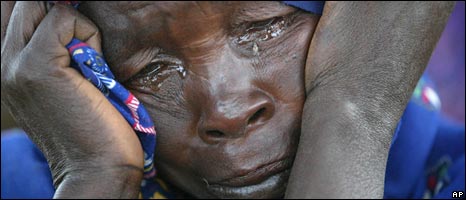 Climate has been cited as a factor behind civil conflict in Darfur
Climate has been a major driver of armed conflict in Africa, research shows – and future warming is likely to increase the number of deaths from war.
US researchers found that across the continent, conflict was about 50% more likely in unusually warm years.
Writing in Proceedings of the National Academy of Sciences (PNAS), they suggest strife arises when the food supply is scarce in warm conditions.
Climatic factors have been cited as a reason for several recent conflicts.
One is the fighting in Darfur in Sudan that according to UN figures has killed 200,000 people and forced two million more from their homes.
Previous research has shown an association between lack of rain and conflict, but this is thought to be the first clear evidence of a temperature link.
The researchers used databases of temperatures across sub-Saharan Africa for the period between 1981 and 2002, and looked for correlations between above average warmth and civil conflict in the same country that left at least 1,000 people dead.
Warm years increased the likelihood of conflict by about 50% – and food seems to be the reason why.
“Studies show that crop yields in the region are really sensitive to small shifts in temperature, even of half a degree (Celsius) or so,” research leader Marshall Burke, from the University of California at Berkeley, told BBC News.
“If the sub-Saharan climate continues to warm and little is done to help its countries better adapt to high temperatures, the human costs are likely to be staggering.”
Conflicting outcomes
If temperatures rise across the continent as computer models project, future conflicts are likely to become more common, researchers suggest.

Northwestern Kenya’s drought has brought conflict between pastoralists.
Their study shows an increase of about 50% over the next 20 years.
When projections of social trends such as population increase and economic development were included in their model of a future Africa, temperature rise still emerged as a likely major cause of increasing armed conflict.
“We were very surprised to find that when you put things like economic growth and better governance into the mix, the temperature effect remains strong,” said Dr Burke.
At next month’s UN climate summit in Copenhagen, governments are due to debate how much money to put into helping African countries prepare for and adapt to impacts of climate change.
“Our findings provide strong impetus to ramp up investments in African adaptation to climate change by such steps as developing crop varieties less sensitive to extreme heat and promoting insurance plans to help protect farmers from adverse effects of the hotter climate,” said Dr Burke.
Nana Poku, Professor of African Studies at the UK’s Bradford University, suggested that it also pointed up the need to improve mechanisms for avoiding and resolving conflict in the continent.
“I think it strengthens the argument for ensuring we compensate the developing world for climate change, especially Africa, and to begin looking at how we link environmental issues to governance,” he said.
“If the argument is that the trend towards rising temperatures will increase conflict, then yes we need to do something around climate change, but more fundamentally we need to resolve the conflicts in the first place.”
Richard.Black-INTERNET@bbc.co.uk
>
by Stephen Zebiak
As I wrote in the previous installment, climate risk management is a process that informs decision making through the application of climate knowledge and information. IRI’s approach to climate risk management consists of four components. The first is identifying vulnerabilities and potential opportunities posed by climate variability or change in a given part of the world and in a given sector. For example, an extended drought or a delayed rainy season could have serious impacts on farmers who grow rain-fed crops. On the other hand, there might be periods of above-normal rainfall they could take advantage of, if they had access to information about the likelihood of when and where those rains would occur.
The second component involves assessing the relevant climate risks. Relevance here is determined by the problem at hand. For example, are wheat farmers in Ethiopia more concerned about the predicted timing of the rainy season–how early or late it starts–or how much total rain is predicted to fall? Perhaps instead they are most interested in the predicted total number of dry days or dry spells. Using the best science and available data, we try to assess the range of possible future conditions for whatever climate parameters are targeted. This typically involves gleaning information from historical records, assessing the skill of climate forecast products and estimating the uncertainties in monitored information. It also requires us to understand the nature of climate variability at the different time scales defined by stakeholders. Farmers and health workers might need information at seasonal to interannual scales–three months to a year ahead of time. Development banks, foresters and dam builders may need decade-level outlooks; national authorities negotiating in the United Nations Framework Convention on Climate Change may require climate scenarios for the next 50-100 years. Each satisfies a set group of stakeholders, and each comes with its own set of uncertainties and limitations.
The third component is identifying technologies and practices that optimize results in normal or favorable years as well as those that can reduce vulnerabilities during unfavorable years or during extreme events such as droughts and floods. Farmers could decide whether to invest in fertilizers and improved seeds or switch crops altogether, if they had access to seasonal forecasts and understood how to interpret them. Forecasts could also help food-security agencies determine if, when, and where to preposition food aid in anticipation of a crisis. Some crop failures may not be avoidable, but every famine is. In the water sector, engineers using good quality decade-scale climate information can optimize the design of dams. For existing reservoirs, they can use the information to make better decisions on how to allocate the water, or better quantify the chances that extremely low or extremely high reservoir levels will occur.
Once we’ve identified the best technologies and practices, the fourth and final step is finding the “real world” arrangements that enable their implementation. Using the example of an early-warning system for food crises, we can ask: what are the actual mechanisms to have in place for hunger relief? Who are the key decision makers to identify? What specific types of climate information do they need in order to take action and who will supply it? How do we make this sustainable?
The fact that climate risk management can be effective doesn’t make it easy. Because the process is inherently interdisciplinary, it requires a detailed understanding of complex, context-specific interactions between physical, natural and social systems. It also involves collaboration among experts who must work together on cross-disciplinary problems. Although developing the proper strategies is a complicated task, climate risk management can be applied to agricultural, water, health or any other sector, on spatial scales that range from local to global, and on time scales from near- to long-term.
While the science of climate risk management is still in its infancy, strategies already exist for every sector. For instance, an effort to address deepening drought in Western Australia created a constructive engagement between water managers and climate scientists that improved practice in both fields and contributed to better policy (see relevant links below). In the realm of public health, a group of partners developed an integrated malaria epidemic early warning and response system that is being implemented in conjunction with the Roll Back Malaria campaign. The system includes seasonal forecasts, climate monitoring, vulnerability assessments, case surveillance and response planning.
Similarly, an IRI project in the Southern Cone of South America manages agriculture related climate risk through a series of technological and policy interventions. It also works to reduce the uncertainty associated with the impacts of climate variability on agriculture. Our project partners are currently developing information and decision support systems that include long-term climate and agricultural impact information, continuous monitoring of climate and vegetation, and seasonal climate forecasts.
We’ve also been involved on innovative weather-risk transfer solutions such as index insurance, which provides a way to minimize the livelihood impacts of ‘bad years’ associated with extreme events. This has the benefit of setting people free to invest in production during good years. In the future, it may be possible to combine index insurance with climate forecast information, providing insurance against the uncertainty of the forecast. At the same time, drought index insurance allows relief agencies to respond quickly as droughts unfold, thus avoiding catastrophes that may otherwise destroy livelihoods and force farmers into poverty traps.
Obstacles to effective climate risk management
The practice of climate risk management as described above is rare throughout the world today. Communities are therefore left exposed to a great deal of climate-related risk. This happens despite the increased interest in climate, evidenced by the resources invested in climate-related science, unprecedented discussions on climate policy and increasing support for disaster-risk reduction and climate-smart development.
Very few development organizations use climate knowledge, information products, or related management strategies as part of their overall toolkit. Practitioner communities in health, water, agriculture, finance and other key sectors have not yet begun to incorporate climate risk management into their day-to-day programs. Many climate service providers do not provide information on scales that are relevant to policy and management decisions, or that can be easily incorporated into their decision-making process.
A recent study by the IRI characterized the current situation as one of market atrophy–negligible demand coupled with inadequate supply of climate services for development decisions. In this sense, the main obstacle to the widespread implementation of climate risk management is the lack of engagement and communication between communities, and the lack of investment to foster these critical interactions. Climate researcher and service communities develop knowledge and related information products from a disciplinary research perspective–often uninformed about stakeholder needs. Meanwhile stakeholders in development, policy and planning are not capable of assimilating relevant climate information that is available. As a result, research is not being taken up, while stakeholders increasingly worry about climate but remain largely at a loss about what to do in practice.
The solution to this dilemma requires a focus at the nexus of these communities. It also requires the cooperation of relevant communities on global and local scales. The extent to which we can meet this challenge will, in large measure, determine the benefit that can be realized from major ongoing investments in research, observations, assessments, international policy and climate-sensitive development programs in years to come.
In the next and final installment, I’ll provide a path forward for the improvement and uptake of climate risk management practices.
The web version of this story offers recommended readings on issues discussed above:
http://iri.columbia.edu/features/2010/what_is_climate_risk_management.html
>
By Fiona Macrae
Mail Online – 31st August 2010
UN climate change experts have been accused of making ‘imprecise and vague’ statements and over-egging the evidence.
A scathing report into the Intergovernmental Panel on Climate Change called for it to avoid politics and stick instead to predictions based on solid science.
The probe, by representatives of the Royal Society and foreign scientific academies, took a thinly-veiled swipe at Rajendra Pachauri, the panel’s chairman for the past eight years.

Exaggerated? Science academies say the Intergovernmental Panel on Climate Change relied on ‘vague’ predictions in making its reports
It recommended a new leader be appointed to bring a ‘fresh approach’ with the term of office cut from 12 years to six.
The IPCC is important because its reports are used by governments to set environmental policy.
The review, which focused on the day-to-day running of the panel, rather than its science, was commissioned after the UN body was accused of making glaring mistakes.
These included the claim that the Himalayan glaciers would vanish within 25 years – and that 55 per cent of the Netherlands was prone to flooding because it was below sea level.
An email scandal involving experts at the University of East Anglia had already fuelled fears that global warming was being exaggerated.
The report demanded a more rigorous conflict of interest policy and said executives should have formal qualifications.
It said: ‘Because the IPCC chair is both the leader and the face of the organisation, he or she must have strong credentials (including high professional standing in an area covered by IPCC assessments), international stature, a broad vision, strong leadership skills, considerable management experience at a senior level, and experience relevant to the assessment task.’
Dr Pachauri has a background in railway engineering rather than science and in recent months has been forced to deny profiting from his role at the IPCC.
When asked yesterday if he would consider resigning, he said he intended to continue working on the panel’s next report on climate change but would abide by any decision the IPCC made.
‘We’ve listened to and learnt from our critics,’ he said.
‘Now that the review has been carried out I believe I have a responsibility to help to implement the changes.
‘I see this as a mission that I cannot shirk or walk away from. It’s now up to the world’s governments to decide when they want to implement the recommendations and which ones they want to implement.’
Dr Benny Peiser, Director of The Global Warming Policy Foundation, said: ‘I interpret the review as an indirect call for Dr Pachauri to step down. That is what it says between the lines, whether or not he understands it.
‘It is clearly a very, very strong criticism of his management and of him personally.
‘The problem is that many in the international community regard him as damaged goods.’
The investigation said the IPCC’s mandate calls for it to be ‘policy relevant’ without ‘straying into advocacy’ which would hurt its credibility.
The scientists charged with writing the IPCC assessments were criticised for saying they were ‘highly confident’ about statements without having the evidence.
One of the summary documents prepared for government use ‘contains many such statements that are not supported sufficiently by the literature, not put into perspective or not expressed clearly’.
Achim Steiner, head of the UN’s environmental programme, said the review of the IPCC ‘re-affirms the integrity, the importance and validity of the IPCC’s work while recognising areas for improvement in a rapidly evolving field’.
MAN IN THE HOT SEAT
Arrogant? Dr Rajendra Pachauri
To his admirers, Rajendra Pachauri is a tireless champion of the perils of climate change. To his critics, he is flamboyant and arrogant.
The Indian-born mechanical engineer worked in the railway industry before entering academia.
He taught in the U.S. and then joined a think-tank promoting sustainable development. He became involved with the UN in the 1990s and was elected chairman of its IPCC climate panel in 2002.
The 70-year-old lives in an exclusive district of New Delhi and is said to enjoy a lavish personal lifestyle with a taste for expensive suits.
He has dismissed claims he profited from his links to green energy firms, saying he gave away all the money earned from directorships.
Despite having full use of an eco-friendly vehicle, he uses a chauffeur-driven car to make the one-mile journey to his office.
He raised eyebrows earlier this year with the publication of a raunchy novel about the life and times of an ageing environmentalist and former engineer.
And he made powerful enemies by refusing to apologise for the false claim that Himalayan glaciers would vanish in 25 years.
SCEPTIC CHANGES HIS MIND ON CLIMATE CHANGE

Bjorn Lomborg, author and political scientist
The world’s most high-profile climate change sceptic has changed his mind and now believes that global warming is ‘a challenge humanity must confront’.
The influential economist Bjorn Lomborg (pictured), who has been compared to Adolf Hitler by the UN’s climate chief, is calling for tens of billions of dollars to be invested into tackling climate change.
He described the current rise in temperatures as ‘undoubtedly one of the chief concerns facing the world today.’
Mr Lomborg proposes taxing people on their carbon emissions to pay for the research and improving green energy.
31/8/2010
Por Fábio de Castro, de Itatiba (SP)
Agência FAPESP – O jornalismo voltado para a cobertura de ciência foi um dos temas debatidos por especialistas em Itatiba (SP), diante de uma plateia composta por alguns dos mais proeminentes cientistas do Brasil e do Reino Unido em diferentes áreas do conhecimento.
O debate ocorreu durante o UK-Brazil Frontiers of Science Symposium, evento que terminou nesta segunda-feira (30/8) e integra o programa Fronteiras da Ciência da Royal Society. A instituição britânica – que comemora 350 anos – e a FAPESP organizaram o evento em parceria com o Consulado Britânico em São Paulo, a Academia Brasileira de Ciências, a Academia Chilena de Ciências e a Cooperação Reino Unido-Brasil em Ciência e Inovação.
Com base em seus estudos sobre jornalismo científico e a percepção pública da ciência, o sociólogo Yurij Castelfranchi defendeu que o envolvimento do público com o universo científico é importante para a sociedade e fundamental para a própria ciência. De acordo com o professor da Universidade Federal de Minas Gerais (UFMG), o Brasil tem atualmente um ambiente favorável para essa aproximação entre ciência e sociedade.
“Quando aprofundamos os estudos sobre o tema, nos surpreendemos ao descobrir que o apoio do público à ciência no Brasil é imenso. Cerca de 80% das pessoas têm uma atitude positiva em relação à ciência. Isso não quer dizer que as pessoas compreendam a ciência. A questão que nos interessa é como transformar essa ‘confiança ignorante’ na ciência e na tecnologia em conhecimento real”, disse.
Segundo ele, não se trata apenas de transmitir informação de forma autoritária, trazendo “a luz do conhecimento” para o público. A tarefa consiste em mostrar ao público, por meio de um jornalismo crítico, como a ciência funciona do ponto de vista político e epistemológico. O jornalista não seria um vulgarizador, mas “uma ponte entre dois mundos”.
“Se transmitirmos a ideia da ciência como uma máquina de invenções maravilhosas, tentando conquistar o interesse do público com uma brilhante lista de descobertas, o efeito pode ser o inverso do desejado. Isso equivale a apresentar a ciência como uma solução mágica. Não temos que fazer marketing da ciência, mas mostrar como ela é feita a partir de um ponto de vista crítico”, afirmou.
A jornalista Mariluce Moura, diretora da revista Pesquisa FAPESP apresentou uma análise da evolução do jornalismo científico no Brasil nas últimas décadas. Segundo ela, nos últimos dez anos, o foco da mídia brasileira sobre o conhecimento científico tem se acentuado de forma extraordinária. A própria revista, derivada do boletim Notícias FAPESP, lançado em 1995, teve um papel central nessa evolução.
“A Pesquisa FAPESP é um exemplo de sucesso em relação à cooperação entre cientistas e jornalistas. A revista se tornou muito próxima da comunidade científica paulista, estabelecendo uma relação de confiança”, disse.
Essa cooperação, segundo Mariluce, é exercida por um procedimento particular adotado na produção da revista: antes de chegar ao público, a informação apurada pelos jornalistas é, em geral, revisada pelos entrevistados.
“Pertencendo a uma instituição pública, normalmente enviamos o texto final para os pesquisadores. Entretanto, há uma recomendação expressa: eles podem corrigir todo tipo de informação científica, mas o texto é a nossa área de excelência. A noção estética e a ideia de produto jornalístico cabem ao profissional da área”, afirmou.
O britânico Tim Hirsch comentou as dificuldades do jornalismo científico e destacou as diferenças marcantes das experiências de divulgação da ciência no Brasil e no Reino Unido. Hirsch foi correspondente da área de meio ambiente da BBC News entre 1997 e 2006 e hoje atua no Brasil como consultor e jornalista independente.
Segundo ele, a interação entre os cientistas e os meios de comunicação de massa é bastante difícil. “Há uma área de cooperação, mas nem sempre isso é possível. O limite entre a informação científica responsável e a liberdade da comunicação não é nada fácil de estabelecer. Não há respostas fáceis nesse terreno. É preciso unir talento e coragem para traduzir um processo de expertise em uma linguagem que seja acessível ao grande público”, afirmou.
Para contornar essas dificuldades, a saída seria desenvolver um relacionamento de confiança entre cientistas e jornalistas. “No Brasil, parece-me, a autocrítica em relação à cobertura jornalística da ciência é muito severa. Há bastante preocupação com a tensão entre jornalistas e cientistas e com a qualidade do material publicado, mas o fato é que grande parte do noticiário é muito bom”, afirmou.
>
By Paul Rincon Science reporter, BBC News
30 August 2010

Himalayan herdsman on glacier The IPCC came under fire after using the wrong date for Himalayan glacier melt
The UN’s climate science body needs stricter checks to prevent damage to the organisation’s credibility, an independent review has concluded.
The Intergovernmental Panel on Climate Change (IPCC) has faced mounting pressure over errors in its last major assessment of climate science in 2007.
The review said guidelines were needed to ensure IPCC leaders were not seen as advocating specific climate policies.
It also urges transparency and suggests changes to the management of the body.
The IPCC has admitted it made a mistake in its 2007 assessment in asserting that Himalayan glaciers could disappear by 2035. But it says this error did not change the broad picture of man-made climate change.
The review committee stressed that previous IPCC science assessments had been successful overall, but it said the body’s response to revelations of errors in its 2007 report had been “slow and inadequate”.
Critics have previously called on the IPCC’s chair, Dr Rajendra Pachauri, to resign. Responding to the report, Dr Pachauri said he wanted to stay to implement changes at the organisation.
He stressed that none of the reviews set up in the wake of recent climate controversies found flaws with the fundamental science of climate change.
In the past year, climate science and political negotiations aimed at dealing with global warming, such as the Copenhagen summit, have come under unprecedented scrutiny.
In February, the UN panel suggested setting up an independent review, feeling that its 20-year-old rules might need an overhaul. It was overseen by the Inter-Academy Council (IAC), an international umbrella body for science academies.
There was also a sense the UN body might have been ill-equipped to handle the attention in the wake of “Glaciergate” and the release of e-mails hacked from the Climatic Research Unit (CRU) and the the University of East Anglia, UK.
The e-mails issue came to light in November last year, when hundreds of messages between CRU scientists and their peers around the world were posted on the internet, along with other documents.
Critics said the e-mail exchanges revealed an attempt by the researchers to manipulate data and three independent reviews were initiated into the affair.
This review of the IPCC’s workings was released at a news conference in New York on Monday. Among the committee’s recommendations was that the UN body should appoint an executive director to handle day-to-day operations and speak on behalf of the panel.
It also said the current limit of two six-year terms for the chair of the organisation was too long.
The report favoured the post of IPCC chair and that of the executive director being limited to the term of one climate science assessment.
Dr Pachauri became head of the organisation in 2002 and was re-elected for his second term in 2008.
A conflict of interest charge has also been levelled at Dr Pachauri over his business interests. The IPCC chair has vigorously defended himself over these charges, but the report said the UN organisation needed a robust conflict of interest policy.
Speaking in New York, Harold Shapiro, who led the IAC review, said that although the IPCC’s assessment process had “served society well”, fundamental changes would help the IPCC continue to perform successfully under a “public microscope”.
Dr Shapiro conceded that controversy over errors in climate science assessments had dented the credibility of the process.
‘Slow’ response
The IAC report concentrates on review processes at the UN body, including the use of non-peer reviewed sources, and quality control on data.
It said the IPCC should establish an executive committee that could include individuals from outside the climate science community in order to enhance credibility and independence.
The IAC committee said processes used by the UN panel to review material in its assessment reports were thorough.
Continue reading the main story
But it said procedures needed tightening to minimise errors. And the IAC urged editors to ensure genuine controversies were reflected and alternative views were accounted for.
Speaking to the BBC, Dr Benny Peiser, director of the Global Warming Policy Foundation, a “sceptical” climate think-tank, welcomed the recommendations, but added: “We really want the IPCC to accept these recommendations and implement them not in 2015, but now. Otherwise, their next report will not be credible.”
Mike Hulme, professor of climate science at the University of East Anglia, called the reforms radical and far-reaching.
“If the recommendations are fully implemented, the way the IPCC reports and communicates its findings will be very different in future,” he told the BBC.
The IAC says part of the IPCC 2007 report contained statements that were based on little evidence, and urges IPCC authors to make future projections only when there is sufficient support for them.
The use by the IPCC of so-called “grey literature” – that which has not been peer-reviewed or published in scientific journals – has sparked controversy, partly because this type of material was behind the glacier error.
The committee said such literature was often appropriate for inclusion in the IPCC’s assessment reports. But it said authors needed to follow the IPCC’s guidelines more closely and that the guidelines themselves were too vague.
The report’s recommendations are likely to be considered at the IPCC’s next plenary meeting in South Korea in October.
Paul.Rincon-INTERNET@bbc.co.uk
Review’s terms of reference
* Analyse the IPCC process, including links with other UN agencies
* Review the use of non-peer reviewed sources, and quality control on data
* Assess how procedures handle “the full range of scientific views”
* Review how the IPCC communicates with the public and the media
Analysis
Roger Harrabin Environment analyst
The Inter-Academy Council (IAC) is actually complimentary about much of the IPCC’s work, praising it for creating a “remarkable international conversation on climate research both among scientists and policymakers”.
When you see this sort of accolade you remember what an extraordinary and unprecedented intellectual venture the IPCC represents.
But in many ways the IAC report looks like more of a triumph for those “outsider” critics sometimes seen as enemies by “insider” climate scientists.
This is because the IAC has accepted many of what the outsider critics have said about the way official climate science is governed.
And when you see those criticisms spelled out in the way the IAC has done, you might wonder why the IPCC has not been more able to reform itself.
>
Review Finds Flaws in U.N. Climate Panel Structure
By NEIL MacFARQUHAR
August 30, 2010
UNITED NATIONS — The United Nations needs to revise the way it manages its assessments of climate change, with the scientists involved more open to alternative views, more transparent about possible conflicts of interest and more careful to avoid making policy prescriptions, an independent review panel said Monday.

A review has been interpreted as hinting that Rajendra K. Pachauri, chairman of a climate change panel, step down. Attila Kisbenedek/Agence France-Presse — Getty Images
The review panel also recommended that the senior officials involved in producing the periodic assessments serve in their voluntary positions for only one report — a statement interpreted to suggest that the current chairman of the climate panel, Rajendra K. Pachauri, step down.
Ban Ki-moon, the secretary general of the United Nations, has been struggling to make the United Nations the main stage for addressing climate change. Errors in the 2007 assessment report, including a prediction that the Himalayan glaciers could disappear by 2035, have threatened to overshadow the United Nations’ message that climate change is a significant threat requiring urgent collective action.
“I think the errors made did dent the credibility of the process,” said Harold T. Shapiro, a former president of Princeton University and professor of economic and public affairs there. Being more open about the process will help the report withstand the public scrutiny it now endures, Mr. Shapiro, the chairman of the review committee, told a news conference.
Although there is widespread scientific consensus that human activity is heating the planet, critics used the mistakes — which emerged at the same time as the unauthorized release of hundreds of e-mails from a climate research center in Britain — to question all the science involved. The e-mails opened prominent climate scientists to charges that they had manipulated some data. Numerous investigations have largely cleared the scientists.
The review committee, which did not evaluate the scientific conclusions made by the United Nations panel, said the way the panel went about its work was “successful over all.”
The review committee’s major recommendation is that, after nearly 20 years of periodic reports produced by scientists volunteering their time, the Intergovernmental Panel on Climate Change should become a more professional organization, paying salaries to its top management. The panel shared the Nobel Peace Prize with former Vice President Al Gore in 2007.
The committee noted that some climate panel leaders had been criticized for public statements perceived as advocating specific policies. “Straying into advocacy can only hurt I.P.C.C.’s credibility,” the report said.
It also suggested that the panel revise the way it rates doubts about some of the science, that the process of choosing the scientists who write the report be more open and that the panel require that any possible conflicts of interest be revealed.
Mr. Pachauri himself has been accused by two British newspapers of profiting from his position by accepting large consulting fees. An independent assessment by KPMG auditors released this month showed that he had, as he claimed, turned over all such fees to a nonprofit organization he founded, the Energy and Resources Institute. The Sunday Telegraph has since apologized to him for the allegations.
The review committee suggested that the top eight officials involved in producing the assessments step down every eight years, hinting that Mr. Pachauri, who has served since 2002, should not direct the fifth assessment report, due in 2013-14.
Asked if he would resign, Mr. Pachauri said that he wanted to see through the reforms but that the ultimate decision lay with the member states. Representatives of the 194 such states that control the panel are scheduled to meet in South Korea in October.
Initial reaction from scientists to the review by the InterAcademy Council, a multinational organization of science academies, was positive. “These are solid recommendations that people would agree with,” said Andrew Weaver, a climatologist at the University of Victoria and longtime panel author.
In the review process for the 2007 report, some 90,000 comments were submitted. The overwhelming number contributed to the fact that a scientist’s offhand remark in an interview about the Himalayan glaciers made it into the final report, Mr. Shapiro said.
Hans von Storch, a climate researcher at the Institute of Meteorology at the University of Hamburg and a frequent critic of the climate panel who has called on Mr. Pachauri to resign, said past mistakes tended to dramatize the effects of climate change.
Carrying out the recommendations would make the climate panel much less aloof and help the climate change debate, Dr. von Storch said. He added, “I am pretty optimistic that all this will lead to a much more rational and cooled-down exchange.”
>
Especiais
31/8/2010

Entre as conclusões da análise sobre o Painel Intergovernamental de Mudanças Climáticas estão que o IPCC precisa reformar sua estrutura gerencial, fortalecer procedimentos, ser mais transparente e destacar a base científica e até mesmo as discordâncias em seus relatórios (foto: Nasa)
Agência FAPESP – Os processos empregados pelo Painel Intergovernamental de Mudanças Climáticas (IPCC) para produzir seus relatórios periódicos têm sido, de modo geral, bem sucedidos. Entretanto, o IPCC precisa reformar fundamentalmente sua estrutura gerencial e fortalecer seus procedimentos, para que possa lidar com avaliações climáticas cada vez mais complexas, bem como com uma intensa demanda pública a respeito dos efeitos das mudanças climáticas globais.
A conclusão é de um comitê independente de especialistas reunido pelo InterAcademy Council (IAC), organização que reúne academias de ciências de diversos países, e está em relatório entregue nesta segunda-feira (30/8), na sede da Organização das Nações Unidas (ONU), em Nova York, ao secretário-geral da ONU, Ban Ki-moon, e ao presidente do conselho do IPCC, Rajendra Pachauri.
O relatório, intitulado Climate change assessments: review of the processes and procedures of the IPCC, foi produzido por 12 especialistas coordenados pelo economista Harold Shapiro, ex-reitor das universidades Princeton e de Michigan, nos Estados Unidos. Carlos Henrique de Brito Cruz, diretor científico da FAPESP, integra o comitê indicado pela Academia Brasileira de Ciências (ABC), uma das academias de ciência que aprovaram o relatório.
“O comitê fez recomendações sobre a governança do IPCC, funções e limites dos mandatos de dirigentes do painel e enfatizou o debate e a valorização de ideias contraditórias. A análise feita trata de como lidar com as incertezas e recomenda cuidado com a avaliação de impactos”, disse Brito Cruz.
A revisão do IPCC foi solicitada pelas Nações Unidas. O comitê revisou os procedimentos empregados pelo painel na preparação de seus relatórios. Entre os assuntos analisados estão o controle e a qualidade dos dados utilizados e a forma como os relatórios lidaram com diferentes pontos de vista científicos.
“Operar sob o foco do microscópio do público da forma como o IPCC faz exige liderança firme, a participação contínua e entusiástica de cientistas destacados, capacidade de adaptação e um comprometimento com a transparência”, disse Shapiro.
O IPCC foi estabelecido em 1988 pela Organização Meteorológica Mundial e pelo Programa das Nações Unidas para o Meio Ambiente com o objetivo de auxiliar na formulação de políticas públicas a partir da divulgação de relatórios sobre os aspectos científicos conhecidos sobre as mudanças climáticas, os impactos globais e regionais dessas mudanças e as alternativas de adaptação e mitigação.
Após a divulgação de seu primeiro relatório, em 1990, o IPCC passou a ganhar a atenção e o respeito do público, a ponto de ter sido premiado com o Nobel da Paz de 2007. No entanto, com a divulgação do relatório de 2007, o painel de especialistas passou a ser alvo de questionamentos a respeito de suas conclusões.
O crescente debate público sobre a acurácia dos relatórios levou a ONU a solicitar ao IAC uma revisão do IPCC e recomendações sobre como fortalecer os procedimentos e processos do painel para os próximos relatórios.
A análise do IAC faz diversas recomendações para que o IPCC melhore sua estrutura gerencial, entre as quais estabelecer um comitê executivo que atue em nome do painel e garanta a manutenção de sua capacidade de tomar decisões.
“Para aumentar sua credibilidade e a independência, esse comitê executivo deveria incluir especialistas externos, não ligados ao IPCC e nem mesmo à comunidade mundial dos cientistas climáticos”, disse Shapiro.
O IPCC também deveria ter um diretor executivo que liderasse o secretariado do painel. Esse diretor seria o responsável pelas operações diárias e falaria em nome do IPCC. Segundo a análise do IAC, o atual secretário do IPCC não tem os níveis de autonomia e responsabilidade equivalentes aos dos diretores executivos de outras organizações.
Os mandatos do presidente do conselho e do novo diretor executivo também deveriam ser menores do que os dos atuais coordenadores do IPCC, limitando-se ao período de produção e divulgação de cada relatório, de modo a manter a variedade de perspectivas e o frescor das abordagens em cada relatório – o mandato atual do presidente do conselho é de até 12 anos.
A análise do IAC também recomenda que o IPCC adote uma política rigorosa para evitar conflitos de interesse entre as lideranças do painel, autores, revisores e responsáveis pela publicação dos relatórios.
Para a produção de sua análise, o comitê de especialistas consultou não apenas o próprio IPCC, mas também pesquisadores de diversos países que participaram na produção dos relatórios, bem como cientistas que criticaram os procedimentos adotados pelo painel em suas conclusões.
O público em geral participou da avaliação, por meio de questionários publicados na internet. O comitê também realizou diversas reuniões, inclusive no Brasil, para chegar às suas considerações.
Abordagem de controvérsias
Como a análise do comitê de especialistas convocado pelo IAC foi solicitada em parte por problemas no mais recente relatório do IPCC, o comitê também examinou os processos de revisão adotados pelo painel.
A conclusão é que o processo é eficaz, mas o comitê sugere que os procedimentos de revisão empregados atualmente sejam fortalecidos de modo a minimizar o número de erros. Para isso, o IPCC deveria encorajar seus editores a exercer sua autoridade de modo que todas as conclusões fossem consideradas adequadamente.
Os editores também deveriam garantir que os relatórios abordem controvérsias genuínas e que a consideração devida seja dada a pontos de vista conflitantes e propriamente bem documentados. Os autores principais deveriam documentar explicitamente que a mais completa gama de abordagens científicas foi considerada.
O uso da chamada “literatura cinza” (de trabalhos científicos não publicados ou não revisados por pares) tem sido bastante discutido, mas a análise do IAC destaca que frequentemente tais fontes de dados e informações são relevantes e apropriadas para utilização nos relatórios do IPCC.
“O IPCC já tem uma norma sobre uso criterioso de fontes de informação sem revisão por pares. O relatório do comitê de revisão confirma que esse tipo de fonte pode ser usado, desde que sejam seguidas as normas estritas já existentes e que protegem a qualidade científica das conclusões”, disse Brito Cruz.
Os problemas ocorrem quando os autores não seguem as normas do painel para a avaliação de tais fontes ou porque tais normas são muito vagas. O comitê recomenda que as normas sejam revisadas de modo a se tornarem mais claras e específicas, principalmente na orientação de que dados do tipo sejam destacados nos relatórios.
O comitê também sugere que os três grupos de trabalho do IPCC sejam mais consistentes nos momentos de caracterizar as incertezas. No relatório de 2007, o comitê identificou que cada grupo usou uma variação diferente das normas do painel sobre incertezas e que as próprias normas não foram sempre seguidas.
O relatório do grupo de trabalho 2, por exemplo, continha conclusões consideradas como de “alta confiança”, mas para as quais havia pouca evidência. O comitê recomenda que os grupos de trabalho descrevam a quantidade de evidência disponível bem como as discordâncias entre os especialistas.
“O relatório do comitê sugere atenção para levar em consideração as diferentes opiniões baseadas em fatos com base científica e para considerar atentamente o uso da literatura científica revisada por pares em línguas que não a inglesa. A intenção é tornar o relatório o mais abrangente possível”, disse Brito Cruz.
A demora do IPCC em responder a críticas sobre as conclusões de seu relatório de 2007 faz da comunicação um assunto crítico para o painel, de acordo com o comitê de revisão.
Os 12 especialistas recomendam que o IPCC complete e implemente a estratégia de comunicação que está em desenvolvimento. Essa estratégia deve se pautar na transparência e incluir um plano de contingência para respostas rápidas e eficazes em momentos de crise.
Segundo o comitê, como o escrutínio intenso por parte dos responsáveis pela formação de políticas públicas, bem como do público em geral, deverá continuar, o IPCC precisa ser “o mais transparente possível no detalhamento de seus processos, particularmente nos seus critérios de seleção de participantes e no tipo de informação científica e técnica utilizado”, disse Shapiro.
O relatório do comitê do IAC e mais informações podem ser lidos em: http://reviewipcc.interacademycouncil.net.
Mais informações sobre o IPCC: http://www.ipcc.ch
>
Q&A: A Human Disaster
By Barry Yeoman
August 26, 2010
Nature & Wildlife Frontlines Fall 2010

Sweet Home Alabama: Steve Picou saw oil wash up 400 yards from his home. Photograph for OnEarth by Cedric Angeles
Gushing pipes, surface slicks, and oiled pelicans — the visible impact of the BP spill was all too apparent. But the invisible toll on people may be every bit as pernicious.
An interview with Steve Picou
In June, when oil from the Deepwater Horizon spill washed up on Orange Beach, Alabama, 400 yards from Steve Picou’s house, the irony couldn’t have been more bitter. A sociology professor at the University of South Alabama, Picou is an expert on the human impact of technological disasters that cause massive environmental contamination. After the Exxon Valdez spill in 1989, he spent two decades studying Cordova, Alaska, a commercial fishing village whose residents have suffered from depression, family conflict, and a host of other woes. In late June, two months after the BP spill, he spoke with Barry Yeoman, a journalist and former Louisianan.
You’ve talked about how a natural disaster can make a community more cohesive, whereas a man-made disaster causes it to become more fragmented. Why is that so?
If you look at the traditional natural-disaster model, people generally quit blaming God for their misfortune within a week and come back to rebuild the community better than it was before. However, with technological disasters, there is a principal responsible party. There’s never an “all-clear” that the disaster is over. People are permanent victims. This becomes a continuous, corrosive source of distress and fragmentation over time.
Tell me about your work in Cordova after the Exxon Valdez spill.
I flew to Cordova in August 1989 with my friend and colleague Duane Gill, who is a sociologist. With such a small community we mapped literally all the residences, and then randomly selected houses, knocked on the doors, and asked people if they would give a face-to-face interview. It may have been the pity factor: two Southern guys walking around in the rain with questionnaires. But we got over 200 interviews. With those in hand, I applied for a National Science Foundation grant and put together an entire research team.
What did you find? And what were the long-term impacts?
In 1993 the former mayor of Cordova, Bobby Van Brocklin, committed suicide. He left a note that partially blamed the spill. By 1994 it was obvious that the community was having serious problems. A grassroots organization called the Cordova Family Resource Center was created to provide shelter for battered women. This wonderful little community had never had that need before. There were a lot of mental health problems. We’re talking about commercial fishermen who are self-reliant, hardworking, and supportive of one another in times of distress at sea. It’s just not their fashion to drive their pickup truck to the mental health center, where everybody sees it, and say, “Look, I need help.” Even though the majority of people who needed help were not receiving it, the center was overrun. Counselors were burning out. Directors were overwhelmed. The caseloads were very, very heavy.
How about the impact at the broader social level?
There was a loss of trust, a breakdown of family and friendship networks. People weren’t talking to one another. Professor Kai Erikson of Yale University talks about “collective trauma.” For example, people would rather not go to the bar—which in Alaska is like the pub in Ireland. They said, “I don’t want to hear all of the venting and anger about this oil spill. So I will go to the liquor store and make my purchase and stay home.” Then, as the litigation dragged on, there were still a lot of people suffering. The primary source of stress had moved from the oil spill to this incredibly complex process that was going back and forth in the courts. So litigation became the second disaster.
I imagine that process must have created a lot of cynicism.
We saw the complete distrust of institutions. Corporations: certainly no trust. Federal government: totally unreliable. State government: How can you believe anything they say? And the legal system: one commercial fisher told us, “I can’t even say the Pledge of Allegiance anymore, because at the very end it says, ‘with liberty and justice for all.’ “
It’s easy for me to understand how all of this causes the social fabric to fragment. Does it also create actual conflict between people?
Yes. For example, some people get their boats leased and some people get to work on the cleanup, but others don’t. There’s no logic to who is selected. That drives a stake through the heart of a community, because you have some people who are fortunate enough to be making money and other people who are hoping to be able to pay their mortgage next month. In Alaska, they called the winners “spillionaires.” But I also heard another term: “Exxon whores.”
Let’s turn to the Gulf. Is it too early to gauge what’s happening there?
I have to be honest with you: what I’m observing is like the Exxon Valdez fast-forwarded. In Alaska we started seeing devastating impacts emerge three, four, five years after the spill. Here, we’ve already had our first suicide [a charter boat captain named Allen Kruse]. It took four years before a suicide occurred in Prince William Sound. I heard the mayor of Bayou La Batre, Alabama, say on local television that calls to his police department have doubled in one month. He also said there’s been a spike in domestic violence. It took time before that happened up in Alaska. But we learned from the Exxon Valdez that this is a marathon. This is not a 100-meter dash.
In dealing with mental health issues, have the Gulf Coast communities been able to draw directly on the techniques that were developed after the Exxon Valdez?
We’re just beginning. Some people came down from Alaska—fishermen and Alaska natives. They did not want any fanfare, but they met with people in South Louisiana and along the Mississippi Gulf Coast. I know St. Bernard Parish, Louisiana, has already developed a peer-to-peer listening program based on a program we started in Cordova. People are getting trained to recognize clinical levels of anger, symptoms of PTSD, depression, and suicidal ideation, and to provide a constant source of friendship.
You talked about Exxon whores. Are we now going to see BP whores?
I think that will unfold over time. Right now, everyone wants to be a BP whore. There are going to be some winners and some losers.You’ve said that although Prince William Sound and the Gulf Coast seem different on the surface, there are also some striking similarities. They’re both made up of small fishing communities, and the Cajuns in South Louisiana have traditions that are very similar in many ways to those of Alaska natives. The communities are entirely dependent on the harvest of renewable resources and are proud to pass this heritage on to the next generation. The children are not prepped to go to college. They are raised to work on their grandfather’s boat.
Unlike the Exxon Valdez, this spill has had a direct impact on you, living right here on the Gulf. What was your first reaction when it happened?
When they said there was no oil coming out after the rig exploded, I said, “I know that’s not true.” So the first feeling was: I don’t trust them. I do not trust BP, and I do not trust the relationship they have with the Coast Guard. It seems too cozy. Then the information came out about the Minerals Management Service and the environmental impact assessment that was written to save walruses and sea lions and sea otters. Even my 8-year-old granddaughter knows there are no walruses and sea lions and sea otters in the Gulf of Mexico. So I have a real understanding of why the people in Cordova can’t say the Pledge of Allegiance.
You can actually walk down to the beach from your house and watch the oil washing up. How does that make you feel?
I had a very emotional response when I saw all these people coming out with cameras to take pictures of the oil. People come from all over the country because of our pristine sugar-sand beaches. Now they’re taking pictures of this poison on my beach. We went out there just one day. We’re not going back. Too much pain.
>
Exclusive: ‘Sceptical environmentalist’ and critic of climate scientists to declare global warming a chief concern facing world

Danish professor Bjorn Lomborg. Photograph: Adrian Dennis/AFP/Getty Images
The world’s most high-profile climate change sceptic is to declare that global warming is “undoubtedly one of the chief concerns facing the world today” and “a challenge humanity must confront”, in an apparent U-turn that will give a huge boost to the embattled environmental lobby.
Bjørn Lomborg, the self-styled “sceptical environmentalist” once compared to Adolf Hitler by the UN’s climate chief, is famous for attacking climate scientists, campaigners, the media and others for exaggerating the rate of global warming and its effects on humans, and the costly waste of policies to stop the problem.
But in a new book to be published next month, Lomborg will call for tens of billions of dollars a year to be invested in tackling climate change. “Investing $100bn annually would mean that we could essentially resolve the climate change problem by the end of this century,” the book concludes.
Examining eight methods to reduce or stop global warming, Lomborg and his fellow economists recommend pouring money into researching and developing clean energy sources such as wind, wave, solar and nuclear power, and more work on climate engineering ideas such as “cloud whitening” to reflect the sun’s heat back into the outer atmosphere.
In a Guardian interview, he said he would finance investment through a tax on carbon emissions that would also raise $50bn to mitigate the effect of climate change, for example by building better sea defences, and $100bn for global healthcare.
His declaration about the importance of action on climate change comes at a crucial point in the debate, with international efforts to agree a global deal on emissions stalled amid a resurgence in scepticism caused by rows over the reliability of the scientific evidence for global warming.
The fallout from those rows continued yesterday when Rajendra Pachauri, head of the UN Intergovernmental Panel on Climate Change, came under new pressure to step down after an independent review of the panel’s work called for tighter term limits for its senior executives and greater transparency in its workings. The IPCC has come under fire in recent months following revelations of inaccuracies in the last assessment of global warming, provided to governments in 2007 – for which it won the Nobel peace prize with former the US vice-president Al Gore. The mistakes, including a claim that the Himalayan glaciers could melt by 2035, prompted a review of the IPCC’s processes and procedures by the InterAcademy Council (IAC), an organisation of world science bodies.
The IAC said the IPCC needed to be as transparent as possible in how it worked, how it selected people to participate in assessments and its choice of scientific information to assess.
Although Pachauri once compared Lomborg to Hitler, he has now given an unlikely endorsement to the new book, Smart Solutions to Climate Change. In a quote for the launch, Pachauri said: “This book provides not only a reservoir of information on the reality of human-induced climate change, but raises vital questions and examines viable options on what can be done.”
Lomborg denies he has performed a volte face, pointing out that even in his first book he accepted the existence of man-made global warming. “The point I’ve always been making is it’s not the end of the world,” he told the Guardian. “That’s why we should be measuring up to what everybody else says, which is we should be spending our money well.”
But he said the crucial turning point in his argument was the Copenhagen Consensus project, in which a group of economists were asked to consider how best to spend $50bn. The first results, in 2004, put global warming near the bottom of the list, arguing instead for policies such as fighting malaria and HIV/Aids. But a repeat analysis in 2008 included new ideas for reducing the temperature rise, some of which emerged about halfway up the ranking. Lomborg said he then decided to consider a much wider variety of policies to reduce global warming, “so it wouldn’t end up at the bottom”.
The difference was made by examining not just the dominant international policy to cut carbon emissions, but also seven other “solutions” including more investment in technology, climate engineering, and planting more trees and reducing soot and methane, also significant contributors to climate change, said Lomborg.
“If the world is going to spend hundreds of millions to treat climate, where could you get the most bang for your buck?” was the question posed, he added.After the analyses, five economists were asked to rank the 15 possible policies which emerged. Current policies to cut carbon emissions through taxes – of which Lomborg has long been critical – were ranked largely at the bottom of four of the lists. At the top were more direct public investment in research and development rather than spending money on low carbon energy now, and climate engineering.
Lomborg acknowledged trust was a problem when committing to long term R&D, but said politicians were already reneging on promises to cut emissions, and spending on R&D would be easier to monitor. Although many believe private companies are better at R&D than governments, Lomborg said low carbon energy was a special case comparable to massive public investment in computers from the 1950s, which later precpitated the commercial IT revolution.
Lomborg also admitted climate engineering could cause “really bad stuff” to happen, but argued if it could be a cheap and quick way to reduce the worst impacts of climate change and thus there was an “obligation to at least look at it”.
He added: “This is not about ‘we have all got to live with less, wear hair-shirts and cut our carbon emissions’. It’s about technologies, about realising there’s a vast array of solutions.”
Despite his change of tack, however, Lomborg is likely to continue to have trenchant critics. Writing for today’s Guardian, Howard Friel, author of the book The Lomborg Deception, said: “If Lomborg were really looking for smart solutions, he would push for an end to perpetual and brutal war, which diverts scarce resources from nearly everything that Lomborg legitimately says needs more money.”


Você precisa fazer login para comentar.