Arquivo da tag: Humor

Unshakeable stereotypes of science (New Scientist)

13 September 2011 by Roger Highfield
Magazine issue 2829.

Science has transformed our world, so why does the public have such an old-fashioned view of scientists, asks Quentin Cooper

What is the problem with the public’s image of scientists?
If you ask anyone, they will tell you that science has transformed their world with amazing discoveries. But then if you invite them to draw a scientist, what they depict is precisely what people would have described 50 years ago, back when the anthropologist Margaret Mead came up with what we now call the “draw a scientist” test.

How do people generally depict scientists?
It is uncanny: they draw someone with a hangdog look, frizzy hair and test tube in hand, all in a scene where things are going wrong. There are national variations. In Italy, scientists tend to be scarred and have bolts in their necks, like Frankenstein’s monster. In general, though, they are mostly white, male, bald and wearing a white coat. No wonder we have a problem recruiting scientists.

What do you think of attempts to make scientists cool, like the Studmuffins of Science calendar and GQ’s Rock Stars of Science?
They are doomed because for geek calendars and suchlike to work, they have to bounce off the stereotype. As a result, they reinforce it.

On TV there are plenty of science presenters who defy the stereotype, such as the physicist Brian Cox. Surely that helps?
It is true. They are not all white, male and old. Some have hair. Some, like Brian, arguably have too much! But while people know them and are familiar with their TV programmes, it is surprising what happens when you ask the public about their favourite science presenters. In the UK they usually nominate veterans, such as David Attenborough. In fact, in the last poll I saw, half the people could not name a TV science presenter. They don’t seem to recognise them as scientists because they don’t conform to the stereotype.

And this stereotype also applies to the best known scientist of all time, Einstein?
The image of the old Einstein with tongue out is the one everyone knows – the one taken on his 72nd birthday. But he was a dapper 26-year-old when he had his “annus mirabilis” and wrote the four papers that changed physics.

What do you think about the depiction of scientists in films?
What I find striking is you almost never see scientists on screen unless they are doing science. There are very few characters who happen to be scientists. And those scientists shown tend to be at best eccentric, at worst mad and/or evil.

How can we improve the image of scientists?
Even though the “draw a scientist” test started half a century ago, it was only in the 1980s that someone had the idea of introducing children to a real scientist after they had drawn one, and then asking them to have another go at drawing. One of my favourite examples is of the schoolgirl who initially drew a man with frizzy hair and a white coat, but afterwards depicted a smiling young woman holding a test tube. Above it is the word “me”. I still find myself choking up when I show it.

Profile
Quentin Cooper is a science journalist and presenter of the BBC radio programme Material World. He is hosting the Cabaret of the Elements at the British Science Festival in Bradford on 10 September.

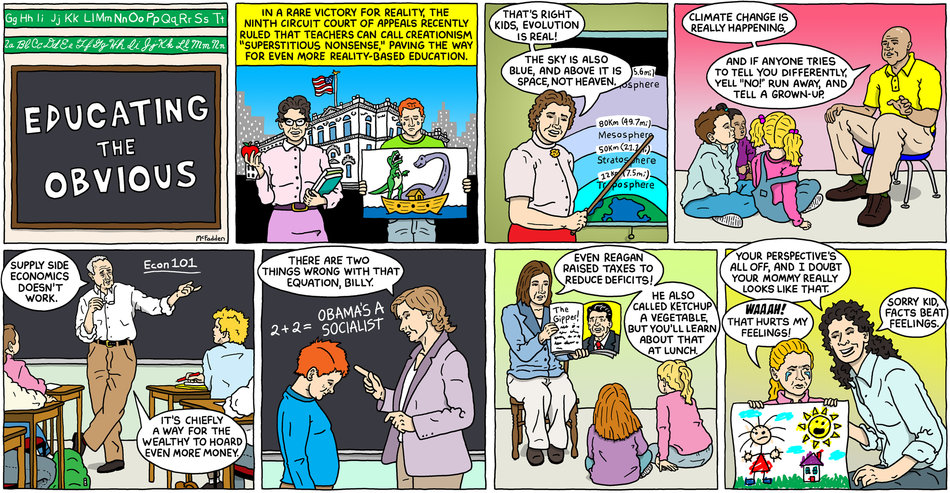
We Need To Do More When It Comes To Having Brief, Panicked Thoughts About Climate Change (The Onion)

COMMENTARY
BY RHETT STEVENSON
SEPTEMBER 6, 2011 | ISSUE 47•36

The 20 hottest years on record have all taken place in the past quarter century. The resulting floods, wildfires, and heat waves have all had deadly consequences, and if we don’t reduce carbon emissions immediately, humanity faces bleak prospects. We can no longer ignore this issue. Beginning today, we must all do more when it comes to our brief and panicked thoughts about climate change.

Indeed, if there was ever a time when a desperate call to take action against global warming should race through our heads as we lie in bed and stare at the ceiling, that time is now.

Many well-intentioned people will take 20 seconds out of their week to consider the consequences of the lifestyle they’ve chosen, perhaps contemplating how their reliance on fossil fuels has contributed to the rapid melting of the Arctic ice cap. But if progress is what we truly want, 20 seconds is simply not enough. Not by a long shot. An issue this critical demands at least 45 seconds to a solid minute of real, concentrated panic.

And I’m not talking about letting the image of a drowning polar bear play out in your mind now and then. If we’re at all serious, we need to let ourselves occasionally be struck with grim visions of coastal cities washing away and people starving as drought-stricken farmlands fail to yield crops—and we need to do this regularly, every couple days or so, before continuing to go about our routines as usual.

This may seem like a lot to ask, but no one ever said making an effort to think about change was easy.

So if you pick up a newspaper and see an article about 10 percent of all living species going extinct by the end of the century, don’t just turn the page. Stop, peruse it for a moment, look at the photos, freak out for a few seconds, and then turn the page.

And the next time you start up your car, stop to think how the exhaust from your vehicle and millions of others like it contributes to air pollution, increasing the likelihood that a child in your neighborhood will develop asthma or other respiratory ailments. Take your time with it. Feel the full, crushing weight of that guilt. Then go ahead and drive wherever it was you wanted to go.

To do anything less is irresponsible.

Suppose you’ve just sat down in a crisply air-conditioned movie theater. Why not take the length of a preview or two to consider the building’s massive carbon footprint? Imagine those greenhouse gases trapped in the atmosphere, disrupting ecosystems and causing infectious diseases to spread rampantly, particularly in regions of the world where the poorest people live. Visualize massive storm systems cutting widespread swaths of destruction. Think of your children’s children dying horrible, unnecessary deaths.

You might even go so far as to experience actual physical symptoms: shaking, hyperventilation, perhaps even a heart palpitation. These are entirely appropriate responses to have, and the kinds of reactions each of us ought to have briefly before casting such worries aside to enjoy Conan The Barbarian.

Ultimately, however, our personal moments of distress won’t matter much unless our government intervenes with occasional mentions of climate change in important speeches, or by passing nonbinding legislation on the subject. I implore you: Spend a couple minutes each year imagining yourself writing impassioned letters to your elected representatives demanding a federal cap on emissions.

Global warming must be met with immediate, short-lasting feelings of overwhelming dread, or else life as we know it will truly cease—oh, God, there’s nothing we can do, is there? Maybe we’re already too late. What am I supposed to do? Unplug my refrigerator? I recycle, I take shorter showers than I used to, doesn’t that count for something? Devastating famines and brutal wars fought over dwindling resources? Is that my fault? Jesus, holy shit, someone do something! Tell me what to do! For the love of God, what can possibly be done?

There you have it. I’ve done my part. Now it’s your turn.

Linguistic joke

A linguistics professor was lecturing the class.
“In English,” he explained, “a double negative forms a positive. In some languages, such as Russian, a double negative is still a negative.”
“However,” the professor continued, “there is no language wherein a double positive can form a negative.”
Immediately, a voice from the back of the room piped up: “Yeah… right…”
(Posted on the LinkedIn Anthropology and Linguistics Group)